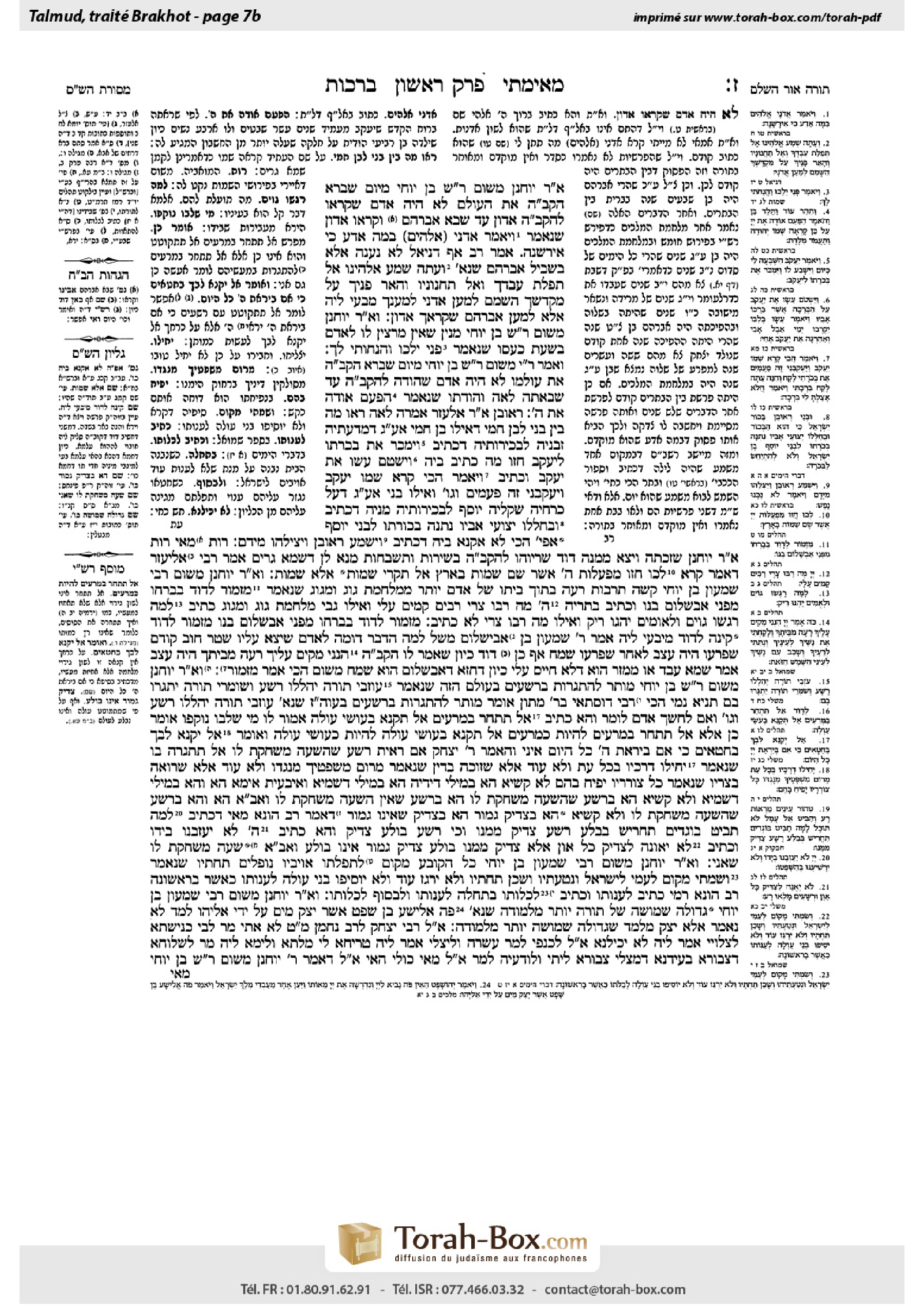
Berakhot 7b: Talmud study for Daf Yomi
Study the Talmud for Daf Yomi with scanned pages, Hebrew text, English translations from Sefaria and AI-generated French translations.
Passage selection and English or AI-generated French translation are available where the scan has annotations. Daf Study is independent of Torah-Box and Sefaria.
Browse Berakhot · ברכות · All tractatesBerakhot 7b text and translations
This page of Berakhot includes the Aramaic text, an English translation and an AI-generated French translation, alongside the scan above.
ברכות ז׳ ב · Aramaic and Hebrew text
אָמַר רַבִּי יוֹחָנָן מִשּׁוּם רַבִּי שִׁמְעוֹן בֶּן יוֹחַי: מִיּוֹם שֶׁבָּרָא הַקָּדוֹשׁ בָּרוּךְ הוּא אֶת הָעוֹלָם, לֹא הָיָה אָדָם שֶׁקְּרָאוֹ לְהַקָּדוֹשׁ בָּרוּךְ הוּא ״אָדוֹן״, עַד שֶׁבָּא אַבְרָהָם וּקְרָאוֹ אָדוֹן, שֶׁנֶּאֱמַר: ״וַיֹּאמַר אֲדֹנָי אֱלֹהִים בַּמָּה אֵדַע כִּי אִירָשֶׁנָּה״.
אָמַר רַב: אַף דָּנִיאֵל לֹא נַעֲנָה אֶלָּא בִּשְׁבִיל אַבְרָהָם, שֶׁנֶּאֱמַר: ״וְעַתָּה שְׁמַע אֱלֹהֵינוּ אֶל תְּפִלַּת עַבְדְּךָ וְאֶל תַּחֲנוּנָיו וְהָאֵר פָּנֶיךָ עַל מִקְדָּשְׁךָ הַשָּׁמֵם לְמַעַן אֲדֹנָי״, ״לְמַעַנְךָ״ מִבְּעֵי לֵיהּ.
אֶלָּא — לְמַעַן אַבְרָהָם שֶׁקְּרָאֲךָ ״אָדוֹן״.
וְאָמַר רַבִּי יוֹחָנָן מִשּׁוּם רַבִּי שִׁמְעוֹן בֶּן יוֹחַי: מִנַּיִן שֶׁאֵין מְרַצִּין לוֹ לָאָדָם בִּשְׁעַת כַּעֲסוֹ — שֶׁנֶּאֱמַר: ״פָּנַי יֵלֵכוּ וַהֲנִחוֹתִי לָךְ״.
וְאָמַר רַבִּי יוֹחָנָן מִשּׁוּם רַבִּי שִׁמְעוֹן בֶּן יוֹחַי: מִיּוֹם שֶׁבָּרָא הַקָּדוֹשׁ בָּרוּךְ הוּא אֶת עוֹלָמוֹ לֹא הָיָה אָדָם שֶׁהוֹדָה לְהַקָּדוֹשׁ בָּרוּךְ הוּא, עַד שֶׁבָּאתָה לֵאָה וְהוֹדַתּוּ, שֶׁנֶּאֱמַר: ״הַפַּעַם אוֹדֶה אֶת ה׳״.
רְאוּבֵן. אָמַר רַבִּי אֶלְעָזָר: אָמְרָה לֵאָה: רְאוּ מָה בֵּין בְּנִי לְבֶן חָמִי. דְּאִילּוּ בֶּן חָמִי, אַף עַל גַּב דְּמִדַּעְתֵּיהּ זַבְּנַיהּ לִבְכֵירוּתֵיהּ, דִּכְתִיב: ״וַיִּמְכֹּר אֶת בְּכֹרָתוֹ לְיַעֲקֹב״, חֲזוֹ מָה כְּתִיב בֵּיהּ: ״וַיִּשְׂטֹם עֵשָׂו אֶת יַעֲקֹב״.
וּכְתִיב: ״וַיֹּאמֶר הֲכִי קָרָא שְׁמוֹ יַעֲקֹב וַיַּעְקְבֵנִי זֶה פַעֲמַיִם״ וְגוֹ׳.
וְאִילּוּ בְּנִי, אַף עַל גַּב דְּעַל כֻּרְחֵיהּ שַׁקְלֵיהּ יוֹסֵף לִבְכֵירוּתֵיהּ מִנֵּיהּ, דִּכְתִיב: ״וּבְחַלְּלוֹ יְצוּעֵי אָבִיו נִתְּנָה בְּכֹרָתוֹ לִבְנֵי יוֹסֵף״, אֲפִילּוּ הָכִי — לָא אִקַּנֵּא בֵּיהּ, דִּכְתִיב: ״וַיִּשְׁמַע רְאוּבֵן וַיַּצִּלֵהוּ מִיָּדָם״.
רוּת, מַאי ״רוּת״? אָמַר רַבִּי יוֹחָנָן: שֶׁזָּכְתָה וְיָצָא מִמֶּנָּה דָּוִד שֶׁרִיוָּהוּ לְהַקָּדוֹשׁ בָּרוּךְ הוּא בְּשִׁירוֹת וְתִשְׁבָּחוֹת.
מְנָא לַן דִּשְׁמָא גָּרֵים? אָמַר רַבִּי אֱלִיעֶזֶר, דְּאָמַר קְרָא: ״לְכוּ חֲזוּ מִפְעֲלוֹת ה׳ אֲשֶׁר שָׂם שַׁמּוֹת בָּאָרֶץ״, אַל תִּקְרֵי ״שַׁמּוֹת״ אֶלָּא ״שֵׁמוֹת״.
וְאָמַר רַבִּי יוֹחָנָן מִשּׁוּם רַבִּי שִׁמְעוֹן בֶּן יוֹחַי: קָשָׁה תַּרְבּוּת רָעָה בְּתוֹךְ בֵּיתוֹ שֶׁל אָדָם יוֹתֵר מִמִּלְחֶמֶת גּוֹג וּמָגוֹג. שֶׁנֶּאֱמַר: ״מִזְמוֹר לְדָוִד בְּבָרְחוֹ מִפְּנֵי אַבְשָׁלוֹם בְּנוֹ״, וּכְתִיב בָּתְרֵיהּ: ״ה׳ מָה רַבּוּ צָרָי רַבִּים קָמִים עָלָי״, וְאִילּוּ גַּבֵּי מִלְחֶמֶת גּוֹג וּמָגוֹג, כְּתִיב: ״לָמָּה רָגְשׁוּ גוֹיִם וּלְאֻמִּים יֶהְגּוּ רִיק״. וְאִילּוּ ״מָה רַבּוּ צָרָי״ לָא כְּתִיב.
״מִזְמוֹר לְדָוִד בְּבָרְחוֹ מִפְּנֵי אַבְשָׁלוֹם בְּנוֹ״, ״מִזְמוֹר לְדָוִד״?! ״קִינָה לְדָוִד״ מִיבְּעֵי לֵיהּ!
אָמַר רַבִּי שִׁמְעוֹן בֶּן אֲבִישָׁלוֹם: מָשָׁל לְמָה הַדָּבָר דּוֹמֶה? — לְאָדָם שֶׁיָּצָא עָלָיו שְׁטַר חוֹב. קוֹדֶם שֶׁפְּרָעוֹ הָיָה עָצֵב, לְאַחַר שֶׁפְּרָעוֹ שָׂמַח.
אַף כֵּן דָּוִד, כֵּיוָן שֶׁאָמַר לוֹ הַקָּדוֹשׁ בָּרוּךְ הוּא: ״הִנְנִי מֵקִים עָלֶיךָ רָעָה מִבֵּיתֶךָ״, הָיָה עָצֵב, אָמַר: שֶׁמָּא עֶבֶד אוֹ מַמְזֵר הוּא, דְּלָא חָיֵיס עֲלַי. כֵּיוָן דַּחֲזָא דְּאַבְשָׁלוֹם הוּא — שָׂמַח. מִשּׁוּם הָכִי אֲמַר ״מִזְמוֹר״.
וְאָמַר רַבִּי יוֹחָנָן מִשּׁוּם רַבִּי שִׁמְעוֹן בֶּן יוֹחַי: מוּתָּר לְהִתְגָּרוֹת בִּרְשָׁעִים בָּעוֹלָם הַזֶּה, שֶׁנֶּאֱמַר: ״עֹזְבֵי תוֹרָה יְהַלְלוּ רָשָׁע וְשֹׁמְרֵי תוֹרָה יִתְגָּרוּ בָם״.
תַּנְיָא נָמֵי הָכִי, רַבִּי דּוֹסְתַּאי בְּרַבִּי מָתוּן אוֹמֵר: מוּתָּר לְהִתְגָּרוֹת בִּרְשָׁעִים בָּעוֹלָם הַזֶּה, שֶׁנֶּאֱמַר: ״עֹזְבֵי תוֹרָה יְהַלְלוּ רָשָׁע״ וְגוֹ׳. וְאִם לְחָשְׁךָ אָדָם לוֹמַר: וְהָא כְּתִיב ״אַל תִּתְחַר בַּמְּרֵעִים אַל תְּקַנֵּא בְּעֹשֵׂי עַוְלָה״ — אֱמוֹר לוֹ: מִי שֶׁלִּבּוֹ נוֹקְפוֹ אוֹמֵר כֵּן. אֶלָּא: ״אַל תִּתְחַר בִּמְרֵעִים״ — לִהְיוֹת כַּמְּרֵעִים, ״אַל תְּקַנֵּא בְּעֹשֵׂי עַוְלָה״ — לִהְיוֹת כָּעוֹשֵׂי עַוְלָה.
וְאוֹמֵר: ״אַל יְקַנֵּא לִבְּךָ בַּחַטָּאִים כִּי אִם בְּיִרְאַת ה׳ כָּל הַיּוֹם״.
אִינִי?! וְהָאָמַר רַבִּי יִצְחָק: אִם רָאִיתָ רָשָׁע שֶׁהַשָּׁעָה מְשַׂחֶקֶת לוֹ אַל תִּתְגָּרֶה בּוֹ, שֶׁנֶּאֱמַר: ״יָחִילוּ דְרָכָיו בְּכָל עֵת״. וְלֹא עוֹד אֶלָּא שֶׁזּוֹכֶה בַּדִּין, שֶׁנֶּאֱמַר: ״מָרוֹם מִשְׁפָּטֶיךָ מִנֶּגְדּוֹ״. וְלֹא עוֹד אֶלָּא שֶׁרוֹאֶה בְּצָרָיו, שֶׁנֶּאֱמַר: ״כָּל צוֹרְרָיו יָפִיחַ בָּהֶם״!
לָא קַשְׁיָא, הָא בְּמִילֵּי דִידֵיהּ, הָא בְּמִילֵּי דִשְׁמַיָּא.
וְאִיבָּעֵית אֵימָא הָא וְהָא בְּמִילֵּי דִשְׁמַיָּא, וְלָא קַשְׁיָא: הָא בְּרָשָׁע שֶׁהַשָּׁעָה מְשַׂחֶקֶת לוֹ, הָא בְּרָשָׁע שֶׁאֵין הַשָּׁעָה מְשַׂחֶקֶת לוֹ.
וְאִיבָּעֵית אֵימָא: הָא וְהָא, בְּרָשָׁע שֶׁהַשָּׁעָה מְשַׂחֶקֶת לוֹ, וְלָא קַשְׁיָא, הָא, בְּצַדִּיק גָּמוּר, הָא, בְּצַדִּיק שֶׁאֵינוֹ גָמוּר. דְּאָמַר רַב הוּנָא: מַאי דִּכְתִיב, ״לָמָּה תַבִּיט בּוֹגְדִים תַּחֲרִישׁ בְּבַלַּע רָשָׁע צַדִּיק מִמֶּנּוּ״, וְכִי רָשָׁע בּוֹלֵעַ צַדִּיק? וְהָא כְּתִיב: ה׳ לֹא יַעַזְבֶנּוּ בְיָדוֹ, וּכְתִיב: ״לֹא יְאֻנֶּה לַצַּדִּיק כָּל אָוֶן״. אֶלָּא: צַדִּיק מִמֶּנּוּ — בּוֹלֵעַ, צַדִּיק גָּמוּר — אֵינוֹ בּוֹלֵעַ.
וְאִיבָּעֵית אֵימָא, שָׁעָה מְשַׂחֶקֶת לוֹ — שָׁאנֵי.
וְאָמַר רַבִּי יוֹחָנָן מִשּׁוּם רַבִּי שִׁמְעוֹן בֶּן יוֹחַי: כָּל הַקּוֹבֵעַ מָקוֹם לִתְפִלָּתוֹ אוֹיְבָיו נוֹפְלִים תַּחְתָּיו. שֶׁנֶּאֱמַר: ״וְשַׂמְתִּי מָקוֹם לְעַמִּי לְיִשְׂרָאֵל וּנְטַעְתִּיו וְשָׁכַן תַּחְתָּיו וְלֹא יִרְגַּז עוֹד וְלֹא יֹסִיפוּ בְנֵי עַוְלָה לְעַנּוֹתוֹ כַּאֲשֶׁר בָּרִאשׁוֹנָה״.
רַב הוּנָא רָמֵי כְּתִיב ״לְעַנּוֹתוֹ״, וּכְתִיב: ״לְכַלּוֹתוֹ״.
בַּתְּחִילָּה — לְעַנּוֹתוֹ, וּלְבַסּוֹף — לְכַלּוֹתוֹ.
וְאָמַר רַבִּי יוֹחָנָן מִשּׁוּם רַבִּי שִׁמְעוֹן בֶּן יוֹחַי: גְּדוֹלָה שִׁמּוּשָׁהּ שֶׁל תּוֹרָה יוֹתֵר מִלִּמּוּדָהּ, שֶׁנֶּאֱמַר: ״פֹּה אֱלִישָׁע בֶּן שָׁפָט אֲשֶׁר יָצַק מַיִם עַל יְדֵי אֵלִיָּהוּ״. ״לָמַד״ לֹא נֶאֱמַר, אֶלָּא ״יָצַק״ — מְלַמֵּד שֶׁגְּדוֹלָה שִׁמּוּשָׁהּ יוֹתֵר מִלִּמּוּדָהּ.
אֲמַר לֵיהּ רַבִּי יִצְחָק לְרַב נַחְמָן: מַאי טַעְמָא לָא אָתֵי מָר לְבֵי כְּנִישְׁתָּא לְצַלּוֹיֵי? אֲמַר לֵיהּ: לָא יָכֵילְנָא. אֲמַר לֵיהּ: לִכַּנְפִי לְמָר עַשְׂרָה וְלִיצַלֵּי. אֲמַר לֵיהּ: טְרִיחָא לִי מִלְּתָא. וְלֵימָא לֵיהּ מָר לִשְׁלוּחָא דְצִבּוּרָא, בְּעִידָּנָא דִּמְצַלֵּי צִבּוּרָא לֵיתֵי וְלוֹדְעֵיהּ לְמָר.
אֲמַר לֵיהּ מַאי כּוּלֵּי הַאי? אֲמַר לֵיהּ דְּאָמַר רַבִּי יוֹחָנָן מִשּׁוּם רַבִּי שִׁמְעוֹן בֶּן יוֹחַי:
Berakhot 7b · English translation
Until now, the Gemara has cited statements made by Rabbi Yoḥanan in the name of the tanna, Rabbi Yosei. Now, the Gemara begins to cite what Rabbi Yoḥanan said in the name of Rabbi Shimon ben Yoḥai: From the day that the Holy One, Blessed be He, created the world there was no person who called him “Lord” until Abraham came and called him Lord. As it is stated: “And he said, ‘My Lord, God, by what shall I know that I will inherit it?’” (Genesis 15:8).
The Gemara cites another statement extolling that virtue of Abraham is mentioned, as Rav said: Even Daniel’s prayers were only answered on account of Abraham, as it is stated: “And now listen, God, to the prayer of Your servant and to his supplication; and cause Your face to shine upon Your desolate Temple, for the sake of the Lord” (Daniel 9:17). The verse should have said: And cause Your face to shine upon Your desolate Temple, for Your sake, as Daniel was addressing the Lord.
Rather, this verse contains an allusion that the prayer should be accepted for the sake of Abraham, who called You, Lord. Daniel utilized that name of God in order to evoke Abraham’s virtue and enhance his prayer.
And Rabbi Yoḥanan said in the name of Rabbi Shimon ben Yoḥai: From where is it derived that one must not placate a person while the person in the throes of his anger? As it is stated: “My face will go, and I will give you rest” (Exodus 33:14).
And Rabbi Yoḥanan said in the name of Rabbi Shimon ben Yoḥai: From the day the Holy One, Blessed be He, created the world, no one thanked the Holy One, Blessed be He, until Leah came and thanked Him, as it is stated: “And she became pregnant and gave birth to a son, and she said, ‘This time I will give thanks to God,’ and thus he was called Judah” (Genesis 29:35).
Tangential to the mention of Leah’s son, Judah, and the reason for his name, the Gemara explains the sources for other names, including Reuben. Rabbi Elazar said: Reuben’s name should be considered a prophecy by Leah, as Leah said: See [re’u] the difference between my son [beni] and the son of my father-in-law, Esau, son of Isaac. Even though Esau knowingly sold his birthright to his brother Jacob, as it is written: “And he sold his birthright to Jacob” (Genesis 25:33), nonetheless, behold what is written about him: “And Esau hated Jacob” (Genesis 27:41).
Esau was not only angry over Isaac’s blessing, but he was angry about another matter as well, as it is written: “And he said, ‘Is he not rightly named Jacob, for he has supplanted me twice? He took my birthright, and behold, now he has taken my blessing’” (Genesis 27:36). Despite having sold his birthright, he refused to relinquish it.
While my son, Reuben, even though Joseph took his birthright from him by force, as it is written: “And the sons of Reuben the firstborn of Israel, for he was the firstborn; but, since he defiled his father’s bed, his birthright was given to the sons of Joseph, son of Israel” (I Chronicles 5:1). Nevertheless, he was not jealous of him, as it is written when Joseph’s brothers sought to kill him: “And Reuben heard and he saved him from their hands, saying ‘Let us not take his life’” (Genesis 37:21).
Continuing on the topic of names, the Gemara asks: What is the meaning of the name Ruth? Rabbi Yoḥanan said: That she had the privilege that David, who inundated the Holy One, Blessed be He, with songs and praises, would descend from her. The name Ruth [Rut] is etymologically similar in Hebrew to the word inundate [riva].
Regarding the basic assumption that these homiletic interpretations of names are allusions to one’s future, the Gemara asks: From where do we derive that the name affects one’s life? Rabbi Eliezer said that the verse says: “Go, see the works of the Lord, who has made desolations [shamot] upon the earth” (Psalms 46:9). Do not read the word as shamot, rather as shemot, names. The names given to people are, therefore, “the works of the Lord upon the earth.”
And Rabbi Yoḥanan said other aggadic statements in the name of Rabbi Shimon ben Yoḥai: The existence of wayward children in a person’s home is more troublesome than the war of Gog and Magog, the ultimate war, the climax of the travails of Messianic times. As it is stated: “A Psalm of David, when he fled from his son, Absalom” (Psalms 3:1). And it is written thereafter: “Lord, how numerous are my enemies, many have risen against me” (Psalms 3:2). While concerning the war of Gog and Magog, which is alluded to in the second chapter of Psalms, it is written: “Why are the nations in an uproar? And why do the peoples speak for naught? The kings of the earth stand up and the rulers take counsel together, against the Lord, and against His anointed…He that sits in heaven laughs, the Lord mocks them” (Psalms 2:1–4). Yet in this chapter describing the war of Gog and Magog “how numerous are my enemies” is not written, as it is not as difficult as raising a wayward son like Absalom.
Regarding the opening phrase of the psalm, which serves as its title, the Gemara wonders: It is said: “A Psalm of David, when fleeing his son, Absalom.” A Psalm of David? It should have said: A lament of David.
Rabbi Shimon ben Avishalom said a parable: To what is this similar? It is similar to a person about whom a promissory note was issued stating that he must repay a debt to the lender. Before he repaid it, he was despondent, worried how he will manage to repay the debt. After he repaid it, he was glad.
So too was the case with David. When the Holy One, Blessed be He, told him, through Natan the prophet, after the incident with Bathsheba, “Behold, I will raise up evil against you from your house” (II Samuel 12:11), David was despondent. He said: Perhaps it will be a slave or a mamzer who will rise up in my house, a person of such lowly status, who will have no pity on me. But once David saw that Absalom was the one through whom the prophecy was to be fulfilled, he rejoiced, as he was certain that Absalom would show him mercy. That is why David said a psalm, not a lament, thanking God for punishing him in the least severe manner possible.
And Rabbi Yoḥanan said in the name of Rabbi Shimon ben Yoḥai: One is permitted to provoke the wicked in this world. Though the ways of the wicked prosper, one is still permitted to provoke them and need not fear (Maharsha), as it is stated: “Those who abandon the Torah will praise wickedness, and the keepers of the Torah will fight them” (Proverbs 28:4).
That statement was also taught in a baraita, as Rabbi Dostai, son of Rabbi Matun, says: One is permitted to provoke the wicked in this world, as it is stated: “Those who abandon the Torah will praise wickedness, and the keepers of the Torah will fight them.” And if someone whispered to you, saying, on the contrary, isn’t it also written: “Do not compete with evil-doers, and do not envy the unjust” (Psalms 37:1), meaning that one should avoid provoking the wicked, say to him: Only one whose heart strikes him with pangs of conscience over sins that he committed says this. Rather, the true meaning of the verse is: Do not compete with evil-doers, to be like the evil-doers, and do not envy the unjust to be like the unjust.
The Gemara cites proof from another verse. And it says: “One shall not envy the unjust, but be in fear of the Lord all the day” (Proverbs 23:17). In this context, to envy means to seek to emulate the unjust.
From these verses in Psalms and Proverbs, it would seem that one is encouraged to provoke the wicked. The Gemara asks: Is this so? Didn’t Rabbi Yitzḥak say: If you see a wicked person upon whom the hour is smiling, do not provoke him. As long as he is enjoying good fortune, there is no point in confronting him. As it is stated: “His ways prosper at all times; Your judgments are far beyond him; as for his adversaries, he snorts at them” (Psalms 10:5). The verse teaches us that the ways of the wicked will always succeed. And not only that, but he emerges victorious in judgment, as it is stated: “Your judgments are far beyond him,” meaning that even when he is brought to justice, it does not affect him. And not only that, but he witnesses his enemies’ downfall, as it is stated: “As for all his adversaries, he snorts at them.”
To resolve this contradiction with regard to whether or not one may provoke the wicked, the Gemara offers several explanations: This is not difficult, as it can be understood that this, which says that one may not provoke the wicked, is referring to his personal matters, while that, which says that it is a mitzva to confront them, is referring to matters of Heaven.
And if you wish, say instead that this, which says not to confront the wicked and that, which says to confront the wicked, are both referring to matters of Heaven, and, nevertheless, it is not difficult. This, which says that one may not provoke the wicked, is referring to a wicked person upon whom the hour is smiling, who is enjoying good fortune. While that, which says that it is a mitzva to confront them, is referring to a wicked person upon whom the hour is not smiling.
And if you wish, say instead that this, which says not to confront and that, which says to confront, are both referring to a wicked person upon whom the hour is smiling, but the question of whether one is permitted to confront him depends on who is confronting him. And nevertheless, this is not difficult. This, which says that it is a mitzva to confront them, is referring to a completely righteous person, while this, which says that one may not confront the wicked, is referring to one who is not completely righteous, as Rav Huna said: What is the meaning of that which is written: “Why do You look on those who deal treacherously and hold Your peace? When the wicked swallows the man more righteous than he?” (Habakkuk 1:13). This verse is difficult to understand. Do the wicked swallow the righteous? Isn’t it written: “The wicked looks to the righteous and seeks to kill him; the Lord will not leave him in his hand, nor allow him to be condemned when he is judged” (Psalms 37:32–33), and it is written: “No mischief shall befall the righteous” (Proverbs 12:21)? Rather, in light of these verses, the verse: “The wicked swallows the man more righteous than he” means: The man who is more righteous than he, but not completely righteous, he swallows. The completely righteous he does not swallow.
And if you wish, say: In general, the wicked cannot swallow the righteous, but when the hour is smiling upon him, it is different. When the wicked are enjoying good fortune, even the righteous can be harmed (Birkat Hashem).
And Rabbi Yoḥanan said in the name of Rabbi Shimon ben Yoḥai: Setting a fixed place for prayer is so important that one who sets a fixed place for his prayer, his enemies fall beneath him, as it is said: “And I will appoint a place for My nation, Israel, and I will plant them, that they may dwell in their own place.” Through setting aside a place for prayer, they will merit to “be disturbed no more; neither shall the children of wickedness afflict them anymore, as in the beginning” (II Samuel 7:10).
This verse, cited by the Gemara, leads to an additional point. Rav Huna raised a contradiction: In the book of Samuel, in this verse it is written: “To afflict them,” while in the parallel verse in I Chronicles (17:9) it is written: “To destroy them.”
The Gemara resolves this contradiction: The enemies of Israel intend first to afflict them, and, ultimately, to destroy them entirely.
And Rabbi Yoḥanan said in the name of Rabbi Shimon ben Yoḥai: Service of Torah is greater than its study, i.e., serving a Torah scholar and spending time in his company is greater than learning Torah from him. Torah study is one component of a Torah life, but one who serves a Torah scholar learns about every aspect of life from his actions. This is derived from the verse that speaks in praise of Elisha, as it is stated: “Here is Elisha son of Shafat, who poured water over Elijah’s hands” (II Kings 3:11). The verse does not say that he learned from Elijah, rather that he poured water, which teaches that the service of Torah represented by Elisha pouring water over Elijah’s hands is greater than its study.
As a prelude to another of the statements by Rabbi Yoḥanan in the name of Rabbi Shimon ben Yoḥai, the Gemara relates the following incident. Rabbi Yitzḥak said to Rav Naḥman: Why did the Master not come to the synagogue to pray? Rav Naḥman said to him: I was weak and unable to come. Rabbi Yitzḥak said to him: Let the Master gather ten individuals, a prayer quorum, at your home and pray. Rav Naḥman said to him: It is difficult for me to impose upon the members of the community to come to my home to pray with me (Sefer Mitzvot Gadol). Rabbi Yitzḥak suggested another option: The Master should tell the congregation to send a messenger when the congregation is praying to come and inform the Master so you may pray at the same time.
Rav Naḥman saw that Rabbi Yitzḥak was struggling to find a way for him to engage in communal prayer. He asked: What is the reason for all this fuss? Rabbi Yitzḥak said to him: As Rabbi Yoḥanan said in the name of Rabbi Shimon ben Yoḥai:
Berakhot 7b · Traduction française (IA)
Jusqu'à présent, la Guemara a cité des déclarations faites par Rabbi Yoḥanan au nom du tanna, Rabbi Yosei. Maintenant, la Guemara commence à citer ce que Rabbi Yoḥanan a dit au nom de Rabbi Shimon ben Yoḥai : Depuis le jour où le Saint, le Très Haut, a créé le monde, il n'y a pas eu de personne qui l'ait appelé « Seigneur » jusqu'à ce que Abraham arrive et l'appelle Seigneur. Comme il est dit : « Et il dit : Mon Seigneur, Dieu, par quoi je connaîtrai que je hériterai ? » (Genèse 15:8).
La Guemara cite une autre déclaration élevant la vertu d'Abraham, comme Rav a dit : Même les prières de Daniel n'ont été acceptées qu'en raison d'Abraham, comme il est dit : « Et maintenant écoute, Dieu, la prière de ton serviteur et de sa supplication ; et fais briller ton visage sur ton temple désolé, pour ton compte » (Daniel 9:17). La versette aurait dû dire : « Et fais briller ton visage sur ton temple désolé, pour ton compte », car Daniel s'adressait à Dieu.
En effet, cette versette contient une allusion selon laquelle la prière doit être acceptée en raison d'Abraham, qui t'a appelé, Seigneur. Daniel a utilisé ce nom de Dieu afin d'évoquer la vertu d'Abraham et d'améliorer sa prière.
Et Rabbi Yoḥanan a dit au nom de Rabbi Shimon ben Yoḥai : D'où est-il tiré que l'on ne doit pas apaiser une personne pendant qu'elle est en colère ? Comme il est dit : « Mon visage ira, et je te donnerai le repos » (Exode 33:14).
Et Rabbi Yoḥanan a dit au nom de Rabbi Shimon ben Yoḥai : Depuis le jour où le Saint, le Très Haut, a créé le monde, personne n'a remercié le Saint, le Très Haut, jusqu'à ce que Léa arrive et le remercie, comme il est dit : « Et elle conçut et enfanta un fils, et elle dit : Cette fois-ci je remercie Dieu, et ainsi il fut appelé Juda » (Genèse 29:35).
En lien avec la mention du fils de Léa, Juda, et la raison de son nom, la Guemara explique les sources d'autres noms, y compris Réuben. Rabbi Eléazar a dit : Le nom de Réuben doit être considéré comme une prophétie de Léa, comme Léa a dit : Voyez [re’u] la différence entre mon fils [beni] et le fils de mon beau-père, Esau, fils d'Isaac. Même si Esau a volontairement vendu son droit de naissance à son frère Jacob, comme il est écrit : « Et il vendit son droit de naissance à Jacob » (Genèse 25:33), néanmoins, voici ce qui est écrit à son sujet : « Et Esau haïssait Jacob » (Genèse 27:41).
Esau n'était pas seulement en colère à cause de la bénédiction d'Isaac, mais il était en colère à cause d'une autre affaire également, comme il est écrit : « Et il dit : N'est-il pas bien nommé Jacob, car il m'a dupé deux fois ? Il a pris mon droit de naissance, et voici, maintenant il a pris ma bénédiction » (Genèse 27:36). Malgré avoir vendu son droit de naissance, il refusait de le renoncer.
Bien que mon fils, Réuben, même si Joseph a pris son droit de naissance par la force, comme il est écrit : « Et les fils de Réuben, le premier-né d'Israël, car il était le premier-né ; mais, puisqu'il avait souillé le lit de son père, son droit de naissance fut donné aux fils de Joseph, fils d'Israël » (Chroniques Premier 5:1). Cependant, il n'était pas jaloux de lui, comme il est écrit lors que les frères de Joseph cherchaient à le tuer : « Et Réuben entendit et il le sauva de leurs mains, disant : Ne nous prenons pas la vie » (Genèse 37:21).
En poursuivant sur le sujet des noms, la Guemara pose la question : Quelle est la signification du nom Ruth ? Rabbi Yoḥanan a dit : C'est un privilège que David, qui a inondé le Saint, le Très Haut, de chants et d'éloges, descendrait d'elle. Le nom Ruth [Rut] est étymologiquement similaire au mot inonder [riva].
Concernant l'hypothèse de base que ces interprétations homilétiques des noms sont des allusions à l'avenir, la Guemara pose la question : D'où tirons-nous que le nom affecte la vie d'une personne ? Rabbi Eléazar a dit que la versette dit : « Allez, voyez les œuvres du Seigneur, qui a fait des noms [shemot] sur la terre » (Psaumes 46:9). Ne lisez pas le mot comme shamot, mais comme shemot, noms. Les noms donnés aux personnes sont donc « les œuvres du Seigneur sur la terre ».
Et Rabbi Yoḥanan a dit d'autres déclarations aggadiques au nom de Rabbi Shimon ben Yoḥai : L'existence d'enfants déviant dans la maison d'une personne est plus problématique que la guerre de Gog et de Magog, la guerre ultime, le sommet des épreuves de l'ère messianique. Comme il est dit : « Psaume de David, lorsqu'il fuyait son fils, Absalom » (Psaumes 3:1). Et il est écrit ensuite : « Seigneur, combien sont nombreux mes ennemis, beaucoup se sont levés contre moi » (Psaumes 3:2). Concernant la guerre de Gog et de Magog, qui est évoquée dans le deuxième chapitre des Psaumes, il est écrit : « Pourquoi les nations s'agitent-elles ? Et pourquoi les peuples parlent-ils pour rien ? Les rois de la terre se lèvent et les chefs prennent conseil ensemble contre le Seigneur et contre son anéantissement… Celui qui siège au ciel rit, le Seigneur moque-les » (Psaumes 2:1–4). Cependant, dans ce chapitre décrivant la guerre de Gog et de Magog, « combien sont nombreux mes ennemis » n'est pas écrit, car cela n'est pas aussi difficile que d'élever un fils déviant comme Absalom.
Concernant la phrase d'ouverture du psaume, qui sert de titre, la Guemara se demande : Il est dit : « Psaume de David, lorsqu'il fuyait son fils, Absalom. » Psaume de David ? Il aurait dû dire : Lamentation de David.
Rabbi Shimon ben Avishalom a dit une parabole : À quoi cela ressemble-t-il ? Cela ressemble à un homme dont un billet de créance a été émis indiquant qu'il doit rembourser un prêt au prêteur. Avant qu'il ne le rembourse, il était triste, inquiet de savoir comment il allait pouvoir rembourser le prêt. Après qu'il l'ait remboursé, il était content.
C'est également le cas de David. Lorsque le Saint, béni soit-Il, lui a dit, par l'intermédiaire du prophète Nathan, après l'incident de Batséba, « Regarde, je vais élever contre toi un malheur de ta maison » (II Rois 12:11), David était désespéré. Il disait : Peut-être ce sera un esclave ou un bâtard qui se lèvera dans ma maison, une personne de telle basse condition, qui n'aura aucun pitié envers moi. Mais une fois que David a vu que c'était Absalom qui devait accomplir la prophétie, il s'est réjoui, car il était certain que Absalom lui montrerait de la miséricorde. C'est pourquoi David a dit un psaume, pas un lamento, en remerciement à Dieu de le punir de la manière la moins sévère possible.
Et le maître Jochanan a dit au nom du maître Simon ben Yochai : On est autorisé à provoquer les méchants dans ce monde. Bien que les voies des méchants prospèrent, on est encore autorisé à les provoquer et n'a pas à avoir peur (Maharsha), car il est dit : « Ceux qui abandonnent la Torah louent le mal, et ceux qui gardent la Torah combattent contre eux » (Proverbes 28:4).
Cette déclaration a également été enseignée dans une baraïta, comme le dit Rabbi Dostai, fils de Rabbi Matun : On est autorisé à provoquer les méchants dans ce monde, car il est dit : « Ceux qui abandonnent la Torah louent le mal, et ceux qui gardent la Torah combattent contre eux. » Et si quelqu'un murmure à votre oreille en disant, au contraire, n'est-il pas aussi écrit : « Ne te dispute pas avec les méchants, ni envie les injustes » (Psaumes 37:1), signifiant que l'on devrait éviter de provoquer les méchants, répondez-lui : Seul celui dont le cœur est pénétré de remords pour les péchés qu'il a commis dit cela. En réalité, le sens véritable de la parole est : Ne te dispute pas avec les méchants, pour être comme eux, et ne vise pas les injustes pour être comme eux.
La Guemara cite une preuve tirée d'un autre verset. Et elle dit : « On ne doit pas envier les injustes, mais avoir la crainte du Seigneur toute la journée » (Proverbes 23:17). Dans ce contexte, envier signifie chercher à imiter les injustes.
À partir de ces versets des Psaumes et des Proverbes, il semble que l'on soit encouragé à provoquer les méchants. La Guemara pose la question : Est-ce ainsi ? N'a-t-il pas dit Rabbi Yitzhak : Si tu vois un méchant dont l'heure sourit, ne le provoque pas. Tant qu'il profite de bonheur, il n'y a pas de raison de le combattre. Car il est dit : « Ses voies prospèrent toujours ; Vos jugements sont bien au-delà de lui ; quant à ses adversaires, il les dédaigne » (Psaumes 10:5). Le verset nous enseigne que les voies des méchants réussiront toujours. Et non seulement cela, mais il l'emporte en jugement, car il est dit : « Vos jugements sont bien au-delà de lui », signifiant que même lorsqu'il est jugé, cela ne l'affecte pas. Et non seulement cela, mais il assiste à la chute de ses ennemis, car il est dit : « Quant à tous ses adversaires, il les dédaigne. »
Pour résoudre cette contradiction concernant la question de savoir si l'on peut provoquer les méchants, la Guemara propose plusieurs explications : Ce n'est pas difficile, car on peut comprendre que celui qui dit qu'on ne doit pas provoquer les méchants fait référence à ses affaires personnelles, tandis que celui qui dit qu'il est un mitsva de les combattre fait référence aux affaires du Ciel.
Et si tu veux, dis plutôt que celui qui dit qu'on ne doit pas provoquer les méchants et celui qui dit qu'il est un mitsva de les provoquer font tous deux référence aux affaires du Ciel, et, néanmoins, ce n'est pas difficile. Celui qui dit qu'on ne doit pas provoquer les méchants fait référence à un méchant dont l'heure sourit, qui profite de bonheur. Tandis que celui qui dit qu'il est un mitsva de les provoquer fait référence à un méchant dont l'heure ne sourit pas.
Et si tu veux, dis plutôt que celui qui dit qu'on ne doit pas provoquer et celui qui dit qu'on doit provoquer font tous deux référence à un méchant dont l'heure sourit, mais la question de savoir si l'on est autorisé à le provoquer dépend de celui qui le provoque. Et néanmoins, ce n'est pas difficile. Celui qui dit qu'il est un mitsva de les provoquer fait référence à un homme parfaitement juste, tandis que celui qui dit qu'on ne doit pas provoquer les méchants fait référence à celui qui n'est pas parfaitement juste, comme a dit Rav Huna : Quel est le sens de ce qui est écrit : « Pourquoi regardes-tu ceux qui agissent avec tromperie et tiens-tu le silence ? Lorsque le méchant dévore l'homme plus juste que lui ? » (Habacuc 1:13). Ce verset est difficile à comprendre. Les méchants dévorent-ils les justes ? N'est-il pas écrit : « Le méchant regarde le juste et cherche à le tuer ; le Seigneur ne le laissera pas en sa main, ni permettra qu'il soit condamné lorsqu'il est jugé » (Psaumes 37:32–33), et il est écrit : « Aucun malheur ne frappera le juste » (Proverbes 12:21) ? En réalité, à la lumière de ces versets, le verset : « Le méchant dévore l'homme plus juste que lui » signifie : L'homme qui est plus juste que lui, mais pas totalement juste, il le dévore. Il ne dévore pas le totalement juste.
Et si tu veux, dis : En général, les méchants ne peuvent pas dévorer les justes, mais lorsque l'heure sourit sur lui, c'est différent. Lorsque les méchants jouissent de bonheur, même les justes peuvent être atteints (Birkat Hashem).
Et le maître Jochanan a dit au nom du maître Simon ben Yochai : Fixer un lieu déterminé pour la prière est si important que celui qui fixe un lieu déterminé pour sa prière, ses ennemis tombent sous lui, car il est dit : « Et je ferai un lieu pour mon peuple, Israël, et je les planterai, afin qu'ils habitent dans leur propre lieu. » Par la fixation d'un lieu pour la prière, ils méritent de « ne plus être troublés ; ni les enfants des méchants ne les opprimeront plus, comme au début » (II Samuel 7:10).
Ce verset, cité par la Guemara, mène à un point supplémentaire. Rav Huna a soulevé une contradiction : Dans le livre de Samuel, dans ce verset, il est écrit : « Pour opprimer », tandis que dans le verset parallèle dans II Chroniques (17:9), il est écrit : « Pour détruire. »
La Guemara résout cette contradiction : Les ennemis d'Israël veulent d'abord les affliger, et, finalement, les détruire entièrement.
Et le maître Rabbi Yoḥanan a dit au nom de Rabbi Shimon ben Yoḥai : Le service de la Torah est supérieur à son étude, c'est-à-dire que servir un savant de la Torah et passer du temps en sa compagnie est supérieur à apprendre la Torah de lui. L'étude de la Torah est une composante de la vie selon la Torah, mais celui qui sert un savant de la Torah apprend à partir de ses actions sur tous les aspects de la vie. Cela est tiré de la parole qui loue Elisha, comme il est dit : « Voici Elisha, fils de Shafat, qui versait de l'eau sur les mains d'Elijah » (II Rois 3:11). La parole ne dit pas qu'il apprenait d'Elijah, mais qu'il versait de l'eau, ce qui enseigne que le service de la Torah, représenté par Elisha qui versait de l'eau sur les mains d'Elijah, est supérieur à son étude.
Avant d'aborder une autre déclaration du maître Rabbi Yoḥanan au nom de Rabbi Shimon ben Yoḥai, la Guemara rapporte l'incident suivant. Rabbi Yitzḥak a dit à Rav Naḥman : Pourquoi le maître n'est-il pas venu à l'église prier ? Rav Naḥman a répondu à lui : Je suis faible et n'ai pas pu venir. Rabbi Yitzḥak a dit à lui : Que le maître réunisse dix personnes, un quorum de prière, à sa maison et prie. Rav Naḥman a dit à lui : C'est difficile pour moi d'imposer aux membres de la communauté de venir à ma maison prier avec moi (Sefer Mitzvot Gadol). Rabbi Yitzḥak a proposé une autre option : Le maître devrait dire à la congrégation de lui envoyer un messager lorsqu'elle prie pour qu'il vienne l'informer afin qu'il prie en même temps.
Rav Naḥman a vu que Rabbi Yitzḥak avait du mal à trouver un moyen pour prier en communauté. Il a demandé : Quelle est la raison de tout ce brouhaha ? Rabbi Yitzḥak a dit à lui : Comme Rabbi Yoḥanan a dit au nom de Rabbi Shimon ben Yoḥai :
Traduction française générée par IA à partir de l’édition anglaise de Sefaria. Vérifie toujours un passage avec le texte source.
Text from Sefaria: William Davidson Edition - Vocalized Aramaic (CC BY NC); William Davidson Edition - English (CC BY NC).