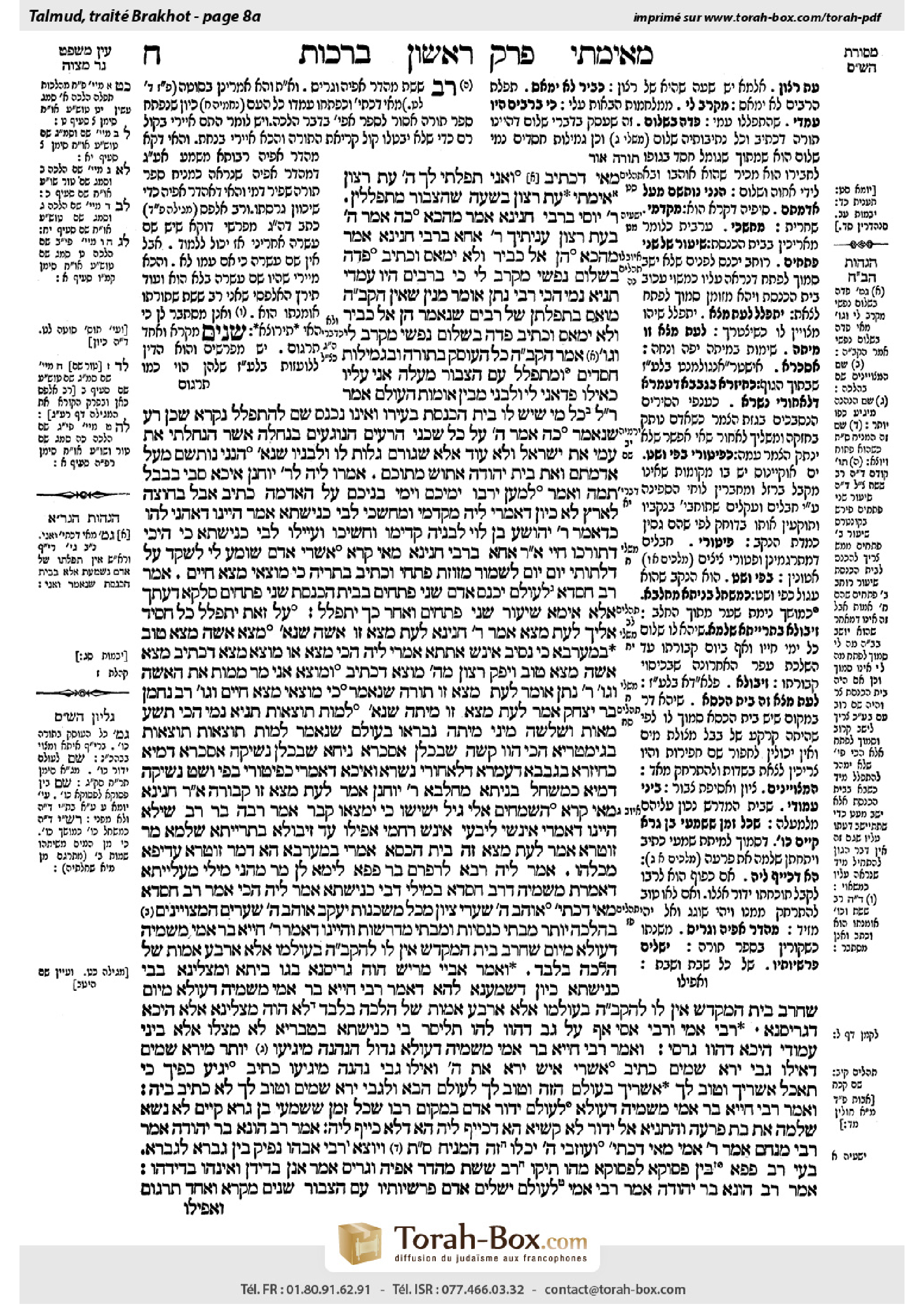
Berakhot 8a: Talmud study for Daf Yomi
Study the Talmud for Daf Yomi with scanned pages, Hebrew text, English translations from Sefaria and AI-generated French translations.
Passage selection and English or AI-generated French translation are available where the scan has annotations. Daf Study is independent of Torah-Box and Sefaria.
Browse Berakhot · ברכות · All tractatesBerakhot 8a text and translations
This page of Berakhot includes the Aramaic text, an English translation and an AI-generated French translation, alongside the scan above.
ברכות ח׳ א · Aramaic and Hebrew text
מַאי דִּכְתִיב ״וַאֲנִי תְפִלָּתִי לְךָ ה׳ עֵת רָצוֹן״. אֵימָתַי עֵת רָצוֹן — בְּשָׁעָה שֶׁהַצִּבּוּר מִתְפַּלְּלִין.
רַבִּי יוֹסֵי בְּרַבִּי חֲנִינָא אָמַר מֵהָכָא: ״כֹּה אָמַר ה׳ בְּעֵת רָצוֹן עֲנִיתִיךָ״.
רַבִּי אַחָא בְּרַבִּי חֲנִינָא אָמַר מֵהָכָא: ״הֶן אֵל כַּבִּיר וְלֹא יִמְאָס״: וּכְתִיב: ״פָּדָה בְשָׁלוֹם נַפְשִׁי מִקְּרָב לִי כִּי בְרַבִּים הָיוּ עִמָּדִי״.
תַּנְיָא נָמֵי הָכִי, רַבִּי נָתָן אוֹמֵר: מִנַּיִן שֶׁאֵין הַקָּדוֹשׁ בָּרוּךְ הוּא מוֹאֵס בִּתְפִלָּתָן שֶׁל רַבִּים שֶׁנֶּאֱמַר: ״הֶן אֵל כַּבִּיר וְלֹא יִמְאָס״, וּכְתִיב: ״פָּדָה בְשָׁלוֹם נַפְשִׁי מִקְּרָב לִי״ וְגוֹ׳, אָמַר הַקָּדוֹשׁ בָּרוּךְ הוּא: כָּל הָעוֹסֵק בְּתוֹרָה וּבִגְמִילוּת חֲסָדִים וּמִתְפַּלֵּל עִם הַצִּבּוּר — מַעֲלֶה אֲנִי עָלָיו כְּאִילּוּ פְּדָאַנִי, לִי וּלְבָנַי, מִבֵּין אוּמּוֹת הָעוֹלָם.
אָמַר רֵישׁ לָקִישׁ: כָּל מִי שֶׁיֵּשׁ לוֹ בֵּית הַכְּנֶסֶת בְּעִירוֹ, וְאֵינוֹ נִכְנָס שָׁם לְהִתְפַּלֵּל, נִקְרָא ״שָׁכֵן רַע״, שֶׁנֶּאֱמַר: ״כֹּה אָמַר ה׳ עַל כָּל שְׁכֵנַי הָרָעִים הַנֹּגְעִים בַּנַּחֲלָה אֲשֶׁר הִנְחַלְתִּי אֶת עַמִּי אֶת יִשְׂרָאֵל״. וְלֹא עוֹד אֶלָּא שֶׁגּוֹרֵם גָּלוּת לוֹ וּלְבָנָיו, שֶׁנֶּאֱמַר: ״הִנְנִי נֹתְשָׁם מֵעַל אַדְמָתָם וְאֶת בֵּית יְהוּדָה אֶתּוֹשׁ מִתּוֹכָם״.
אֲמַרוּ לֵיהּ לְרַבִּי יוֹחָנָן: אִיכָּא סָבֵי בְּבָבֶל. תְּמַהּ וַאֲמַר: ״לְמַעַן יִרְבּוּ יְמֵיכֶם וִימֵי בְנֵיכֶם עַל הָאֲדָמָה״ כְּתִיב, אֲבָל בְּחוּצָה לָאָרֶץ — לָא? כֵּיוָן דְאָמְרִי לֵיהּ מְקַדְּמִי וּמְחַשְּׁכִי לְבֵי כְנִישְׁתָּא, אֲמַר: הַיְינוּ דְּאַהֲנִי לְהוּ.
דְּאָמַר רַבִּי יְהוֹשֻׁעַ בֶּן לֵוִי לִבְנֵיהּ: קַדִּימוּ וְחַשִּׁיכוּ וְעַיִּילוּ לְבֵי כְנִישְׁתָּא, כִּי הֵיכִי דְּתוֹרְכוּ חַיֵּי. אָמַר רַבִּי אַחָא בְּרַבִּי חֲנִינָא: מַאי קְרָא — ״אַשְׁרֵי אָדָם שֹׁמֵעַ לִי לִשְׁקֹד עַל דַּלְתֹתַי יוֹם יוֹם לִשְׁמוֹר מְזוּזֹת פְּתָחָי״, וּכְתִיב בָּתְרֵיהּ: ״כִּי מֹצְאִי מָצָא חַיִּים״.
אָמַר רַב חִסְדָּא: לְעוֹלָם יִכָּנֵס אָדָם שְׁנֵי פְתָחִים בְּבֵית הַכְּנֶסֶת. שְׁנֵי פְתָחִים סָלְקָא דַעְתָּךְ?! אֶלָּא אֵימָא, שִׁיעוּר שְׁנֵי פְתָחִים, וְאַחַר כָּךְ יִתְפַּלֵּל.
״עַל זֹאת יִתְפַּלֵּל כָּל חָסִיד אֵלֶיךָ לְעֵת מְצֹא״, אָמַר רַבִּי חֲנִינָא: ״לְעֵת מְצֹא״ זוֹ אִשָּׁה, שֶׁנֶּאֱמַר: ״מָצָא אִשָּׁה מָצָא טוֹב״.
בְּמַעְרְבָא כִּי נָסֵיב אִינָשׁ אִתְּתָא, אָמְרִי לֵיהּ הָכִי: ״מָצָא״ אוֹ ״מוֹצֵא״? ״מָצָא״ דִּכְתִיב: ״מָצָא אִשָּׁה מָצָא טוֹב וַיָּפֶק רָצוֹן מֵה׳״, ״מוֹצֵא״ דִּכְתִיב: ״וּמוֹצֶא אֲנִי מָר מִמָּוֶת אֶת הָאִשָּׁה״ וְגוֹ׳.
רַבִּי נָתָן אוֹמֵר: ״לְעֵת מְצֹא״ — זוֹ תּוֹרָה, שֶׁנֶּאֱמַר: ״כִּי מֹצְאִי מָצָא חַיִּים״ וְגוֹ׳.
רַב נַחְמָן בַּר יִצְחָק אָמַר — ״לְעֵת מְצֹא״ זוֹ מִיתָה, שֶׁנֶּאֱמַר: ״לַמָּוֶת תּוֹצָאוֹת״.
תַּנְיָא נָמֵי הָכִי: תְּשַׁע מֵאוֹת וּשְׁלֹשָׁה מִינֵי מִיתָה נִבְרְאוּ בָּעוֹלָם, שֶׁנֶּאֱמַר: ״לַמָּוֶת תּוֹצָאוֹת״, ״תּוֹצָאוֹת״ בְּגִימַטְרִיָּא הָכִי הָווּ. קָשָׁה שֶׁבְּכֻלָּן — אַסְכָּרָא, נִיחָא שֶׁבְּכֻלָּן — נְשִׁיקָה. אַסְכָּרָא דָּמְיָא כְּחִיזְרָא בִּגְבָבָא דְעַמְרָא דִּלְאַחוֹרֵי נַשְׁרָא, וְאִיכָּא דְאָמְרִי כְּפִיטּוּרֵי בְּפִי וֶשֶׁט, נְשִׁיקָה דָּמְיָא כְּמִשְׁחַל בִּנִיתָא מֵחֲלָבָא.
רַבִּי יוֹחָנָן אָמַר: ״לְעֵת מְצֹא״ — זוֹ קְבוּרָה. אָמַר רַבִּי חֲנִינָא, מַאי קְרָא ״הַשְּׂמֵחִים אֱלֵי גִיל יָשִׂישׂוּ כִּי יִמְצְאוּ קָבֶר״. אָמַר רַבָּה בַּר רַב שֵׁילָא, הַיְינוּ דְּאָמְרִי אִינָשֵׁי: לִיבְעֵי אִינָשׁ רַחֲמֵי אֲפִילּוּ עַד זִיבּוּלָא בָּתְרָיְיתָא שְׁלָמָא.
מָר זוּטְרָא אָמַר: ״לְעֵת מְצֹא״ — זֶה בֵּית הַכִּסֵּא. אָמְרִי בְּמַעְרְבָא: הָא דְּמָר זוּטְרָא עֲדִיפָא מִכֻּלְּהוּ.
אֲמַר לֵיהּ רָבָא לְרַפְרָם בַּר פָּפָּא: לֵימָא לָן מָר מֵהָנֵי מִילֵּי מְעַלְּיָיתָא דְּאָמְרַתְּ מִשְּׁמֵיהּ דְּרַב חִסְדָּא בְּמִילֵּי דְבֵי כְנִישְׁתָּא.
אֲמַר לֵיהּ, הָכִי אָמַר רַב חִסְדָּא: מַאי דִּכְתִיב, ״אֹהֵב ה׳ שַׁעֲרֵי צִיּוֹן מִכֹּל מִשְׁכְּנוֹת יַעֲקֹב״: אוֹהֵב ה׳ שְׁעָרִים הַמְצוּיָּינִים בַּהֲלָכָה, יוֹתֵר מִבָּתֵּי כְנֵסִיּוֹת וּמִבָּתֵּי מִדְרָשׁוֹת.
וְהַיְינוּ דְּאָמַר רַבִּי חִיָּיא בַּר אַמֵּי מִשְּׁמֵיהּ דְּעוּלָּא: מִיּוֹם שֶׁחָרַב בֵּית הַמִּקְדָּשׁ אֵין לוֹ לְהַקָּדוֹשׁ בָּרוּךְ הוּא בְּעוֹלָמוֹ אֶלָּא אַרְבַּע אַמּוֹת שֶׁל הֲלָכָה בִּלְבַד.
וְאָמַר אַבָּיֵי: מֵרֵישׁ הֲוָה גָּרֵיסְנָא בְּגוֹ בֵּיתָא וּמְצַלֵּינָא בְּבֵי כְנִישְׁתָּא. כֵּיוָן דִּשְׁמַעְנָא לְהָא דְּאָמַר רַבִּי חִיָּיא בַּר אַמֵּי מִשְּׁמֵיהּ דְּעוּלָּא — מִיּוֹם שֶׁחָרַב בֵּית הַמִּקְדָּשׁ אֵין לוֹ לְהַקָּדוֹשׁ בָּרוּךְ הוּא בְּעוֹלָמוֹ אֶלָּא אַרְבַּע אַמּוֹת שֶׁל הֲלָכָה בִּלְבַד — לָא הֲוָה מְצַלֵּינָא אֶלָּא הֵיכָא דְּגָרֵיסְנָא.
רַבִּי אַמֵּי וְרַבִּי אַסִּי אַף עַל גַּב דַּהֲווֹ לְהוּ תְּלֵיסַר בֵּי כְנִישְׁתָּא בִּטְבֶרְיָא לָא מְצַלּוּ אֶלָּא בֵּינֵי עַמּוּדֵי, הֵיכָא דַּהֲווֹ גָּרְסִי.
וְאָמַר רַבִּי חִיָּיא בַּר אַמֵּי מִשְּׁמֵיהּ דְּעוּלָּא: גָּדוֹל הַנֶּהֱנֶה מִיגִיעוֹ יוֹתֵר מִיְּרֵא שָׁמַיִם, דְּאִילּוּ גַּבֵּי יְרֵא שָׁמַיִם כְּתִיב ״אַשְׁרֵי אִישׁ יָרֵא אֶת ה׳״, וְאִילּוּ גַּבֵּי נֶהֱנָה מִיגִיעוֹ כְּתִיב: ״יְגִיעַ כַּפֶּיךָ כִּי תֹאכֵל אַשְׁרֶיךָ וְטוֹב לָךְ״. ״אַשְׁרֶיךָ״ — בָּעוֹלָם הַזֶּה, ״וְטוֹב לָךְ״ — לָעוֹלָם הַבָּא, וּלְגַבֵּי יְרֵא שָׁמַיִם, ״וְטוֹב לָךְ״ לָא כְּתִיב בֵּיהּ.
וְאָמַר רַבִּי חִיָּיא בַּר אַמֵּי מִשְּׁמֵיהּ דְּעוּלָּא: לְעוֹלָם יָדוּר אָדָם בִּמְקוֹם רַבּוֹ, שֶׁכָּל זְמַן שֶׁשִּׁמְעִי בֶּן גֵּרָא קַיָּים, לֹא נָשָׂא שְׁלֹמֹה אֶת בַּת פַּרְעֹה.
וְהָתַנְיָא אַל יָדוּר!
לָא קַשְׁיָא, הָא דִּכְיִיף לֵיהּ, הָא דְּלָא כְּיִיף לֵיהּ.
אָמַר רַב הוּנָא בַּר יְהוּדָה, אָמַר רַבִּי מְנַחֵם, אָמַר רַבִּי אַמֵּי: מַאי דִּכְתִיב, ״וְעוֹזְבֵי ה׳ יִכְלוּ״ — זֶה הַמַּנִּיחַ סֵפֶר תּוֹרָה וְיוֹצֵא.
רַבִּי אֲבָהוּ נָפֵיק בֵּין גַּבְרָא לְגַבְרָא.
בָּעֵי רַב פָּפָּא: בֵּין פְּסוּקָא לִפְסוּקָא מַהוּ?
תֵּיקוּ.
רַב שֵׁשֶׁת מַהְדַּר אַפֵּיהּ וְגָרֵיס. אָמַר: אֲנַן בְּדִידַן וְאִינְהוּ בְּדִידְהוּ.
אָמַר רַב הוּנָא בַּר יְהוּדָה, אָמַר רַבִּי אַמֵּי: לְעוֹלָם יַשְׁלִים אָדָם פָּרָשִׁיּוֹתָיו עִם הַצִּבּוּר. שְׁנַיִם מִקְרָא וְאֶחָד תַּרְגּוּם.
Berakhot 8a · English translation
What is the meaning of that which is written: “But as for me, let my prayer be unto You, Lord, in a time of favor; O God, in the abundance of Your mercy, answer me with the truth of Your salvation” (Psalms 69:14)? It appears that the individual is praying that his prayers will coincide with a special time of Divine favor. When is a time of favor? It is at the time when the congregation is praying. It is beneficial to pray together with the congregation, for God does not fail to respond to the entreaties of the congregation.
Rabbi Yosei, son of Rabbi Ḥanina, said that the unique quality of communal prayer is derived from here: “Thus said the Lord, in a time of acceptance I have answered you and on a day of salvation I have aided you” (Isaiah 49:8).
Rabbi Aḥa, son of Rabbi Ḥanina, said that it is derived from here: “Behold, God is mighty, He despises no one” (Job 36:5). He adopts an alternative reading of the verse: “Behold, God will not despise” the prayer of “the mighty,” i.e., the community. And it is written: “He has redeemed my soul in peace so that none came upon me; for there were many with me. God shall hear and answer them…” (Psalms 55:19–20). This verse teaches that the prayer was answered because there were many with me when it was offered.
That last proof was also taught in a baraita. Rabbi Natan says: From where do we know that the Holy One, Blessed be He, does not despise the prayer of the masses? As it is stated: “Behold, God does not despise the mighty,” and it is written: “He has redeemed my soul in peace so that none came upon me; for there were many with me.” Rabbi Natan interprets this not as David speaking about himself, but as God speaking to Israel. The Holy One, Blessed be He, says: Anyone who engages in Torah study, which is called peace in the verse: “All its ways are peace” (Proverbs 3:17); and in acts of kindness, and prays with the congregation, I ascribe to him credit as if he redeemed Me and My children from among the nations of the world.
Continuing to extol communal prayer, Reish Lakish said: One who has a synagogue nearby in his city but does not enter to pray there is called an evil neighbor, as it is stated: “Thus said the Lord: As for all My evil neighbors who touch My inheritance which I have caused My people Israel to inherit, behold, I will pluck them up from off their land, and will pluck the house of Judah up from among them” (Jeremiah 12:14). One who only touches, but does not enter the place of prayer, My inheritance, is considered an evil neighbor. And furthermore, he is punished in that he causes himself and his children to go into exile, as it is stated: “Behold, I will pluck them up from off their land, and will pluck the house of Judah up from among them.”
The Gemara relates that when the Sages told Rabbi Yoḥanan that there are elders in Babylonia, he was confounded and said: It is written: “So that your days will be lengthened and the days of your children upon the land the Lord swore to your forefathers to give to them like the days of heaven on the earth” (Deuteronomy 11:21); lengthened in Eretz Yisrael but not outside of the Land. Why then, do the residents of Babylonia live long lives? When they told him that the people in Babylonia go early in the morning and go late in the evening to the synagogue, he said: That is what was effective for them in extending their lives.
As Rabbi Yehoshua ben Levi said to his sons: Go early and go late and enter the synagogue, so that your lives will be extended. And Rabbi Aḥa, son of Rabbi Ḥanina, said: Upon what verse is this based? As it is stated: “Happy is the man who listens to Me, watching daily at My gates, guarding at My door posts” (Proverbs 8:34). And the reward for doing so is written thereafter: “For whoso finds Me finds life and obtains the favor of the Lord” (Proverbs 8:35).
Based on this verse, Rav Ḥisda said: A person should always enter two doorways into the synagogue. This statement is unclear. Immediately, the Gemara asks: Does it enter your mind that Rav Ḥisda meant that one should enter two doorways literally? What if a synagogue only has a single doorway? Rather, emend his statement and say that Rav Ḥisda meant that one should enter a distance of two doorways into the synagogue and then pray. In entering a distance of two doorways, one fulfills the verse: Guarding at My door posts, in the plural.
Having mentioned the verse, “For whoso finds Me finds life,” the Gemara seeks to clarify its meaning. It is said, “For this, let every pious man pray to You in the time of finding, that the overflowing waters may not reach him” (Psalms 32:6). With regard to the phrase, the time of finding, Rabbi Ḥanina said: The time of finding refers to the time one must find a wife, that one should pray to find a suitable woman to marry. As it is said: “He who finds [matza] a wife finds [matza] good and obtains favor from the Lord” (Proverbs 18:22).
In Eretz Yisrael, the custom was that when a man married a woman, they would ask him: Matza or motzeh? In other words, they would ask the groom whether the appropriate passage for his wife is the above verse from Proverbs that begins with the word matza, as it is written: “He who finds a wife finds good and obtains favor from the Lord” or whether the more appropriate verse is the one beginning with the word motzeh, as it is written: “And I find [motzeh] the woman more bitter than death” (Ecclesiastes 7:26).
Rabbi Natan says: The time of finding refers to the time of finding Torah, as it is stated in a verse referring to Torah: “He who finds Me finds life.” The Torah is the object most sought.
Rav Naḥman bar Yitzḥak said: The time of finding refers to death. One should pray that when death comes, he will leave the world peacefully, as it is stated: “Issues [totzaot] of death” (Psalms 68:21). Rav Naḥman bar Yitzḥak’s statement is based on the etymological similarity between totzaot and matza, finding.
It was also taught in a baraita: Nine hundred and three types of death were created in the world, as it is stated: “Issues [totzaot] of death,” and that, 903, is the numerical value [gimatriya] of totzaot. The Gemara explains that the most difficult of all these types of death is croup [askara], while the easiest is the kiss of death. Croup is like a thorn entangled in a wool fleece, which, when pulled out backwards, tears the wool. Some say that croup is like ropes at the entrance to the esophagus, which would be nearly impossible to insert and excruciating to remove. The kiss of death is like drawing a hair from milk. One should pray that he does not die a painful death.
Rabbi Yoḥanan said: The time of finding refers to a respectful burial, for which one should pray. Supporting Rabbi Yoḥanan’s interpretation, Rabbi Ḥanina said: What is the verse that teaches that the time of finding refers to burial? “Who rejoice in exultation and are glad when they can find a grave” (Job 3:22), as there are situations in which one is relieved when his body finds a grave in which to rest. Rabba bar Rav Sheila said, that is the meaning of the folk saying: A person should even pray for mercy until the final shovelful of dirt is thrown upon his grave.
Mar Zutra said: The time of finding refers to finding a lavatory. As most places did not have a sewage system, one was forced to relieve himself outside the city. Because of this unpleasantness, finding a suitable location was called by Mar Zutra, the time of finding. In the West, Eretz Yisrael, they say: This explanation of Mar Zutra is preferable to all of them, as the term motza is explicitly associated in the Bible (see II Kings 10:27) with the lavatory (Rabbi Abraham Moshe Horovitz).
Returning to the tractate’s central topic, Rava said to Rafram bar Pappa: Let the Master say to us some of those outstanding statements that you said in the name of Rav Ḥisda with regard to matters of the synagogue.
Rafram said to him, Rav Ḥisda said as follows: What is the meaning of the verse: “The Lord loves the gates of Zion [Tziyyon] more than all the dwellings of Jacob” (Psalms 87:2)? This means that the Lord loves the gates distinguished [metzuyanim] through the study of halakha as they are the gates of Zion, the outstanding gates, more than the synagogues and study halls. Although those places are the most outstanding of the dwellings of Jacob, they are not engaged in the study of halakha.
And this concept, that halakha is the most sublime pursuit, is expressed in that which Rabbi Ḥiyya bar Ami said in the name of Ulla: Since the day the Temple, where the Divine Presence rested in this world, was destroyed, the Holy One, Blessed be He, has only one place in His world where he reveals His presence exclusively; only the four cubits where the study of halakha is undertaken.
This statement has practical ramifications. Abaye said: At first I studied in the house and prayed in the synagogue. Once I heard what Rabbi Ḥiyya bar Ami said in the name of Ulla: Since the day the Temple was destroyed, the Holy One, Blessed be He, has only one place in His world, only the four cubits of halakha alone, from which I understood the significance of the four cubits of halakha, and I pray only where I study.
Similarly, the Gemara relates that Rabbi Ami and Rabbi Asi, despite the fact that they had thirteen synagogues in Tiberias, they would only pray between the pillars where they studied.
And Rabbi Ḥiyya bar Ami said in the name of Ulla: One who benefits from his hard labor is greater than a God-fearing person, i.e., one who is so enthralled by his fear of God that he sits idly by and does not work. As with regard to a God-fearing person, it is written: “Happy is the man who fears the Lord, who greatly desires His mitzvot” (Psalms 112:1), while with regard to one who benefits from his hard work, it is written: “By the labor of your hands you will live; you are happy and it is good for you” (Psalms 128:2). The Gemara explains this verse to mean that you are happy in this world, and it is good for you in the World-to-Come. And regarding a God-fearing person, happy is the man, is written about him but and it is good for you, is not written about him.
And Rabbi Ḥiyya bar Ami said in the name of Ulla: One should always live in the place where his teacher lives; thereby he will avoid sin. For as long as Shimi ben Gera, who according to tradition was a great Torah scholar and teacher of Solomon (see Gittin 59a), was alive, Solomon did not marry Pharaoh’s daughter. Immediately after the Bible relates the death of Shimi (I Kings, end of ch. 2), Solomon’s marriage to Pharaoh’s daughter is recorded (beginning of ch. 3).
The Gemara raises an objection: Wasn’t it taught in a baraita that one should not live where his teacher lives?
The Gemara answers: This is not difficult. This, which says that one should live where his teacher lives, is referring to a case where he is acquiescent to his teacher and will heed his teaching and instruction. While this baraita, which says that one should not live where his teacher lives, is referring to a case where he is not acquiescent to him and that will lead them to quarrel.
The Gemara again returns to the topic of the synagogue. Rav Huna bar Yehuda said that Rabbi Menaḥem said that Rabbi Ami said: What is the practical halakhic meaning of that which is written: “They who forsake the Lord will perish” (Isaiah 1:28)? This verse refers to one who abandons the Torah scroll when it was taken out to be read and leaves the synagogue, as it appears that he is fleeing from God.
Practically speaking, the Gemara relates that Rabbi Abbahu would go out between one person who read the Torah and the next person who did so. Since the scroll was closed between readers, it was not considered to be a show of contempt.
Rav Pappa raised a dilemma: What is the ruling with regard to leaving between one verse and the next verse? Is one permitted to leave during a break in the Torah reading while the verse was translated into Aramaic?
An answer to this question was not found, so the dilemma stands unresolved.
The Gemara relates that Rav Sheshet would turn his face away from the Torah while it was being read and study. Explaining this practice, he said: We are engaged in ours, the study of the Oral Torah and they are engaged in theirs, listening to the Written Torah. Since Rav Sheshet was engaged in Torah study, he is not considered one who forsakes the Lord.
Rav Huna bar Yehuda said that Rabbi Ami said: A person should always complete his Torah portions with the congregation. The congregation reads a particular Torah portion every Shabbat, and during the week prior to each Shabbat, one is required to read the Bible text of the weekly portion twice and the translation once.
Berakhot 8a · Traduction française (IA)
Quel est le sens de ce qui est écrit : « Mais pour moi, que ma prière soit envers Toi, Seigneur, en un temps de grâce ; ô Éternel, en l'abondance de Ta miséricorde, réponds-moi avec la vérité de Ta salut » (Psaumes 69:14) ? Il semble que la personne prie afin que ses prières correspondent à un moment spécial de grâce divine. Quand est-ce un temps de grâce ? C'est lorsqu'il y a une communauté qui prie. Il est bénéfique de prier avec la communauté, car Dieu ne manque pas de répondre aux supplications de la communauté.
Rabbi Yosei, fils de Rabbi Ḥanina, a dit que la qualité unique de la prière communautaire est tirée de là : « Ainsi a dit l'Éternel, en un temps d'acceptation j'ai répondu à toi et sur un jour de salut j'ai aidé à toi » (Isaïe 49:8).
Rabbi Aḥa, fils de Rabbi Ḥanina, a dit que cela est tiré de là : « Regarde, l'Éternel est puissant, Il ne méprise personne » (Job 36:5). Il adopte une lecture alternative du verset : « Regarde, l'Éternel ne méprise pas » la prière de « ceux qui sont puissants », c'est-à-dire la communauté. Et il est écrit : « Il a racheté mon âme en paix, de sorte qu'aucun ne m'est venu ; car il y avait beaucoup avec moi. L'Éternel entendra et répondra à eux… » (Psaumes 55:19–20). Ce verset enseigne que la prière a été répondue car il y avait beaucoup avec moi lorsqu'elle a été offerte.
Cette dernière preuve a également été enseignée dans une baraïta. Rabbi Natan dit : D'où savons-nous que l'Éternel, béni soit Son Nom, ne méprise pas la prière des masses ? Comme il est dit : « Regarde, l'Éternel ne méprise pas le puissant », et il est écrit : « Il a racheté mon âme en paix, de sorte qu'aucun ne m'est venu ; car il y avait beaucoup avec moi ». Rabbi Natan interprète cela non pas comme David parlant de lui-même, mais comme Dieu parlant à Israël. L'Éternel, béni soit Son Nom, dit : Quiconque s'engage dans l'étude de la Torah, qui est appelée paix dans le verset : « Toutes ses voies sont paix » (Lévitique 3:17) ; et dans les actes de bonté, et prie avec la communauté, je lui attribue un mérite comme s'il avait racheté Moi et Mes enfants parmi les nations du monde.
En poursuivant l'éloge de la prière communautaire, Reish Lakish a dit : Celui qui a une synagogue près de chez lui dans sa ville mais ne s'y rend pas pour prier est appelé un mauvais voisin, comme il est dit : « Ainsi a dit l'Éternel : Concernant tous mes mauvais voisins qui touchent mon héritage que J'ai fait hériter à Mon peuple Israël, voici, je les arracherai de leur terre, et je ferai sortir la maison de Juda d'entre eux » (Jérémie 12:14). Celui qui touche seulement, mais ne s'engage pas dans la place de prière, mon héritage, est considéré comme un mauvais voisin. Et de plus, il est puni dans le sens où il cause lui-même et ses enfants à être en exil, comme il est dit : « Voici, je les arracherai de leur terre, et je ferai sortir la maison de Juda d'entre eux ».
La Guemara rapporte que lorsqu'on a informé Rabbi Yoḥanan qu'il y avait des anciens en Babylone, il a été confondu et a dit : Il est écrit : « Ainsi que vos jours seront prolongés et les jours de vos enfants sur la terre que l'Éternel a juré à vos pères de leur donner, comme les jours du ciel sur la terre » (Deutéronome 11:21) ; prolongés en Terre d'Israël mais pas en dehors du Pays. Pourquoi donc les habitants de Babylone vivent-ils longtemps ? Lorsqu'on lui a dit que les gens de Babylone vont tôt le matin et tard le soir à la synagogue, il a dit : C'est ce qui a été efficace pour eux dans l'extension de leurs jours.
Rabbi Yehoshua ben Levi a dit à ses fils : Allez tôt et allez tard et entrez dans la synagogue, afin que vos jours soient prolongés. Et Rabbi Aḥa, fils de Rabbi Ḥanina, a dit : Sur quelle verset est-ce basé ? Comme il est dit : « Heureux l'homme qui m'écoute, qui surveille quotidiennement mes portes, qui garde mes seuils » (Proverbes 8:34). Et la récompense pour cela est écrite ensuite : « Celui qui me trouve trouve la vie et obtient la faveur de l'Éternel » (Proverbes 8:35).
Sur ce verset, Rav Ḥisda a dit : Une personne devrait toujours entrer à une distance de deux portes dans la synagogue et prier. Cette déclaration est obscure. Immédiatement, la Guemara pose la question : Est-ce que cela entre dans ton esprit que Rav Ḥisda veuille dire qu'une personne devrait entrer dans deux portes littéralement ? Qu'est-ce que faire si une synagogue n'a qu'une seule porte ? Plutôt, corrige cette déclaration et dis que Rav Ḥisda voulait dire qu'une personne devrait entrer à une distance de deux portes dans la synagogue et ensuite prier. En entrant à une distance de deux portes, on remplit le verset : Garde à mes seuils, au pluriel.
Ayant mentionné le verset « Pour celui qui me trouve, il trouve la vie », la Guemara cherche à clarifier son sens. Il est dit : « Pour cela, que chaque homme pieux prie Toi en temps de trouver, afin que les eaux abondantes ne l'atteignent pas » (Psaumes 32:6). Concernant la phrase « le temps de trouver », Rabbi Ḥanina a dit : Le temps de trouver désigne le temps où l'on doit trouver une épouse, que l'on doive prier pour trouver une femme appropriée à marier. Comme il est dit : « Celui qui trouve [matza] une épouse trouve [matza] le bon et obtient la faveur de l'Éternel » (Proverbes 18:22).
En Terre d'Israël, la coutume était que lorsqu'un homme épousait une femme, on lui demandait : Matza ou motzeh ? En d'autres termes, on lui demandait si la passe appropriée pour sa femme était le verset ci-dessus de Proverbes qui commence par le mot matza, comme il est écrit : « Celui qui trouve une épouse trouve le bon et obtient la faveur de l'Éternel » ou si la passe plus appropriée était le verset qui commence par le mot motzeh, comme il est écrit : « Et je trouve [motzeh] la femme plus amère que la mort » (Ecclésiaste 7:26).
Rabbi Natan dit : Le temps de trouver désigne le temps de trouver la Torah, comme il est dit dans un verset concernant la Torah : « Celui qui me trouve trouve la vie ». La Torah est l'objet le plus recherché.
Rav Naḥman bar Yitzḥak a dit : Le temps de trouver désigne la mort. On devrait prier afin que lorsqu'il viendra la mort, il quitte le monde en paix, comme il est dit : « Les issues [totzaot] de la mort » (Psaumes 68:21). La déclaration de Rav Naḥman bar Yitzḥak est basée sur la similitude étymologique entre totzaot et matza, trouver.
Il fut également enseigné dans une baraïta : Neuf cents et trois types de mort furent créés dans le monde, comme il est dit : « Issues [totzaot] de la mort », et que 903 est la valeur numérique [gimatriya] de totzaot. La Guemara explique que le plus difficile de tous ces types de mort est l'asquera, tandis que le plus facile est le baiser de la mort. L'asquera est comme une épine enroulée dans une laine, qui, lorsqu'on la retire en arrière, déchire la laine. Certains disent que l'asquera est comme des cordes à l'entrée de l'œsophage, qui seraient presque impossibles à insérer et extrêmement douloureux à retirer. Le baiser de la mort est comme tirer un cheveu du lait. On devrait prier afin de ne pas mourir une mort douloureuse.
Rabbi Yoḥanan dit : Le temps de trouver fait référence à un enterrement digne, pour lequel on devrait prier. Soutenant l'interprétation de Rabbi Yoḥanan, Rabbi Ḥanina dit : Quel est le verset qui enseigne que le temps de trouver fait référence à l'enterrement ? « Qui se réjouit en exultation et est joyeux lorsqu'il peut trouver une tombe » (Job 3:22), car il existe des situations où l'on est soulagé lorsque son corps trouve une tombe où reposer. Rabba bar Rav Sheila dit, c'est la signification de la devise populaire : Une personne devrait même prier pour la miséricorde jusqu'au dernier pellet de terre jeté sur sa tombe.
Mar Zutra dit : Le temps de trouver fait référence à trouver une latrine. Comme la plupart des lieux n'avaient pas de système d'assainissement, on était contraint de s'acquitter de ses besoins en dehors de la ville. En raison de cette désagréable situation, trouver un lieu approprié était appelé par Mar Zutra, le temps de trouver. En Occident, en Eretz Yisrael, ils disent : Cette explication de Mar Zutra est préférable à toutes les autres, car le terme motza est explicitement associé dans la Bible (voir II Rois 10:27) à la latrine (Rabbi Abraham Moshe Horovitz).
En revenant sur le sujet principal du traité, Rava dit à Rafram bar Pappa : Faisons-nous dire au Maître l'une des déclarations remarquables que tu as dites au nom de Rav Ḥisda concernant les affaires de la synagogue.
Rafram dit à lui, Rav Ḥisda dit comme suit : Quelle est la signification du verset : « L'Éternel aime les portes de Zébon plus que toutes les demeures de Jacob » (Psaumes 87:2) ? Cela signifie que l'Éternel aime les portes distinguées par l'étude de la halakha, car elles sont les portes de Zébon, les portes exceptionnelles, plus que les synagogues et les salles de study. Bien que ces lieux soient les plus remarquables des demeures de Jacob, ils ne sont pas engagés dans l'étude de la halakha.
Ce concept, selon lequel l'étude de la halakha est la plus sublime des recherches, est exprimé dans ce que Rabbi Ḥiyya bar Ami a dit au nom d'Ulla : Depuis la destruction du Temple, où la présence divine résidait dans ce monde, l'Éternel, béni soit-Il, a seulement un lieu dans Son monde où Il révèle Sa présence exclusivement ; seulement les quatre cubits où l'étude de la halakha est entreprise.
Cette déclaration a des implications pratiques. Abaye dit : D'abord j'étudiais dans la maison et je priais dans la synagogue. Une fois que j'ai entendu ce que Rabbi Ḥiyya bar Ami a dit au nom d'Ulla : Depuis la destruction du Temple, l'Éternel, béni soit-Il, a seulement un lieu dans Son monde, seulement les quatre cubits de la halakha, d'où j'ai compris l'importance des quatre cubits de la halakha, et je prie seulement là où j'étudie.
De même, la Guemara rapporte que Rabbi Ami et Rabbi Asi, malgré le fait qu'ils avaient treize synagogues à Tibériade, ne prieraient qu'entre les piliers où ils étudiaient.
Et Rabbi Ḥiyya bar Ami dit au nom d'Ulla : Celui qui bénéficie de son labeur est supérieur à un homme craignant Dieu, c'est-à-dire à celui qui est si envoûté par sa crainte de Dieu qu'il reste inactif et ne travaille pas. Comme concernant un homme craignant Dieu, il est écrit : « Heureux l'homme qui craint l'Éternel, qui désire beaucoup Ses commandements » (Psaumes 112:1), tandis que concernant celui qui bénéficie de son labeur, il est écrit : « Par le labeur de tes mains tu vivras ; tu es heureux et c'est bon pour toi » (Psaumes 128:2). La Guemara explique ce verset pour signifier que tu es heureux dans ce monde, et c'est bon pour toi dans le Monde à Venir. Et concernant un homme craignant Dieu, « heureux l'homme » est dit à son sujet, mais « c'est bon pour toi » n'est pas dit à son sujet.
Et Rabbi Ḥiyya bar Ami dit au nom d'Ulla : On devrait toujours vivre là où vit son maître ; ainsi on évitera le péché. Tant que Shimi ben Gera, selon la tradition un grand savant de la Torah et maître de Salomon (voir Gittin 59a), était vivant, Salomon ne se mariait pas avec la fille du pharaon. Immédiatement après que la Bible rapporte la mort de Shimi (I Rois, fin du chapitre 2), le mariage de Salomon avec la fille du pharaon est mentionné (début du chapitre 3).
La Guemara soulève une objection : N'était-ce pas enseigné dans une baraïta que l'on ne devrait pas vivre là où vit son maître ?
La Guemara répond : Ce n'est pas difficile. Ce qui dit que l'on devrait vivre là où vit son maître fait référence à un cas où l'on est soumis à son maître et suivra ses enseignements. Tandis que cette baraïta, qui dit que l'on ne devrait pas vivre là où vit son maître, fait référence à un cas où l'on n'est pas soumis à lui et cela entraînera des querelles.
La Guemara reprend le sujet de la synagogue. Rav Huna bar Yehuda dit que Rabbi Menaḥem dit que Rabbi Ami dit : Quelle est la signification halakhique pratique de ce qui est écrit : « Ceux qui abandonnent l'Éternel périront » (Isaïe 1:28) ? Ce verset fait référence à celui qui abandonne le rouleau de la Torah lorsqu'il est sorti pour être lu et quitte la synagogue, car cela semble qu'il fuit Dieu.
Pratiquement parlant, la Guemara rapporte que Rabbi Abbahu sortait entre la personne qui lisait la Torah et la suivante. Puisque le rouleau était fermé entre les lecteurs, cela ne constituait pas un affront.
Rav Pappa a soulevé un dilemme : Quel est le statut lorsqu'on laisse un espace entre un verset et le suivant ? Est-on autorisé à s'arrêter pendant une pause dans la lecture de la Torah, alors que le verset est traduit en araméen ?
Une réponse à cette question n'a pas été trouvée, donc le dilemme reste sans solution.
La Guemara rapporte que Rav Sheshet tournait le visage de côté pendant que la Torah était lue et étudiait. Expliquant cette pratique, il dit : Nous sommes engagés dans notre propre étude, celle de la Torah orale, et ils sont engagés dans la leur, l'écoute de la Torah écrite. Puisque Rav Sheshet était engagé dans l'étude de la Torah, il n'est pas considéré comme celui qui abandonne l'Éternel.
Rav Huna bar Yehuda a dit que Rabbi Ami a dit : Une personne devrait toujours achever ses portions de Torah avec la congrégation. La congrégation lit une portion particulière de la Torah chaque sabbat, et durant la semaine précédant chaque sabbat, on est tenu de lire deux fois le texte biblique de la portion hebdomadaire et une fois la traduction.
Traduction française générée par IA à partir de l’édition anglaise de Sefaria. Vérifie toujours un passage avec le texte source.
Text from Sefaria: William Davidson Edition - Vocalized Aramaic (CC BY NC); William Davidson Edition - English (CC BY NC).