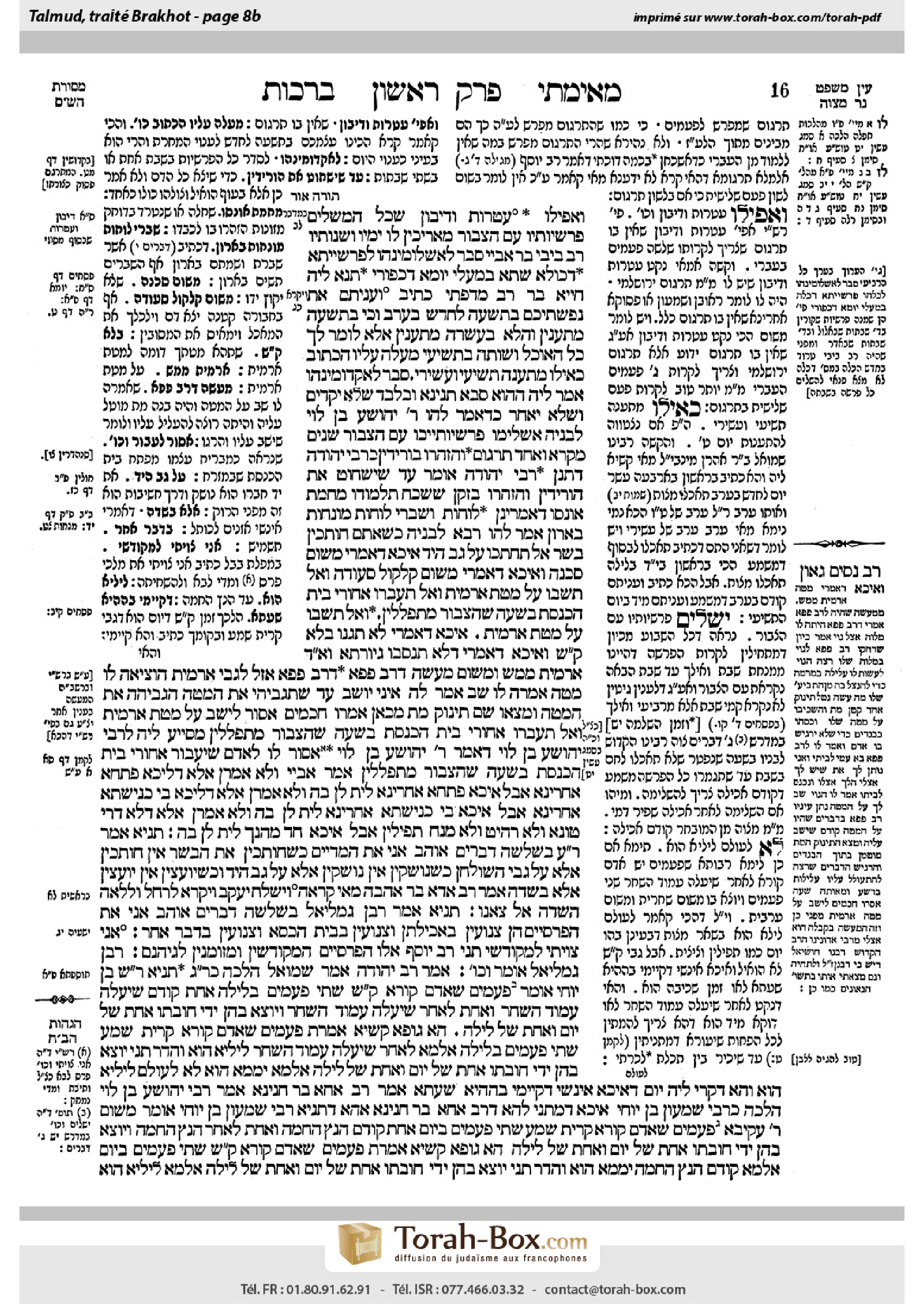
Berakhot 8b: Talmud study for Daf Yomi
Study the Talmud for Daf Yomi with scanned pages, Hebrew text, English translations from Sefaria and AI-generated French translations.
Passage selection and English or AI-generated French translation are available where the scan has annotations. Daf Study is independent of Torah-Box and Sefaria.
Browse Berakhot · ברכות · All tractatesBerakhot 8b text and translations
This page of Berakhot includes the Aramaic text, an English translation and an AI-generated French translation, alongside the scan above.
ברכות ח׳ ב · Aramaic and Hebrew text
וַאֲפִילּוּ ״עֲטָרוֹת וְדִיבֹן״. שֶׁכָּל הַמַּשְׁלִים פָּרָשִׁיּוֹתָיו עִם הַצִּבּוּר מֵאֲרִיכִין לוֹ יָמָיו וּשְׁנוֹתָיו.
רַב בִּיבִי בַּר אַבָּיֵי סָבַר לְאַשְׁלוֹמִינְהוּ לְפָרָשְׁיָיתָא דְּכֹלָּא שַׁתָּא בְּמַעֲלֵי יוֹמָא דְכִפּוּרֵי, תְּנָא לֵיהּ חִיָּיא בַּר רַב מִדִּפְתִּי: כְּתִיב: ״וְעִנִּיתֶם אֶת נַפְשֹׁתֵיכֶם בְּתִשְׁעָה לַחֹדֶשׁ בָּעֶרֶב״.
וְכִי בְּתִשְׁעָה מִתְעַנִּין?! וַהֲלֹא בַּעֲשָׂרָה מִתְעַנִּין! אֶלָּא לוֹמַר לְךָ כָּל הָאוֹכֵל וְשׁוֹתֶה בִּתְשִׁיעִי, מַעֲלֶה עָלָיו הַכָּתוּב כְּאִילּוּ מִתְעַנֶּה תְּשִׁיעִי וַעֲשִׂירִי.
סָבַר לְאַקְדּוֹמִינְהוּ, אָמַר לֵיהּ הָהוּא סָבָא, תְּנֵינָא: וּבִלְבַד שֶׁלֹּא יַקְדִּים וְשֶׁלֹּא יְאַחֵר.
כְּדַאֲמַר לְהוּ רַבִּי יְהוֹשֻׁעַ בֶּן לֵוִי לִבְנֵיהּ: אַשְׁלִימוּ פָּרָשְׁיוֹתַיְיכוּ עִם הַצִּבּוּר שְׁנַיִם מִקְרָא וְאֶחָד תַּרְגּוּם.
וְהִזָּהֲרוּ בִּוְרִידִין כְּרַבִּי יְהוּדָה, דִּתְנַן: רַבִּי יְהוּדָה אוֹמֵר: עַד שֶׁיִּשְׁחוֹט אֶת הַוְּרִידִין.
וְהִזָּהֲרוּ בְּזָקֵן שֶׁשָּׁכַח תַּלְמוּדוֹ מֵחֲמַת אוֹנְסוֹ. דְּאָמְרִינַן: לוּחוֹת וְשִׁבְרֵי לוּחוֹת מוּנָּחוֹת בָּאָרוֹן.
אָמַר לְהוּ רָבָא לִבְנֵיהּ: כְּשֶׁאַתֶּם חוֹתְכִין בָּשָׂר, אַל תַּחְתְּכוּ עַל גַּב הַיָּד. אִיכָּא דְאָמְרִי: מִשּׁוּם סַכָּנָה. וְאִיכָּא דְאָמְרִי: מִשּׁוּם קִלְקוּל סְעוּדָה.
וְאַל תֵּשְׁבוּ עַל מִטַּת אֲרַמִּית, וְאַל תַּעַבְרוּ אֲחוֹרֵי בֵּית הַכְּנֶסֶת בְּשָׁעָה שֶׁהַצִּבּוּר מִתְפַּלְּלִין. וְאַל תֵּשְׁבוּ עַל מִטַּת אֲרַמִּית, אִיכָּא דְאָמְרִי לָא תִּגְנוֹ בְּלָא קְרִיאַת שְׁמַע, וְאִיכָּא דְאָמְרִי דְּלָא תִּנְסְבוּ גִּיּוֹרְתָא. וְאִיכָּא דְאָמְרִי, אֲרַמִּית מַמָּשׁ.
וּמִשּׁוּם מַעֲשֶׂה דְרַב פָּפָּא. דְּרַב פָּפָּא אֲזַל לְגַבֵּי אֲרַמִּית, הוֹצִיאָה לוֹ מִטָּה. אָמְרָה לוֹ: שֵׁב! אָמַר לָהּ: אֵינִי יוֹשֵׁב, עַד שֶׁתַּגְבִּיהִי אֶת הַמִּטָּה. הִגְבִּיהָה אֶת הַמִּטָּה וּמָצְאוּ שָׁם תִּינוֹק מֵת. מִכָּאן אָמְרוּ חֲכָמִים: אָסוּר לֵישֵׁב עַל מִטַּת אֲרַמִּית.
וְאַל תַּעַבְרוּ אֲחוֹרֵי בֵּית הַכְּנֶסֶת בְּשָׁעָה שֶׁהַצִּבּוּר מִתְפַּלְּלִין — מְסַיַּיע לֵיהּ לְרַבִּי יְהוֹשֻׁעַ בֶּן לֵוִי. דְּאָמַר רַבִּי יְהוֹשֻׁעַ בֶּן לֵוִי: אָסוּר לוֹ לְאָדָם שֶׁיַּעֲבוֹר אֲחוֹרֵי בֵּית הַכְּנֶסֶת בְּשָׁעָה שֶׁהַצִּבּוּר מִתְפַּלְּלִין.
אָמַר אַבָּיֵי: וְלָא אֲמַרַן אֶלָּא דְּלֵיכָּא פִּתְחָא אַחֲרִינָא, אֲבָל אִיכָּא פִּתְחָא אַחֲרִינָא — לֵית לָן בַּהּ. וְלָא אֲמַרַן אֶלָּא דְּלֵיכָּא בֵּי כְנִישְׁתָּא אַחֲרִינָא, אֲבָל אִיכָּא בֵּי כְנִישְׁתָּא אַחֲרִינָא — לֵית לָן בַּהּ. וְלָא אֲמַרַן אֶלָּא דְּלָא דָּרֵי טוּנָא, וְלָא רָהֵיט, וְלָא מַנַּח תְּפִילִּין, אֲבָל אִיכָּא חַד מֵהָנָךְ — לֵית לַן בַּהּ.
תַּנְיָא, אָמַר רַבִּי עֲקִיבָא: בִּשְׁלֹשָׁה דְבָרִים אוֹהֵב אֲנִי אֶת הַמָּדִיִּים, כְּשֶׁחוֹתְכִין אֶת הַבָּשָׂר — אֵין חוֹתְכִין אֶלָּא עַל גַּבֵּי הַשּׁוּלְחָן, כְּשֶׁנּוֹשְׁקִין — אֵין נוֹשְׁקִין אֶלָּא עַל גַּב הַיָּד, וּכְשֶׁיּוֹעֲצִין — אֵין יוֹעֲצִין אֶלָּא בַּשָּׂדֶה.
אָמַר רַב אַדָּא בַּר אַהֲבָה: מַאי קְרָאָה ״וַיִּשְׁלַח יַעֲקֹב וַיִּקְרָא לְרָחֵל וּלְלֵאָה הַשָּׂדֶה אֶל צֹאנוֹ״.
תַּנְיָא אָמַר רַבָּן גַּמְלִיאֵל: בִּשְׁלֹשָׁה דְבָרִים אוֹהֵב אֲנִי אֶת הַפַּרְסִיִּים: הֵן צְנוּעִין בַּאֲכִילָתָן, וּצְנוּעִין בְּבֵית הַכִּסֵּא, וּצְנוּעִין בְּדָבָר אַחֵר.
״אֲנִי צִוֵּיתִי לִמְקֻדָּשָׁי״, תָּנֵי רַב יוֹסֵף: אֵלּוּ הַפַּרְסִיִּים הַמְקוּדָּשִׁין וּמְזוּמָּנִין לְגֵיהִנָּם.
רַבָּן גַּמְלִיאֵל אוֹמֵר וְכוּ׳: אָמַר רַב יְהוּדָה, אָמַר שְׁמוּאֵל: הֲלָכָה כְּרַבָּן גַּמְלִיאֵל.
תַּנְיָא: רַבִּי שִׁמְעוֹן בֶּן יוֹחַי אוֹמֵר פְּעָמִים שֶׁאָדָם קוֹרֵא קְרִיאַת שְׁמַע שְׁתֵּי פְּעָמִים בַּלַּיְלָה, אַחַת קוֹדֶם שֶׁיַּעֲלֶה עַמּוּד הַשַּׁחַר וְאַחַת לְאַחַר שֶׁיַּעֲלֶה עַמּוּד הַשַּׁחַר, וְיוֹצֵא בָּהֶן יְדֵי חוֹבָתוֹ אַחַת שֶׁל יוֹם וְאַחַת שֶׁל לַיְלָה.
הָא גוּפָא קַשְׁיָא, אָמְרַתְּ: פְּעָמִים שֶׁאָדָם קוֹרֵא קְרִיאַת שְׁמַע שְׁתֵּי פְּעָמִים בַּלַּיְלָה, אַלְמָא לְאַחַר שֶׁיַּעֲלֶה עַמּוּד הַשַּׁחַר לֵילְיָא הוּא, וַהֲדַר תָּנֵי: יוֹצֵא בָּהֶן יְדֵי חוֹבָתוֹ אַחַת שֶׁל יוֹם וְאַחַת שֶׁל לַיְלָה, אַלְמָא יְמָמָא הוּא!
לָא — לְעוֹלָם לֵילְיָא הוּא. וְהָא דְּקָרֵי לֵיהּ ״יוֹם״ — דְּאִיכָּא אִינָשֵׁי דְּקָיְימִי בְּהַהִיא שַׁעְתָּא.
אָמַר רַב אַחָא בַּר חֲנִינָא, אָמַר רַבִּי יְהוֹשֻׁעַ בֶּן לֵוִי: הֲלָכָה כְּרַבִּי שִׁמְעוֹן בֶּן יוֹחַי.
אִיכָּא דְּמַתְנֵי לְהָא דְּרַב אַחָא בַּר חֲנִינָא אַהָא. דְּתַנְיָא, רַבִּי שִׁמְעוֹן בֶּן יוֹחַי אוֹמֵר מִשּׁוּם רַבִּי עֲקִיבָא: פְּעָמִים שֶׁאָדָם קוֹרֵא קְרִיאַת שְׁמַע שְׁתֵּי פְּעָמִים בַּיּוֹם, אַחַת קוֹדֶם הָנֵץ הַחַמָּה, וְאַחַת לְאַחַר הַנֵּץ הַחַמָּה, וְיוֹצֵא בָּהֶן יְדֵי חוֹבָתוֹ, אַחַת שֶׁל יוֹם וְאַחַת שֶׁל לַיְלָה.
הָא גוּפָא קַשְׁיָא. אָמְרַתְּ פְּעָמִים שֶׁאָדָם קוֹרֵא קְרִיאַת שְׁמַע שְׁתֵּי פְּעָמִים בַּיּוֹם, אַלְמָא קוֹדֶם הָנֵץ הַחַמָּה יְמָמָא הוּא, וַהֲדַר תָּנֵי יוֹצֵא בָּהֶן יְדֵי חוֹבָתוֹ אַחַת שֶׁל יוֹם וְאַחַת שֶׁל לַיְלָה, אַלְמָא לֵילְיָא הוּא!
Berakhot 8b · English translation
This applies to every verse, even a verse like: “Atarot and Divon and Yazer and Nimra and Ḥeshbon and Elaleh and Sevam and Nevo and Beon” (Numbers 32:3). While that verse is comprised entirely of names of places that are identical in Hebrew and Aramaic, one is nevertheless required to read the verse twice and its translation once, as one who completes his Torah portions with the congregation is rewarded that his days and years are extended.
Rav Beivai bar Abaye thought to finish all the Torah portions of the entire year, which he had been unable to complete at their appointed time, on the eve of Yom Kippur when he would have time to do so. But Ḥiyya bar Rav of Difti taught him: It is written with regard to Yom Kippur: “And you shall afflict your souls on the ninth day of the month in the evening, from evening to evening you shall keep your Sabbath” (Leviticus 23:32).
The Gemara wonders: And does one fast on the ninth of Tishrei? Doesn’t one fast on the tenth of Tishrei, as the Torah says at the beginning of that portion: “However, on the tenth day of this seventh month is the Day of Atonement; there shall be a holy convocation for you, and you shall afflict your souls” (Leviticus 23:27)? Rather, this verse comes to tell you: One who eats and drinks on the ninth day of Tishrei in preparation for the fast the next day, the verse ascribes him credit as if he fasted on both the ninth and the tenth of Tishrei. Ḥiyya bar Rav of Difti cited this verse to Rav Beivai bar Abaye to teach him that Yom Kippur eve is dedicated to eating and drinking, not to completing the Torah portions one may have missed throughout the year.
When Rav Beivai heard this, he thought to read the Torah portions earlier, before they were to be read by the community. A certain unnamed elder told him, we learned: As long as one does not read the Torah portions earlier or later than the congregation. One must read them together with the congregation.
As Rabbi Yehoshua ben Levi told his sons: Complete your portions with the congregation, the Bible text twice and the translation once.
He also advised them: Be careful with the jugular veins, in accordance with the opinion of Rabbi Yehuda, as we learned in a mishna with regard to the laws of ritual slaughter: Rabbi Yehuda said: Cutting the trachea and esophagus in the ritual slaughter of a bird does not render the bird kosher until he slaughters the jugular veins as well. While this is not halakhically required, it is appropriate to do so to prevent significant amounts of blood from remaining in the bird.
Rabbi Yehoshua ben Levi further advised: And be careful to continue to respect an elder who has forgotten his Torah knowledge due to circumstances beyond his control. Even though he is no longer a Torah scholar, he must still be respected for the Torah that he once possessed. As we say: Both the tablets of the Covenant and the broken tablets are placed in the Ark of the Covenant in the Temple. Even though the first tablets were broken, their sanctity obligates one not to treat them with contempt. An elder who forgot the Torah knowledge he once possessed is likened to these broken tablets.
Rava said to his sons three bits of advice: When you cut meat, do not cut it on your hand. The Gemara offers two explanations for this. Some say: Due to the danger that one might accidentally cut his hand, and some say: Due to the fact that it could ruin the meal, as even if one only cut himself slightly, that small amount of blood could still spoil the meat and render it repulsive to eat.
And Rava also advised: Do not sit on the bed of an Aramean woman, and do not pass by a synagogue when the community is praying. The Gemara explains: Some say: Do not sit on the bed of an Aramean woman means one should not go to sleep without reciting Shema, as by doing so, it is tantamount to sleeping in the bed of a non-Jew, as his conduct is unbecoming a Jew. Others say: This means that one should not marry a woman who converted, and it is better to marry a woman who was born Jewish. And some say: It literally means that one should not sit on the bed of an Aramean, i.e., a non-Jewish woman.
This bit of advice was due to an incident involving Rav Pappa. Rav Pappa went to visit an Aramean woman. She took out a bed and she said to him: Sit. He said to her: I will not sit until you lift the sheets covering the bed. She did so and they found a dead baby there. Had Rav Pappa sat upon the bed, he would have been blamed for killing the baby. From that incident, the Sages said: One is prohibited from sitting on the bed of an Aramean woman.
And Rava’s third bit of advice was, do not pass behind a synagogue while the congregation is praying. This statement supports the opinion of Rabbi Yehoshua ben Levi, as Rabbi Yehoshua ben Levi said: One is prohibited from passing behind a synagogue while the congregation is praying because they will suspect that he does not want to pray, and it is a show of contempt for the synagogue.
Abaye introduced several caveats to Rabbi Yehoshua ben Levi’s statement and said:
We only said this prohibition if there is no other entrance to the synagogue, but if there is another entrance, since it is possible that he will simply use the second entrance, they will not suspect him, and the prohibition does not apply.
And we only said this prohibition if there is no other synagogue in the city, but if there is another synagogue, the prohibition does not apply.
And we only said this prohibition when he is not carrying a burden, and not running, and not wearing phylacteries. But if one of those factors applies, the prohibition does not apply. If he is carrying a burden or running, clearly he is occupied with his work. If he is wearing phylacteries, it is evident that he is a God-fearing individual and they will not suspect him.
The Gemara cites a statement from a baraita, along the lines of Rava’s advice to refrain from cutting meat on one’s hands: Rabbi Akiva said: In three aspects of their conduct, I like the Medes, and we should learn from their practices. When they cut meat, they cut it only on the table and not on their hands; when they kiss, either as a show of affection or honor, they kiss only the back of the hand and do not give the person being kissed an unpleasant feeling; and when they hold counsel, they only hold counsel in the field so others will not hear their secrets.
Rav Adda bar Ahava said: From what verse is this derived? From the verse, “And Jacob sent and he called Rachel and Leah to the field to his flock” (Genesis 31:4); it was only there in the field that he held counsel with them.
It was taught in a baraita, Rabban Gamliel said: In three aspects of their conduct, I like the Persians: They are a modest people; they are modest in their eating, they are modest in the lavatory, and they are modest in another matter, i.e., sexual relations.
While they have been praised here regarding certain specific aspects of their conduct, the Gemara proceeds to offer another perspective on the Persians based on a verse describing the destruction of Babylonia at the hands of the Persian and Median armies: “I have commanded My consecrated ones; I have also called My mighty ones for My anger, even My proudly exulting ones” (Isaiah 13:3). Rav Yosef taught a baraita: These are the Persians who are consecrated and designated for Gehenna, for they have been sent by God to carry out his mission of anger, and they will be sent to Gehenna.
The Gemara returns to explain the mishna, in which we learned that Rabban Gamliel says: One may recite Shema until dawn. Rav Yehuda said that Shmuel said: The halakha is in accordance with the opinion of Rabban Gamliel.
It was taught in a baraita: Based on Rabban Gamliel’s ruling, Rabbi Shimon ben Yoḥai said: At times, one recites Shema twice at night, once just before dawn and once just after dawn, and he thereby fulfills his obligation to recite Shema, one of the day and one of the night. According to Rabban Gamliel, the Shema that he recited before dawn fulfills his evening obligation and the Shema that he recited after dawn fulfills his morning obligation.
This Tosefta is self-contradictory. Initially, you said: At times one recites Shema twice at night. Apparently, the time just after dawn is still night. And then you taught: He thereby fulfills his obligation to recite Shema one of the day and one of the night. Apparently, the time in question is considered day, as otherwise, he would not have fulfilled his obligation to recite Shema during the day. There is an internal contradiction with regard to the status of the time just after dawn. Is it considered day or night?
The Gemara answers: No, there is no contradiction. Actually, the time just after dawn, when it is still dark, is considered night and the fact that it is referred to here as day is because there are people who rise from their sleep at that time and, if the need arises, it can be characterized as bekumekha, when you rise, despite the fact that it is still night.
Rav Aḥa bar Ḥanina said that Rabbi Yehoshua ben Levi said: The halakha is in accordance with the opinion of Rabbi Shimon ben Yoḥai.
Some teach this statement of Rav Aḥa bar Ḥanina, in which he ruled that the halakha is in accordance with the opinion of Rabbi Shimon ben Yoḥai, with regard to this halakha, which is stylistically similar to the previous halakha. As it was taught in a baraita that Rabbi Shimon ben Yoḥai said in the name of Rabbi Akiva: At times, one recites Shema twice during the day, once just before sunrise and once just after sunrise, and he thereby fulfills his dual obligation to recite Shema: One, that he recites after sunrise, Shema of the day, and one, that he recites before sunrise, Shema of the night.
This baraita is self-contradictory. Initially, you said: “At times one recites Shema twice during the day.” Apparently, the time just before sunrise is considered day. And then you taught: “He thereby fulfills his dual obligation to recite Shema, one of the day and one of the night.” Apparently, the time in question is considered night, as otherwise, he could not thereby fulfill his obligation to recite Shema during the night.
Berakhot 8b · Traduction française (IA)
Cela s'applique à chaque verset, même un verset tel que : « Atarot et Divon et Yazer et Nimra et Ḥeshbon et Elaleh et Sevam et Nevo et Beon » (Nombres 32:3). Bien que ce verset soit composé uniquement de noms de lieux identiques en hébreu et en araméen, il est toutefois nécessaire de lire le verset deux fois et sa traduction une fois, comme celui qui termine ses portions de Torah avec la communauté est récompensé par l'allongement de ses jours et de ses années.
Rav Beivai bar Abaye avait l'intention de terminer toutes les portions de la Torah de l'année, qu'il n'avait pas pu achever à leur moment prévu, le soir de Yom Kippur, lorsqu'il aurait le temps de le faire. Mais Ḥiyya bar Rav de Difti lui enseigna : Il est écrit concernant Yom Kippur : « Et vous affligerez vos âmes le neuvième jour du mois, de l'après-midi à l'après-midi, vous observerez votre sabbat » (Lévitique 23:32).
La Guemara se demande : Et l'on jeûne-t-il le neuvième de Tishrei ? N'est-ce pas le dixième de Tishrei que l'on jeûne, comme la Torah le dit au début de cette portion : « Cependant, le dixième jour de ce septième mois est le jour d'expiation ; il y aura une assemblée sainte pour vous, et vous affligerez vos âmes » (Lévitique 23:27) ? Plutôt, ce verset vient vous dire : Celui qui mange et boit le neuvième jour de Tishrei en préparation pour le jeûne du lendemain, le verset lui accorde le mérite comme s'il avait jeûné à la fois le neuvième et le dixième de Tishrei. Ḥiyya bar Rav de Difti cita ce verset à Rav Beivai bar Abaye pour lui enseigner que la veille de Yom Kippur est dédiée à manger et boire, pas à terminer les portions de Torah que l'on a pu négliger tout au long de l'année.
Lorsque Rav Beivai entendit cela, il pensa à lire les portions de la Torah plus tôt, avant qu'elles ne soient lues par la communauté. Un certain vieillard inconnu lui dit : Nous avons appris : Tant que l'on ne lit pas les portions de la Torah plus tôt ou plus tard que la communauté. Il faut les lire ensemble avec la communauté.
Comme Rabbi Yehoshua ben Levi avait dit à ses fils : Terminez vos portions avec la communauté, le texte biblique deux fois et la traduction une fois.
Il avait également conseillé à ses fils : Soyez attentifs aux veines jugulaires, conformément à l'opinion de Rabbi Yehuda, comme nous l'avons appris dans une mitsna concernant les lois de la bête sacrée : Rabbi Yehuda dit : Couper la trachée et l'œsophage lors de la bête sacrée d'un oiseau ne rend l'oiseau kasher que lorsqu'il a également sacrifié les veines jugulaires. Bien que cela ne soit pas halakhiquement requis, il est approprié de le faire pour éviter que beaucoup de sang ne reste dans l'oiseau.
Rabbi Yehoshua ben Levi a encore conseillé : Et soyez attentifs à respecter un vieillard qui a oublié ses connaissances de la Torah en raison de circonstances hors de son contrôle. Même s'il n'est plus un savant de la Torah, il doit être respecté pour la Torah qu'il a autrefois possédée. Comme nous disons : Les tables du Pacte et les tables brisées sont placées dans l'Arca du Pacte dans le Temple. Même si les premières tables étaient brisées, leur sainteté impose à l'individu de ne pas les traiter avec mépris. Un vieillard qui a oublié ses connaissances de la Torah qu'il possédait autrefois est comparé à ces tables brisées.
Rava dit à ses fils trois conseils : Lorsque vous coupez de la viande, ne la coupez pas avec votre main. La Guemara offre deux explications à cela. Certains disent : En raison du danger qu'on pourrait accidentellement couper sa main, et d'autres disent : En raison du fait que cela pourrait ruiner le repas, car même si l'on n'avait coupé que légèrement, cette petite quantité de sang pourrait encore salir la viande et la rendre répugnante à manger.
Et Rava a également conseillé : Ne vous asseyez pas sur le lit d'une femme araméenne, et ne passez pas devant une synagogue lorsque la communauté prie. La Guemara explique : Certains disent : Ne vous asseyez pas sur le lit d'une femme araméenne signifie qu'on ne devrait pas s'endormir sans réciter le Chéma, car en le faisant, cela équivaut à dormir sur le lit d'un non-Juif, car son comportement est inapproprié pour un Juif. D'autres disent : Cela signifie qu'on ne devrait pas épouser une femme convertie, et il est préférable d'épouser une femme née juive. Et certains disent : Cela signifie littéralement qu'on ne devrait pas s'asseoir sur le lit d'une Araméen, c'est-à-dire une femme non-Juive.
Ce conseil était dû à un incident impliquant Rav Pappa. Rav Pappa alla rendre visite à une femme araméenne. Elle sortit un lit et elle lui dit : Assieds-toi. Il lui dit : Je ne m'assiérai pas avant que tu ne lèves les draps couvrant le lit. Elle le fit et ils trouvèrent un bébé mort là-dessous. Si Rav Pappa s'était assis sur le lit, il aurait été blâmé pour avoir tué le bébé. À partir de cet incident, les Sages dirent : On est interdit de s'asseoir sur le lit d'une femme araméenne.
Et le troisième conseil de Rava était : Ne passez pas derrière une synagogue lorsque la communauté prie. Cette déclaration soutient l'opinion de Rabbi Yehoshua ben Levi, comme Rabbi Yehoshua ben Levi dit : On est interdit de passer derrière une synagogue lorsque la communauté prie, car ils pourraient soupçonner qu'on ne veut pas prier, et cela montre un mépris envers la synagogue.
Abaye introduisit plusieurs réserves à l'affirmation de Rabbi Yehoshua ben Levi et dit : Nous avons dit cette interdiction uniquement si il n'y a pas d'autre entrée dans la synagogue, mais si il y a une autre entrée, puisque l'on peut utiliser l'entrée secondaire, ils ne le soupçonneront pas, et l'interdiction ne s'applique pas. Et nous avons dit cette interdiction uniquement si il n'y a pas d'autre synagogue dans la ville, mais si il y a une autre synagogue, l'interdiction ne s'applique pas. Et nous avons dit cette interdiction lorsque l'on n'est pas chargé, et qu'on ne court pas, et qu'on ne porte pas les phylactères. Mais si l'un de ces facteurs s'applique, l'interdiction ne s'applique pas. Si l'on est chargé ou qu'on court, on est clairement occupé par son travail. Si l'on porte les phylactères, il est évident qu'on est un homme craignant Dieu et ils ne le soupçonneront pas.
La Guemara cite un enseignement d'une baraïta, du style de l'avis de Rava sur l'interdiction de trancher la viande avec les mains : Rabbi Akiva dit : Dans trois aspects de leur conduite, je préfère les Mèdes, et nous devons apprendre de leurs pratiques. Lorsqu'ils tranchent la viande, ils le font seulement sur la table et non avec les mains ; lorsqu'ils embrassent, soit en signe d'affection soit en signe d'honneur, ils embrassent seulement la main et ne donnent pas à l'embrassé un sentiment désagréable ; et lorsqu'ils tiennent conseil, ils le font seulement en plein air afin que les secrets ne soient pas entendus par d'autres.
Rav Adda bar Ahava dit : D'après quelle verset ce texte est-il déduit ? D'après la verset : « Et Jacob envoya et il appela Rachel et Leah vers le champ à son troupeau » (Genèse 31:4) ; c'est seulement là, dans le champ, qu'il tint conseil avec eux.
Il a été enseigné dans une baraïta, Rabban Gamliel dit : Dans trois aspects de leur conduite, je préfère les Perses : Ils sont un peuple modeste ; ils sont modeste dans leur alimentation, modeste dans la toilette, et modeste dans un autre aspect, à savoir les relations sexuelles.
Bien qu'ils aient été loués ici concernant certains aspects spécifiques de leur conduite, la Guemara passe à une autre perspective sur les Perses, fondée sur un verset décrivant la destruction de Babylone entre les mains des armées perses et médianes : « J'ai commandé mes saints ; j'ai aussi appelé mes puissants pour ma colère, même mes exaltés avec orgueil » (Isaïe 13:3). Rav Yosef enseigna une baraïta : Ce sont les Perses qui sont consacrés et désignés pour l'Enfer, car ils ont été envoyés par Dieu pour exécuter sa mission de colère, et ils seront envoyés en Enfer.
La Guemara revient à expliquer la mishna, dans laquelle nous avons appris que Rabban Gamliel dit : On peut réciter Chéma jusqu'au lever du soleil. Rav Yehuda dit que Shmuel dit : La halakha suit l'opinion de Rabban Gamliel.
Il a été enseigné dans une baraïta : Sur la base de l'arrêt de Rabban Gamliel, Rabbi Shimon ben Yoḥai dit : Parfois, on récite Chéma deux fois la nuit, une fois juste avant le lever du soleil et une fois juste après, et ainsi on rempli son obligation de réciter Chéma, l'une du jour et l'autre de la nuit. Selon Rabban Gamliel, la Chéma qu'il a récité avant le lever du soleil rempli son obligation du soir, et la Chéma qu'il a récité après le lever du soleil rempli son obligation du matin.
Cette Tosefta est contradictoire. Initialement, vous dites : Parfois, on récite Chéma deux fois la nuit. Apparemment, le temps juste après le lever du soleil est encore la nuit. Et puis vous enseignez : Ainsi, il rempli son obligation de réciter Chéma, l'une du jour et l'autre de la nuit. Apparemment, le temps en question est considéré comme le jour, car autrement, il ne remplirait pas son obligation de réciter Chéma pendant le jour. Il y a une contradiction interne concernant le statut du temps juste après le lever du soleil. Est-ce considéré comme jour ou nuit ?
La Guemara répond : Non, il n'y a pas de contradiction. En réalité, le temps juste après le lever du soleil, lorsque c'est encore sombre, est considéré comme la nuit et le fait qu'il soit appelé jour ici est dû au fait qu'il y a des gens qui se lèvent de leur sommeil à ce moment-là, et si besoin est, il peut être caractérisé comme bekumekha, lorsque l'on se lève, malgré le fait qu'il reste encore la nuit.
Rav Aḥa bar Ḥanina dit que Rabbi Yehoshua ben Levi dit : La halakha suit l'opinion de Rabbi Shimon ben Yoḥai.
Certains enseignent cette déclaration de Rav Aḥa bar Ḥanina, dans laquelle il a décidé que la halakha suit l'opinion de Rabbi Shimon ben Yoḥai, concernant cette halakha, qui est stylistiquement similaire à la précédente. Comme il a été enseigné dans une baraïta que Rabbi Shimon ben Yoḥai a dit en nom de Rabbi Akiva : Parfois, on récite Chéma deux fois pendant la journée, une fois juste avant le lever du soleil et une fois juste après, et ainsi on rempli son double obligation de réciter Chéma : l'une, celle qu'on récite après le lever du soleil, Chéma du jour, et l'autre, celle qu'on récite avant le lever du soleil, Chéma de la nuit.
Cette baraïta est contradictoire. Initialement, vous dites : « Parfois, on récite Chéma deux fois pendant la journée. » Apparemment, le temps juste avant le lever du soleil est considéré comme le jour. Et puis vous enseignez : « Ainsi, il rempli son double obligation de réciter Chéma, l'une du jour et l'autre de la nuit. » Apparemment, le temps en question est considéré comme la nuit, car autrement, il ne remplirait pas son obligation de réciter Chéma pendant la nuit.
Traduction française générée par IA à partir de l’édition anglaise de Sefaria. Vérifie toujours un passage avec le texte source.
Text from Sefaria: William Davidson Edition - Vocalized Aramaic (CC BY NC); William Davidson Edition - English (CC BY NC).