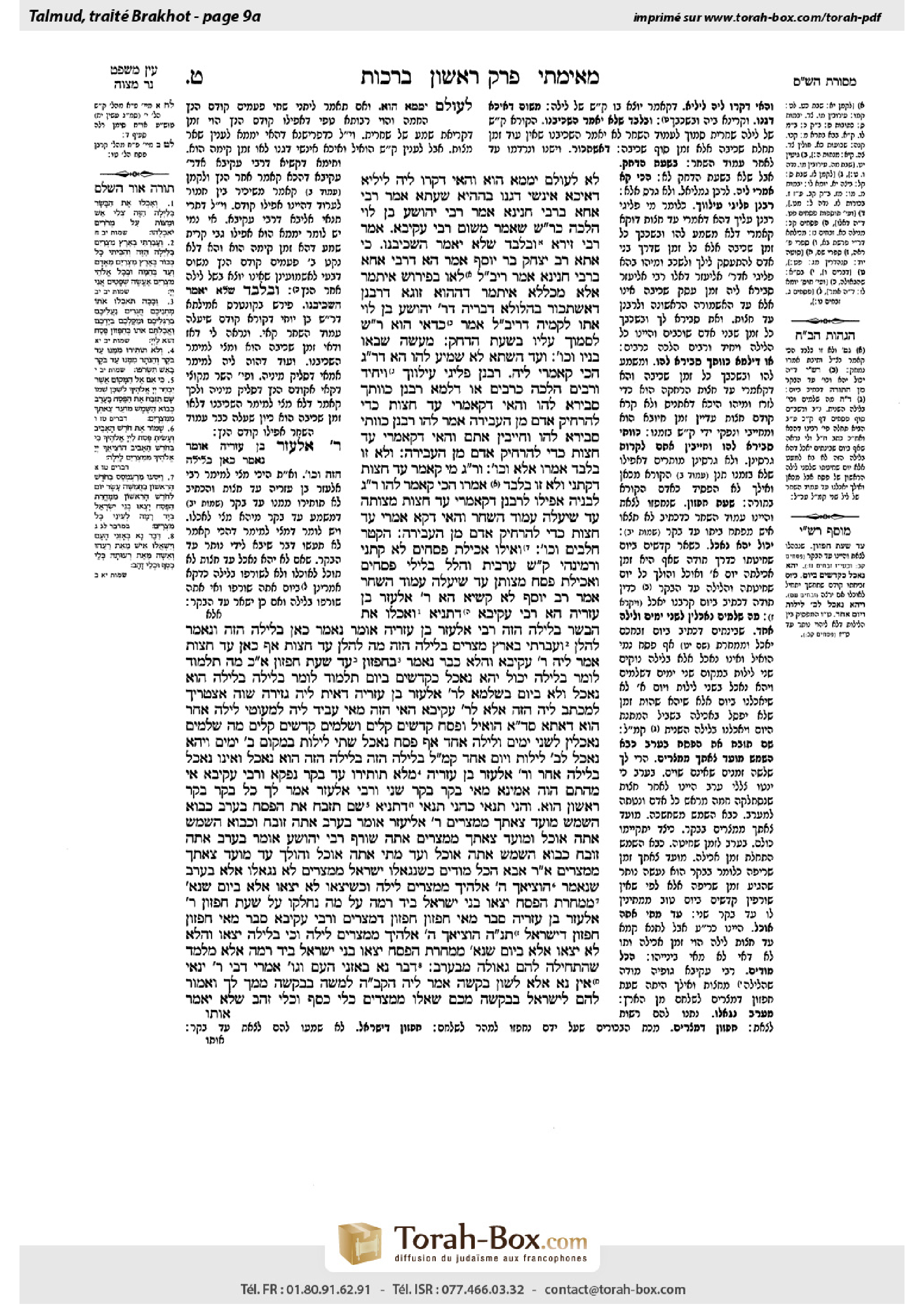
Berakhot 9a: Talmud study for Daf Yomi
Study the Talmud for Daf Yomi with scanned pages, Hebrew text, English translations from Sefaria and AI-generated French translations.
Passage selection and English or AI-generated French translation are available where the scan has annotations. Daf Study is independent of Torah-Box and Sefaria.
Browse Berakhot · ברכות · All tractatesBerakhot 9a text and translations
This page of Berakhot includes the Aramaic text, an English translation and an AI-generated French translation, alongside the scan above.
ברכות ט׳ א · Aramaic and Hebrew text
לָא, לְעוֹלָם יְמָמָא הוּא, וְהַאי דְּקָרוּ לֵיהּ ״לֵילְיָא״ — דְּאִיכָּא אִינָשֵׁי דְּגָנוּ בְּהַהִיא שַׁעְתָּא.
אָמַר רַבִּי אַחָא בְּרַבִּי חֲנִינָא, אָמַר רַבִּי יְהוֹשֻׁעַ בֶּן לֵוִי: הֲלָכָה כְּרַבִּי שִׁמְעוֹן שֶׁאָמַר מִשּׁוּם רַבִּי עֲקִיבָא. אָמַר רַבִּי זֵירָא: וּבִלְבַד שֶׁלֹּא יֹאמַר ״הַשְׁכִּיבֵנוּ״.
כִּי אֲתָא רַב יִצְחָק בַּר יוֹסֵף, אֲמַר: הָא דְּרַבִּי אַחָא בְּרַבִּי חֲנִינָא אָמַר רַבִּי יְהוֹשֻׁעַ בֶּן לֵוִי, לָאו בְּפֵירוּשׁ אִיתְּמַר, אֶלָּא מִכְּלָלָא אִיתְּמַר.
דְּהָהוּא זוּגָא דְּרַבָּנַן דְּאִשְׁתַּכּוּר בְּהִלּוּלָא דִּבְרֵיהּ דְּרַבִּי יְהוֹשֻׁעַ בֶּן לֵוִי. אֲתוֹ לְקַמֵּיהּ דְּרַבִּי יְהוֹשֻׁעַ בֶּן לֵוִי, אֲמַר: כְּדַאי הוּא רַבִּי שִׁמְעוֹן לִסְמוֹךְ עָלָיו בִּשְׁעַת הַדְּחָק.
מַעֲשֶׂה שֶׁבָּאוּ בָּנָיו וְכוּ׳:
וְעַד הַשְׁתָּא לָא שְׁמִיעַ לְהוּ הָא דְּרַבָּן גַּמְלִיאֵל?!
הָכִי קָאָמְרִי לֵיהּ: רַבָּנַן פְּלִיגִי עִילָּווֹךְ, וְיָחִיד וְרַבִּים, הֲלָכָה כְּרַבִּים, אוֹ דִּלְמָא רַבָּנַן כְּווֹתָךְ סְבִירָא לְהוּ, וְהַאי דְּקָאָמְרִי ״עַד חֲצוֹת״ — כְּדֵי לְהַרְחִיק אָדָם מִן הָעֲבֵירָה. אָמַר לְהוּ: רַבָּנָן כְּווֹתִי סְבִירָא לְהוּ, וְחַיָּיבִין אַתֶּם. וְהַאי דְּקָאָמְרִי ״עַד חֲצוֹת״ — כְּדֵי לְהַרְחִיק אָדָם מִן הָעֲבֵירָה.
וְלֹא זוֹ בִּלְבַד אָמְרוּ, אֶלָּא וְכוּ׳:
וְרַבָּן גַּמְלִיאֵל מִי קָאָמַר ״עַד חֲצוֹת״ דְּקָתָנֵי ״וְלֹא זוֹ בִּלְבַד אָמְרוּ״?
הָכִי קָאָמַר לְהוּ רַבָּן גַּמְלִיאֵל לִבְנֵיהּ: אֲפִילּוּ לְרַבָּנַן דְּקָאָמְרִי ״עַד חֲצוֹת״, מִצְוָתָהּ עַד שֶׁיַּעֲלֶה עַמּוּד הַשַּׁחַר. וְהַאי דְּקָא אָמְרִי עַד חֲצוֹת — כְּדֵי לְהַרְחִיק אָדָם מִן הָעֲבֵירָה.
הֶקְטֵר חֲלָבִים וְכוּ׳.
וְאִילּוּ אֲכִילַת פְּסָחִים לָא קָתָנֵי.
וּרְמִינְהִי: קְרִיאַת שְׁמַע עַרְבִית, וְהַלֵּל בְּלֵילֵי פְּסָחִים, וַאֲכִילַת פֶּסַח, מִצְוָתָן עַד שֶׁיַּעֲלֶה עַמּוּד הַשַּׁחַר!
אָמַר רַב יוֹסֵף: לָא קַשְׁיָא: הָא רַבִּי אֶלְעָזָר בֶּן עֲזַרְיָה, הָא רַבִּי עֲקִיבָא. דְּתַנְיָא: ״וְאָכְלוּ אֶת הַבָּשָׂר בַּלַּיְלָה הַזֶּה״, רַבִּי אֶלְעָזָר בֶּן עֲזַרְיָה אוֹמֵר: נֶאֱמַר כָּאן ״בַּלַּיְלָה הַזֶּה״, וְנֶאֱמַר לְהַלָּן: ״וְעָבַרְתִּי בְאֶרֶץ מִצְרַיִם בַּלַּיְלָה הַזֶּה״, מַה לְּהַלָּן עַד חֲצוֹת, אַף כָּאן עַד חֲצוֹת.
אָמַר לֵיהּ רַבִּי עֲקִיבָא: וַהֲלֹא כְּבָר נֶאֱמַר ״בְּחִפָּזוֹן״, עַד שְׁעַת חִפָּזוֹן. אִם כֵּן מָה תַּלְמוּד לוֹמַר ״בַּלַּיְלָה״?
יָכוֹל יְהֵא נֶאֱכָל כְּקָדָשִׁים בַּיּוֹם תַּלְמוּד לוֹמַר ״בַּלַּיְלָה״, בַּלַּיְלָה הוּא נֶאֱכָל, וְלֹא בַּיּוֹם.
בִּשְׁלָמָא לְרַבִּי אֶלְעָזָר בֶּן עֲזַרְיָה דְּאִית לֵיהּ גְּזֵירָה שָׁוָה, אִצְטְרִיךְ לְמִכְתַּב לֵיהּ ״הַזֶּה״. אֶלָּא לְרַבִּי עֲקִיבָא הַאי ״הַזֶּה״ מַאי עָבֵיד לֵיהּ?
לְמַעוֹטֵי לַיְלָה אַחֵר הוּא דַּאֲתָא, סָלְקָא דַּעְתָּךְ אָמֵינָא: הוֹאִיל וּפֶסַח קָדָשִׁים קַלִּים, וּשְׁלָמִים קָדָשִׁים קַלִּים, מָה שְׁלָמִים נֶאֱכָלִין לִשְׁנֵי יָמִים וְלַיְלָה אֶחָד — אַף פֶּסַח נֶאֱכָל שְׁתֵּי לֵילוֹת בִּמְקוֹם שְׁנֵי יָמִים, וִיהֵא נֶאֱכָל לִשְׁנֵי לֵילוֹת וְיוֹם אֶחָד. קָמַשְׁמַע לָן ״בַּלַּיְלָה הַזֶּה״, בַּלַּיְלָה הַזֶּה הוּא נֶאֱכָל וְאֵינוֹ נֶאֱכָל בְּלַיְלָה אַחֵר.
וְרַבִּי אֶלְעָזָר בֶּן עֲזַרְיָה
מִ״לֹּא תוֹתִירוּ עַד בֹּקֶר״ נָפְקָא.
וְרַבִּי עֲקִיבָא — אִי מֵהָתָם, הֲוָה אָמֵינָא מַאי ״בֹּקֶר״ — בֹּקֶר שֵׁנִי.
וְרַבִּי אֶלְעָזָר אָמַר לָךְ: כָּל ״בֹּקֶר״ — בֹּקֶר רִאשׁוֹן הוּא.
וְהָנֵי תַּנָּאֵי כְּהָנֵי תַּנָּאֵי. דְּתַנְיָא, ״שָׁם תִּזְבַּח אֶת הַפֶּסַח בָּעָרֶב כְּבוֹא הַשֶּׁמֶשׁ מוֹעֵד צֵאתְךָ מִמִּצְרָיִם״.
רַבִּי אֱלִיעֶזֶר אוֹמֵר: ״בָּעֶרֶב״ אַתָּה זוֹבֵחַ, וּ״כְבוֹא הַשֶּׁמֶשׁ״ אַתָּה אוֹכֵל, וּ״מוֹעֵד צֵאתְךָ מִמִּצְרָיִם״ אַתָּה שׂוֹרֵף. רַבִּי יְהוֹשֻׁעַ אוֹמֵר ״בָּעֶרֶב״ אַתָּה זוֹבֵחַ ״כְּבוֹא הַשֶּׁמֶשׁ״ אַתָּה אוֹכֵל וְעַד מָתַי אַתָּה אוֹכֵל וְהוֹלֵךְ — עַד ״מוֹעֵד צֵאתְךָ מִמִּצְרָיִם״.
אָמַר רַבִּי אַבָּא: הַכֹּל מוֹדִים כְּשֶׁנִּגְאֲלוּ יִשְׂרָאֵל מִמִּצְרַיִם, לֹא נִגְאֲלוּ אֶלָּא בָּעֶרֶב, שֶׁנֶּאֱמַר: ״הוֹצִיאֲךָ ה׳ אֱלֹהֶיךָ מִמִּצְרַיִם לָיְלָה״, וּכְשֶׁיָּצְאוּ — לֹא יָצְאוּ אֶלָּא בַּיּוֹם, שֶׁנֶּאֱמַר: ״מִמָּחֳרַת הַפֶּסַח יָצְאוּ בְנֵי יִשְׂרָאֵל בְּיָד רָמָה״.
עַל מָה נֶחְלְקוּ — עַל שְׁעַת חִפָּזוֹן, רַבִּי אֶלְעָזָר בֶּן עֲזַרְיָה סָבַר: מַאי ״חִפָּזוֹן״ — חִפָּזוֹן דְּמִצְרַיִם.
וְרַבִּי עֲקִיבָא סָבַר: מַאי ״חִפָּזוֹן״ — חִפָּזוֹן דְּיִשְׂרָאֵל.
תַּנְיָא נָמֵי הָכִי: ״הוֹצִיאֲךָ ה׳ אֱלֹהֶיךָ מִמִּצְרַיִם לָיְלָה״: וְכִי בַּלַּיְלָה יָצְאוּ? וַהֲלֹא לֹא יָצְאוּ אֶלָּא בַּיּוֹם, שֶׁנֶּאֱמַר: ״מִמָּחֳרַת הַפֶּסַח יָצְאוּ בְנֵי יִשְׂרָאֵל בְּיָד רָמָה״! אֶלָּא, מְלַמֵּד שֶׁהִתְחִילָה לָהֶם גְּאוּלָּה מִבָּעֶרֶב.
״דַּבֶּר נָא בְּאָזְנֵי הָעָם״ וְגוֹ׳. אָמְרִי דְּבֵי רַבִּי יַנַּאי: אֵין ״נָא״ אֶלָּא לְשׁוֹן בַּקָּשָׁה, אָמַר לֵיהּ הַקָּדוֹשׁ בָּרוּךְ הוּא לְמֹשֶׁה: בְּבַקָּשָׁה מִמְּךָ, לֵךְ וֶאֱמוֹר לָהֶם לְיִשְׂרָאֵל: בְּבַקָּשָׁה מִכֶּם, שַׁאֲלוּ מִמִּצְרַיִם כְּלֵי כֶסֶף וּכְלֵי זָהָב, שֶׁלֹּא יֹאמַר
Berakhot 9a · English translation
The Gemara answers: No, there is no contradiction. Actually, the time just before sunrise is considered day and the fact that it is referred to here as night is because there are people who are still asleep at that time and, if the need arises, it can be characterized as beshokhbekha [when you lie down] despite the fact that it is already day.
Rabbi Aḥa, son of Rabbi Ḥanina, said that Rabbi Yehoshua ben Levi said: The halakha is in accordance with the opinion of Rabbi Shimon who said it in the name of Rabbi Akiva. Rabbi Zeira said: As long as he will not recite: Help us lie down [hashkivenu] as well, after reciting the evening Shema before sunrise, as the blessing: Help us lie down, is a prayer that we sleep in peace, which is inappropriate in the morning.
That is how the halakha was taught in the study hall. However, when Rav Yitzḥak bar Yosef came to Babylonia from Eretz Yisrael, where Rabbi Yehoshua ben Levi lived, he said that this ruling that Rabbi Aḥa, son of Rabbi Ḥanina, said that Rabbi Yehoshua ben Levi said, was not said explicitly by Rabbi Yehoshua ben Levi. Rather, it was stated that he held that the halakha is in accordance with the opinion of Rabbi Shimon who said it in the name of Rabbi Akiva based on inference.
The incident was as follows: This pair of Sages got drunk at the wedding of Rabbi Yehoshua ben Levi’s son and fell asleep before reciting the evening Shema. By the time they awoke, dawn had already passed. They came before Rabbi Yehoshua ben Levi and asked him if they could still recite the evening Shema. He said to them: Rabbi Shimon is worthy to rely upon in exigent circumstances. Rabbi Yehoshua ben Levi did not rule in accordance with the opinion of Rabbi Shimon, and, in a case where there are no exigent circumstances, one may not rely on this ruling.
The mishna relates that there was an incident where Rabban Gamliel’s sons returned very late from a wedding hall and they asked their father if they were permitted to recite Shema after midnight.
The Gemara asks: And until now, had they not heard this halakha of Rabban Gamliel? Were they unaware that he held that one is permitted to recite the evening Shema after midnight?
The Gemara answers that Rabban Gamliel’s sons did not ask him his opinion. Rather, they said to him as follows: Do the Rabbis fundamentally disagree with you concerning this halakha, holding that Shema may be recited only until midnight? If so, when there is a disagreement between an individual Sage and many Sages, the halakha is in accordance with the opinion of the many, in which case we must, in practice, follow the opinion of the Rabbis. Or perhaps, do the Rabbis hold in accordance with your opinion that the time of the evening Shema extends throughout the night, and that which they say that it may only be recited until midnight is in order to distance a person from transgression? If the latter is true, then, when there are extenuating circumstances, one may recite the evening Shema after midnight. Rabban Gamliel replied to his sons: The Rabbis agree with me and you are still obligated to recite Shema. The Rabbis say that Shema may only be recited until midnight in order to distance a person from transgression, but, after the fact, even the Rabbis permit recitation after midnight.
We learned in the mishna that Rabban Gamliel told his sons: And that is not only with regard to the halakha of the recitation of Shema, but, rather, wherever the Rabbis say until midnight, the mitzva may be performed until dawn.
The Gemara questions the formulation of the mishna: Does Rabban Gamliel say until midnight, that he teaches: And not only did they say? Rabban Gamliel does not restrict the time for the recitation of Shema until midnight, so why does he say, and not only do they say, implying that he agrees with that stringency?
The Gemara explains that this is what Rabban Gamliel said to his sons: Even according to the Rabbis, who say that the mitzva may be performed only until midnight, the biblical obligation to perform the mitzva continues until dawn, and that which they say that it may only be recited until midnight is in order to distance a person from transgression.
In the mishna, Rabban Gamliel cites several cases where a mitzva may be performed until dawn; among them, the burning of fats and limbs on the altar.
The Gemara notes: In our mishna, the eating of the Paschal lamb was not taught among those mitzvot that may be performed until dawn, indicating that the mitzva of eating the Paschal lamb does not extend until dawn.
The Gemara raises a contradiction to this conclusion based on a baraita: The mitzvot of the recitation of the evening Shema, the recitation of hallel on the nights of Passover accompanying the sacrifice of the Paschal lamb, as well as eating the Paschal lamb, may all be performed until dawn.
Rav Yosef said: This is not difficult as these two sources reflect two conflicting opinions. This, our mishna, is in accordance with the opinion of Rabbi Elazar ben Azarya. While this, the baraita, is in accordance with the opinion of Rabbi Akiva. As it was taught in a baraita with regard to the verse discussing the mitzva to eat the Paschal lamb: “And they shall eat of the meat on that night; roasted over fire and matzot with bitter herbs shall they eat it” (Exodus 12:8); Rabbi Elazar ben Azarya says: Here it is stated: “On that night,” from which we cannot determine when night ends. The same expression is encountered later in the same chapter: “And I will pass through the land of Egypt on that night and I will strike every firstborn in the land of Egypt, from person to animal” (Exodus 12:12). We know when the firstborns were struck down based on the verse “Thus said the Lord: At about midnight, I will go out into the midst of Egypt and every firstborn in Egypt shall die” (Exodus 11:4–5). Therefore, just as in the verse below, the striking of the firstborns took place until midnight, as stated explicitly in the verse, so too in the verse here, the mitzva to eat the Paschal lamb continues until midnight.
Rabbi Akiva said to him: Was it not already said, “Thus you shall eat it, with your loins girded, your shoes on your feet, your staffs in your hands and you will eat it in haste for it is the Paschal offering for the Lord” (Exodus 12:11)? Therefore the Paschal lamb may be eaten until the time of haste. Since the time of haste is when Israel left Egypt, and it is said, “You will not leave, every man from his house, until the morning,” then the Paschal lamb may be eaten until dawn. If that is so, why does the verse state: On that night?
The Gemara explains that the phrase on that night is necessary because without it I might have thought that the Paschal lamb is eaten during the day, like all other sacrifices, which must all be slaughtered and eaten during the day. Therefore, the verse states: On that night, to underscore that this particular sacrifice is eaten at night and not during the day.
Essentially, the difference between these two opinions revolves around which word they deemed significant. Rabbi Elazar ben Azarya considered the word night as the key word, while Rabbi Akiva considered the word haste as the key word. The Gemara begins to analyze their statements.
Granted, according to Rabbi Elazar ben Azarya, who has the tradition of a verbal analogy between the phrase, on that night, with regard to the eating of the Paschal lamb and the phrase, on that night, with regard to the striking of the firstborn in Egypt, it was necessary for the verse to write “that” in order to indicate that these times are parallel. However, according to Rabbi Akiva, who has no such tradition, what does he do with “that”? Why is it necessary to emphasize on that night?
The Gemara answers: On that night comes to exclude another night, as one might otherwise have concluded that the Paschal lamb may be eaten for two nights. It would have entered your mind to say: Since the Paschal lamb falls into the category of sacrifices of lesser sanctity, and peace-offerings are also sacrifices of lesser sanctity, just as peace-offerings may be eaten for two days and one night, i.e., the day that they are sacrificed through the following day, as we learned in the Torah, so too the Paschal lamb may be eaten for two nights instead of two days. In other words, one might otherwise mistakenly conclude from its parallel to peace-offerings, that the Paschal lamb is to be eaten for two nights and the day between them. Therefore, the verse teaches us specifically on that night, i.e., on that night it is eaten, and it is not eaten on another night.
The Gemara asks: If so, from where does Rabbi Elazar ben Azarya derive that the Paschal lamb cannot be eaten for two nights?
The Gemara answers: Rabbi Elazar ben Azarya derives this conclusion from the verse: “It should not remain until the morning” (Exodus 12:10). If one is prohibited from leaving over any part of the sacrifice until the morning, he is certainly prohibited from leaving it over until the following night. Therefore, it is unnecessary to cite an additional source to teach that the Paschal lamb may only be eaten on the first night.
And why does Rabbi Akiva require “that” to derive that the Paschal lamb may not be eaten on the second night? According to Rabbi Akiva, if it was derived from the verse: “It should not remain until the morning,” I would have said: What is the meaning of morning? It means the second morning, as the Torah does not specify until which morning the Paschal lamb may not be left; until the first morning or the second morning. Therefore, the Torah needed to write on that night and no other.
And what would Rabbi Elazar ben Azarya respond? He could have said to you: If it is not otherwise noted, every unmodified mention of the word morning in the Bible refers to the first, i.e., the next, morning. If that were not the case, no biblical text could have any definite meaning.
Concerning the tannaitic dispute between Rabbi Akiva and Rabbi Elazar ben Azarya regarding until when the Paschal lamb may be eaten, the Gemara remarks: The dispute between these tanna’im is parallel to the dispute between those tanna’im, who disagree over the same issue. As it was taught in a baraita with regard to the verse: “There you will offer the Paschal lamb, in the evening when the sun sets at the time when you left the land of Egypt” (Deuteronomy 16:6). Upon closer examination, it seems that this verse mentions three distinct times: In the evening, refers to the afternoon until sunset; when the sun sets, refers to the time of sunset itself; and the time when you left the land of Egypt refers to, as explained in Exodus, the early hours of the morning. Therefore it seems that these times parallel the different stages of the mitzva of the Paschal lamb, and it is regarding these details that the tanna’im disagree.
Rabbi Eliezer says: In the evening, the afternoon, you slaughter the sacrifice, from when the sun sets until midnight you eat it, and at the time when you left the land of Egypt you burn what remains from the sacrifice, in accordance with the opinion of Rabbi Elazar ben Azarya.
Rabbi Yehoshua says: In the evening, the afternoon, you slaughter the sacrifice, from when the sun sets, you eat it. And until when do you continue eating? Until the time when you left the land of Egypt, meaning until morning, in accordance with the opinion of Rabbi Akiva.
The Gemara cites an alternative explanation of the dispute between Rabbi Elazer ben Azarya and Rabbi Akiva. Rabbi Abba said: Everyone agrees that when the children of Israel were redeemed from Egypt were given permission to leave, they were redeemed only in the evening, as it is stated: “In the spring the Lord, your God, took you out from Egypt at night” (Deuteronomy 16:1). And when they actually left, they left only during the day, as it is stated: “On the fifteenth of the first month, on the day after the offering of the Paschal lamb, the children of Israel went out with a high hand before the eyes of Egypt” (Numbers 33:3), indicating that they actually went out during the day.
However, with regard to what did they disagree? They disagreed with regard to the time of haste, as it is written: “You will eat it in haste for it is the Paschal offering for the Lord” (Exodus 12:11). Rabbi Elazar ben Azarya held: What is the meaning of haste? It is the haste of the Egyptians at midnight, as they hurried to the houses of the people of Israel to send them away, in fear of the plague of the firstborn.
And Rabbi Akiva held: What is the meaning of haste? It is the haste of Israel in the morning, as they rushed to leave Egypt.
Similar to Rabbi Abba’s statement, it was also taught in a baraita, regarding the verse: “The Lord, your God, took you out from Egypt at night,” the question arises: Did they leave at night? Didn’t they leave during the day, as it is stated: “On the day after the offering of the Paschal lamb, the children of Israel went out with a high hand”? Rather, this teaches that the redemption began for them in the evening.
Since the last topic discussed in the Gemara revolved around the exodus from Egypt, the Gemara cites additional aggadic midrash on that subject. With regard to the verse: “Speak, please [na] in the ears of the people, and they should borrow, every man from his fellow and every woman from her fellow, silver and gold vessels” (Exodus 11:2), the word please [na] is unclear. The students of the school of Rabbi Yannai said: Please [na] is nothing more than an expression of supplication. Why would God employ an expression of supplication in approaching Israel? The Gemara explains that the Holy One, Blessed be He, said to Moses: I beseech you, go and tell Israel: I beseech you; borrow vessels of silver and vessels of gold from the Egyptians in order to fulfill the promise I made to Abraham in the “Covenant between the Pieces,” so that
Berakhot 9a · Traduction française (IA)
Le Guemara répond : Non, il n'y a pas de contradiction. En réalité, le temps juste avant l'aube est considéré comme le jour et le fait qu'il soit appelé ici la nuit est dû au fait qu'il y a des personnes qui dorment encore à cette heure, et, si nécessaire, il peut être considéré comme beshokhbekha [lorsque l'on dort] malgré le fait qu'il est déjà jour.
Rabbi Aḥa, fils de Rabbi Ḥanina, a dit que Rabbi Yehoshua ben Levi a dit : La halakha suit l'opinion de Rabbi Shimon qui l'a exprimée au nom de Rabbi Akiva. Rabbi Zeira a dit : tant que l'on ne récitera pas : Aide-nous à nous endormir [hashkivenu], après avoir récité le Chéma du soir avant l'aube, car la bénédiction : Aide-nous à nous endormir, est une prière pour dormir en paix, ce qui n'est pas approprié le matin.
C'est ainsi que la halakha a été enseignée dans la salle de study. Cependant, lorsque Rav Yitzḥak bar Yosef est venu en Babylone depuis Eretz Yisrael, où vivait Rabbi Yehoshua ben Levi, il a dit que cette décision que Rabbi Aḥa, fils de Rabbi Ḥanina, avait rapportée que Rabbi Yehoshua ben Levi avait dite, n'avait pas été explicitement formulée par Rabbi Yehoshua ben Levi. Plutôt, on a dit qu'il maintenait que la halakha suit l'opinion de Rabbi Shimon qui l'avait exprimée au nom de Rabbi Akiva, basé sur une déduction.
L'incident était le suivant : Ce couple de Sages s'est saoulé à la fête de Rabbi Yehoshua ben Levi et s'est endormi avant de réciter le Chéma du soir. Lorsqu'ils se sont réveillés, l'aube était déjà passée. Ils se sont présentés devant Rabbi Yehoshua ben Levi et lui ont demandé s'ils pouvaient encore réciter le Chéma du soir. Il leur a dit : Rabbi Shimon est digne de confiance en cas d'urgence. Rabbi Yehoshua ben Levi n'a pas tranché en faveur de l'opinion de Rabbi Shimon, et, en cas où il n'y a pas d'urgence, on ne peut pas se fier à cette décision.
La mitsva relate que lors d'un incident, les fils de Rabban Gamliel sont revenus très tard d'une salle de mariage et ils ont demandé à leur père s'ils étaient autorisés à réciter le Chéma après minuit.
Le Guemara demande : Et jusqu'à présent, n'avaient-ils pas entendu cette halakha de Rabban Gamliel ? N'étaient-ils pas conscients qu'il maintenait que l'on est autorisé à réciter le Chéma du soir après minuit ?
Le Guemara répond que les fils de Rabban Gamliel n'ont pas demandé son avis. Plutôt, ils lui ont dit ceci : Les Rabbins ne s'opposent-ils pas fondamentalement à votre opinion concernant cette halakha, en considérant que le Chéma peut être récité uniquement jusqu'à minuit ? Si c'est le cas, lorsque l'on a un désaccord entre un Sage individuel et de nombreux Sages, la halakha suit l'opinion des nombreux Sages, et nous devons, en pratique, suivre l'opinion des Rabbins. Ou peut-être, les Rabbins suivent-ils votre opinion, en considérant que la période du Chéma s'étend toute la nuit, et ce qu'ils disent qu'il peut être récité uniquement jusqu'à minuit est pour éloigner une personne du péché ? Si c'est vrai, alors, en cas d'urgence, on peut réciter le Chéma après minuit. Rabban Gamliel a répondu à ses fils : Les Rabbins sont d'accord avec moi et vous êtes encore tenus de réciter le Chéma. Les Rabbins disent que le Chéma peut être récité uniquement jusqu'à minuit pour éloigner une personne du péché, mais, après coup, même les Rabbins autorisent la récitation après minuit.
Nous avons appris dans la Michna que Rabban Gamliel a dit à ses fils : Et cela n'est pas seulement concernant la halakha de la récitation du Chéma, mais plutôt, partout où les Rabbins disent jusqu'à minuit, la mitsva peut être accomplie jusqu'à l'aube.
Le Guemara questionne la formulation de la Michna : Rabban Gamliel dit jusqu'à minuit, ce qu'il enseigne : Et n'est-ce pas seulement ce qu'ils disent ? Rabban Gamliel ne restreint pas le temps de la récitation du Chéma jusqu'à minuit, donc pourquoi dit-il, et n'est-ce pas seulement ce qu'ils disent, suggérant qu'il est d'accord avec cette stricte limitation ?
Le Guemara explique que c'est ce que Rabban Gamliel a dit à ses fils : Même selon les Rabbins, qui disent que la mitsva peut être accomplie uniquement jusqu'à minuit, l'obligation biblique de l'accomplir continue jusqu'à l'aube, et ce qu'ils disent qu'il peut être récité uniquement jusqu'à minuit est afin d'éloigner une personne du péché.
Dans la Michna, Rabban Gamliel cite plusieurs cas où une mitsva peut être accomplie jusqu'à l'aube ; parmi eux, la combustion des graisses et des membres sur l'autel.
Le Guemara note : Dans notre Michna, la consommation de l'agneau pascal n'a pas été enseignée parmi ces mitsvot qui peuvent être accomplies jusqu'à l'aube, indiquant que la mitsva de consommer l'agneau pascal ne s'étend pas jusqu'à l'aube.
Le Guemara soulève une contradiction à cette conclusion basée sur une baraïta : Les mitsvot de la récitation du Chéma du soir, la récitation de hallel les nuits de Pessah accompagnant la sacrifice de l'agneau pascal, ainsi que la consommation de l'agneau pascal, peuvent toutes être accomplies jusqu'à l'aube.
Rav Yosef a dit : Cela n'est pas difficile, car ces deux sources reflètent deux opinions contradictoires. Celle-ci, notre mitsna, est selon l'opinion de Rabbi Elazar ben Azarya. Celle-ci, la baraïta, est selon l'opinion de Rabbi Akiva. Comme il a été enseigné dans une baraïta concernant la parole du verset parlant de la mitsva de manger l'agneau pascal : « Et ils mangeront de la viande ce soir-là ; cuite sur le feu, et des matzot avec des herbes amères mangeront-ils » (Exode 12:8) ; Rabbi Elazar ben Azarya dit : Ici il est dit : « Ce soir-là », d'où nous ne pouvons pas déterminer quand la nuit finit. La même expression est rencontrée plus tard dans le même chapitre : « Et je passerai par la terre d'Égypte ce soir-là et je frapperai chaque premier-né de la terre d'Égypte, du homme à l'animal » (Exode 12:12). Nous savons quand les premiers-nés ont été frappés grâce au verset « Ainsi dit l'Éternel : Vers la nuit, je sortirai au milieu d'Égypte et chaque premier-né d'Égypte mourra » (Exode 11:4–5). Par conséquent, tout comme dans le verset suivant, la frappe des premiers-nés s'est produite jusqu'à minuit, comme indiqué explicitement dans le verset, de même la mitsva de manger l'agneau pascal continue jusqu'à minuit.
Rabbi Akiva a dit à lui : N'était-ce pas déjà dit : « Vous mangerez ainsi, vos reins girdés, vos sandales sur vos pieds, vos bâtons à la main, et vous mangerez en hâte, car c'est l'offrande pascal de l'Éternel » (Exode 12:11) ? Par conséquent, l'agneau pascal peut être mangé jusqu'au moment de l'hâte. Puisque le moment de l'hâte est celui où Israël est parti d'Égypte, et il est dit : « Vous ne quitterez pas, chacun de sa maison, jusqu'au matin », alors l'agneau pascal peut être mangé jusqu'au lever du soleil. Si c'est ainsi, pourquoi le verset dit : « Ce soir-là » ?
La Guemara explique que la phrase « ce soir-là » est nécessaire car sans cela, je pourrais penser que l'agneau pascal est mangé pendant la journée, comme tous les autres sacrifices, qui doivent tous être sacrifiés et mangés pendant la journée. Par conséquent, le verset dit : « Ce soir-là », pour souligner que ce sacrifice particulier est mangé la nuit et non pendant la journée. Essentiellement, la différence entre ces deux opinions tourne autour du mot qu'ils ont considéré comme important. Rabbi Elazar ben Azarya a considéré le mot « nuit » comme le mot clé, tandis que Rabbi Akiva a considéré le mot « hâte » comme le mot clé. La Guemara commence à analyser leurs déclarations.
Admis que selon Rabbi Elazar ben Azarya, qui a la tradition d'une analogie verbale entre la phrase « ce soir-là » concernant la consommation de l'agneau pascal et la phrase « ce soir-là » concernant la frappe des premiers-nés en Égypte, il était nécessaire que le verset écrive « que » afin d'indiquer que ces moments sont parallèles. Cependant, selon Rabbi Akiva, qui n'a pas cette tradition, que fait-il avec « que » ? Pourquoi est-il nécessaire d'insister sur « ce soir-là » ?
La Guemara répond : « Ce soir-là » vient exclure une autre nuit, car on pourrait autrement conclure que l'agneau pascal peut être mangé pendant deux nuits. Il aurait pu entrer dans votre esprit de dire : Puisque l'agneau pascal entre dans la catégorie des sacrifices de moindre sanctité, et les offrandes de paix sont aussi des sacrifices de moindre sanctité, tout comme les offrandes de paix peuvent être mangées pendant deux jours et une nuit, c'est-à-dire la journée où ils sont sacrifiés jusqu'au lendemain, comme nous l'avons appris dans la Torah, de même l'agneau pascal peut être mangé pendant deux nuits au lieu de deux jours. En d'autres termes, on pourrait autrement conclure à tort de son parallèle avec les offrandes de paix, que l'agneau pascal doit être mangé pendant deux nuits et la journée entre elles. Par conséquent, le verset nous enseigne spécifiquement « ce soir-là », c'est-à-dire qu'il est mangé ce soir-là, et il n'est pas mangé une autre nuit.
La Guemara demande : Si c'est ainsi, d'où Rabbi Elazar ben Azarya dérive-t-il que l'agneau pascal ne peut pas être mangé pendant deux nuits ?
La Guemara répond : Rabbi Elazar ben Azarya dérive cette conclusion du verset : « Il ne doit pas rester jusqu'au matin » (Exode 12:10). Si l'on est interdit de laisser rester toute partie du sacrifice jusqu'au matin, il est certainement interdit de laisser rester jusqu'au lendemain soir. Par conséquent, il n'était pas nécessaire de citer une source supplémentaire pour enseigner que l'agneau pascal peut être mangé seulement le premier soir.
Et pourquoi Rabbi Akiva a-t-il besoin de « que » pour dériver que l'agneau pascal ne peut pas être mangé le deuxième soir ? Selon Rabbi Akiva, si cela était dérivé du verset : « Il ne doit pas rester jusqu'au matin », je dirais : Quel est le sens de « matin » ? Cela signifie le deuxième matin, car la Torah ne précise pas jusqu'à quel matin l'agneau pascal ne doit pas être laissé ; jusqu'au premier matin ou au deuxième matin. Par conséquent, la Torah a besoin d'écrire « ce soir-là » et pas un autre.
Et que répondrait Rabbi Elazar ben Azarya ? Il pourrait vous répondre : Si cela n'est pas autrement noté, toute mention non modifiée du mot « matin » dans la Bible fait référence au premier, c'est-à-dire au matin suivant. Si cela n'était pas le cas, aucun texte biblique ne pourrait avoir un sens défini.
Concernant le débat tannaitique entre Rabbi Akiva et Rabbi Elazar ben Azarya concernant jusqu'à quand l'agneau pascal peut être mangé, la Guemara remarque : Le débat entre ces tanna’im est parallèle au débat entre ces tanna’im, qui s'opposent sur le même sujet. Comme il a été enseigné dans une baraïta concernant le verset : « Là, vous offrirez l'agneau pascal, à l'heure du soir, lorsque le soleil se couche, à l'heure où vous avez quitté la terre d'Égypte » (Deutéronome 16:6). En examinant de plus près, cela semble mentionner trois moments distincts : « Le soir » fait référence à l'après-midi jusqu'au coucher du soleil ; « Lorsque le soleil se couche » fait référence au moment du coucher du soleil lui-même ; et « L'heure où vous avez quitté la terre d'Égypte » fait référence, comme expliqué dans Exode, aux premières heures du matin. Par conséquent, cela semble que ces moments correspondent aux différentes étapes de la mitsva de l'agneau pascal, et c'est à propos de ces détails que les tanna’im s'opposent.
Le Rabbi Eliezer dit : Le soir, l'après-midi, vous immolez le sacrifice, de la tombée du soleil jusqu'à minuit vous le mangez, et à l'heure où vous êtes sortis du pays d'Égypte vous brûlez ce qui reste du sacrifice, selon l'opinion du Rabbi Elazar ben Azarya. Le Rabbi Yéhoshua dit : Le soir, l'après-midi, vous immolez le sacrifice, de la tombée du soleil vous le mangez. Et jusqu'à quand continuez-vous de le manger ? Jusqu'à l'heure où vous êtes sortis du pays d'Égypte, c'est-à-dire jusqu'au matin, selon l'opinion du Rabbi Akiva.
La Guemara cite une autre explication de l'opposition entre le Rabbi Elazar ben Azarya et le Rabbi Akiva. Le Rabbi Abba dit : Tout le monde convient que lors que les enfants d'Israël furent libérés d'Égypte, ils furent autorisés à partir, ils furent libérés seulement le soir, comme il est dit : « Au printemps, le Seigneur, votre Dieu, vous a tirés d'Égypte la nuit » (Deutéronome 16:1). Et lors qu'ils sont partis effectivement, ils sont partis seulement pendant la journée, comme il est dit : « Le quinzième du premier mois, le jour après l'offrande de l'agneau pascal, les enfants d'Israël sortirent avec une main haute devant les yeux d'Égypte » (Nombres 33:3), indiquant qu'ils sont partis effectivement pendant la journée.
Cependant, à propos de quel point se sont-ils disputés ? Ils se sont disputés à propos du moment de la hâte, comme il est écrit : « Vous le mangerez en hâte, car c'est l'offrande pascal du Seigneur » (Exode 12:11). Le Rabbi Elazar ben Azarya affirmait : Qu'entend-on par hâte ? C'est la hâte des Égyptiens à minuit, comme ils se précipitaient vers les maisons du peuple d'Israël pour les expulser, en crainte de l'épidémie du premier-né.
Et le Rabbi Akiva affirmait : Qu'entend-on par hâte ? C'est la hâte d'Israël au matin, comme ils se précipitaient pour sortir d'Égypte.
Similaire à l'affirmation du Rabbi Abba, il a également été enseigné dans une baraïta, concernant la verset : « Le Seigneur, votre Dieu, vous a tirés d'Égypte la nuit », la question se pose : Ont-ils quitté la nuit ? N'ont-ils pas quitté pendant la journée, comme il est dit : « Le jour après l'offrande de l'agneau pascal, les enfants d'Israël sortirent avec une main haute » ? Plutôt, cela enseigne que la libération a commencé pour eux le soir.
Puisque le dernier sujet discuté dans la Guemara concernait la sortie d'Égypte, la Guemara cite une autre midrash aggadique sur ce sujet. Concernant la verset : « Parle, s'il te plaît [na], aux oreilles du peuple, et ils devront emprunter, chaque homme à son frère et chaque femme à sa sœur, des vases d'argent et d'or » (Exode 11:2), le mot s'il te plaît [na] est ambigu. Les élèves de la maison de Rabbi Yannai dirent : S'il te plaît [na] n'est rien de plus qu'une expression de supplication. Pourquoi Dieu utiliserait-il une expression de supplication pour s'adresser à Israël ? La Guemara explique que le Saint, le Très Haut, dit à Moïse : Je t'implorais, va et dis à Israël : Je t'implorais ; emprunte des vases d'argent et des vases d'or aux Égyptiens afin de remplir la promesse que j'ai faite à Abraham dans le « Pacte entre les morceaux », afin que
Traduction française générée par IA à partir de l’édition anglaise de Sefaria. Vérifie toujours un passage avec le texte source.
Text from Sefaria: William Davidson Edition - Vocalized Aramaic (CC BY NC); William Davidson Edition - English (CC BY NC).