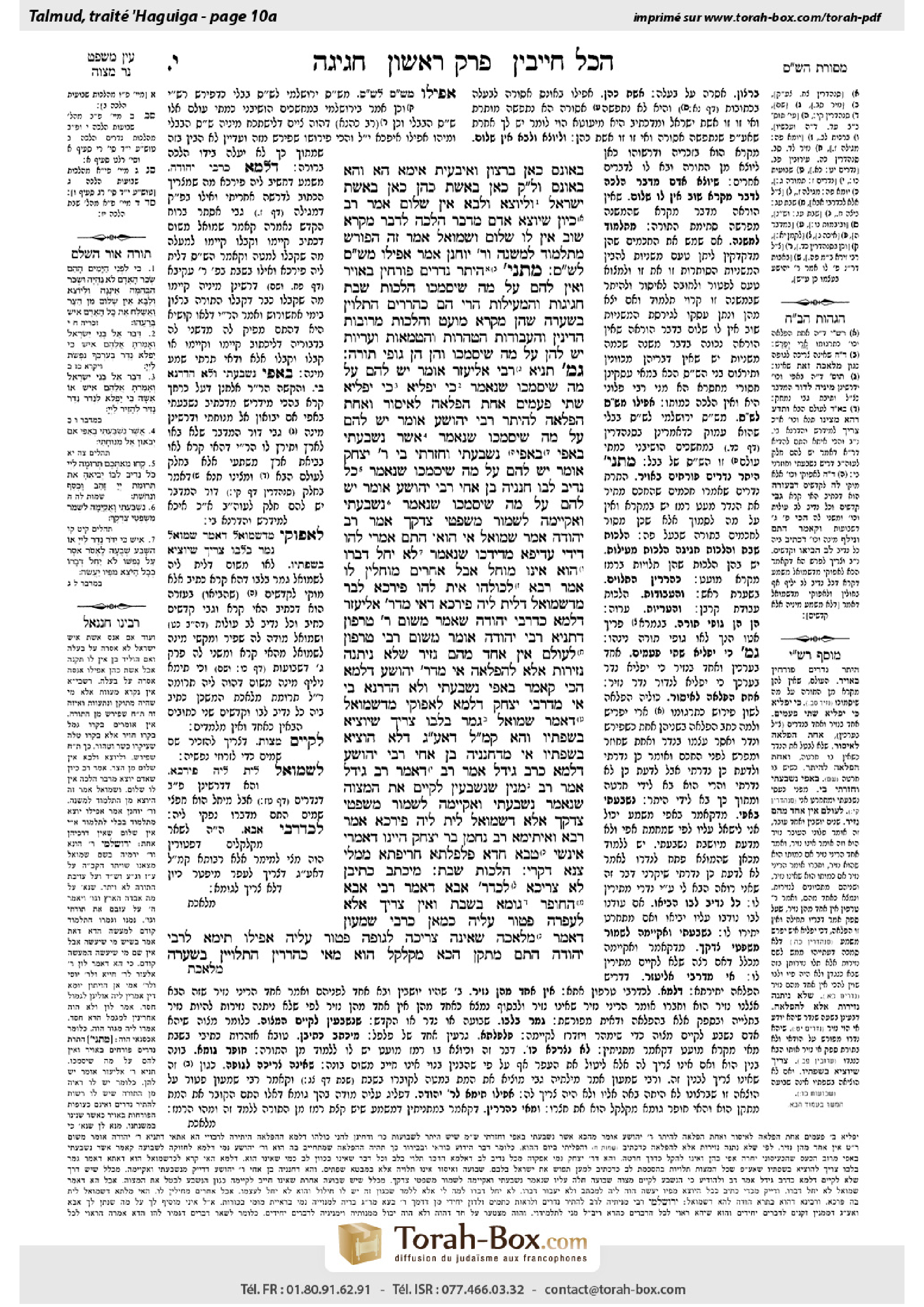
Chagigah 10a: Talmud study for Daf Yomi
Study the Talmud for Daf Yomi with scanned pages, Hebrew text, English translations from Sefaria and AI-generated French translations.
Passage selection and English or AI-generated French translation are available where the scan has annotations. Daf Study is independent of Torah-Box and Sefaria.
Browse Chagigah · חגיגה · All tractatesChagigah 10a text and translations
This page of Chagigah includes the Aramaic text, an English translation and an AI-generated French translation, alongside the scan above.
חגיגה י׳ א · Aramaic and Hebrew text
בְּאוֹנֶס, כָּאן בְּרָצוֹן. וְאִיבָּעֵית אֵימָא הָא וְהָא בְּאוֹנֶס, וְלָא קַשְׁיָא: כָּאן בְּאֵשֶׁת כֹּהֵן, כָּאן בְּאֵשֶׁת יִשְׂרָאֵל.
״וְלַיּוֹצֵא וְלַבָּא אֵין שָׁלוֹם״, אָמַר רַב: כֵּיוָן שֶׁיּוֹצֵא אָדָם מִדְּבַר הֲלָכָה לִדְבַר מִקְרָא — שׁוּב אֵין לוֹ שָׁלוֹם.
וּשְׁמוּאֵל אָמַר: זֶה הַפּוֹרֵשׁ מִתַּלְמוּד לְמִשְׁנָה. וְרַבִּי יוֹחָנָן אָמַר: אֲפִילּוּ מִתַּלְמוּד לְתַלְמוּד.
מַתְנִי׳ הֶיתֵּר נְדָרִים — פּוֹרְחִין בָּאֲוִיר וְאֵין לָהֶם עַל מָה שֶׁיִּסָּמֵכוּ.
הִלְכוֹת שַׁבָּת, חֲגִיגוֹת וְהַמְּעִילוֹת — הֲרֵי הֵם כַּהֲרָרִים הַתְּלוּיִן בִּשְׂעָרָהּ, שֶׁהֵן מִקְרָא מוּעָט וַהֲלָכוֹת מְרוּבּוֹת. הַדִּינִין וְהָעֲבוֹדוֹת הַטְּהָרוֹת וְהַטְּמָאוֹת וַעֲרָיוֹת — יֵשׁ לָהֶן עַל מָה שֶׁיִּסָּמֵכוּ, וְהֵן הֵן גּוּפֵי תוֹרָה.
גְּמָ׳ תַּנְיָא, רַבִּי אֱלִיעֶזֶר אוֹמֵר: יֵשׁ לָהֶם עַל מָה שֶׁיִּסָּמֵכוּ, שֶׁנֶּאֱמַר: ״כִּי יַפְלִיא״ ״כִּי יַפְלִיא״ שְׁתֵּי פְּעָמִים: אַחַת הַפְלָאָה לְאִיסּוּר, וְאַחַת הַפְלָאָה לְהֶיתֵּר.
רַבִּי יְהוֹשֻׁעַ אוֹמֵר: יֵשׁ לָהֶם עַל מָה שֶׁיִּסָּמֵכוּ, שֶׁנֶּאֱמַר: ״אֲשֶׁר נִשְׁבַּעְתִּי בְאַפִּי״ — בְּאַפִּי נִשְׁבַּעְתִּי, וְחָזַרְתִּי בִּי.
רַבִּי יִצְחָק אוֹמֵר: יֵשׁ לָהֶם עַל מָה שֶׁיִּסָּמֵכוּ, שֶׁנֶּאֱמַר: ״כֹּל נְדִיב לִבּוֹ״. חֲנַנְיָה בֶּן אֲחִי רַבִּי יְהוֹשֻׁעַ אוֹמֵר: יֵשׁ לָהֶם עַל מָה שֶׁיִּסָּמֵכוּ, שֶׁנֶּאֱמַר: ״נִשְׁבַּעְתִּי וָאֲקַיֵּימָה לִשְׁמוֹר מִשְׁפְּטֵי צִדְקֶךָ״.
אָמַר רַב יְהוּדָה אָמַר שְׁמוּאֵל: אִי הֲוַאי הָתָם, אָמְרִי לְהוּ: דִּידִי עֲדִיפָא מִדִּידְכוּ — שֶׁנֶּאֱמַר: ״לֹא יַחֵל דְּבָרוֹ״ — הוּא אֵינוֹ מוֹחֵל, אֲבָל אֲחֵרִים מוֹחֲלִין לוֹ. אָמַר רָבָא: לְכוּלְּהוּ אִית לְהוּ פִּירְכָא, לְבַר מִדִּשְׁמוּאֵל דְּלֵית לֵיהּ פִּירְכָא.
דְּאִי מִדְּרַבִּי אֱלִיעֶזֶר — דִּלְמָא כִּדְרַבִּי יְהוּדָה שֶׁאָמַר מִשּׁוּם רַבִּי טַרְפוֹן. דְּתַנְיָא, רַבִּי יְהוּדָה אוֹמֵר מִשּׁוּם רַבִּי טַרְפוֹן: לְעוֹלָם אֵין אֶחָד מֵהֶם נָזִיר, שֶׁלֹּא נִיתְּנָה נְזִירוּת אֶלָּא לְהַפְלָאָה.
אִי מִדְּרַבִּי יְהוֹשֻׁעַ — דִּלְמָא הָכִי קָאָמַר: בְּאַפִּי נִשְׁבַּעְתִּי — וְלָא הָדַרְנָא בִּי. אִי מִדְּרַבִּי יִצְחָק — דִּלְמָא לְאַפּוֹקֵי מִדִּשְׁמוּאֵל. דְּאָמַר שְׁמוּאֵל: גָּמַר בְּלִבּוֹ — צָרִיךְ שֶׁיּוֹצִיא בִּשְׂפָתָיו, וְהָא קָא מַשְׁמַע לַן: דְּאַף עַל גַּב דְּלֹא הוֹצִיא בִּשְׂפָתָיו.
אִי מִדַּחֲנַנְיָה בֶּן אֲחִי רַבִּי יְהוֹשֻׁעַ — דִּלְמָא כְּרַב גִּידֵּל אָמַר רַב. דְּאָמַר רַב גִּידֵּל אָמַר רַב: מִנַּיִן שֶׁנִּשְׁבָּעִין לְקַיֵּים אֶת הַמִּצְוָה — שֶׁנֶּאֱמַר: ״נִשְׁבַּעְתִּי וָאֲקַיֵּימָה לִשְׁמוֹר מִשְׁפְּטֵי צִדְקֶךָ״.
אֶלָּא דִּשְׁמוּאֵל לֵית לֵיהּ פִּירְכָא. אָמַר רָבָא, וְאִיתֵּימָא רַב נַחְמָן בַּר יִצְחָק: הַיְינוּ דְּאָמְרִי אִינָשֵׁי: טָבָא חֲדָא פִּלְפַּלְתָּא חֲרִיפְתָּא מִמְּלֵי צַנָּא דְקָרֵי.
הִלְכוֹת שַׁבָּת. מִיכְתָּב כְּתִיבָן! לָא צְרִיכָא, לְכִדְרַבִּי אַבָּא. דְּאָמַר רַבִּי אַבָּא: הַחוֹפֵר גּוּמָּא בְּשַׁבָּת וְאֵין צָרִיךְ אֶלָּא לַעֲפָרָהּ — פָּטוּר עָלֶיהָ.
כְּמַאן — כְּרַבִּי שִׁמְעוֹן, דְּאָמַר: מְלָאכָה שֶׁאֵינָהּ צְרִיכָה לְגוּפָהּ — פָּטוּר עָלֶיהָ.
אֲפִילּוּ תֵּימָא לְרַבִּי יְהוּדָה: הָתָם מְתַקֵּן, הָכָא מְקַלְקֵל הוּא.
מַאי ״כַּהֲרָרִין הַתְּלוּיִין בִּשְׂעָרָה״?
Chagigah 10a · English translation
with a rape, in which case it is not prohibited for the woman to return to her husband. There, it is referring to a woman who had relations willfully, and therefore she is forbidden to her husband. And if you wish, say that this and that are both dealing with a rape, and it is still not difficult. Here, where the transgression cannot be rectified, it is referring to one who raped the wife of a priest, as it is forbidden for a priest to have relations with his wife once she has intercourse with any other man, even unwillingly. There, it is referring to one who raped the wife of an Israelite, in which case there is no prohibition against her returning to her husband.
Since the Gemara mentioned a Torah scholar who abandons the study of Torah, it cites a relevant verse: “Neither was there any peace to him that went out or came in due to the adversary” (Zechariah 8:10). Rav said: Once a person leaves the study of halakha, i.e., Mishna and Gemara, even for the study of the Torah itself, he will no longer have peace. The verses of the Torah are often obscure and it is difficult to learn halakha directly from them without the aid of the interpretations of the Talmud.
And Shmuel said: This is referring to one who leaves the study of Talmud to learn Mishna. Whereas the reasoning of the Talmud is relatively clear, the Mishna cites legal rulings without explaining their reasoning. And Rabbi Yoḥanan said: The verse applies even to one who leaves the study of one Talmud for the other Talmud, i.e., who leaves off his study of the Jerusalem Talmud to begin the Babylonian Talmud, as he will encounter difficulties with the new style of learning.
MISHNA: Incidental to the Festival peace-offering, the mishna describes the nature of various areas of Torah study. The halakhot of the dissolution of vows, when one requests from a Sage to dissolve them, fly in the air and have nothing to support them, as these halakhot are not mentioned explicitly in the Torah. There is only a slight allusion to the dissolution of vows in the Torah, which is taught by the Sages as part of the oral tradition.
The halakhot of Shabbat, Festival peace-offerings, and misuse of consecrated property are like mountains suspended by a hair, as they have little written about them in the Torah, and yet the details of their halakhot are numerous. The details of monetary law, sacrificial rites, ritual purity and impurity, and the halakhot of those with whom relations are forbidden all have something to support them, i.e., there is ample basis in the Torah for these halakhot, and these are the essential parts of Torah.
GEMARA: It is taught in a baraita that Rabbi Eliezer said: The halakhot of the dissolution of vows have something to support them, as it is stated: “When a man shall clearly utter a vow” (Leviticus 27:2), and: “When either man or woman shall clearly utter a vow” (Numbers 6:2), i.e., the words “clearly utter” appear twice. One clear utterance is for prohibition, i.e., when one states his intention to accept the vow, and one clear utterance is for dissolution, when he provides the Sage with a reason why the vow should no longer apply. This is an allusion in the Torah to the annulment of vows.
Rabbi Yehoshua likewise says: These halakhot have something to support them, as it is stated: “Wherefore I swore in My wrath” (Psalms 95:11), meaning: In my wrath I swore, and I retracted. This is the basis for the dissolution of vows, in which the one who uttered the vow tells the Sage that he regrets it, as he did so in a moment of anger.
Rabbi Yitzḥak says: These halakhot have something to support them, as it is stated: “Whoever is of a willing heart, let him bring it” (Exodus 35:5). This verse indicates that as long as one retains the same desire to fulfill the vow, he must continue to fulfill it, but if he regrets taking the vow he may arrange for it to be dissolved. Ḥananya, son of Rabbi Yehoshua’s brother, also says: They have something to support them, as it is stated: “I have sworn, and have fulfilled it, to observe your righteous ordinances” (Psalms 119:106). This verse indicates that certain oaths need not be fulfilled, i.e., those that have been dissolved.
Rav Yehuda said that Shmuel said: If I had been there, sitting with those Sages, I would have said to them: My source is better than yours, as it is stated: “He shall not nullify his word” (Numbers 30:3), from which it may be inferred: He himself cannot nullify his word; however, others, i.e., a Sage, may nullify it for him by dissolving his vow. Rava said: For all of the suggested sources for the dissolution of vows there is a possible refutation, except for that of Shmuel, for which there is no refutation.
Rava elaborates. As, if it is derived from the statement of Rabbi Eliezer, perhaps the phrase: “Clearly utter” should be understood in accordance with the opinion of Rabbi Yehuda, who said an alternative interpretation in the name of Rabbi Tarfon. As it is taught in a baraita with regard to two people who are arguing whether or not someone who passed before them is a nazirite, each of them declaring that if he is correct he himself will become a nazirite, Rabbi Yehuda says in the name of Rabbi Tarfon: Actually, neither of them is a nazirite, as naziriteship is effected only by means of a clear utterance and neither party is certain they will be a nazirite at the time of their utterance. He derives this halakha from this phrase: “Clearly utter.”
Similarly, if it is derived from the statement of Rabbi Yehoshua, perhaps this is what the verse is saying: In my wrath I swore and I do not take it back, despite the fact that it was stated in a moment of anger. If it is derived from the statement of Rabbi Yitzḥak, perhaps the phrase “a willing heart” comes to exclude the statement of Shmuel, as Shmuel said: If one decided in his heart but did not verbalize a vow, it is insufficient, as he must verbally express it. And therefore this phrase teaches us that even though he did not verbally express the vow he is still obligated to fulfill it.
Finally, if it is derived from the statement of Rabbi Ḥananya, son of Rabbi Yehoshua’s brother, perhaps the phrase “and fulfilled it” should be explained in accordance with the opinion of Rav Giddel, who said that Rav said a different interpretation of this verse. As Rav Giddel said that Rav said: From where is it derived that although one is already obligated to fulfill all mitzvot one may take an oath to fulfill a mitzva, and this is not considered an oath taken in vain? As it is stated: “I have sworn, and have fulfilled it, to observe Your righteous ordinances” (Psalms 119:106).
Rav concludes. However, for Shmuel’s source there is no refutation. Rava said, and some say it was Rav Naḥman bar Yitzḥak who said: This explains the folk saying that people say: One spicy pepper is better than a basketful of squash, as the single pepper has more flavor than all the squash combined.
§ The mishna stated that the halakhot of Shabbat are like mountains suspended by a hair. The Gemara asks: But the halakhot of Shabbat are written, i.e., the prohibition against performing labor is explicit in the Torah. The Gemara answers: No, it is necessary to say this in accordance with the opinion of Rabbi Abba. As Rabbi Abba said: One who digs a hole on Shabbat only because he needs its dirt and not for the hole itself is exempt from liability for that act, as this is not the labor of digging prohibited on Shabbat by Torah law.
The Gemara asks: In accordance with whose opinion did Rabbi Abba issue this ruling? It is in accordance with the opinion of Rabbi Shimon, who said: One who performs on Shabbat a labor that is not necessary for its own sake, i.e., he performs the labor for a purpose other than the direct result of the action, is exempt from liability for it.
The Gemara offers an alternative possibility. This ruling can be explained even if you say that Rabbi Abba holds in accordance with the opinion of Rabbi Yehuda, that one is liable for a labor that is not necessary for its own sake. There, in other cases, Rabbi Yehuda deems one liable because his purpose is creative. Here, where one is digging the hole for the dirt, the purpose is destructive, as the action damages the ground. Therefore, Rabbi Yehuda concedes that in this case he is exempt.
The Gemara returns to the mishna. What then does the mishna mean by the phrase: Like mountains suspended by a hair?
Chagigah 10a · Traduction française (IA)
avec une viol, dans ce cas il n'est pas interdit à la femme de retourner vers son mari. Là, il s'agit d'une femme qui a eu des relations volontairement, et donc elle est interdite à son mari. Et si tu veux, dis que cela et cela traitent tous les deux d'une viol, et il n'est toujours pas difficile. Ici, où la transgression ne peut être réparée, il s'agit d'une personne qui a violé la femme d'un prêtre, car il est interdit à un prêtre d'avoir des relations avec sa femme une fois qu'elle a eu des relations avec un autre homme, même contre son gré. Là, il s'agit d'une personne qui a violé la femme d'un Israélite, dans ce cas il n'y a pas d'interdiction pour elle de retourner vers son mari.
Puisque la Guemara mentionne un savant de la Torah qui abandonne l'étude de la Torah, elle cite un verset pertinent : « Il n'y avait pas de paix pour celui qui sortait ou entrait en raison de l'adversaire » (Zacharie 8:10). Rav dit : Une fois qu'une personne quitte l'étude de la halakha, c'est-à-dire de la Michna et de la Guemara, même pour étudier la Torah elle-même, il n'aura plus de paix. Les versets de la Torah sont souvent obscurs et il est difficile d'apprendre directement la halakha à partir d'eux sans l'aide des interprétations de la Talmud.
Et Shmuel dit : Cela s'applique à celui qui quitte l'étude de la Talmud pour étudier la Michna. Bien que la raison de la Talmud soit relativement claire, la Michna cite des décisions juridiques sans expliquer leur raisonnement. Et Rabbi Yoḥanan dit : Le verset s'applique même à celui qui quitte l'étude d'un Talmud pour l'autre Talmud, c'est-à-dire celui qui arrête d'étudier le Talmud de Jérusalem pour commencer le Talmud de Babylone, car il rencontrera des difficultés avec le nouveau style d'apprentissage.
MICHA : En ce qui concerne le sacrifice de paix du festival, la Michna décrit la nature de divers domaines d'étude de la Torah. Les halakhot de la dissolution des vœux, lorsqu'une personne demande à un Sage de les dissoudre, flottent dans l'air et n'ont rien à soutenir, car ces halakhot ne sont pas mentionnés explicitement dans la Torah. Il n'y a qu'une légère allusion à la dissolution des vœux dans la Torah, enseignée par les Sages comme partie de la tradition orale.
Les halakhot de la Shabbat, des sacrifices de paix du festival et de l'usage de la propriété consacrée sont comme des montagnes suspendues par un cheveu, car ils sont peu mentionnés dans la Torah, et pourtant les détails de leurs halakhot sont nombreux. Les détails du droit des biens, des rites sacrificiels, de la pureté et de l'impureté, et les halakhot des personnes avec lesquelles les relations sont interdites ont quelque chose à soutenir, c'est-à-dire qu'il y a une base abondante dans la Torah pour ces halakhot, et ces sont les parties essentielles de la Torah.
LA GUEMARA : Il est enseigné dans une baraïta que Rabbi Eliezer dit : Les halakhot de la dissolution des vœux ont quelque chose à soutenir, car il est dit : « Quand un homme aura clairement prononcé un vœu » (Lévitique 27:2), et : « Quand un homme ou une femme aura clairement prononcé un vœu » (Nb 6:2), c'est-à-dire que le mot « clairement prononcé » apparaît deux fois. Une claire prononciation est pour l'interdiction, c'est-à-dire quand l'on déclare son intention d'accepter le vœu, et une claire prononciation est pour la dissolution, quand l'on fournit au Sage une raison pour laquelle le vœu ne devrait plus s'appliquer. C'est une allusion dans la Torah à l'annulation des vœux.
Rabbi Yehoshua dit également : Ces halakhot ont quelque chose à soutenir, car il est dit : « Par conséquent, j'ai juré en mon courroux » (Psa 95:11), c'est-à-dire : En mon courroux j'ai juré, et j'ai rétracté. C'est la base pour la dissolution des vœux, dans laquelle celui qui a prononcé le vœu dit au Sage qu'il regrette, car il l'a fait en un moment de colère.
Rabbi Yitzḥak dit : Ces halakhot ont quelque chose à soutenir, car il est dit : « Celui qui a un cœur volontaire, qu'il l'apporte » (Ex 35:5). Ce verset indique que tant que l'on conserve le même désir de remplir le vœu, l'on doit le remplir, mais si l'on regrette d'avoir pris le vœu, l'on peut organiser sa dissolution. Ḥananya, fils du frère de Rabbi Yehoshua, dit également : Ils ont quelque chose à soutenir, car il est dit : « J'ai juré, et j'ai accompli, pour observer vos ordonnances justes » (Psa 119:106). Ce verset indique que certains vœux n'ont pas besoin d'être accomplis, c'est-à-dire ceux qui ont été dissous.
Rav Yehuda dit que Shmuel a dit : Si j'avais été là, assis avec ces Sages, j'aurais dit à eux : Mon fondement est meilleur que le vôtre, car il est dit : « Il ne doit pas annuler son mot » (Nb 30:3), d'où on peut déduire : Il lui-même ne peut pas annuler son mot ; cependant, les autres, c'est-à-dire un Sage, peuvent l'annuler pour lui en dissolvant son vœu. Rava dit : Pour toutes les sources suggérées pour la dissolution des vœux, il y a une possible réfutation, sauf celle de Shmuel, pour laquelle il n'y a pas de réfutation.
Rava développe. Car, si cela provient de la déclaration de Rabbi Eliezer, peut-être la phrase : « Clairement prononcé » devrait être interprétée selon l'opinion de Rabbi Yehuda, qui a dit une interprétation alternative en nom de Rabbi Tarfon. Il est enseigné dans une baraïta concernant deux personnes qui s'argumentent sur le fait qu'une personne qui est passée devant eux est un nazir, chacun déclarant que s'il est correct, il lui-même deviendra un nazir. Rabbi Yehuda dit en nom de Rabbi Tarfon : En réalité, ni l'un ni l'autre n'est un nazir, car la nazirité est effectuée uniquement par une claire prononciation et aucun des deux n'est certain d'être un nazir au moment de leur prononciation. Il dérive cette halakha de cette phrase : « Clairement prononcé ».
De même, si cela provient de la déclaration de Rabbi Yehoshua, peut-être le verset dit : « En mon courroux j'ai juré et je ne le rétracte pas », malgré le fait qu'il ait été dit en un moment de colère. Si cela provient de la déclaration de Rabbi Yitzḥak, peut-être la phrase « un cœur volontaire » vient exclure la déclaration de Shmuel, car Shmuel a dit : Si l'on a décidé dans son cœur mais n'a pas verbalisé un vœu, cela est insuffisant, car il doit exprimer verbalement. Et donc cette phrase nous apprend que même s'il n'a pas verbalisé le vœu, il est toujours tenu de le remplir.
Enfin, si cela provient de la déclaration de Rabbi Ḥananya, fils du frère de Rabbi Yehoshua, peut-être la phrase « et l'a accompli » devrait être expliquée selon l'opinion de Rav Giddel, qui a dit que Rav avait une autre interprétation de cette verset. Comme Rav Giddel a dit que Rav a dit : D'où vient-on que bien qu'on soit déjà tenu de remplir toutes les mitsvot, on peut prendre un serment pour remplir une mitsva, et cela n'est pas considéré comme un serment vaine ? Comme il est dit : « J'ai juré, et j'ai accompli, pour observer tes ordonnances justes » (Psaumes 119:106).
Rav conclut. Cependant, pour la source de Shmuel, il n'y a pas de réfutation. Rava a dit, et certains disent que c'était Rav Naḥman bar Yitzḥak qui a dit : Cela explique la devise populaire que les gens disent : Un piment épicé est meilleur qu'un panier de courges, car le piment seul a plus de goût que toutes les courges combinées.
§ La mitsna a dit que les halakhot de Shabbat sont comme des montagnes suspendues par un cheveu. La Guemara demande : Mais les halakhot de Shabbat sont écrites, c'est-à-dire l'interdiction de faire un travail est explicite dans la Torah. La Guemara répond : Non, il faut dire cela selon l'opinion de Rabbi Abba. Comme Rabbi Abba a dit : Celui qui creuse un trou le sabbat uniquement parce qu'il a besoin de la terre et non du trou lui-même est exempt de responsabilité pour cet acte, car cela n'est pas le travail de creuser interdit le sabbat par la loi divine.
La Guemara demande : Selon l'opinion de qui Rabbi Abba a-t-il rendu cette décision ? C'est selon l'opinion de Rabbi Shimon, qui a dit : Celui qui exécute un travail le sabbat qui n'est pas nécessaire à son propre but, c'est-à-dire qu'il exécute le travail pour un but autre que le résultat direct de l'action, est exempt de responsabilité pour cela.
La Guemara propose une alternative. Cette décision peut être expliquée même si vous dites que Rabbi Abba tient selon l'opinion de Rabbi Yehuda, que l'on est tenu pour un travail qui n'est pas nécessaire à son propre but. Là, dans d'autres cas, Rabbi Yehuda considère qu'on est tenu car son but est créatif. Ici, où l'on creuse le trou pour la terre, le but est destructeur, car l'action endommage le sol. Ainsi, Rabbi Yehuda reconnaît qu'on est exempt dans ce cas.
La Guemara revient à la mitsna. Quel est alors le sens de la phrase : « Comme des montagnes suspendues par un cheveu » ?
Traduction française générée par IA à partir de l’édition anglaise de Sefaria. Vérifie toujours un passage avec le texte source.
Text from Sefaria: William Davidson Edition - Vocalized Aramaic (CC BY NC); William Davidson Edition - English (CC BY NC).