Chagigah 10b: Talmud study for Daf Yomi
Study the Talmud for Daf Yomi with scanned pages, Hebrew text, English translations from Sefaria and AI-generated French translations.
Passage selection and English or AI-generated French translation are available where the scan has annotations. Daf Study is independent of Torah-Box and Sefaria.
Browse Chagigah · חגיגה · All tractatesChagigah 10b text and translations
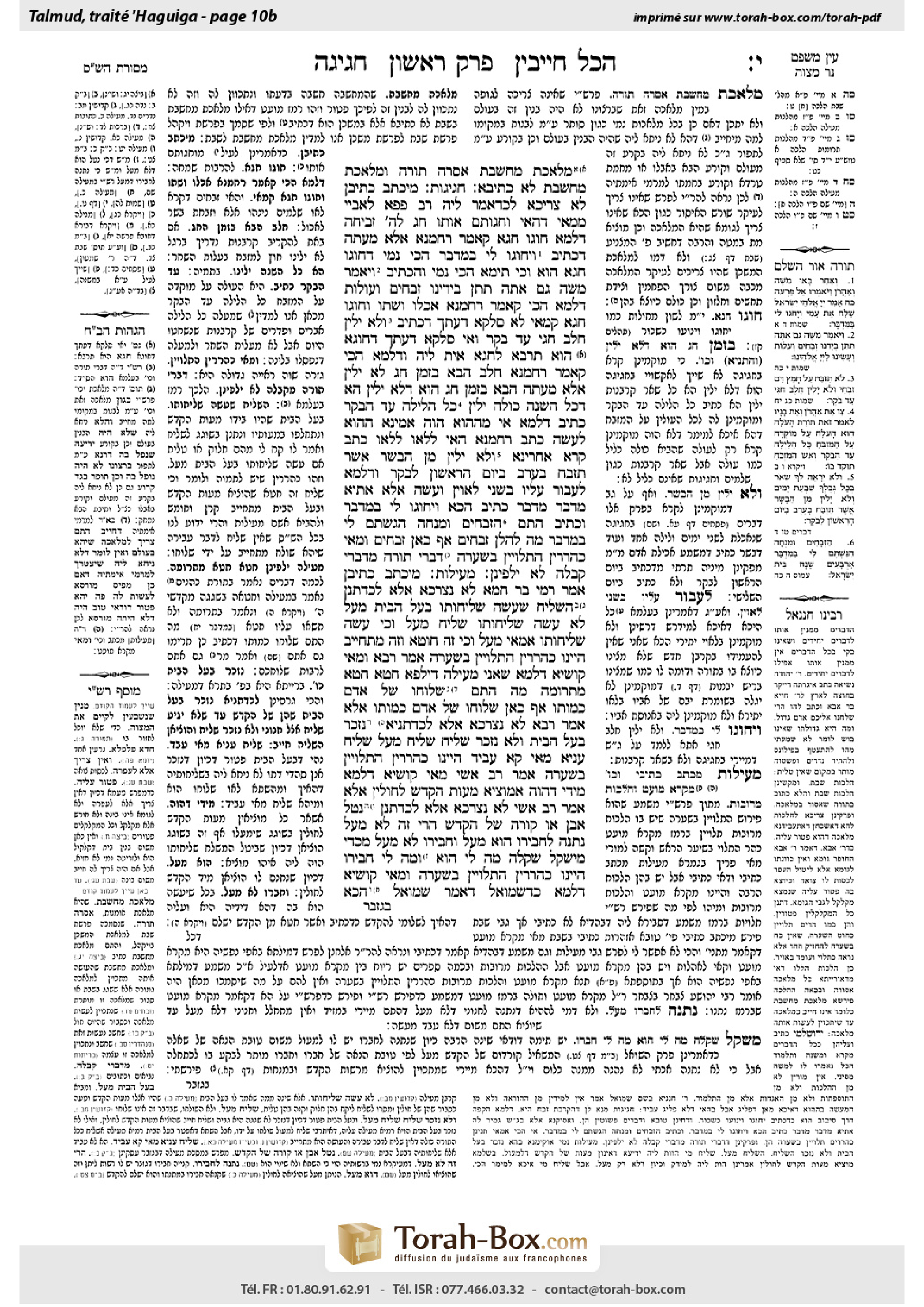
This page of Chagigah includes the Aramaic text, an English translation and an AI-generated French translation, alongside the scan above.
חגיגה י׳ ב · Aramaic and Hebrew text
מְלֶאכֶת מַחְשֶׁבֶת אָסְרָה תּוֹרָה, וּמְלֶאכֶת מַחְשֶׁבֶת לָא כְּתִיבָא.
חֲגִיגוֹת. מִיכְתָּב כְּתִיבָן! לָא צְרִיכָא, לִכְדַאֲמַר לֵיהּ רַב פָּפָּא לְאַבָּיֵי: מִמַּאי דְּהַאי ״וְחַגּוֹתֶם אוֹתוֹ חַג לַה׳״ — זְבִיחָה? דִּלְמָא ״חוֹגּוּ חַגָּא״ קָאָמַר רַחֲמָנָא!
אֶלָּא מֵעַתָּה, דִּכְתִיב ״וְיָחוֹגּוּ לִי בַּמִּדְבָּר״, הָכִי נָמֵי דְּחוֹגּוּ חַגָּא הוּא? וְכִי תֵּימָא הָכִי נָמֵי, וְהָכְתִיב: ״וַיֹּאמַר מֹשֶׁה גַּם אַתָּה תִּתֵּן בְּיָדֵינוּ זְבָחִים וְעוֹלוֹת״.
דִּלְמָא הָכִי קָאָמַר רַחֲמָנָא: ״אִכְלוּ וּשְׁתוּ וְחוֹגּוּ חַגָּא קַמַּאי״? לָא סָלְקָא דַּעְתָּךְ, דִּכְתִיב: ״וְלֹא יָלִין חֵלֶב חַגִּי עַד בֹּקֶר״, וְאִי סָלְקָא דַעְתָּךְ דְּחוֹגָּא הוּא, תַּרְבָּא לְחַגָּא אִית לֵיהּ?!
וְדִלְמָא הָכִי קָאָמַר רַחֲמָנָא: חֵלֶב הַבָּא בִּזְמַן חַג — ״לֹא יָלִין״!
אֶלָּא מֵעַתָּה: הַבָּא בִּזְמַן חַג — הוּא דְּלֹא יָלִין, הָא דְּכׇל הַשָּׁנָה כּוּלָּהּ — יָלִין?! ״כׇּל הַלַּיְלָה עַד הַבֹּקֶר״, כְּתִיב!
דִּלְמָא אִי מֵהָהוּא, הֲוָה אָמֵינָא: הָהוּא לַעֲשֵׂה כְּתַב רַחֲמָנָא, הַאי לְלָאו!
לְלָאו כְּתַב קְרָא אַחֲרִינָא: ״וְלֹא יָלִין מִן הַבָּשָׂר אֲשֶׁר תִּזְבַּח בָּעֶרֶב בַּיּוֹם הָרִאשׁוֹן לַבֹּקֶר״. וְדִלְמָא לַעֲבוֹר עָלָיו בִּשְׁנֵי לָאוִין וַעֲשֵׂה!
אֶלָּא: אָתְיָא ״מִדְבָּר״ ״מִדְבָּר״. כְּתִיב הָכָא: ״וְיָחוֹגּוּ לִי בַּמִּדְבָּר״, וּכְתִיב הָתָם: ״הַזְּבָחִים וּמִנְחָה הִגַּשְׁתֶּם לִי בַּמִּדְבָּר״, מָה לְהַלָּן זְבָחִים — אַף כָּאן זְבָחִים.
וּמַאי ״כַּהֲרָרִין הַתְּלוּיִין בִּשְׂעָרָה״ — דִּבְרֵי תוֹרָה מִדִּבְרֵי קַבָּלָה לָא יָלְפִינַן.
מְעִילוֹת. מִיכְתָּב כְּתִיבָן! אָמַר רָמֵי בַּר חָמָא: לֹא נִצְרְכָא אֶלָּא לִכְדִתְנַן: הַשָּׁלִיחַ שֶׁעָשָׂה שְׁלִיחוּתוֹ — בַּעַל הַבַּיִת מָעַל, לֹא עָשָׂה שְׁלִיחוּתוֹ — שָׁלִיחַ מָעַל.
וְכִי עָשָׂה שְׁלִיחוּתוֹ, אַמַּאי מָעַל? וְכִי זֶה חוֹטֵא וְזֶה מִתְחַיֵּיב? הַיְינוּ כַּהֲרָרִין הַתְּלוּיִין בִּשְׂעָרָה.
אָמַר רָבָא: וּמַאי קוּשְׁיָא? דִּלְמָא שָׁאנֵי מְעִילָה דְּיָלְפָא ״חֵטְא״ ״חֵטְא״ מִתְּרוּמָה, מָה הָתָם שְׁלוּחוֹ שֶׁל אָדָם כְּמוֹתוֹ — אַף כָּאן שְׁלוּחוֹ שֶׁל אָדָם כְּמוֹתוֹ?
אֶלָּא אָמַר רָבָא: לֹא נִצְרְכָא אֶלָּא לְכִדְתַנְיָא: נִזְכַּר בַּעַל הַבַּיִת וְלֹא נִזְכַּר שָׁלִיחַ — שָׁלִיחַ מָעַל. שָׁלִיחַ עַנְיָא מַאי קָא עָבֵיד? הַיְינוּ כַּהֲרָרִין הַתְּלוּיִין בִּשְׂעָרָה.
אָמַר רַב אָשֵׁי: מַאי קוּשְׁיָא? דִּלְמָא מִידֵּי דְּהָוֵה אַמּוֹצִיא מְעוֹת הֶקְדֵּשׁ לְחוּלִּין!
אֶלָּא אָמַר רַב אָשֵׁי: לֹא נִצְרְכָא אֶלָּא לִכְדִתְנַן: נָטַל אֶבֶן אוֹ קוֹרָה שֶׁל הֶקְדֵּשׁ — הֲרֵי זֶה לֹא מָעַל, נְתָנָהּ לַחֲבֵירוֹ — הוּא מָעַל וַחֲבֵירוֹ לֹא מָעַל. מִכְּדֵי מִישְׁקָל שַׁקְלַהּ, מָה לִי הוּא וּמָה לִי חֲבֵירוֹ? הַיְינוּ כַּהֲרָרִין הַתְּלוּיִין בִּשְׂעָרָה.
וּמַאי קוּשְׁיָא? דִּלְמָא כְּדִשְׁמוּאֵל, דְּאָמַר שְׁמוּאֵל: הָכָא
Chagigah 10b · English translation
The Gemara answers: The Torah prohibited only planned, creative labor on Shabbat. An act of labor that is not intended, or whose result is unintended, or whose consequence is destructive, is not included in this category. Therefore, one who performs labor in this manner is exempt. And limitation of the prohibition against creative labor is not written anywhere in the Torah with regard to the laws of Shabbat. Admittedly, this principle is written in connection with the Tabernacle, and there is an established exegetical link between the building of the Tabernacle and Shabbat. Nevertheless, as this fundamental principle concerning the halakhot of Shabbat does not appear explicitly, it is compared to mountains suspended by a hair.
§ The mishna taught that the halakhot of Festival peace-offerings are like mountains suspended by a hair. The Gemara asks: But they are written in the Torah. The Gemara answers: No, it is necessary to say this in accordance with that which Rav Pappa said to Abaye: From where is it derived that this verse: “And you shall celebrate it as a Festival [veḥagotem] to the Lord” (Leviticus 23:41), is referring to an animal offering? Perhaps the Merciful One is simply saying: Celebrate a Festival.
Abaye responded: However, if that is so, consider that it is written: “Let My people go, that they may hold a feast [veyaḥogu] to Me in the wilderness” (Exodus 5:1). So too, the meaning of this verse is that they will merely celebrate a Festival, and not bring an offering. And if you would say that is indeed so, that this means that they should celebrate a Festival, but isn’t it written: “And Moses said: You must also give into our hand sacrifices and burnt-offerings, that we may sacrifice to the Lord our God” (Exodus 10:25)? This shows that the command is referring to offerings.
The Gemara raises a difficulty. But perhaps this is what the Merciful One said: Slaughter animals so that you can eat, drink, and celebrate a Festival before Me, but no offerings are necessary. The Gemara answers: This cannot enter your mind, as it is written: “The fat of My Festival feast [ḥagi] shall not remain all night until the morning” (Exodus 23:18). And if it enters your mind to say that it is referring to a regular Festival feast and not an offering, does a Festival feast have forbidden fats?
The Gemara asks: But perhaps this is what the Merciful One states in the Torah: The fats of gift offerings that are brought during a Festival may not remain all night. If so, the phrase “My Festival feast” is not referring to a type of offering at all, but to a particular time.
The Gemara answers: However, if that is so, this verse indicates that it is only those fats that are brought during a Festival that may not remain overnight. It may be inferred from here that fats which are brought throughout the year may remain all night. But it is written about burnt-offerings: “On its firewood upon the altar all night into the morning” (Leviticus 6:2). This shows that burnt-offerings must burn upon the altar all night.
The Gemara further asks: Perhaps if this halakha was derived from that verse, I would say that verse serves as the source of a positive mitzva. Therefore, the Merciful One writes this verse: “Shall not remain all night,” as a prohibition as well.
The Gemara responds. With regard to the prohibition against leaving over an offering on a Festival, another verse was written: “Neither shall any of the flesh, which you sacrifice the first day at evening, remain all night until the morning” (Deuteronomy 16:4). The Gemara asks: But perhaps the verse: “Shall not remain all night” comes to teach that one who does so violates two prohibitions and a positive mitzva.
Rather, the Gemara rejects this explanation in favor of the claim that the source for a Festival peace-offering comes from a verbal analogy between the term “wilderness” stated here and the term: “wilderness” stated elsewhere. It is written here: “They shall make an offering to Me in the wilderness” (Exodus 5:1), and it is written there: “Did you bring to Me sacrifices and offerings forty years in the wilderness, house of Israel?” (Amos 5:25). Just as there it is referring to actual animal offerings, so too here, it is referring to animal offerings, not merely the celebration of a Festival.
The Gemara asks: And in light of this verbal analogy, in what way is this halakha like mountains suspended by a hair? The Gemara answers: The textual evidence is not that strong, as generally one does not derive Torah matters from texts of the tradition, i.e., Prophets and Writings. Since the prophets were not permitted to introduce new halakhot, as the Torah is the only authoritative source in that regard, this verbal analogy does not carry the same weight as a halakha derived from the Torah itself.
§ The mishna taught that the details of the halakhot of misuse of consecrated property are like mountains suspended by a hair. The Gemara asks: But they are written in the Torah (Leviticus 5:14–16). Rami bar Ḥama said: This statement is necessary only for that which we learned in a mishna (Me’ila 20a): With regard to an agent who performs his agency, e.g., when a homeowner sends someone to buy an object with consecrated money and the agent does as he was instructed, the homeowner has misused consecrated property and must bring an offering for the actions of the agent performed on his behalf. However, if the agent did not perform his agency, but in some way acted on his own account, the agent has misused consecrated property, and he is the one obligated to bring the offering.
The Gemara explains: And when he performed his agency, why is the owner considered to have misused consecrated property? And is it possible that this one sins and that one is rendered liable? Since this halakha is counterintuitive, it is not apparent from the verses. This is what the mishna was referring to when it said that these halakhot are like mountains suspended by a hair.
Rava said: And what is the logical difficulty with this halakha? Perhaps the transgression of misuse of consecrated property is different, as it is derived through a verbal analogy from the parallel term “sin” (Leviticus 5:6) and “sin” (Numbers 18:9), from the case of teruma: Just as there, with regard to teruma, the legal status of a person’s agent is like that of himself, and therefore the agent may separate teruma on behalf of the owner of the produce, so too here, with regard to misuse of consecrated property, the legal status of a person’s agent is like that of himself, which means that when the agent properly performs his agency the owner is liable.
Rather, Rava said: The mishna’s statement with regard to mountains is necessary only for that which is taught in a baraita: If, after he sent an agent to use a consecrated object, the homeowner remembered that it was a consecrated item and the agent did not remember, the agent has misused consecrated property despite the fact that he was merely performing his agency. This is because one is liable for the misuse of consecrated property only if he acted unwittingly. In this instance, what did the poor agent do? He simply performed his agency on behalf of the owner, and yet because the owner remembered about the consecrated object, the agent is liable. This is what the mishna is referring to when it says that these halakhot are like mountains suspended by a hair.
Rav Ashi said: And what is the logical difficulty with this halakha? Perhaps this is just as it is with regard to one who spends consecrated money for non-sacred purposes. Although this individual did not know that the money was consecrated, he is nevertheless obligated to bring an offering. Here too, once the owner canceled the agency upon realizing the money was consecrated, the agent unwittingly misused consecrated property, and therefore he is liable.
Rather, Rav Ashi said: The mishna is necessary only for that which we learned in a mishna (Me’ila 19b): If one picked up a consecrated stone or beam, he has not misused consecrated property merely by this action. However, if he gave it to another, he has misused consecrated property and the other person has not misused consecrated property. The Gemara analyzes this case: Since he picked it up, what difference is there to me if he keeps it, and what difference is there to me if he gives it to another? What is the basis for the distinction between the two cases? Rather, this is the case the mishna is referring to when it says that these halakhot are like mountains suspended by a hair.
The Gemara raises a difficulty. What is the logical difficulty with this halakha? Perhaps it should be explained in accordance with the opinion of Shmuel, as Shmuel said: Here, this mishna is not referring to an ordinary person who picked up a consecrated stone for himself.
Chagigah 10b · Traduction française (IA)
La Guemara répond : La Torah a interdit uniquement le travail planifié et créatif le sabbat. Une action de travail non intentionnelle, ou dont les résultats sont inattendus, ou dont les conséquences sont destructrices, n’est pas incluse dans cette catégorie. Ainsi, celui qui exécute un tel travail est exempt. Et la limitation de l’interdiction du travail créatif n’est nulle part inscrite dans la Torah concernant les lois du sabbat. En effet, ce principe est écrit en lien avec le Tabernacle, et il existe un lien exégétique établi entre la construction du Tabernacle et le sabbat. Cependant, comme ce principe fondamental concernant les halakhot du sabbat n’apparaît pas explicitement, il est comparé à des montagnes suspendues par un cheveu.
§ La mitsna enseignait que les halakhot des offrandes de paix des fêtes sont comme des montagnes suspendues par un cheveu. La Guemara pose la question : Mais elles sont écrites dans la Torah. La Guemara répond : Non, il faut dire cela conformément à ce que Rav Pappa a dit à Abaye : D’où vient-on que ce verset : « Et vous fêterez [veḥagotem] l’Éternel » (Lévitique 23:41) fait référence à une offrande ? Peut-être que l’Éternel dit simplement : Fêtez un festival.
Abaye répondit : Cependant, si c’est ainsi, considérez que cela est écrit : « Laissez mon peuple partir, afin qu’il célèbre [veyaḥogu] un festival à moi dans le désert » (Ex 5:1). De même, la signification de ce verset est qu’ils célèbrent simplement un festival, et non qu’ils apportent une offrande. Et si vous dites que c’est effectivement ainsi, c’est-à-dire qu’il s’agit de célébrer un festival, n’est-il pas écrit : « Et Moïse dit : Vous devez aussi apporter à notre main des offrandes et des holocaustes, afin que nous sacrifions à l’Éternel notre Dieu » (Ex 10:25) ? Cela montre que la commande fait référence aux offrandes.
La Guemara soulève une difficulté. Mais peut-être que c’est ce que l’Éternel dit : Tu tues des animaux afin que tu puisses manger, boire et célébrer un festival devant moi, mais les offrandes ne sont pas nécessaires. La Guemara répond : Cela ne peut pas entrer dans votre esprit, car il est écrit : « La graisse de mon festival [ḥagi] ne doit pas rester toute la nuit jusqu’au matin » (Exode 23:18). Et si vous pensez qu’il s’agit d’un festival ordinaire et non d’une offrande, la graisse interdite d’un festival a-t-elle une graisse interdite ?
La Guemara pose la question : Mais peut-être que c’est ce que l’Éternel dit dans la Torah : La graisse des offrandes de dons apportées pendant un festival ne doit pas rester toute la nuit. Si c’est ainsi, la phrase « Mon festival » ne fait pas référence à un type d’offrande, mais à un moment particulier.
La Guemara répond : Cependant, si c’est ainsi, ce verset indique que seules les graisses apportées pendant un festival ne doivent pas rester toute la nuit. On peut en déduire que les graisses apportées tout au long de l’année peuvent rester toute la nuit. Mais il est écrit concernant les sacrifices expiatoires : « Sur son bois sur l’autel, toute la nuit jusqu’au matin » (Lévitique 6:2). Cela montre que les sacrifices expiatoires doivent brûler sur l’autel toute la nuit.
La Guemara pose une autre question : Peut-être que si cette halakha est issue de ce verset, je dirais que ce verset sert de source à un commandement positif. Ainsi, l’Éternel écrit ce verset : « Ne doit pas rester toute la nuit », comme une interdiction également.
La Guemara répond. Concernant l’interdiction de laisser une offrande sur un festival, un autre verset a été écrit : « Ni aucune de la viande que vous sacrifiez le premier jour à l’heure du soir ne doit rester toute la nuit jusqu’au matin » (Dt 16:4). La Guemara pose la question : Mais peut-être que le verset : « Ne doit pas rester toute la nuit » vient enseigner que celui qui le fait viole deux interdits et un commandement positif.
Plutôt, la Guemara rejette cette explication en faveur de l’affirmation que la source de l’offrande de paix de la fête provient d’une analogie verbale entre le terme « désert » mentionné ici et le terme « désert » mentionné ailleurs. Il est écrit ici : « Ils feront une offrande à moi dans le désert » (Ex 5:1), et il est écrit ailleurs : « N’avez-vous pas apporté à moi des sacrifices et des offrandes quarante ans dans le désert, maison d’Israël ? » (Am 5:25). Tout comme là, il s’agit d’offrandes d’animaux réelles, de même ici, il s’agit d’offrandes d’animaux, pas seulement de la célébration d’un festival.
La Guemara pose la question : Et en lumière de cette analogie verbale, dans quelle mesure cette halakha est-elle comme des montagnes suspendues par un cheveu ? La Guemara répond : La preuve textuelle n’est pas très forte, car généralement on ne dérive pas les questions de la Torah à partir des textes de la tradition, c’est-à-dire des Prophètes et des Ecritures. Puisque les prophètes n’étaient pas autorisés à introduire de nouvelles halakhot, car la Torah est la seule source autoritaire à cet égard, cette analogie verbale ne pèse pas aussi lourd qu’une halakha dérivée directement de la Torah elle-même.
§ La mitsna enseignait que les détails des halakhot de l’abus de la propriété consacrée sont comme des montagnes suspendues par un cheveu. La Guemara pose la question : Mais elles sont écrites dans la Torah (Lévitique 5:14–16). Rami bar Ḥama dit : Cette déclaration est nécessaire uniquement pour ce que nous avons appris dans une mitsna (Me’ila 20a) : Concernant un agent qui exécute son agence, par exemple, lorsque le propriétaire d’une maison envoie quelqu’un acheter un objet avec des fonds consacrés et que l’agent agit selon les instructions, le propriétaire a abusé de la propriété consacrée et doit apporter une offrande pour les actions de l’agent exécutées à sa place. Cependant, si l’agent n’a pas exécuté son agence, mais a agi de son propre chef, l’agent a abusé de la propriété consacrée, et c’est lui qui est tenu de présenter l’offrande.
La Guemara explique : Et lorsqu’il a exécuté son agence, pourquoi le propriétaire est-il considéré comme ayant abusé de la propriété consacrée ? Et est-il possible que l’un pèche et que l’autre soit rendu responsable ? Puisque cette halakha est contre-intuitive, elle n’est pas évidente à partir des versets. C’est ce à quoi la mitsna faisait référence lorsqu’elle disait que ces halakhot sont comme des montagnes suspendues par un cheveu.
Rava a dit : Et quelle est la difficulté logique concernant cette halakha ? Peut-être que la transgression de l'usage d'une propriété consacrée est différente, car elle est dérivée par analogie verbale du terme parallèle « péché » (Lévitique 5:6) et « péché » (Nb 18:9), du cas de la terouma : Tout comme là, concernant la terouma, le statut juridique d'un agent d'une personne est comme celui de lui-même, et donc l'agent peut séparer la terouma au nom du propriétaire des produits, de même ici, concernant l'usage d'une propriété consacrée, le statut juridique d'un agent d'une personne est comme celui de lui-même, ce qui signifie que lorsque l'agent exécute correctement son mandat, le propriétaire est responsable.
Plutôt, Rava a dit : L'affirmation de la mitsna concernant les montagnes est nécessaire uniquement pour ce qui est enseigné dans une baraïta : Si, après avoir envoyé un agent utiliser un objet consacré, le propriétaire se souvient qu'il s'agit d'un objet consacré et que l'agent n'y a pas pensé, l'agent a mal utilisé une propriété consacrée, même s'il exécutait simplement son mandat. Cela est dû au fait qu'on est responsable de l'usage d'une propriété consacrée uniquement s'il agit sans savoir. Dans ce cas, que l'agent a-t-il fait ? Il a simplement exécuté son mandat au nom du propriétaire, et pourtant, parce que le propriétaire se souvenait de l'objet consacré, l'agent est responsable. C'est ce à quoi la mitsna fait référence lorsqu'elle dit que ces halakhot sont comme des montagnes suspendues par un cheveu.
Rav Ashi a dit : Et quelle est la difficulté logique concernant cette halakha ? Peut-être que cela est tout à fait comparable à celui qui dépense de l'argent consacré à des fins non sacrées. Bien que cette personne ne sache pas que l'argent est consacré, elle est néanmoins tenue de présenter un sacrifice. De même, une fois que le propriétaire a annulé le mandat en réalisant que l'argent était consacré, l'agent a mal utilisé de l'argent consacré sans le savoir, et donc il est responsable.
Plutôt, Rav Ashi a dit : La mitsna est nécessaire uniquement pour ce que nous avons appris dans une mitsna (Meïla 19b) : Si l'on a ramassé une pierre ou un poteau consacrés, on n'a pas mal utilisé une propriété consacrée simplement en accomplissant cette action. Cependant, si l'on a donné cela à un autre, on a mal utilisé une propriété consacrée et l'autre personne n'a pas mal utilisé une propriété consacrée. La Guemara analyse ce cas : Puisque l'on a ramassé la pierre, quelle différence y a-t-il si l'on la garde, et quelle différence y a-t-il si l'on la donne à un autre ? Quelle est la base de la distinction entre ces deux cas ? Plutôt, c'est ce cas auquel la mitsna fait référence lorsqu'elle dit que ces halakhot sont comme des montagnes suspendues par un cheveu.
La Guemara soulève une difficulté. Quelle est la difficulté logique concernant cette halakha ? Peut-être qu'il faut l'expliquer selon l'opinion de Shmuel, car Shmuel a dit : Ici, cette mitsna ne fait pas référence à un homme ordinaire qui a ramassé une pierre consacrée pour lui-même.
Traduction française générée par IA à partir de l’édition anglaise de Sefaria. Vérifie toujours un passage avec le texte source.
Text from Sefaria: William Davidson Edition - Vocalized Aramaic (CC BY NC); William Davidson Edition - English (CC BY NC).