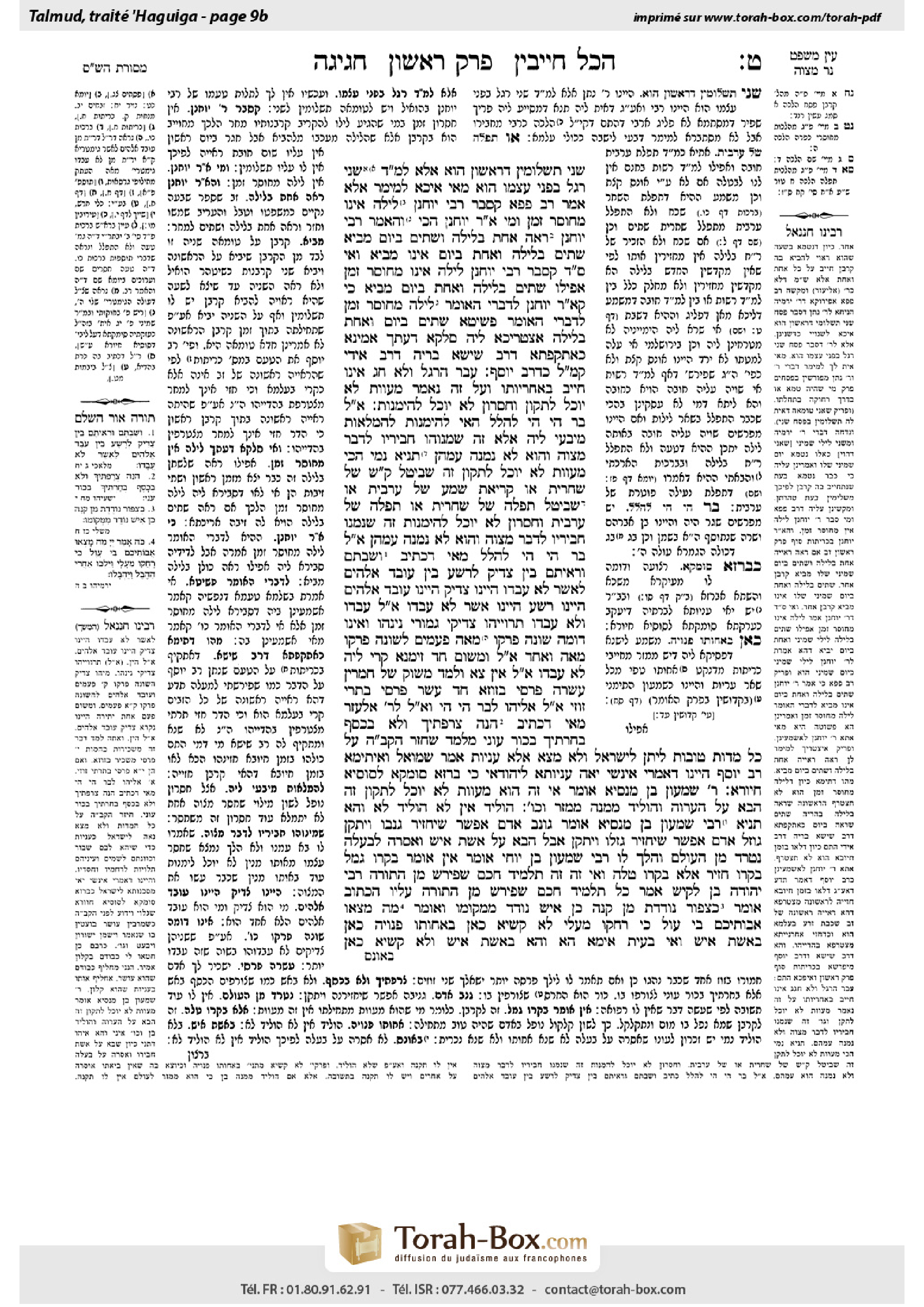
Chagigah 9b: Talmud study for Daf Yomi
Study the Talmud for Daf Yomi with scanned pages, Hebrew text, English translations from Sefaria and AI-generated French translations.
Passage selection and English or AI-generated French translation are available where the scan has annotations. Daf Study is independent of Torah-Box and Sefaria.
Browse Chagigah · חגיגה · All tractatesChagigah 9b text and translations
This page of Chagigah includes the Aramaic text, an English translation and an AI-generated French translation, alongside the scan above.
חגיגה ט׳ ב · Aramaic and Hebrew text
שֵׁנִי — תַּשְׁלוּמִין דְּרִאשׁוֹן הוּא. אֶלָּא לְמַאן דְּאָמַר שֵׁנִי רֶגֶל בִּפְנֵי עַצְמוֹ הוּא, מַאי אִיכָּא לְמֵימַר?
אֶלָּא אָמַר רַב פָּפָּא: קָסָבַר רַבִּי יוֹחָנָן לַיְלָה אֵינוֹ מְחוּסַּר זְמַן. וּמִי אָמַר רַבִּי יוֹחָנָן הָכִי?
וְהָאָמַר רַבִּי יוֹחָנָן: רָאָה אַחַת בַּלַּיְלָה וּשְׁתַּיִם בַּיּוֹם — מֵבִיא.
שְׁתַּיִם בַּלַּיְלָה וְאַחַת בַּיּוֹם — אֵינוֹ מֵבִיא. וְאִי סָלְקָא דַעְתָּךְ קָסָבַר רַבִּי יוֹחָנָן לַיְלָה אֵינוֹ מְחוּסַּר זְמַן, אֲפִילּוּ שְׁתַּיִם בַּלַּיְלָה וְאַחַת בַּיּוֹם — מֵבִיא!
כִּי קָאָמַר רַבִּי יוֹחָנָן, לְדִבְרֵי הָאוֹמֵר לַיְלָה מְחוּסַּר זְמַן, לְדִבְרֵי הָאוֹמֵר — פְּשִׁיטָא! שְׁתַּיִם בַּיּוֹם וְאַחַת בַּלַּיְלָה אִצְטְרִיכָא לֵיהּ.
סָלְקָא דַּעְתָּךְ אָמֵינָא כְּאַתְקַפְתָּא דְּרַב שִׁישָׁא בְּרֵיהּ דְּרַב אִידִי, קָא מַשְׁמַע לַן כִּדְרַב יוֹסֵף.
עָבַר הָרֶגֶל וְלֹא חָג אֵינוֹ חַיָּיב בְּאַחְרָיוּתוֹ, וְעַל זֶה נֶאֱמַר: ״מְעֻוָּת לֹא יוּכַל לִתְקוֹן וְחֶסְרוֹן לֹא יוּכַל לְהִימָּנוֹת״.
אֲמַר לֵיהּ בַּר הֵי הֵי לְהִלֵּל: הַאי ״לְהִימָּנוֹת״, לְהִמָּלאוֹת מִיבְּעֵי לֵיהּ. אֶלָּא, זֶה (שֶׁמִּנּוּהוּ) [שֶׁנִּמְנוּ] חֲבֵירָיו לִדְבַר מִצְוָה, וְהוּא לֹא נִמְנָה עִמָּהֶן.
תַּנְיָא נָמֵי הָכִי: ״מְעֻוָּת לֹא יוּכַל לִתְקוֹן״ — זֶה שֶׁבִּיטֵּל קְרִיאַת שְׁמַע שֶׁל שַׁחֲרִית, אוֹ קְרִיאַת שְׁמַע שֶׁל עַרְבִית, אוֹ שֶׁבִּיטֵּל תְּפִלָּה שֶׁל שַׁחֲרִית אוֹ תְּפִלָּה שֶׁל עַרְבִית. ״וְחֶסְרוֹן לֹא יוּכַל לְהִימָּנוֹת״ — זֶה שֶׁנִּמְנוּ חֲבֵירָיו לִדְבַר מִצְוָה וְהוּא לֹא נִמְנָה עִמָּהֶן.
אֲמַר לֵיהּ בַּר הֵי הֵי לְהִלֵּל, מַאי דִּכְתִיב: ״וְשַׁבְתֶּם וּרְאִיתֶם בֵּין צַדִּיק לְרָשָׁע בֵּין עוֹבֵד אֱלֹהִים לַאֲשֶׁר לֹא עֲבָדוֹ״, הַיְינוּ ״צַדִּיק״ — הַיְינוּ ״עוֹבֵד אֱלֹהִים״, הַיְינוּ ״רָשָׁע״ — הַיְינוּ ״אֲשֶׁר לֹא עֲבָדוֹ״! אֲמַר לֵיהּ: ״עֲבָדוֹ״ וְ״לֹא עֲבָדוֹ״ — תַּרְוַיְיהוּ צַדִּיקֵי גְּמוּרֵי נִינְהוּ, וְאֵינוֹ דּוֹמֶה שׁוֹנֶה פִּרְקוֹ מֵאָה פְּעָמִים, לְשׁוֹנֶה פִּרְקוֹ מֵאָה וְאֶחָד.
אֲמַר לֵיהּ: וּמִשּׁוּם חַד זִימְנָא קָרֵי לֵיהּ ״לֹא עֲבָדוֹ״? אֲמַר לֵיהּ: אִין, צֵא וּלְמַד מִשּׁוּק שֶׁל חֲמָרִין: עַשְׂרָה פַּרְסֵי — בְּזוּזָא, חַד עֲשַׂר פַּרְסֵי — בִּתְרֵי זוּזֵי.
אֲמַר לֵיהּ אֵלִיָּהוּ לְבַר הֵי הֵי, וְאָמְרִי לַהּ לְרַבִּי אֶלְעָזָר: מַאי דִּכְתִיב: ״הִנֵּה צְרַפְתִּיךָ וְלֹא בְכָסֶף בְּחַרְתִּיךָ בְּכוּר עוֹנִי״ — מְלַמֵּד שֶׁחָזַר הַקָּדוֹשׁ בָּרוּךְ הוּא עַל כׇּל מִדּוֹת טוֹבוֹת לִיתֵּן לְיִשְׂרָאֵל, וְלֹא מָצָא אֶלָּא עֲנִיּוּת. אָמַר שְׁמוּאֵל וְאִיתֵּימָא רַב יוֹסֵף, הַיְינוּ דְּאָמְרִי אִינָשֵׁי: יָאָה עַנְיוּתָא לִיהוּדָאֵי כִּי בַּרְזָא סוּמָּקָא לְסוּסְיָא חִיוָּרָא.
רַבִּי שִׁמְעוֹן בֶּן מְנַסְיָא אוֹמֵר: אֵי זֶה הוּא ״מְעֻוָּת לֹא יוּכַל לִתְקוֹן״ — זֶה הַבָּא עַל הָעֶרְוָה וְהוֹלִיד מִמֶּנָּה מַמְזֵר וְכוּ׳. הוֹלִיד — אִין, לֹא הוֹלִיד — לָא?
וְהָא תַּנְיָא, רַבִּי שִׁמְעוֹן בֶּן מְנַסְיָא אוֹמֵר: גּוֹנֵב אָדָם — אֶפְשָׁר שֶׁיַּחֲזִיר גְּנֵבוֹ וִיתַקֵּן, גּוֹזֵל אָדָם — אֶפְשָׁר שֶׁיַּחֲזִיר גְּזֵלוֹ וִיתַקֵּן, אֲבָל הַבָּא עַל אֵשֶׁת אִישׁ וַאֲסָרָהּ לְבַעְלָהּ — נִטְרַד מִן הָעוֹלָם וְהָלַךְ לוֹ.
רַבִּי שִׁמְעוֹן בֶּן יוֹחַי אוֹמֵר: אֵין אוֹמֵר ״בַּקְּרוּ גָּמָל״ ״בַּקְּרוּ חֲזִיר״, אֶלָּא ״בַּקְּרוּ טָלֶה״. וְאֵי זֶה — זֶה תַּלְמִיד חָכָם שֶׁפֵּירַשׁ מִן הַתּוֹרָה.
רַבִּי יְהוּדָה בֶּן לָקִישׁ אָמַר: כׇּל תַּלְמִיד חָכָם שֶׁפֵּירַשׁ מִן הַתּוֹרָה, עָלָיו הַכָּתוּב אוֹמֵר: ״כְּצִפּוֹר נוֹדֶדֶת מִן קִנָּהּ כֵּן אִישׁ נוֹדֵד מִמְּקוֹמוֹ״, וְאוֹמֵר: ״מַה מָּצְאוּ אֲבוֹתֵיכֶם בִּי עָוֶל כִּי רָחֲקוּ מֵעָלָי״!
לָא קַשְׁיָא: כָּאן בַּאֲחוֹתוֹ פְּנוּיָה, כָּאן בְּאֵשֶׁת אִישׁ. וְאִי בָּעֵית אֵימָא: הָא וְהָא בְּאֵשֶׁת אִישׁ, וְלָא קַשְׁיָא: כָּאן
Chagigah 9b · English translation
is redress for the first Paschal offering. According to this opinion, it is clear that ritual impurity does not nullify one’s obligation. However, according to the one who said that the second Pesaḥ is a separate pilgrimage Festival, established for those who were unable to sacrifice the Paschal offering at the proper time, what is there to say? In that case, Rav Yirmeya’s answer does not apply, and therefore it remains unclear that Rabbi Yoḥanan holds that one who is not obligated in the Festival offerings on the first day is exempt during the remaining days.
Rather, Rav Pappa said: Rabbi Yoḥanan holds that night is not considered part of a date whose time has not yet arrived. Although one may not sacrifice offerings at night, the date itself has arrived and his period of impurity is complete, which is why any further impurity requires a second set of offerings. Consequently, Rabbi Yoḥanan’s opinion with regard to a lame person does not contradict his ruling concerning a nazirite. The Gemara asks: And did Rabbi Yoḥanan actually say this, that night is not considered part of a date whose time has not yet arrived?
But didn’t Rabbi Yoḥanan say: A zav at the end of his seven-day purification process who saw that he experienced one emission at night and then two in the day brings additional offerings for the second impurity? Had he experienced the emissions before he became ritually pure, he would have been required to bring only one set of offerings. However, once his purification is complete he must bring a separate set. In this case, the first emission occurred before he was able to sacrifice the offerings for his initial period of impurity. Nevertheless, as the two subsequent sightings occurred during the day, and they alone would suffice to confer upon him the status of a zav, they combine with the one from the previous night and he is required to bring new offerings.
However, if he saw two emissions at night and one in the day, he does not bring additional offerings, because at night he could not yet sacrifice the offerings owed due to his current status, and without those two new sightings he would not become a zav again. And if it enters your mind that Rabbi Yoḥanan holds that night is not considered a date whose time has not yet arrived, then even in the case where he saw two emissions at night and one in the day he should have to bring another set of offerings. He already reached the date of sacrificing the previous offerings before these new emissions occurred. This indicates that Rabbi Yoḥanan holds that night is considered part of a date whose time has not yet arrived.
The Gemara answers: When Rabbi Yoḥanan said this statement, he spoke according to the one who says that night is considered part of a date whose time has not yet arrived. However, he himself maintains that even if a zav saw all three emissions at night he must bring another offering. The Gemara asks: If he spoke only according to the one who says that opinion, it is obvious that no new offerings are required; what novel idea did Rabbi Yoḥanan intend to express? The Gemara answers: Nevertheless, it was necessary for him to teach the case of a zav who saw two in the day and one at night.
The Gemara elaborates: It was necessary for Rabbi Yoḥanan to say this, lest it enter your mind to say in the manner of the strong objection of Rav Sheisha, son of Rav Idi (see Keritot 8a), who holds that there is no reason to distinguish between a zav seeing one or two emissions at night. Therefore, Rabbi Yoḥanan teaches us that the halakha is in accordance with the opinion of Rav Yosef, that the first sighting confers merely the status of ritual impurity of one who has a seminal emission, and he is not yet classified as a zav. Consequently, there is a difference between one who experienced one emission at night and one who experienced two.
§ The mishna taught that if the pilgrimage Festival passed and one did not celebrate it by sacrificing a Festival peace-offering, he is not obligated to pay restitution for it. And about this it is stated: “That which is crooked cannot be made straight; and that which is wanting cannot be numbered” (Ecclesiastes 1:15).
The Sage bar Hei Hei said to Hillel that if this is the correct interpretation of the verse, this term: “Be numbered [lehimanot]” is apparently inappropriate. It should have said: Be filled. Rather, this verse is referring to one whose friends reached a consensus [manuhu] with regard to a matter of a mitzva and he was not part of their consensus, and therefore he missed his opportunity to join them in the performance of the mitzva.
This explanation is also taught in a baraita. The meaning of the verse “That which is crooked cannot be made straight; and that which is wanting cannot be numbered” is as follows: “That which is crooked cannot be made straight” is referring to one who omitted the recitation of the morning Shema or the recitation of the evening Shema, or who omitted the morning prayer or the evening prayer. “And that which is wanting cannot be numbered” is referring to one whose friends reached a consensus with regard to a matter of a mitzva and he was not part of their consensus.
The Gemara records another discussion between bar Hei Hei and Hillel. Bar Hei Hei said to Hillel: What is the meaning of that which is written: “Then you shall again discern between the righteous and the wicked, between he who serves God and he who does not serve Him” (Malachi 3:18). There are two redundancies here: “The righteous” is the same as “he who serves God,” and “the wicked” is the same as “he who does not serve Him.” Hillel said to him: The one “who serves Him” and the one “who does not serve Him” are both referring to completely righteous people. But the verse is hinting at a distinction between them, as one who reviews his studies one hundred times is not comparable to one who reviews his studies one hundred and one times.
Bar Hei Hei said to him: And due to one extra time that he did not review, the verse calls him a person “who does not serve Him”? He said to him: Yes. Go and learn from the market of donkey drivers. One can hire a driver to travel up to ten parasangs for one dinar. However, he will travel eleven parasangs only for two dinars. This shows that any departure beyond the norm is considered a significant difference.
The Gemara relates that Elijah the Prophet said to bar Hei Hei, and some say that he said this to Rabbi Elazar: What is the meaning of that which is written: “Behold, I have refined you, but not as silver; I have tried you in the furnace of affliction [oni]” (Isaiah 48:10)? This teaches that the Holy One, Blessed be He, sought after all good character traits to impart them to the Jewish people, and He found only poverty [aniyut] capable of preventing them from sin. Shmuel said, and some say it was Rav Yosef: This explains the folk saying that people say: Poverty is good for the Jewish people like a red bridle [barza] for a white horse. Just as a red bridle accentuates the white color of the horse, so the challenge of poverty draws out the purity of the Jewish people.
§ The mishna taught that Rabbi Shimon ben Menasya says: Who is the crooked that cannot be made straight? This verse is referring to one who engaged in intercourse with a woman forbidden to him and fathered a mamzer with her. The Gemara infers from the mishna: If he fathers a child, yes, this verse applies, as he cannot remedy the situation; if he does not father a child, no, the verse does not apply, as he can make amends.
The Gemara asks: Isn’t it taught in a baraita that Rabbi Shimon ben Menasya says: If a person steals it is possible that he might return his stolen property and be made straight; if a person robs from another it is possible that he might return his robbed property and be made straight. However, one who has sexual relations with a married woman with her consent and thereby renders her forbidden to her husband is banished from the world and passes away. There is no way for him to rectify the situation and achieve atonement, because a married woman who willingly has sexual relations with another man is permanently forbidden to her husband.
Rabbi Shimon ben Yoḥai says: Someone who wants to examine an animal for blemishes to bring it as an offering does not say: Inspect the camel, or: Inspect the pig, as these are inherently disqualified for the altar. Rather, he says: Inspect the lamb. Similarly, the term: “Crooked,” applies only to one who was previously straight. And who is this? This is a Torah scholar who leaves his Torah study.
Rabbi Yehuda ben Lakish said: Any Torah scholar who leaves the Torah, about him the verse says: “As a bird that wanders from her nest, so is a man who wanders from his place” (Proverbs 27:8). And it says: “What unrighteousness have your fathers found in Me, that they are gone far from Me?” (Jeremiah 2:5). This indicates that the punishment is greater for one who was close to God and became distant from Him. In any case, there is a contradiction here, as in the mishna Rabbi Shimon ben Menasya says that the act of one who fathers an illegitimate child is crooked and cannot be straightened, whereas in the baraita he says the same applies to anyone who has forbidden sexual relations, regardless of whether or not he fathers a child.
The Gemara answers: This is not difficult. Here, the mishna is dealing with a case where he had forbidden sexual relations with his unmarried sister. Although the intercourse itself is a severe sin, if he does not sire a child it can be rectified through repentance. There, in the baraita, it is referring to a case where he sinned with a married woman, causing irreparable damage to her marriage. And if you wish, say instead: This and that are both referring to a married woman. And it is not difficult. Here, the mishna is dealing
Chagigah 9b · Traduction française (IA)
C'est une réparation pour le premier sacrifice pascal. Selon cet avis, il est clair que l'impureté rituelle n'annule pas l'obligation. Cependant, selon celui qui affirme que le second Pessa'h est un festival de pèlerinage distinct, établi pour ceux qui n'ont pas pu sacrifier le sacrifice pascal à l'heure appropriée, que dire alors ? Dans ce cas, la réponse de Rav Yirmeya ne s'applique pas, et donc il reste incertain que Rabbi Yoḥanan considère que celui qui n'est pas tenu de sacrifier les offrandes du festival le premier jour est exempt pendant les jours restants.
Au contraire, Rav Pappa a dit : Rabbi Yoḥanan considère que la nuit n'est pas considérée comme faisant partie d'une date dont l'heure n'est pas encore arrivée. Bien qu'on ne puisse pas sacrifier d'offrandes la nuit, la date elle-même est arrivée et sa période d'impureté est terminée, ce qui explique pourquoi toute impureté ultérieure exige un second ensemble d'offrandes. Ainsi, l'avis de Rabbi Yoḥanan concernant une personne boiteuse ne contredit pas son jugement concernant un nazir. La Guemara demande : Et Rabbi Yoḥanan a-t-il vraiment dit cela, que la nuit n'est pas considérée comme faisant partie d'une date dont l'heure n'est pas encore arrivée ?
Mais n'a-t-il pas dit Rabbi Yoḥanan : Un zav à la fin de son processus de purification de sept jours, qui a constaté qu'il avait eu une émission la nuit et deux le jour, apporte des offrandes supplémentaires pour la deuxième impureté ? S'il avait eu ces émissions avant qu'il ne devienne rituellement pur, il aurait été tenu de présenter seulement un ensemble d'offrandes. Cependant, une fois sa purification terminée, il doit présenter un ensemble séparé. Dans ce cas, la première émission s'est produite avant qu'il ne puisse sacrifier les offrandes pour sa première période d'impureté. Cependant, comme les deux observations suivantes se sont produites le jour, et qu'elles suffiraient seules à lui conférer le statut de zav, elles s'ajoutent à celle de la nuit précédente et il est tenu de présenter des offrandes nouvelles.
Cependant, s'il a vu deux émissions la nuit et une le jour, il ne présente pas d'offrandes supplémentaires, car la nuit il ne pouvait pas encore présenter les offrandes dues à son statut actuel, et sans ces deux nouvelles observations, il ne deviendrait pas à nouveau un zav. Et si vous pensez que Rabbi Yoḥanan considère que la nuit fait partie d'une date dont l'heure n'est pas encore arrivée, alors même dans le cas où il a vu deux émissions la nuit et une le jour, il devrait être tenu de présenter un autre ensemble d'offrandes. Il a déjà atteint l'heure de sacrifier les offrandes précédentes avant ces nouvelles émissions. Cela indique que Rabbi Yoḥanan considère que la nuit fait partie d'une date dont l'heure n'est pas encore arrivée.
La Guemara répond : Lorsque Rabbi Yoḥanan a dit cette déclaration, il parlait selon celui qui affirme que la nuit fait partie d'une date dont l'heure n'est pas encore arrivée. Cependant, il maintient lui-même que même si un zav a vu toutes les trois émissions la nuit, il doit présenter une autre offrande. La Guemara demande : Si il a parlé uniquement selon celui qui affirme cet avis, il est évident que des offrandes supplémentaires ne sont pas nécessaires ; qu'idea nouvelle Rabbi Yoḥanan voulait-il exprimer ? La Guemara répond : Néanmoins, il était nécessaire qu'il enseigne le cas d'un zav qui a vu deux émissions le jour et une la nuit.
La Guemara développe : Il était nécessaire que Rabbi Yoḥanan dise cela, afin que cela ne rentre pas dans votre esprit de dire selon l'objection forte de Rav Sheisha, fils de Rav Idi (voir Keritot 8a), qui considère qu'il n'y a pas de raison de distinguer entre un zav qui voit une ou deux émissions la nuit. Ainsi, Rabbi Yoḥanan nous enseigne que la halakha suit l'avis de Rav Yosef, selon lequel la première observation confère seulement le statut d'impureté rituelle d'une personne ayant eu une émission sémencière, et il n'est pas encore classé comme un zav. Ainsi, il y a une différence entre celui qui a eu une émission la nuit et celui qui a eu deux.
§ La mitsva enseigne que si le festival de pèlerinage est passé et qu'on n'a pas célébré en sacrifiant une offrande de paix du festival, on n'est pas tenu de payer une réparation pour cela. Et sur cela il est dit : « Ce qui est courbé ne peut être redressé ; et ce qui est manquant ne peut être compté » (Ecclésiaste 1:15).
Le Sage bar Hei Hei a dit à Hillel : Si cette interprétation de la parole est correcte, ce terme : « Soit compté [lehimanot] » semble inadapté. Il aurait dû dire : Soit rempli. Plutôt, cette parole fait référence à celui dont les amis ont atteint un consensus [manuhu] concernant une affaire de mitsva et qui n'était pas partie de leur consensus, et donc il a manqué l'occasion de les rejoindre dans la performance de la mitsva.
Cette explication est également enseignée dans une baraïta. Le sens de la parole « Ce qui est courbé ne peut être redressé ; et ce qui est manquant ne peut être compté » est le suivant : « Ce qui est courbé ne peut être redressé » fait référence à celui qui a omis la récitation du Chéma du matin ou de la récitation du Chéma du soir, ou qui a omis la prière du matin ou de la prière du soir. « Et ce qui est manquant ne peut être compté » fait référence à celui dont les amis ont atteint un consensus concernant une affaire de mitsva et qui n'était pas partie de leur consensus.
La Guemara enregistre une autre discussion entre bar Hei Hei et Hillel. Bar Hei Hei a dit à Hillel : Quel est le sens de ce qui est écrit : « Alors vous discernerez à nouveau entre le juste et l'injuste, entre celui qui sert Dieu et celui qui ne le sert pas » (Malachie 3:18). Il y a deux redondances ici : « Le juste » est le même que « celui qui sert Dieu », et « l'injuste » est le même que « celui qui ne sert pas Dieu ». Hillel a dit à lui : « Celui qui sert Dieu » et « celui qui ne sert pas Dieu » font référence tous deux à des personnes parfaitement justes. Mais la parole fait allusion à une distinction entre eux, car celui qui révise ses études cent fois n'est pas comparable à celui qui révise ses études cent une fois.
Bar Hei Hei dit à lui : Et à cause d'une seule fois supplémentaire qu'il n'a pas révisé, la versette l'appelle un homme « qui ne sert pas Lui » ? Il lui dit : Oui. Allez apprendre au marché des conducteurs de mules. On peut embaucher un conducteur pour voyager jusqu'à dix parasangs pour un dinar. Cependant, il voyage onze parasangs seulement pour deux dinars. Cela montre que toute déviation au-delà de la norme est considérée comme une différence significative.
La Guemara rapporte que le Prophète Elie dit à Bar Hei Hei, et certains disent qu'il a dit cela à Rabbi Elazar : Quelle est la signification de ce qui est écrit : « Regarde, j'ai purifié toi, mais non comme l'argent ; j'ai éprouvé toi dans le fourneau de l'affliction [oni] » (Yachout 48:10) ? Cela enseigne que l'Éternel, béni soit Son Nom, a cherché toutes les bonnes qualités de caractère pour les transmettre au peuple juif, et Il a trouvé seulement la pauvreté [aniyut] capable de les empêcher de pécher. Shmuel dit, et certains disent que c'était Rav Yosef : Cela explique la devise populaire qui dit : La pauvreté est bonne pour le peuple juif comme un licou rouge pour un cheval blanc. Tout comme un licou rouge met en évidence la couleur blanche du cheval, ainsi la difficulté de la pauvreté met en évidence la pureté du peuple juif.
§ La Michna enseignait que Rabbi Shimon ben Menasya dit : Qui est le déviant qui ne peut pas être corrigé ? Cette versette fait référence à celui qui a eu des relations sexuelles avec une femme interdite à lui et a engendré un mamzer avec elle. La Guemara déduit de la Michna : Si il engendre un enfant, oui, cette versette s'applique, car il ne peut pas remédier à la situation ; si il ne génère pas d'enfant, non, la versette ne s'applique pas, car il peut faire amende.
La Guemara pose la question : N'est-ce pas enseigné dans une baraïta que Rabbi Shimon ben Menasya dit : Si un homme vole, il est possible qu'il puisse rendre son bien volé et être rétabli ; si un homme vole à un autre, il est possible qu'il puisse rendre son bien volé et être rétabli. Cependant, celui qui a des relations sexuelles avec une femme mariée avec son consentement et rend ainsi cette femme interdite à son mari est expulsé du monde et meurt. Il n'y a aucun moyen de rectifier la situation et d'atteindre l'atonement, car une femme mariée qui a des relations sexuelles volontairement avec un autre homme est définitivement interdite à son mari.
Rabbi Shimon ben Yoḥai dit : Quelqu'un qui veut examiner un animal pour des défauts afin de l'apporter en offrande ne dit pas : Examine le chameau, ou : Examine le porc, car ces animaux sont intrinsèquement disqualifiés pour l'autel. Plutôt, il dit : Examine l'agneau. De même, le terme : « Déviant », s'applique uniquement à celui qui était auparavant droit. Et qui est-ce ? C'est un savant de la Torah qui quitte ses études de Torah.
Rabbi Yehuda ben Lakish dit : Tout savant de la Torah qui quitte la Torah, à son sujet la versette dit : « Comme un oiseau qui s'éloigne de son nid, ainsi est un homme qui s'éloigne de son lieu » (Proverbes 27:8). Et il dit : « Quel mal faites-vous à Moi, vos pères, que vous êtes loin de Moi ? » (Jérémie 2:5). Cela indique que la punition est plus grande pour celui qui était proche de Dieu et est devenu éloigné de Lui. En tout cas, il y a une contradiction ici, car dans la Michna Rabbi Shimon ben Menasya dit que l'acte de celui qui engendre un enfant illégitime est déviant et ne peut être corrigé, tandis que dans la baraïta il dit que cela s'applique également à toute personne qui a des relations sexuelles interdites, indépendamment du fait qu'il engendre un enfant ou non.
La Guemara répond : Cela n'est pas difficile. Ici, la Michna traite d'un cas où il a eu des relations sexuelles avec sa sœur non mariée. Bien que l'acte lui-même soit un grand péché, s'il ne génère pas d'enfant, il peut être corrigé par la repentance. Là, dans la baraïta, il s'agit d'un cas où il a péché avec une femme mariée, causant un dommage irréparable à son mariage. Et si vous le souhaitez, dites plutôt : Cela et cela s'appliquent tous deux à une femme mariée. Et cela n'est pas difficile. Ici, la Michna traite
Traduction française générée par IA à partir de l’édition anglaise de Sefaria. Vérifie toujours un passage avec le texte source.
Text from Sefaria: William Davidson Edition - Vocalized Aramaic (CC BY NC); William Davidson Edition - English (CC BY NC).