Chagigah 11a: Talmud study for Daf Yomi
Study the Talmud for Daf Yomi with scanned pages, Hebrew text, English translations from Sefaria and AI-generated French translations.
Passage selection and English or AI-generated French translation are available where the scan has annotations. Daf Study is independent of Torah-Box and Sefaria.
Browse Chagigah · חגיגה · All tractatesChagigah 11a text and translations
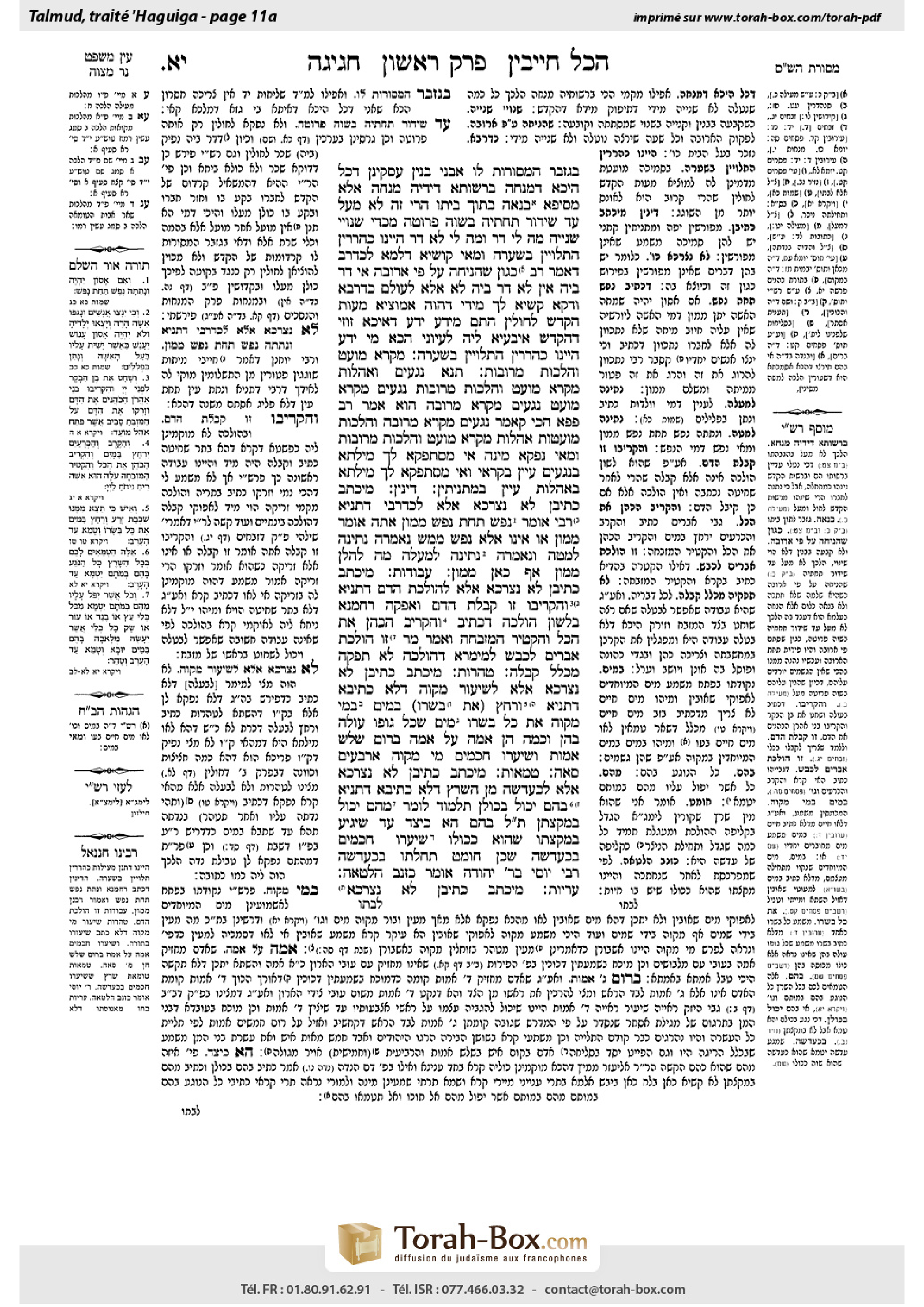
This page of Chagigah includes the Aramaic text, an English translation and an AI-generated French translation, alongside the scan above.
חגיגה י״א א · Aramaic and Hebrew text
בְּגִזְבָּר הַמְּסוּרוֹת לוֹ אַבְנֵי בִנְיָן עָסְקִינַן, דְּכׇל הֵיכָא דְּמַנְּחָה — בִּרְשׁוּתָא דִּידֵיהּ מַנְּחָה.
אֶלָּא מִסֵּיפָא: בְּנָאָהּ בְּתוֹךְ בֵּיתוֹ — הֲרֵי זֶה לֹא מָעַל עַד שֶׁיָּדוּר תַּחְתֶּיהָ בְּשָׁוֶה פְּרוּטָה. מִכְּדֵי שַׁנּוֹיֵי שַׁנְּיַיהּ, מָה לִי דָּר וּמָה לִי לָא דָּר, הַיְינוּ כַּהֲרָרִין הַתְּלוּיִין בִּשְׂעָרָה?
וּמַאי קוּשְׁיָא? דִּלְמָא לְכִדְרַב. דְּאָמַר רַב: כְּגוֹן שֶׁהִנִּיחָהּ עַל פִּי אֲרוּבָּה. אִי דָּר בֵּיהּ — אִין, לָא דָּר בֵּיהּ — לָא.
אֶלָּא לְעוֹלָם כִּדְרָבָא. וּדְקָא קַשְׁיָא לָךְ: מִידֵּי דְּהָוֵה אַמּוֹצִיא מְעוֹת הֶקְדֵּשׁ לְחוּלִּין, הָתָם מִידָּע יָדַע דְּאִיכָּא זוּזֵי דְהֶקְדֵּשׁ, אִיבַּעְיָא לֵיהּ לְעַיּוֹנֵי. הָכָא מִי יָדַע! הַיְינוּ כַּהֲרָרִין הַתְּלוּיִין בִּשְׂעָרָה.
מִקְרָא מוּעָט וַהֲלָכוֹת מְרוּבּוֹת. תָּנָא: נְגָעִים וְאֹהָלוֹת, מִקְרָא מוּעָט וַהֲלָכוֹת מְרוּבּוֹת. נְגָעִים מִקְרָא מוּעָט? נְגָעִים מִקְרָא מְרוּבֶּה הוּא! אָמַר רַב פָּפָּא, הָכִי קָאָמַר: נְגָעִים — מִקְרָא מְרוּבֶּה וַהֲלָכוֹת מוּעָטוֹת, אֹהָלוֹת — מִקְרָא מוּעָט וַהֲלָכוֹת מְרוּבּוֹת.
וּמַאי נָפְקָא מִינַּהּ? אִי מִסְתַּפְּקָא לָךְ מִילְּתָא בִּנְגָעִים — עַיֵּין בִּקְרָאֵי, וְאִי מִסְתַּפְּקָא לָךְ מִילְּתָא בְּאֹהָלוֹת — עַיֵּין בְּמַתְנִיתִין.
דִּינִין. מִיכְתָּב כְּתִיבָן! לֹא נִצְרְכָה אֶלָּא לְכִדְרַבִּי.
דְּתַנְיָא, רַבִּי אוֹמֵר: ״נֶפֶשׁ תַּחַת נָפֶשׁ״ — מָמוֹן. אַתָּה אוֹמֵר מָמוֹן, אוֹ אֵינוֹ אֶלָּא נֶפֶשׁ מַמָּשׁ? נֶאֶמְרָה נְתִינָה לְמַטָּה. וְנֶאֶמְרָה נְתִינָה לְמַעְלָה. מָה לְהַלָּן — מָמוֹן, אַף כָּאן — מָמוֹן.
עֲבוֹדוֹת. מִיכְתָּב כְּתִיבָן! לֹא נִצְרְכָה אֶלָּא לְהוֹלָכַת הַדָּם. דְּתַנְיָא: ״וְהִקְרִיבוּ״, זוֹ קַבָּלַת הַדָּם.
וְאַפְּקַהּ רַחֲמָנָא בִּלְשׁוֹן הוֹלָכָה, דִּכְתִיב: ״וְהִקְרִיב הַכֹּהֵן אֶת הַכֹּל וְהִקְטִיר הַמִּזְבֵּחָה״, וְאָמַר מָר: זוֹ הוֹלָכַת אֵבָרִים לַכֶּבֶשׁ.
לְמֵימְרָא דְּהוֹלָכָה לָא תַּפְּקַהּ מִכְּלַל קַבָּלָה.
טְהָרוֹת. מִיכְתָּב כְּתִיבָן! לֹא נִצְרְכָה אֶלָּא לְשִׁיעוּר מִקְוֶה דְּלָא כְּתִיבָא, דְּתַנְיָא: ״וְרָחַץ אֶת בְּשָׂרוֹ בְּמַיִם״ — בְּמֵי מִקְוֶה. ״אֶת כׇּל בְּשָׂרוֹ״ — מַיִם שֶׁכׇּל גּוּפוֹ עוֹלֶה בָּהֶן, וְכַמָּה הֵן — אַמָּה עַל אַמָּה בְּרוּם שָׁלֹשׁ אַמּוֹת. וְשִׁיעֲרוּ חֲכָמִים מֵי מִקְוֶה אַרְבָּעִים סְאָה.
טְמָאוֹת. מִיכְתָּב כְּתִיבָן! לֹא נִצְרְכָא אֶלָּא לְכַעֲדָשָׁה מִן הַשֶּׁרֶץ, דְּלָא כְּתִיבָא. דְּתַנְיָא: ״בָּהֶם״ —
יָכוֹל בְּכוּלָּן, תַּלְמוּד לוֹמַר: ״מֵהֶם״. יָכוֹל בְּמִקְצָתָן — תַּלְמוּד לוֹמַר: ״בָּהֶם״.
הָא כֵּיצַד? עַד שֶׁיַּגִּיעַ בְּמִקְצָתוֹ שֶׁהוּא כְּכוּלּוֹ. שִׁיעֲרוּ חֲכָמִים בְּכַעֲדָשָׁה, שֶׁכֵּן חוֹמֶט — תְּחִלָּתוֹ בְּכַעֲדָשָׁה. רַבִּי יוֹסֵי בְּרַבִּי יְהוּדָה אוֹמֵר: כִּזְנַב הַלְּטָאָה.
עֲרָיוֹת. מִיכְתָּב כְּתִיבָן! לֹא נִצְרְכָה
Chagigah 11a · English translation
Rather, we are dealing with the treasurer of the Temple, to whom the consecrated building stones were transferred for safekeeping. The reason for the exemption is that anywhere that the stone is resting, it is considered to be resting within his domain. Consequently, he is not liable for picking up the stone or beam, as he is permitted to carry it. However, he does not have permission to give it to someone else, and therefore when he hands it over to someone else he has misused consecrated property. If so, this halakha is also perfectly logical and should not be considered like mountains suspended by a hair.
Rather, the comparison of these halakhot to mountains suspended by a hair is based on the latter clause of that same mishna: If he built the stone into his house, he has not misused consecrated property until he dwells under it an amount of time that is worth a peruta. Since he has changed the stone by incorporating it into his house, what difference is there to me if he dwelt there, and what difference is there to me if he did not dwell there? Apparently, this is the halakha considered like mountains suspended by a hair.
The Gemara rejects this claim. And what is the logical difficulty with this halakha? Perhaps it is stated in accordance with the opinion of Rav. As Rav said: This mishna is referring to a case where he placed the stone over a window, but he did not make any adjustment to the stone itself. If he dwelt in the house, yes, he has misused consecrated property, as he derived benefit from it. If he did not dwell in it, no, he has not misused consecrated property, as he gained no benefit from the stone.
Rather, the reason is actually in accordance with the aforementioned opinion of Rava, who holds that the innovative element of this halakha involves a case where the homeowner remembered, which caused the agent to misuse consecrated property. And with regard to that which posed a difficulty for you, i.e., that the halakha here should be just as it is with regard to one who spends consecrated money for non-sacred purposes, the two cases are not identical. There, in the case that Rava mentioned, the agent knew that he also had consecrated coins and therefore he should have examined carefully whether this money was consecrated. Here, did the agent know that there was a possibility that the money was consecrated? This is why this halakha is like mountains suspended by a hair.
§ The mishna explained that those matters that are like mountains suspended by a hair have little written about them in the Torah, and yet the details of their halakhot are numerous. A Sage taught in the Tosefta: The halakhot of leprosy and the halakhot of ritual impurity imparted by tents in which a corpse lies have little in the Torah and their halakhot are numerous. The Gemara asks: With regard to leprosy, is there little about their halakhot in the Torah? Leprosy is something about which there are numerous details stated in the Torah (see Leviticus, chapters 13–14). Rav Pappa said that this is what the mishna is saying: Leprosy has numerous details in the Torah but relatively few halakhot. In contrast, the case of ritual impurity imparted by tents has little in the Torah but numerous halakhot.
The Gemara asks: And what is the practical difference whether there are numerous or few references to a particular halakha in the Torah? The Gemara answers: If you are uncertain about a matter with regard to the halakhot of leprosy, delve into the verses, as it is treated extensively there. And if you are uncertain about a matter with regard to the halakhot of the ritual impurity imparted by tents, delve into the Mishna, as these halakhot are not sufficiently explicated in the Torah.
§ The mishna taught that monetary law is one of those matters that have something to support them in the Torah. The Gemara asks: Monetary laws are written in the Torah; why does the mishna merely say it has something to support it? The Gemara answers: This is necessary only according to the opinion of Rabbi Yehuda HaNasi.
The Gemara elaborates. As it is taught in a baraita that Rabbi Yehuda HaNasi says: “But if any harm follow, then you shall give life for life” (Exodus 21:23). This verse is referring to a payment of money. Do you say money, or perhaps it is solely an actual life that is demanded? The term giving is stated below: “You shall give life for life,” and giving is stated above, in the previous verse: “And he shall give as the judges determine” (Exodus 21:22). Just as there, the giving is in the form of money, so too here, it is referring to a payment of money. Although this halakha is not explicit in the Torah, the verses lend support to it.
§ The mishna stated that the halakhot of sacrificial rites have something to support them. The Gemara asks: Sacrificial rites are written explicitly in the Torah. The Gemara answers: It is necessary to state that sacrificial rites have merely something to support them only with regard to the rite of carrying the blood to the altar. As it is taught in a baraita: “And Aaron’s sons, the priests, shall offer the blood” (Leviticus 1:5); this is referring to collecting the blood, which is the stage before carrying the blood to the altar.
And the Merciful One expressed collecting the blood in the language of carrying, i.e., by means of the term offer. As it is written: “And the priest shall offer the whole, and make it smoke upon the altar” (Leviticus 1:13). And the Master said that this term, “offer,” is not referring to sacrificing on the altar, as that is expressed by the phrase: “Make it smoke upon the altar.” Rather, this is referring to carrying the limbs to the ramp next to the altar, from where it is placed on the altar itself.
Evidently, the Torah is referring to collecting the blood with the same terminology it used when referring to carrying. That is to say that carrying should not be excluded from the category of collecting. In other words, all the halakhot that pertain to collecting the blood of offerings, e.g., that it must be performed by a priest with his right hand, apply equally to carrying the blood.
§ The mishna further taught that the halakhot of ritual purity have something to support them. The Gemara again asks: But ritual purity is written explicitly in the Torah. The Gemara answers: The observation that the halakhot of ritual purity merely have something to support them is necessary only for the minimum measure of a ritual bath, which is not written explicitly in the Torah. As it is taught in a baraita: “And he shall bathe his flesh in water” (Leviticus 14:9). This means in the water of a ritual bath. And it is stated: “And he shall wash all his flesh in water” (Leviticus 15:16), which indicates that it must contain water in which his whole body can enter. And how much water is this? One cubit by one cubit with a height of three cubits. And the Sages estimated that the measure for ritual bath water is forty se’a.
§ The mishna stated that the halakhot of ritual impurity also have something to support them. Once again the Gemara asks: Ritual impurity is written explicitly in the Torah. The Gemara answers: This is necessary only with regard to the size of a lentil-bulk from a creeping animal, which is not written. As it is taught in a baraita with regard to a verse that deals with creeping animals: “Whoever touches them when they are dead shall be impure” (Leviticus 11:31).
One might have thought that only someone who touches an entire, whole creeping animal becomes ritually impure. The verse states: “And upon whatever any of them falls, when they are dead, it shall be impure” (Leviticus 11:32). “Of them” indicates that this halakha applies even if one comes into contact with a part of them. One might have thought that even some of them suffices to impart impurity. The verse states: “Them,” i.e., all of them. This conclusion apparently contradicts the first ruling.
How can this apparent contradiction be resolved? One does not become impure until he touches some of it that is like the whole, i.e., a significant amount. And the Sages estimated this measure as the size of a lentil-bulk. The reason is that in its early stages, the ḥomet, the smallest of these creeping animals, is the size of a lentil-bulk. Rabbi Yosei, son of Rabbi Yehuda, says: The size of a lentil-bulk is that of a lizard’s tail, which is considered a part that is like the whole. The tail of a lizard can be cut off easily, and as it continues to twitch even after it has been cut off, it has the appearance of life. Consequently, it is fitting to label it as a part that is like the whole.
§ The mishna further taught that the halakhot of those with whom relations are forbidden have something to support them. The Gemara asks: The halakhot of those with whom relations are forbidden are written explicitly in the Torah. The Gemara answers: This is necessary only
Chagigah 11a · Traduction française (IA)
En réalité, nous parlons du trésorier du Temple, à qui les pierres consacrées ont été confiées pour conservation. La raison de l'exonération est que partout où la pierre est placée, on considère qu'elle est placée dans son domaine. Ainsi, il n'est pas tenu responsable de ramasser la pierre ou le poteau, car il est autorisé à les transporter. Cependant, il n'a pas le droit de les donner à quelqu'un d'autre, et donc, lorsqu'il les remet à quelqu'un d'autre, il abuser de propriété consacrée. Si c'est ainsi, cette halakha est également parfaitement logique et ne devrait pas être considérée comme des montagnes suspendues par un cheveu.
En réalité, la comparaison de ces halakhot aux montagnes suspendues par un cheveu s'appuie sur la dernière clause de cette même mitsna : Si il a intégré la pierre dans sa maison, il n'a pas abusé de propriété consacrée jusqu'à ce qu'il y demeure pendant un temps équivalent à un peruta. Puisqu'il a modifié la pierre en l'intégrant dans sa maison, quelle différence y a-t-il si il y demeure, et quelle différence y a-t-il si il n'y demeure pas ? Apparemment, c'est cette halakha qui est considérée comme des montagnes suspendues par un cheveu.
La Guemara rejette cette affirmation. Et quelle est la difficulté logique de cette halakha ? Peut-être est-elle émise selon l'opinion de Rav. Comme Rav a dit : cette mitsna parle d'un cas où la pierre a été placée sur une fenêtre, mais il n'a pas modifié la pierre elle-même. Si il a habité dans la maison, oui, il a abusé de propriété consacrée, car il a tiré un bénéfice d'elle. Si il n'a pas habité dans la maison, non, il n'a pas abusé de propriété consacrée, car il n'a pas tiré de bénéfice de la pierre.
En réalité, la raison correspond à l'opinion précédente de Rava, qui considère que l'innovation de cette halakha est un cas où le propriétaire s'est souvenu, ce qui a conduit l'agent à abuser de la propriété consacrée. Et concernant ce qui posait une difficulté pour vous, c'est-à-dire que cette halakha devrait être identique à celui qui dépense de l'argent consacré à des fins non sacrées, les deux cas ne sont pas identiques. Là, dans le cas mentionné par Rava, l'agent savait qu'il possédait des pièces consacrées et aurait donc dû examiner soigneusement si cet argent était consacré. Ici, l'agent savait-il qu'il y avait une possibilité que l'argent fût consacré ? C'est pourquoi cette halakha est comme des montagnes suspendues par un cheveu.
§ La mitsna explique que ces affaires qui sont comme des montagnes suspendues par un cheveu sont peu mentionnées dans la Torah, et pourtant les détails de leurs halakhot sont nombreux. Un Sage a enseigné dans la Tosefta : les halakhot de la lèpre et les halakhot de l'impureté rituelle causée par des tentes où un cadavre repose sont peu mentionnés dans la Torah, mais leurs halakhot sont nombreux. La Guemara demande : concernant la lèpre, y a-t-il peu de détails sur leurs halakhot dans la Torah ? La lèpre est quelque chose sur lequel la Torah mentionne de nombreux détails (voir Lévitique, chapitres 13-14). Rav Pappa a dit que c'est ce que la mitsna dit : la lèpre a de nombreux détails dans la Torah mais relativement peu de halakhot. À l'inverse, le cas de l'impureté rituelle causée par des tentes a peu dans la Torah mais de nombreuses halakhot.
La Guemara demande : quelle est la différence pratique entre avoir peu ou beaucoup de références à une halakha particulière dans la Torah ? La Guemara répond : si vous êtes incertain concernant une question relative aux halakhot de la lèpre, explorez les versets, car cela est traité en détail là. Et si vous êtes incertain concernant une question relative aux halakhot de l'impureté rituelle causée par des tentes, explorez la Michna, car ces halakhot ne sont pas suffisamment expliqués dans la Torah.
§ La mitsna a enseigné que les lois monétaires sont l'une de ces affaires qui ont quelque chose de soutenu dans la Torah. La Guemara demande : les lois monétaires sont écrites dans la Torah ; pourquoi la mitsna dit-elle simplement qu'elles ont quelque chose de soutenu ? La Guemara répond : cela est nécessaire uniquement selon l'opinion de Rabbi Yehuda HaNasi.
La Guemara développe. Comme il est enseigné dans une baraïta que Rabbi Yehuda HaNasi dit : « Mais si quelque dommage suit, alors tu donneras la vie pour la vie » (Exode 21:23). Ce verset fait référence à un paiement d'argent. Dis-tu argent, ou peut-être s'agit-il uniquement d'une vie réelle qui est demandée ? Le terme « donner » est mentionné plus bas : « Tu donneras la vie pour la vie », et « donner » est mentionné plus haut, dans le verset précédent : « Et il donnera selon la décision des juges » (Exode 21:22). Tout comme là, le « donner » est en forme d'argent, ainsi ici, il fait référence à un paiement d'argent. Bien que cette halakha ne soit pas explicite dans la Torah, les versets lui donnent un soutien.
§ La mitsna a indiqué que les halakhot des rites sacrificiels sont soutenues par quelque chose. La Guemara pose la question : les rites sacrificiels sont explicitement mentionnés dans la Torah. La Guemara répond : il est nécessaire de dire que les rites sacrificiels sont soutenus par quelque chose uniquement concernant le rite de transport du sang vers l'autel. Comme il est enseigné dans une baraïta : « Et les fils d'Aaron, les prêtres, offriront le sang » (Lévitique 1:5) ; cela fait référence à la collecte du sang, qui est la phase précédant le transport du sang vers l'autel.
Et le Très Miséricordieux a exprimé la collecte du sang dans le langage du transport, c'est-à-dire par le terme « offrir ». Comme il est écrit : « Et le prêtre offrira l'ensemble, et le fera monter sur l'autel » (Lévitique 1:13). Et le Maître a dit que ce terme « offrir » ne fait pas référence à la sacrifice sur l'autel, car cela est exprimé par la phrase : « Faites-le monter sur l'autel ». Plutôt, cela fait référence au transport des membres vers la rampe à côté de l'autel, d'où ils sont placés sur l'autel lui-même.
Apparemment, la Torah fait référence à la collecte du sang avec le même vocabulaire qu'elle utilise pour le transport. C'est-à-dire que le transport ne devrait pas être exclu de la catégorie de la collecte. En d'autres termes, toutes les halakhot qui concernent la collecte du sang des offrandes, par exemple qu'elle doit être effectuée par un prêtre avec sa main droite, s'appliquent également au transport du sang.
§ La Michna a également enseigné que les halakhot de la pureté rituelle sont appuyées par quelque chose. La Guemara pose à nouveau la question : Mais la pureté rituelle est explicitement écrite dans la Torah. La Guemara répond : L'observation selon laquelle les halakhot de la pureté rituelle sont simplement appuyées par quelque chose est nécessaire uniquement pour la mesure minimale d'un mikvé, qui n'est pas explicitement écrite dans la Torah. Comme il est enseigné dans une baraïta : « Et il baignera sa chair dans l'eau » (Lévitique 14:9). Cela signifie dans l'eau du mikvé. Et il est dit : « Et il laverait toute sa chair dans l'eau » (Lévitique 15:16), ce qui indique qu'il doit contenir de l'eau dans lequel son corps entier puisse entrer. Et combien d'eau cela représente-t-il ? Un cubit par un cubit avec une hauteur de trois cubits. Et les Sages ont estimé que la mesure de l'eau du mikvé est de quarante se'ah.
§ La Michna a déclaré que les halakhot de l'impureté rituelle sont également appuyées par quelque chose. La Guemara pose à nouveau la question : L'impureté rituelle est explicitement écrite dans la Torah. La Guemara répond : Cela est nécessaire uniquement concernant la quantité d'une poignée de lentilles provenant d'un animal rampant, qui n'est pas écrite. Comme il est enseigné dans une baraïta concernant un verset qui traite des animaux rampants : « Celui qui touche eux lorsqu'ils sont morts devient impur » (Lévitique 11:31).
On aurait pu penser que seul celui qui touche un animal rampant entier devient impur. Le verset dit : « Et sur toute chose que l'un d'eux tombe, lorsqu'ils sont morts, cela devient impur » (Lévitique 11:32). « D'eux » indique que cette halakha s'applique même si l'on entre en contact avec une partie d'eux. On aurait pu penser que même une partie d'eux suffit à transmettre l'impureté. Le verset dit : « eux », c'est-à-dire tous d'eux. Cette conclusion semble contredire la première décision.
Comment peut-on résoudre cette contradiction apparente ? On ne devient impur qu'en touchant une partie qui est comme l'ensemble, c'est-à-dire une quantité significative. Et les Sages ont estimé cette mesure à la taille d'une poignée de lentilles. La raison est que dans ses premiers stades, le ḥomet, le plus petit de ces animaux rampants, est de la taille d'une poignée de lentilles. Rabbi Yosei, fils de Rabbi Yéhuda, dit : La taille d'une poignée de lentilles est celle d'une queue de lézard, qui est considérée comme une partie qui est comme l'ensemble. La queue d'un lézard peut être facilement coupée, et comme elle continue à bouger même après avoir été coupée, elle a l'aspect de la vie. Par conséquent, il est approprié de la qualifier d'une partie qui est comme l'ensemble.
§ La Michna a également enseigné que les halakhot des personnes avec lesquelles les relations sont interdites sont appuyées par quelque chose. La Guemara pose la question : Les halakhot des personnes avec lesquelles les relations sont interdites sont explicitement écrites dans la Torah. La Guemara répond : Cela est nécessaire uniquement
Traduction française générée par IA à partir de l’édition anglaise de Sefaria. Vérifie toujours un passage avec le texte source.
Text from Sefaria: William Davidson Edition - Vocalized Aramaic (CC BY NC); William Davidson Edition - English (CC BY NC).