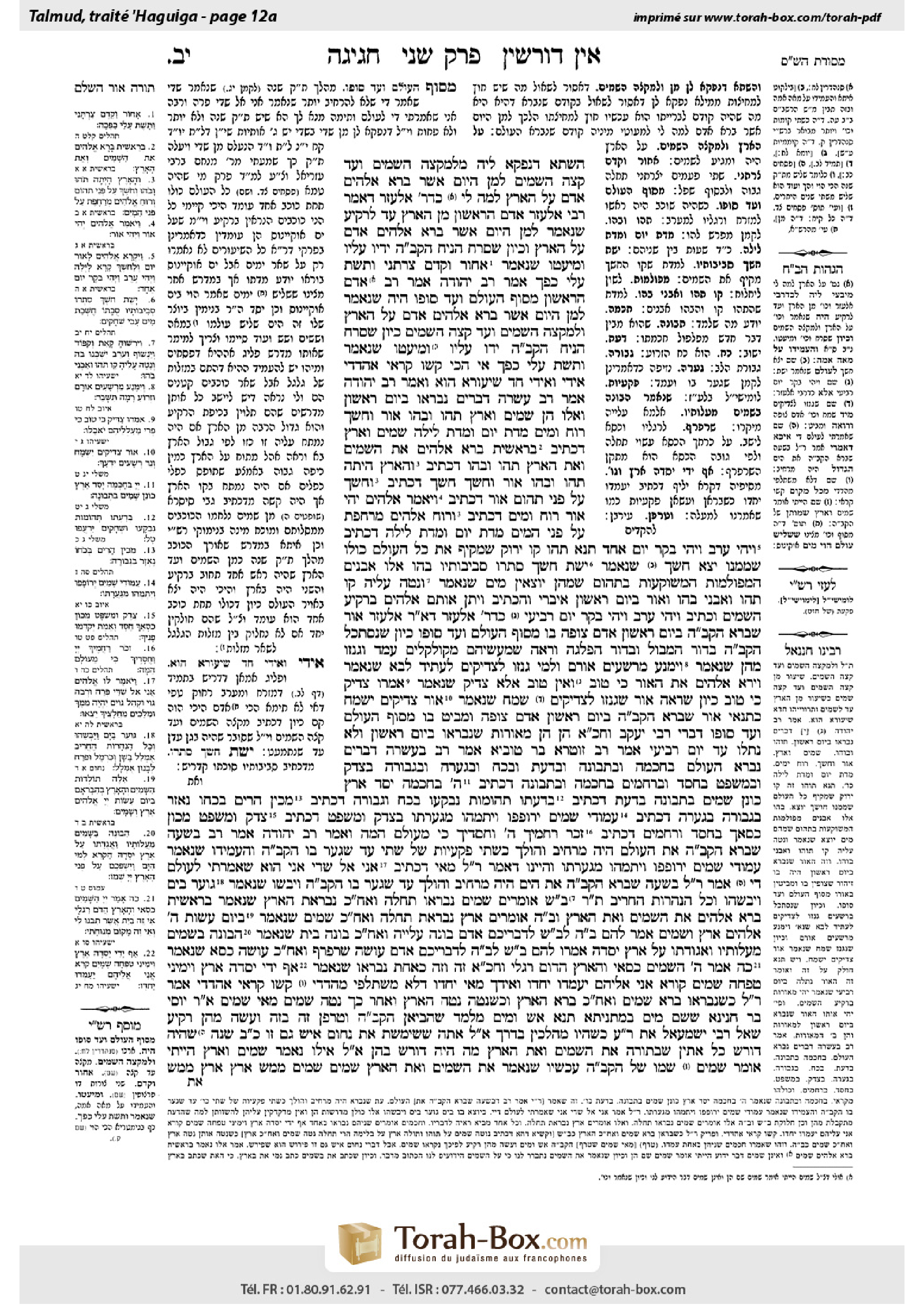
Chagigah 12a: Talmud study for Daf Yomi
Study the Talmud for Daf Yomi with scanned pages, Hebrew text, English translations from Sefaria and AI-generated French translations.
Passage selection and English or AI-generated French translation are available where the scan has annotations. Daf Study is independent of Torah-Box and Sefaria.
Browse Chagigah · חגיגה · All tractatesChagigah 12a text and translations
This page of Chagigah includes the Aramaic text, an English translation and an AI-generated French translation, alongside the scan above.
חגיגה י״ב א · Aramaic and Hebrew text
הַשְׁתָּא דְּנָפְקָא לֵיהּ מִ״לְּמִקְצֵה הַשָּׁמַיִם וְעַד קְצֵה הַשָּׁמָיִם״, ״לְמִן הַיּוֹם אֲשֶׁר בָּרָא אֱלֹהִים אָדָם עַל הָאָרֶץ״ — לְמָה לִי?
כִּדְרַבִּי אֶלְעָזָר. דְּאָמַר רַבִּי אֶלְעָזָר: אָדָם הָרִאשׁוֹן מִן הָאָרֶץ עַד לָרָקִיעַ, שֶׁנֶּאֱמַר: ״לְמִן הַיּוֹם אֲשֶׁר בָּרָא אֱלֹהִים אָדָם עַל הָאָרֶץ״. וְכֵיוָן שֶׁסָּרַח — הִנִּיחַ הַקָּדוֹשׁ בָּרוּךְ הוּא יָדָיו עָלָיו וּמִיעֲטוֹ, שֶׁנֶּאֱמַר: ״אָחוֹר וָקֶדֶם צַרְתָּנִי וַתָּשֶׁת עָלַי כַּפֶּכָה״.
אָמַר רַב יְהוּדָה אָמַר רַב: אָדָם הָרִאשׁוֹן, מִסּוֹף הָעוֹלָם וְעַד סוֹפוֹ הָיָה, שֶׁנֶּאֱמַר: ״לְמִן הַיּוֹם אֲשֶׁר בָּרָא אֱלֹהִים אָדָם עַל הָאָרֶץ וּלְמִקְצֵה הַשָּׁמַיִם וְעַד קְצֵה הַשָּׁמָיִם״, כֵּיוָן שֶׁסָּרַח הִנִּיחַ הַקָּדוֹשׁ בָּרוּךְ הוּא יָדוֹ עָלָיו וּמִיעֲטוֹ, שֶׁנֶּאֱמַר: ״וַתָּשֶׁת עָלַי כַּפֶּכָה״.
אִי הָכִי, קָשׁוּ קְרָאֵי אַהֲדָדֵי! אִידֵּי וְאִידֵּי חַד שִׁיעוּרָא הוּא.
וְאָמַר רַב יְהוּדָה אָמַר רַב: עֲשָׂרָה דְּבָרִים נִבְרְאוּ בְּיוֹם רִאשׁוֹן, וְאֵלּוּ הֵן: שָׁמַיִם וָאָרֶץ, תֹּהוּ וָבֹהוּ, אוֹר וָחֹשֶׁךְ, רוּחַ וּמַיִם, מִדַּת יוֹם וּמִדַּת לַיְלָה.
שָׁמַיִם וָאָרֶץ — דִּכְתִיב: ״בְּרֵאשִׁית בָּרָא אֱלֹהִים אֵת הַשָּׁמַיִם וְאֵת הָאָרֶץ״, תֹּהוּ וָבֹהוּ — דִּכְתִיב: ״וְהָאָרֶץ הָיְתָה תֹהוּ וָבֹהוּ״, אוֹר וָחֹשֶׁךְ, חֹשֶׁךְ — דִּכְתִיב: ״וְחֹשֶׁךְ עַל פְּנֵי תְהוֹם״, אוֹר — דִּכְתִיב: ״וַיֹּאמֶר אֱלֹהִים יְהִי אוֹר״, רוּחַ וּמַיִם — דִּכְתִיב: ״וְרוּחַ אֱלֹהִים מְרַחֶפֶת עַל פְּנֵי הַמָּיִם״, מִדַּת יוֹם וּמִדַּת לַיְלָה — דִּכְתִיב: ״וַיְהִי עֶרֶב וַיְהִי בֹקֶר יוֹם אֶחָד״.
תָּנָא: תֹּהוּ — קַו יָרוֹק שֶׁמַּקִּיף אֶת כָּל הָעוֹלָם כּוּלּוֹ, שֶׁמִּמֶּנּוּ יָצָא חֹשֶׁךְ, שֶׁנֶּאֱמַר: ״יָשֶׁת חֹשֶׁךְ סִתְרוֹ סְבִיבוֹתָיו״. בֹהוּ — אֵלּוּ אֲבָנִים הַמְפוּלָּמוֹת הַמְשׁוּקָּעוֹת בַּתְּהוֹם, שֶׁמֵּהֶן יוֹצְאִין מַיִם, שֶׁנֶּאֱמַר: ״וְנָטָה עָלֶיהָ קַו תֹהוּ וְאַבְנֵי בֹהוּ״.
וְאוֹר בְּיוֹם רִאשׁוֹן אִיבְּרִי? וְהָכְתִיב: ״וַיִּתֵּן אוֹתָם אֱלֹהִים בִּרְקִיעַ הַשָּׁמָיִם״, וּכְתִיב: ״וַיְהִי עֶרֶב וַיְהִי בֹקֶר יוֹם רְבִיעִי״!
כִּדְרַבִּי אֶלְעָזָר. דְּאָמַר רַבִּי אֶלְעָזָר: אוֹר שֶׁבָּרָא הַקָּדוֹשׁ בָּרוּךְ הוּא בְּיוֹם רִאשׁוֹן, אָדָם צוֹפֶה בּוֹ מִסּוֹף הָעוֹלָם וְעַד סוֹפוֹ. כֵּיוָן שֶׁנִּסְתַּכֵּל הַקָּדוֹשׁ בָּרוּךְ הוּא בְּדוֹר הַמַּבּוּל וּבְדוֹר הַפְּלַגָּה וְרָאָה שֶׁמַּעֲשֵׂיהֶם מְקוּלְקָלִים — עָמַד וּגְנָזוֹ מֵהֶן, שֶׁנֶּאֱמַר: ״וְיִמָּנַע מֵרְשָׁעִים אוֹרָם״.
וּלְמִי גְּנָזוֹ — לַצַּדִּיקִים לֶעָתִיד לָבֹא, שֶׁנֶּאֱמַר: ״וַיַּרְא אֱלֹהִים אֶת הָאוֹר כִּי טוֹב״, וְאֵין ״טוֹב״ אֶלָּא צַדִּיק, שֶׁנֶּאֱמַר: ״אִמְרוּ צַדִּיק כִּי טוֹב״.
כֵּיוָן שֶׁרָאָה אוֹר שֶׁגְּנָזוֹ לַצַּדִּיקִים שָׂמַח, שֶׁנֶּאֱמַר: ״אוֹר צַדִּיקִים יִשְׂמָח״.
כְּתַנָּאֵי: אוֹר שֶׁבָּרָא הַקָּדוֹשׁ בָּרוּךְ הוּא בְּיוֹם רִאשׁוֹן, אָדָם צוֹפֶה וּמַבִּיט בּוֹ מִסּוֹף הָעוֹלָם וְעַד סוֹפוֹ, דִּבְרֵי רַבִּי יַעֲקֹב. וַחֲכָמִים אוֹמְרִים: הֵן הֵן מְאוֹרוֹת שֶׁנִּבְרְאוּ בְּיוֹם רִאשׁוֹן, וְלֹא נִתְלוּ עַד יוֹם רְבִיעִי.
אָמַר רַב זוּטְרָא בַּר טוֹבִיָּא אָמַר רַב: בַּעֲשָׂרָה דְּבָרִים נִבְרָא הָעוֹלָם: בְּחׇכְמָה וּבִתְבוּנָה וּבְדַעַת, וּבְכֹחַ וּבִגְעָרָה וּבִגְבוּרָה, בְּצֶדֶק וּבְמִשְׁפָּט, בְּחֶסֶד וּבְרַחֲמִים.
בְּחׇכְמָה וּבִתְבוּנָה — דִּכְתִיב: ״ה׳ בְּחׇכְמָה יָסַד אָרֶץ כּוֹנֵן שָׁמַיִם בִּתְבוּנָה״. בְּדַעַת — דִּכְתִיב: ״בְּדַעְתּוֹ תְּהוֹמוֹת נִבְקָעוּ״. בְּכֹחַ וּגְבוּרָה, דִּכְתִיב: ״מֵכִין הָרִים בְּכֹחוֹ נֶאְזָר בִּגְבוּרָה״. בִּגְעָרָה — דִּכְתִיב: ״עַמּוּדֵי שָׁמַיִם יְרוֹפָפוּ וְיִתְמְהוּ מִגַּעֲרָתוֹ״. בְּצֶדֶק וּמִשְׁפָּט — דִּכְתִיב: ״צֶדֶק וּמִשְׁפָּט מְכוֹן כִּסְאֶךָ״. בְּחֶסֶד וְרַחֲמִים — דִּכְתִיב: ״זְכֹר רַחֲמֶיךָ ה׳ וַחֲסָדֶיךָ כִּי מֵעוֹלָם הֵמָּה״.
וְאָמַר רַב יְהוּדָה אָמַר רַב: בְּשָׁעָה שֶׁבָּרָא הַקָּדוֹשׁ בָּרוּךְ הוּא אֶת הָעוֹלָם, הָיָה מַרְחִיב וְהוֹלֵךְ כִּשְׁתֵּי פַקְעִיּוֹת שֶׁל שְׁתִי, עַד שֶׁגָּעַר בּוֹ הַקָּדוֹשׁ בָּרוּךְ הוּא וְהֶעֱמִידוֹ, שֶׁנֶּאֱמַר: ״עַמּוּדֵי שָׁמַיִם יְרוֹפָפוּ וְיִתְמְהוּ מִגַּעֲרָתוֹ״, וְהַיְינוּ דְּאָמַר רֵישׁ לָקִישׁ: מַאי דִּכְתִיב: ״אֲנִי אֵל שַׁדַּי״ — אֲנִי הוּא שֶׁאָמַרְתִּי לָעוֹלָם דַּי. אָמַר רֵישׁ לָקִישׁ: בְּשָׁעָה שֶׁבָּרָא הַקָּדוֹשׁ בָּרוּךְ הוּא אֶת הַיָּם הָיָה מַרְחִיב וְהוֹלֵךְ, עַד שֶׁגָּעַר בּוֹ הַקָּדוֹשׁ בָּרוּךְ הוּא וְיִבְּשׁוֹ, שֶׁנֶּאֱמַר: ״גּוֹעֵר בַּיָּם וַיַּבְּשֵׁהוּ וְכׇל הַנְּהָרוֹת הֶחֱרִיב״.
תָּנוּ רַבָּנַן, בֵּית שַׁמַּאי אוֹמְרִים: שָׁמַיִם נִבְרְאוּ תְּחִלָּה וְאַחַר כָּךְ נִבְרֵאת הָאָרֶץ, שֶׁנֶּאֱמַר: ״בְּרֵאשִׁית בָּרָא אֱלֹהִים אֵת הַשָּׁמַיִם וְאֵת הָאָרֶץ״. וּבֵית הִלֵּל אוֹמְרִים: אֶרֶץ נִבְרֵאת תְּחִלָּה וְאַחַר כָּךְ שָׁמַיִם, שֶׁנֶּאֱמַר: ״בְּיוֹם עֲשׂוֹת ה׳ אֱלֹהִים אֶרֶץ וְשָׁמָיִם״.
אָמְרוּ לָהֶם בֵּית הִלֵּל לְבֵית שַׁמַּאי: לְדִבְרֵיכֶם, אָדָם בּוֹנֶה עֲלִיָּיה וְאַחַר כָּךְ בּוֹנֶה בַּיִת?! שֶׁנֶּאֱמַר: ״הַבּוֹנֶה בַשָּׁמַיִם מַעֲלוֹתָיו וַאֲגוּדָּתוֹ עַל אֶרֶץ יְסָדָהּ״. אָמְרוּ לָהֶם בֵּית שַׁמַּאי לְבֵית הִלֵּל: לְדִבְרֵיכֶם, אָדָם עוֹשֶׂה שְׁרַפְרַף, וְאַחַר כָּךְ עוֹשֶׂה כִּסֵּא?! שֶׁנֶּאֱמַר: ״כֹּה אָמַר ה׳ הַשָּׁמַיִם כִּסְאִי וְהָאָרֶץ הֲדוֹם רַגְלָי״. וַחֲכָמִים אוֹמְרִים: זֶה וָזֶה כְּאַחַת נִבְרְאוּ, שֶׁנֶּאֱמַר: ״אַף יָדִי יָסְדָה אֶרֶץ וִימִינִי טִפְּחָה שָׁמָיִם קוֹרֵא אֲנִי אֲלֵיהֶם יַעַמְדוּ יַחְדָּו״.
וְאִידָּךְ, מַאי ״יַחְדָּו״? דְּלָא מִשְׁתַּלְּפִי מֵהֲדָדֵי. קָשׁוּ קְרָאֵי אַהֲדָדֵי! אָמַר רֵישׁ לָקִישׁ: כְּשֶׁנִּבְרְאוּ — בָּרָא שָׁמַיִם וְאַחַר כָּךְ בָּרָא הָאָרֶץ, וּכְשֶׁנָּטָה — נָטָה הָאָרֶץ וְאַחַר כָּךְ נָטָה שָׁמַיִם.
מַאי ״שָׁמַיִם״? אָמַר רַבִּי יוֹסֵי בַּר חֲנִינָא: שֶׁשָּׁם מַיִם. בְּמַתְנִיתָא תָּנָא: אֵשׁ וּמַיִם, מְלַמֵּד שֶׁהֱבִיאָן הַקָּדוֹשׁ בָּרוּךְ הוּא וּטְרָפָן זֶה בָּזֶה, וְעָשָׂה מֵהֶן רָקִיעַ.
שָׁאַל רַבִּי יִשְׁמָעֵאל אֶת רַבִּי עֲקִיבָא כְּשֶׁהָיוּ מְהַלְּכִין בַּדֶּרֶךְ, אֲמַר לֵיהּ: אַתָּה שֶׁשִּׁימַּשְׁתָּ אֶת נַחוּם אִישׁ גַּם זוֹ עֶשְׂרִים וּשְׁתַּיִם שָׁנָה, שֶׁהָיָה דּוֹרֵשׁ כׇּל ״אֶתִּין״ שֶׁבַּתּוֹרָה, ״אֵת הַשָּׁמַיִם וְאֵת הָאָרֶץ״, מָה הָיָה דּוֹרֵשׁ בָּהֶן? אָמַר לוֹ: אִילּוּ נֶאֱמַר ״שָׁמַיִם וָאָרֶץ״, הָיִיתִי אוֹמֵר: ״שָׁמַיִם״ — שְׁמוֹ שֶׁל הַקָּדוֹשׁ בָּרוּךְ הוּא. עַכְשָׁיו שֶׁנֶּאֱמַר: ״אֵת הַשָּׁמַיִם וְאֵת הָאָרֶץ״, ״שָׁמַיִם״ — שָׁמַיִם מַמָּשׁ, ״אָרֶץ״ — אֶרֶץ מַמָּשׁ.
Chagigah 12a · English translation
The Gemara poses a question: Now that it is derived from the phrase “from one end of the heavens to the other,” why do I need the phrase “since the day that God created man upon the earth”?
The Gemara answers that this phrase teaches us something else, according to Rabbi Elazar. As Rabbi Elazar said: The height of Adam the first man reached from the ground to the skies, as it is stated: “Since the day that God created man upon the earth, and from one end of the heavens” (Deuteronomy 4:32). When he sinned, the Holy One, Blessed be He, placed His hand upon him and diminished him, as it is stated: “You fashioned me behind and before, and laid Your hand upon me” (Psalms 139:5).
Rav Yehuda said that Rav said: The size of Adam the first man was from one end of the world to the other, as it is stated: “Since the day that God created man upon the earth, and from one end of the heavens to the other,” which indicates that he spanned the entire length of the world. Once he sinned, the Holy One, Blessed be He, placed His hand upon him and diminished him, as it states: “And laid Your hand upon me.”
The Gemara asks: If so, the two parts of the verse contradict each other, since one indicates that his height reached the heavens while the other says it reached the end of the earth. The Gemara answers: Both this and that are one, the same, measure.
§ The Gemara continues to discuss Creation: Rav Yehuda said that Rav said: Ten things were created on the first day of Creation, and they are as follows: Heaven and earth; tohu and vohu, i.e., unformed and void; light and darkness; wind and water; the length of day and the length of night.
All of these are derived from the Torah: Heaven and earth, as it is written: “In the beginning God created the heaven and the earth” (Genesis 1:1). Tohu and vohu, as it is written: “And the earth was unformed and void [tohu vavohu]” (Genesis 1:2). Light and darkness; darkness, as it is written: “And darkness was upon the face of the deep” (Genesis 1:2); light, as it is written: “And God said: Let there be light” (Genesis 1:3). Wind and water, as it is written: “And the wind of God hovered over the face of the waters” (Genesis 1:2). The length of day and the length of night, as it is written: “And there was evening, and there was morning, one day” (Genesis 1:5).
It was taught in the Tosefta: Tohu is a green line that encompasses the entire world, and from which darkness emerges, as it is stated: “He made darkness His hiding place round about Him” (Psalms 18:12), indicating that a line of darkness surrounds the world. Vohu; these are damp stones submerged in the depths, from which water emerges, as it is stated: “And He shall stretch over it the line of tohu and stones of vohu” (Isaiah 34:11), which demonstrates that tohu is a line and that vohu is referring to stones.
The Gemara poses a question: And was light created on the first day? But isn’t it written: “And God set them in the firmament of the heaven” (Genesis 1:17), and it is also written: “And there was evening, and there was morning, a fourth day” (Genesis 1:19), indicating that light was created on the fourth day.
The Gemara answers: This should be understood in accordance with Rabbi Elazar, as Rabbi Elazar said: The light that the Holy One, Blessed be He, created on the first day was not that of the sun but a different kind of light, through which man could observe from one end of the world to the other. But when the Holy One, Blessed be He, looked upon the generation of the Flood and the generation of the Dispersion and saw that their ways were corrupt and that they might misuse this light for evil, He arose and concealed it from them, as it is stated: “And from the wicked their light is withheld” (Job 38:15).
And for whom did He conceal it? For the righteous people in the future, as it is stated: “And God saw the light, that it was good” (Genesis 1:4), and “good” is referring to none other than the righteous, as it is stated: “Say of the righteous that it shall be good for them, for they shall eat the fruit of their actions” (Isaiah 3:10).
When the light saw that it had been concealed for the righteous, it rejoiced, as it is stated: “The light for the righteous shall rejoice” (Proverbs 13:9).
The Gemara comments: This is like a dispute between tanna’im: The light that the Holy One, Blessed be He, created on the first day was so profound that man could observe through it from one end of the world to the other; this is the statement of Rabbi Ya’akov. And the Rabbis say: This light is the very same as the lights created on the first day, but they were not suspended in their designated places in the firmament until the fourth day.
§ Rav Zutra bar Tuvya said that Rav said: The world was created through ten attributes: Through wisdom, through understanding, through knowledge, through strength, through rebuke, through might, through righteousness, through justice, through kindness, and through mercy.
Scriptural proof is provided for this statement as follows: It was created through wisdom and through understanding, as it is written: “The Lord founded earth with wisdom, and established the heavens with understanding” (Proverbs 3:19); through knowledge, as it is written: “With His knowledge the depths were broken up” (Proverbs 3:20); through strength and through might, as it is written: “Who by Your strength sets fast the mountains, who is girded about with might” (Psalms 65:7); through rebuke, as it is written: “The pillars of heaven tremble and are astonished at His rebuke” (Job 26:11); through righteousness and justice, as it is written: “Righteousness and justice are the foundation of Your throne” (Psalms 89:15); through kindness and mercy, as it is written: “Remember Your mercies, O Lord, and Your kindnesses, for they are from times of old” (Psalms 25:6).
And Rav Yehuda said that Rav said, with regard to the same matter: When the Holy One, Blessed be He, created the world, it continued to expand like two balls of a warp, whose cord lengthens as they unravel, until the Holy One, Blessed be He, rebuked it and made it stand still, as it is stated: “The pillars of heaven tremble and are astonished at His rebuke” (Job 26:11). And this is the same as that which Reish Lakish said: What is the meaning of that which is written: “I am the Almighty God [El Shaddai]” (Genesis 17:1)? It means: I am He Who said to the world “enough [dai],” instructing it to stop expanding. Similarly, Reish Lakish said: When the Holy One, Blessed be He, created the sea, it continued to expand until the Holy One, Blessed be He, rebuked it and made it dry, as it is stated: “He rebukes the sea and makes it dry, and desiccates all the rivers” (Nahum 1:4).
§ Beit Shammai and Beit Hillel dispute the order of Creation, as the Sages taught: Beit Shammai say: The heavens were created first and afterward the earth was created, as it is stated: “In the beginning God created the heaven and the earth” (Genesis 1:1), which indicates that heaven came first. And Beit Hillel say: The earth was created first, and heaven after it, as it is stated: “On the day that the Lord God made earth and heaven” (Genesis 2:4).
Beit Hillel said to Beit Shammai: According to your words, does a person build a second floor and build the first floor of the house afterward? As it is stated: “It is He Who builds His upper chambers in the heaven, and has founded His vault upon the earth” (Amos 9:6), indicating that the upper floor, heaven, was built above the earth. Beit Shammai said to Beit Hillel: According to your words, does a person make a stool for his feet, and make a seat afterward? As it is stated: “So said the Lord: The heavens are My seat, and the earth My footstool” (Isaiah 66:1). But the Rabbis say: Both this and that were created as one, for it is stated: “Indeed, My hand has laid the foundation of the earth, and My right hand has spread out the heavens; when I call to them, they stand up together” (Isaiah 48:13), implying that they were created as one.
The Gemara asks: And the others, Beit Shammai and Beit Hillel, what, in their opinion, is the meaning of “together”? The Gemara responds: It means that they do not separate from each other. In other words, the term “together” is referring not to the moment of their creation but to the manner of their positioning. The Gemara comments: In any case, the verses contradict each other, as heaven is sometimes mentioned first, while on other occasions earth is listed beforehand. Reish Lakish said: When they were created, He first created the heavens and afterward created the earth, but when He spread them out and fixed them in their places, He spread out the earth and afterward He spread out the heavens.
Incidental to the above, the Gemara asks: What is the meaning and source of the word “heaven” [shamayim]? Rabbi Yosei bar Ḥanina said: It is an acronym, shesham mayim, meaning: That water is there. It was taught in a baraita: Shamayim means esh umayim, fire and water, which teaches that the Holy One, Blessed be He, brought them both and combined them together, and made the firmament from them.
§ The Gemara relates: Rabbi Yishmael asked Rabbi Akiva a question when they were walking along the way. He said to him: You who served Naḥum of Gam Zu for twenty-two years, who would expound and learn that every appearance of the word et in the Torah is meant to teach something, what would he expound from the phrase: “The heaven and the earth” [et hashamayim ve’et ha’aretz] (Genesis 1:1)? He said to him: These words should be expounded as follows: Had it stated: In the beginning God created hashamayim veha’aretz, i.e., the heaven and the earth, without the word et, I would have said: Shamayim is the name of the Holy One, Blessed be He, and the same goes for aretz, and the verse would sound as if it meant that God, whose name is Shamayim and Aretz, created the world. Since it states “et hashamayim ve’et ha’aretz,” it is clear that these are created objects and that shamayim means the actual heaven and aretz is the actual earth. It is for this reason that the word et is necessary.
Chagigah 12a · Traduction française (IA)
La Guemara pose une question : Maintenant que l'on déduit de la phrase « du bord des cieux jusqu'au bord de la terre », pourquoi a-t-on besoin de la phrase « depuis le jour où Dieu a créé l'homme sur la terre » ?
La Guemara répond que cette phrase enseigne quelque chose d'autre, selon Rabbi Eléazar. Comme Rabbi Eléazar a dit : La hauteur d'Adam, le premier homme, s'étendait du sol jusqu'au ciel, comme il est écrit : « Depuis le jour où Dieu a créé l'homme sur la terre, et du bord des cieux jusqu'au bord de la terre » (Deutéronome 4:32). Lorsqu'il pécha, le Saint, le Bienheureux, posa Sa main sur lui et le diminua, comme il est dit : « Tu m'as fait derrière et devant, et mis ta main sur moi » (Psaumes 139:5).
Rav Yéhuda a dit que Rav a dit : La taille d'Adam, le premier homme, était du bord du monde jusqu'au bord de l'autre, comme il est écrit : « Depuis le jour où Dieu a créé l'homme sur la terre, et du bord des cieux jusqu'au bord de la terre », ce qui indique qu'il s'étendait sur toute la longueur du monde. Lorsqu'il pécha, le Saint, le Bienheureux, posa Sa main sur lui et le diminua, comme il est dit : « Et mis ta main sur moi. »
La Guemara pose une question : Si c'est ainsi, les deux parties de la versette s'opposent, puisque l'une indique que sa hauteur atteignait le ciel, tandis que l'autre dit qu'elle atteignait la fin de la terre. La Guemara répond : Ces deux choses sont une seule et même mesure.
§ La Guemara continue à discuter de la Création : Rav Yéhuda a dit que Rav a dit : Dix choses furent créées le premier jour de la Création, et ce sont les suivantes : Ciel et terre ; tohu et vohu, c'est-à-dire vide et désert ; lumière et ténèbres ; vent et eau ; la longueur du jour et la longueur de la nuit.
Toutes ces choses sont déduites de la Torah : Ciel et terre, comme il est écrit : « Au commencement, Dieu créa le ciel et la terre » (Genèse 1:1). Tohu et vohu, comme il est écrit : « Et la terre était vide et sans forme [tohu vavohu] » (Genèse 1:2). Lumière et ténèbres ; ténèbres, comme il est écrit : « Et l'obscurité était sur la face des eaux » (Genèse 1:2) ; lumière, comme il est écrit : « Et Dieu dit : Qu'il y ait lumière » (Genèse 1:3). Vent et eau, comme il est écrit : « Et l'Esprit de Dieu planait sur les eaux » (Genèse 1:2). La longueur du jour et la longueur de la nuit, comme il est écrit : « Et il y eut l'après-midi, et il y eut le matin, un jour » (Genèse 1:5).
Il a été enseigné dans la Tosefta : Tohu est une ligne qui englobe toute la création, d'où l'obscurité émerge, comme il est dit : « Il fit l'obscurité Son abri autour de Lui » (Psaumes 18:12), ce qui indique qu'une ligne d'obscurité entoure le monde. Vohu ; ce sont des pierres immergées dans les profondeurs, d'où l'eau émerge, comme il est dit : « Et Il étendra sur lui la ligne de tohu et les pierres de vohu » (Isaïe 34:11), ce qui démontre que tohu est une ligne et que vohu fait référence aux pierres.
La Guemara pose une question : Et la lumière fut-elle créée le premier jour ? Mais n'est-il pas écrit : « Et Il les posa dans le firmament du ciel » (Genèse 1:17), et il est aussi écrit : « Et il y eut l'après-midi, et il y eut le matin, un quatrième jour » (Genèse 1:19), ce qui indique que la lumière fut créée le quatrième jour.
La Guemara répond : Cela doit être compris selon Rabbi Eléazar, comme Rabbi Eléazar a dit : La lumière que le Saint, le Bienheureux, créa le premier jour n'était pas celle du soleil, mais une autre sorte de lumière, grâce à laquelle l'homme pouvait voir du bord du monde à l'autre. Mais lorsque le Saint, le Bienheureux, regarda la génération de la Déluge et la génération de la Dispersion et vit que leurs voies étaient corrompues et qu'ils pourraient mal utiliser cette lumière, Il se leva et la cacha d'eux, comme il est dit : « Et de l'impie, leur lumière est cachée » (Job 38:15).
Et pour qui l'a-t-Il cachée ? Pour les justes du futur, comme il est dit : « Et Dieu vit la lumière, et cela fut bon » (Genèse 1:4), et « bon » fait référence à aucun autre que les justes, comme il est dit : « Dites de justes que cela sera bon pour eux, car ils mangeront la fruit de leurs actions » (Isaïe 3:10).
Lorsque la lumière vit qu'elle avait été cachée pour les justes, elle se réjouit, comme il est dit : « La lumière des justes se réjouit » (Proverbes 13:9).
La Guemara commente : Cela est comme un débat entre les tannaïm : La lumière que le Saint, le Bienheureux, créa le premier jour était si profonde que l'homme pouvait voir à travers elle du bord du monde à l'autre ; c'est la déclaration de Rabbi Ya'akov. Et les Rabbins disent : Cette lumière est exactement la même que les lumières créées le premier jour, mais elles n'étaient pas suspendues à leur place désignée dans le firmament jusqu'au quatrième jour.
§ Rav Zutra bar Tuvya a dit que Rav a dit : Le monde fut créé par dix attributs : par la sagesse, par la compréhension, par la connaissance, par la force, par la réprimande, par la puissance, par la justice, par la droiture, par la bonté, et par la miséricorde.
Une preuve scripturaire est fournie pour cette déclaration comme suit : Il fut créé par la sagesse et par la compréhension, comme il est écrit : « L'Éternel a fondé la terre par la sagesse, et a établi les cieux par la compréhension » (Proverbes 3:19) ; par la connaissance, comme il est écrit : « Avec Sa connaissance, les profondeurs furent rompues » (Proverbes 3:20) ; par la force et par la puissance, comme il est écrit : « Qui, par Ta force, fixe les montagnes, qui est ceint de puissance » (Psaumes 65:7) ; par la réprimande, comme il est écrit : « Les piliers du ciel tremblent et sont étonnés à Sa réprimande » (Job 26:11) ; par la justice et la droiture, comme il est écrit : « La justice et la droiture sont la base de Ta trône » (Psaumes 89:15) ; par la bonté et la miséricorde, comme il est écrit : « Souviens-Toi de Tes miséricordes, ô Éternel, et de Tes bontés, car elles sont d'ancienne date » (Psaumes 25:6).
Et Rav Yehuda a dit que Rav avait dit, concernant la même question : Lorsque le Saint, le Très Haut, a créé le monde, il a continué à s'étendre comme deux balles d'un métier à tisser, dont la corde s'allonge à mesure qu'elles se déroulent, jusqu'à ce que le Saint, le Très Haut, le réprimande et le fasse s'arrêter, comme il est dit : « Les piliers du ciel tremblent et sont étonnés à sa réprimande » (Job 26:11). Et c'est la même chose que ce que Reish Lakish avait dit : Quelle est la signification de ce qui est écrit : « Je suis l'Éternel, le Dieu Tout-Puissant [El Shaddai] » (Genèse 17:1) ? Cela signifie : Je suis celui qui a dit au monde « assez [dai] », instruisant ainsi le monde à s'arrêter d'augmenter. De même, Reish Lakish avait dit : Lorsque le Saint, le Très Haut, a créé la mer, elle a continué à s'étendre jusqu'à ce que le Saint, le Très Haut, la réprimande et la fasse sécher, comme il est dit : « Il réprimande la mer et la fait sécher, et dessèche tous les fleuves » (Nahum 1:4).
§ Beit Shammai et Beit Hillel débattent de l'ordre de la Création, comme les Sages l'ont enseigné : Beit Shammai disent : Les cieux furent créés en premier, puis la terre fut créée, comme il est dit : « Au commencement, Dieu créa les cieux et la terre » (Genèse 1:1), ce qui indique que les cieux vinrent en premier. Et Beit Hillel disent : La terre fut créée en premier, puis les cieux après elle, comme il est dit : « Le jour où l'Éternel, le Dieu du ciel, fit la terre et les cieux » (Genèse 2:4).
Beit Hillel dit à Beit Shammai : Selon vos paroles, un homme construit un étage supérieur et construit ensuite le premier étage de la maison ? Comme il est dit : « C'est Lui qui construit Ses chambres supérieures au ciel, et a fondé Son dôme sur la terre » (Amos 9:6), ce qui indique que l'étage supérieur, le ciel, fut construit au-dessus de la terre. Beit Shammai dit à Beit Hillel : Selon vos paroles, un homme fait un tabouret pour ses pieds, puis fait un siège ? Comme il est dit : « Ainsi parla l'Éternel : Le ciel est Mon siège, et la terre Mon tabouret » (Isaïe 66:1). Mais les Rabbins disent : Les deux furent créés ensemble, car il est dit : « En effet, Ma main a fondé la terre, et Mon bras droit a étendu les cieux ; quand je les appelle, ils se lèvent ensemble » (Isaïe 48:13), ce qui implique qu'ils furent créés ensemble.
La Guemara pose la question : Et les autres, Beit Shammai et Beit Hillel, selon leur opinion, quelle est la signification du mot « ensemble » ? La Guemara répond : Cela signifie qu'ils ne se séparent pas l'un de l'autre. En d'autres termes, le mot « ensemble » fait référence non au moment de leur création, mais à la manière de leur positionnement. La Guemara commente : En tout cas, les versets s'opposent les uns aux autres, car le ciel est parfois mentionné en premier, tandis que parfois la terre est mentionnée en premier. Reish Lakish a dit : Lorsqu'ils furent créés, Il a d'abord créé les cieux, puis la terre, mais lorsqu'Il les a étendus et fixés à leur place, Il a d'abord étendu la terre, puis les cieux.
En complément de ce qui précède, la Guemara pose la question : Quelle est la signification et la source du mot « ciel » [shamayim] ? Rabbi Yosei bar Ḥanina a dit : C'est un acronyme, shesham mayim, signifiant : L'eau est là. Il a été enseigné dans une baraïta : Shamayim signifie esh umayim, feu et eau, ce qui enseigne que le Saint, le Très Haut, a apporté les deux et les a combinés ensemble, et a fait le firmament à partir d'eux.
§ La Guemara relate : Rabbi Yishmael posa une question à Rabbi Akiva lorsqu'ils marchaient sur le chemin. Il lui dit : Toi, qui as servi Naḥum de Gam Zu pendant vingt-deux ans, qui a expliqué et appris que chaque occurrence du mot « et » dans la Torah enseigne quelque chose, que dirait-il de la phrase : « Le ciel et la terre » [et hashamayim ve’et ha’aretz] (Genèse 1:1) ? Il lui répondit : Ces mots devraient être expliqués comme suit : Si la Torah avait dit : Au commencement, Dieu créa hashamayim veha’aretz, c'est-à-dire le ciel et la terre, sans le mot « et », je dirais : Shamayim est le nom du Saint, le Très Haut, et c'est pareil pour aretz, et la versette sonnerait comme si elle voulait dire que Dieu, dont le nom est Shamayim et Aretz, a créé le monde. Comme la Torah dit « et hashamayim ve’et ha’aretz », c'est clair que ces sont des objets créés et que shamayim signifie le ciel réel et aretz la terre réelle. C'est pour cette raison que le mot « et » est nécessaire.
Traduction française générée par IA à partir de l’édition anglaise de Sefaria. Vérifie toujours un passage avec le texte source.
Text from Sefaria: William Davidson Edition - Vocalized Aramaic (CC BY NC); William Davidson Edition - English (CC BY NC).