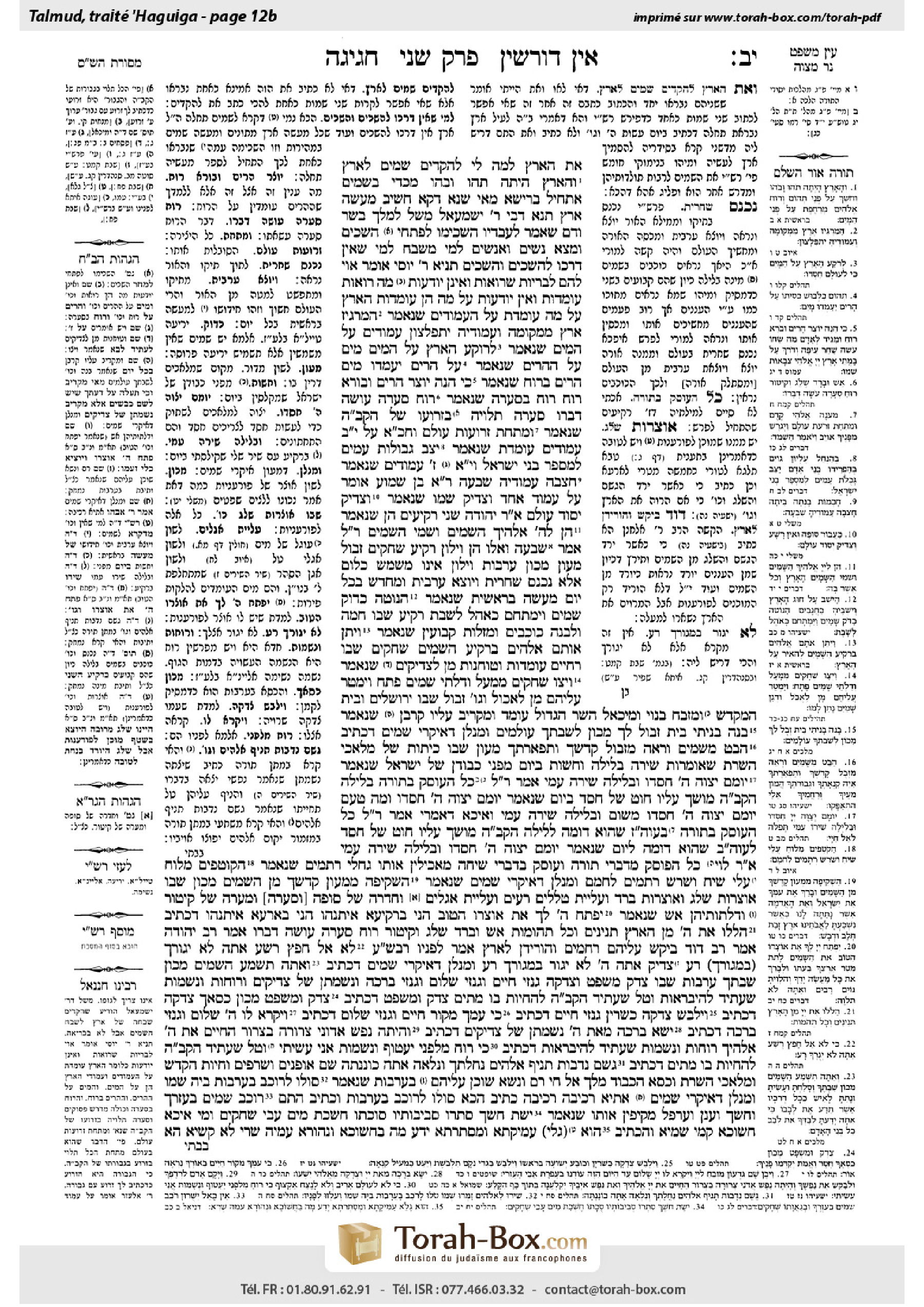
Chagigah 12b: Talmud study for Daf Yomi
Study the Talmud for Daf Yomi with scanned pages, Hebrew text, English translations from Sefaria and AI-generated French translations.
Passage selection and English or AI-generated French translation are available where the scan has annotations. Daf Study is independent of Torah-Box and Sefaria.
Browse Chagigah · חגיגה · All tractatesChagigah 12b text and translations
This page of Chagigah includes the Aramaic text, an English translation and an AI-generated French translation, alongside the scan above.
חגיגה י״ב ב · Aramaic and Hebrew text
״אֵת הָאָרֶץ״ לְמָה לִי — לְהַקְדִּים שָׁמַיִם לָאָרֶץ. ״וְהָאָרֶץ הָיְתָה תֹהוּ וָבֹהוּ״, מִכְּדִי בְּשָׁמַיִם אַתְחֵיל בְּרֵישָׁא, מַאי שְׁנָא דְּקָא חָשֵׁיב מַעֲשֵׂה אֶרֶץ? תָּנָא דְּבֵי ר׳ יִשְׁמָעֵאל: מָשָׁל לְמֶלֶךְ בָּשָׂר וָדָם שֶׁאָמַר לַעֲבָדָיו: הַשְׁכִּימוּ לְפִתְחִי. הִשְׁכִּים וּמָצָא נָשִׁים וַאֲנָשִׁים. לְמִי מְשַׁבֵּחַ — לְמִי שֶׁאֵין דַּרְכּוֹ לְהַשְׁכִּים וְהִשְׁכִּים.
תַּנְיָא, רַבִּי יוֹסֵי אוֹמֵר: אוֹי לָהֶם לַבְּרִיּוֹת, שֶׁרוֹאוֹת, וְאֵינָן יוֹדְעוֹת מָה רוֹאוֹת. עוֹמְדוֹת, וְאֵין יוֹדְעוֹת עַל מָה הֵן עוֹמְדוֹת. הָאָרֶץ עַל מָה עוֹמֶדֶת — עַל הָעַמּוּדִים, שֶׁנֶּאֱמַר: ״הַמַּרְגִּיז אֶרֶץ מִמְּקוֹמָהּ וְעַמּוּדֶיהָ יִתְפַלָּצוּן״. עַמּוּדִים, עַל הַמַּיִם — שֶׁנֶּאֱמַר: ״לְרוֹקַע הָאָרֶץ עַל הַמָּיִם״. מַיִם, עַל הֶהָרִים — שֶׁנֶּאֱמַר: ״עַל הָרִים יַעַמְדוּ מָיִם״. הָרִים, בְּרוּחַ — שֶׁנֶּאֱמַר: ״כִּי הִנֵּה יוֹצֵר הָרִים וּבוֹרֵא רוּחַ״. רוּחַ, בִּסְעָרָה — שֶׁנֶּאֱמַר: ״רוּחַ סְעָרָה עוֹשָׂה דְבָרוֹ״. סְעָרָה, תְּלוּיָה בִּזְרוֹעוֹ שֶׁל הַקָּדוֹשׁ בָּרוּךְ הוּא — שֶׁנֶּאֱמַר: ״וּמִתַּחַת זְרוֹעוֹת עוֹלָם״.
וַחֲכָמִים אוֹמְרִים: עַל שְׁנֵים עָשָׂר עַמּוּדִים עוֹמֶדֶת, שֶׁנֶּאֱמַר: ״יַצֵּב גְּבוּלוֹת עַמִּים לְמִסְפַּר בְּנֵי יִשְׂרָאֵל״. וְיֵשׁ אוֹמְרִים: שִׁבְעָה עַמּוּדִים, שֶׁנֶּאֱמַר: ״חָצְבָה עַמּוּדֶיהָ שִׁבְעָה״. רַבִּי אֶלְעָזָר בֶּן שַׁמּוּעַ אוֹמֵר: עַל עַמּוּד אֶחָד, וְצַדִּיק שְׁמוֹ, שֶׁנֶּאֱמַר: ״וְצַדִּיק יְסוֹד עוֹלָם״.
אָמַר רַב יְהוּדָה: שְׁנֵי רְקִיעִים הֵן, שֶׁנֶּאֱמַר: ״הֵן לַה׳ אֱלֹהֶיךָ הַשָּׁמַיִם וּשְׁמֵי הַשָּׁמָיִם״.
רֵישׁ לָקִישׁ אָמַר: שִׁבְעָה, וְאֵלּוּ הֵן: וִילוֹן, רָקִיעַ, שְׁחָקִים, זְבוּל, מָעוֹן, מָכוֹן, עֲרָבוֹת. וִילוֹן — אֵינוֹ מְשַׁמֵּשׁ כְּלוּם, אֶלָּא נִכְנָס שַׁחֲרִית וְיוֹצֵא עַרְבִית, וּמְחַדֵּשׁ בְּכׇל יוֹם מַעֲשֵׂה בְרֵאשִׁית, שֶׁנֶּאֱמַר: ״הַנּוֹטֶה כַדּוֹק שָׁמַיִם וַיִּמְתָּחֵם כָּאֹהֶל לָשָׁבֶת״. רָקִיעַ — שֶׁבּוֹ חַמָּה וּלְבָנָה כּוֹכָבִים וּמַזָּלוֹת קְבוּעִין, שֶׁנֶּאֱמַר: ״וַיִּתֵּן אוֹתָם אֱלֹהִים בִּרְקִיעַ הַשָּׁמָיִם״. שְׁחָקִים — שֶׁבּוֹ רֵחַיִים עוֹמְדוֹת וְטוֹחֲנוֹת מָן לַצַּדִּיקִים, שֶׁנֶּאֱמַר: ״וַיְצַו שְׁחָקִים מִמָּעַל וְדַלְתֵי שָׁמַיִם פָּתָח. וַיַּמְטֵר עֲלֵיהֶם מָן לֶאֱכוֹל וְגוֹ׳״.
זְבוּל — שֶׁבּוֹ יְרוּשָׁלַיִם וּבֵית הַמִּקְדָּשׁ, וּמִזְבֵּחַ בָּנוּי, וּמִיכָאֵל הַשַּׂר הַגָּדוֹל עוֹמֵד וּמַקְרִיב עָלָיו קׇרְבָּן, שֶׁנֶּאֱמַר: ״בָּנֹה בָנִיתִי בֵּית זְבוּל לָךְ מָכוֹן לְשִׁבְתְּךָ עוֹלָמִים״. וּמְנָלַן דְּאִיקְּרִי שָׁמַיִם, דִּכְתִיב: ״הַבֵּט מִשָּׁמַיִם וּרְאֵה מִזְּבוּל קׇדְשְׁךָ וְתִפְאַרְתֶּךָ״.
מָעוֹן — שֶׁבּוֹ כִּיתּוֹת שֶׁל מַלְאֲכֵי הַשָּׁרֵת, שֶׁאוֹמְרוֹת שִׁירָה בַּלַּיְלָה וְחָשׁוֹת בַּיּוֹם, מִפְּנֵי כְבוֹדָן שֶׁל יִשְׂרָאֵל, שֶׁנֶּאֱמַר: ״יוֹמָם יְצַוֶּה ה׳ חַסְדּוֹ וּבַלַּיְלָה שִׁירֹה עִמִּי״.
אָמַר רֵישׁ לָקִישׁ: כׇּל הָעוֹסֵק בְּתוֹרָה בַּלַּיְלָה — הַקָּדוֹשׁ בָּרוּךְ הוּא מוֹשֵׁךְ עָלָיו חוּט שֶׁל חֶסֶד בַּיּוֹם, שֶׁנֶּאֱמַר: ״יוֹמָם יְצַוֶּה ה׳ חַסְדּוֹ״. וּמָה טַעַם ״יוֹמָם יְצַוֶּה ה׳ חַסְדּוֹ״ — מִשּׁוּם ״וּבַלַּיְלָה שִׁירֹה עִמִּי״. וְאִיכָּא דְּאָמְרִי, אָמַר רֵישׁ לָקִישׁ: כׇּל הָעוֹסֵק בַּתּוֹרָה בָּעוֹלָם הַזֶּה שֶׁהוּא דּוֹמֶה לְלַיְלָה, הַקָּדוֹשׁ בָּרוּךְ הוּא מוֹשֵׁךְ עָלָיו חוּט שֶׁל חֶסֶד לָעוֹלָם הַבָּא שֶׁהוּא דּוֹמֶה לְיוֹם, שֶׁנֶּאֱמַר: ״יוֹמָם יְצַוֶּה ה׳ חַסְדּוֹ וּבַלַּיְלָה שִׁירֹה עִמִּי״.
אָמַר רַבִּי לֵוִי כׇּל הַפּוֹסֵק מִדִּבְרֵי תוֹרָה וְעוֹסֵק בְּדִבְרֵי שִׂיחָה — מַאֲכִילִין אוֹתוֹ גַּחֲלֵי רְתָמִים, שֶׁנֶּאֱמַר: ״הַקּוֹטְפִים מַלּוּחַ עֲלֵי שִׂיחַ וְשֹׁרֶשׁ רְתָמִים לַחְמָם״. וּמְנָלַן דְּאִיקְּרִי שָׁמַיִם — שֶׁנֶּאֱמַר: ״הַשְׁקִיפָה מִמְּעוֹן קׇדְשְׁךָ מִן הַשָּׁמַיִם״.
מְכוֹן — שֶׁבּוֹ אוֹצְרוֹת שָׁלֶג וְאוֹצְרוֹת בָּרָד, וַעֲלִיַּית טְלָלִים רָעִים, וַעֲלִיַּית אֲגָלִים, וְחַדְרָהּ שֶׁל סוּפָה [וּסְעָרָה], וּמְעָרָה שֶׁל קִיטוֹר. וְדַלְתוֹתֵיהֶן אֵשׁ — שֶׁנֶּאֱמַר: ״יִפְתַּח ה׳ לְךָ אֶת אוֹצָרוֹ הַטּוֹב״.
הָנֵי בִּרְקִיעָא אִיתַנְהוּ? הָנֵי בְּאַרְעָא אִיתַנְהוּ! דִּכְתִיב: ״הַלְלוּ אֶת ה׳ מִן הָאָרֶץ תַּנִּינִים וְכׇל תְּהוֹמוֹת אֵשׁ וּבָרָד שֶׁלֶג וְקִיטוֹר רוּחַ סְעָרָה עוֹשָׂה דְבָרוֹ״! אָמַר רַב יְהוּדָה אָמַר רַב: דָּוִד בִּיקֵּשׁ עֲלֵיהֶם רַחֲמִים, וְהוֹרִידָן לָאָרֶץ. אָמַר לְפָנָיו: רִבּוֹנוֹ שֶׁל עוֹלָם, ״לֹא אֵל חָפֵץ רֶשַׁע אָתָּה לֹא יְגוּרְךָ (בִּמְגוּרְךָ) רָע״. צַדִּיק אַתָּה ה׳, לֹא יָגוּר בִּמְגוּרְךָ רָע. וּמְנָלַן דְּאִיקְּרִי ״שָׁמַיִם״ — דִּכְתִיב: ״וְאַתָּה תִּשְׁמַע הַשָּׁמַיִם מְכוֹן שִׁבְתֶּךָ״.
עֲרָבוֹת — שֶׁבּוֹ צֶדֶק מִשְׁפָּט וּצְדָקָה, גִּנְזֵי חַיִּים וְגִנְזֵי שָׁלוֹם וְגִנְזֵי בְרָכָה, וְנִשְׁמָתָן שֶׁל צַדִּיקִים, וְרוּחוֹת וּנְשָׁמוֹת שֶׁעֲתִיד[וֹת] לְהִיבָּרְאוֹת, וְטַל שֶׁעָתִיד הַקָּדוֹשׁ בָּרוּךְ הוּא לְהַחֲיוֹת בּוֹ מֵתִים. צֶדֶק וּמִשְׁפָּט — דִּכְתִיב: ״צֶדֶק וּמִשְׁפָּט מְכוֹן כִּסְאֶךָ״. צְדָקָה — דִּכְתִיב: ״וַיִּלְבַּשׁ צְדָקָה כַּשִּׁרְיָן״. גִּנְזֵי חַיִּים — דִּכְתִיב: ״כִּי עִמְּךָ מְקוֹר חַיִּים״. וְגִנְזֵי שָׁלוֹם — דִּכְתִיב: ״וַיִּקְרָא לוֹ ה׳ שָׁלוֹם״. וְגִנְזֵי בְרָכָה — דִּכְתִיב: ״יִשָּׂא בְרָכָה מֵאֵת ה׳״.
נִשְׁמָתָן שֶׁל צַדִּיקִים — דִּכְתִיב: ״וְהָיְתָה נֶפֶשׁ אֲדוֹנִי צְרוּרָה בִּצְרוֹר הַחַיִּים אֵת ה׳ אֱלֹהֶיךָ״. רוּחוֹת וּנְשָׁמוֹת שֶׁעֲתִיד[וֹת] לְהִיבָּרְאוֹת — דִּכְתִיב: ״כִּי רוּחַ מִלְּפָנַי יַעֲטוֹף וּנְשָׁמוֹת אֲנִי עָשִׂיתִי״. וְטַל שֶׁעָתִיד הַקָּדוֹשׁ בָּרוּךְ הוּא לְהַחְיוֹת בּוֹ מֵתִים — דִּכְתִיב: ״גֶּשֶׁם נְדָבוֹת תָּנִיף אֱלֹהִים נַחֲלָתְךָ וְנִלְאָה אַתָּה כוֹנַנְתָּהּ״.
שָׁם אוֹפַנִּים וּשְׂרָפִים וְחַיּוֹת הַקֹּדֶשׁ, וּמַלְאֲכֵי הַשָּׁרֵת, וְכִסֵּא הַכָּבוֹד, מֶלֶךְ אֵל חַי רָם וְנִשָּׂא שׁוֹכֵן עֲלֵיהֶם בָּעֲרָבוֹת, שֶׁנֶּאֱמַר: ״סוֹלּוּ לָרוֹכֵב בָּעֲרָבוֹת בְּיָהּ שְׁמוֹ״, וּמְנָלַן דְּאִיקְּרִי ״שָׁמַיִם״? אָתְיָא ״רְכִיבָה״ ״רְכִיבָה״, כְּתִיב הָכָא: ״סוֹלּוּ לָרוֹכֵב בָּעֲרָבוֹת״ וּכְתִיב הָתָם: ״רוֹכֵב שָׁמַיִם בְּעֶזְרֶךָ״.
וְחֹשֶׁךְ וְעָנָן וַעֲרָפֶל מַקִּיפִין אוֹתוֹ — שֶׁנֶּאֱמַר: ״יָשֶׁת חֹשֶׁךְ סִתְרוֹ סְבִיבוֹתָיו סוּכָּתוֹ חֶשְׁכַת מַיִם עָבֵי שְׁחָקִים״. וּמִי אִיכָּא חֲשׁוֹכָא קַמֵּי שְׁמַיָּא? וְהָכְתִיב: ״הוּא גָּלֵא עַמִּיקָתָא וּמְסַתְּרָתָא יָדַע מָה בַחֲשׁוֹכָא וּנְהוֹרָא עִמֵּהּ שְׁרֵא״! לָא קַשְׁיָא: הָא
Chagigah 12b · English translation
Why do I need “and the earth” [et ha’aretz]? To teach that heaven preceded earth in the order of Creation. The next verse states: “And the earth was unformed and void” (Genesis 1:2). The Gemara asks: After all, the Bible began with heaven first; what is different about the second verse? Why does the Bible recount the creation of earth first in the second verse? The Sage of the school of Rabbi Yishmael taught: This can be explained by a parable of a flesh-and-blood king who said to his servants: Rise early and come to my entrance. He arose and found women and men waiting for him. Whom does he praise? Those who are unaccustomed to rising early but yet rose early, the women. The same applies to the earth: Since it is a lowly, physical sphere, we would not have expected it to be created together with heaven. Therefore, it is fitting to discuss it at greater length.
§ It is taught in a baraita: Rabbi Yosei says: Woe to them, the creations, who see and know not what they see; who stand and know not upon what they stand. He clarifies: Upon what does the earth stand? Upon pillars, as it is stated: “Who shakes the earth out of its place, and its pillars tremble” (Job 9:6). These pillars are positioned upon water, as it is stated: “To Him Who spread forth the earth over the waters” (Psalms 136:6). These waters stand upon mountains, as it is stated: “The waters stood above the mountains” (Psalms 104:6). The mountains are upon the wind, as it is stated: “For behold He forms the mountains and creates the wind” (Amos 4:13). The wind is upon a storm, as it is stated: “Stormy wind, fulfilling His word” (Psalms 148:8). The storm hangs upon the arm of the Holy One, Blessed be He, as it is stated: “And underneath are the everlasting arms” (Deuteronomy 33:27), which demonstrates that the entire world rests upon the arms of the Holy One, Blessed be He.
And the Rabbis say: The earth stands on twelve pillars, as it is stated: “He set the borders of the nations according to the number of the children of Israel” (Deuteronomy 32:8). Just as the children of Israel, i.e., the sons of Jacob, are twelve in number, so does the world rest on twelve pillars. And some say: There are seven pillars, as it is stated: “She has hewn out her seven pillars” (Proverbs 9:1). Rabbi Elazar ben Shammua says: The earth rests on one pillar and a righteous person is its name, as it is stated: “But a righteous person is the foundation of the world” (Proverbs 10:25).
§ Rabbi Yehuda said: There are two firmaments, as it is stated: “Behold, to the Lord your God belongs the heaven and the heaven of heavens” (Deuteronomy 10:14), indicating that there is a heaven above our heaven.
Reish Lakish said: There are seven firmaments, and they are as follows: Vilon, Rakia, Sheḥakim, Zevul, Ma’on, Makhon, and Aravot. The Gemara proceeds to explain the role of each firmament: Vilon, curtain, is the firmament that does not contain anything, but enters at morning and departs in the evening, and renews the act of Creation daily, as it is stated: “Who stretches out the heavens as a curtain [Vilon], and spreads them out as a tent to dwell in” (Isaiah 40:22). Rakia, firmament, is the one in which the sun, moon, stars, and zodiac signs are fixed, as it is stated: “And God set them in the firmament [Rakia] of the heaven” (Genesis 1:17). Sheḥakim, heights, is the one in which mills stand and grind manna for the righteous, as it is stated: “And He commanded the heights [Sheḥakim] above, and opened the doors of heaven; and He caused manna to rain upon them for food, and gave them of the corn of heaven” (Psalms 78:23–24).
Zevul, abode, is the location of the heavenly Jerusalem and the heavenly Temple, and there the heavenly altar is built, and the angel Michael, the great minister, stands and sacrifices an offering upon it, as it is stated: “I have surely built a house of Zevul for You, a place for You to dwell forever” (I Kings 8:13). And from where do we derive that Zevul is called heaven? As it is written: “Look down from heaven and see, from Your holy and glorious abode [Zevul]” (Isaiah 63:15).
Ma’on, habitation, is where there are groups of ministering angels who recite song at night and are silent during the day out of respect for Israel, in order not to compete with their songs, as it is stated: “By day the Lord will command His kindness, and in the night His song is with me” (Psalms 42:9), indicating that the song of the angels is with God only at night.
With regard to the aforementioned verse, Reish Lakish said: Whoever occupies himself with Torah at night, the Holy One, Blessed be He, extends a thread of kindness over him by day, as it is stated: “By day, the Lord will command His kindness,” and what is the reason that “by day, the Lord will command His kindness”? Because “and in the night His song,” i.e., the song of Torah, “is with me.” And some say that Reish Lakish said: Whoever occupies himself with Torah in this world, which is comparable to night, the Holy One, Blessed be He, extends a thread of kindness over him in the World-to-Come, which is comparable to day, as it is stated: “By day, the Lord will command His kindness, and in the night His song is with me.”
With regard to the same matter, Rabbi Levi said: Anyone who pauses from words of Torah to occupy himself with mundane conversation will be fed with the coals of the broom tree, as it is stated: “They pluck saltwort [maluaḥ] with wormwood [alei siaḥ], and the roots of the broom tree [retamim] are their food” (Job 30:4). The exposition is as follows: Those who pluck, i.e., pause, from learning Torah, which was given upon two tablets, luḥot, which sounds similar to maluaḥ, for the purpose of siaḥ, idle chatter, are punished by having to eat coals made from “the roots of the broom tree.” And from where do we derive that Ma’on is called heaven? As it is stated: “Look forth from Your holy Ma’on, from heaven” (Deuteronomy 26:15).
Makhon, dwelling place, is where there are storehouses of snow and storehouses of hail, and the upper chamber of harmful dews, and the upper chamber of drops, and the room of tempests and storms, and the cave of mist. And the doors of all these are made of fire. How do we know that there are storehouses for evil things? For it is stated: “The Lord will open for you His good storehouse, the heavens” (Deuteronomy 28:12), which indicates the existence of a storehouse that contains the opposite of good.
The Gemara asks a question: With regard to these things listed above, are they located in heaven? It is obvious that they are located on the earth. As it is written: “Praise the Lord from the earth, sea monsters and all depths, fire and hail, snow and mist, stormy wind, fulfilling His word” (Psalms 148:7–8). The verse seems to indicate that all these things are found on the earth. Rav Yehuda said that Rav said: David requested mercy with regard to them, that they should not remain in heaven, and He brought them down to earth. He said before Him: Master of the Universe, “You are not a God that has pleasure in wickedness, evil shall not sojourn with You” (Psalms 5:5). In other words, You are righteous, O Lord. Nothing evil should sojourn in Your vicinity. Rather, it is better that they remain close to us. And from where do we derive that this place is called “heaven”? As it is written: “And You shall hear in heaven, the Makhon of Your dwelling” (I Kings 8:39).
Aravot, skies, is the firmament that contains righteousness; justice; righteousness, i.e., charity; the treasuries of life; the treasuries of peace; the treasuries of blessing; the souls of the righteous; the spirits and souls that are to be created; and the dew that the Holy One, Blessed be He, will use to revive the dead. The Gemara proves this statement: Righteousness and justice are found in heaven, as it is written: “Righteousness and justice are the foundation of Your throne” (Psalms 89:15); righteousness, as it is written: “And He donned righteousness as armor” (Isaiah 59:17); the treasuries of life, as it is written: “For with You is the source of life” (Psalms 36:10). And the treasuries of peace are found in heaven, as it is written: “And he called Him the Lord of peace” (Judges 6:24), implying that peace is God’s name and is therefore found close to Him. And the treasuries of blessing, as it is written: “He shall receive a blessing from the Lord” (Psalms 24:5).
The souls of the righteous are found in heaven, as it is written: “And the soul of my master shall be bound in the bundle of life with the Lord, your God” (I Samuel 25:29). Spirits and souls that are to be created are found there, as it is written: “For the spirit that enwraps itself is from Me, and the souls that I have made” (Isaiah 57:16), which indicates that the spirit to be released into the world, wrapped around a body, is located close to God. The dew that the Holy One, Blessed be He, will use to revive the dead is found in heaven, as it is written: “A bountiful rain You will pour down, God; when Your inheritance was weary, You confirmed it” (Psalms 68:10).
There, in the firmaments, are the ofanim, the seraphim, the holy divine creatures, and the ministering angels, and the Throne of Glory. The King, God, the living, lofty, exalted One dwells above them in Aravot, as it is stated: “Extol Him Who rides upon the skies [Aravot], Whose name is God” (Psalms 68:5). And from where do we derive that Aravot is called “heaven”? This is learned by using a verbal analogy between two instances of “rides” and “rides”: Here, it is written: “Extol Him Who rides upon the skies [Aravot],” and there, it is written: “Who rides upon the heaven as your help” (Deuteronomy 33:26).
And darkness and clouds and fog surround Him, as it is stated: “He made darkness His hiding place, His pavilion round about Him; darkness of waters, thick clouds of the skies” (Psalms 18:12). The Gemara asks: And is there darkness before Heaven, i.e., before God? But isn’t it written: “He reveals deep and secret things, He knows what is in the darkness, and the light dwells with Him” (Daniel 2:22), demonstrating that only light, not darkness, is found with God? The Gemara answers: This is not difficult. This verse, which states that only light dwells with Him, is referring
Chagigah 12b · Traduction française (IA)
Pourquoi a-t-on besoin de « et la terre » [et ha’aretz]? Pour enseigner que le ciel a précédé la terre dans l'ordre de la Création. La prochaine versette dit : « Et la terre était vide et sans forme » (Genèse 1:2). La Guemara demande : Après tout, la Bible commence par le ciel d'abord ; qu'y a-t-il de particulier dans la deuxième versette ? Pourquoi la Bible raconte-t-elle d'abord la création de la terre dans la deuxième versette ? Le Sage de l'école de Rabbi Yishmael enseigna : cela peut être expliqué par un parabole d'un roi corporel qui dit à ses serviteurs : Réveillez-vous tôt et venez à mon entrée. Il se leva et trouva des femmes et des hommes attendant pour lui. À qui loue-t-il ? Ceux qui ne sont pas habitués à se lever tôt mais qui le font quand même, les femmes. De même, la terre : puisqu'il s'agit d'une sphère basse et physique, nous n'aurions pas pu attendre qu'elle soit créée avec le ciel. Par conséquent, il est approprié de la discuter plus longuement.
§ Il est enseigné dans une baraïta : Rabbi Yosei dit : Malheur à eux, les créations, qui voient et ne savent pas ce qu'ils voient ; qui se tiennent et ne savent pas sur quoi ils se tiennent. Il clarifie : Sur quoi la terre se tient-elle ? Sur des colonnes, comme il est dit : « Celui qui fait trembler la terre de son lieu, et ses colonnes tremblent » (Job 9:6). Ces colonnes sont positionnées sur l'eau, comme il est dit : « À Lui qui a étendu la terre sur les eaux » (Psaumes 136:6). Ces eaux se tiennent sur des montagnes, comme il est dit : « Les eaux se tenaient au-dessus des montagnes » (Psaumes 104:6). Les montagnes sont sur le vent, comme il est dit : « Car voici, Il forme les montagnes et crée le vent » (Amos 4:13). Le vent est sur une tempête, comme il est dit : « Tempête, accomplissant Son mot » (Psaumes 148:8). La tempête est suspendue au bras du Saint, béni soit-Il, comme il est dit : « Et sous sont les bras éternels » (Deutéronome 33:27), ce qui démontre que tout le monde repose sur les bras du Saint, béni soit-Il.
Et les Rabbins disent : la terre se tient sur douze colonnes, comme il est dit : « Il a fixé les limites des nations selon le nombre des enfants d'Israël » (Deutéronome 32:8). Tout comme les enfants d'Israël, c'est-à-dire les fils de Jacob, sont douze en nombre, ainsi la terre repose sur douze colonnes. Et certains disent : il y a sept colonnes, comme il est dit : « Elle a taillé ses sept colonnes » (Proverbes 9:1). Rabbi Elazar ben Shammua dit : la terre se tient sur une seule colonne et un justiste est son nom, comme il est dit : « Mais un justiste est la fondation du monde » (Proverbes 10:25).
§ Rabbi Yehuda dit : il y a deux firmaments, comme il est dit : « Voici, au Seigneur votre Dieu appartient le ciel et le ciel des cieux » (Deutéronome 10:14), indiquant qu'il y a un ciel au-dessus de notre ciel.
Reish Lakish dit : il y a sept firmaments, et ils sont comme suit : Vilon, Rakia, Sheḥakim, Zevul, Ma’on, Makhon, et Aravot. La Guemara poursuit à expliquer le rôle de chaque firmament : Vilon, rideau, est le firmament qui ne contient rien, mais entre le matin et quitte le soir, et renouvelle l'acte de Création quotidiennement, comme il est dit : « Qui étire les cieux comme un rideau [Vilon], et étend les cieux comme un tenture pour habiter » (Isaïe 40:22). Rakia, firmament, est celui où le soleil, la lune, les étoiles et les signes zodiaques sont fixés, comme il est dit : « Et Dieu les a mis dans le firmament [Rakia] du ciel » (Genèse 1:17). Sheḥakim, hauteurs, est celui où les moulinettes sont et moulent le manna pour les justes, comme il est dit : « Et Il a commandé les hauteurs [Sheḥakim] au-dessus, et Il a ouvert les portes du ciel ; et Il a fait pleuvoir du manna sur eux pour leur nourriture, et Il a donné à eux de la céréale du ciel » (Psaumes 78:23–24).
Zevul, demeure, est la localisation de Jérusalem céleste et du Temple céleste, et là est construit l'autel céleste, et l'ange Michel, le grand ministre, se tient et sacrifie un sacrifice sur lui, comme il est dit : « J'ai certainement construit une maison de Zevul pour Toi, un lieu pour Toi de demeurer éternellement » (I Rois 8:13). Et d'où dérivons-nous que Zevul est appelé ciel ? Comme il est écrit : « Regarde du ciel et vois, de ton saint et glorieux demeure [Zevul] » (Isaïe 63:15).
Ma’on, habitation, est là où il y a des groupes d'anges ministraux qui chantent la nuit et sont silencieux pendant la journée par respect pour Israël, afin de ne pas rivaliser avec leurs chants, comme il est dit : « Le jour, le Seigneur commandera Sa bonté, et la nuit Son chant est avec moi » (Psaumes 42:9), indiquant que le chant des anges est avec Dieu seulement la nuit.
Concernant la versette mentionnée, Reish Lakish dit : celui qui s'occupe de la Torah la nuit, le Saint, béni soit-Il, étend un fil de bonté sur lui le jour, comme il est dit : « Le jour, le Seigneur commandera Sa bonté », et quelle est la raison que « le jour, le Seigneur commandera Sa bonté » ? Parce que « et la nuit Son chant », c'est-à-dire le chant de la Torah, « est avec moi ». Et certains disent que Reish Lakish dit : celui qui s'occupe de la Torah dans ce monde, qui est comparable à la nuit, le Saint, béni soit-Il, étend un fil de bonté sur lui dans le Monde à Venir, qui est comparable au jour, comme il est dit : « Le jour, le Seigneur commandera Sa bonté, et la nuit Son chant est avec moi. »
Concernant la même affaire, Rabbi Levi dit : celui qui s'arrête des paroles de Torah pour s'occuper de conversations mondaines sera nourri avec les cendres de l'arbre de la brosse, comme il est dit : « Ils cueillent le sel [maluaḥ] avec le muguet [alei siaḥ], et les racines de l'arbre de la brosse [retamim] sont leur nourriture » (Job 30:4). L'explication est la suivante : ceux qui cueillent, c'est-à-dire s'arrêtent, d'apprendre la Torah, qui fut donnée sur deux tables, luḥot, qui sonne semblable à maluaḥ, à la fin de siaḥ, conversation futile, sont punis en ayant à manger des cendres faites de « les racines de l'arbre de la brosse ». Et d'où dérivons-nous que Ma’on est appelé ciel ? Comme il est dit : « Regarde de ton saint Ma’on, du ciel » (Deutéronome 26:15).
Makhon, lieu de résidence, est le lieu où il y a des entrepôts de neige et d'averse, et la chambre supérieure des buissons nuisibles, et la chambre supérieure des gouttes, et la pièce des tempêtes et des ouragans, et la grotte de la brume. Et les portes de tous ces lieux sont faites de feu. Comment savons-nous qu'il y a des entrepôts de choses mauvaises ? Parce qu'il est dit : « Le Seigneur ouvrira pour toi son bon entrepôt, les cieux » (Deutéronome 28:12), ce qui indique l'existence d'un entrepôt qui contient l'opposé du bien.
La Guemara pose une question : concernant ces choses énumérées ci-dessus, sont-elles situées au ciel ? Il est évident qu'elles sont situées sur la terre. Car il est écrit : « Louez le Seigneur de la terre, les monstres de la mer et toutes les profondeurs, le feu et la grêle, la neige et la brume, le vent tempestueux, accomplissant Sa parole » (Psaumes 148:7–8). La parole semble indiquer que toutes ces choses sont trouvées sur la terre. Rav Yehuda a dit que Rav a dit : David a prié pour la miséricorde concernant ces choses, qu'elles ne restent pas au ciel, et Il les a fait descendre sur la terre. Il a dit devant Lui : Seigneur, « Tu n'es pas un Dieu qui a plaisir à la malice, la malice ne séjournera pas avec Toi » (Psaumes 5:5). En d'autres termes, Tu es juste, ô Seigneur. Rien de mal ne devrait séjourner à proximité de Toi. Il est préférable qu'elles restent proches de nous. Et d'où dérivons-nous que ce lieu est appelé « ciel » ? Comme il est écrit : « Et Tu entends du ciel, le Makhon de Ta résidence » (I Rois 8:39).
Aravot, cieux, est le firmament qui contient la justice, la charité, les trésors de la vie, les trésors de la paix, les trésors de la bénédiction, les âmes des justes, les esprits et les âmes à créer, et la rosée que le Saint, le Bienheureux, utilisera pour ressusciter les morts. La Guemara prouve cette affirmation : La justice et la charité sont trouvées au ciel, comme il est écrit : « La justice et la charité sont la base de Ta couronne » (Psaumes 89:15) ; les trésors de la vie, comme il est écrit : « Car avec Toi est la source de la vie » (Psaumes 36:10) ; les trésors de la paix sont trouvés au ciel, comme il est écrit : « Et Il l'appela le Seigneur de la paix » (Juges 6:24), ce qui implique que la paix est le nom de Dieu et est donc trouvée près de Lui ; les trésors de la bénédiction, comme il est écrit : « Il recevra une bénédiction du Seigneur » (Psaumes 24:5).
Les âmes des justes sont trouvées au ciel, comme il est écrit : « Et l'âme de mon maître sera liée dans le faisceau de la vie avec le Seigneur, ton Dieu » (I Samuel 25:29). Les esprits et les âmes à créer sont trouvés là, comme il est écrit : « Car l'esprit qui s'enveloppe est de Moi, et les âmes que J'ai faites » (Isaïe 57:16), ce qui indique que l'esprit à libérer dans le monde, enveloppé dans un corps, est situé près de Dieu. La rosée que le Saint, le Bienheureux, utilisera pour ressusciter les morts est trouvée au ciel, comme il est écrit : « Une pluie abondante Tu verseras, ô Dieu ; quand Ta possession était épuisée, Tu l'as confirmée » (Psaumes 68:10).
Il y a, dans les firmaments, les ofanim, les seraphim, les créatures divines saintes, et les anges ministraux, et le Trône de Gloire. Le Roi, Dieu, le vivant, le haut, le glorieux, demeure au-dessus d'eux dans Aravot, comme il est dit : « Louez Celui qui monte sur les cieux [Aravot], dont le nom est Dieu » (Psaumes 68:5). Et d'où dérivons-nous que Aravot est appelé « ciel » ? Cela est appris par une analogie verbale entre deux occurrences de « monte » et « monte » : ici, il est écrit : « Louez Celui qui monte sur les cieux [Aravot] », et là, il est écrit : « Qui monte sur le ciel comme ton secours » (Deutéronome 33:26).
Et l'obscurité et les nuages et la brume l'entourent, comme il est dit : « Il fit l'obscurité Son abri, Son pavillon autour de Lui ; l'obscurité des eaux, les épais nuages des cieux » (Psaumes 18:12). La Guemara pose une question : Et y a-t-il de l'obscurité avant le Ciel, c'est-à-dire avant Dieu ? Mais n'est-il pas écrit : « Il révèle les choses profondes et secrètes, Il connaît ce qui est dans l'obscurité, et la lumière demeure avec Lui » (Daniel 2:22), démontrant que seule la lumière, pas l'obscurité, est trouvée avec Dieu ? La Guemara répond : Ce n'est pas difficile. Cette versette, qui affirme que seule la lumière demeure avec Lui, fait référence
Traduction française générée par IA à partir de l’édition anglaise de Sefaria. Vérifie toujours un passage avec le texte source.
Text from Sefaria: William Davidson Edition - Vocalized Aramaic (CC BY NC); William Davidson Edition - English (CC BY NC).