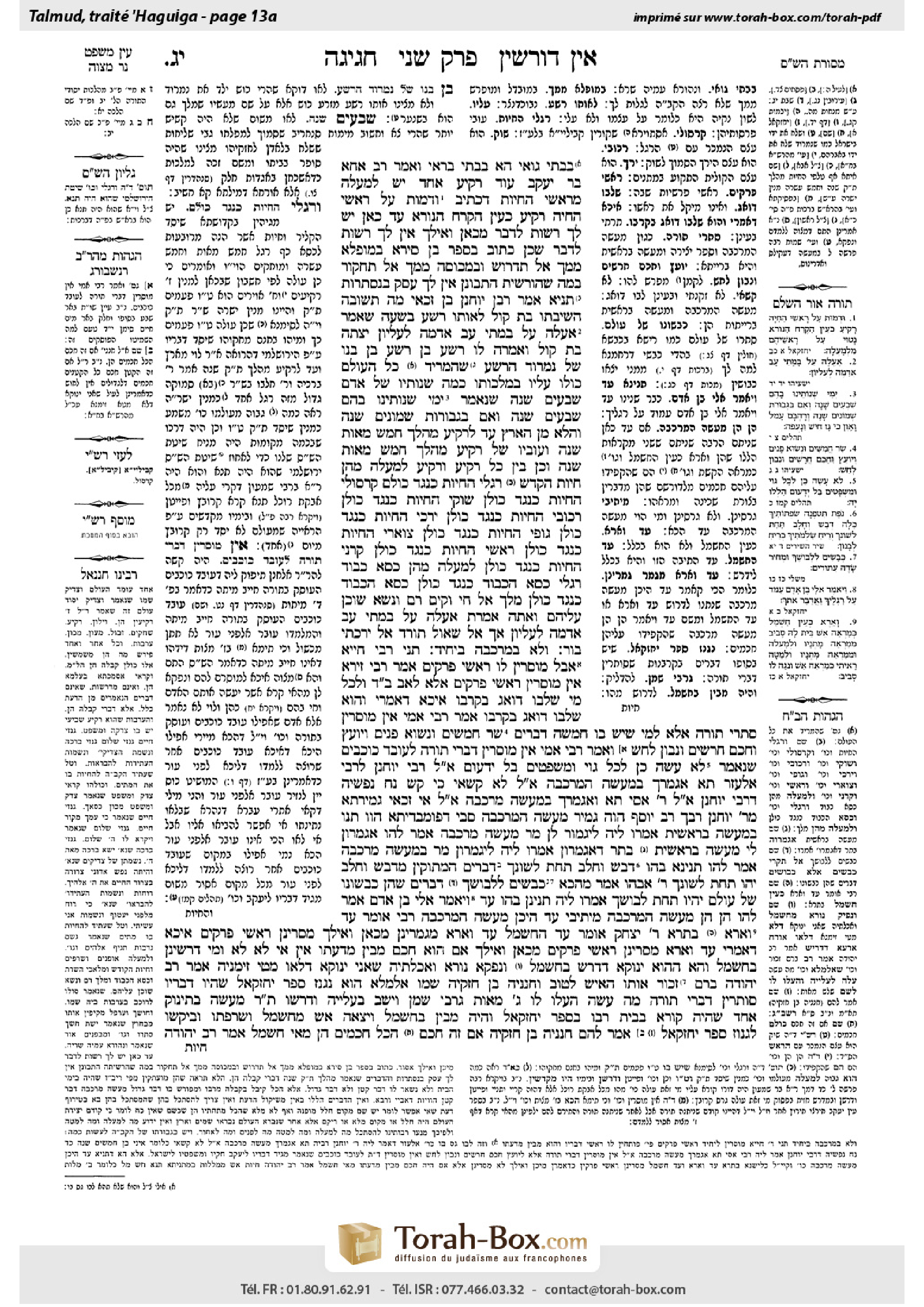
Chagigah 13a: Talmud study for Daf Yomi
Study the Talmud for Daf Yomi with scanned pages, Hebrew text, English translations from Sefaria and AI-generated French translations.
Passage selection and English or AI-generated French translation are available where the scan has annotations. Daf Study is independent of Torah-Box and Sefaria.
Browse Chagigah · חגיגה · All tractatesChagigah 13a text and translations
This page of Chagigah includes the Aramaic text, an English translation and an AI-generated French translation, alongside the scan above.
חגיגה י״ג א · Aramaic and Hebrew text
בְּבָתֵּי גַוָּאֵי, הָא בְּבָתֵּי בָרָאֵי. וְאָמַר רַב אַחָא בַּר יַעֲקֹב: עוֹד רָקִיעַ אֶחָד יֵשׁ לְמַעְלָה מֵרָאשֵׁי הַחַיּוֹת, דִּכְתִיב: ״וּדְמוּת עַל רָאשֵׁי הַחַיָּה רָקִיעַ כְּעֵין הַקֶּרַח הַנּוֹרָא״.
עַד כָּאן יֵשׁ לְךָ רְשׁוּת לְדַבֵּר, מִכָּאן וְאֵילָךְ — אֵין לְךָ רְשׁוּת לְדַבֵּר, שֶׁכֵּן כָּתוּב בְּסֵפֶר בֶּן סִירָא: ״בַּמּוּפְלָא מִמְּךָ אַל תִּדְרוֹשׁ, וּבַמְכוּסֶּה מִמְּךָ אַל תַּחְקוֹר. בַּמֶּה שֶׁהוֹרְשֵׁיתָ הִתְבּוֹנֵן, אֵין לְךָ עֵסֶק בַּנִּסְתָּרוֹת״. תַּנְיָא, אָמַר רַבָּן יוֹחָנָן בֶּן זַכַּאי: מָה תְּשׁוּבָה הֱשִׁיבַתּוּ בַּת קוֹל לְאוֹתוֹ רָשָׁע בְּשָׁעָה שֶׁאָמַר ״אֶעֱלֶה עַל בָּמֳתֵי עָב אֶדַּמֶּה לְעֶלְיוֹן״ — יָצְתָה בַּת קוֹל וְאָמְרָה לוֹ: רָשָׁע בֶּן רָשָׁע, בֶּן בְּנוֹ שֶׁל נִמְרוֹד הָרָשָׁע, שֶׁהִמְרִיד כָּל הָעוֹלָם כּוּלּוֹ עָלָיו בְּמַלְכוּתוֹ —
כַּמָּה שְׁנוֹתָיו שֶׁל אָדָם — שִׁבְעִים שָׁנָה, שֶׁנֶּאֱמַר: ״יְמֵי שְׁנוֹתֵינוּ בָהֶם שִׁבְעִים שָׁנָה וְאִם בִּגְבוּרוֹת שְׁמוֹנִים שָׁנָה״. וַהֲלֹא מִן הָאָרֶץ עַד לָרָקִיעַ מַהֲלַךְ חֲמֵשׁ מֵאוֹת שָׁנָה, וְעוֹבְיוֹ שֶׁל רָקִיעַ מַהֲלַךְ חֲמֵשׁ מֵאוֹת שָׁנָה, וְכֵן בֵּין כׇּל רָקִיעַ וְרָקִיעַ.
לְמַעְלָה מֵהֶן — חַיּוֹת הַקֹּדֶשׁ. רַגְלֵי הַחַיּוֹת כְּנֶגֶד כּוּלָּם, קַרְסוּלֵי הַחַיּוֹת כְּנֶגֶד כּוּלָּן, שׁוֹקֵי הַחַיּוֹת כְּנֶגֶד כּוּלָּן, רְכוּבֵּי הַחַיּוֹת כְּנֶגֶד כּוּלָּן, יַרְכֵי הַחַיּוֹת כְּנֶגֶד כּוּלָּן, גּוּפֵי הַחַיּוֹת כְּנֶגֶד כּוּלָּן, צַוְּארֵי הַחַיּוֹת כְּנֶגֶד כּוּלָּן, רָאשֵׁי הַחַיּוֹת כְּנֶגֶד כּוּלָּן, קַרְנֵי הַחַיּוֹת כְּנֶגֶד כּוּלָּן. לְמַעְלָה מֵהֶן — כִּסֵּא כָּבוֹד. רַגְלֵי כִּסֵּא הַכָּבוֹד כְּנֶגֶד כּוּלָּן, כִּסֵּא הַכָּבוֹד כְּנֶגֶד כּוּלָּן, מֶלֶךְ אֵל חַי וְקַיָּם רָם וְנִשָּׂא שׁוֹכֵן עֲלֵיהֶם, וְאַתָּה אָמַרְתָּ: ״אֶעֱלֶה עַל בָּמֳתֵי עָב אֶדַּמֶּה לְעֶלְיוֹן״ — ״אַךְ אֶל שְׁאוֹל תּוּרָד אֶל יַרְכְּתֵי בוֹר״.
וְלֹא בַּמֶּרְכָּבָה בְּיָחִיד. תָּנֵי רַבִּי חִיָּיא: אֲבָל מוֹסְרִין לוֹ רָאשֵׁי פְרָקִים. אָמַר רַבִּי זֵירָא: אֵין מוֹסְרִין רָאשֵׁי פְרָקִים אֶלָּא לְאַב בֵּית דִּין, וּלְכׇל מִי שֶׁלִּבּוֹ דּוֹאֵג בְּקִרְבּוֹ. אִיכָּא דְּאָמְרִי, וְהוּא שֶׁלִּבּוֹ דּוֹאֵג בְּקִרְבּוֹ.
אָמַר רַבִּי אַמֵּי: אֵין מוֹסְרִין סִתְרֵי תוֹרָה אֶלָּא לְמִי שֶׁיֵּשׁ בּוֹ חֲמִשָּׁה דְבָרִים: ״שַׂר חֲמִשִּׁים, וּנְשׂוּא פָנִים, וְיוֹעֵץ, וַחֲכַם חֲרָשִׁים, וּנְבוֹן לָחַשׁ״. וְאָמַר רַבִּי אַמֵּי: אֵין מוֹסְרִין דִּבְרֵי תוֹרָה לְגוֹי, שֶׁנֶּאֱמַר: ״לֹא עָשָׂה כֵן לְכׇל גּוֹי וּמִשְׁפָּטִים בַּל יְדָעוּם״.
אֲמַר לֵיהּ רַבִּי יוֹחָנָן לְרַבִּי אֶלְעָזָר: תָּא אַגְמְרָךְ בְּמַעֲשֵׂה הַמֶּרְכָּבָה, אֲמַר לֵיהּ: לָא קַשַּׁאי. כִּי קַשׁ — נָח נַפְשֵׁיהּ דְּרַבִּי יוֹחָנָן. אֲמַר לֵיהּ רַבִּי אַסִּי: תָּא וְאַגְמְרָךְ בְּמַעֲשֵׂה מֶרְכָּבָה. אֲמַר לֵיהּ: אִי זְכַאי גְּמִירְתַּהּ מֵרַבִּי יוֹחָנָן רַבָּךְ.
רַב יוֹסֵף הֲוָה גְּמִיר מַעֲשֵׂה הַמֶּרְכָּבָה. סָבֵי דְפוּמְבְּדִיתָא הֲווֹ תָּנוּ בְּמַעֲשֵׂה בְרֵאשִׁית. אֲמַרוּ לֵיהּ: (לִיגְמוֹר לַן) [לַיגְמְרַן] מָר מַעֲשֵׂה מֶרְכָּבָה. אֲמַר לְהוּ: אַגְמְרוּן לִי מַעֲשֵׂה בְרֵאשִׁית. בָּתַר דְּאַגְמְרוּהּ, אֲמַרוּ לֵיהּ: לַיגְמְרַון מָר בְּמַעֲשֵׂה מֶרְכָּבָה! אֲמַר לְהוּ: תְּנֵינָא בְּהוּ ״דְּבַשׁ וְחָלָב תַּחַת לְשׁוֹנֵךְ״, דְּבָרִים הַמְּתוּקִין מִדְּבַשׁ וְחָלָב — יְהוּ תַּחַת לְשׁוֹנֵךְ.
רַבִּי אֲבָהוּ אָמַר מֵהָכָא: ״כְּבָשִׁים לִלְבוּשֶׁךָ״, דְּבָרִים שֶׁהֵן כִּבְשׁוֹנוֹ שֶׁל עוֹלָם — יִהְיוּ תַּחַת לְבוּשֶׁךָ. אֲמַרוּ לֵיהּ: תְּנֵינַן בְּהוּ עַד ״וַיֹּאמֶר אֵלַי בֶּן אָדָם״. אֲמַר לְהוּ: הֵן הֵן מַעֲשֵׂה הַמֶּרְכָּבָה.
מֵיתִיבִי: עַד הֵיכָן מַעֲשֵׂה הַמֶּרְכָּבָה? רַבִּי אוֹמֵר: עַד ״וָאֵרֶא״ בָּתְרָא, רַבִּי יִצְחָק אוֹמֵר: עַד ״הַחַשְׁמַל״. עַד ״וָאֵרֶא״ מַגְמְרִינַן, מִכָּאן וְאֵילָךְ מָסְרִינַן רָאשֵׁי פְרָקִים. אִיכָּא דְּאָמְרִי: עַד ״וָאֵרֶא״ מָסְרִינַן רָאשֵׁי פְרָקִים, מִכָּאן וְאֵילָךְ, אִם הוּא חָכָם מֵבִין מִדַּעְתּוֹ — אִין, אִי לָא — לָא.
וּמִי דָּרְשִׁינַן בְּחַשְׁמַל? וְהָא הָהוּא יָנוֹקָא דִּדְרַשׁ בְּחַשְׁמַל, וּנְפַקָא נוּרָא וַאֲכַלְתֵּיהּ! שָׁאנֵי יָנוֹקָא, דְּלָאו מָטֵי זִימְנֵיהּ.
אָמַר רַב יְהוּדָה: בְּרַם זָכוּר אוֹתוֹ הָאִישׁ לַטּוֹב, וַחֲנַנְיָה בֶּן חִזְקִיָּה שְׁמוֹ. אִלְמָלֵא הוּא — נִגְנַז סֵפֶר יְחֶזְקֵאל, שֶׁהָיוּ דְּבָרָיו סוֹתְרִין דִּבְרֵי תוֹרָה. מֶה עָשָׂה? הֶעֱלוּ לוֹ שְׁלוֹשׁ מֵאוֹת גַּרְבֵי שֶׁמֶן, וְיָשַׁב בַּעֲלִיָּיה וּדְרָשׁוֹ.
תָּנוּ רַבָּנַן: מַעֲשֶׂה בְּתִינוֹק אֶחָד שֶׁהָיָה קוֹרֵא בְּבֵית רַבּוֹ בְּסֵפֶר יְחֶזְקֵאל וְהָיָה מֵבִין בְּחַשְׁמַל, וְיָצְאָה אֵשׁ מֵחַשְׁמַל וּשְׂרָפַתּוּ, וּבִיקְשׁוּ לִגְנוֹז סֵפֶר יְחֶזְקֵאל. אָמַר לָהֶם חֲנַנְיָה בֶּן חִזְקִיָּה: אִם זֶה חָכָם — הַכֹּל חֲכָמִים הֵן?
מַאי חַשְׁמַל? אָמַר רַב יְהוּדָה:
Chagigah 13a · English translation
to the inner houses, where there is only light; that source, according to which He is surrounded by darkness, is referring to the outer houses. And Rav Aḥa bar Ya’akov said: There is one more firmament above these, which is above the heads of the divine creatures, as it is written: “And over the heads of the divine creatures there was the likeness of a firmament, like the color of the terrible ice” (Ezekiel 1:22).
The Gemara comments: Until here, you have permission to speak; from this point forward you do not have permission to speak, as it is written in the book of Ben Sira: Seek not things concealed from you, nor search those hidden from you. Reflect on that which is permitted to you; you have no business with secret matters. It is taught in a baraita: Rabban Yoḥanan ben Zakkai said: What response did the Divine Voice provide to that wicked man, Nebuchadnezzar, when he said: “I will ascend above the heights of the clouds; I will be like the Most High” (Isaiah 14:14), thereby intending to rise to heaven? A Divine Voice came and said to him: Wicked man, son of a wicked man, descendant, i.e., follower of the ways, of Nimrod the wicked, who caused the entire world to rebel against Him during the time of his reign.
How many are the years of man? Seventy years, as it is stated: “The span of our life is seventy years, or if we are strong, eighty years” (Psalms 90:10). Now is there not from the earth to the firmament a walking distance of five hundred years, and the thickness of the firmament itself is a walking distance of five hundred years, and a similar distance exists between each and every one of the firmaments?
And above them, above all the firmaments, are the divine creatures. The feet of the divine creatures correspond in distance to all the firmaments; the ankles of the animals correspond to all of them, the shins of the animals correspond to all of them, the knees of the animals correspond to all of them, the thighs of the animals correspond to all of them, the bodies of the animals correspond to all of them, the necks of the animals correspond to all of them, the heads of the animals correspond to all of them, and the horns of the animals correspond to all of them. Above them is the Throne of Glory: The feet of the Throne of Glory correspond to all of them, the Throne of Glory corresponds to all of them, and the living, almighty, lofty, exalted King dwells above them. And you, Nebuchadnezzar, say: “I will ascend above the heights of the clouds; I will be like the Most High” (Isaiah 14:15), but the next verse states: “Yet you shall be brought down to the netherworld, to the uttermost parts of the pit” (Isaiah 14:15).
§ It is taught in the mishna, according to the Gemara’s explanation: Nor may one expound the Design of the Divine Chariot to an individual. Rabbi Ḥiyya taught: But one may transmit to him, an individual, the outlines of this topic, leaving him to comprehend the rest on his own. Rabbi Zeira said: One may transmit the outlines of the Design of the Divine Chariot only to the president of the court, who needs to know them due to his wisdom and meritorious deeds, and to anyone whose heart inside him is concerned, i.e., one who is concerned about his sins and desires to achieve full repentance. There are those who say that this does not refer to two separate individuals, but to the president of the court, whose heart inside him is concerned.
Rabbi Ami said: The secrets of the Torah may be transmitted only to one who possesses the following five characteristics: “The captain of fifty, and the man of favor, and the counselor, and the cunning charmer, and the skillful enchanter” (Isaiah 3:3). And Rabbi Ami said further: The words of Torah may not be transmitted to a gentile, as it is stated: “He has not dealt so with any nation, and as for His ordinances, they have not known them” (Psalms 147:20).
§ The Gemara relates: Rabbi Yoḥanan said to Rabbi Elazar: Come and I will teach you the Design of the Divine Chariot. Rabbi Elazar said to him: I have not yet aged sufficiently, as one must be very settled in one’s mind for these studies. When he grew old, Rabbi Yoḥanan had already passed away. Rabbi Asi said to him: Come and I will teach you the Design of the Divine Chariot. He said to him: Had I merited, I would have learned it from Rabbi Yoḥanan, your teacher. It therefore appears that I am unworthy of studying it.
The Gemara relates: Rav Yosef would study the Design of the Divine Chariot and was familiar with the subject, whereas the Elders of Pumbedita would study the act of Creation. They said to Rav Yosef: Let the Master teach us the Design of the Divine Chariot. He said to them: You teach me the act of Creation. After they taught him that subject, they said to him: Let the Master teach us the Design of the Divine Chariot. He said to them: We learned with regard to them the secrets of the Torah: “Honey and milk are under your tongue” (Song of Songs 4:11), meaning that matters that are sweeter than honey and milk should remain under your tongue. In other words, one should not speak of such matters, and anyone who is familiar with them may not reveal them to others.
Rabbi Abbahu said: It is derived from here, from the following verse: “The lambs [kevasim] will be for your clothing” (Proverbs 27:26), which he expounds as though it were written with the letter shin, kevashim, meaning concealed matters: Things that constitute the concealed matters of the world should be under your clothing; you should not reveal them. When the Elders of Pumbedita saw that Rav Yosef was not going to teach them, they said to him: We have learned them, the verses concerning the Design of the Divine Chariot written in the book of Ezekiel, up to the verse “And He said to me, son of man” (Ezekiel 2:1). He said to them: If so, these verses are the very essence of the Design of the Divine Chariot, as they provide the main details of the topic.
The Gemara raises an objection to this from a baraita: Until where is the Design of the Divine Chariot related? Rabbi Yehuda HaNasi says: Until the latter “And I saw” (Ezekiel 1:27), not including the last verse. Rabbi Yitzḥak says: Until the word “the electrum” (Ezekiel 1:27). Neither of these opinions accord with Rav Yosef’s opinion that the Design of the Divine Chariot continues until the end of the chapter. The Gemara answers: Until “And I saw,” we teach those worthy of it; from this point forward, we transmit only the outlines. There are those who say: Until “And I saw,” we transmit the outlines; from this point forward, if he is wise and can understand of his own accord, yes, we teach him. If not, we do not teach him even the outlines.
The Gemara poses a question: And may one teach about the electrum of the Design of the Divine Chariot at all? But wasn’t there a certain youth who expounded the electrum, and fire came out and consumed him, showing that such study is highly dangerous? The Gemara answers: That youth was different, for his time to study such matters had not yet arrived. Therefore, he was punished.
Rav Yehuda said: Indeed, that man is remembered for good, and Ḥananya ben Ḥizkiya was his name, because were it not for him, the book of Ezekiel would have been suppressed. Why did they wish to suppress it? Because they found that its words contradicted the words of Torah, as its later chapters contain many halakhot that appear not to accord with those of the Torah. What did he do? They brought up to him three hundred barrels of oil, for light and sustenance, and he sat in an upper chamber and expounded it, to reconcile its teachings with those of the Torah.
The Sages taught: An incident occurred involving a youth who was reading the book of Ezekiel in the house of his teacher, and he was able to comprehend the electrum, and fire came out of the electrum and burned him. And they sought to suppress the book of Ezekiel due to the danger it posed. Ḥananya ben Ḥizkiya said to them: If this youth happened to be wise, are all people wise enough to understand this book?
The Gemara asks: What is the electrum? Rav Yehuda said:
Chagigah 13a · Traduction française (IA)
vers les maisons intérieures, où il n'y a que la lumière ; cette source, selon laquelle Il est entouré d'obscurité, fait référence aux maisons extérieures. Et Rav Aḥa bar Ya’akov a dit : Il y a une autre couronne au-dessus de ces maisons, qui est au-dessus des têtes des créatures divines, comme il est écrit : « Et sur les têtes des créatures divines, il y avait l'aspect d'une couronne, comme la couleur de l'ice terrible » (Ezéchiel 1:22).
La Guemara commente : Jusqu'ici, vous avez le droit de parler ; à partir de ce point, vous n'avez plus le droit de parler, comme il est écrit dans le livre de Ben Sira : « Ne cherchez pas les choses cachées pour vous, ni ne recherchez celles qui sont cachées pour vous. Réfléchissez à ce qui vous est permis ; vous n'avez rien à faire avec les choses secrètes. Il est enseigné dans une baraïta : Rabban Yoḥanan ben Zakkai a dit : Quelle réponse a donné la Voix Divine à ce mauvais homme, Nabuchodolonosar, lorsqu'il a dit : « Je monterai au-dessus des hauteurs des nuages ; je serai comme le Très Haut » (Michna Isaïe 14:14), en voulant ainsi monter au ciel ? Une Voix Divine est venue et a dit à lui : Mauvais homme, fils de mauvais homme, descendant, c'est-à-dire disciple des voies, de Nimrod le mauvais, qui a fait rebeller tout le monde contre Lui pendant son règne.
Combien d'années a l'homme ? Soixante-dix ans, comme il est dit : « La durée de notre vie est soixante-dix ans, ou si nous sommes forts, quatre-vingts ans » (Psaumes 90:10). Maintenant, n'y a-t-il pas, du sol jusqu'à la couronne, une distance marchable de cinq cents ans, et l'épaisseur de la couronne elle-même est une distance marchable de cinq cents ans, et une distance semblable existe entre chaque couronne ?
Et au-dessus d'eux, au-dessus de toutes les firmaments, sont les créatures divines. Les pieds des créatures divines correspondent à la distance de toutes les firmaments ; les chevilles des animaux correspondent à toutes celles-ci, les tibias des animaux correspondent à toutes celles-ci, les genoux des animaux correspondent à toutes celles-ci, les cuisses des animaux correspondent à toutes celles-ci, les corps des animaux correspondent à toutes celles-ci, les cous des animaux correspondent à toutes celles-ci, les têtes des animaux correspondent à toutes celles-ci, et les cornes des animaux correspondent à toutes celles-ci. Au-dessus d'eux est le Trône de Gloire : les pieds du Trône de Gloire correspondent à toutes celles-ci, le Trône de Gloire correspond à toutes celles-ci, et le Roi vivant, puissant, élevé, exalté demeure au-dessus d'eux. Et toi, Nabuchodolonosar, dis : « Je monterai au-dessus des hauteurs des nuages ; je serai comme le Très Haut » (Isaïe 14:15), mais la prochaine verset dit : « Cependant, tu seras ramené en enfer, aux extrémités du puits » (Isaïe 14:15).
§ Il est enseigné dans la mishna, selon l'explication de la Guemara : On ne doit pas expliquer la conception du Chariot divin à un individu. Rabbi Ḥiyya a enseigné : Mais on peut transmettre à lui, un individu, les grandes lignes de ce sujet, laissant à lui comprendre le reste par lui-même. Rabbi Zeira a dit : On peut transmettre les grandes lignes de la conception du Chariot divin uniquement au président du tribunal, qui a besoin de les connaître en raison de sa sagesse et de ses mérites, et à quiconque a un cœur préoccupé, c'est-à-dire celui qui s'occupe de ses péchés et désire atteindre la repentance totale. Il y a ceux qui disent que cela ne fait pas référence à deux individus séparés, mais au président du tribunal, dont le cœur est préoccupé.
Rabbi Ami a dit : Les secrets de la Torah peuvent être transmis uniquement à celui qui possède les cinq caractéristiques suivantes : « Le chef de cinquante, et l'homme favori, et le conseiller, et le charmeur rusé, et l'enchanteresse habile » (Isaïe 3:3). Et Rabbi Ami a dit plus tard : Les paroles de la Torah ne peuvent pas être transmises à un non-Juif, comme il est dit : « Il n'a pas agi ainsi avec aucune nation, et quant à ses ordonnances, ils n'ont pas connu cela » (Psaumes 147:20).
§ La Guemara rapporte : Rabbi Yoḥanan a dit à Rabbi Elazar : Viens, je vais t'enseigner la conception du Chariot divin. Rabbi Elazar a dit à lui : Je n'ai pas encore assez vieilli, car on doit être très fixé dans son esprit pour étudier ces choses. Quand il est devenu vieux, Rabbi Yoḥanan était déjà décédé. Rabbi Asi a dit à lui : Viens, je vais t'enseigner la conception du Chariot divin. Il a dit à lui : Si j'avais mérité, j'aurais appris cela de Rabbi Yoḥanan, ton maître. Il semble donc que je ne mérite pas d'étudier cela.
La Guemara rapporte : Rav Yosef étudiait la conception du Chariot divin et était familier avec la matière, tandis que les Anciens de Pumbedita étudiaient l'acte de Création. Ils dirent à Rav Yosef : Fais-nous apprendre la conception du Chariot divin. Il dit à eux : Tu m'apprends l'acte de Création. Après qu'ils lui eurent enseigné cette matière, ils dirent à lui : Fais-nous apprendre la conception du Chariot divin. Il dit à eux : Nous avons appris à leur sujet les secrets de la Torah : « Le miel et le lait sont sous votre langue » (Cantique des Cantiques 4:11), ce qui signifie que les choses plus douces que le miel et le lait devraient rester sous votre langue. En d'autres termes, on ne doit pas parler de telles choses, et celui qui en est familier ne doit pas les révéler à d'autres.
Rabbi Abbahu a dit : Il est tiré de là, de la suivante verset : « Les agneaux [kevasim] seront pour votre vêtement » (Proverbes 27:26), qu'il interprète comme si elle était écrite avec la lettre shin, kevashim, signifiant les choses cachées : Les choses qui constituent les choses cachées du monde devraient être sous votre vêtement ; vous ne devez pas les révéler. Quand les Anciens de Pumbedita virent que Rav Yosef ne voulait pas les enseigner, ils dirent à lui : Nous avons appris ces versets concernant la conception du Chariot Divine, écrits dans le livre d'Ezéchiel, jusqu'au verset « Et il dit à moi, fils de l'homme » (Ezéchiel 2:1). Il dit à eux : Si c'est ainsi, ces versets sont l'essence même de la conception du Chariot Divine, car ils donnent les détails principaux du sujet.
La Guemara soulève un objet contre cela à partir d'une baraïta : Jusqu'où le Design du Chariot divin est-il relatif ? Rabbi Yéhuda haNasi dit : Jusqu'au dernier « Et j'ai vu » (Ézéchiel 1:27), sans inclure le dernier verset. Rabbi Yitzhak dit : Jusqu'au mot « l'or » (Ézéchiel 1:27). Aucune de ces opinions ne correspond à l'opinion de Rav Yosef, qui considère que le Design du Chariot divin continue jusqu'à la fin du chapitre. La Guemara répond : Jusqu'au « Et j'ai vu », nous enseignons à ceux qui méritent ; à partir de ce point, nous transmettons seulement les grandes lignes. Il y a ceux qui disent : Jusqu'au « Et j'ai vu », nous transmettons les grandes lignes ; à partir de ce point, si l'on est sage et peut comprendre par soi-même, oui, nous l'enseignons. Si non, nous ne l'enseignons même pas les grandes lignes.
La Guemara pose une question : Et peut-on enseigner sur l'or du Design du Chariot divin en tout ? Mais n'y avait-il pas un jeune homme qui a expliqué l'or, et le feu est sorti et l'a consumé, montrant que cette étude est très dangereuse ? La Guemara répond : Ce jeune homme était différent, car son temps d'étudier de tels sujets n'était pas encore arrivé. Par conséquent, il a été puni.
Rav Yéhuda dit : En effet, cette personne est retenue pour le bien, et son nom était Hananya ben Chizkiya, car sans lui, le livre d'Ézéchiel aurait été supprimé. Pourquoi souhaitaient-ils le supprimer ? Parce qu'ils ont trouvé que ses paroles contredisent les paroles de la Torah, car ses chapitres ultérieurs contiennent beaucoup de halakhot qui semblent ne pas correspondre à ceux de la Torah. Qu'as-tu fait ? Ils ont apporté à lui trois cents barils d'huile, pour la lumière et la subsistance, et il s'est assis dans une pièce supérieure et l'a expliqué, afin de concilier ses enseignements avec ceux de la Torah.
Les Sages enseignèrent : Un incident eut lieu concernant un jeune homme qui lisait le livre d'Ézéchiel chez son maître, et il pouvait comprendre l'or, et le feu sortit de l'or et le brûla. Et ils souhaitaient supprimer le livre d'Ézéchiel en raison du danger qu'il représentait. Hananya ben Chizkiya dit à eux : Si ce jeune homme avait été sage, sont-ce que tous les gens sont suffisamment sages pour comprendre ce livre ?
La Guemara demande : Qu'est-ce que l'or ? Rav Yéhuda dit :
Traduction française générée par IA à partir de l’édition anglaise de Sefaria. Vérifie toujours un passage avec le texte source.
Text from Sefaria: William Davidson Edition - Vocalized Aramaic (CC BY NC); William Davidson Edition - English (CC BY NC).