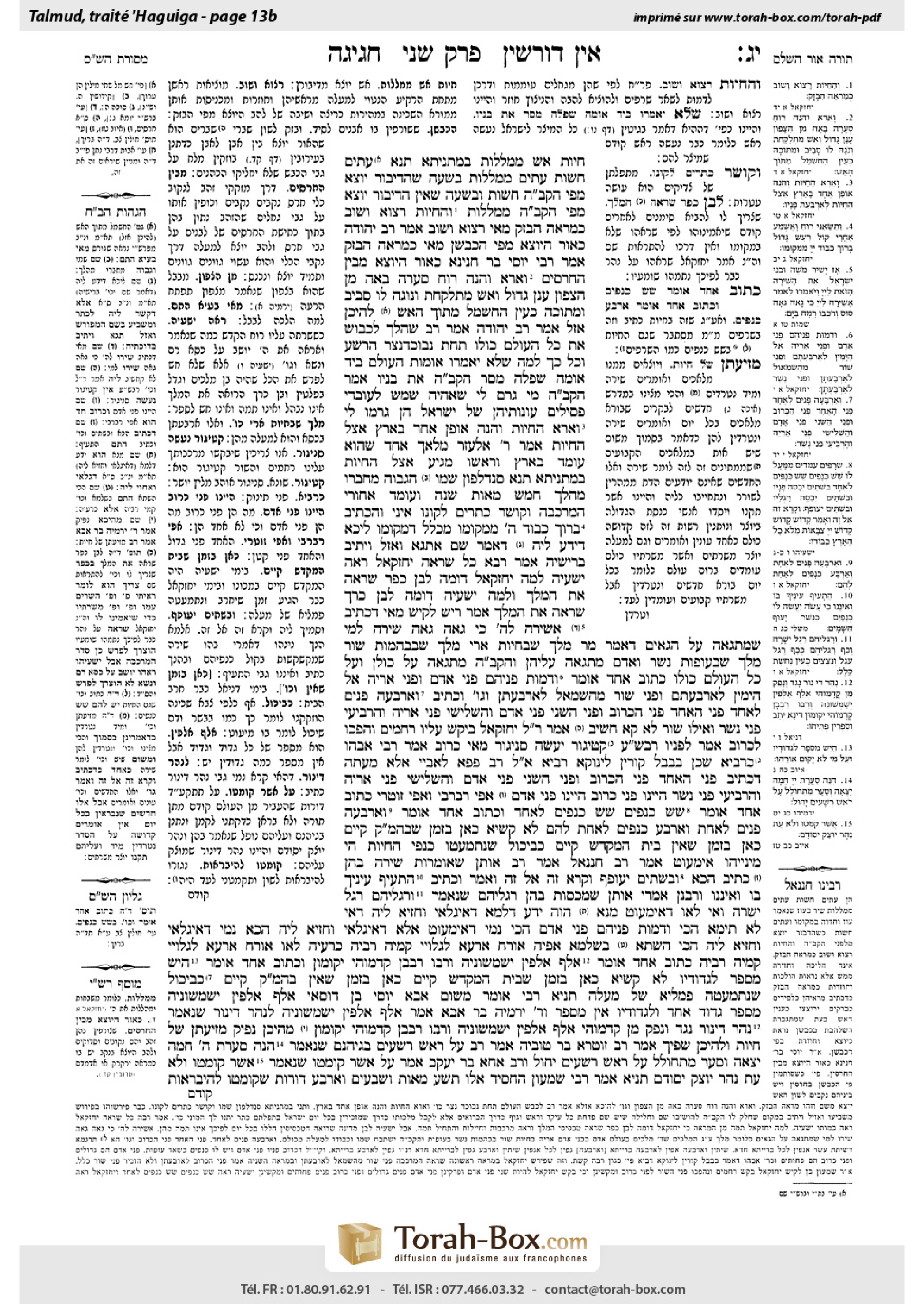
Chagigah 13b: Talmud study for Daf Yomi
Study the Talmud for Daf Yomi with scanned pages, Hebrew text, English translations from Sefaria and AI-generated French translations.
Passage selection and English or AI-generated French translation are available where the scan has annotations. Daf Study is independent of Torah-Box and Sefaria.
Browse Chagigah · חגיגה · All tractatesChagigah 13b text and translations
This page of Chagigah includes the Aramaic text, an English translation and an AI-generated French translation, alongside the scan above.
חגיגה י״ג ב · Aramaic and Hebrew text
חַיּוֹת אֵשׁ מְמַלְּלוֹת. בְּמַתְנִיתָא תָּנָא: עִתִּים חָשׁוֹת, עִתִּים מְמַלְּלוֹת. בְּשָׁעָה שֶׁהַדִּיבּוּר יוֹצֵא מִפִּי הַקָּדוֹשׁ בָּרוּךְ הוּא — חָשׁוֹת, וּבְשָׁעָה שֶׁאֵין הַדִּיבּוּר יוֹצֵא מִפִּי הַקָּדוֹשׁ בָּרוּךְ הוּא — מְמַלְּלוֹת.
״וְהַחַיּוֹת רָצוֹא וָשׁוֹב כְּמַרְאֵה הַבָּזָק״. מַאי ״רָצוֹא וָשׁוֹב״? אָמַר רַב יְהוּדָה: כְּאוּר הַיּוֹצֵא מִפִּי הַכִּבְשָׁן. מַאי ״כְּמַרְאֵה הַבָּזָק״? אָמַר רַבִּי יוֹסֵי בַּר חֲנִינָא: כְּאוּר הַיּוֹצֵא מִבֵּין הַחֲרָסִים.
״וָאֵרֶא וְהִנֵּה רוּחַ סְעָרָה בָּאָה מִן הַצָּפוֹן עָנָן גָּדוֹל וְאֵשׁ מִתְלַקַּחַת וְנוֹגַהּ לוֹ סָבִיב וּמִתּוֹכָהּ כְּעֵין הַחַשְׁמַל מִתּוֹךְ הָאֵשׁ״. לְהֵיכָן אֲזַל? אֲמַר רַב יְהוּדָה אָמַר רַב: שֶׁהָלַךְ לִכְבּוֹשׁ אֶת כָּל הָעוֹלָם כּוּלּוֹ תַּחַת נְבוּכַדְנֶצַּר הָרָשָׁע. וְכׇל כָּךְ לָמָּה? שֶׁלֹּא יֹאמְרוּ אוּמּוֹת הָעוֹלָם: בְּיַד אוּמָּה שְׁפָלָה מָסַר הַקָּדוֹשׁ בָּרוּךְ הוּא אֶת בָּנָיו. אָמַר הַקָּדוֹשׁ בָּרוּךְ הוּא: מִי גָּרַם לִי שֶׁאֶהְיֶה שַׁמָּשׁ לְעוֹבְדֵי פְסִילִים — עֲוֹנוֹתֵיהֶן שֶׁל יִשְׂרָאֵל הֵן גָּרְמוּ לִי.
״וָאֵרֶא הַחַיּוֹת וְהִנֵּה אוֹפַן אֶחָד בָּאָרֶץ אֵצֶל הַחַיּוֹת״, אָמַר רַבִּי אֶלְעָזָר: מַלְאָךְ אֶחָד שֶׁהוּא עוֹמֵד בָּאָרֶץ, וְרֹאשׁוֹ מַגִּיעַ אֵצֶל הַחַיּוֹת. בְּמַתְנִיתָא תָּנָא: סַנְדַּלְפוֹן שְׁמוֹ, הַגָּבוֹהַּ מֵחֲבֵרוֹ מַהֲלַךְ חֲמֵשׁ מֵאוֹת שָׁנָה. וְעוֹמֵד אֲחוֹרֵי הַמֶּרְכָּבָה וְקוֹשֵׁר כְּתָרִים לְקוֹנוֹ. אִינִי? וְהָכְתִיב: ״בָּרוּךְ כְּבוֹד ה׳ מִמְּקוֹמוֹ״, מִכְּלָל דִּמְקוֹמוֹ לֵיכָּא דְּיָדַע לֵיהּ! דְּאָמַר שֵׁם אַתָּגָא וְאָזֵל וְיָתֵיב בְּרֵישֵׁיהּ.
אָמַר רָבָא: כׇּל שֶׁרָאָה יְחֶזְקֵאל, רָאָה יְשַׁעְיָה. לְמָה יְחֶזְקֵאל דּוֹמֶה — לְבֶן כְּפָר שֶׁרָאָה אֶת הַמֶּלֶךְ, וּלְמָה יְשַׁעְיָה דּוֹמֶה — לְבֶן כְּרַךְ שֶׁרָאָה אֶת הַמֶּלֶךְ. אָמַר רֵישׁ לָקִישׁ: מַאי דִּכְתִיב: ״אָשִׁירָה לַה׳ כִּי גָאֹה גָּאָה״ — שִׁירָה לְמִי שֶׁמִּתְגָּאֶה עַל הַגֵּאִים. דְּאָמַר מָר: מֶלֶךְ שֶׁבַּחַיּוֹת — אֲרִי, מֶלֶךְ שֶׁבַּבְּהֵמוֹת — שׁוֹר, מֶלֶךְ שֶׁבָּעוֹפוֹת — נֶשֶׁר, וְאָדָם מִתְגָּאֶה עֲלֵיהֶן, וְהַקָּדוֹשׁ בָּרוּךְ הוּא מִתְגָּאֶה עַל כּוּלָּן וְעַל כׇּל הָעוֹלָם כּוּלּוֹ.
כָּתוּב אֶחָד אוֹמֵר: ״וּדְמוּת פְּנֵיהֶם פְּנֵי אָדָם וּפְנֵי אַרְיֵה אֶל הַיָּמִין לְאַרְבַּעְתָּם וּפְנֵי שׁוֹר מֵהַשְּׂמֹאל לְאַרְבַּעְתָּן וְגוֹ׳״, וּכְתִיב: ״וְאַרְבָּעָה פָנִים לְאֶחָד פְּנֵי הָאֶחָד פְּנֵי הַכְּרוּב וּפְנֵי הַשֵּׁנִי פְּנֵי אָדָם וְהַשְּׁלִישִׁי פְּנֵי אַרְיֵה וְהָרְבִיעִי פְּנֵי נָשֶׁר״, וְאִילּוּ שׁוֹר לָא קָא חָשֵׁיב! אָמַר רֵישׁ לָקִישׁ: יְחֶזְקֵאל בִּיקֵּשׁ עָלָיו רַחֲמִים, וַהֲפָכוֹ לִכְרוּב. אָמַר לְפָנָיו: רִבּוֹנוֹ שֶׁל עוֹלָם! קָטֵיגוֹר יֵעָשֶׂה סָנֵיגוֹר?
מַאי ״כְּרוּב״? אָמַר רַבִּי אֲבָהוּ: כְּרָבְיָא, שֶׁכֵּן בְּבָבֶל קוֹרִין לְיָנוֹקָא רָבְיָא. אֲמַר לֵיהּ רַב פָּפָּא לְאַבָּיֵי: אֶלָּא מֵעַתָּה, דִּכְתִיב: ״פְּנֵי הָאֶחָד פְּנֵי הַכְּרוּב וּפְנֵי הַשֵּׁנִי פְּנֵי אָדָם וְהַשְּׁלִישִׁי פְּנֵי אַרְיֵה וְהָרְבִיעִי פְּנֵי נָשֶׁר״, הַיְינוּ פְּנֵי כְרוּב הַיְינוּ פְּנֵי אָדָם? אַפֵּי רַבְרְבֵי וְאַפֵּי זוּטְרֵי.
כָּתוּב אֶחָד אוֹמֵר: ״שֵׁשׁ כְּנָפַיִם שֵׁשׁ כְּנָפַיִם לְאֶחָד״, וְכָתוּב אֶחָד אוֹמֵר: ״וְאַרְבָּעָה פָנִים לְאֶחָת וְאַרְבַּע כְּנָפַיִם לְאַחַת לָהֶם״? לָא קַשְׁיָא: כָּאן בִּזְמַן שֶׁבֵּית הַמִּקְדָּשׁ קַיָּים, כָּאן בִּזְמַן שֶׁאֵין בֵּית הַמִּקְדָּשׁ קַיָּים. כִּבְיָכוֹל, שֶׁנִּתְמַעֲטוּ כַּנְפֵי הַחַיּוֹת.
הֵי מִינַּיְיהוּ אִימַּעוּט? אָמַר רַב חֲנַנְאֵל אָמַר רַב: אוֹתָן שֶׁאוֹמְרוֹת שִׁירָה בָּהֶן. כְּתִיב הָכָא: ״וּבִשְׁתַּיִם יְעוֹפֵף וְקָרָא זֶה אֶל זֶה וְאָמַר״, וּכְתִיב: ״הֲתָעִיף עֵינֶיךָ בּוֹ וְאֵינֶנּוּ״.
וְרַבָּנַן אָמְרִי: אוֹתָן שֶׁמְּכַסּוֹת בָּהֶן רַגְלֵיהֶם, שֶׁנֶּאֱמַר: ״וְרַגְלֵיהֶם רֶגֶל יְשָׁרָה״, וְאִי לָאו דְּאִימַּעוּט — מְנָא הֲוָה יָדַע? דִּלְמָא דְּאִיגַּלַּאי וְחַזְיָא לֵיהּ. דְּאִי לָא תֵּימָא הָכִי, ״וּדְמוּת פְּנֵיהֶם פְּנֵי אָדָם״, הָכִי נָמֵי דְּאִימַּעוּט?! אֶלָּא דְּאִיגַּלַּאי וְחַזְיָא לֵיהּ, הָכָא נָמֵי — דְּאִיגַּלַּאי וְחַזְיָא לֵיהּ.
הָכִי הַשְׁתָּא?! בִּשְׁלָמָא אַפֵּיהּ — אוֹרַח אַרְעָא לְגַלּוֹיֵי קַמֵּיהּ רַבֵּיהּ. כַּרְעֵיהּ — לָאו אוֹרַח אַרְעָא לְגַלּוֹיֵי קַמֵּיהּ רַבֵּיהּ.
כָּתוּב אֶחָד אוֹמֵר: ״אֶלֶף אַלְפִין יְשַׁמְּשׁוּנֵּיהּ וְרִבּוֹ רִבְבָן קָדָמוֹהִי יְקוּמוּן״, וְכָתוּב אֶחָד אוֹמֵר: ״הֲיֵשׁ מִסְפָּר לִגְדוּדָיו״! לָא קַשְׁיָא: כָּאן בִּזְמַן שֶׁבֵּית הַמִּקְדָּשׁ קַיָּים, כָּאן בִּזְמַן שֶׁאֵין בֵּית הַמִּקְדָּשׁ קַיָּים, כִּבְיָכוֹל שֶׁנִּתְמַעֲטָה פָּמַלְיָא שֶׁל מַעְלָה.
תַּנְיָא, רַבִּי אוֹמֵר מִשּׁוּם אַבָּא יוֹסֵי בֶּן דּוֹסַאי: ״אֶלֶף אַלְפִין יְשַׁמְּשׁוּנֵּיהּ״ — מִסְפַּר גְּדוּד אֶחָד, ״וְלִגְדוּדָיו אֵין מִסְפָּר״. וְרַבִּי יִרְמְיָה בַּר אַבָּא אָמַר: ״אֶלֶף אַלְפִין יְשַׁמְּשׁוּנֵּיהּ״, לִנְהַר דִּינוּר, שֶׁנֶּאֱמַר: ״נְהַר דִּינוּר נָגֵד וְנָפֵק מִן קֳדָמוֹהִי אֶלֶף אַלְפִין יְשַׁמְּשׁוּנֵּיהּ וְרִבּוֹ רִבְבָן קָדָמוֹהִי יְקוּמוּן״.
מֵהֵיכָן נָפֵיק? מִזֵּיעָתָן שֶׁל חַיּוֹת. וּלְהֵיכָן שָׁפֵיךְ? אָמַר רַב זוּטְרָא בַּר טוֹבִיָּה אָמַר רַב: עַל רֹאשׁ רְשָׁעִים בְּגֵיהִנָּם, שֶׁנֶּאֱמַר: ״הִנֵּה סַעֲרַת ה׳ חֵמָה יָצְאָה וְסַעַר מִתְחוֹלֵל עַל רֹאשׁ רְשָׁעִים יָחוּל״. וְרַב אַחָא בַּר יַעֲקֹב אָמַר: עַל אֲשֶׁר קוּמְּטוּ, שֶׁנֶּאֱמַר: ״אֲשֶׁר קוּמְּטוּ וְלֹא עֵת נָהָר יוּצַק יְסוֹדָם״. תַּנְיָא, אָמַר רַבִּי שִׁמְעוֹן הֶחָסִיד: אֵלּוּ תְּשַׁע מֵאוֹת וְשִׁבְעִים וְאַרְבַּע דּוֹרוֹת שֶׁקּוּמְּטוּ לְהִיבָּרְאוֹת
Chagigah 13b · English translation
It refers to speaking animals of fire. Electrum [ḥashmal] is an acrostic of this phrase [ḥayyot esh memallelot]. It was taught in a baraita: At times they are silent; at times they speak. When the divine speech emerges from the mouth of the Holy One, Blessed be He, they are silent; and when the divine speech does not emerge from the mouth of the Holy One, Blessed be He, they speak.
§ The verse states: “And the divine creatures ran and returned like the appearance of a flash of lightning [bazak]” (Ezekiel 1:14). What is the meaning of “ran and returned”? Rav Yehuda said: Like fire that is emitted from a furnace, whose flame is continuously bursting out and withdrawing. What is the meaning of “like the appearance of a flash of lightning”? Rabbi Yosei bar Ḥanina said: Like the fire that is emitted from between pieces of earthenware used for refining gold, as an additional meaning ascribed to the word bazak is shards of earthenware.
The verse states: “And I looked and, behold, a stormy wind came out of the north, a great cloud, with a fire flashing up, so that a brightness was round about it; and out of its midst was like the color of electrum, out of the midst of the fire” (Ezekiel 1:4). The Gemara poses a question: Where did that wind go? Rav Yehuda said that Rav said: It went to conquer the entire world under the wicked Nebuchadnezzar. And why was all of this necessary? Why was it necessary that the entire world be subjected to his dominion? So that the nations of the world would not say: The Holy One, Blessed be He, delivered His children into the hands of a lowly nation. Since it was already decreed that the kingdom of Israel would fall into the hands of Nebuchadnezzar, God made him into a great conqueror, so that Israel would not be ashamed of being defeated by him. The Holy One, Blessed be He, said with regard to this: Who caused Me to be an attendant to worshippers of molten images, forcing Me to wage their wars? It was the sins of Israel that led Me to do so.
Another verse in the same chapter states: “Now as I beheld the divine creatures, behold, one wheel [ofan] was upon the earth near the divine creatures” (Ezekiel 1:15). Rabbi Elazar said: This wheel is a certain angel who stands on the earth and its head reaches the divine creatures. It was taught in a baraita: This angel is named Sandalfon, who is taller than his colleague by a distance of five hundred years, and he stands behind the Divine Chariot and weaves crowns for his Maker. The Gemara asks: Is that so? Can crowns be woven for God? But isn’t it written: “Blessed be the Lord’s glory from His place” (Ezekiel 3:12), which proves by inference that no one knows His place? Therefore, how can crowns be woven for Him? Rather, it can be done by saying a name for the crown, and then the crown goes and sits on God’s head of its own accord.
§ Rava said: All that Ezekiel saw, the prophet Isaiah saw as well, but the latter did not find it necessary to describe his vision in such detail. To what may Ezekiel be compared? To a villager who saw the king and is excited by all the extravagances of the king’s palace and everything it contains, as he is unaccustomed to them. And to what may Isaiah be compared? To a city dweller who saw the king. Such an individual focuses on the encounter with the king, and is oblivious to all the distractions. Reish Lakish said: What is the meaning of that which is written: “I will sing to the Lord, for He is highly exalted” (Exodus 15:1)? It is fitting to sing to He Who is exalted above the exalted. As the Master said: The king of the beasts is the lion, the king of the domestic animals is the ox, the king of the birds is the eagle, and man is exalted and lords over them, but the Holy One, Blessed be He, is exalted above all of them and above the entire world, as the creatures that appear in the Divine Chariot are the ox, the lion, the eagle, and man.
The Gemara poses a question with regard to the animals of the Divine Chariot: One verse states: “As for the likeness of their faces, they had the face of a man; and the four had the face of a lion on the right side; and the four had the face of an ox on the left side” (Ezekiel 1:10). And it is also written: “And each one had four faces: The first face was the face of the cherub, and the second face was the face of a man, and the third the face of a lion, and the fourth the face of an eagle” (Ezekiel 10:14), but it does not include the face of an ox in this second list. Reish Lakish said: Ezekiel requested mercy with regard to it, i.e., the face of the ox, and had it turned into a cherub. He said before Him as follows: Master of the Universe. Shall an accuser [kateigor] become a defender [saneigor]? As the face of an ox recalls Israel’s sin of the Golden Calf, it would be preferable for there to be a different face on the Divine Chariot.
The Gemara asks: What is the meaning of “cherub”? Rabbi Abbahu said: Like a baby [keravya], for in Babylonia they call a baby ravya. Rav Pappa said to Abaye: However, if that is so, what is the meaning of that which is written: “The first face was the face of the cherub, and the second face was the face of a man, and the third the face of a lion, and the fourth the face of an eagle”? The face of a cherub is the same as the face of a man; what is the difference between them? He replied: The difference is that the face of a man is referring to a large face, whereas the face of a cherub means the small face of a baby.
The Gemara asks another question: One verse states: “Each one had six wings; with two it covered its face and with two it covered its feet, and with two it flew” (Isaiah 6:2), and another verse states: “And every one had four faces, and every one of them had four wings” (Ezekiel 1:6). The Gemara answers: This is not difficult, as here, when the verse states they each had six wings, it is referring to the time when the Temple is standing, while there, where four wings are described, it is referring to the time when the Temple is not standing, for it is as if the number of the wings of the animals were diminished so that they now have only four.
The Gemara asks: Which of the wings were diminished? Rav Ḥananel said that Rav said: Those with which they recite song. The proof is that it is written here: “And with two it flew [yeofef]. And one called to the other and said” (Isaiah 6:2–3), and it is written: “Will you set [hata’if] your eyes upon it? It is gone” (Proverbs 23:5), implying that the flight of these wings had ceased.
And the Rabbis say that the wings they lost are those with which they cover their feet, for it is stated: “And their feet were straight feet” (Ezekiel 1:7). Now if these wings had not been diminished, how would he know what their feet looked like? Clearly their feet were no longer covered. The Gemara rejects this: This is no proof, for perhaps they were momentarily revealed, allowing him to see them. Because if you do not say so, that he saw them for a moment, then with regard to the verse: “And the likeness of their faces, they had the face of a man” (Ezekiel 1:10), so too will you say that these the wings covering their faces were diminished as well? Rather, it must be that they were revealed and he saw them. Here too, they were revealed and he saw them.
The Gemara refutes this: How can these cases be compared? Granted, it is logical that his face was revealed, as it is proper conduct for an angel to reveal his face before his Master, and therefore it is possible that they would have revealed their faces at certain times; but with regard to his feet, it is not proper conduct to reveal them before his Master. Therefore, they must have lacked wings to cover their feet.
§ The Gemara continues to address apparent contradictions between verses concerning similar matters: One verse states: “A thousand thousands ministered to Him, and ten thousand times ten thousand stood before him” (Daniel 7:10), and another verse states: “Is there a number to His troops?” (Job 25:3), implying that they are even more numerous than “ten thousand times ten thousand.” The Gemara answers: This is not difficult, for here, when they are without number, the verse is referring to the time when the Temple is standing; there, the other verse is referring to the time when the Temple is not standing, for it is as though the heavenly entourage [pamalya] were diminished.
It is taught in a baraita: Rabbi Yehuda HaNasi says in the name of Abba Yosei ben Dosai: “A thousand thousands ministered to Him” is referring to the number of angels in a single troop, but with regard to the number of his troops, it can be said: “And to his troops, there is no number”. And Rabbi Yirmeya bar Abba said: There is no contradiction, since with regard to the phrase “a thousand thousands ministered to Him,” the pronoun “Him” can be literally translated as: It, referring not to those who serve God Himself, but to those who administer to the River Dinur, as it is stated: “A fiery [dinur] river issued and came forth from before him; a thousand thousands ministered to it, and a myriad myriads stand before it” (Daniel 7:10). The ministers of God, however, are indeed too numerous to count.
The Gemara asks: From where does this river flow? The Gemara answers: From the perspiration of the divine creatures. And where does it flow to? Rav Zutra bar Toviya said that Rav said: Upon the heads of the wicked in Gehenna, as it is stated: “Behold, a storm of the Lord has gone forth in fury, a whirling storm; it shall whirl upon the head of the wicked” (Jeremiah 23:19). And Rav Aḥa bar Ya’akov said: The river flows over those who were snatched away, i.e., the generations that were never created, as it is stated: “Who were snatched away before their time, whose foundation was poured out as a stream” (Job 22:16), implying that the River Dinur flows over them. It is taught in a baraita: Rabbi Shimon HeḤasid said in explanation of this verse: These people “who were snatched away” are those nine hundred and seventy-four generations that were snatched away; they were to have been created
Chagigah 13b · Traduction française (IA)
Il s'agit des animaux de feu. L'électrum [ḥashmal] est une acrostique de cette phrase [ḥayyot esh memallelot]. Il a été enseigné dans une baraïta : Parfois ils sont muets ; parfois ils parlent. Lorsque la parole divine sort de la bouche du Saint des Saints, ils sont muets ; et lorsque la parole divine ne sort pas de la bouche du Saint des Saints, ils parlent.
§ La versette dit : « Et les créatures divines couraient et revenaient comme l'aspect d'un éclair [bazak] » (Ezéchiel 1:14). Quelle est la signification de « couraient et revenaient » ? Rav Yehuda a dit : Comme le feu qui sort d'un four, dont la flamme est constamment en émission et en retrait. Quelle est la signification de « comme l'aspect d'un éclair » ? Rabbi Yosei bar Ḥanina a dit : Comme le feu qui sort entre des morceaux de terre utilisés pour affiner l'or, en tant qu'une interprétation supplémentaire du mot bazak est des morceaux de terre.
La versette dit : « Et je vis et, voici, un vent tumultueux venait du nord, un grand nuage, avec un feu qui brillait, de sorte qu'une lumière était autour de lui ; et sortant de son milieu était comme la couleur de l'electrum, sortant du milieu du feu » (Ezéchiel 1:4). La Guemara pose une question : Où est-ce que ce vent est allé ? Rav Yehuda a dit que Rav a dit : Il est allé conquérir tout le monde sous le maléfique Nebuchadnezzar. Et pourquoi cela était-il nécessaire ? Pourquoi était-il nécessaire que tout le monde soit soumis à son règne ? Afin que les nations du monde ne disent pas : Le Saint des Saints a livré Ses enfants entre les mains d'une nation méprisable. Puisque cela était déjà décidé que le royaume d'Israël tomberait entre les mains de Nebuchadnezzar, Dieu l'a rendu en grand conquérant, afin que Israël ne soit pas honteux de sa défaite par lui. Le Saint des Saints a dit à ce sujet : Qui m'a fait devenir un serviteur des adorateurs d'images fondues, me forçant à mener leurs guerres ? C'étaient les péchés d'Israël qui m'ont conduit à le faire.
Une autre versette du même chapitre dit : « Maintenant que je regardais les créatures divines, voici, un roue [ofan] était sur la terre près des créatures divines » (Ezéchiel 1:15). Rabbi Elazar a dit : Cette roue est un certain ange qui se tient sur la terre et dont la tête atteint les créatures divines. Il a été enseigné dans une baraïta : Cet ange s'appelle Sandalfon, qui est plus grand que son collègue d'une distance de cinq cents ans, et il se tient derrière le Chariot Divin et tisse des couronnes pour son Créateur. La Guemara pose une question : Est-ce ainsi ? Peut-on tisser des couronnes pour Dieu ? Mais n'est-il pas écrit : « Béni soit la gloire du Seigneur de Son lieu » (Ezéchiel 3:12), qui prouve par déduction que personne ne connaît Son lieu ? Donc comment peut-on tisser des couronnes pour Lui ? Plutôt, cela peut être fait en disant un nom pour la couronne, et alors la couronne va et s'assoit sur la tête de Dieu d'elle-même.
§ Rava dit : Tout ce que l'Ézéchiel a vu, le prophète Isaïe l'a vu également, mais le second n'a pas jugé nécessaire de décrire sa vision en détail. À quoi peut-on comparer l'Ézéchiel ? À un villageois qui a vu le roi et est excité par toutes les splendeurs du palais royal et tout ce qu'il contient, comme il n'y est pas habitué. Et à quoi peut-on comparer Isaïe ? À un habitant de ville qui a vu le roi. Une telle personne se concentre sur l'entretien avec le roi et ignore toutes les distractions. Reish Lakish dit : Quelle est la signification de ce qui est écrit : « Je chanterai au Seigneur, car Il est très exalté » (Exode 15:1) ? Il est convenable de chanter à Celui qui est exalté au-dessus des exaltés. Comme le Maître a dit : Le roi des bêtes est le lion, le roi des animaux domestiques est la bête, le roi des oiseaux est l'aigle, et l'homme est exalté et domine sur eux, mais le Saint des Saints est exalté au-dessus de tous ceux-ci et au-dessus de tout le monde, comme les créatures qui apparaissent dans le Chariot Divin sont la bête, le lion, l'aigle et l'homme.
La Guemara pose une question concernant les animaux du Chariot Divin : Une versette dit : « En ce qui concerne la ressemblance de leurs visages, ils avaient la figure d'un homme ; et les quatre avaient la figure d'un lion sur le côté droit ; et les quatre avaient la figure d'une bête sur le côté gauche » (Ezéchiel 1:10). Et il est également écrit : « Et chacun avait quatre visages : le premier visage était la figure du cherubin, et le second visage était la figure d'un homme, et le troisième la figure d'un lion, et le quatrième la figure d'un aigle » (Ezéchiel 10:14), mais il ne mentionne pas la figure d'une bête dans cette deuxième liste. Reish Lakish dit : Ezéchiel a demandé la miséricorde concernant cela, c'est-à-dire la figure de la bête, et l'a transformé en un cherubin. Il a dit devant Lui comme suit : Maître du monde. Un accusateur [kateigor] devient-il un défenseur [saneigor] ? Comme la figure d'une bête rappelle le péché d'Israël du Veau d'or, il serait préférable qu'il y ait une autre figure sur le Chariot Divin.
La Guemara pose une question : Quelle est la signification du mot « cherub » ? Rabbi Abbahu dit : Comme un bébé [keravya], car en Babylonie, on appelle un bébé ravya. Rav Pappa dit à Abaye : Cependant, si c'est ainsi, quelle est la signification de ce qui est écrit : « La première face était la face du cherub, et la deuxième face était la face d'un homme, et la troisième la face d'un lion, et la quatrième la face d'un aigle » ? La face du cherub est la même que la face d'un homme ; quelle est la différence entre elles ? Il répondit : La différence est que la face d'un homme désigne une grande face, tandis que la face du cherub signifie la petite face d'un bébé.
La Guemara pose une autre question : Une versette dit : « Chacun avait six ailes ; avec deux il couvrait son visage et avec deux il couvrait ses pieds, et avec deux il volait » (Isaïe 6:2), et une autre versette dit : « Et chacun avait quatre visages, et chacun d'eux avait quatre ailes » (Ezéchiel 1:6). La Guemara répond : Ce n'est pas difficile, car ici, lorsque la versette dit qu'ils avaient six ailes, il s'agit du temps où le Temple est debout, tandis que là, où les ailes de quatre sont décrites, il s'agit du temps où le Temple n'est pas debout, car c'est comme si le nombre des ailes des animaux avait diminué de sorte qu'ils en ont maintenant seulement quatre.
La Guemara pose la question : Quelles ailes ont été diminuées ? Rav Ḥananel dit que Rav a dit : celles avec lesquelles ils chantaient. La preuve est que cela est écrit ici : « Et avec deux il vola [yeofef]. Et l’un appela l’autre et dit » (Yachout 6 : 2-3), et il est écrit : « Veux-tu fixer [hata’if] tes yeux sur lui ? Il est parti » (Proverbes 23 : 5), ce qui implique que le vol de ces ailes avait cessé.
Et les Rabbins disent que les ailes qu'ils ont perdues sont celles avec lesquelles ils couvrent leurs pieds, car il est dit : « Et leurs pieds étaient des pieds droits » (Ezechiel 1 : 7). Maintenant, si ces ailes n'avaient pas été diminuées, comment aurait-il su ce que leurs pieds ressemblaient ? Évidemment, leurs pieds n'étaient plus couverts. La Guemara rejette cette interprétation : cela n'est pas une preuve, car peut-être ils étaient momentanément révélés, permettant à l'homme de les voir. Car si vous ne dites pas cela, c'est-à-dire qu'il les a vus un instant, alors concernant la verset : « Et la ressemblance de leurs visages, ils avaient la figure d'un homme » (Ezechiel 1 : 10), vous direz aussi que ces ailes qui couvraient leurs visages ont été diminuées ? Plutôt, il faut dire qu'elles étaient révélées et qu'il les a vus. Ici aussi, elles étaient révélées et il les a vus.
La Guemara réfute cela : comment peuvent ces cas être comparés ? Bien que ce soit logique que son visage fût révélé, car c'est la conduite appropriée pour un ange de révéler son visage devant son Maître, et donc il est possible qu'ils aient révélé leur visage à certains moments ; mais concernant ses pieds, il n'est pas approprié de les révéler devant son Maître. Par conséquent, ils devaient manquer d'ailes pour couvrir leurs pieds.
§ La Guemara continue à examiner les contradictions apparentes entre les versets relatifs à des sujets similaires : un verset dit : « Un millier de milliers lui rendaient service, et dix mille fois dix mille étaient devant lui » (Daniel 7 : 10), et un autre verset dit : « Y a-t-il un nombre à ses troupes ? » (Job 25 : 3), suggérant qu'ils sont même plus nombreux que « dix mille fois dix mille ». La Guemara répond : cela n'est pas difficile, car ici, lorsqu'ils sont sans nombre, le verset fait référence à la période où le Temple est debout ; là, le verset fait référence à la période où le Temple n'est pas debout, car cela semble que la couronne céleste [pamalya] ait été diminuée.
Il est enseigné dans une baraïta : Rabbi Yéhouda HaNasi dit au nom d'Abba Yosei ben Dosai : « Un millier de milliers lui rendaient service » fait référence au nombre d'anges dans une seule troupe, mais concernant le nombre de ses troupes, on peut dire : « Et à ses troupes, il n'y a pas de nombre ». Et Rabbi Yirmeyah bar Abba dit : il n'y a pas de contradiction, car concernant la phrase « un millier de milliers lui rendaient service », le pronom « lui » peut être littéralement traduit comme : « il », faisant référence non pas à ceux qui servent Dieu lui-même, mais à ceux qui administrent au fleuve Dinur, comme il est dit : « Un fleuve de feu [dinur] est sorti et est sorti devant lui ; un millier de milliers lui rendaient service, et un myriade de myriades étaient devant lui » (Daniel 7 : 10). Les ministres de Dieu, cependant, sont effectivement trop nombreux pour être comptés.
La Guemara pose la question : d'où ce fleuve provient-il ? La Guemara répond : de la sueur des créatures divines. Et vers où coule-t-il ? Rav Zutra bar Toviya dit que Rav a dit : sur la tête des méchants dans l'Enfer, comme il est dit : « Regarde, un ouragan du Seigneur est sorti en fureur, un ouragan tourbillonnant ; il tourbillonnera sur la tête des méchants » (Jérémie 23 : 19). Et Rav Acha bar Ya'akov dit : le fleuve coule sur ceux qui ont été emportés, c'est-à-dire les générations qui n'ont jamais été créées, comme il est dit : « Qui ont été emportés avant leur temps, dont la base a été versée comme un cours d'eau » (Job 22 : 16), impliquant que le fleuve Dinur coule sur eux. Il est enseigné dans une baraïta : Rabbi Shim'on HeḤasid explique ce verset : ces gens « qui ont été emportés » sont ceux neuf cents soixante-quatorze générations qui ont été emportés ; ils devaient être créés
Traduction française générée par IA à partir de l’édition anglaise de Sefaria. Vérifie toujours un passage avec le texte source.
Text from Sefaria: William Davidson Edition - Vocalized Aramaic (CC BY NC); William Davidson Edition - English (CC BY NC).