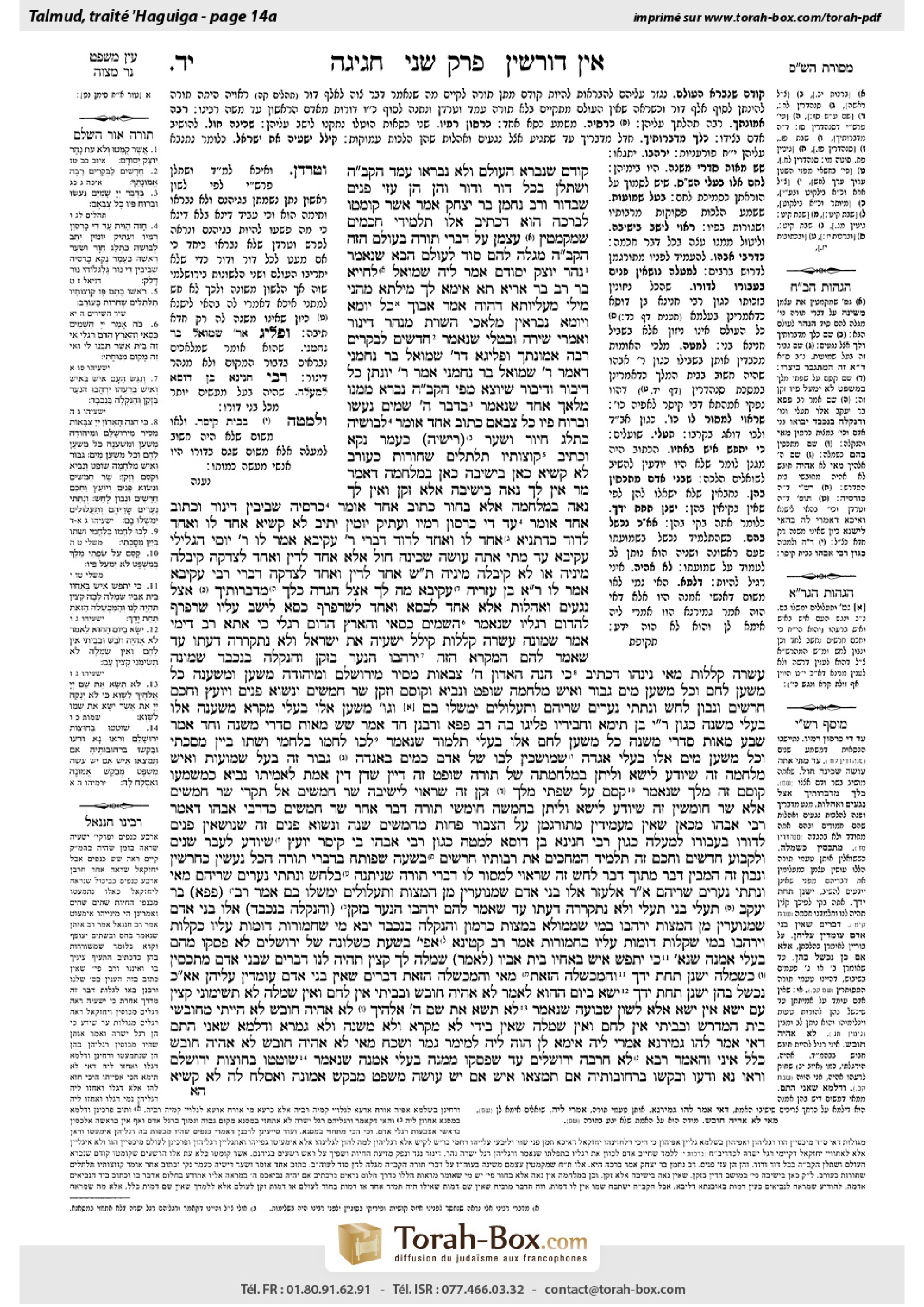
Chagigah 14a: Talmud study for Daf Yomi
Study the Talmud for Daf Yomi with scanned pages, Hebrew text, English translations from Sefaria and AI-generated French translations.
Passage selection and English or AI-generated French translation are available where the scan has annotations. Daf Study is independent of Torah-Box and Sefaria.
Browse Chagigah · חגיגה · All tractatesChagigah 14a text and translations
This page of Chagigah includes the Aramaic text, an English translation and an AI-generated French translation, alongside the scan above.
חגיגה י״ד א · Aramaic and Hebrew text
קוֹדֶם שֶׁנִּבְרָא הָעוֹלָם, וְלֹא נִבְרְאוּ. עָמַד הַקָּדוֹשׁ בָּרוּךְ הוּא וּשְׁתָלָן בְּכׇל דּוֹר וָדוֹר, וְהֵן הֵן עַזֵּי פָנִים שֶׁבַּדּוֹר.
וְרַב נַחְמָן בַּר יִצְחָק אָמַר: ״אֲשֶׁר קוּמְּטוּ״ — לִבְרָכָה הוּא דִּכְתִיב. אֵלּוּ תַּלְמִידֵי חֲכָמִים שֶׁמְּקַמְּטִין עַצְמָן עַל דִּבְרֵי תוֹרָה בָּעוֹלָם הַזֶּה, הַקָּדוֹשׁ בָּרוּךְ הוּא מְגַלֶּה לָהֶם סוֹד לָעוֹלָם הַבָּא, שֶׁנֶּאֱמַר: ״נָהָר יוּצַק יְסוֹדָם״.
אֲמַר לֵיהּ שְׁמוּאֵל לְחִיָּיא בַּר רַב: בַּר אַרְיָא! תָּא אֵימָא לָךְ מִילְּתָא מֵהָנֵי מִילֵּי מְעַלְּיָיתָא דַּהֲוָה אָמַר אֲבוּךְ: כֹּל יוֹמָא וְיוֹמָא נִבְרָאִין מַלְאֲכֵי הַשָּׁרֵת מִנְּהַר דִּינוּר, וְאָמְרִי שִׁירָה וּבָטְלִי, שֶׁנֶּאֱמַר: ״חֲדָשִׁים לַבְּקָרִים רַבָּה אֱמוּנָתֶךָ״. וּפְלִיגָא דְּרַבִּי שְׁמוּאֵל בַּר נַחְמָנִי. דְּאָמַר רַבִּי שְׁמוּאֵל בַּר נַחְמָנִי אָמַר רַבִּי יוֹנָתָן: כׇּל דִּיבּוּר וְדִיבּוּר שֶׁיּוֹצֵא מִפִּי הַקָּדוֹשׁ בָּרוּךְ הוּא נִבְרָא מִמֶּנּוּ מַלְאָךְ אֶחָד, שֶׁנֶּאֱמַר: ״בִּדְבַר ה׳ שָׁמַיִם נַעֲשׂוּ וּבְרוּחַ פִּיו כׇּל צְבָאָם״.
כָּתוּב אֶחָד אוֹמֵר: ״לְבוּשֵׁיהּ כִּתְלַג חִיוָּר וּשְׂעַר רֵישֵׁיהּ כַּעֲמַר נְקֵא״. וּכְתִיב: ״קְוֻצּוֹתָיו תַּלְתַּלִּים שְׁחוֹרוֹת כָּעוֹרֵב״! לָא קַשְׁיָא: כָּאן בִּישִׁיבָה, כָּאן בַּמִּלְחָמָה. דְּאָמַר מָר: אֵין לְךָ נָאֶה בִּישִׁיבָה אֶלָּא זָקֵן, וְאֵין לְךָ נָאֶה בַּמִּלְחָמָה אֶלָּא בָּחוּר.
כָּתוּב אֶחָד אוֹמֵר: ״כׇּרְסְיֵהּ שְׁבִיבִין דִּינוּר״, וְכָתוּב אֶחָד אוֹמֵר: ״עַד דִּי כׇרְסָוָן רְמִיו וְעַתִּיק יוֹמִין יְתִיב״! לָא קַשְׁיָא: אֶחָד לוֹ וְאֶחָד לְדָוִד. כִּדְתַנְיָא: אֶחָד לוֹ וְאֶחָד לְדָוִד, דִּבְרֵי רַבִּי עֲקִיבָא. אָמַר לוֹ רַבִּי יוֹסֵי הַגְּלִילִי: עֲקִיבָא, עַד מָתַי אַתָּה עוֹשֶׂה שְׁכִינָה חוֹל?! אֶלָּא: אֶחָד לְדִין וְאֶחָד לִצְדָקָה.
קַיבְּלַהּ מִינֵּיהּ, אוֹ לָא קַיבְּלַהּ מִינֵּיהּ? תָּא שְׁמַע: אֶחָד לְדִין וְאֶחָד לִצְדָקָה, דִּבְרֵי רַבִּי עֲקִיבָא. אָמַר לוֹ רַבִּי אֶלְעָזָר בֶּן עֲזַרְיָה: עֲקִיבָא, מָה לְךָ אֵצֶל הַגָּדָה! כְּלָךְ מִדַּבְּרוֹתֶיךָ אֵצֶל נְגָעִים וְאֹהָלוֹת. אֶלָּא: אֶחָד לְכִסֵּא וְאֶחָד לִשְׁרַפְרַף. כִּסֵּא — לֵישֵׁב עָלָיו, שְׁרַפְרַף — לַהֲדוֹם רַגְלָיו, שֶׁנֶּאֱמַר: ״הַשָּׁמַיִם כִּסְאִי וְהָאָרֶץ הֲדוֹם רַגְלָי״.
כִּי אֲתָא רַב דִּימִי, אָמַר: שְׁמוֹנֶה עֶשְׂרֵה קְלָלוֹת קִילֵּל יְשַׁעְיָה אֶת יִשְׂרָאֵל, וְלֹא נִתְקָרְרָה דַּעְתּוֹ עַד שֶׁאָמַר לָהֶם הַמִּקְרָא הַזֶּה: ״יִרְהֲבוּ הַנַּעַר בַּזָּקֵן וְהַנִּקְלֶה בַּנִּכְבָּד״.
שְׁמוֹנֶה עֶשְׂרֵה קְלָלוֹת, מַאי נִינְהוּ? דִּכְתִיב: ״כִּי הִנֵּה הָאָדוֹן ה׳ צְבָאוֹת מֵסִיר מִירוּשָׁלִַם וּמִיהוּדָה מַשְׁעֵן וּמַשְׁעֵנָה כֹּל מִשְׁעַן לֶחֶם וְכֹל מִשְׁעַן מָיִם גִּבּוֹר וְאִישׁ מִלְחָמָה שׁוֹפֵט וְנָבִיא וְקוֹסֵם וְזָקֵן. שַׂר חֲמִשִּׁים וּנְשׂוּא פָנִים וְיוֹעֵץ וַחֲכַם חֲרָשִׁים וּנְבוֹן לָחַשׁ. וְנָתַתִּי נְעָרִים שָׂרֵיהֶם וְתַעֲלוּלִים יִמְשְׁלוּ בָם וְגוֹ׳״.
״מַשְׁעֵן״ — אֵלּוּ בַּעֲלֵי מִקְרָא. ״מַשְׁעֵנָה״ — אֵלּוּ בַּעְלֵי מִשְׁנָה, כְּגוֹן רַבִּי יְהוּדָה בֶּן תֵּימָא וַחֲבֵירָיו. פְּלִיגִי בַּהּ רַב פָּפָּא וְרַבָּנַן, חַד אָמַר: שֵׁשׁ מֵאוֹת סִדְרֵי מִשְׁנָה, וְחַד אָמַר: שְׁבַע מֵאוֹת סִדְרֵי מִשְׁנָה.
״כֹּל מִשְׁעַן לֶחֶם״ — אֵלּוּ בַּעֲלֵי תַלְמוּד, שֶׁנֶּאֱמַר: ״לְכוּ לַחֲמוּ בְלַחֲמִי וּשְׁתוּ בְּיַיִן מָסָכְתִּי״. ״וְכֹל מִשְׁעַן מָיִם״ — אֵלּוּ בַּעֲלֵי אַגָּדָה, שֶׁמּוֹשְׁכִין לִבּוֹ שֶׁל אָדָם כַּמַּיִם בְּאַגָּדָה. ״גִּבּוֹר״ — זֶה בַּעַל שְׁמוּעוֹת. ״וְאִישׁ מִלְחָמָה״ — זֶה שֶׁיּוֹדֵעַ לִישָּׂא וְלִיתֵּן בְּמִלְחַמְתָּהּ שֶׁל תּוֹרָה. ״שׁוֹפֵט״ — זֶה דַּיָּין שֶׁדָּן דִּין אֱמֶת לַאֲמִיתּוֹ. ״נָבִיא״ — כְּמַשְׁמָעוֹ. ״קוֹסֵם״ — זֶה מֶלֶךְ, שֶׁנֶּאֱמַר: ״קֶסֶם עַל שִׂפְתֵי מֶלֶךְ״. ״זָקֵן״ — זֶה שֶׁרָאוּי לִישִׁיבָה.
״שַׂר חֲמִשִּׁים״ — אַל תִּקְרֵי ״שַׂר חֲמִשִּׁים״, אֶלָּא ״שַׂר חוּמָּשִׁין״. זֶה שֶׁיּוֹדֵעַ לִישָּׂא וְלִיתֵּן בַּחֲמִשָּׁה חוּמְשֵׁי תוֹרָה. דָּבָר אַחֵר: ״שַׂר חֲמִשִּׁים״ — כִּדְרַבִּי אֲבָהוּ. דְּאָמַר רַבִּי אֲבָהוּ: מִכָּאן שֶׁאֵין מַעֲמִידִין מְתוּרְגְּמָן עַל הַצִּבּוּר פָּחוֹת מֵחֲמִשִּׁים שָׁנָה. ״וּנְשׂוּא פָּנִים״ — זֶה שֶׁנּוֹשְׂאִין פָּנִים לְדוֹרוֹ בַּעֲבוּרוֹ. לְמַעְלָה, כְּגוֹן רַבִּי חֲנִינָא בֶּן דּוֹסָא. לְמַטָּה, כְּגוֹן רַבִּי אֲבָהוּ בֵּי קֵיסָר.
״יוֹעֵץ״ — שֶׁיּוֹדֵעַ לְעַבֵּר שָׁנִים וְלִקְבּוֹעַ חֳדָשִׁים. ״וְחָכָם״ — זֶה תַּלְמִיד הַמַּחְכִּים אֶת רַבּוֹתָיו. ״חֲרָשִׁים״ — בְּשָׁעָה שֶׁפּוֹתֵחַ בְּדִבְרֵי תוֹרָה הַכֹּל נַעֲשִׂין כְּחֵרְשִׁין. ״וְנָבוֹן״ — זֶה הַמֵּבִין דָּבָר מִתּוֹךְ דָּבָר. ״לָחַשׁ״ — זֶה שֶׁרָאוּי לִמְסוֹר לוֹ דִּבְרֵי תוֹרָה שֶׁנִּיתְּנָה בְּלַחַשׁ.
״וְנָתַתִּי נְעָרִים שָׂרֵיהֶם״. מַאי ״וְנָתַתִּי נְעָרִים שָׂרֵיהֶם״? אָמַר רַבִּי אֶלְעָזָר: אֵלּוּ בְּנֵי אָדָם שֶׁמְּנוֹעָרִין מִן הַמִּצְוֹת.
״וְתַעֲלוּלִים יִמְשְׁלוּ בָּם״ — אָמַר רַב פָּפָּא בַּר יַעֲקֹב: תַּעֲלֵי בְּנֵי תַעֲלֵי. וְלֹא נִתְקָרְרָה דַּעְתּוֹ, עַד שֶׁאָמַר לָהֶם: ״יִרְהֲבוּ הַנַּעַר בַּזָּקֵן וְהַנִּקְלֶה בַּנִּכְבָּד״ — אֵלּוּ בְּנֵי אָדָם שֶׁמְּנוֹעָרִין מִן הַמִּצְוֹת, יִרְהֲבוּ בְּמֵי שֶׁמְּמוּלָּא בְּמִצְוֹת כְּרִמּוֹן. ״וְהַנִּקְלֶה בַּנִּכְבָּד״ — יָבֹא מִי שֶׁחֲמוּרוֹת דּוֹמוֹת עָלָיו כְּקַלּוֹת, וְיִרְהֲבוּ בְּמִי שֶׁקַּלּוֹת דּוֹמוֹת עָלָיו כַּחֲמוּרוֹת.
אָמַר רַב קַטִּינָא: אֲפִילּוּ בִּשְׁעַת כִּשְׁלוֹנָהּ שֶׁל יְרוּשָׁלָיִם — לֹא פָּסְקוּ מֵהֶם בַּעֲלֵי אֲמָנָה, שֶׁנֶּאֱמַר: ״כִּי יִתְפֹּשׂ אִישׁ בְּאָחִיו בֵּית אָבִיו שִׂמְלָה לְךָ קָצִין תִּהְיֶה לָנוּ״. דְּבָרִים שֶׁבְּנֵי אָדָם מִתְכַּסִּין כְּשִׂמְלָה, יֶשְׁנָן תַּחַת יָדֶךָ.
״וְהַמַּכְשֵׁלָה הַזֹּאת״. מַאי ״וְהַמַּכְשֵׁלָה הַזֹּאת״ — דְּבָרִים שֶׁאֵין בְּנֵי אָדָם עוֹמְדִין עֲלֵיהֶן אֶלָּא אִם כֵּן נִכְשָׁל בָּהֶן — ״יֶשְׁנָן תַּחַת יָדֶךָ״. ״יִשָּׂא בַיּוֹם הַהוּא לֵאמֹר לֹא אֶהְיֶה חוֹבֵשׁ וּבְבֵיתִי אֵין לֶחֶם וְאֵין שִׂמְלָה לֹא תְשִׂימוּנִי קְצִין עָם״. ״יִשָּׂא״ — אֵין יִשָּׂא אֶלָּא לְשׁוֹן שְׁבוּעָה, שֶׁנֶּאֱמַר: ״לֹא תִשָּׂא אֶת שֵׁם ה׳ אֱלֹהֶיךָ״. ״לֹא אֶהְיֶה חוֹבֵשׁ״ — לֹא הָיִיתִי מֵחוֹבְשֵׁי בֵּית הַמִּדְרָשׁ. ״וּבְבֵיתִי אֵין לֶחֶם וְאֵין שִׂמְלָה״ — שֶׁאֵין בְּיָדִי לֹא מִקְרָא וְלֹא מִשְׁנָה וְלֹא גְּמָרָא.
וְדִלְמָא שָׁאנֵי הָתָם, דְּאִי אָמַר לְהוּ גְּמִירְנָא — אָמְרִי לֵיהּ: אֵימָא לַן! הֲוָה לֵיהּ לְמֵימַר גְּמַר וּשְׁכַח. מַאי ״לֹא אֶהְיֶה חוֹבֵשׁ״ — לֹא אֶהְיֶה חוֹבֵשׁ כְּלָל.
אִינִי?! וְהָאָמַר רָבָא: לֹא חָרְבָה יְרוּשָׁלַיִם עַד שֶׁפָּסְקוּ מִמֶּנָּה בַּעֲלֵי אֲמָנָה, שֶׁנֶּאֱמַר: ״שׁוֹטְטוּ בְּחוּצוֹת יְרוּשָׁלִַם וּרְאוּ נָא וּדְעוּ וּבַקְשׁוּ בִרְחוֹבוֹתֶיהָ אִם תִּמְצְאוּ אִישׁ אִם יֵשׁ עוֹשֶׂה מִשְׁפָּט מְבַקֵּשׁ אֱמוּנָה וְאֶסְלַח לָהּ״! לָא קַשְׁיָא:
Chagigah 14a · English translation
before the creation of the world, but they were not created. The Torah was supposed to have been given a thousand generations after the world was created, as it is written: “He commanded His word for a thousand generations” (Psalms 105:8), but God gave it earlier, after only twenty-six generations, so that nine-hundred and seventy-four generations should have been created but were not. The Holy One, Blessed be He, acted by planting a few of them in each and every generation, and they are the insolent ones of the generation, as they belonged to generations that should not have been created at all.
And Rav Naḥman bar Yitzḥak said that the verse: “Who were snatched [kumtu]” (Job 22:16), is written for a blessing, as the verse is not referring to lowly, cursed people, but to the blessed. These are Torah scholars, who shrivel [mekamtin], i.e., humble, themselves over the words of Torah in this world. The Holy One, Blessed be He, reveals a secret to them in the World-to-Come, as it is stated: “Whose foundation [yesodam] was poured out as a stream” (Job 22:16), implying that He will provide them with an abundant knowledge of secret matters [sod].
Shmuel said to Ḥiyya bar Rav: Son of great ones, come and I will tell you something of the great things that your father would say: Each and every day, ministering angels are created from the River Dinur, and they recite song to God and then immediately cease to exist, as it is stated: “They are new every morning; great is Your faithfulness” (Lamentations 3:23), indicating that new angels praise God each morning. The Gemara comments: And this opinion disagrees with that of Rabbi Shmuel bar Naḥmani, as Rabbi Shmuel bar Naḥmani said that Rabbi Yonatan said: With each and every word that emerges from the mouth of the Holy One, Blessed be He, an angel is created, as it is stated: “By the word of the Lord the heavens were made, and by the breath of His mouth all their hosts” (Psalms 33:6). The hosts of heaven are the angels, who, he claims, are created from the mouth of God, rather than from the River Dinur.
§ The Gemara continues to reconcile verses that seem to contradict each other: One verse states: “His raiment was as white snow, and the hair of his head like pure white wool” (Daniel 7:9), and it is written: “His locks are curled, black as a raven” (Song of Songs 5:11). The Gemara answers: This is not difficult. Here the verse in Daniel is referring to when He is in the heavenly academy, while there the verse in Song of Songs speaks of when He is at war, for the Master said: There is no finer individual to study Torah in an academy than an old man, and there is no finer individual to wage war than a youth. A different metaphor is therefore used to describe God on each occasion.
The Gemara poses another question: One verse states: “His throne was fiery flames” (Daniel 7:9), and another phrase in the same verse states: “Till thrones were placed, and one who was ancient of days sat,” implying the existence of two thrones. The Gemara answers: This is not difficult. One throne is for Him and one is for David, as it is taught in a baraita with regard to this issue: One throne for Him and one for David; this is the statement of Rabbi Akiva. Rabbi Yosei HaGelili said to him: Akiva, how long shall you make the Divine Presence profane, by presenting it as though one could sit next to Him? Rather, the two thrones are designated for different purposes: One for judgment and one for righteousness.
The Gemara asks: Did Rabbi Akiva accept this rebuff from him, or did he not accept it from him? The Gemara offers a proof: Come and hear the following teaching of a different baraita: One throne is for judgment and one is for righteousness; this is the statement of Rabbi Akiva. Rabbi Elazar ben Azarya said to him: Akiva, what are you doing occupying yourself with the study of aggada? This is not your field of expertise. Take [kelakh] your words to the topics of plagues and tents. Meaning, it is preferable that you teach the halakhot of the impurity of leprosy and the impurity of the dead, which are within your field of expertise. Rather, with regard to the two thrones: One throne is for a seat and one is for a small seat. The seat is to sit on, and the small seat is for His footstool, as it is stated: “The heavens are My seat, and the earth My footstool” (Isaiah 66:1).
§ The Gemara stated earlier that one who studies the secrets of Torah must be “a captain of fifty and a man of favor” (Isaiah 3:3), but it did not explain the meaning of these requirements. It now returns to analyze that verse in detail. When Rav Dimi came from Israel to Babylonia, he said: Isaiah cursed Israel with eighteen curses, and his mind was not calmed, i.e., he was not satisfied, until he said to them the great curse of the following verse: “The child shall behave insolently against the aged, and the base against the honorable” (Isaiah 3:5).
The Gemara asks: What are these eighteen curses? The Gemara answers: As it is written: “For behold, the Master, the Lord of hosts, shall take away from Jerusalem and from Judah support and staff, every support of bread, and every support of water; the mighty man, and the man of war; the judge, and the prophet, and the diviner, and the elder; the captain of fifty, and the man of favor, and the counselor, and the cunning charmer, and the skillful enchanter. And I will make children their princes, and babes shall rule over them” (Isaiah 3:1–4). The eighteen items listed in these verses shall be removed from Israel.
The Gemara proceeds to clarify the homiletical meaning of these terms: “Support”; these are masters of the Bible. “Staff”; these are masters of Mishna, such as Rabbi Yehuda ben Teima and his colleagues. The Gemara interjects: Rav Pappa and the Rabbis disagreed with regard to this. One of them said: They were proficient in six hundred orders of Mishna, and the other one said: In seven hundred orders of Mishna, only six of which remain today.
“Every support of bread”; these are masters of Talmud, as it is stated: “Come, eat of my bread, and drink of the wine that I have mingled” (Proverbs 9:5). “And every support of water”; these are the masters of aggada, who draw people’s hearts like water by means of aggada. “The mighty man”; this is the master of halakhic tradition, one who masters the halakhot transmitted to him from his rabbis. “And the man of war”; this is one who knows how to engage in the discourse of Torah, generating novel teachings in the war of Torah. “A judge”; this is a judge who judges a true judgment truthfully. “A prophet”; as it literally indicates. “A diviner”; this is a king. Why is he called a diviner? For it is stated: “A divine sentence is on the lips of the king” (Proverbs 16:10). “An elder”; this is one fit for the position of head of an academy.
“A captain of fifty,” do not read it as “sar ḥamishim,” rather read it as “sar ḥumashin”; this is one who knows how to engage in discourse with regard to the five books of [ḥamisha ḥumshei] the Torah. Alternatively, “a captain of fifty” should be understood in accordance with Rabbi Abbahu, for Rabbi Abbahu said: From here we learn that one may not appoint a disseminator over the public to transmit words of Torah or teachings of the Sages if he is less than fifty years of age. “And the man of favor”; this is one for whose sake favor is shown to his generation. The Gemara provides different examples of this: Some garner favor above, such as Rabbi Ḥanina ben Dosa, whose prayers for his generation would invariably be answered. Others gain favor below, for example: Rabbi Abbahu, who would plead Israel’s case in the house of the emperor.
“The counselor”; this is referring to one who knows how to intercalate years and determine months, due to his expertise in the phases of the moon and the calculation of the yearly cycle. “The cunning”; this is a student who makes his rabbis wise through his questions. “Charmer [ḥarashim]”; this is referring to one so wise that when he begins speaking matters of Torah, all those listening are as though deaf [ḥershin], as they are unable to comprehend the profundity of his comments. “The skillful”; this is one who understands something new from something else he has learned. “Enchanter [laḥash]”; this is referring to one who is worthy of having words of the Torah that were given in whispers [laḥash], i.e., the secrets of the Torah, transmitted to him.
The Gemara continues to interpret this verse: “And I will make children their princes” (Isaiah 3:4). The Gemara asks: What is the meaning of “And I will make children [ne’arim] their princes”? Rabbi Elazar said: These are people who are devoid [meno’arin] of mitzvot; such people will become the leaders of the nation.
“And babes [ta’alulim] shall rule over them”; Rav Pappa bar Ya’akov said: Ta’alulim means foxes [ta’alei], sons of foxes. In other words, inferior people both in terms of deeds and in terms of lineage. And the prophet Isaiah’s mind was not calmed until he said to them: “The child shall behave insolently against the aged, and the base against the honorable” (Isaiah 3:5). “The child” [na’ar]; these are people who are devoid of mitzvot, who will behave insolently toward one who is as filled with mitzvot as a pomegranate. “And the base [nikleh] against the honorable [nikhbad]”; this means that one for whom major [kaved] transgressions are like minor ones [kalot] in his mind will come and behave insolently with one for whom even minor transgressions are like major ones in his mind.
§ The Gemara continues its explanation of the chapter in Isaiah. Rav Ketina said: Even at the time of Jerusalem’s downfall, trustworthy men did not cease to exist among its people, as it is stated: “For a man shall take hold of his brother of the house of his father, and say: You have a cloak, be our ruler” (Isaiah 3:6). The Gemara explains that they would approach someone and say to him: Things that people are careful to keep covered as with a cloak, i.e., words of Torah that are covered and concealed, are under your hand, as you are an expert with regard to them.
What is the meaning of the end of that verse: “And this stumbling block” (Isaiah 3:6)? Things that people cannot grasp unless they have stumbled over them, as they can be understood only with much effort, are under your hand. Although they will approach an individual with these statements, he “shall swear that day, saying: I will not be a healer, for in my house there is neither bread nor a cloak; you shall not make me ruler of a people” (Isaiah 3:7). When the verse states: “Shall swear [yissa],” yissa is none other than an expression of an oath, as it is stated: “You shall not take [tissa] the name of the Lord your God in vain” (Exodus 20:6). Therefore, the inhabitant of Jerusalem swears: “I will not be a healer [ḥovesh]” (Isaiah 3:7), which means: I was never one of those who sit [meḥovshei] in the study hall; “for in my house there is neither bread nor a cloak,” as I possess knowledge of neither the Bible, nor Mishna, nor Gemara. This shows that even at Jerusalem’s lowest spiritual ebb, its inhabitants would admit the truth and own up to their complete ignorance.
The Gemara raises a difficulty: But perhaps it is different there, for if he had said: I have learned, they would have said to him: Tell us, and people do not lie about things that can be easily verified. The Gemara rejects this claim: If he were a liar, he would have said that he learned and forgot, thereby avoiding shame. What is the meaning of “I will not be a healer,” which seems to imply that he had learned in the past? It means: I will not be a healer at all, as I have never learned. Consequently, there were trustworthy men in Jerusalem after all.
The Gemara raises another difficulty: Is that so? But didn’t Rava say: Jerusalem was not destroyed until trustworthy men ceased to exist in it, as it is stated: “Run to and fro through the streets of Jerusalem, and see now and know, and seek in its broad places, if you can find a man, if there is any that acts justly, that seeks truth, and I will pardon her” (Jeremiah 5:1), implying there were no trustworthy people at that time? The Gemara answers: This is not difficult:
Chagigah 14a · Traduction française (IA)
Avant la création du monde, ils n'ont pas été créés. La Torah aurait dû être donnée mille générations après la création du monde, comme il est écrit : « Il a commandé Sa parole pour mille générations » (Psaumes 105:8), mais Dieu l'a donnée plus tôt, après seulement vingt-six générations, de sorte que neuf-cent-soixante-quatorze générations auraient dû être créées mais ne l'ont pas été. Le Saint, le Bienheureux, a agi en plantant quelques-uns d'entre eux dans chaque génération, et ils sont les insolents de la génération, car ils appartenaient à des générations qui ne devraient pas avoir été créées du tout.
Et Rav Naḥman bar Yitzḥak a dit que la versette : « Qui furent arrachés [kumtu] » (Job 22:16), est écrite pour une bénédiction, car la versette ne fait pas référence à des personnes misérables, maudites, mais aux bénis. Ce sont des savants de la Torah, qui se prosternent [mekamtin], c'est-à-dire humbles, sur les paroles de la Torah dans ce monde. Le Saint, le Bienheureux, révèle un secret à eux dans le Monde à Venir, comme il est dit : « Dont la fondation [yesodam] fut versée comme un cours d'eau » (Job 22:16), impliquant qu'Il leur fournira une connaissance abondante des secrets [sod].
Shmuel a dit à Ḥiyya bar Rav : Fils de grands, viens et je te dirai quelque chose des grandes choses que ton père disait : Chaque jour, des anges ministraux sont créés du fleuve Dinur, et ils chantent à Dieu et puis disparaissent immédiatement, comme il est dit : « Ils sont nouveaux chaque matin ; grand est Ta fidélité » (Lamentations 3:23), indiquant que de nouveaux anges louent Dieu chaque matin. La Guemara commente : Et cet avis s'oppose à celui de Rabbi Shmuel bar Naḥmani, car Rabbi Shmuel bar Naḥmani a dit que Rabbi Yonatan a dit : Avec chaque parole qui sort de la bouche du Saint, le Bienheureux, un ange est créé, comme il est dit : « Par la parole du Seigneur les cieux furent faits, et par le souffle de Sa bouche toutes ses armées » (Psaumes 33:6). Les armées du ciel sont les anges, qui, selon lui, sont créés de la bouche de Dieu, et non du fleuve Dinur.
§ La Guemara continue à concilier des versets qui semblent s'opposer les uns aux autres : Un verset dit : « Sa robe était comme la neige blanche, et la chevelure de sa tête comme la laine blanche pure » (Daniel 7:9), et il est écrit : « Ses cheveux sont bouclés, noirs comme un corbeau » (Cantique des Cantiques 5:11). La Guemara répond : Ce n'est pas difficile. Ici, le verset de Daniel fait référence à l'époque où Il est dans l'académie céleste, tandis que là, le verset du Cantique des Cantiques parle de l'époque où Il est en guerre, car le Maître a dit : Il n'y a pas de personne plus excellente pour étudier la Torah dans une académie que l'homme âgé, et il n'y a pas de personne plus excellente pour mener une guerre que le jeune homme. Un autre métaphore est donc utilisée pour décrire Dieu à chaque occasion.
La Guemara pose une autre question : Un verset dit : « Son trône était des flammes » (Daniel 7:9), et une autre phrase du même verset dit : « Jusqu'à ce que les trônes fussent placés, et celui qui était ancien des jours s'assit », suggérant l'existence de deux trônes. La Guemara répond : Ce n'est pas difficile. Un trône est pour Lui et un autre pour David, comme il est enseigné dans une baraïta concernant cette question : Un trône pour Lui et un pour David ; c'est l'opinion de Rabbi Akiva. Rabbi Yosei HaGelili a dit à lui : Akiva, combien de temps vas-tu profaner la Présence Divine en le présentant comme si l'on pouvait s'asseoir à côté de Lui ? Plutôt, les deux trônes sont désignés pour des buts différents : Un pour le jugement et un pour la justice.
La Guemara demande : Rabbi Akiva a-t-il accepté cette réprimande, ou non ? La Guemara offre une preuve : Viens et écoute la suivante enseignement d'une autre baraïta : Un trône pour le jugement et un pour la justice ; c'est l'opinion de Rabbi Akiva. Rabbi Elazar ben Azarya a dit à lui : Akiva, que fais-tu en t'occupant de l'étude de l'aggada ? Cela n'est pas ton domaine d'expertise. Prends [kelakh] tes paroles sur les sujets des épidémies et des tentes. Cela signifie qu'il est préférable que tu enseignes les halakhot de l'impureté de la lèpre et de la mort, qui sont dans ton domaine d'expertise. Plutôt, concernant les deux trônes : Un trône est pour un siège et un autre est pour un petit siège. Le siège est pour s'asseoir, et le petit siège est pour son escabeau, comme il est dit : « Les cieux sont mon siège, et la terre mon escabeau » (Michée 66:1).
§ La Guemara avait dit précédemment qu'on doit être « un chef de cinquante et un homme de faveur » (Isaïe 3:3) pour étudier les secrets de la Torah, mais elle n'avait pas expliqué le sens de ces exigences. Elle revient maintenant à analyser ce verset en détail. Quand Rav Dimi est venu d'Israël vers Babylone, il a dit : Isaïe a maudit Israël avec dix-huit maledictions, et son esprit n'était pas apaisé, c'est-à-dire il n'était pas satisfait, jusqu'à ce qu'il ait dit à eux la grande malédiction du verset suivant : « L'enfant se comportera insolentement contre les vieillards, et le bas contre l'honorable » (Isaïe 3:5).
La Guemara demande : Quelles sont ces dix-huit maledictions ? La Guemara répond : Comme il est écrit : « Car voici, le Seigneur, l'Éternel des armées, enlèvera de Jérusalem et de Juda le soutien et la verge, tout soutien de pain et tout soutien d'eau ; le puissant et le guerrier ; le juge, le prophète, le divin, l'ancien ; le chef de cinquante, l'homme de faveur, le conseiller, le charmeur habile, le magicien habile. Et je ferai des enfants leurs rois, et des bébés commanderont sur eux » (Isaïe 3:1–4). Les dix-huit choses listées dans ces versets seront retirées d'Israël.
La Guemara poursuit pour clarifier le sens allégorique de ces termes : « Soutien » ; ce sont les maîtres de la Bible. « Verges » ; ce sont les maîtres de la Michna, tels que Rabbi Yehuda ben Teima et ses collègues. La Guemara intercale : Rav Pappa et les Rabbins étaient en désaccord sur ce point. L'un d'eux a dit : Ils étaient experts en six cents ordres de Michna, et l'autre a dit : En sept cents ordres de Michna, seulement six desquels restent aujourd'hui.
«Tout appui du pain» ; ces sont les maîtres de la Talmud, comme il est dit : «Viens, mange de mon pain, et bois du vin que j'ai mélangé» (Proverbes 9:5). «Et tout appui de l'eau» ; ces sont les maîtres de l'aggada, qui attirent les cœurs des gens comme l'eau par l'aggada. «Le fort» ; c'est le maître de la tradition halakhique, celui qui maîtrise les halakhot transmis par ses rabbins. «Et l'homme de guerre» ; c'est celui qui sait s'engager dans la discussion de la Torah, générant des enseignements nouveaux dans la guerre de la Torah. «Un juge» ; c'est un juge qui rend un jugement véritable avec vérité. «Un prophète» ; comme il l'indique littéralement. «Un devin» ; c'est un roi. Pourquoi est-il appelé un devin ? Parce qu'il est dit : «Un jugement divin est sur les lèvres du roi» (Proverbes 16:10). «Un vieillard» ; c'est celui qui est digne du poste de chef d'une académie.
«Un chef de cinquante» ; ne le lis pas comme «sar ḥamishim», mais comme «sar ḥumashin» ; c'est celui qui sait s'engager dans la discussion concernant les cinq livres [ḥamisha ḥumshei] de la Torah. D'une autre manière, «un chef de cinquante» doit être compris selon Rabbi Abbahu, car Rabbi Abbahu a dit : d'ici nous apprenons que l'on ne peut pas nommer un diffuseur sur le public pour transmettre des paroles de Torah ou des enseignements des Sages si celui-ci n'a pas atteint l'âge de cinquante ans. «Et l'homme de faveur» ; c'est celui pour lequel la faveur est donnée à sa génération. La Guemara donne différents exemples de cela : certains gagnent la faveur au-dessus, comme Rabbi Ḥanina ben Dosa, dont les prières pour sa génération étaient toujours exaucées. D'autres gagnent la faveur en dessous, par exemple : Rabbi Abbahu, qui plaide la cause d'Israël dans la maison de l'empereur.
«Le conseiller» ; cela fait référence à celui qui sait intercaler les années et déterminer les mois, en raison de son expertise sur les phases de la lune et le calcul du cycle annuel. «Le rusé» ; c'est un étudiant qui rend ses rabbins sages par ses questions. «Le charmeur [ḥarashim]» ; cela fait référence à celui qui est si sage que lorsqu'il commence à parler de choses de la Torah, tous ceux qui l'écoutent sont comme sourds [ḥershin], car ils ne peuvent pas comprendre la profondeur de ses commentaires. «Le habile» ; c'est celui qui comprend quelque chose de nouveau à partir de quelque chose qu'il a appris. «L'enchanter [laḥash]» ; cela fait référence à celui qui est digne de recevoir des paroles de la Torah données en murmures [laḥash], c'est-à-dire les secrets de la Torah, transmis à lui.
La Guemara continue l'interprétation de cette verset : «Et je ferai des enfants leurs princes» (Isaïe 3:4). La Guemara demande : Quelle est la signification de «Et je ferai des enfants [ne’arim] leurs princes» ? Rabbi Elazar a dit : Ce sont des gens qui sont dépourvus [meno’arin] de mitsvot ; tels gens deviendront les chefs du peuple.
«Et les bébés [ta’alulim] régneront sur eux» ; Rav Pappa bar Ya’akov a dit : ta’alulim signifie des renards [ta’alei], enfants de renards. En d'autres termes, des gens inférieurs à la fois en termes d'actions et de lignage. Et l'esprit du prophète Isaïe ne s'est calmé que lorsqu'il a dit à eux : «L'enfant se comportera impudément contre les vieillards, et le bas contre l'honorable» (Isaïe 3:5). «L'enfant» [na’ar] ; ce sont des gens dépourvus de mitsvot, qui se comporteront impudément envers celui qui est aussi rempli de mitsvot qu'un pamplemousse. «Et le bas [nikleh] contre l'honorable [nikhbad]» ; cela signifie que celui pour qui les transgressions graves sont comme les transgressions légères dans son esprit viendra et se comportera impudément avec celui pour qui même les transgressions légères sont comme les graves dans son esprit.
§ La Guemara continue son explication du chapitre d'Isaïe. Rav Ketina a dit : Même à l'époque de la chute de Jérusalem, des hommes dignes n'ont pas cessé d'exister parmi son peuple, comme il est dit : «Un homme saisira son frère de la maison de son père, et dira : Tu as une cape, sois notre chef» (Isaïe 3:6). La Guemara explique qu'ils approcheraient quelqu'un et lui diraient : Les choses que les gens prennent soin de couvrir comme avec une cape, c'est-à-dire les paroles de la Torah qui sont couvertes et cachées, sont sous ta main, car tu es un expert à cet égard.
Quelle est la signification de la fin de ce verset : «Et ce blocage» (Isaïe 3:6) ? Les choses que les gens ne peuvent pas saisir à moins qu'ils ne s'y soient heurtés, car elles peuvent être comprises seulement avec beaucoup d'effort, sont sous ta main. Bien qu'ils approchent un individu avec ces déclarations, il «jurera ce jour, disant : Je ne serai pas un guérisseur, car chez moi il n'y a ni pain ni cape ; tu ne me feras pas roi d'un peuple» (Isaïe 3:7). Lorsque le verset dit : «Jurera [yissa]», yissa n'est autre qu'une expression d'un serment, comme il est dit : «Tu ne prendras pas [tissa] le nom du Seigneur ton Dieu en vain» (Exode 20:6). Ainsi, l'habitant de Jérusalem jure : «Je ne serai pas un guérisseur [ḥovesh]» (Isaïe 3:7), ce qui signifie : Je n'étais jamais l'un de ceux qui s'assoient [meḥovshei] dans la salle de étude ; «car chez moi il n'y a ni pain ni cape», car je possède la connaissance ni de la Bible, ni de la Michna, ni de la Guemara. Cela montre que même à l'époque la plus basse de Jérusalem, ses habitants reconnaîtraient la vérité et avoueraient leur ignorance totale.
La Guemara soulève un doute : Mais peut-être cela est différent là-bas, car s'il avait dit : J'ai appris, ils auraient dit à lui : Dis-nous, et les gens ne mentent pas sur les choses qu'ils peuvent facilement vérifier. La Guemara rejette cette affirmation : Si c'était un menteur, il aurait dit qu'il avait appris et oublié, pour éviter la honte. Quelle est la signification de « Je ne serai pas un guérisseur », qui semble impliquer qu'il avait appris dans le passé ? Cela signifie : Je ne serai pas un guérisseur du tout, car je n'ai jamais appris. Ainsi, il y avait des hommes dignes à Jérusalem après tout.
La Guemara soulève un autre doute : Est-ce ainsi ? Mais n'a-t-il pas dit Rava : Jérusalem n'a pas été détruite jusqu'à ce que les hommes dignes cesseront d'exister en elle, comme il est dit : « Fuis dans les rues de Jérusalem, et vois maintenant et sais, et cherche dans ses vastes espaces, si tu peux trouver un homme, s'il y a quelqu'un qui agit justement, qui cherche la vérité, et je pardonnerai à elle » (Jérémie 5:1), impliquant qu'il n'y avait plus d'hommes dignes à cette époque ? La Guemara répond : Ce n'est pas difficile :
Traduction française générée par IA à partir de l’édition anglaise de Sefaria. Vérifie toujours un passage avec le texte source.
Text from Sefaria: William Davidson Edition - Vocalized Aramaic (CC BY NC); William Davidson Edition - English (CC BY NC).