Chagigah 14b: Talmud study for Daf Yomi
Study the Talmud for Daf Yomi with scanned pages, Hebrew text, English translations from Sefaria and AI-generated French translations.
Passage selection and English or AI-generated French translation are available where the scan has annotations. Daf Study is independent of Torah-Box and Sefaria.
Browse Chagigah · חגיגה · All tractatesChagigah 14b text and translations
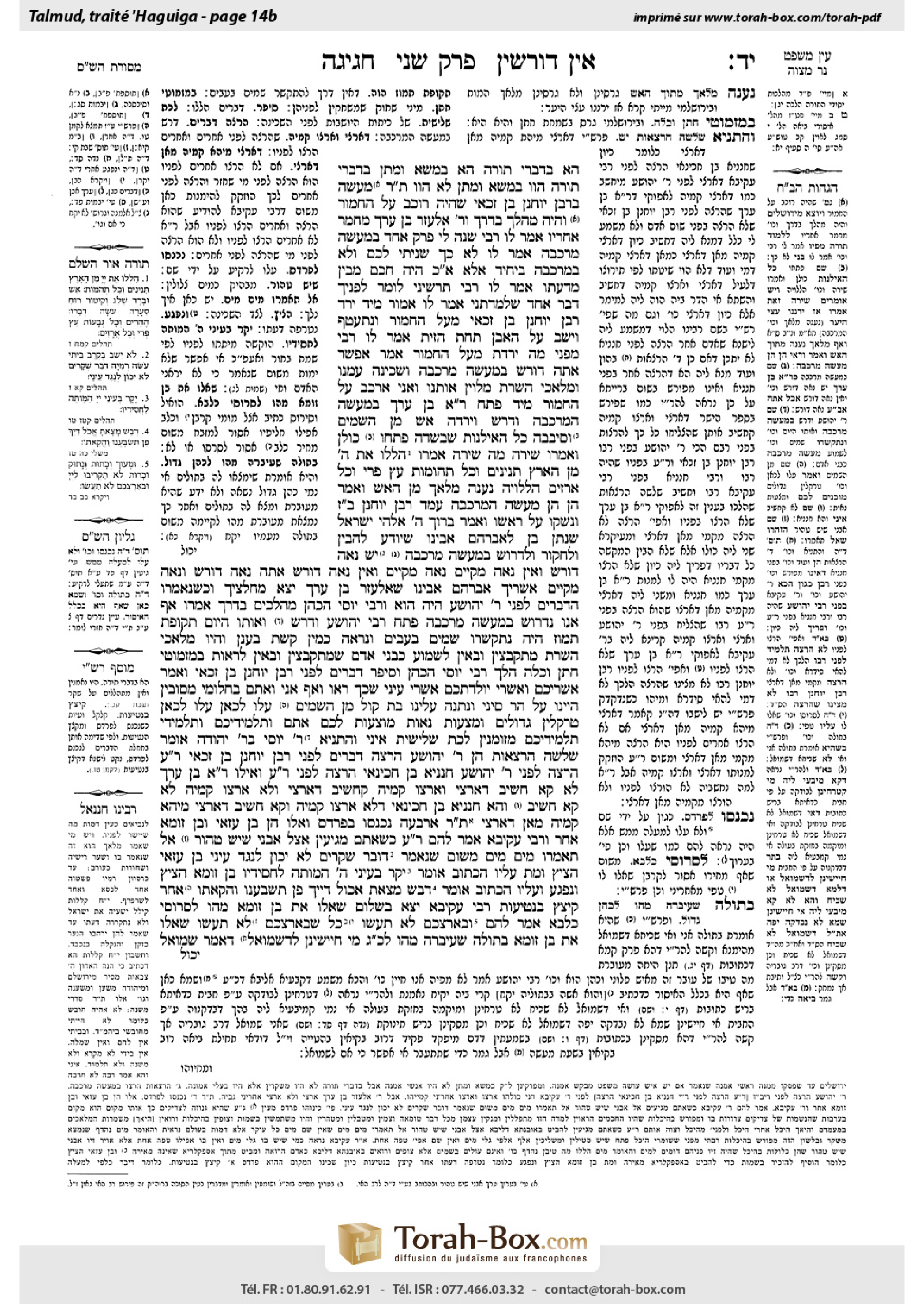
This page of Chagigah includes the Aramaic text, an English translation and an AI-generated French translation, alongside the scan above.
חגיגה י״ד ב · Aramaic and Hebrew text
הָא בְּדִבְרֵי תוֹרָה, הָא בְּמַשָּׂא וּמַתָּן. בְּדִבְרֵי תוֹרָה — הֲווֹ, בְּמַשָּׂא וּמַתָּן — לָא הֲווֹ.
תָּנוּ רַבָּנַן: מַעֲשֶׂה בְּרַבָּן יוֹחָנָן בֶּן זַכַּאי שֶׁהָיָה רוֹכֵב עַל הַחֲמוֹר, וְהָיָה מְהַלֵּךְ בַּדֶּרֶךְ, וְרַבִּי אֶלְעָזָר בֶּן עֲרָךְ מְחַמֵּר אַחֲרָיו. אָמַר לוֹ: רַבִּי, שְׁנֵה לִי פֶּרֶק אֶחָד בְּמַעֲשֵׂה מֶרְכָּבָה. אָמַר לוֹ, לֹא כָּךְ שָׁנִיתִי לָכֶם: וְלֹא בַּמֶּרְכָּבָה בְּיָחִיד אֶלָּא אִם כֵּן הָיָה חָכָם מֵבִין מִדַּעְתּוֹ? אָמַר לוֹ: רַבִּי, תַּרְשֵׁינִי לוֹמַר לְפָנֶיךָ דָּבָר אֶחָד שֶׁלִּמַּדְתַּנִי. אָמַר לוֹ: אֱמוֹר.
מִיָּד יָרַד רַבָּן יוֹחָנָן בֶּן זַכַּאי מֵעַל הַחֲמוֹר, וְנִתְעַטֵּף, וְיָשַׁב עַל הָאֶבֶן תַּחַת הַזַּיִת. אָמַר לוֹ: רַבִּי, מִפְּנֵי מָה יָרַדְתָּ מֵעַל הַחֲמוֹר? אָמַר: אֶפְשָׁר אַתָּה דּוֹרֵשׁ בְּמַעֲשֵׂה מֶרְכָּבָה, וּשְׁכִינָה עִמָּנוּ, וּמַלְאֲכֵי הַשָּׁרֵת מְלַוִּין אוֹתָנוּ, וַאֲנִי אֶרְכַּב עַל הַחֲמוֹר?! מִיָּד פָּתַח רַבִּי אֶלְעָזָר בֶּן עֲרָךְ בְּמַעֲשֵׂה הַמֶּרְכָּבָה וְדָרַשׁ. וְיָרְדָה אֵשׁ מִן הַשָּׁמַיִם, וְסִיבְּבָה כׇּל הָאִילָנוֹת שֶׁבַּשָּׂדֶה, פָּתְחוּ כּוּלָּן וְאָמְרוּ שִׁירָה.
מָה שִׁירָה אָמְרוּ — ״הַלְלוּ אֶת ה׳ מִן הָאָרֶץ תַּנִּינִים וְכׇל תְּהוֹמוֹת ... עֵץ פְּרִי וְכׇל אֲרָזִים ... הַלְלוּיָהּ״. נַעֲנָה מַלְאָךְ מִן הָאֵשׁ, וְאָמַר: הֵן הֵן מַעֲשֵׂה הַמֶּרְכָּבָה. עָמַד רַבָּן יוֹחָנָן בֶּן זַכַּאי וּנְשָׁקוֹ עַל רֹאשׁוֹ, וְאָמַר: בָּרוּךְ ה׳ אֱלֹהֵי יִשְׂרָאֵל שֶׁנָּתַן בֵּן לְאַבְרָהָם אָבִינוּ שֶׁיּוֹדֵעַ לְהָבִין וְלַחְקוֹר וְלִדְרוֹשׁ בְּמַעֲשֵׂה מֶרְכָּבָה. יֵשׁ נָאֶה דּוֹרֵשׁ וְאֵין נָאֶה מְקַיֵּים, נָאֶה מְקַיֵּים וְאֵין נָאֶה דּוֹרֵשׁ. אַתָּה נָאֶה דּוֹרֵשׁ וְנָאֶה מְקַיֵּים. אַשְׁרֶיךָ אַבְרָהָם אָבִינוּ, שֶׁאֶלְעָזָר בֶּן עֲרָךְ יָצָא מֵחֲלָצֶיךָ.
וּכְשֶׁנֶּאֶמְרוּ הַדְּבָרִים לִפְנֵי רַבִּי יְהוֹשֻׁעַ, הָיָה הוּא וְרַבִּי יוֹסֵי הַכֹּהֵן מְהַלְּכִים בַּדֶּרֶךְ. אָמְרוּ: אַף אָנוּ נִדְרוֹשׁ בְּמַעֲשֵׂה מֶרְכָּבָה. פָּתַח רַבִּי יְהוֹשֻׁעַ וְדָרַשׁ. וְאוֹתוֹ הַיּוֹם תְּקוּפַת תַּמּוּז הָיָה. נִתְקַשְּׁרוּ שָׁמַיִם בְּעָבִים וְנִרְאֶה כְּמִין קֶשֶׁת בֶּעָנָן, וְהָיוּ מַלְאֲכֵי הַשָּׁרֵת מִתְקַבְּצִין וּבָאִין לִשְׁמוֹעַ, כִּבְנֵי אָדָם שֶׁמִּתְקַבְּצִין וּבָאִין לִרְאוֹת בְּמַזְמוּטֵי חָתָן וְכַלָּה.
הָלָךְ רַבִּי יוֹסֵי הַכֹּהֵן וְסִיפֵּר דְּבָרִים לִפְנֵי רַבָּן יוֹחָנָן בֶּן זַכַּאי, וְאָמַר: אַשְׁרֵיכֶם וְאַשְׁרֵי יוֹלַדְתְּכֶם, אַשְׁרֵי עֵינַי שֶׁכָּךְ רָאוּ. וְאַף אֲנִי וְאַתֶּם, בַּחֲלוֹמִי מְסוּבִּין הַיְינוּ עַל הַר סִינַי, וְנִתְּנָה עָלֵינוּ בַּת קוֹל מִן הַשָּׁמַיִם: עֲלוּ לְכָאן, עֲלוּ לְכָאן! טְרַקְלִין גְּדוֹלִים וּמַצָּעוֹת נָאוֹת מוּצָּעוֹת לָכֶם, אַתֶּם, וְתַלְמִידֵיכֶם, וְתַלְמִידֵי תַלְמִידֵיכֶם מְזוּמָּנִין לְכַת שְׁלִישִׁית.
אִינִי?! וְהָתַנְיָא, רַבִּי יוֹסֵי בְּרַבִּי יְהוּדָה אוֹמֵר: שְׁלֹשָׁה הַרְצָאוֹת הֵן, רַבִּי יְהוֹשֻׁעַ הִרְצָה דְּבָרִים לִפְנֵי רַבָּן יוֹחָנָן בֶּן זַכַּאי, רַבִּי עֲקִיבָא הִרְצָה לִפְנֵי רַבִּי יְהוֹשֻׁעַ, חֲנַנְיָא בֶּן חֲכִינַאי הִרְצָה לִפְנֵי רַבִּי עֲקִיבָא. וְאִילּוּ רַבִּי אֶלְעָזָר בֶּן עֲרָךְ לָא קָא חָשֵׁיב! דְּאַרְצִי וְאַרְצוֹ קַמֵּיהּ — קָחָשֵׁיב, דְּאַרְצִי וְלָא אַרְצוֹ קַמֵּיהּ — לָא קָא חָשֵׁיב. וְהָא חֲנַנְיָא בֶּן חֲכִינַאי דְּלָא אַרְצוֹ קַמֵּיהּ, וְקָא חָשֵׁיב! דְּאַרְצִי מִיהָא קַמֵּיהּ מַאן דְּאַרְצִי.
תָּנוּ רַבָּנַן: אַרְבָּעָה נִכְנְסוּ בַּפַּרְדֵּס, וְאֵלּוּ הֵן: בֶּן עַזַּאי, וּבֶן זוֹמָא, אַחֵר, וְרַבִּי עֲקִיבָא. אֲמַר לָהֶם רַבִּי עֲקִיבָא: כְּשֶׁאַתֶּם מַגִּיעִין אֵצֶל אַבְנֵי שַׁיִשׁ טָהוֹר, אַל תֹּאמְרוּ ״מַיִם מַיִם״, מִשּׁוּם שֶׁנֶּאֱמַר: ״דּוֹבֵר שְׁקָרִים לֹא יִכּוֹן לְנֶגֶד עֵינָי״.
בֶּן עַזַּאי הֵצִיץ וָמֵת, עָלָיו הַכָּתוּב אוֹמֵר: ״יָקָר בְּעֵינֵי ה׳ הַמָּוְתָה לַחֲסִידָיו״. בֶּן זוֹמָא הֵצִיץ וְנִפְגַּע, וְעָלָיו הַכָּתוּב אוֹמֵר: ״דְּבַשׁ מָצָאתָ אֱכוֹל דַּיֶּיךָּ פֶּן תִּשְׂבָּעֶנּוּ וַהֲקֵאתוֹ״. אַחֵר קִיצֵּץ בִּנְטִיעוֹת. רַבִּי עֲקִיבָא יָצָא בְּשָׁלוֹם.
שָׁאֲלוּ אֶת בֶּן זוֹמָא: מַהוּ לְסָרוֹסֵי כַּלְבָּא? אָמַר לָהֶם: ״וּבְאַרְצְכֶם לֹא תַעֲשׂוּ״, כֹּל שֶׁבְּאַרְצְכֶם לֹא תַעֲשׂוּ. שָׁאֲלוּ אֶת בֶּן זוֹמָא: בְּתוּלָה שֶׁעִיבְּרָה, מַהוּ לְכֹהֵן גָּדוֹל? מִי חָיְישִׁינַן לְדִשְׁמוּאֵל, דְּאָמַר שְׁמוּאֵל:
Chagigah 14b · English translation
This case is referring to words of Torah, while that case is referring to commerce. With regard to words of Torah, they were trustworthy; with regard to commerce, they were not.
§ The Gemara returns to the topic of the Design of the Divine Chariot. The Sages taught: An incident occurred involving Rabban Yoḥanan ben Zakkai, who was riding on a donkey and was traveling along the way, and his student, Rabbi Elazar ben Arakh, was riding a donkey behind him. Rabbi Elazar said to him: My teacher, teach me one chapter in the Design of the Divine Chariot. He said to him: Have I not taught you: And one may not expound the Design of the Divine Chariot to an individual, unless he is a Sage who understands on his own accord? Rabbi Elazar said to him: My teacher, allow me to say before you one thing that you taught me. In other words, he humbly requested to recite before him his own understanding of this issue. He said to him: Speak.
Immediately, Rabban Yoḥanan ben Zakkai alighted from the donkey, and wrapped his head in his cloak in a manner of reverence, and sat on a stone under an olive tree. Rabbi Elazar said to him: My teacher, for what reason did you alight from the donkey? He said: Is it possible that while you are expounding the Design of the Divine Chariot, and the Divine Presence is with us, and the ministering angels are accompanying us, that I should ride on a donkey? Immediately, Rabbi Elazar ben Arakh began to discuss the Design of the Divine Chariot and expounded, and fire descended from heaven and encircled all the trees in the field, and all the trees began reciting song.
What song did they recite? “Praise the Lord from the earth, sea monsters and all depths…fruit trees and all cedars…praise the Lord” (Psalms 148:7–14). An angel responded from the fire, saying: This is the very Design of the Divine Chariot, just as you expounded. Rabban Yoḥanan ben Zakkai stood and kissed Rabbi Elazar ben Arakh on his head, and said: Blessed be God, Lord of Israel, who gave our father Abraham a son like you, who knows how to understand, investigate, and expound the Design of the Divine Chariot. There are some who expound the Torah’s verses well but do not fulfill its imperatives well, and there are some who fulfill its imperatives well but do not expound its verses well, whereas you expound its verses well and fulfill its imperatives well. Happy are you, our father Abraham, that Elazar ben Arakh came from your loins.
The Gemara relates: And when these matters, this story involving his colleague Rabbi Elazar ben Arakh, were recounted before Rabbi Yehoshua, he was walking along the way with Rabbi Yosei the Priest. They said: We too shall expound the Design of the Divine Chariot. Rabbi Yehoshua began expounding. And that was the day of the summer solstice, when there are no clouds in the sky. Yet the heavens became filled with clouds, and there was the appearance of a kind of rainbow in a cloud. And ministering angels gathered and came to listen, like people gathering and coming to see the rejoicing of a bridegroom and bride.
Rabbi Yosei the Priest went and recited these matters before Rabban Yoḥanan ben Zakkai, who said to him: Happy are all of you, and happy are the mothers who gave birth to you; happy are my eyes that saw this, students such as these. As for you and I, I saw in my dream that we were seated at Mount Sinai, and a Divine Voice came to us from heaven: Ascend here, ascend here, for large halls [teraklin] and pleasant couches are made up for you. You, your students, and the students of your students are invited to the third group, those who will merit to welcome the Divine Presence.
The Gemara poses a question: Is that so? But isn’t it taught in a baraita: Rabbi Yosei, son of Rabbi Yehuda, says: There are three lectures. In other words, there are three Sages with regard to whom it states that they delivered lectures on the mystical tradition: Rabbi Yehoshua lectured on these matters before Rabban Yoḥanan ben Zakkai; Rabbi Akiva lectured before Rabbi Yehoshua; and Ḥananya ben Ḥakhinai lectured before Rabbi Akiva. However, Rabbi Elazar ben Arakh was not included in the list, despite the testimony that he lectured before Rabban Yoḥanan. The Gemara explains: Those who lectured and were also lectured to were included; but those who lectured and were not lectured to were not included. The Gemara asks: But wasn’t there Ḥananya ben Ḥakhinai, who was not lectured to, and yet he is included? The Gemara answers: Ḥananya ben Ḥakhinai actually lectured before one who lectured in front of his own rabbi, so he was also included in this list.
§ The Sages taught: Four entered the orchard [pardes], i.e., dealt with the loftiest secrets of Torah, and they are as follows: Ben Azzai; and ben Zoma; Aḥer, the other, a name for Elisha ben Avuya; and Rabbi Akiva. Rabbi Akiva, the senior among them, said to them: When, upon your arrival in the upper worlds, you reach pure marble stones, do not say: Water, water, although they appear to be water, because it is stated: “He who speaks falsehood shall not be established before My eyes” (Psalms 101:7).
The Gemara proceeds to relate what happened to each of them: Ben Azzai glimpsed at the Divine Presence and died. And with regard to him the verse states: “Precious in the eyes of the Lord is the death of His pious ones” (Psalms 116:15). Ben Zoma glimpsed at the Divine Presence and was harmed, i.e., he lost his mind. And with regard to him the verse states: “Have you found honey? Eat as much as is sufficient for you, lest you become full from it and vomit it” (Proverbs 25:16). Aḥer chopped down the shoots of saplings. In other words, he became a heretic. Rabbi Akiva came out safely.
The Gemara recounts the greatness of ben Zoma, who was an expert interpreter of the Torah and could find obscure proofs: They asked ben Zoma: What is the halakha with regard to castrating a dog? The prohibition against castration appears alongside the sacrificial blemishes, which may imply that it is permitted to castrate an animal that cannot be sacrificed as an offering. He said to them: The verse states “That which has its testicles bruised, or crushed, or torn, or cut, you shall not offer to God, nor shall you do so in your land” (Leviticus 22:24), from which we learn: With regard to any animal that is in your land, you shall not do such a thing. They also asked ben Zoma: A woman considered to be a virgin who became pregnant, what is the halakha? A High Priest may marry only a virgin; is he permitted to marry her? The answer depends on the following: Are we concerned for the opinion of Shmuel? Shmuel says:
Chagigah 14b · Traduction française (IA)
Ce cas concerne des paroles de Torah, tandis que l'autre cas concerne le commerce. En ce qui concerne les paroles de Torah, ils étaient dignes de confiance ; en ce qui concerne le commerce, ils ne l'étaient pas.
§ La Guemara reprend le sujet du Chariot divin. Les Sages enseignèrent : un incident eut lieu concernant Rabban Yoḥanan ben Zakkai, qui montait un âne et voyageait sur la route, et son élève, Rabbi Elazar ben Arakh, montait un âne derrière lui. Rabbi Elazar dit à lui : Mon maître, apprends-moi un chapitre sur le Chariot divin. Il lui répondit : N'ai-je pas déjà enseigné que l'on ne peut pas expliquer le Chariot divin à un individu, sauf s'il est un Sage qui comprend par lui-même ? Rabbi Elazar dit à lui : Mon maître, permets-moi de dire devant toi une chose que tu as enseignée. En d'autres termes, il demanda humblement à reciter devant lui sa propre compréhension de ce sujet. Il lui dit : Parle.
Immédiatement, Rabban Yoḥanan ben Zakkai descendit de l'âne et enveloppa sa tête dans son manteau avec une attitude de respect, puis s'assit sur une pierre sous un olivier. Rabbi Elazar lui demanda : Mon maître, pourquoi as-tu descendu de l'âne ? Il répondit : Est-ce possible que, pendant que tu expliques le Chariot divin et que la Divine Présence est avec nous, et que les anges ministraux nous accompagnent, je monte un âne ? Immédiatement, Rabbi Elazar ben Arakh commença à discuter du Chariot divin et l'expliqua, et un feu descendit du ciel et entoura tous les arbres du champ, et tous les arbres commencèrent à chanter.
Quelle chanson chantaient-ils ? « Louez l'Éternel de la terre, les monstres de la mer et toutes les profondeurs… les arbres fruitiers et tous les cèdres… louez l'Éternel » (Psaumes 148 : 7–14). Un ange répondit depuis le feu, disant : C'est précisément le Design du Chariot divin, comme tu l'as expliqué. Rabban Yoḥanan ben Zakkai se leva et baisa la tête de Rabbi Elazar ben Arakh, et dit : Béni soit Dieu, Seigneur d'Israël, qui a donné à notre père Abraham un fils comme toi, qui sait comprendre, investiguer et expliquer le Design du Chariot divin. Il y a des gens qui expliquent bien les versets de la Torah mais ne remplissent pas bien ses commandements, et il y a des gens qui remplissent bien ses commandements mais n'expliquent pas bien ses versets, tandis que toi, tu expliques bien ses versets et remplis bien ses commandements. Heureux es-tu, notre père Abraham, que Elazar ben Arakh est venu de tes entrailles.
La Guemara rapporte : Et lorsqu'on raconta ces choses, ce récit concernant son collègue Rabbi Elazar ben Arakh, devant Rabbi Yehoshua, il marchait sur la route avec Rabbi Yosei le Prêtre. Ils dirent : Nous aussi, nous explicherons le Design du Chariot divin. Rabbi Yehoshua commença à l'expliquer. Et c'était le jour du solstice d'été, où il n'y a pas de nuages au ciel. Cependant, le ciel s'emplissait de nuages, et il y avait l'apparition d'une sorte d'arc-en-ciel dans un nuage. Et les anges ministraux se rassemblèrent et vinrent écouter, comme des gens se rassemblant et venant voir la joie d'un mari et d'une mariée.
Rabbi Yosei le Prêtre alla et exposa ces choses devant Rabban Yoḥanan ben Zakkai, qui lui dit : Heureux êtes-vous tous, et heureux sont les mères qui vous ont donnés la vie ; heureux sont mes yeux qui ont vu cela, des élèves tels que ceux-ci. Quant à vous et moi, j'ai vu dans mon rêve que nous étions assis à Mount Sinai, et une Voix Divine vint vers nous du ciel : Montez ici, montez ici, car des grandes salles [teraklin] et des belles chaises sont préparées pour vous. Vous, vos élèves, et les élèves de vos élèves sont invités au troisième groupe, ceux qui méritent d'accueillir la Présence Divine.
La Guemara pose une question : Est-ce ainsi ? Mais n'est-il pas enseigné dans une baraïta : Rabbi Yosei, fils de Rabbi Yehuda, dit : Il y a trois discours. En d'autres termes, il y a trois Sages auxquels il est dit qu'ils ont délivré des discours sur la tradition mystique : Rabbi Yehoshua a délivré ces choses devant Rabban Yoḥanan ben Zakkai ; Rabbi Akiva a délivré devant Rabbi Yehoshua ; et Ḥananya ben Ḥakhinai a délivré devant Rabbi Akiva. Cependant, Rabbi Elazar ben Arakh n'était pas inclus dans la liste, malgré le témoignage qu'il avait délivré devant Rabban Yoḥanan. La Guemara explique : ceux qui ont délivré et ont été aussi délivrés ont été inclus ; ceux qui ont délivré mais n'ont pas été délivrés n'étaient pas inclus. La Guemara pose la question : Mais n'était-il pas Ḥananya ben Ḥakhinai, qui n'a pas été délivré, et pourtant il est inclus ? La Guemara répond : Ḥananya ben Ḥakhinai a délivré devant celui qui a délivré devant son propre rabbi, donc il a été également inclus dans cette liste.
§ Les Sages enseignèrent : Quatre entrèrent dans le jardin [pardes], c'est-à-dire qu'ils étudièrent les plus hautes secrets de la Torah, et ils sont les suivants : Ben Azzai ; et Ben Zoma ; Aḥer, l'autre, un nom pour Elisha ben Avuya ; et Rabbi Akiva. Rabbi Akiva, le plus âgé d'entre eux, dit à eux : Lorsque, sur votre arrivée dans les mondes supérieurs, vous atteindrez des pierres pures de marbre, ne dites pas : Eau, eau, bien qu'elles semblent de l'eau, car il est dit : « Celui qui parle de mensonge ne sera pas établi devant mes yeux » (Psaumes 101 : 7).
La Guemara poursuit en racontant ce qui arriva à chacun d'eux : Ben Azzai a entrevu la Présence divine et est mort. Et concernant lui, la versette dit : « Précieux aux yeux de l'Éternel est la mort de ses justes » (Psaumes 116 : 15). Ben Zoma a entrevu la Présence divine et a été blessé, c'est-à-dire qu'il a perdu la raison. Et concernant lui, la versette dit : « As-tu trouvé du miel ? Mange autant que tu en as besoin, afin que tu ne deviennes pas trop plein et que tu ne vomisses pas » (Proverbes 25 : 16). Aḥer a coupé les pousses des jeunes arbres. En d'autres termes, il est devenu un hérétique. Rabbi Akiva est sorti en sécurité.
La Guemara rapporte la grandeur de ben Zoma, qui était un expert interprète de la Torah et pouvait trouver des preuves obscures : Ils demandèrent à ben Zoma : Quelle est la halakha concernant la castration d'un chien ? La prohibition de la castration apparaît à côté des défauts des sacrifices, ce qui pourrait impliquer qu'il est permis de castrer un animal qui ne peut être sacrifié comme offrande. Il répondit à ceux-ci : La parole « Celui dont les testicules sont écrasés, ou brisés, ou déchirés, ou tranchés, vous ne le présenterez pas à Dieu, ni ne le ferez-vous dans votre terre » (Lévitique 22:24), d'après laquelle nous apprenons : Concernant tout animal qui est dans votre terre, vous ne ferez pas cela. Ils demandèrent aussi à ben Zoma : Une femme considérée comme vierge qui est devenue enceinte, quelle est la halakha ? Un prêtre souverain peut épouser uniquement une vierge ; est-il autorisé à l'épouser ? La réponse dépend du suivant : Sommes-nous préoccupés par l'opinion de Shmuel ? Shmuel dit :
Traduction française générée par IA à partir de l’édition anglaise de Sefaria. Vérifie toujours un passage avec le texte source.
Text from Sefaria: William Davidson Edition - Vocalized Aramaic (CC BY NC); William Davidson Edition - English (CC BY NC).