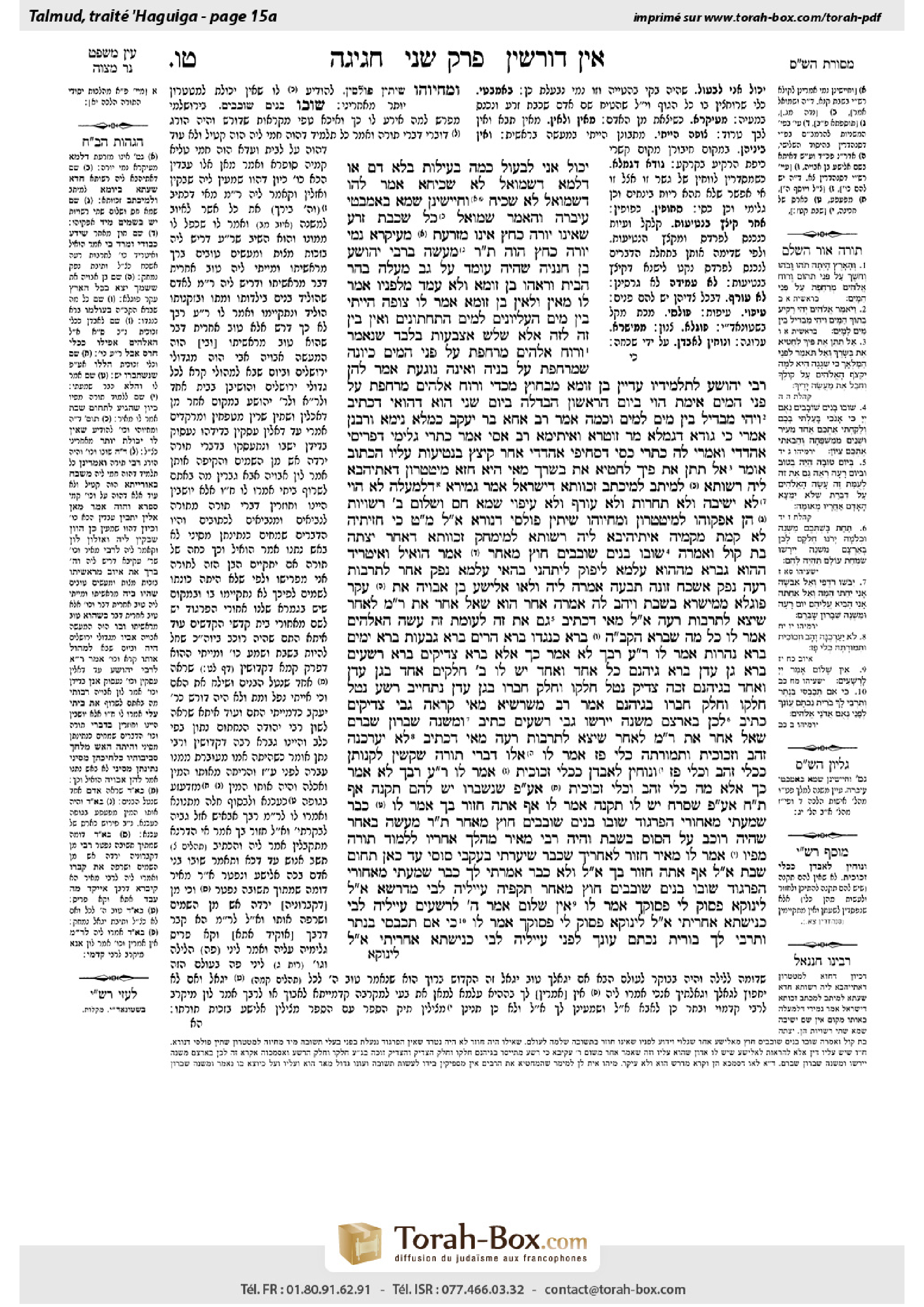
Chagigah 15a: Talmud study for Daf Yomi
Study the Talmud for Daf Yomi with scanned pages, Hebrew text, English translations from Sefaria and AI-generated French translations.
Passage selection and English or AI-generated French translation are available where the scan has annotations. Daf Study is independent of Torah-Box and Sefaria.
Browse Chagigah · חגיגה · All tractatesChagigah 15a text and translations
This page of Chagigah includes the Aramaic text, an English translation and an AI-generated French translation, alongside the scan above.
חגיגה י״ה א · Aramaic and Hebrew text
יָכוֹל אֲנִי לִבְעוֹל כַּמָּה בְּעִילוֹת בְּלֹא דָּם. אוֹ דִלְמָא דִּשְׁמוּאֵל לָא שְׁכִיחָא? אֲמַר לְהוּ: דִּשְׁמוּאֵל לָא שְׁכִיחַ, וְחָיְישִׁינַן שֶׁמָּא בְּאַמְבָּטִי עִיבְּרָה.
וְהָאָמַר שְׁמוּאֵל: כׇּל שִׁכְבַת זֶרַע שֶׁאֵינוֹ יוֹרֶה כְּחֵץ — אֵינָהּ מַזְרַעַת! מֵעִיקָּרָא נָמֵי יוֹרֶה כְּחֵץ הֲוָה.
תָּנוּ רַבָּנַן: מַעֲשֶׂה בְּרַבִּי יְהוֹשֻׁעַ בֶּן חֲנַנְיָה שֶׁהָיָה עוֹמֵד עַל גַּב מַעֲלָה בְּהַר הַבַּיִת, וְרָאָהוּ בֶּן זוֹמָא וְלֹא עָמַד מִלְּפָנָיו. אָמַר לוֹ: מֵאַיִן וּלְאַיִן בֶּן זוֹמָא? אָמַר לוֹ: צוֹפֶה הָיִיתִי בֵּין מַיִם הָעֶלְיוֹנִים לְמַיִם הַתַּחְתּוֹנִים, וְאֵין בֵּין זֶה לָזֶה אֶלָּא שָׁלֹשׁ אֶצְבָּעוֹת בִּלְבַד, שֶׁנֶּאֱמַר: ״וְרוּחַ אֱלֹהִים מְרַחֶפֶת עַל פְּנֵי הַמָּיִם״ — כְּיוֹנָה שֶׁמְּרַחֶפֶת עַל בָּנֶיהָ וְאֵינָהּ נוֹגַעַת. אָמַר לָהֶן רַבִּי יְהוֹשֻׁעַ לְתַלְמִידָיו: עֲדַיִין בֶּן זוֹמָא מִבַּחוּץ.
מִכְּדֵי ״וְרוּחַ אֱלֹהִים מְרַחֶפֶת עַל פְּנֵי הַמָּיִם״ אֵימַת הָוֵי — בַּיּוֹם הָרִאשׁוֹן, הַבְדָּלָה — בְּיוֹם שֵׁנִי הוּא דַּהֲוַאי, דִּכְתִיב: ״וִיהִי מַבְדִּיל בֵּין מַיִם לָמָיִם״. וְכַמָּה? אָמַר רַב אַחָא בַּר יַעֲקֹב: כִּמְלֹא נִימָא. וְרַבָּנַן אָמְרִי: כִּי גוּדָּא דְגַמְלָא. מָר זוּטְרָא, וְאִיתֵּימָא רַב אַסִּי אָמַר: כִּתְרֵי גְלִימֵי דִּפְרִיסִי אַהֲדָדֵי. וְאָמְרִי לַהּ: כִּתְרֵי כָסֵי דִּסְחִיפִי אַהֲדָדֵי.
אַחֵר קִיצֵּץ בִּנְטִיעוֹת, עָלָיו הַכָּתוּב אוֹמֵר: ״אַל תִּתֵּן אֶת פִּיךָ לַחֲטִיא אֶת בְּשָׂרֶךָ״. מַאי הִיא? חֲזָא מֶיטַטְרוֹן דְּאִתְיְהִבָא לֵיהּ רְשׁוּתָא לְמֵיתַב לְמִיכְתַּב זַכְווֹתָא דְיִשְׂרָאֵל, אֲמַר: גְּמִירִי דִּלְמַעְלָה לָא הָוֵי לֹא יְשִׁיבָה וְלֹא תַּחֲרוּת, וְלֹא עוֹרֶף וְלֹא עִיפּוּי. שֶׁמָּא, חַס וְשָׁלוֹם, שְׁתֵּי רְשׁוּיוֹת הֵן.
אַפְּקוּהּ לְמֶיטַטְרוֹן ומַחְיוּהּ שִׁיתִּין פּוּלְסֵי דְנוּרָא. אֲמַרוּ לֵיהּ: מַאי טַעְמָא כִּי חֲזִיתֵיהּ לָא קַמְתְּ מִקַּמֵּיהּ? אִיתְיְהִיבָא לֵיהּ רְשׁוּתָא לְמִימְחַק זַכְווֹתָא דְאַחֵר. יָצְתָה בַּת קוֹל וְאָמְרָה: ״שׁוּבוּ בָּנִים שׁוֹבָבִים״ — חוּץ מֵאַחֵר.
אֲמַר: הוֹאִיל וְאִיטְּרִיד הָהוּא גַּבְרָא מֵהָהוּא עָלְמָא, לִיפּוֹק לִיתְהֲנֵי בְּהַאי עָלְמָא. נְפַק אַחֵר לְתַרְבּוּת רָעָה. נְפַק, אַשְׁכַּח זוֹנָה תַּבְעַהּ, אֲמַרָה לֵיהּ: וְלָאו אֱלִישָׁע בֶּן אֲבוּיָה אַתְּ? עֲקַר פּוּגְלָא מִמֵּישְׁרָא בְּשַׁבָּת וִיהַב לַהּ, אָמְרָה: אַחֵר הוּא.
שָׁאַל אַחֵר אֶת רַבִּי מֵאִיר לְאַחַר שֶׁיָּצָא לְתַרְבּוּת רָעָה, אֲמַר לֵיהּ: מַאי דִּכְתִיב: ״גַּם אֶת זֶה לְעוּמַּת זֶה עָשָׂה הָאֱלֹהִים״? אָמַר לוֹ: כׇּל מַה שֶּׁבָּרָא הַקָּדוֹשׁ בָּרוּךְ הוּא, בָּרָא כְּנֶגְדּוֹ. בָּרָא הָרִים — בָּרָא גְּבָעוֹת, בָּרָא יַמִּים — בָּרָא נְהָרוֹת.
אָמַר לוֹ: רַבִּי עֲקִיבָא רַבְּךָ לֹא אָמַר כָּךְ, אֶלָּא: בָּרָא צַדִּיקִים בָּרָא רְשָׁעִים, בָּרָא גַּן עֵדֶן בָּרָא גֵּיהִנָּם. כׇּל אֶחָד וְאֶחָד יֵשׁ לוֹ שְׁנֵי חֲלָקִים, אֶחָד בְּגַן עֵדֶן וְאֶחָד בְּגֵיהִנָּם. זָכָה צַדִּיק — נָטַל חֶלְקוֹ וְחֵלֶק חֲבֵרוֹ בְּגַן עֵדֶן, נִתְחַיֵּיב רָשָׁע — נָטַל חֶלְקוֹ וְחֵלֶק חֲבֵרוֹ בְּגֵיהִנָּם.
אָמַר רַב מְשַׁרְשְׁיָא: מַאי קְרָאָה — גַּבֵּי צַדִּיקִים כְּתִיב: ״לָכֵן בְּאַרְצָם מִשְׁנֶה יִירָשׁוּ״, גַּבֵּי רְשָׁעִים כְּתִיב: ״וּמִשְׁנֶה שִׁבָּרוֹן שׇׁבְרֵם״.
שָׁאַל אַחֵר אֶת רַבִּי מֵאִיר לְאַחַר שֶׁיָּצָא לְתַרְבּוּת רָעָה, מַאי דִּכְתִיב: ״לֹא יַעַרְכֶנָּה זָהָב וּזְכוֹכִית וּתְמוּרָתָהּ כְּלִי פָז״? אָמַר לוֹ: אֵלּוּ דִּבְרֵי תוֹרָה, שֶׁקָּשִׁין לִקְנוֹתָן כִּכְלֵי זָהָב וּכְלֵי פָז, וְנוֹחִין לְאַבְּדָן כִּכְלֵי זְכוּכִית. אָמַר לוֹ: רַבִּי עֲקִיבָא רַבָּךְ לֹא אָמַר כָּךְ, אֶלָּא: מָה כְּלֵי זָהָב וּכְלֵי זְכוּכִית, אַף עַל פִּי שֶׁנִּשְׁבְּרוּ — יֵשׁ לָהֶם תַּקָּנָה, אַף תַּלְמִיד חָכָם, אַף עַל פִּי שֶׁסָּרַח — יֵשׁ לוֹ תַּקָּנָה. אָמַר לוֹ: אַף אַתָּה חֲזוֹר בָּךְ! אָמַר לוֹ: כְּבָר שָׁמַעְתִּי מֵאֲחוֹרֵי הַפַּרְגּוֹד: ״שׁוּבוּ בָּנִים שׁוֹבָבִים״ — חוּץ מֵאַחֵר.
תָּנוּ רַבָּנַן: מַעֲשֶׂה בְּאַחֵר שֶׁהָיָה רוֹכֵב עַל הַסּוּס בְּשַׁבָּת, וְהָיָה רַבִּי מֵאִיר מְהַלֵּךְ אַחֲרָיו לִלְמוֹד תּוֹרָה מִפִּיו, אָמַר לוֹ: מֵאִיר, חֲזוֹר לְאַחֲרֶיךָ, שֶׁכְּבָר שִׁיעַרְתִּי בְּעִקְבֵי סוּסִי עַד כָּאן תְּחוּם שַׁבָּת. אָמַר לוֹ: אַף אַתָּה חֲזוֹר בָּךְ. אָמַר לוֹ: וְלֹא כְּבָר אָמַרְתִּי לְךָ כְּבָר שָׁמַעְתִּי מֵאֲחוֹרֵי הַפַּרְגּוֹד: ״שׁוּבוּ בָּנִים שׁוֹבָבִים״ — חוּץ מֵאַחֵר.
תַּקְפֵיהּ עַיְּילֵיהּ לְבֵי מִדְרְשָׁא, אֲמַר לֵיהּ לְיָנוֹקָא: פְּסוֹק לִי פְּסוּקָךְ. אָמַר לוֹ: ״אֵין שָׁלוֹם אָמַר ה׳ לָרְשָׁעִים״. עַיְּילֵיהּ לְבֵי כְנִישְׁתָּא אַחֲרִיתִי, אֲמַר לֵיהּ לְיָנוֹקָא: פְּסוֹק לִי פְּסוּקָךְ. אָמַר לוֹ: ״כִּי אִם תְּכַבְּסִי בַּנֶּתֶר וְתַרְבִּי לָךְ בּוֹרִית נִכְתָּם עֲוֹנֵךְ לְפָנַי״. עַיְּילֵיהּ לְבֵי כְּנִישְׁתָּא אַחֲרִיתִי, אֲמַר לֵיהּ
Chagigah 15a · English translation
I can engage in intercourse several times without blood. In other words, I can have relations with a woman while leaving her hymen intact. If this is so, it is possible that the assumed virgin had intercourse in this manner and is forbidden to the High Priest. Or, perhaps a person who can act like Shmuel is not common and the halakha is not concerned with this case. He said to them: One like Shmuel is not common, and we are concerned that she may have conceived in a bath. Perhaps she washed in a bath that contained a man’s semen, from which she became impregnated while remaining a virgin.
The Gemara asks: How could she possibly become pregnant in such a manner? Didn’t Shmuel say: Any semen that is not shot like an arrow cannot fertilize? The Gemara answers: This does not mean that it must be shot like an arrow at the moment of fertilization. Even if initially, when released from the male, it was shot as an arrow, it can also fertilize a woman at a later moment.
With regard to the fate of ben Zoma, the Sages taught: There was once an incident with regard to Rabbi Yehoshua ben Ḥananya, who was standing on a step on the Temple Mount, and ben Zoma saw him and did not stand before him to honor him, as he was deep in thought. Rabbi Yehoshua said to him: From where do you come and where are you going, ben Zoma, i.e., what is on your mind? He said to him: In my thoughts I was looking upon the act of Creation, at the gap between the upper waters and the lower waters, as there is only the breadth of a mere three fingers between them, as it is stated: “And the spirit of God hovered over the face of the waters” (Genesis 1:2), like a dove hovering over its young without touching them. Rabbi Yehoshua said to his students who had overheard this exchange: Ben Zoma is still outside; he has not yet achieved full understanding of these matters.
The Gemara explains: Now, this verse: “And the spirit of God hovered over the face of the waters,” when was it stated? On the first day, whereas the division of the waters occurred on the second day, as it is written: “And let it divide the waters from the waters” (Genesis 1:6). How, then, could ben Zoma derive a proof from the former verse? The Gemara asks: And how much, in fact, is the gap between them? Rav Aḥa bar Ya’akov said: Like the thickness of a thread; and the Rabbis said: Like the gap between the boards of a bridge. Mar Zutra, and some say it was Rav Asi, said: Like two robes spread one over the other, with a slight gap in between. And some said: Like two cups placed one upon the other.
§ The Gemara stated earlier that Aḥer chopped down the saplings, becoming a heretic. With regard to him, the verse states: “Do not let your mouth bring your flesh into guilt” (Ecclesiastes 5:5). The Gemara poses a question: What was it that led him to heresy? He saw the angel Mitatron, who was granted permission to sit and write the merits of Israel. He said: There is a tradition that in the world above there is no sitting; no competition; no turning one’s back before Him, i.e., all face the Divine Presence; and no lethargy. Seeing that someone other than God was seated above, he said: Perhaps, the Gemara here interjects, Heaven forbid, there are two authorities, and there is another source of power in control of the world in addition to God. Such thoughts led Aḥer to heresy.
The Gemara relates: They removed Mitatron from his place in heaven and smote him with sixty rods [pulsei] of fire, so that others would not make the mistake that Aḥer made. They said to the angel: What is the reason that when you saw Elisha ben Avuya you did not stand before him? Despite this conduct, since Mitatron was personally involved, he was granted permission to erase the merits of Aḥer and cause him to stumble in any manner. A Divine Voice went forth saying: “Return, rebellious children” (Jeremiah 3:22), apart from Aḥer.
Upon hearing this, Elisha ben Avuya said: Since that man, meaning himself, has been banished from that world, let him go out and enjoy this world. Aḥer went astray. He went and found a prostitute and solicited her for intercourse. She said to him: And are you not Elisha ben Avuya? Shall a person of your stature perform such an act? He uprooted a radish from a patch of radishes on Shabbat and gave it to her, to demonstrate that he no longer observed the Torah. The prostitute said: He is other than he was. He is not the same Elisha ben Avuya, he is Aḥer, other.
The Gemara relates: Aḥer asked Rabbi Meir a question, after he had gone astray. He said to him: What is the meaning of that which is written: “God has made even the one as well as the other” (Ecclesiastes 7:14)? Rabbi Meir said to him: Everything that the Holy One, Blessed be He, created, He created a similar creation corresponding to it. He created mountains, He created hills; He created seas, He created rivers.
Aḥer said to him: Rabbi Akiva, your teacher, did not say so, but explained the verse as follows: Everything has its opposite: He created the righteous, He created the wicked; He created the Garden of Eden, He created Gehenna. Each and every person has two portions, one in the Garden of Eden and one in Gehenna. If he merits it, by becoming righteous, he takes his portion and the portion of his wicked colleague in the Garden of Eden; if he is found culpable by becoming wicked, he takes his portion and the portion of his colleague in Gehenna.
Rav Mesharshiyya said: What is the verse from which it is derived? With regard to the righteous, it is stated: “Therefore in their land they shall possess double” (Isaiah 61:7); whereas with regard to the wicked, it is stated: “And destroy them with double destruction” (Jeremiah 17:18); therefore, each receives a double portion.
Aḥer asked Rabbi Meir another question, again after he had gone astray. What is the meaning of that which is written: “Gold and glass cannot equal it; neither shall its exchange be vessels of fine gold” (Job 28:17)? If it is referring to the praise and honor of the Torah, it should have compared it only to gold, not to glass. He said to him: This is referring to words of Torah, which are as difficult to acquire as gilded vessels and vessels of fine gold but are as easy to lose as glass vessels. Aḥer said to him: Rabbi Akiva, your teacher, did not say so, but taught as follows: Just as golden vessels and glass vessels have a remedy even when they have broken, as they can be melted down and made into new vessels, so too a Torah scholar, although he has transgressed, has a remedy. Rabbi Meir said to him: If so, you too, return from your ways. He said to him: I have already heard the following declaration behind the dividing curtain, which conceals God from the world: “Return, rebellious children,” (Jeremiah 3:22) apart from Aḥer.
The Gemara cites a related story: The Sages taught: There was once an incident involving Aḥer, who was riding on a horse on Shabbat, and Rabbi Meir was walking behind him to learn Torah from him. After a while, Aḥer said to him: Meir, turn back, for I have already estimated and measured according to the steps of my horse that the Shabbat boundary ends here, and you may therefore venture no further. Rabbi Meir said to him: You, too, return to the correct path. He said to him: But have I not already told you that I have already heard behind the dividing curtain: “Return, rebellious children,” apart from Aḥer?
Nevertheless, Rabbi Meir took hold of him and brought him to the study hall. Aḥer said to a child, by way of divination: Recite your verse that you studied today to me. He recited the following verse to him: “There is no peace, said the Lord, concerning the wicked” (Isaiah 48:22). He brought him to another study hall. Aḥer said to a child: Recite your verse to me. He recited to him: “For though you wash with niter, and take for you much soap, yet your iniquity is marked before Me” (Jeremiah 2:22). He brought him to another study hall. Aḥer said to
Chagigah 15a · Traduction française (IA)
Je peux avoir des relations sexuelles plusieurs fois sans que le sang ne soit versé. En d'autres termes, je peux avoir des relations avec une femme tout en laissant intact son hymen. Si c'est le cas, il est possible que la jeune fille supposée vierge ait eu des relations de cette manière et soit interdite au grand prêtre. Ou bien, peut-être qu'une personne capable de se comporter comme Shmuel n'est pas courante et la halakha ne s'occupe pas de ce cas. Il leur dit : Un tel homme comme Shmuel n'est pas commun, et nous craignons qu'elle ait pu être enceinte dans un bain. Peut-être qu'elle a lavé dans un bain contenant le sperme d'un homme, d'où elle est devenue enceinte tout en restant vierge.
La Guemara pose la question : Comment une femme aurait-elle pu être enceinte de cette manière ? N'a-t-il pas dit Shmuel : Tout sperme qui n'est pas expulsé comme une flèche ne peut pas féconder ? La Guemara répond : Cela ne signifie pas qu'il doit être expulsé comme une flèche au moment de la fécondation. Même si initialement, lorsqu'il est sorti du mâle, il a été expulsé comme une flèche, il peut aussi féconder une femme à un moment ultérieur.
En ce qui concerne le sort de ben Zoma, les Sages enseignèrent : Il y avait un incident concernant Rabbi Yehoshua ben Ḥananya, qui était debout sur une marche du Mont du Temple, et ben Zoma l'a vu sans lui rendre honneur, car il était plongé dans ses réflexions. Rabbi Yehoshua lui a dit : D'où viens-tu et où vas-tu, ben Zoma, c'est-à-dire, qu'est-ce qui t'occupe ? Il lui a répondu : Dans mes pensées, j'étais en train d'observer l'acte de la Création, le vide entre les eaux supérieures et les eaux inférieures, car il n'y a que la largeur de trois doigts entre eux, comme il est dit : « Et l'Esprit de Dieu planait sur la surface des eaux » (Genèse 1:2), comme un pigeon planant sur ses petits sans les toucher. Rabbi Yehoshua a dit à ses élèves qui avaient entendu cette conversation : Ben Zoma est encore dehors ; il n'a pas encore atteint une compréhension complète de ces choses.
La Guemara explique : Maintenant, cette verset : « Et l'Esprit de Dieu planait sur la surface des eaux », quand a-t-il été dit ? Le premier jour, alors que la division des eaux s'est produite le deuxième jour, comme il est écrit : « Et qu'il divise les eaux des eaux » (Genèse 1:6). Comment, alors, ben Zoma a-t-il pu tirer une preuve de ce verset ? La Guemara pose la question : Et combien, en réalité, est-ce que le vide entre eux ? Rav Aḥa bar Ya’akov a dit : Comme l'épaisseur d'un fil ; et les Sages ont dit : Comme le vide entre les planches d'un pont. Mar Zutra, et certains disent que c'était Rav Asi, a dit : Comme deux robes étalées l'une sur l'autre, avec un léger vide entre eux. Et certains ont dit : Comme deux coupes placées l'une sur l'autre.
§ La Guemara avait dit précédemment que Aḥer a coupé les jeunes pousses, devenant un hérétique. En ce qui concerne lui, le verset dit : « Ne laisse pas ta bouche t'entraîner à la faute » (Ecclésiaste 5:5). La Guemara pose une question : Qu'est-ce qui l'a conduit à l'hérésie ? Il a vu l'ange Mitatron, qui avait été autorisé à s'asseoir et à écrire les mérites d'Israël. Il a dit : Il y a une tradition selon laquelle dans le monde supérieur, il n'y a pas de s'asseoir ; pas de compétition ; pas de tourner le dos à Lui, c'est-à-dire que tous font face à la Présence divine ; et pas de lassitude. Voyant que quelqu'un d'autre que Dieu était assis au-dessus, il a dit : Peut-être, intercale la Guemara, Dieu forbid, il y a deux autorités, et il y a une autre source de pouvoir contrôlant le monde en plus de Dieu. Ces pensées ont conduit Aḥer à l'hérésie.
La Guemara rapporte : Ils ont retiré Mitatron de son lieu au ciel et l'ont frappé avec soixante verges [pulsei] de feu, afin que les autres ne fassent pas la même erreur que Aḥer. Ils ont dit à l'ange : Quel est le motif qui t'a fait ne pas t'asseoir devant Elisha ben Avuya ? Malgré ce comportement, puisque Mitatron était personnellement impliqué, il a été autorisé à effacer les mérites d'Aḥer et à le faire trébucher de toute manière. Une Voix divine est sortie en disant : « Retournés, enfants rebelles » (Jérémie 3:22), à l'exception d'Aḥer.
En entendant cela, Elisha ben Avuya a dit : Puisque cette personne, c'est-à-dire lui-même, a été expulsé de ce monde, laisse-le sortir et profiter de ce monde. Aḥer s'est écarté. Il est allé trouver une prostituée et a sollicité des relations sexuelles avec elle. Elle lui a dit : Et ne serais-tu pas Elisha ben Avuya ? Un homme de ton rang pourrait-il faire une telle chose ? Il a arraché un radis d'un tas de radis le sabbat et l'a donné à elle, pour montrer qu'il ne respectait plus la Torah. La prostituée a dit : Il est différent de ce qu'il était. Il n'est plus le même Elisha ben Avuya, il est Aḥer, autre.
La Guemara rapporte : Aḥer a posé une question à Rabbi Meir après qu'il eut dévié. Il lui a dit : Quelle est la signification de ce qui est écrit : « Dieu a fait l'un comme l'autre » (Ecclésiaste 7:14) ? Rabbi Meir lui a dit : Tout ce que le Saint, le Très Haut, a créé, Il a créé une création similaire à celle-ci. Il a créé des montagnes, Il a créé des collines ; Il a créé des mers, Il a créé des rivières.
Aḥer dit à lui : Rabbi Akiva, ton maître, n'a pas dit cela, mais il a expliqué le verset ainsi : Tout a son opposé : Il a créé les justes, Il a créé les méchants ; Il a créé le Jardin d'Éden, Il a créé l'Enfer. Chacun des hommes a deux parts, une dans le Jardin d'Éden et une dans l'Enfer. Si l'on mérite, en devenant juste, on prend sa part et la part de son collègue méchant dans le Jardin d'Éden ; si l'on est trouvé coupable en devenant méchant, on prend sa part et la part de son collègue dans l'Enfer.
Rav Mesharshiyya dit : De quel verset cela est-il dérivé ? En ce qui concerne les justes, il est dit : « Ainsi, dans leur terre, ils posséderont doublement » (Isaïe 61:7) ; tandis qu'en ce qui concerne les méchants, il est dit : « Et détruis-les avec une double destruction » (Jérémie 17:18) ; donc, chacun reçoit une part double.
Aḥer posa une autre question à Rabbi Meir, encore après qu'il eut erré. Quelle est la signification de ce qui est écrit : « L'or et le verre ne peuvent pas égaler cela ; ni son échange ne peut être des vases d'or fin » (Job 28:17) ? Si cela fait référence à la louange et à l'honneur de la Torah, il aurait dû la comparer uniquement à l'or, pas au verre. Il lui répondit : Cela fait référence aux paroles de la Torah, qui sont aussi difficiles à acquérir que des vases dorés et des vases d'or fin, mais aussi faciles à perdre que des vases de verre. Aḥer lui dit : Rabbi Akiva, votre maître, n'a pas dit cela, mais il enseigna comme suit : Tout comme les vases d'or et les vases de verre ont un remède même s'ils sont brisés, car ils peuvent être fondus et recréés en nouveaux vases, de même un savant de la Torah, même s'il a transgressé, a un remède. Rabbi Meir lui dit : Si c'est ainsi, vous aussi, retournez de vos mauvaises voies. Il lui dit : J'ai déjà entendu la déclaration suivante derrière le rideau qui cache Dieu du monde : « Retournez, enfants rebelles », (Jérémie 3:22) à l'exception d'Aḥer.
La Guemara cite une histoire liée : Les Sages enseignèrent : Il y avait une fois un incident impliquant Aḥer, qui montait à cheval le sabbat, et Rabbi Meir marchait derrière lui pour apprendre la Torah. Après un moment, Aḥer dit à lui : Meir, retourne, car j'ai déjà estimé et mesuré selon les pas de mon cheval que la limite du sabbat se termine ici, et vous pouvez donc ne pas aller plus loin. Rabbi Meir lui dit : Vous aussi, retournez sur le chemin correct. Il lui dit : Mais n'ai-je pas déjà dit à vous que j'ai déjà entendu derrière le rideau : « Retournez, enfants rebelles », à l'exception d'Aḥer ?
Néanmoins, le rabbi Meïr s'empara de lui et l'emmena dans la salle de étude. Aḥer dit à un enfant, par divination : Recitez votre verset que vous avez étudié aujourd'hui à moi. Il recita le verset suivant à lui : « Il n'y a pas de paix, dit l'Éternel, concernant le méchant » (Yachout 48:22). Il l'emmena dans une autre salle de étude. Aḥer dit à un enfant : Recitez votre verset à moi. Il recita à lui : « Bien que vous vous laviez avec du niter et que vous preniez beaucoup de savon, votre iniquité est marquée devant Moi » (Jérémie 2:22). Il l'emmena dans une autre salle de étude. Aḥer dit à
Traduction française générée par IA à partir de l’édition anglaise de Sefaria. Vérifie toujours un passage avec le texte source.
Text from Sefaria: William Davidson Edition - Vocalized Aramaic (CC BY NC); William Davidson Edition - English (CC BY NC).