Chagigah 15b: Talmud study for Daf Yomi
Study the Talmud for Daf Yomi with scanned pages, Hebrew text, English translations from Sefaria and AI-generated French translations.
Passage selection and English or AI-generated French translation are available where the scan has annotations. Daf Study is independent of Torah-Box and Sefaria.
Browse Chagigah · חגיגה · All tractatesChagigah 15b text and translations
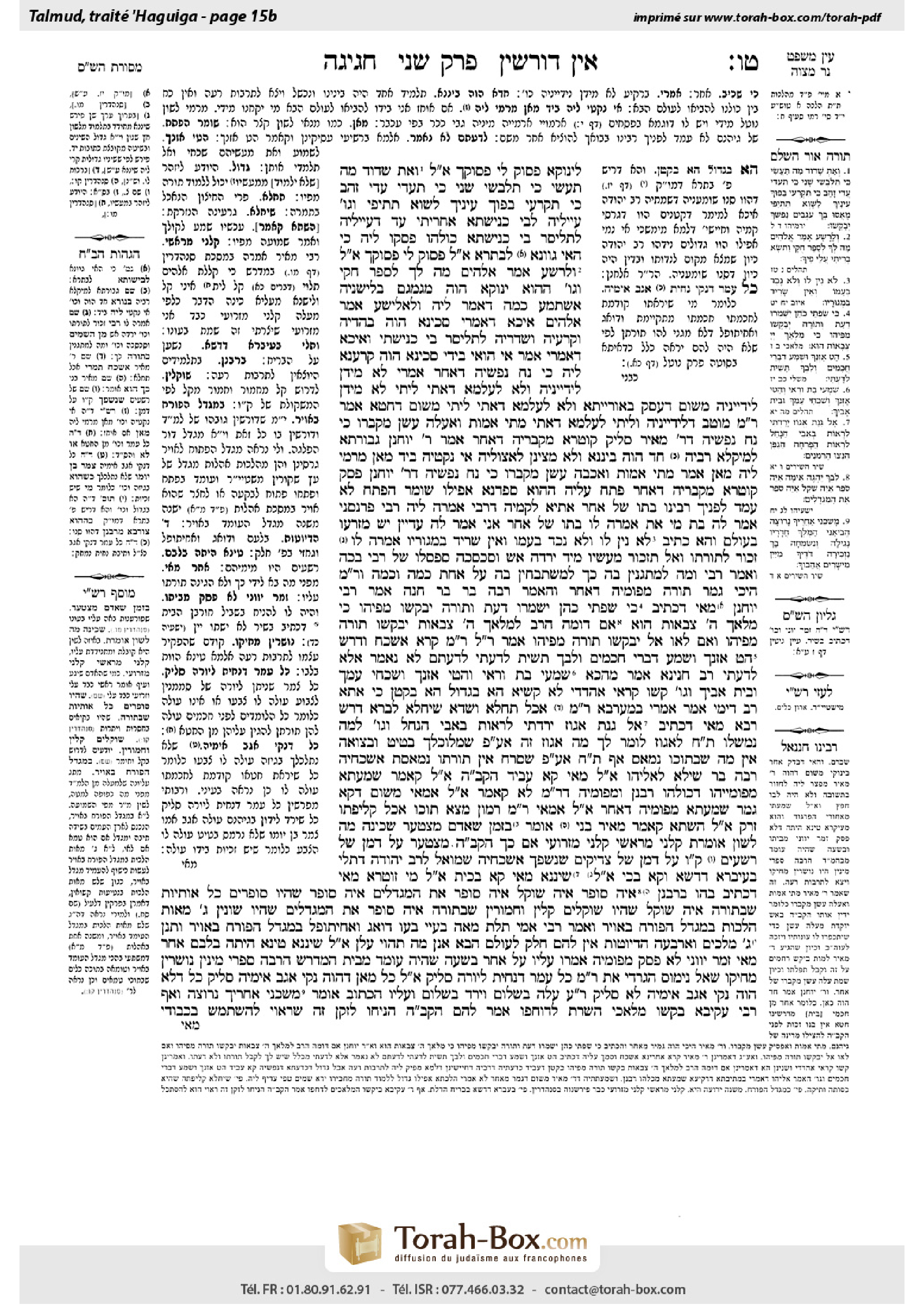
This page of Chagigah includes the Aramaic text, an English translation and an AI-generated French translation, alongside the scan above.
חגיגה י״ה ב · Aramaic and Hebrew text
לְיָנוֹקָא: פְּסוֹק לִי פְּסוּקָךְ. אֲמַר לֵיהּ: ״וְאַתְּ שָׁדוּד מַה תַּעֲשִׂי כִּי תִלְבְּשִׁי שָׁנִי כִּי תַעְדִּי עֲדִי זָהָב כִּי תִקְרְעִי בַפּוּךְ עֵינַיִךְ לַשָּׁוְא תִּתְיַפִּי וְגוֹ׳״.
עַיְּילֵיהּ לְבֵי כְנִישְׁתָּא אַחֲרִיתִי, עַד דְּעַיְּילֵיהּ לִתְלֵיסַר בֵּי כְנִישָׁתָא, כּוּלְּהוּ פְּסַקוּ לֵיהּ כִּי הַאי גַוְונָא. לְבָתְרָא אֲמַר לֵיהּ: פְּסוֹק לִי פְּסוּקָךְ. אֲמַר לֵיהּ: ״וְלָרָשָׁע אָמַר אֱלֹהִים מַה לְּךָ לְסַפֵּר חֻקָּי וְגוֹ׳״. הָהוּא יָנוֹקָא הֲוָה מְגַמְגֵּם בְּלִישָּׁנֵיהּ, אִשְׁתְּמַע כְּמָה דַּאֲמַר לֵיהּ: ״וְלֶאֱלִישָׁע אָמַר אֱלֹהִים״, אִיכָּא דְּאָמְרִי: סַכִּינָא הֲוָה בַּהֲדֵיהּ, וְקַרְעֵיהּ וְשַׁדַּרֵיהּ לִתְלֵיסַר בֵּי כְנִישָׁתֵי. וְאִיכָּא דְּאָמְרִי, אֲמַר: אִי הֲוַאי בִּידִי סַכִּינָא, הֲוָה קָרַעְנָא לֵיהּ.
כִּי נָח נַפְשֵׁיהּ דְּאַחֵר, אָמְרִי: לָא מֵידָן לִידַיְּינֵיהּ, וְלָא לְעָלְמָא דְּאָתֵי לֵיתֵי. לָא מֵידָן לִידַיְּינֵיהּ — מִשּׁוּם דַּעֲסַק בְּאוֹרָיְיתָא, וְלָא לְעָלְמָא דְּאָתֵי לֵיתֵי — מִשּׁוּם דַּחֲטָא. אֲמַר רַבִּי מֵאִיר: מוּטָב דְּלִידַיְּינֵיהּ וְלֵיתֵי לְעָלְמָא דְּאָתֵי. מָתַי אָמוּת, וְאַעֲלֶה עָשָׁן מִקִּבְרוֹ. כִּי נָח נַפְשֵׁיהּ דְּרַבִּי מֵאִיר סְלֵיק קוּטְרָא מִקִּבְרֵיהּ דְּאַחֵר.
אָמַר רַבִּי יוֹחָנָן: גְּבוּרְתָּא לְמִיקְלֵי רַבֵּיהּ? חַד הֲוָה בֵּינַנָא וְלָא מָצֵינַן לְאַצּוֹלֵיהּ? אִינְקְטֵיהּ בְּיָד, מַאן מַרְמֵי לֵיהּ מִן. אָמַר: מָתַי אָמוּת, וַאֲכַבֶּה עָשָׁן מִקִּבְרוֹ. כִּי נָח נַפְשֵׁיהּ דְּרַבִּי יוֹחָנָן פְּסַק קוּטְרָא מִקִּבְרֵיהּ דְּאַחֵר. פְּתַח עֲלֵיהּ הַהוּא סַפְדָנָא: אֲפִילּוּ שׁוֹמֵר הַפֶּתַח לֹא עָמַד לְפָנֶיךָ, רַבֵּינוּ!
בִּתּוֹ שֶׁל אַחֵר אָתְיָא לְקַמֵּיהּ דְּרַבִּי, אֲמַרָה לֵיהּ: רַבִּי, פַּרְנְסֵנִי. אָמַר לָהּ: בַּת מִי אַתְּ? אָמְרָה לוֹ: בִּתּוֹ שֶׁל אַחֵר אֲנִי. אָמַר לָהּ: עֲדַיִין יֵשׁ מִזַּרְעוֹ בָּעוֹלָם?! וְהָא כְּתִיב: ״לֹא נִין לוֹ וְלֹא נֶכֶד בְּעַמּוֹ וְאֵין שָׂרִיד בִּמְגוּרָיו״! אָמְרָה לוֹ: זְכוֹר לְתוֹרָתוֹ, וְאַל תִּזְכּוֹר מַעֲשָׂיו. מִיָּד יָרְדָה אֵשׁ וְסִכְסְכָה סַפְסָלוֹ שֶׁל רַבִּי. בָּכָה וְאָמַר רַבִּי: וּמָה לַמִּתְגַּנִּין בָּהּ — כָּךְ, לַמִּשְׁתַּבְּחִין בָּהּ — עַל אַחַת כַּמָּה וְכַמָּה!
וְרַבִּי מֵאִיר, הֵיכִי גְּמַר תּוֹרָה מִפּוּמֵּיהּ דְּאַחֵר? וְהָאָמַר רַבָּה בַּר בַּר חָנָה אָמַר רַבִּי יוֹחָנָן: מַאי דִּכְתִיב: ״כִּי שִׂפְתֵי כֹהֵן יִשְׁמְרוּ דַעַת וְתוֹרָה יְבַקְשׁוּ מִפִּיהוּ כִּי מַלְאַךְ ה׳ צְבָאוֹת הוּא״. אִם דּוֹמֶה הָרַב לְמַלְאַךְ ה׳ צְבָאוֹת — יְבַקְּשׁוּ תּוֹרָה מִפִּיהוּ, וְאִם לָאו — אַל יְבַקְּשׁוּ תּוֹרָה מִפִּיהוּ!
אָמַר רֵישׁ לָקִישׁ: רַבִּי מֵאִיר — קְרָא אַשְׁכַּח וּדְרַשׁ: ״הַט אׇזְנְךָ וּשְׁמַע דִּבְרֵי חֲכָמִים וְלִבְּךָ תָּשִׁית לְדַעְתִּי״, ״לְדַעְתָּם״ לֹא נֶאֱמַר, אֶלָּא ״לְדַעְתִּי״.
רַב חֲנִינָא אָמַר מֵהָכָא: ״שִׁמְעִי בַת וּרְאִי וְהַטִּי אׇזְנֵךְ וְשִׁכְחִי עַמֵּךְ וּבֵית אָבִיךְ וְגוֹ׳״.
קָשׁוּ קְרָאֵי אַהֲדָדֵי? לָא קַשְׁיָא: הָא בְּגָדוֹל, הָא בְּקָטָן.
כִּי אֲתָא רַב דִּימִי, אֲמַר, אָמְרִי בְּמַעְרְבָא: רַבִּי מֵאִיר אֲכַל תַּחְלָא, וּשְׁדָא שִׁיחְלָא לְבָרָא. דָּרֵשׁ רָבָא: מַאי דִּכְתִיב: ״אֶל גִּנַּת אֱגוֹז יָרַדְתִּי לִרְאוֹת בְּאִבֵּי הַנָּחַל וְגוֹ׳״, לָמָּה נִמְשְׁלוּ תַּלְמִידֵי חֲכָמִים לֶאֱגוֹז — לוֹמַר לָךְ: מָה אֱגוֹז זֶה, אַף עַל פִּי שֶׁמְּלוּכְלָךְ בְּטִיט וּבְצוֹאָה — אֵין מַה שֶּׁבְּתוֹכוֹ נִמְאָס; אַף תַּלְמִיד חָכָם, אַף עַל פִּי שֶׁסָּרַח — אֵין תּוֹרָתוֹ נִמְאֶסֶת.
אַשְׁכְּחֵיהּ רַבָּה בַּר שֵׁילָא לְאֵלִיָּהוּ. אֲמַר לֵיהּ: מַאי קָא עָבֵיד הַקָּדוֹשׁ בָּרוּךְ הוּא? אֲמַר לֵיהּ: קָאָמַר שְׁמַעְתָּא מִפּוּמַּיְיהוּ דְּכוּלְּהוּ רַבָּנַן, וּמִפּוּמֵּיהּ דְּרַבִּי מֵאִיר לָא קָאָמַר. אֲמַר לֵיהּ: אַמַּאי? מִשּׁוּם דְּקָא גָמַר שְׁמַעְתָּא מִפּוּמֵּיהּ דְּאַחֵר. אָמַר לֵיהּ: אַמַּאי? רַבִּי מֵאִיר רִמּוֹן מָצָא, תּוֹכוֹ אָכַל, קְלִיפָּתוֹ זָרַק. אֲמַר לֵיהּ: הַשְׁתָּא קָאָמַר, מֵאִיר בְּנִי אוֹמֵר: בִּזְמַן שֶׁאָדָם מִצְטַעֵר, שְׁכִינָה מָה לָשׁוֹן אוֹמֶרֶת: קַלַּנִי מֵרֹאשִׁי, קַלַּנִי מִזְּרוֹעִי. אִם כָּךְ הַקָּדוֹשׁ בָּרוּךְ הוּא מִצְטַעֵר עַל דָּמָן שֶׁל רְשָׁעִים — קַל וָחוֹמֶר עַל דָּמָן שֶׁל צַדִּיקִים שֶׁנִּשְׁפַּךְ.
אַשְׁכְּחֵיהּ שְׁמוּאֵל לְרַב יְהוּדָה דִּתְלֵי בְּעִיבְרָא דְּדַשָּׁא וְקָא בָכֵי. אָמַר לֵיהּ: שִׁינָּנָא! מַאי קָא בָכֵית? אֲמַר לֵיהּ: מִי זוּטְרָא מַאי דִּכְתִיב בְּהוּ בְּרַבָּנַן: ״אַיֵּה סוֹפֵר אַיֵּה שׁוֹקֵל אַיֵּה סוֹפֵר אֶת הַמִּגְדָּלִים״. ״אַיֵּה סוֹפֵר״ — שֶׁהָיוּ סוֹפְרִים כׇּל אוֹתִיּוֹת שֶׁבַּתּוֹרָה. ״אַיֵּה שׁוֹקֵל״ — שֶׁהָיוּ שׁוֹקְלִים קַלִּין וַחֲמוּרִין שֶׁבַּתּוֹרָה. ״אַיֵּה סוֹפֵר אֶת הַמִּגְדָּלִים״ — שֶׁהָיוּ שׁוֹנִין שְׁלֹשׁ מֵאוֹת הֲלָכוֹת בְּמִגְדָּל הַפּוֹרֵחַ בָּאֲוִיר.
וְאָמַר רַבִּי אַמֵּי: תְּלָת מְאָה בַּעְיֵי בְּעוֹ דּוֹאֵג וַאֲחִיתוֹפֶל בְּמִגְדָּל הַפּוֹרֵחַ בָּאֲוִיר. וּתְנַן: שְׁלֹשָׁה מְלָכִים וְאַרְבָּעָה הֶדְיוֹטוֹת אֵין לָהֶם חֵלֶק לָעוֹלָם הַבָּא. אֲנַן מָה תִּהְוֵי עֲלַן? אֲמַר לֵיהּ: שִׁינָּנָא! טִינָא הָיְתָה בְּלִבָּם.
אַחֵר מַאי — זֶמֶר יְווֹנִי לָא פְּסַק מִפּוּמֵּיהּ. אָמְרוּ עָלָיו עַל אַחֵר: בְּשָׁעָה שֶׁהָיָה עוֹמֵד מִבֵּית הַמִּדְרָשׁ, הַרְבֵּה סִפְרֵי מִינִין נוֹשְׁרִין מֵחֵיקוֹ.
שָׁאַל נִימוֹס הַגַּרְדִּי אֶת רַבִּי מֵאִיר: כֹּל עֲמַר דְּנָחֵית לְיוֹרָה סָלֵיק? אֲמַר לֵיהּ: כֹּל מַאן דַּהֲוָה נְקֵי אַגַּב אִימֵּיהּ — סָלֵיק, כֹּל דְּלָא הֲוָה נְקֵי אַגַּב אִימֵּיהּ — לָא סָלֵיק.
רַבִּי עֲקִיבָא עָלָה בְּשָׁלוֹם וְיָרַד בְּשָׁלוֹם, וְעָלָיו הַכָּתוּב אוֹמֵר: ״מׇשְׁכֵנִי אַחֲרֶיךָ נָרוּצָה״. וְאַף רַבִּי עֲקִיבָא בִּקְּשׁוּ מַלְאֲכֵי הַשָּׁרֵת לְדוֹחְפוֹ, אָמַר לָהֶם הַקָּדוֹשׁ בָּרוּךְ הוּא: הַנִּיחוּ לְזָקֵן זֶה, שֶׁרָאוּי לְהִשְׁתַּמֵּשׁ בִּכְבוֹדִי.
Chagigah 15b · English translation
a child: Recite your verse to me. He recited to him: “And you, spoiled one, what are you doing, that you clothe yourself with scarlet, that you deck yourself with ornaments of gold, that you enlarge your eyes with paint? In vain you make yourself fair” (Jeremiah 4:30).
He brought him to another synagogue, until he had brought him into thirteen synagogues, where all the children recited to him similar verses that speak of the hopeless situation of the wicked. At the last one, he said to him: Recite your verse to me. He recited to him: “And to the wicked [velerasha] God says, what is it for you to declare My statutes” (Psalms 50:16). The Gemara relates: That child had a stutter, so it sounded as though he were saying to him: Vele’elisha, i.e., and to Elisha, God says. This made Elisha think the child was deliberately insulting him. Some say Aḥer had a knife, and he tore the child apart and sent him to the thirteen synagogues. And others say that Aḥer merely said: Had I a knife, I would have torn him apart.
The Gemara relates: When Aḥer passed away, the Heavenly Court declared that he should not be judged, nor brought into the World-to-Come. He should not be judged in a manner befitting his deeds, because he occupied himself with Torah, whose merit protects him. And he should not be brought into the World-to-Come because he sinned. Rabbi Meir said: It is better that he be judged properly and be brought into the World-to-Come. When I die I will request this of Heaven, and I will cause smoke to rise up from his grave, as a sign that he is being sentenced in Gehenna. The Gemara relates: When Rabbi Meir passed away, smoke rose up from the grave of Aḥer, implying that Rabbi Meir’s wish was granted.
Rabbi Yoḥanan said: Was this a mighty deed on Rabbi Meir’s part, to burn his teacher? Was this the only remedy available? Can it be that there was one Sage among us who left the path and we cannot save him? If we hold him by the hand, who will remove him from our protection; who? Rabbi Yoḥanan continued and said: When I die I will have the smoke extinguished from his grave, as a sign that he has been released from the sentence of Gehenna and brought to the World-to-Come. Indeed, when Rabbi Yoḥanan passed away, the smoke ceased to rise up from the grave of Aḥer. A certain eulogizer began his eulogy of Rabbi Yoḥanan with the following: Even the guard at the entrance could not stand before you, our rabbi. The guard at the entrance to Gehenna could not prevent Rabbi Yoḥanan from arranging the release of Aḥer.
The Gemara relates: The daughter of Aḥer came before Rabbi Yehuda HaNasi and said to him: Rabbi, provide me with sustenance, as she was in need of food. He said to her: Whose daughter are you? She said to him: I am the daughter of Aḥer. He said to her, angrily: Is there still of his seed remaining in the world? But isn’t it stated: “He shall have neither son nor grandson among his people or any remaining in his dwellings” (Job 18:19)? She said to him: Remember his Torah, and do not remember his deeds. Immediately, fire descended and licked Rabbi Yehuda HaNasi’s bench. Rabbi Yehuda HaNasi wept and said: If God protects the honor of those who treat the Torah with contempt in such a manner, as Aḥer despised the Torah and relinquished its teachings, how much more so would He do for those who treat it with honor.
The Gemara poses a question: And Rabbi Meir, how could he learn Torah from the mouth of Aḥer? But didn’t Rabba bar bar Ḥana say that Rabbi Yoḥanan said: What is the meaning of that which is written: “For the priest’s lips should keep knowledge, and they should seek Torah from his mouth; for he is an angel of the Lord of hosts” (Malachi 2:7)? The verse teaches: If the rabbi is similar to an angel of the Lord of hosts, perfect in his ways, they should seek Torah from his mouth; but if not, they should not seek Torah from his mouth.
Reish Lakish said: Rabbi Meir found a verse and interpreted it homiletically: “Incline your ear, and hear the words of the wise, and apply your heart to My knowledge” (Proverbs 22:17). It does not state “to their knowledge,” but “to My knowledge.” In other words, one must listen to the words of the Sages, despite their flaws, provided that their opinion concurs with that of God.
Rav Ḥanina said that one can find support for this idea from here: “Listen, daughter and consider, and incline your ear; forget also your own people and your father’s house” (Psalms 45:11), which likewise indicates that one must listen to the words of a Sage while forgetting, i.e., ignoring, the faulty aspects of his teachings.
The Gemara asks: If so, the verses contradict each other, for one source states that one may learn only from a scholar who is perfect in his ways, while the other indicates that it is permitted even to learn from one whose character is flawed. The Gemara answers: This is not difficult. This case, in which it is permitted to learn from a flawed scholar, is referring to an adult; whereas that case, which prohibits doing so, is referring to a minor, who should learn only from a righteous person, so that his ways are not corrupted by a teacher with flawed character.
When Rav Dimi came from Eretz Yisrael to Babylonia, he said: In the West, Eretz Yisrael, they say: Rabbi Meir ate a half-ripe date and threw the peel away. In other words, he was able to extract the important content from the inedible shell. Rava taught: What is the meaning of that which is written: “I went down into the garden of nuts, to look at the green plants of the valley” (Song of Songs 6:11)? Why are Torah scholars compared to nuts? To tell you: Just as this nut, despite being soiled with mud and excrement, its content is not made repulsive, as only its shell is soiled; so too a Torah scholar, although he has sinned, his Torah is not made repulsive.
The Gemara relates: Rabba bar Sheila found Elijah the prophet, who had appeared to him. He said to Elijah: What is the Holy One, Blessed be He, doing? Elijah said to him: He is stating halakhot transmitted by all of the Sages, but in the name of Rabbi Meir He will not speak. He said to him: Why? He replied: Because he learned halakhot from the mouth of Aḥer. He said to him: Why should he be judged unfavorably for that? Rabbi Meir found a pomegranate and ate its contents while throwing away its peel. He said to him: Indeed, your defense has been heard above. Now God is saying: My son, Meir, says: When a person suffers, e.g., by receiving lashes or the death penalty at the hands of the court, how does the Divine Presence express itself? Woe is Me from My head, woe is Me from My arm, as God empathizes with the sufferer. If the Holy One, Blessed be He, suffers to such an extent over the blood of the wicked, how much more so does He suffer over the blood of the righteous that is spilled.
The Gemara relates: Shmuel found Rav Yehuda leaning on the bar of the door, crying. He said to him: Long-toothed one [shinnana], what are you crying for? He said to him: Is it a small matter, that which is written with regard to Sages who have sinned: “Where is he who counted, where is he who weighed? Where is he who counted the towers?” (Isaiah 33:18). He proceeded to explain: “Where is he who counted”; for they would count all the letters of the Torah. “Where is he who weighed”; for they would weigh and compare the minor and major transgressions of the Torah. “Where is he who counted the towers”; for they would teach three hundred halakhot concerning the details of tent impurity involving a wooden closet floating in the air. If they studied a subject so removed from reality in such depths, how much more so did they analyze other issues.
And Rabbi Ami said: Doeg asked Ahithophel three hundred questions with regard to a closet floating in the air, as they were both great Torah scholars. And we learned in a mishna (Sanhedrin 90a): Three kings and four commoners have no portion in the World-to-Come, a list that includes Doeg and Ahithophel. If such great Sages could sin and forfeit their share in the World-to-Come, we, who are less knowledgeable than they, what will be of us? He said to him: Long-toothed one, there was mud [tina] in their hearts, i.e., they had certain flaws that prevented their Torah learning from protecting them.
The Gemara explains: Aḥer, what was his failing? Greek tunes never ceased from his mouth. He would constantly hum Greek songs, even when he was among the Sages. This shows that from the outset he was drawn to gentile culture and beliefs. Similarly, they said about Aḥer: When he would stand after learning in the study hall, many heretical books, which he had been reading, would fall from his lap. Therefore, he was somewhat unsound even when among the Sages.
The gentile philosopher, Nimos HaGardi, asked Rabbi Meir: Does all wool that enters the cauldron to be dyed emerge colored? In other words, do all those who learn Torah emerge as decent and worthy? He said to him: Whoever was clean when he was with his mother, from the outset, will emerge decent and worthy, but all those who were not clean when they were with their mother will not emerge worthy. One who approaches Torah study having been flawed from the outset will not be properly influenced by it.
§ The Gemara returns to the four who entered the orchard. It is stated above that Rabbi Akiva ascended in safety and descended safely. With regard to him, the verse states: “Draw me, we will run after you; the king has brought me into his chambers” (Song of Songs 1:4). The Gemara relates: And even Rabbi Akiva, the ministering angels sought to push him out of the orchard. The Holy One, Blessed be He, said to them: Leave this Elder, for he is fit to serve My glory.
Chagigah 15b · Traduction française (IA)
Un enfant : Récite-moi ton verset. Il lui récita : « Et toi, l'adultère, qu'est-ce que tu fais, que tu t'habilles de pourpre, que tu t'ornes de bijoux d'or, que tu élargis tes yeux avec du khôl ? En vain tu t'embellis » (Jérémie 4:30).
On l'emmena dans un autre synagogue, jusqu'à ce qu'on l'ait conduit dans treize synagogues, où tous les enfants lui récitaient des versets semblables qui parlaient de la situation désespérée des méchants. À la dernière, il dit à lui : Récite-moi ton verset. Il lui récita : « Et à l'impie [velerasha] Dieu dit, à quoi bon proclamer mes statuts » (Psaumes 50:16). La Guemara rapporte : Ce petit avait un bégai, de sorte qu'il semblait dire : Vele’elisha, c'est-à-dire et à Elisha, Dieu dit. Cela fit penser à Elisha que l'enfant le traitait délibérément de manière insultante. Certains disent que Aḥer avait un couteau, et il déchira l'enfant et l'envoya dans les treize synagogues. D'autres disent que Aḥer dit simplement : Si j'avais un couteau, je l'aurais déchiré.
La Guemara rapporte : Lorsque Aḥer est décédé, le Tribunal céleste déclara qu'il ne devrait pas être jugé, ni introduit dans le Monde à Venir. Il ne devrait pas être jugé selon la mesure de ses actes, car il s'était occupé de la Torah, dont la mérite le protège. Et il ne devrait pas être introduit dans le Monde à Venir car il avait péché. Rabbi Meir dit : Il est préférable qu'il soit jugé correctement et introduit dans le Monde à Venir. Lorsque je mourrai, je demanderai cela au Ciel, et je ferai monter de la fumée de son tombeau, comme un signe qu'il est condamné en Enfer. La Guemara rapporte : Lorsque Rabbi Meir est décédé, la fumée s'est élevée du tombeau d'Aḥer, impliquant que le souhait de Rabbi Meir a été exaucé.
Rabbi Yoḥanan dit : Était-ce une grande action de Rabbi Meir, de brûler son maître ? Était-ce la seule solution disponible ? Peut-être qu'il y avait un Sage parmi nous qui s'est écarté du chemin et nous ne pouvons pas le sauver ? Si nous le tenons par la main, qui le retirera de notre protection ? Qui ? Rabbi Yoḥanan continua et dit : Lorsque je mourrai, je ferai cesser la fumée de son tombeau, comme un signe qu'il a été libéré de la condamnation d'Enfer et introduit dans le Monde à Venir. En effet, lorsque Rabbi Yoḥanan est décédé, la fumée cessa d'ascendre du tombeau d'Aḥer. Un éulogisateur commença son éloge de Rabbi Yoḥanan avec les mots suivants : Même le gardien de l'entrée ne pouvait pas résister devant vous, notre rabbi. Le gardien de l'entrée d'Enfer ne pouvait pas empêcher Rabbi Yoḥanan d'organiser la libération d'Aḥer.
La Guemara rapporte : La fille d'Aḥer vint devant Rabbi Yehuda HaNasi et lui dit : Rabbi, fournissez-moi un aliment, car elle avait besoin de nourriture. Il lui dit : Qui es-tu ? Elle lui dit : Je suis la fille d'Aḥer. Il lui dit, en colère : Y a-t-il encore de sa descendance restante dans le monde ? Mais n'est-il pas dit : « Il n'aura ni fils ni petit-fils parmi son peuple, ni aucun restant dans ses demeures » (Job 18:19) ? Elle lui dit : Souviens-toi de sa Torah, et ne souviens pas de ses actes. Aussitôt, une flamme descendit et mordit le siège de Rabbi Yehuda HaNasi. Rabbi Yehuda HaNasi pleura et dit : Si Dieu protège l'honneur de ceux qui traitent la Torah avec mépris de cette manière, comme Aḥer a méprisé la Torah et a abandonné ses enseignements, combien plus encore ferait-il pour ceux qui la traitent avec honneur.
La Guemara pose une question : Et Rabbi Meir, comment pouvait-il apprendre la Torah à la bouche d'Aḥer ? Mais n’a-t-il pas dit Rabba bar bar Ḥana que Rabbi Yoḥanan a dit : Quelle est la signification de ce qui est écrit : « Les lèvres du prêtre doivent garder la connaissance, et ils doivent chercher la Torah à sa bouche ; car il est un ange du Seigneur des armées » (Malachie 2:7) ? La verset enseigne : Si le rabbin est semblable à un ange du Seigneur des armées, parfait dans ses manières, ils doivent chercher la Torah à sa bouche ; mais s’il n’est pas ainsi, ils ne doivent pas chercher la Torah à sa bouche.
Reish Lakish dit : Rabbi Meir trouva un verset et l’interpréta par allégorie : « Incline ton oreille, et écoute les paroles des sages, et applique ton cœur à ma connaissance » (Proverbes 22:17). Il ne dit pas « à leur connaissance », mais « à ma connaissance ». En d’autres termes, on doit écouter les paroles des Sages, malgré leurs défauts, à condition que leur opinion corresponde à celle de Dieu.
Rav Ḥanina dit que l’on peut trouver un soutien à cette idée ici : « Écoute, fille, et considère, et incline ton oreille ; oublie aussi ton peuple et ta maison paternelle » (Psaumes 45:11), qui indique également qu’on doit écouter les paroles d’un Sage tout en oubliant, c’est-à-dire en ignorant, les aspects déficients de ses enseignements.
La Guemara pose une question : Si c'est ainsi, les versets s'opposent entre eux, car l'un dit qu'on peut apprendre seulement d'un savant parfait dans ses manières, tandis que l'autre indique qu'on peut même apprendre d'un savant dont le caractère est déficient. La Guemara répond : Ce n'est pas difficile. Ce cas, dans lequel on peut apprendre d'un savant déficient, se réfère à un adulte ; tandis que celui qui interdit cela se réfère à un mineur, qui doit apprendre seulement d'une personne juste, afin que ses manières ne soient pas corrompues par un enseignant dont le caractère est déficient.
Lorsque Rav Dimi est venu de la Terre d'Israël vers Babylone, il dit : Dans l'Ouest, la Terre d'Israël, ils disent : Rabbi Meir mangea une dattes à demi-ripe et jeta la peau. En d'autres termes, il était capable d'extraire le contenu important de la coquille inedible. Rava enseigna : Quelle est la signification de ce qui est écrit : « Je suis descendu dans le jardin de noix, pour regarder les plantes vertes de la vallée » (Cantique des Cantiques 6:11) ? Pourquoi les savants de la Torah sont-ils comparés aux noix ? Pour te dire : Tout comme cette noix, malgré être souillée par la boue et les excréments, son contenu n'est pas rendu répugnant, car seulement sa coquille est souillée ; de même, un savant de la Torah, bien qu'il ait péché, sa Torah n'est pas rendue répugnante.
La Guemara rapporte : Rabba bar Sheila a rencontré Elie le prophète, qui lui était apparu. Il lui a demandé : Qu'accomplit le Saint, le Béni soit-Il ? Elie lui a répondu : Il énonce des halakhot transmises par tous les Sages, mais en nom de Rabbi Meir, Il ne parlera pas. Il lui a demandé : Pourquoi ? Il a répondu : Parce qu'il avait appris des halakhot à la bouche d'Aḥer. Il lui a dit : Pourquoi donc sera-t-il jugé de manière défavorable pour cela ? Rabbi Meir a trouvé un pamplemousse et a mangé son contenu tout en jetant sa peau. Il lui a dit : Vraiment, votre défense a été entendue au-dessus. Maintenant, Dieu dit : Mon fils, Meir, dit : Lorsqu'une personne souffre, par exemple en recevant des coups de fouet ou la peine de mort à la main du tribunal, comment l'Essence divine s'exprime-t-Elle ? Hélas, moi, de ma tête, hélas, moi, de mon bras, car Dieu partage la souffrance du souffrant. Si le Saint, le Béni soit-Il, souffre à ce point pour le sang des méchants, combien plus encore souffre-t-Il pour le sang des justes qui est versé.
La Guemara rapporte : Shmuel a trouvé Rav Yehuda appuyé sur la barre de la porte, pleurant. Il lui a dit : Long-denté [shinnana], pourquoi pleures-tu ? Il lui a répondu : Est-ce une petite chose que ce qui est écrit concernant les Sages qui ont péché : « Où est celui qui a compté, où est celui qui a pesé ? Où est celui qui a compté les tours ? » (Yachin 33:18). Il a poursuivi en expliquant : « Où est celui qui a compté » ; car ils comptaient toutes les lettres de la Torah. « Où est celui qui a pesé » ; car ils pesaient et comparaient les transgressions mineures et graves de la Torah. « Où est celui qui a compté les tours » ; car ils enseignaient trois cents halakhot concernant les détails de l'impureté du tentérieur impliquant un placard en bois flottant dans l'air. Si ils étudiaient un sujet si éloigné de la réalité avec une telle profondeur, combien plus encore analysaient-ils d'autres questions.
Et Rabbi Ami a dit : Doeg a posé trois cents questions à Ahithophel concernant un placard flottant dans l'air, car ils étaient tous deux des grands savants en Torah. Et nous avons appris dans une mitsna (Sanhedrin 90a) : Trois rois et quatre simples citoyens n'ont pas leur part dans le monde à venir, une liste qui inclut Doeg et Ahithophel. Si de tels grands Sages pouvaient pécher et perdre leur part dans le monde à venir, nous, qui sommes moins instruits qu'eux, que deviendrons-nous ? Il lui a dit : Long-denté, il y avait de la boue [tina] dans leur cœur, c'est-à-dire qu'ils avaient certains défauts qui empêchaient leur étude de la Torah de les protéger.
La Guemara explique : Aḥer, quel était son défaut ? Les mélodies grecques ne cessaient jamais de sortir de sa bouche. Il chantait constamment des chansons grecques, même lorsqu'il était parmi les Sages. Cela montre qu'il était dès le début attiré par la culture et les croyances païennes. De même, on disait à propos d'Aḥer : Lorsqu'il se levait après avoir étudié dans la salle de récitation, beaucoup de livres hérétiques, qu'il avait lus, tombaient de ses genoux. Ainsi, il était un peu dérangé même parmi les Sages.
Le philosophe païen, Nimos HaGardi, a demandé à Rabbi Meir : Tous les fils de laine qui entrent dans la marmite pour être teints en sortent-ils colorés ? En d'autres termes, tous ceux qui étudient la Torah en sortent-ils dignes et méritants ? Il lui a répondu : Celui qui était propre lorsqu'il était avec sa mère, dès le départ, sortira digne et méritant, mais tous ceux qui n'étaient pas propres lorsqu'ils étaient avec leur mère ne sortiront pas méritants. Celui qui s'approche de l'étude de la Torah ayant été corrompu dès le départ ne sera pas correctement influencé par elle.
§ La Guemara reprend l'histoire des quatre qui sont entrés dans le verger. Il est dit ci-dessus que Rabbi Akiva est monté en sécurité et est descendu en sécurité. En ce qui le concerne, le verset dit : « Attire-moi, nous courrons après toi ; le roi m'a conduit dans ses chambres » (Cantique des Cantiques 1:4). La Guemara rapporte : Et même Rabbi Akiva, les anges ministériels cherchaient à le pousser hors du verger. Le Saint, le Béni soit-Il, a dit à eux : Laissez cet Ancien, car il est digne de servir Ma gloire.
Traduction française générée par IA à partir de l’édition anglaise de Sefaria. Vérifie toujours un passage avec le texte source.
Text from Sefaria: William Davidson Edition - Vocalized Aramaic (CC BY NC); William Davidson Edition - English (CC BY NC).