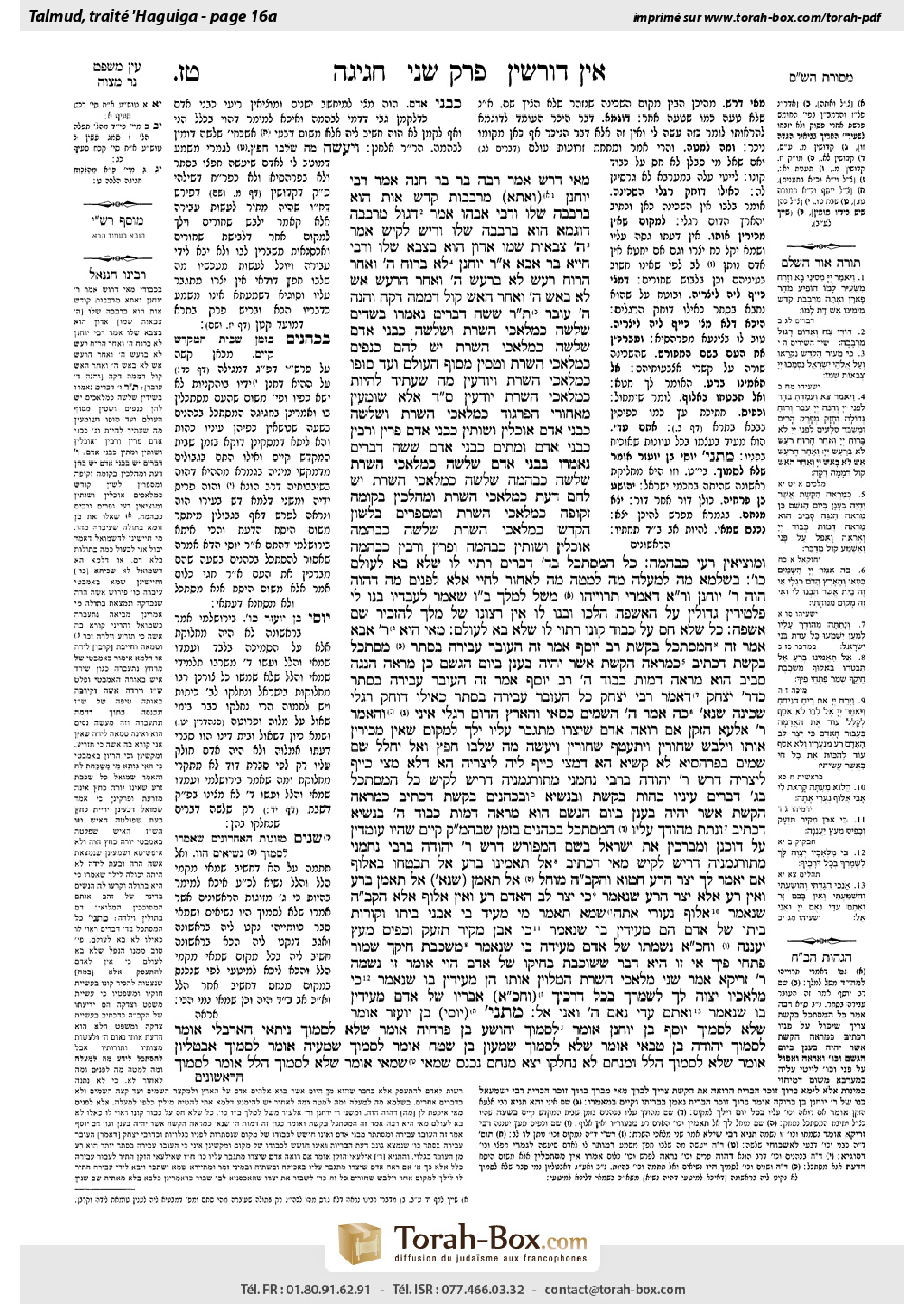
Chagigah 16a: Talmud study for Daf Yomi
Study the Talmud for Daf Yomi with scanned pages, Hebrew text, English translations from Sefaria and AI-generated French translations.
Passage selection and English or AI-generated French translation are available where the scan has annotations. Daf Study is independent of Torah-Box and Sefaria.
Browse Chagigah · חגיגה · All tractatesChagigah 16a text and translations
This page of Chagigah includes the Aramaic text, an English translation and an AI-generated French translation, alongside the scan above.
חגיגה י״ו א · Aramaic and Hebrew text
מַאי דְּרַשׁ? אָמַר רַבָּה בַּר בַּר חָנָה אָמַר רַבִּי יוֹחָנָן: ״וְאָתָא מֵרִבְבוֹת קֹדֶשׁ״ — אוֹת הוּא בָּרְבָבָה שֶׁלּוֹ.
וְרַבִּי אֲבָהוּ אָמַר: ״דָּגוּל מֵרְבָבָה״ — דּוּגְמָא הוּא בָּרְבָבָה שֶׁלּוֹ.
וְרֵישׁ לָקִישׁ אָמַר: ״ה׳ צְבָאוֹת שְׁמוֹ״ — אָדוֹן הוּא בַּצָּבָא שֶׁלּוֹ.
וְרַבִּי חִיָּיא בַּר אַבָּא אָמַר רַבִּי יוֹחָנָן: ״לֹא בָרוּחַ ה׳ וְאַחַר הָרוּחַ רַעַשׁ לֹא בָרַעַשׁ ה׳. וְאַחַר הָרַעַשׁ אֵשׁ לֹא בָאֵשׁ ה׳ וְאַחַר הָאֵשׁ קוֹל דְּמָמָה דַקָּה״, ״וְהִנֵּה ה׳ עוֹבֵר״.
תָּנוּ רַבָּנַן, שִׁשָּׁה דְּבָרִים נֶאֶמְרוּ בַּשֵּׁדִים: שְׁלֹשָׁה כְּמַלְאֲכֵי הַשָּׁרֵת, וּשְׁלֹשָׁה כִּבְנֵי אָדָם. שְׁלֹשָׁה כְּמַלְאֲכֵי הַשָּׁרֵת — יֵשׁ לָהֶם כְּנָפַיִם כְּמַלְאֲכֵי הַשָּׁרֵת, וְטָסִין מִסּוֹף הָעוֹלָם וְעַד סוֹפוֹ כְּמַלְאֲכֵי הַשָּׁרֵת, וְיוֹדְעִין מַה שֶּׁעָתִיד לִהְיוֹת כְּמַלְאֲכֵי הַשָּׁרֵת.
יוֹדְעִין סָלְקָא דַּעְתָּךְ?! אֶלָּא, שׁוֹמְעִין מֵאֲחוֹרֵי הַפַּרְגּוֹד, כְּמַלְאֲכֵי הַשָּׁרֵת.
וּשְׁלֹשָׁה כִּבְנֵי אָדָם — אוֹכְלִין וְשׁוֹתִין כִּבְנֵי אָדָם, פָּרִין וְרָבִין כִּבְנֵי אָדָם, וּמֵתִים כִּבְנֵי אָדָם.
שִׁשָּׁה דְּבָרִים נֶאֶמְרוּ בִּבְנֵי אָדָם: שְׁלֹשָׁה כְּמַלְאֲכֵי הַשָּׁרֵת, שְׁלֹשָׁה כִּבְהֵמָה. שְׁלֹשָׁה כְּמַלְאֲכֵי הַשָּׁרֵת — יֵשׁ לָהֶם דַּעַת כְּמַלְאֲכֵי הַשָּׁרֵת, וּמְהַלְּכִין בְּקוֹמָה זְקוּפָה כְּמַלְאֲכֵי הַשָּׁרֵת, וּמְסַפְּרִים בִּלְשׁוֹן הַקֹּדֶשׁ כְּמַלְאֲכֵי הַשָּׁרֵת. שְׁלֹשָׁה כִּבְהֵמָה — אוֹכְלִין וְשׁוֹתִין כִּבְהֵמָה, וּפָרִין וְרָבִין כִּבְהֵמָה, וּמוֹצִיאִין רְעִי כִּבְהֵמָה.
כׇּל הַמִּסְתַּכֵּל בְּאַרְבָּעָה דְּבָרִים רָתוּי לוֹ שֶׁלֹּא בָּא לָעוֹלָם כּוּ׳. בִּשְׁלָמָא מָה לְמַעְלָה מָה לְמַטָּה מָה לְאָחוֹר — לְחַיֵּי. אֶלָּא לְפָנִים — מָה דַּהֲוָה הֲוָה?
רַבִּי יוֹחָנָן וְרַבִּי אֶלְעָזָר דְאָמְרִי תַּרְוַיְיהוּ: מָשָׁל לְמֶלֶךְ בָּשָׂר וָדָם שֶׁאָמַר לַעֲבָדָיו: בְּנוּ לִי פַּלְטֵירִין גְּדוֹלִין עַל הָאַשְׁפָּה. הָלְכוּ וּבָנוּ לוֹ, אֵין רְצוֹנוֹ שֶׁל מֶלֶךְ לְהַזְכִּיר שֵׁם אַשְׁפָּה.
כׇּל שֶׁלֹּא חָס עַל כְּבוֹד קוֹנוֹ, רָתוּי לוֹ שֶׁלֹּא בָּא לְעוֹלָם. מַאי הִיא? רַבִּי אַבָּא אָמַר: זֶה הַמִּסְתַּכֵּל בַּקֶּשֶׁת. רַב יוֹסֵף אָמַר: זֶה הָעוֹבֵר עֲבֵירָה בַּסֵּתֶר. מִסְתַּכֵּל בַּקֶּשֶׁת, דִּכְתִיב: ״כְּמַרְאֵה הַקֶּשֶׁת אֲשֶׁר יִהְיֶה בֶעָנָן בְּיוֹם הַגֶּשֶׁם כֵּן מַרְאֵה הַנֹּגַהּ סָבִיב הוּא מַרְאֵה דְּמוּת כְּבוֹד ה׳״.
רַב יוֹסֵף אָמַר: זֶה הָעוֹבֵר עֲבֵירָה בַּסֵּתֶר, כִּדְרַבִּי יִצְחָק. דְּאָמַר רַבִּי יִצְחָק: כׇּל הָעוֹבֵר עֲבֵירָה בַּסֵּתֶר, כְּאִילּוּ דּוֹחֵק רַגְלֵי שְׁכִינָה, שֶׁנֶּאֱמַר: ״כֹּה אָמַר ה׳ הַשָּׁמַיִם כִּסְאִי וְהָאָרֶץ הֲדוֹם רַגְלָי״.
אִינִי?! וְהָאָמַר רַבִּי אִלְעָא הַזָּקֵן: אִם רוֹאֶה אָדָם שֶׁיִּצְרוֹ מִתְגַּבֵּר עָלָיו — יֵלֵךְ לְמָקוֹם שֶׁאֵין מַכִּירִין אוֹתוֹ, וְיִלְבַּשׁ שְׁחוֹרִין וְיִתְעַטֵּף שְׁחוֹרִין, וְיַעֲשֶׂה מַה שֶּׁלִּבּוֹ חָפֵץ, וְאַל יְחַלֵּל שֵׁם שָׁמַיִם בְּפַרְהֶסְיָא! לָא קַשְׁיָא: הָא — דְּמָצֵי כָּיֵיף לֵיהּ לְיִצְרֵיהּ, הָא — דְּלָא מָצֵי כָּיֵיף לְיִצְרֵיהּ.
דָּרֵשׁ רַבִּי יְהוּדָה בְּרַבִּי נַחְמָנִי מְתוּרְגְּמָנֵיהּ דְּרֵישׁ לָקִישׁ: כׇּל הַמִּסְתַּכֵּל בִּשְׁלֹשָׁה דְּבָרִים עֵינָיו כֵּהוֹת: בַּקֶּשֶׁת, וּבַנָּשִׂיא, וּבַכֹּהֲנִים. בַּקֶּשֶׁת — דִּכְתִיב: ״כְּמַרְאֵה הַקֶּשֶׁת אֲשֶׁר יִהְיֶה בֶעָנָן בְּיוֹם הַגֶּשֶׁם הוּא מַרְאֵה דְּמוּת כְּבוֹד ה׳״. בַּנָּשִׂיא — דִּכְתִיב: ״וְנָתַתָּ מֵהוֹדְךָ עָלָיו״. הַמִּסְתַּכֵּל בַּכֹּהֲנִים בִּזְמַן שֶׁבֵּית הַמִּקְדָּשׁ קַיָּים, שֶׁהָיוּ עוֹמְדִין עַל דּוּכָנָן וּמְבָרְכִין אֶת יִשְׂרָאֵל בַּשֵּׁם הַמְפוֹרָשׁ.
דָּרֵשׁ רַבִּי יְהוּדָה בְּרַבִּי נַחְמָנִי מְתוּרְגְּמָנֵיהּ דְּרֵישׁ לָקִישׁ, מַאי דִּכְתִיב: ״אַל תַּאֲמִינוּ בְרֵעַ אַל תִּבְטְחוּ בְּאַלּוּף״ — אִם יֹאמַר לְךָ יֵצֶר הָרָע, חֲטוֹא וְהַקָּדוֹשׁ בָּרוּךְ הוּא מוֹחֵל אַל תַּאֲמֵן, שֶׁנֶּאֱמַר: ״אַל תַּאֲמִינוּ בְרֵעַ״, וְאֵין ״רַע״ אֶלָּא יֵצֶר הָרַע שֶׁנֶּאֱמַר ״כִּי יֵצֶר לֵב הָאָדָם רַע״,
וְאֵין ״אַלּוּף״ אֶלָּא הַקָּדוֹשׁ בָּרוּךְ הוּא, שֶׁנֶּאֱמַר: ״אַלּוּף נְעוּרַי אָתָּה״. שֶׁמָּא תֹּאמַר מִי מֵעִיד בִּי? אַבְנֵי בֵיתוֹ וְקוֹרוֹת בֵּיתוֹ שֶׁל אָדָם הֵם מְעִידִין בּוֹ, שֶׁנֶּאֱמַר: ״כִּי אֶבֶן מִקִּיר תִּזְעָק וְכָפִיס מֵעֵץ יַעֲנֶנָּה״,
וַחֲכָמִים אוֹמְרִים: נִשְׁמָתוֹ שֶׁל אָדָם מְעִידָה בּוֹ שֶׁנֶּאֱמַר ״מִשֹּׁכֶבֶת חֵיקֶךָ שְׁמוֹר פִּתְחֵי פִיךָ״, (אִי זוֹ הִיא דָּבָר שֶׁשּׁוֹכֶבֶת) [אֵי זֶה הוּא דָּבָר שֶׁשָּׁרוּי] בְּחֵיקוֹ שֶׁל אָדָם — הֱוֵי אוֹמֵר: זוֹ נְשָׁמָה. רַבִּי זְרִיקָא אֹמֵר: שְׁנֵי מַלְאֲכֵי הַשָּׁרֵת הַמְלַוִּין אוֹתוֹ, הֵן מְעִידִין בּוֹ, שֶׁנֶּאֱמַר: ״כִּי מַלְאָכָיו יְצַוֶּה לָּךְ לִשְׁמָרְךָ בְּכׇל דְּרָכֶיךָ״. וַחֲכָמִים אוֹמְרִים: אֵבָרָיו שֶׁל אָדָם מְעִידִין בּוֹ, שֶׁנֶּאֱמַר: ״וְאַתֶּם עֵדַי נְאֻם ה' וַאֲנִי אֵל״.
מַתְנִי׳ יוֹסֵי בֶּן יוֹעֶזֶר אוֹמֵר שֶׁלֹּא לִסְמוֹךְ, יוֹסֵף בֶּן יוֹחָנָן אוֹמֵר לִסְמוֹךְ. יְהוֹשֻׁעַ בֶּן פְּרַחְיָה אוֹמֵר שֶׁלֹּא לִסְמוֹךְ, נִיתַּאי הַאַרְבֵּלִי אוֹמֵר לִסְמוֹךְ. יְהוּדָה בֶּן טָבַאי אוֹמֵר שֶׁלֹּא לִסְמוֹךְ, שִׁמְעוֹן בֶּן שָׁטַח אוֹמֵר לִסְמוֹךְ. שְׁמַעְיָה אוֹמֵר לִסְמוֹךְ, אַבְטַלְיוֹן אוֹמֵר שֶׁלֹּא לִסְמוֹךְ. הִלֵּל וּמְנַחֵם לֹא נֶחְלְקוּ. יָצָא מְנַחֵם, נִכְנַס שַׁמַּאי. שַׁמַּאי אוֹמֵר שֶׁלֹּא לִסְמוֹךְ, הִלֵּל אוֹמֵר לִסְמוֹךְ.
Chagigah 16a · English translation
The Gemara asks: What verse did Rabbi Akiva expound that prevented him from making the same mistake as Aḥer? Rabba bar bar Ḥana said that Rabbi Yoḥanan said: It was the following: “And He came [ve’ata] from the holy myriads” (Deuteronomy 33:2), which he explained in this manner: He, God, is unique [ot] among His myriads of angels. Therefore, he knew that he had merely seen an angel.
And Rabbi Abbahu said: Rabbi Akiva expounded the verse: “Preeminent above a myriad” (Song of Songs 5:10) to indicate that He is exemplary among His myriad.
And Reish Lakish said: He expounded the verse: “The Lord of hosts is His name” (Isaiah 48:2); He is the Master in His host.
And Rav Ḥiyya bar Abba said that Rabbi Yoḥanan said: He expounded the verses: “But the Lord was not in the wind. And after the wind, an earthquake; the Lord was not in the earthquake. And after the earthquake, fire; but the Lord was not in the fire. And after the fire, a still, small voice,” and it states in that verse: “And behold, the Lord passed by” (I Kings 19:11–12). Rabbi Akiva used this verse in order to recognize the place of His presence and refrain from trespassing there.
§ The Gemara returns to discussing the heavenly beings. The Sages taught: Six statements were said with regard to demons: In three ways they are like ministering angels, and in three ways they are like humans. The baraita specifies: In three ways they are like ministering angels: They have wings like ministering angels; and they fly from one end of the world to the other like ministering angels; and they know what will be in the future like ministering angels.
The Gemara is puzzled by this last statement: Should it enter your mind that they know this? Not even the angels are privy to the future. Rather, they hear from behind the curtain when God reveals something of the future, like ministering angels.
And in three ways they are similar to humans: They eat and drink like humans; they multiply like humans; and they die like humans.
Six statements were said with regard to humans: In three ways, they are like ministering angels, and in three ways they are like animals. The baraita explains: In three ways they are like ministering angels: They have intelligence like ministering angels; and they walk upright like ministering angels; and they speak in the holy tongue like ministering angels. In three ways humans are like animals: They eat and drink like animals; and they multiply like animals; and they emit excrement like animals.
§ The mishna taught: Whoever looks at four things, it would have been better for him had he never entered the world: Anyone who reflects upon that which is above the firmament; that which is below the earth; what was before the creation of the world; and what will be after the end of the world. The Gemara asks: Granted, it is prohibited to reflect on what is above, what is below, and what is after. This is fine, since one is examining things that are not part of the world but lie beyond it. But before the creation of the world, what has happened has happened. Why is it prohibited to reflect upon this?
The Gemara explains: Rabbi Yoḥanan and Rabbi Elazar both say: This can be demonstrated through a parable with regard to a flesh-and-blood king who said to his servants: Build for me large palaces on a garbage dump. They went and built them for him. Clearly, in that case, the king does not desire that they mention the garbage dump. Here too, God does not want people to concern themselves with the chaos that preceded the world.
It is taught in the mishna: Whoever has no concern for the honor of his Maker deserves to have never come to the world. The Gemara asks: What is lack of concern for the honor of one’s Maker? Rabbi Abba said: This is one who looks at a rainbow. Rav Yosef said: This is one who commits a transgression in private. They proceed to clarify their opinions: Looking at a rainbow constitutes an act of disrespect toward the Divine Presence, as it is written: “As the appearance of the bow that is in the cloud in the day of rain so was the appearance of the brightness round about. This was the appearance of the likeness of the glory of the Lord” (Ezekiel 1:28), and it is a dishonor to God to stare at His likeness.
Rav Yosef said: This is one who commits a transgression in private, in accordance with Rabbi Yitzḥak, as Rabbi Yitzḥak said: Whoever commits a transgression in private, it is as though he pushed away the feet of the Divine Presence, as it is stated: “Thus said the Lord: The heavens are My seat, and the earth My footstool” (Isaiah 66:1). If one believes that no one can see what he is doing in private, it is as though he said that God is absent from that place. He is therefore compared to one who attempts to remove God from His footstool.
The Gemara raises a difficulty: And is that so? But didn’t Rabbi Ela the Elder say: If a person sees that his inclination is overcoming him, he should go to a place where he is unknown, and wear black, and wrap himself in black, in the manner of mourners, because he should be ashamed of his weakness, and do there what his heart desires, but let him not desecrate the Name of Heaven in public. This shows that sinning in private is sometimes preferable to the public performance of a transgression. The Gemara answers: This is not difficult. This case, where one who commits a transgression in public has no concern for the honor of his Maker, occurs when one is capable of overcoming his inclination and fails to do so. That case, where it is preferable to sin in private, occurs when one is incapable of overcoming his inclination. He is therefore advised to, at the very least, refrain from desecrating God’s name in public.
Rabbi Yehuda, son of Rabbi Naḥmani, the disseminator of Reish Lakish, interpreted a verse homiletically: Whoever looks at the following three things, his eyes will grow dim: One who looks at a rainbow, at a Nasi, and at the priests. He explains: At a rainbow, as it is written: “As the appearance of the bow that is in the cloud on the day of rain, so was the appearance of the brightness round about, this was the appearance of the likeness of the glory of the Lord” (Ezekiel 1:28). At a Nasi, as it is written: “And you shall put of your splendor upon him” (Numbers 27:20), which indicates that the splendor of the Divine Presence rested upon Moses, who was the Nasi of Israel. The third item, looking at priests, is referring to one who looks at the priests when the Temple is standing, as they would stand on their platform and bless Israel with the ineffable name, at which point the Divine Presence would rest above the joints of their fingers.
Apropos this Sage, the Gemara cites another statement of his: Rabbi Yehuda, son of Rabbi Naḥmani, the disseminator of Reish Lakish, interpreted a verse homiletically: What is the meaning of that which is written: “Trust not in a companion, do not put your confidence in an intimate friend” (Micah 7:5)? If the evil inclination says to you: Sin, and the Holy One, Blessed be He, will forgive, do not trust it, since it is stated: “Trust not in a companion [rei’a].” And rei’a is referring to none other than the evil [ra] inclination, as it is stated: “For the inclination of the heart of man is evil [ra]” (Genesis 8:21).
And “intimate friend” is referring to none other than the Holy One, Blessed be He, as it is stated: “You are the intimate friend of my youth” (Jeremiah 3:4). Lest you say: Since I am acting in private, who will testify against me? The stones of the house and the beams of the house of each person testify against him, as it is stated: “For the stone shall cry out of the wall, and the beam out of the timber shall answer it” (Habakkuk 2:11).
And the Sages say: A person’s soul shall itself testify against him, as it is stated: “Guard the doors of your mouth from she who lies in your bosom” (Micah 7:5). What thing lies in a person’s bosom? You must say it is his soul. Rabbi Zerika said: The two ministering angels who accompany him, i.e., each individual, they testify against him, as it is stated: “For He will command His angels over you, to guard you in all your ways” (Psalms 91:11). And the Sages say: A person’s limbs testify against him, as it is stated: “Therefore you are My witnesses, says the Lord, and I am God” (Isaiah 43:12), which indicates that each individual becomes his own witness and testifies against himself on the Day of Judgment.
MISHNA: Yosei ben Yo’ezer says not to place one’s hands on offerings before slaughtering them on a Festival because this is considered performing labor with an animal on a Festival. His colleague, Yosef ben Yoḥanan, says to place them; Yehoshua ben Peraḥya says not to place them; Nitai HaArbeli says to place them; Yehuda ben Tabbai says not to place them; Shimon ben Shataḥ says to place them; Shemaya says to place them; Avtalyon says not to place them. Hillel and Menaḥem did not disagree with regard to this issue. Menaḥem departed from his post, and Shammai entered in his stead. Shammai says not to place them; Hillel says to place them.
Chagigah 16a · Traduction française (IA)
Le Guemara pose la question : Quel verset le Rabbi Akiva a-t-il interprété qui l'a empêché de commettre la même erreur qu'Aḥer ? Rabba bar bar Ḥana dit que Rabbi Yoḥanan a dit : C'était le suivant : « Et il vint [ve’ata] des myriades saints » (Deutéronome 33 : 2), qu'il a expliqué ainsi : Lui, Dieu, est unique [ot] parmi Ses myriades d'anges. Il savait donc qu'il avait simplement vu un ange.
Et Rabbi Abbahu a dit : Rabbi Akiva a interprété le verset : « Supérieur à un myriade » (Cantique des Cantiques 5 : 10) pour indiquer qu'Il est exemplaire parmi Ses myriades.
Et Reish Lakish a dit : Il a interprété le verset : « L'Éternel des armées est Son nom » (Isaïe 48 : 2) ; Il est le Maître parmi Son armée.
Et Rav Ḥiyya bar Abba a dit que Rabbi Yoḥanan a dit : Il a expliqué les versets : « Mais l'Éternel n'était pas dans le vent. Et après le vent, un tremblement de terre ; l'Éternel n'était pas dans le tremblement de terre. Et après le tremblement de terre, le feu ; mais l'Éternel n'était pas dans le feu. Et après le feu, une voix douce et calme », et il est dit dans ce verset : « Et voici, l'Éternel passa devant » (I Rois 19 : 11–12). Rabbi Akiva a utilisé ce verset afin de reconnaître le lieu de Sa présence et de se tenir éloigné de celui-ci.
§ Le Guemara reprend la discussion sur les entités célestes. Les Sages ont enseigné : Six affirmations ont été dites concernant les démons : En trois manières ils sont semblables aux anges ministraux, et en trois manières ils sont semblables aux humains. La baraïta précise : En trois manières ils sont semblables aux anges ministraux : Ils ont des ailes comme les anges ministraux ; et ils volent d'un bout du monde à l'autre comme les anges ministraux ; et ils connaissent ce qui sera à l'avenir comme les anges ministraux.
Le Guemara est perplexe face à cette dernière affirmation : Devrait-il entrer en vous l'idée qu'ils connaissent cela ? Même les anges ne sont pas informés du futur. Plutôt, ils entendent derrière le rideau quand Dieu révèle quelque chose du futur, comme les anges ministraux.
Et en trois manières ils sont semblables aux humains : Ils mangent et boivent comme les humains ; ils se multiplient comme les humains ; et ils meurent comme les humains.
Six affirmations ont été dites concernant les humains : En trois manières, ils sont semblables aux anges ministraux, et en trois manières ils sont semblables aux animaux. La baraïta explique : En trois manières ils sont semblables aux anges ministraux : Ils possèdent l'intelligence comme les anges ministraux ; ils marchent droit comme les anges ministraux ; et ils parlent dans la langue sainte comme les anges ministraux. En trois manières les humains sont semblables aux animaux : Ils mangent et boivent comme les animaux ; ils se multiplient comme les animaux ; et ils émettent des déjections comme les animaux.
§ La mishna a enseigné : Celui qui contemple quatre choses, il aurait mieux valu qu'il n'ait jamais entré dans le monde : Quiconque réfléchit sur ce qui est au-dessus du firmament ; sur ce qui est en dessous de la terre ; sur ce qui fut avant la création du monde ; et sur ce qui sera après la fin du monde. Le Guemara pose la question : C'est admis que c'est interdit de réfléchir sur ce qui est au-dessus, sur ce qui est en dessous et sur ce qui est après. C'est bien, puisque l'on examine des choses qui n'appartiennent pas au monde mais qui le dépassent. Mais avant la création du monde, ce qui a eu lieu a eu lieu. Pourquoi est-il interdit de réfléchir sur cela ?
Le Guemara explique : Rabbi Yoḥanan et Rabbi Elazar disent tous les deux : Cela peut être démontré par une comparaison avec un roi terrestre qui a dit à ses serviteurs : Construisez pour moi de grands palais sur un tas de détritus. Ils sont allés et les ont construits pour lui. Évidemment, dans ce cas, le roi ne désire pas qu'ils mentionnent le tas de détritus. De même, Dieu ne veut pas que les gens s'occupent de la confusion qui a précédé le monde.
Il est enseigné dans la mishna : Celui qui n'a pas d'attention pour l'honneur de Son Créateur mérite qu'il n'ait jamais été mis sur la terre. Le Guemara pose la question : Qu'est-ce que l'ignorance de l'honneur de son Créateur ? Rabbi Abba a dit : C'est celui qui regarde un arc-en-ciel. Rav Yosef a dit : C'est celui qui commet un péché en privé. Ils poursuivent à clarifier leurs opinions : Regarder un arc-en-ciel constitue un acte de mépris envers la Présence Divine, car il est écrit : « Comme l'apparence de l'arc qui est dans le nuage en temps de pluie, ainsi était l'apparence de la lumière autour. C'était l'apparence de la ressemblance de la gloire de l'Éternel » (Ezechiel 1 : 28), et il est un déshonneur pour Dieu de fixer Son ressemblance.
Rav Yosef a dit : C'est celui qui commet un péché en privé, conformément à Rabbi Yitzḥak, car Rabbi Yitzḥak a dit : Celui qui commet un péché en privé, c'est comme s'il repoussait les pieds de la Présence Divine, car il est dit : « Ainsi parla l'Éternel : Les cieux sont Mon trône, et la terre Mon pied-de-battant » (Isaïe 66 : 1). Si l'on croit que personne ne peut voir ce qu'il fait en privé, c'est comme s'il disait que Dieu n'est pas présent là. Il est donc comparé à celui qui tente de retirer Dieu de Son pied-de-battant.
Le Guemara soulève une difficulté : Et c'est ainsi ? Mais n'a-t-il pas dit Rabbi Ela le Vieux : Si un homme voit que son penchant l'emporte, il devrait aller à un lieu où il est inconnu, et porter des vêtements noirs, et s'envelopper de noir, comme les veufs, car il devrait être honteux de sa faiblesse, et faire là ce que son cœur désire, mais qu'il ne déshonore pas le Nom du Ciel en public. Cela montre que commettre un péché en privé est parfois préférable à la performance publique d'un péché. Le Guemara répond : Ce n'est pas difficile. Ce cas, où l'on commet un péché en public et n'a pas d'attention pour l'honneur de son Créateur, se produit lorsque l'on est capable de surmonter son penchant et ne le fait pas. Ce cas, où il est préférable de commettre un péché en privé, se produit lorsque l'on est incapable de surmonter son penchant. Il est donc conseillé de, tout au moins, éviter de déshonorer le Nom de Dieu en public.
Rabbi Yéhuda, fils de Rabbi Naḥmani, le diffuseur de Rachi Lakish, interprète un verset de manière allégorique : Celui qui regarde les trois choses suivantes, ses yeux s'assombriront : celui qui regarde un arc-en-ciel, un Nasi et les prêtres. Il explique : En regardant un arc-en-ciel, comme il est écrit : « Comme l'apparence de l'arc qui est dans le nuage le jour de la pluie, ainsi était l'apparence de la lumière autour, c'était l'apparence de la ressemblance de la gloire du Seigneur » (Ezéchiel 1 : 28). En regardant un Nasi, comme il est écrit : « Et tu mettras de ton splendeur sur lui » (Nombres 27 : 20), ce qui indique que la splendeur de la présence divine reposait sur Moïse, qui était le Nasi d'Israël. La troisième chose, regarder les prêtres, fait référence à celui qui regarde les prêtres lorsqu'il y a un Temple, car ils se tenaient sur leur plateforme et bénissaient Israël avec le nom ineffable, à ce moment la présence divine reposait au-dessus des jointures de leurs doigts.
À propos de ce Sage, la Guemara cite une autre déclaration de lui : Rabbi Yéhuda, fils de Rabbi Naḥmani, le diffuseur de Rachi Lakish, interprète un verset de manière allégorique : Quelle est la signification de ce qui est écrit : « Ne fais pas confiance à un compagnon, ne mets pas ta confiance dans un ami proche » (Micha 7 : 5) ? Si la tendance mauvaise dit à toi : Pèche, et le Saint, béni soit-Il, pardonnera, ne fais pas confiance à cela, car il est dit : « Ne fais pas confiance à un compagnon [rei’a] ». Et rei’a fait référence à rien d'autre que la tendance mauvaise [ra], comme il est dit : « Car la tendance du cœur de l'homme est mauvaise [ra] » (Genèse 8 : 21).
Et « intime ami » fait référence à rien d'autre que le Saint, béni soit-Il, comme il est dit : « Tu es l'intime ami de ma jeunesse » (Jérémie 3 : 4). De peur que tu dises : Puisque je fais des choses en privé, qui témoignera contre moi ? Les pierres de la maison et les poutres de la maison de chaque personne témoigneront contre lui, comme il est dit : « Car la pierre crierait de la muraille, et la poutre de bois répondrait à cela » (Habacuc 2 : 11).
Et les Sages disent : L'âme d'une personne témoignera elle-même contre lui, comme il est dit : « Garde les portes de ta bouche de celle qui dort dans ton sein » (Micha 7 : 5). Quel est l'objet qui dort dans le sein d'une personne ? Tu dois dire que c'est son âme. Rabbi Zérikha a dit : Les deux anges qui l'accompagnent, c'est-à-dire chaque individu, témoigneront contre lui, comme il est dit : « Car Il commandera Ses anges sur toi, pour te garder en tous tes chemins » (Psaumes 91 : 11). Et les Sages disent : Les membres d'une personne témoigneront contre lui, comme il est dit : « Donc vous êtes mes témoins, dit l'Éternel, et je suis l'Éternel » (Yachout 43 : 12), ce qui indique que chaque individu devient son propre témoin et témoignera contre lui le Jour du Jugement.
MICHNA : Yosei ben Yoézer dit de ne pas poser ses mains sur les offrandes avant de les sacrifier lors d'un festival, car cela est considéré comme travailler avec un animal lors d'un festival. Son collègue, Yosef ben Yoḥanan, dit de les poser ; Yéhoshua ben Péraḥya dit de ne pas les poser ; Nitai HaArbeli dit de les poser ; Yéhuda ben Tabbai dit de ne pas les poser ; Shimon ben Shataḥ dit de les poser ; Shemaya dit de les poser ; Avtalyon dit de ne pas les poser. Hillel et Menaḥem n'ont pas eu de désaccord sur ce point. Menaḥem a quitté son poste, et Shammai est entré à sa place. Shammai dit de ne pas les poser ; Hillel dit de les poser.
Traduction française générée par IA à partir de l’édition anglaise de Sefaria. Vérifie toujours un passage avec le texte source.
Text from Sefaria: William Davidson Edition - Vocalized Aramaic (CC BY NC); William Davidson Edition - English (CC BY NC).