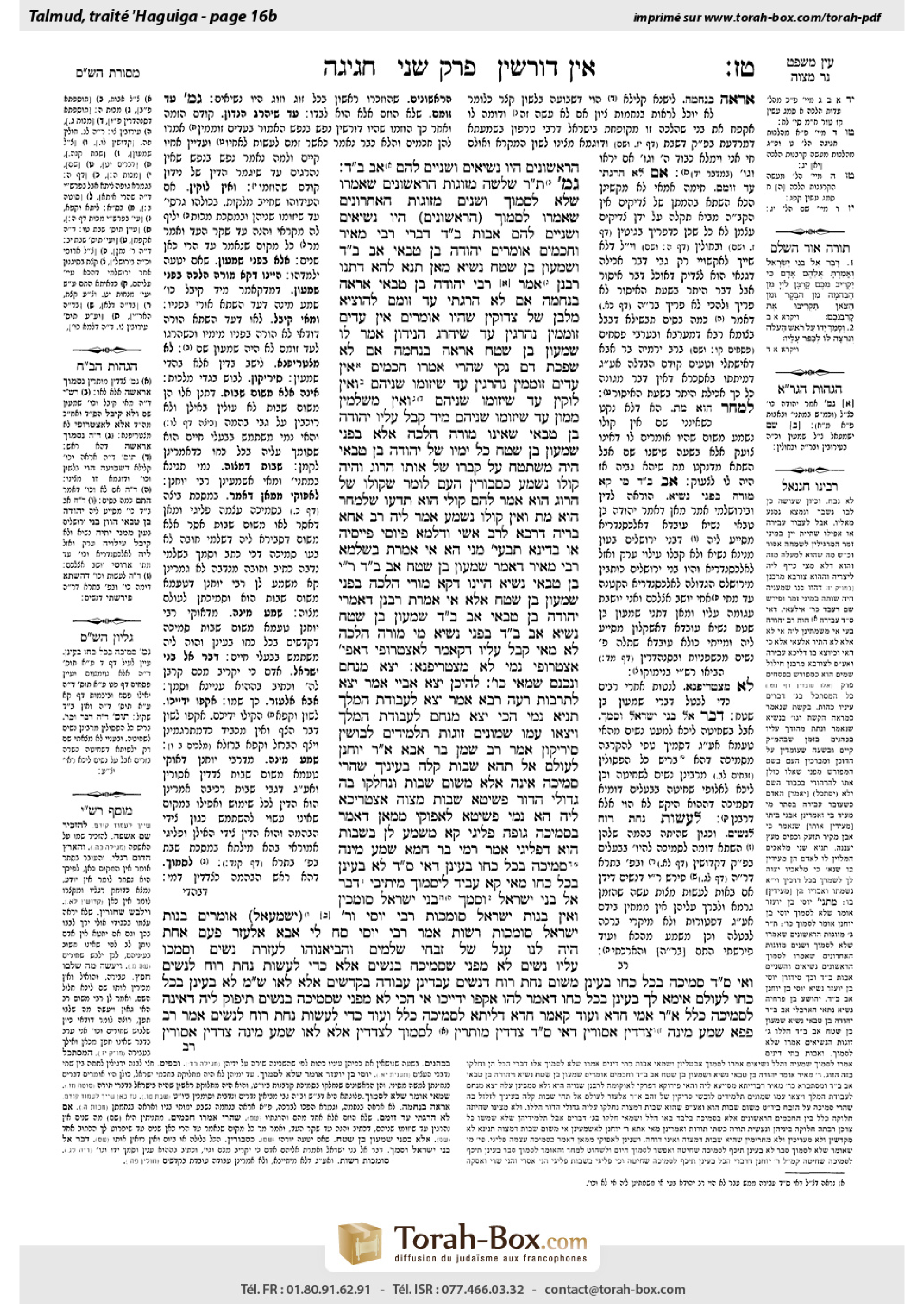
Chagigah 16b: Talmud study for Daf Yomi
Study the Talmud for Daf Yomi with scanned pages, Hebrew text, English translations from Sefaria and AI-generated French translations.
Passage selection and English or AI-generated French translation are available where the scan has annotations. Daf Study is independent of Torah-Box and Sefaria.
Browse Chagigah · חגיגה · All tractatesChagigah 16b text and translations
This page of Chagigah includes the Aramaic text, an English translation and an AI-generated French translation, alongside the scan above.
חגיגה י״ו ב · Aramaic and Hebrew text
הָרִאשׁוֹנִים הָיוּ נְשִׂיאִים, וּשְׁנִיִּים לָהֶם אֲבוֹת בֵּית דִּין.
גְּמָ׳ תָּנוּ רַבָּנַן: שְׁלֹשָׁה מִזּוּגוֹת הָרִאשׁוֹנִים שֶׁאָמְרוּ שֶׁלֹּא לִסְמוֹךְ, וּשְׁנַיִם מִזּוּגוֹת הָאַחֲרוֹנִים שֶׁאָמְרוּ לִסְמוֹךְ — (הָרִאשׁוֹנִים) הָיוּ נְשִׂיאִים, וּשְׁנִיִּים לָהֶם אֲבוֹת בֵּית דִּין, דִּבְרֵי רַבִּי מֵאִיר. וַחֲכָמִים אוֹמְרִים: יְהוּדָה בֶּן טָבַאי — אַב בֵּית דִּין, וְשִׁמְעוֹן בֶּן שָׁטַח — נָשִׂיא.
מַאן תְּנָא לְהָא דְּתָנוּ רַבָּנַן: אָמַר רַבִּי יְהוּדָה בֶּן טָבַאי: אֶרְאֶה בְּנֶחָמָה אִם לֹא הָרַגְתִּי עֵד זוֹמֵם, לְהוֹצִיא מִלִּבָּן שֶׁל צַדּוּקִין. שֶׁהָיוּ אוֹמְרִים: אֵין עֵדִים זוֹמְמִין נֶהֱרָגִין עַד שֶׁיֵּהָרֵג הַנִּידּוֹן.
אָמַר לוֹ שִׁמְעוֹן בֶּן שָׁטַח: אֶרְאֶה בְּנֶחָמָה אִם לֹא שָׁפַכְתָּ דָּם נָקִי, שֶׁהֲרֵי אָמְרוּ חֲכָמִים: אֵין עֵדִים זוֹמְמִין נֶהֱרָגִין עַד שֶׁיִּזּוֹמּוּ שְׁנֵיהֶם, וְאֵין לוֹקִין עַד שֶׁיִּזּוֹמּוּ שְׁנֵיהֶם, וְאֵין מְשַׁלְּמִין מָמוֹן עַד שֶׁיִּזּוֹמּוּ שְׁנֵיהֶם.
מִיָּד קִבֵּל עָלָיו יְהוּדָה בֶּן טָבַאי שֶׁאֵינוֹ מוֹרֶה הֲלָכָה אֶלָּא בִּפְנֵי שִׁמְעוֹן בֶּן שָׁטַח.
כׇּל יָמָיו שֶׁל יְהוּדָה בֶּן טָבַאי הָיָה מִשְׁתַּטֵּחַ עַל קִבְרוֹ שֶׁל אוֹתוֹ הָרוּג, וְהָיָה קוֹלוֹ נִשְׁמָע. כִּסְבוּרִין הָעָם לוֹמַר שֶׁקּוֹלוֹ שֶׁל הָרוּג הוּא. אָמַר לָהֶם: קוֹלִי הוּא. תֵּדְעוּ, שֶׁלְּמָחָר הוּא מֵת, וְאֵין קוֹלוֹ נִשְׁמָע.
אֲמַר לֵיהּ רַב אַחָא בְּרֵיהּ דְּרָבָא לְרַב אָשֵׁי: וְדִלְמָא פַּיּוֹסֵי פַּיְּיסֵיהּ, אוֹ בְּדִינָא תַּבְעֵיהּ.
מַנִּי הָא? אִי אָמְרַתְּ בִּשְׁלָמָא, רַבִּי מֵאִיר דְּאָמַר שִׁמְעוֹן בֶּן שָׁטַח אַב בֵּית דִּין, רַבִּי יְהוּדָה בֶּן טָבַאי נָשִׂיא — הַיְינוּ דְּקָא מוֹרֵי הֲלָכָה בִּפְנֵי שִׁמְעוֹן בֶּן שָׁטַח. אֶלָּא אִי אָמְרַתְּ רַבָּנַן דְּאָמְרִי: יְהוּדָה בֶּן טָבַאי אַב בֵּית דִּין, שִׁמְעוֹן בֶּן שָׁטַח נָשִׂיא — אַב בֵּית דִּין בִּפְנֵי נָשִׂיא מִי מוֹרֶה הֲלָכָה?
לָא, מַאי ״קִבֵּל עָלָיו״ דְּקָאָמַר — לְאִצְטְרוֹפֵי, דַּאֲפִילּוּ אִצְטְרוֹפֵי נָמֵי לָא מִצְטְרֵיפְנָא.
יָצָא מְנַחֵם וְנִכְנַס שַׁמַּאי כּוּ׳. לְהֵיכָן יָצָא? אַבָּיֵי אָמַר: יָצָא לְתַרְבּוּת רָעָה. רָבָא אָמַר: יָצָא לַעֲבוֹדַת הַמֶּלֶךְ. תַּנְיָא נָמֵי הָכִי: יָצָא מְנַחֵם לַעֲבוֹדַת הַמֶּלֶךְ, וְיָצְאוּ עִמּוֹ שְׁמוֹנִים זוּגוֹת תַּלְמִידִים לְבוּשִׁין סִירִיקוֹן.
אָמַר רַב שֶׁמֶן בַּר אַבָּא אָמַר רַבִּי יוֹחָנָן: לְעוֹלָם אַל תְּהֵא שְׁבוּת קַלָּה בְּעֵינֶיךָ, שֶׁהֲרֵי סְמִיכָה אֵינָהּ אֶלָּא מִשּׁוּם שְׁבוּת, וְנֶחְלְקוּ בָּהּ גְּדוֹלֵי הַדּוֹר.
פְּשִׁיטָא? שְׁבוּת מִצְוָה אִצְטְרִיכָא לֵיהּ.
הָא נָמֵי פְּשִׁיטָא! לְאַפּוֹקֵי מִמַּאן דְּאָמַר בִּסְמִיכָה גּוּפַהּ פְּלִיגִי, קָא מַשְׁמַע לַן בִּשְׁבוּת הוּא דִּפְלִיגִי.
אָמַר רָמֵי בַּר חָמָא: שְׁמַע מִינַּהּ סְמִיכָה בְּכׇל כֹּחוֹ בָּעֵינַן, דְּאִי סָלְקָא דַּעְתָּךְ לָא בָּעֵינַן בְּכׇל כֹּחוֹ — מַאי קָא עָבֵיד? לִיסְמוֹךְ!
מֵיתִיבִי: ״דַּבֵּר אֶל בְּנֵי יִשְׂרָאֵל ... וְסָמַךְ״, בְּנֵי יִשְׂרָאֵל סוֹמְכִין, וְאֵין בְּנוֹת יִשְׂרָאֵל סוֹמְכוֹת. רַבִּי יוֹסֵי וְרַבִּי יִשְׁמָעֵאל אוֹמְרִים: בְּנוֹת יִשְׂרָאֵל סוֹמְכוֹת רְשׁוּת.
אָמַר רַבִּי יוֹסֵי, סָח לִי אַבָּא אֶלְעָזָר: פַּעַם אַחַת הָיָה לָנוּ עֵגֶל שֶׁל זִבְחֵי שְׁלָמִים, וַהֲבֵיאנוּהוּ לְעֶזְרַת נָשִׁים, וְסָמְכוּ עָלָיו נָשִׁים. לֹא מִפְּנֵי שֶׁסְּמִיכָה בְּנָשִׁים, אֶלָּא כְּדֵי לַעֲשׂוֹת נַחַת רוּחַ לַנָּשִׁים. וְאִי סָלְקָא דַעְתָּךְ סְמִיכָה בְּכׇל כֹּחוֹ בָּעֵינַן — מִשּׁוּם נַחַת רוּחַ דְּנָשִׁים עָבְדִינַן עֲבוֹדָה בְּקָדָשִׁים? אֶלָּא לָאו, שְׁמַע מִינַּהּ לָא בָּעֵינַן בְּכׇל כֹּחוֹ!
לְעוֹלָם אֵימָא לָךְ בָּעֵינַן בְּכׇל כֹּחוֹ — דַּאֲמַר לְהוּ: אַקְפּוֹ יְדַיְיכוּ. אִי הָכִי, לֹא מִפְּנֵי שֶׁסְּמִיכָה בְּנָשִׁים, תִּיפּוֹק לֵיהּ דְּאֵינָהּ לִסְמִיכָה כְּלָל!
אָמַר רַבִּי אַמֵּי: חֲדָא וְעוֹד קָאָמַר. חֲדָא — דְּלֵיתָא לִסְמִיכָה כְּלָל, וְעוֹד — כְּדֵי לַעֲשׂוֹת נַחַת רוּחַ לַנָּשִׁים.
אָמַר רַב פָּפָּא: שְׁמַע מִינַּהּ — צְדָדִין אֲסוּרִין, דְּאִי סָלְקָא דַעְתָּךְ צְדָדִין מוּתָּרִין, לִסְמוֹךְ לִצְדָדִין. אֶלָּא לָאו, שְׁמַע מִינַּהּ צְדָדִין אֲסוּרִין.
Chagigah 16b · English translation
The first members of each pair served as Nasi, and their counterparts served as deputy Nasi.
GEMARA: The Sages taught: Three of the first pairs who say not to place hands and two of the last pairs who say to place hands served as Nasi, and their counterparts served as deputy Nasi; this is the statement of Rabbi Meir. And the Rabbis say the opposite: Yehuda ben Tabbai was deputy Nasi and Shimon ben Shataḥ was the Nasi.
The Gemara asks: Who is the tanna who taught that which the Sages taught in a baraita: Rabbi Yehuda ben Tabbai said: I swear that I will not see the consolation of Israel if I did not kill a conspiring witness. This means that Rabbi Yehuda ben Tabbai sentenced a conspiring witness to death, in order to counter the views of the Sadducees, who would say: Conspiring witnesses are not executed unless the sentenced one has been executed. Their views opposed the traditional view, which maintains that conspiring witnesses are executed only if the one sentenced by their testimony has not yet been executed.
Shimon ben Shataḥ said to him: I swear that I will not see the consolation of Israel if you did not shed innocent blood, as the Sages said: Conspiring witnesses are not executed unless they are both found to be conspirators; if only one is found to be a conspirator, he is not executed. And they are not flogged if they are liable to such a penalty, unless they are both found to be conspirators. And if they testified falsely that someone owed money, they do not pay money unless they are both found to be conspirators.
Hearing this, Yehuda ben Tabbai immediately accepted upon himself not to rule on any matter of law unless he was in the presence of Shimon ben Shataḥ, as he realized he could not rely on his own judgment.
The baraita further relates: All of Yehuda ben Tabbai’s days, he would prostrate himself on the grave of that executed individual, to request forgiveness, and his voice was heard weeping. The people thought that it was the voice of that executed person, rising from his grave. Yehuda ben Tabbai said to them: It is my voice, and you shall know that it is so, for tomorrow, i.e., sometime in the future, he will die, and his voice will no longer be heard. Yehuda ben Tabbai was referring to himself, but he did not want to mention something negative about himself in direct terms.
Rav Aḥa, son of Rava, said to Rav Ashi: This provides no conclusive proof that the voice was not that of the executed man, as perhaps ben Tabbai appeased the executed individual in the World-to-Come. Or, alternatively, the latter may have prosecuted him by the law of Heaven, and that is why his voice can no longer be heard.
The Gemara returns to its original question: Whose opinion does this baraita follow? Granted, if you say it is in accordance with that of Rabbi Meir, who said that Shimon ben Shataḥ was deputy Nasi while Rabbi Yehuda ben Tabbai was Nasi, that explains why he had previously issued a halakhic ruling in the presence of Shimon ben Shataḥ to execute the conspiring witness, and only after that unfortunate incident did he undertake to issue rulings only in the presence of his colleague. But if you say that the baraita is in accordance with the Sages, who said: Yehuda ben Tabbai was deputy Nasi and Shimon ben Shataḥ the Nasi, why did he need to make such a commitment? May the deputy Nasi issue a halakhic ruling in the presence of the Nasi?
The Gemara refutes this: No; what did he mean by accepting upon himself not to rule on his own? He spoke with regard to joining the ruling of others: Even with regard to joining the ruling of others, I will also not join until I have first heard the view of Shimon ben Shataḥ.
§ It is taught in the mishna: Menaḥem departed and Shammai entered. The Gemara asks: To where did Menaḥem depart? Abaye said: He departed and went astray. Therefore, the mishna did not wish to delve into the details of his case. Rava said: He departed for the king’s service. He received a post from the king and had to leave the court. This is also taught in a baraita: Menaḥem departed for the king’s service, and eighty pairs of students dressed in silk robes left with him to work for the king, and that they no longer studied Torah.
§ Rav Shemen bar Abba said that Rabbi Yoḥanan said: A rabbinic decree [shevut] should never be taken lightly in your eyes, since placing hands on the head of an offering on a Festival is prohibited only as a rabbinic decree because it is considered making use of an animal, which is not considered a prohibited labor but merely resembles one, and yet the greatest scholars of each generation disputed it.
The Gemara is puzzled by this statement: This is obvious. Since it is an accepted rabbinic decree, why should people take it lightly? The Gemara answers: It was necessary for him to state it because it is a rabbinic decree related to a mitzva. In other words, although this rabbinic decree of placing the hands on an animal is not performed for one’s own sake but for the purpose of a mitzva, it was nevertheless a serious matter in the eyes of the Sages.
The Gemara remains puzzled: This too is obvious. In that case as well, the act is prohibited by the Sages. The Gemara responds: Rabbi Yoḥanan’s statement comes to exclude the opinion of the one who said that they disagree with regard to the actual obligation of placing hands, i.e., whether or not obligatory peace-offerings require placing the hands. He therefore teaches us that it is a rabbinic decree that is the subject of their dispute, not the requirement itself.
Rami bar Ḥama said: You can learn from here, from this dispute, that the mitzva of placing hands requires not only placing one’s hands on the animal’s head, but we also require that one places his hands with all his strength. For if it enters your mind that we do not require all his strength, what prohibition does one violate by placing his hands? Let him place them on a Festival as well, as this does not resemble a prohibited action at all.
The Gemara raises an objection to this from a baraita: “Speak to the children of [benei] Israel” (Leviticus 1:2). The word benei literally means: Sons of. And it states nearby: “And he shall place his hand on the head of the burnt-offering” (Leviticus 1:4), from which we learn that the sons of Israel place their hands, but the daughters of Israel do not place them. Rabbi Yosei and Rabbi Yishmael say: It is optional for the daughters of Israel to place their hands. They may place their hands if they so choose, although they are not obligated to do so.
Rabbi Yosei said: The Sage Abba Elazar related to me the following incident: On one occasion, we had a calf for a peace-offering, and we brought it to the Women’s Courtyard, and women placed their hands on it. We did this not because there is an obligation of placing hands in the case of women, but in order to please the women, by allowing them to sacrifice an offering, in all of its particulars, as men do. Now, if it enters your mind that we require placing hands with all one’s strength, would we perform work with consecrated offerings in order to please the women? Placing one’s hands forcefully on an animal is considered performing work with it, and if one does it without being obligated to do so, he has thereby performed work with an offering. Rather, isn’t it correct to conclude from this that we do not require placing hands with all one’s strength?
The Gemara rejects this: Actually, I could say to you that we do require placing hands with all one’s strength, but here they allowed women to place their hands by saying to them: Ease your hands and do not press forcefully, so that their hand placing should not constitute work. The Gemara retorts: If so, then the reason formulated as: Not because there is an obligation to place hands in the case of women, is irrelevant to this law. Let him derive the permission for women to do so from the reason that it is not considered placing hands at all. If placing hands must be performed with all one’s strength, this action the women are performing does not constitute placing hands.
Rabbi Ami said: He stated one reason and another. One reason is that it is not considered placing hands at all, as it is not performed with all of one’s strength; and another reason is that they allowed it in order to please the women.
Rav Pappa said: Learn from this that anything upon which one may not place objects or upon which one may not sit on Shabbat, its sides are likewise prohibited, for if it enters your mind to say that the sides are permitted, they could have told the women to place their hands on the sides, i.e., on the head of the animal rather than on its back, as the head of the animal is considered as if it were one of its sides. Rather, must one not conclude from this that the sides are prohibited?
Chagigah 16b · Traduction française (IA)
Les premiers membres de chaque couple ont servi de Nasi, et leurs homologues ont servi de sous-chef du Nasi.
GUEMARA : Les Sages enseignèrent : Trois des premiers couples qui disent ne pas poser les mains et deux des derniers couples qui disent poser les mains ont servi de Nasi, et leurs homologues ont servi de sous-chef du Nasi ; c'est l'opinion de Rabbi Meir. Et les Rabbins disent l'inverse : Yéhouda ben Tabbai était le sous-chef du Nasi et Shimon ben Shataḥ était le Nasi.
La Guemara pose la question : Qui est le tanna qui a enseigné ce que les Sages enseignèrent dans une baraïta : Rabbi Yéhouda ben Tabbai dit : Je jure que je ne verrai pas la consolation d'Israël si je n'ai pas tué un témoin conjuré. Cela signifie que Rabbi Yéhouda ben Tabbai a condamné un témoin conjuré à la mort, afin de contrecarrer les vues des Sadducéens, qui disaient : Les témoins conjurés ne sont pas exécutés à moins que la personne condamnée ne soit déjà exécutée. Leur opinion s'opposait à la vision traditionnelle, qui maintient que les témoins conjurés sont exécutés uniquement si la personne condamnée par leurs témoignages n'a pas encore été exécutée.
Shimon ben Shataḥ dit à lui : Je jure que je ne verrai pas la consolation d'Israël si tu n'as pas versé du sang innocent, comme les Sages dirent : Les témoins conjurés ne sont pas exécutés à moins qu'ils soient tous deux trouvés conjurés ; si seul l'un est trouvé conjuré, il n'est pas exécuté. Et ils ne sont pas battus s'ils sont passibles de cette peine, à moins qu'ils soient tous deux trouvés conjurés. Et s'ils ont témoigné faussement que quelqu'un devait de l'argent, ils ne paient pas l'argent à moins qu'ils soient tous deux trouvés conjurés.
En entendant cela, Yéhouda ben Tabbai accepta immédiatement de ne pas décider de toute affaire de droit sans être en présence de Shimon ben Shataḥ, car il réalisa qu'il ne pouvait pas se fier à son propre jugement.
La baraïta rapporte également : Tous les jours de Yéhouda ben Tabbai, il se prosternait sur la tombe de la personne exécutée, pour demander la rémission, et sa voix était entendue pleurer. Le peuple pensait que c'était la voix de la personne exécutée, montant de sa tombe. Yéhouda ben Tabbai dit à eux : C'est ma voix, et vous saurez que c'est ainsi, car demain, c'est-à-dire à un moment donné dans le futur, il mourra, et sa voix ne sera plus entendue. Yéhouda ben Tabbai faisait référence à lui-même, mais il ne voulait pas mentionner quelque chose de négatif à son sujet de manière directe.
Rav Acha, fils de Rava, dit à Rav Ashi : Cela ne fournit pas de preuve concluante que la voix n'était pas celle de la personne exécutée, car peut-être ben Tabbai a apaisé la personne exécutée dans le Monde à Venir. Ou, de manière alternative, le dernier peut avoir poursuivi lui par la loi du Ciel, et c'est pourquoi sa voix ne peut plus être entendue.
La Guemara retourne à sa question originale : À quel avis cette baraïta suit-elle ? Étant donné, si vous dites qu'elle suit celui de Rabbi Meir, qui dit que Shimon ben Shataḥ était le sous-chef du Nasi alors que Rabbi Yéhouda ben Tabbai était le Nasi, cela explique pourquoi il avait précédemment rendu un jugement halakhique en présence de Shimon ben Shataḥ pour exécuter le témoin conjuré, et seulement après cet incident désagréable a-t-il entrepris de rendre des jugements uniquement en présence de son collègue. Mais si vous dites que la baraïta suit les Sages, qui disent : Yéhouda ben Tabbai était le sous-chef du Nasi et Shimon ben Shataḥ le Nasi, pourquoi a-t-il eu besoin de faire de tels engagements ? Le sous-chef du Nasi peut-il rendre un jugement halakhique en présence du Nasi ?
La Guemara réfute cela : Non ; à quoi voulait-il dire en acceptant de ne pas décider seul ? Il parlait de rejoindre le jugement des autres : Même en ce qui concerne le rejoindre au jugement des autres, je ne le ferai pas avant d'avoir d'abord entendu l'opinion de Shimon ben Shataḥ.
§ Il est enseigné dans la mishna : Menaḥem est parti et Shammai est entré. La Guemara pose la question : Où Menaḥem est-il parti ? Abaye dit : Il est parti et s'est éloigné. Ainsi, la mishna n'avait pas souhaité entrer dans les détails de son cas. Rava dit : Il est parti pour le service du roi. Il a reçu un poste du roi et devait quitter le tribunal. Cela est également enseigné dans une baraïta : Menaḥem est parti pour le service du roi, et soixante-dix couples d'étudiants vêtus de robes de soie sont partis avec lui pour travailler pour le roi, et ils n'ont plus étudié la Torah.
§ Rav Shemen bar Abba dit que Rabbi Yoḥanan dit : Une déclaration rabbinique [shevut] ne doit jamais être prise à la légère, car poser les mains sur la tête d'une offrande pendant un festival est interdit uniquement comme déclaration rabbinique, car cela est considéré comme l'utilisation d'un animal, qui n'est pas considéré comme un travail interdit, mais simplement ressemblant à un tel travail, et pourtant les plus grands savants de chaque génération ont disputé cela.
La Guemara est perplexe face à cette déclaration : Cela est évident. Puisque c'est un décret rabbinique accepté, pourquoi les gens devraient-ils le prendre à la légère ? La Guemara répond : Il était nécessaire qu'il le mentionne, car il s'agit d'un décret rabbinique lié à une mitsva. En d'autres termes, bien que ce décret rabbinique de poser les mains sur un animal ne soit pas fait à son propre profit mais à l'intention d'une mitsva, il était tout de même une affaire sérieuse aux yeux des Sages.
La Guemara reste perplexe : Cela est également évident. Dans ce cas également, l'acte est interdit par les Sages. La Guemara répond : L'affirmation de Rabbi Yoḥanan vise à exclure l'opinion de celui qui disait qu'ils s'opposaient à l'obligation réelle de poser les mains, c'est-à-dire si les offrandes de paix obligatoires nécessitent ou non de poser les mains. Il enseigne ainsi que c'est une déclaration rabbinique qui est le sujet de leur débat, pas l'obligation elle-même.
Rami bar Ḥama a dit : On peut apprendre de cela, de ce débat, que la mitsva de poser les mains exige non seulement de poser ses mains sur la tête de l'animal, mais on exige aussi que l'on pose ses mains avec toute sa force. Car si l'idée vous vient que nous n'exigeons pas toute la force, quelle transgression commet-on en posant ses mains ? Laissez-le poser ses mains pendant un festival également, car cela ne ressemble en rien à une action interdite.
Le Guemara émet une objection contre cela à partir d'une baraïta : « Parle aux enfants de [benei] Israël » (Lévitique 1:2). Le mot benei signifie littéralement : Fils de. Et il est dit plus loin : « Et il posera ses mains sur la tête de l'holocauste » (Lévitique 1:4), d'où l'on apprend que les fils d'Israël posent leurs mains, mais les filles d'Israël ne les posent pas. Rabbi Yosei et Rabbi Yishmael disent : Il est facultatif pour les filles d'Israël de poser leurs mains. Elles peuvent poser leurs mains si elles le souhaitent, bien qu'elles ne soient pas tenues de le faire.
Rabbi Yosei a dit : Le Sage Abba Elazar m'a raconté l'incident suivant : Une fois, nous avions un veau pour un sacrifice de paix, et nous l'avions amené dans le Cour de Femmes, et les femmes posaient leurs mains sur lui. Nous l'avons fait non pas parce qu'il y a une obligation de poser les mains dans le cas des femmes, mais afin de plaire aux femmes, en leur permettant de sacrifier un sacrifice, dans tous ses détails, comme les hommes. Maintenant, si l'idée vous vient que nous exigeons de poser les mains avec toute sa force, ferions-nous un travail avec des offrandes consacrées pour plaire aux femmes ? Poser ses mains avec force sur un animal est considéré comme un travail avec lui, et si l'on le fait sans être tenu de le faire, on a ainsi accompli un travail avec une offrande. Plutôt, n'est-ce pas correct de conclure de cela que nous n'exigeons pas de poser les mains avec toute sa force ?
Le Guemara rejette cela : En réalité, je pourrais dire à vous que nous exigeons de poser les mains avec toute sa force, mais ici ils ont permis aux femmes de poser leurs mains en leur disant : Relaxe tes mains et ne presse pas fortement, afin que leur pose des mains ne constitue pas un travail. Le Guemara rétorque : Si c'est ainsi, alors la raison formulée comme : Non parce qu'il y a une obligation de poser les mains dans le cas des femmes, est inutile pour cette loi. Laissez-le déduire la permission pour les femmes de le faire à partir de la raison selon laquelle cela ne constitue pas du tout une pose des mains. Si la pose des mains doit être accomplie avec toute sa force, cette action que les femmes accomplissent ne constitue pas une pose des mains.
Rabbi Ami a dit : Il a formulé une raison et une autre. Une raison est que cela ne constitue pas du tout une pose des mains, car elle n'est pas accomplie avec toute sa force ; et une autre raison est qu'ils l'ont permis afin de plaire aux femmes.
Rav Pappa a dit : Apprenez de cela que tout ce sur lequel on ne peut pas poser des objets ou sur lequel on ne peut pas s'asseoir le sabbat, ses côtés sont également interdits, car si l'idée vous vient de dire que les côtés sont permis, ils pourraient avoir dit aux femmes de poser leurs mains sur les côtés, c'est-à-dire sur la tête de l'animal plutôt que sur son dos, car la tête de l'animal est considérée comme l'un de ses côtés. Plutôt, ne doit-on pas conclure de cela que les côtés sont interdits ?
Traduction française générée par IA à partir de l’édition anglaise de Sefaria. Vérifie toujours un passage avec le texte source.
Text from Sefaria: William Davidson Edition - Vocalized Aramaic (CC BY NC); William Davidson Edition - English (CC BY NC).