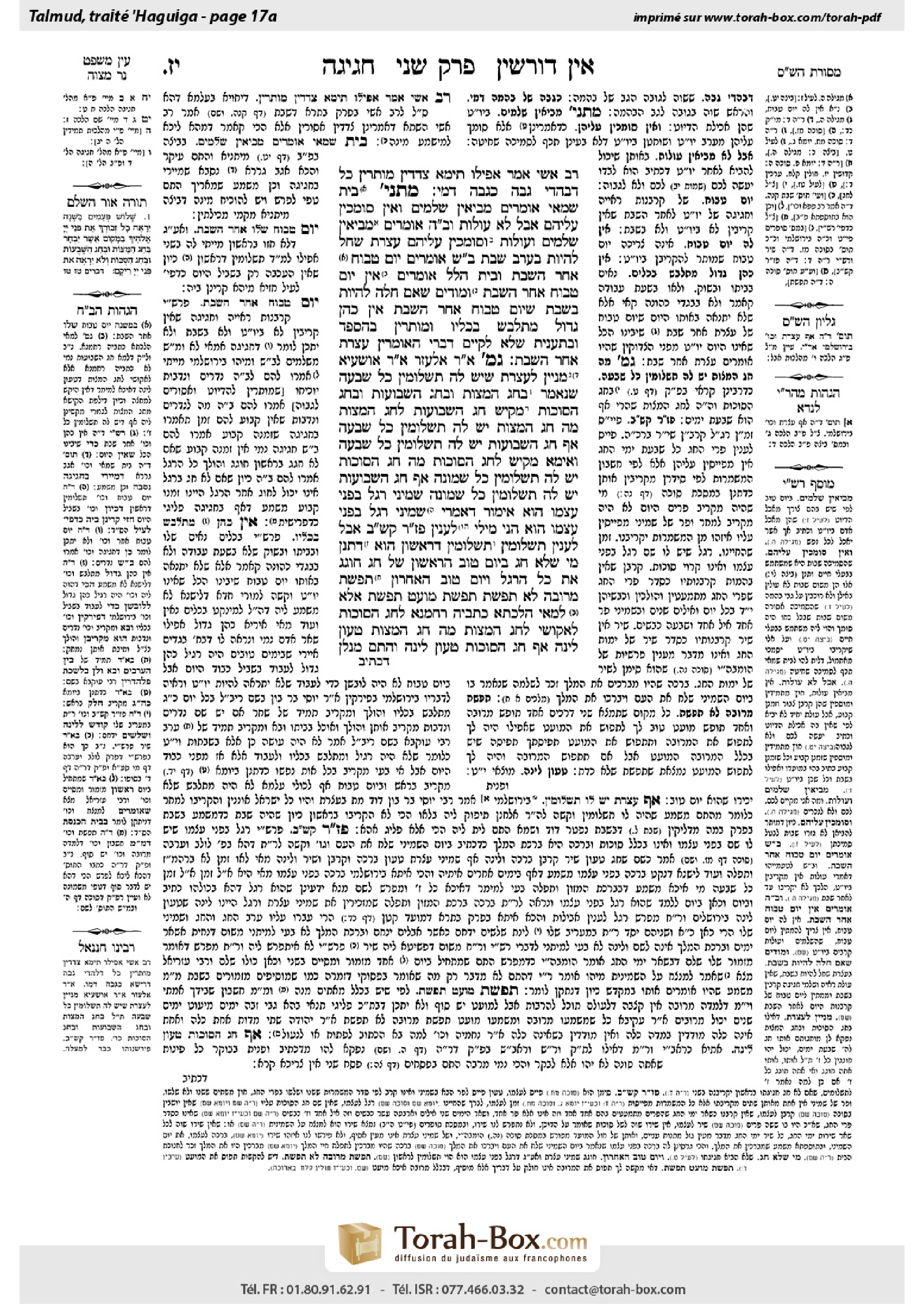
Chagigah 17a: Talmud study for Daf Yomi
Study the Talmud for Daf Yomi with scanned pages, Hebrew text, English translations from Sefaria and AI-generated French translations.
Passage selection and English or AI-generated French translation are available where the scan has annotations. Daf Study is independent of Torah-Box and Sefaria.
Browse Chagigah · חגיגה · All tractatesChagigah 17a text and translations
This page of Chagigah includes the Aramaic text, an English translation and an AI-generated French translation, alongside the scan above.
חגיגה י״ז א · Aramaic and Hebrew text
רַב אָשֵׁי אָמַר: אֲפִילּוּ תֵּימָא צְדָדִין מוּתָּרִין, כָּל דְּבַהֲדֵי גַּבַּהּ — כְּגַבַּהּ דָּמֵי.
מַתְנִי׳ בֵּית שַׁמַּאי אוֹמְרִים: מְבִיאִין שְׁלָמִים, וְאֵין סוֹמְכִין עֲלֵיהֶם, אֲבָל לֹא עוֹלוֹת. וּבֵית הִלֵּל אוֹמְרִים: מְבִיאִין שְׁלָמִים וְעוֹלוֹת, וְסוֹמְכִין עֲלֵיהֶם.
עֲצֶרֶת שֶׁחָל לִהְיוֹת בְּעֶרֶב שַׁבָּת, בֵּית שַׁמַּאי אוֹמְרִים: יוֹם טְבוֹחַ אַחַר הַשַּׁבָּת. וּבֵית הִלֵּל אוֹמְרִים: אֵין יוֹם טְבוֹחַ אַחַר הַשַּׁבָּת. וּמוֹדִים שֶׁאִם חָלָה לִהְיוֹת בְּשַׁבָּת, שֶׁיּוֹם טְבוֹחַ אַחַר הַשַּׁבָּת.
אֵין כֹּהֵן גָּדוֹל מִתְלַבֵּשׁ בְּכֵלָיו, וּמוּתָּרִין בְּהֶסְפֵּד וּבְתַעֲנִית, שֶׁלֹּא לְקַיֵּים דִּבְרֵי הָאוֹמְרִין: עֲצֶרֶת אַחַר הַשַּׁבָּת.
גְּמָ׳ אָמַר רַבִּי אֶלְעָזָר אָמַר רַבִּי אוֹשַׁעְיָא: מִנַּיִין לָעֲצֶרֶת שֶׁיֵּשׁ לָהּ תַּשְׁלוּמִין, כָּל שִׁבְעָה — שֶׁנֶּאֱמַר: ״בְּחַג הַמַּצּוֹת וּבְחַג הַשָּׁבוּעוֹת וּבְחַג הַסּוּכּוֹת״, מַקִּישׁ חַג הַשָּׁבוּעוֹת לְחַג הַמַּצּוֹת: מָה חַג הַמַּצּוֹת יֵשׁ לָהּ תַּשְׁלוּמִין כָּל שִׁבְעָה — אַף חַג הַשָּׁבוּעוֹת יֵשׁ לָהּ תַּשְׁלוּמִין כָּל שִׁבְעָה.
וְאֵימָא: מַקִּישׁ לְחַג הַסּוּכּוֹת, מָה חַג הַסּוּכּוֹת יֵשׁ לָהּ תַּשְׁלוּמִין כָּל שְׁמוֹנָה — אַף חַג הַשָּׁבוּעוֹת יֵשׁ לָהּ תַּשְׁלוּמִין כָּל שְׁמוֹנָה! שְׁמִינִי רֶגֶל בִּפְנֵי עַצְמוֹ הוּא.
אֵימוֹר דְּאָמְרִי[נַן] שְׁמִינִי רֶגֶל בִּפְנֵי עַצְמוֹ הוּא — הָנֵי מִילֵּי לְעִנְיַן פָּזֵ״ר קֶשֶׁ״ב. אֲבָל לְעִנְיַן תַּשְׁלוּמִין — תַּשְׁלוּמִין דְּרִאשׁוֹן הוּא. דִּתְנַן: מִי שֶׁלֹּא חָג בְּיוֹם טוֹב הָרִאשׁוֹן שֶׁל חַג — חוֹגֵג אֶת כָּל הָרֶגֶל, וְיוֹם טוֹב הָאַחֲרוֹן.
תָּפַשְׂתָּ מְרוּבֶּה לֹא תָּפַשְׂתָּ, תָּפַשְׂתָּ מוּעָט תָּפַשְׂתָּ.
אֶלָּא, לְמַאי הִלְכְתָא כַּתְבֵיהּ רַחֲמָנָא לְחַג הַסּוּכּוֹת? לְאַקּוֹשֵׁי לְחַג הַמַּצּוֹת: מָה חַג הַמַּצּוֹת טָעוּן לִינָה — אַף חַג הַסּוּכּוֹת טָעוּן לִינָה.
וְהָתָם מְנָלַן?
Chagigah 17a · English translation
Rav Ashi said: Even if you say that sides are permitted in general, there is no proof from here, since anything that is near the animal’s back is considered as its back. Therefore, placing the hands on the head of the animal is the same as placing them on the animal itself, as opposed to its sides.
MISHNA: Beit Shammai say: One may bring peace-offerings on a Festival because both the owners and the priests partake of them, but one may not place his hands on them, on the peace-offerings before sacrificing them. However, one may not bring burnt-offerings at all because they are not eaten, and labor is permitted on Festivals only for the sake of preparing food for humans. And Beit Hillel say: One may bring peace-offerings and also burnt-offerings, and one places his hands on both of them.
If the festival of Shavuot occurs on the eve of Shabbat, Beit Shammai say: The day of slaughter is after Shabbat, on Sunday. This is the day on which the animals brought in honor of the pilgrim Festival are slaughtered, since they maintain that the Festival burnt-offering is not sacrificed on the Festival day itself but on the following day, and all burnt-offerings vowed by individuals are postponed to the following day. And Beit Hillel say: The day of slaughter is not after Shabbat. Since the slaughter may be performed on the Festival day itself, it is unnecessary to postpone it. But they concede that if Shavuot occurs on Shabbat, the day of slaughter is after Shabbat.
The mishna relates that when the day of slaughter was on a Sunday, the High Priest would not dress in his festive garments but would wear his regular clothing. And all were permitted to eulogize and fast on this day. This was done in order not to uphold and reinforce the opinion of the Sadducees, who would say: Shavuot must always occur after Shabbat. As the day of slaughter was on Sunday, it was necessary to demonstrate that we do not accept the view of the Sadducees, and that the day is not a Festival.
GEMARA: Rabbi Elazar said that Rabbi Oshaya said: From where is it derived that the Shavuot offerings can be redressed, i.e., that the obligatory Festival offerings can be sacrificed all seven days following the Festival? As it is stated: “Three times a year all your males shall appear…on the festival of Passover, and on the festival of Shavuot, and on the festival of Sukkot” (Deuteronomy 16:16). The verse compares the festival of Shavuot to the festival of Passover by analogy: Just as one can redress the failure to bring the offering on the festival of Passover on all seven days of the Festival, so too, on the festival of Shavuot, one can redress the failure to bring the offering for all seven, i.e., Shavuot and the six days following it.
The Gemara raises a difficulty: But perhaps you should say instead that the verse compares Shavuot to the festival of Sukkot by analogy: Just as the Festival day of Sukkot can be redressed for all eight days, as the Eighth Day of Assembly is part of the Festival, so too can the festival of Shavuot be redressed for all eight days. The Gemara answers: The Eighth Day of Assembly is an independent pilgrimage Festival and is not considered part of Sukkot.
The Gemara continues to ask: You can say that when they said that The Eighth Day of Assembly is an independent pilgrimage Festival, this applies only to the issue of peh, zayin, reish, kuf, shin, beit, an acronym for the six halakhot that differentiate The Eighth Day of Assembly from the festival of Sukkot. But with regard to the redress of the Festival offerings, it is considered a day of redress for the first Festival day, as we learned in a mishna (9a): One who did not celebrate by sacrificing the Festival offerings on the first day of the Sukkot Festival can celebrate by sacrificing them throughout the pilgrimage Festival of Sukkot and on the last day of that Festival. If so, the question remains: Why do we not compare Shavuot to Sukkot and allow its offerings to be completed on all eight days?
The Gemara answers by implementing the following principle: If you grasped many, you did not grasp anything; if you grasped few, you grasped something. In other words, when one must choose between a smaller number and a larger one, there is more certainty in choosing the smaller one. Even if that choice turns out to be erroneous, it is preferable to the larger one, as it is included in it. In this case, seven is included in eight. Therefore, it is preferable to compare Shavuot to the seven days of Passover than to the eight days of Sukkot.
The Gemara asks: But if we do not compare Shavuot to Sukkot, for the sake of what halakha did the Merciful One write the festival of Sukkot in this context? The laws of all the Festivals were already listed, so the Torah must have mentioned their names again in order to compare them for a particular reason. The Gemara answers: The festival of Sukkot was mentioned in order to compare it by analogy to the festival of Passover, in the following manner: Just as the festival of Passover requires lodging overnight in Jerusalem after the conclusion of the Festival, as one may not depart that night, so too the festival of Sukkot requires lodging in Jerusalem after Sukkot has ended.
The Gemara asks: And there, with regard to Passover itself, from where do we derive that it requires lodging?
Chagigah 17a · Traduction française (IA)
Rav Ashi a dit : Même si l'on dit que les côtés sont permis en général, il n'y a pas de preuve à partir de cela, car tout ce qui est proche du dos de l'animal est considéré comme son dos. Par conséquent, poser les mains sur la tête de l'animal est comme poser les mains sur l'animal lui-même, contrairement à ses côtés.
MICHNA : Beit Shammai disent : On peut apporter des offrandes de paix lors d'un festival, car à la fois les propriétaires et les prêtres en mangent, mais on ne peut pas poser ses mains sur elles, sur les offrandes de paix avant de les sacrifier. Cependant, on ne peut pas apporter d'offrandes brûlées du tout, car elles ne sont pas mangées, et le travail est permis aux festivals uniquement pour préparer la nourriture pour les humains. Et Beit Hillel disent : On peut apporter des offrandes de paix et aussi des offrandes brûlées, et on pose ses mains sur les deux.
Si le festival de Shavuot tombe le soir du sabbat, Beit Shammai disent : La journée de sacrifice est après le sabbat, le dimanche. C'est la journée où les animaux apportés en honneur du festival de pèlerinage sont sacrifiés, car ils maintiennent que l'holocauste du festival n'est pas sacrifiée le jour même du festival mais le jour suivant, et toutes les offrandes brûlées vœu par des individus sont reportées au jour suivant. Et Beit Hillel disent : La journée de sacrifice n'est pas après le sabbat. Puisque le sacrifice peut être effectué le jour même du festival, il n'est pas nécessaire de le reporter. Cependant, ils reconnaissent que si Shavuot tombe un sabbat, la journée de sacrifice est après le sabbat.
La Michna rapporte que lorsque la journée de sacrifice était un dimanche, le grand prêtre ne portait pas ses vêtements festifs mais ses vêtements ordinaires. Et tous étaient autorisés à faire des funérailles et à jeûner ce jour-là. Cela a été fait afin de ne pas soutenir et renforcer l'opinion des Sadducéens, qui disaient que Shavuot doit toujours avoir lieu après le sabbat. Comme la journée de sacrifice était un dimanche, il était nécessaire de montrer que nous ne reconnaissons pas l'opinion des Sadducéens, et que ce jour n'est pas un festival.
GUEMARA : Rabbi Elazar a dit que Rabbi Oshaya a dit : D'où tire-t-on que les offrandes de Shavuot peuvent être réparées, c'est-à-dire que les offrandes obligatoires du festival peuvent être sacrifiées pendant les sept jours suivant le festival ? Comme il est dit : « Trois fois l'an, tous vos mâles doivent venir... au festival de Pessah, et au festival de Shavuot, et au festival de Sucot » (Deutéronome 16:16). La verset compare le festival de Shavuot au festival de Pessah par analogie : Comme l'on peut réparer l'absence d'offrande au festival de Pessah pendant les sept jours du festival, ainsi aussi au festival de Shavuot, on peut réparer l'absence d'offrande pendant les sept jours, c'est-à-dire Shavuot et les six jours suivants.
La Guemara soulève un problème : Mais peut-être devrait-on dire plutôt que le verset compare Shavuot au festival de Sucot par analogie : Comme le jour du festival de Sucot peut être réparé pendant les huit jours, car le huitième jour de réunion est partie du festival, ainsi aussi le festival de Shavuot peut être réparé pendant les huit jours. La Guemara répond : Le huitième jour de réunion est un festival de pèlerinage indépendant et n'est pas considéré comme faisant partie de Sucot.
La Guemara continue à poser la question : Vous pouvez dire que lorsque l'on a dit que le huitième jour de la fête est un festival de pèlerinage indépendant, cela s'applique uniquement à la question de peh, zayin, reish, kuf, shin, beit, un acronyme pour les six halakhot qui distinguent le huitième jour de la fête du festival de Sucot. Mais concernant la réparation des offrandes du festival, il est considéré comme un jour de réparation pour le premier jour du festival, comme nous l'avons appris dans une mishna (9a) : Celui qui n'a pas célébré en sacrifiant les offrandes du festival le premier jour du festival de Sucot peut célébrer en sacrifiant les offrandes tout au long du festival de pèlerinage de Sucot et le dernier jour de ce festival. Si c'est ainsi, la question reste : pourquoi ne comparons-nous pas Shavuot à Sucot et permettons ainsi la réparation de ses offrandes pendant les huit jours ?
La Guemara répond en appliquant le principe suivant : Si vous avez saisi beaucoup, vous n'avez saisi rien ; si vous avez saisi peu, vous avez saisi quelque chose. En d'autres termes, lorsque l'on doit choisir entre un nombre plus petit et un plus grand, il y a plus de certitude à choisir le plus petit. Même si ce choix se révèle erroné, il est préférable au plus grand, car il est inclus dedans. Dans ce cas, sept est inclus dans huit. Par conséquent, il est préférable de comparer Shavuot aux sept jours de Pessah plutôt qu'aux huit jours de Sucot.
La Guemara pose la question : Mais si nous ne comparons pas Shavuot à Sucot, pour quelle halakha l'Éternel Miséricordieux a-t-il inscrit le festival de Sucot dans ce contexte ? Les lois de tous les festivals avaient déjà été énumérées, donc la Torah a dû mentionner leurs noms à nouveau afin de les comparer pour une raison particulière. La Guemara répond : Le festival de Sucot a été mentionné afin de le comparer par analogie au festival de Pessah, comme suit : Comme le festival de Pessah exige de loger à Jérusalem après la fin du festival, car on ne peut pas partir cette nuit, ainsi aussi le festival de Sucot exige de loger à Jérusalem après la fin de Sucot.
La Guemara pose la question : Et là, concernant Pessah lui-même, d'où tire-t-on qu'il exige de loger ?
Traduction française générée par IA à partir de l’édition anglaise de Sefaria. Vérifie toujours un passage avec le texte source.
Text from Sefaria: William Davidson Edition - Vocalized Aramaic (CC BY NC); William Davidson Edition - English (CC BY NC).