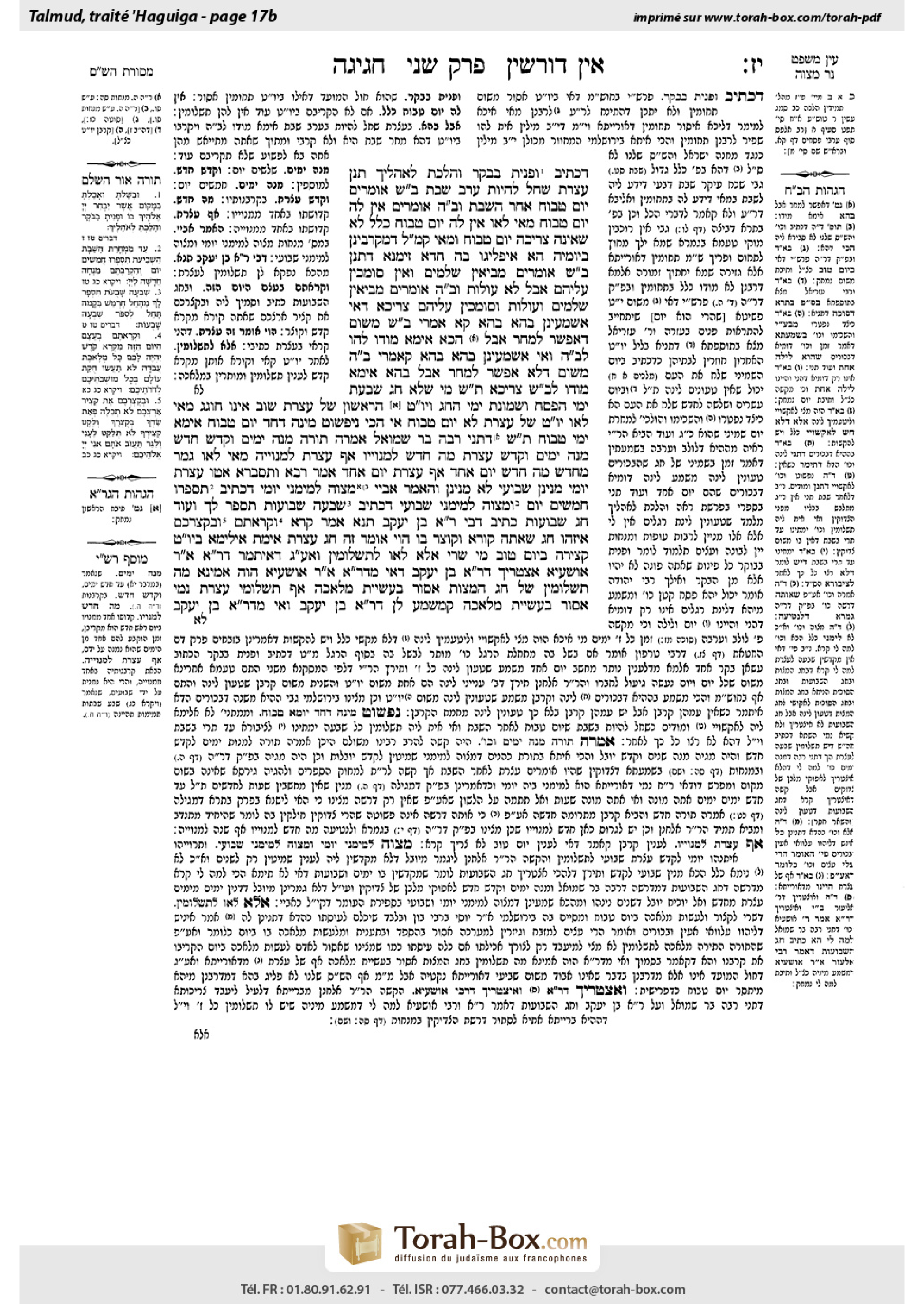
Chagigah 17b: Talmud study for Daf Yomi
Study the Talmud for Daf Yomi with scanned pages, Hebrew text, English translations from Sefaria and AI-generated French translations.
Passage selection and English or AI-generated French translation are available where the scan has annotations. Daf Study is independent of Torah-Box and Sefaria.
Browse Chagigah · חגיגה · All tractatesChagigah 17b text and translations
This page of Chagigah includes the Aramaic text, an English translation and an AI-generated French translation, alongside the scan above.
חגיגה י״ז ב · Aramaic and Hebrew text
דִּכְתִיב: ״וּפָנִיתָ בַבֹּקֶר וְהָלַכְתָּ לְאֹהָלֶיךָ״.
תְּנַן: עֲצֶרֶת שֶׁחָל לִהְיוֹת עֶרֶב שַׁבָּת, בֵּית שַׁמַּאי אוֹמְרִים: יוֹם טְבוֹחַ אַחַר הַשַּׁבָּת, וּבֵית הִלֵּל אוֹמְרִים: אֵין לָהּ יוֹם טְבוֹחַ. מַאי לָאו, אֵין לָהּ יוֹם טְבוֹחַ כְּלָל? לָא, שֶׁאֵינָהּ צְרִיכָה יוֹם טְבוֹחַ.
וּמַאי קָא מַשְׁמַע לַן — דִּמְקָרְבִינַן בְּיוֹמֵיהּ, הָא אִיפְּלִיגוּ בַּהּ חֲדָא זִימְנָא! דִּתְנַן, בֵּית שַׁמַּאי אוֹמְרִים: מְבִיאִין שְׁלָמִים וְאֵין סוֹמְכִין עֲלֵיהֶם, אֲבָל לֹא עוֹלוֹת, וּבֵית הִלֵּל אוֹמְרִים: מְבִיאִין שְׁלָמִים וְעוֹלוֹת וְסוֹמְכִין עֲלֵיהֶם.
צְרִיכָא, דְּאִי אַשְׁמְעִינַן בְּהָא: בְּהָא קָא אָמְרִי בֵּית שַׁמַּאי, מִשּׁוּם דְּאֶפְשָׁר לִמְחַר. אֲבָל הָכָא, אֵימָא מוֹדוּ לְהוּ לְבֵית הִלֵּל.
וְאִי אַשְׁמְעִינַן בְּהָא: בְּהָא קָאָמְרִי בֵּית הִלֵּל, מִשּׁוּם דְּלָא אֶפְשָׁר לִמְחַר, אֲבָל בְּהָא — אֵימָא מוֹדוּ לְבֵית שַׁמַּאי, צְרִיכָא.
תָּא שְׁמַע: מִי שֶׁלֹּא חָג שִׁבְעַת יְמֵי הַפֶּסַח, וּשְׁמוֹנַת יְמֵי הֶחָג, וְיוֹם טוֹב הָרִאשׁוֹן שֶׁל עֲצֶרֶת, שׁוּב אֵינוֹ חוֹגֵג. מַאי לָאו: יוֹם טוֹב שֶׁל עֲצֶרֶת! לֹא, יוֹם טְבוֹחַ. אִי הָכִי, נִיפְשׁוֹט מִינַּהּ דְּחַד יוֹם טְבוֹחַ! אֵימָא: יְמֵי טְבוֹחַ.
תָּא שְׁמַע, דְּתָנֵי רַבָּה בַּר שְׁמוּאֵל: אָמְרָה תּוֹרָה מְנֵה יָמִים וְקַדֵּשׁ חֹדֶשׁ, מְנֵה יָמִים וְקַדֵּשׁ עֲצֶרֶת. מָה חֹדֶשׁ — לִמְנוּיָיו, אַף עֲצֶרֶת — לִמְנוּיֶיהָ. מַאי לָאו: גָּמַר מֵחֹדֶשׁ, מָה חֹדֶשׁ — יוֹם אֶחָד, אַף עֲצֶרֶת — יוֹם אֶחָד!
אָמַר רָבָא: וְתִסְבְּרָא?! אַטּוּ עֲצֶרֶת, יוֹמֵי מָנֵינַן שָׁבוּעֵי לָא מָנֵינַן? וְהָאָמַר אַבָּיֵי: מִצְוָה לְמִימְנֵי יוֹמֵי, דִּכְתִיב: ״תִּסְפְּרוּ חֲמִשִּׁים יוֹם״, וּמִצְוָה לְמִימְנֵי שָׁבוּעֵי, דִּכְתִיב: ״שִׁבְעָה שָׁבוּעוֹת תִּסְפָּר לָךְ״. וְעוֹד: ״חַג שָׁבוּעוֹת״, כְּתִיב.
דְּבֵי רַבִּי אֱלִיעֶזֶר בֶּן יַעֲקֹב תָּנָא, אָמַר קְרָא: ״וּקְרָאתֶם וּבְקֻצְרְכֶם״. אֵיזֶהוּ חַג שֶׁאַתָּה קוֹרֵא וְקוֹצֵר בּוֹ — הֱוֵי אוֹמֵר זֶה חַג עֲצֶרֶת.
אֵימַת? אִילֵּימָא בְּיוֹם טוֹב — קְצִירָה בְּיוֹם טוֹב מִי שְׁרֵי? אֶלָּא לָאו לְתַשְׁלוּמִין.
וְאַף עַל גַּב דְּאִיתְּמַר דְּרַבִּי אֶלְעָזָר אָמַר רַבִּי אוֹשַׁעְיָא, אִצְטְרִיךְ דְּרַבִּי אֱלִיעֶזֶר בֶּן יַעֲקֹב. דְּאִי מִדְּרַבִּי אֶלְעָזָר אָמַר רַבִּי אוֹשַׁעְיָא — הֲוָה אָמֵינָא: מָה תַּשְׁלוּמִין שֶׁל חַג הַמַּצּוֹת אָסוּר בַּעֲשִׂיַּית מְלָאכָה, אַף תַּשְׁלוּמֵי עֲצֶרֶת נָמֵי אָסוּר בַּעֲשִׂיַּית מְלָאכָה, קָמַשְׁמַע לַן דְּרַבִּי אֱלִיעֶזֶר בֶּן יַעֲקֹב. וְאִי מִדְּרַבִּי אֱלִיעֶזֶר בֶּן יַעֲקֹב,
Chagigah 17b · English translation
The Gemara answers: One may leave Jerusalem only in the morning, after staying there for the night following the Festival, as it is written following the laws of the Paschal offering: “And you shall turn in the morning and go to your tents” (Deuteronomy 16:7).
§ We learned in the mishna: If the festival of Shavuot occurs on the eve of Shabbat, Beit Shammai say: The day of slaughter is after Shabbat; and Beit Hillel say: It does not have a day of slaughter. What, is it not that it does not have a day of slaughter at all; i.e., there are no days of redress for an offering that was meant to be sacrificed on the festival of Shavuot itself? The Gemara rejects this: No, Beit Hillel means that it does not require a day of slaughter.
The Gemara asks: And what does this teach us; that all offerings are sacrificed on their day? But they have already disputed this once, as we learned in a mishna: Beit Shammai say: One may bring peace-offerings on a Festival but one may not place his hands on them. However, one may not bring burnt-offerings at all; and Beit Hillel say: One may bring peace-offerings and also burnt-offerings, and one places his hands on both of them. Why is it necessary to restate this argument in different terms?
The Gemara answers: It is necessary, for had the mishna taught us only this case, that Beit Shammai prohibits bringing burnt-offerings on a Festival, we might have said: It is with regard to this case, a regular Festival followed by a weekday, that Beit Shammai state their opinion, because it is possible to sacrifice these burnt-offerings on the following day, on the day of slaughter after the Festival; but there, with regard to a Shavuot that occurs on a Friday, when one cannot sacrifice offerings on the following day, you might perhaps say that they agree with Beit Hillel that the burnt-offerings should be sacrificed on the Festival itself. It was therefore necessary to state that Beit Shammai’s view is the same in both cases.
The reverse also applies: And had it taught us only that case, that there is no day of slaughter after Shabbat, we might have said: It is with regard to that case that Beit Hillel state their view, that the offerings should be sacrificed on the Festival itself, because it is not possible to sacrifice them on the following day, which is Shabbat; but here, on a regular Festival followed by a weekday, you might say that perhaps they agree with Beit Shammai. It is therefore necessary for the mishna to specify both cases. The question of whether there are days of redress for Shavuot according to Beit Hillel therefore remains unresolved.
The Gemara suggests: Come and hear a proof from a different source: One who did not celebrate by sacrificing the peace-offerings of the Festival on the seven days of Passover, or on the eight days of the festival of Sukkot, or on the first day of Shavuot may no longer celebrate and sacrifice those offerings. The Gemara infers: Does this not mean that if one did not sacrifice on the Festival day of Shavuot itself, this lapse cannot be remedied, thereby demonstrating that there are no days of redress for Shavuot? The Gemara refutes this: No, the term Festival day is referring to the day of slaughter, rather than the Festival itself. The Gemara immediately counters: If so, let us at least resolve from here, i.e., the mishna that there is only one day of slaughter and not seven days. The Gemara rejects this: Say that the wording of the mishna should be corrected, so that instead of: A day of slaughter, it reads: Days of slaughter.
The Gemara suggests further: Come and hear a proof from another source, as Rabba bar Shmuel taught the following baraita: The Torah said to count thirty days, as it is stated: “A month of days” (Numbers 11:20), and then sanctify the month with offerings. And the Torah also said to count days from Passover and then sanctify the festival of Shavuot with offerings, as it is stated: “You shall count fifty days” (Leviticus 23:16). From this comparison, we learn the following halakha: Just as the new month is sanctified for the unit of time by which it is counted, i.e., for one day, so too, Shavuot is sanctified for the unit of time by which it is counted, i.e., for one full week, as it is stated: “Seven complete weeks shall there be” (Leviticus 23:15). The Gemara infers from this: Does this not mean that we learn from the month? If so, we can also learn that just as the festival of a month, the New Moon, is one day, so too Shavuot is only one day, without days of redress.
Rava said: And how can you understand it that way? Is that to say that for Shavuot we count days but we do not count weeks? Didn’t Abaye say: It is a mitzva to count days, in the counting of the omer, as it is written: “Until the morrow of the seventh week, you shall count fifty days” (Leviticus 23:16); and it is also a mitzva to count weeks, as it is written: “Seven weeks you shall count for yourself, from when the sickle is first put to the standing corn” (Deuteronomy 16:9); and further, it is written: “The festival of weeks [shavuot]” (Deuteronomy 16:10), which indicates that it is a Festival that is established through a count of weeks? Consequently, the days of redress for Shavuot should last a week, in accordance with its components.
§ In the school of Rabbi Eliezer ben Ya’akov, a Sage taught the following: The verse states with regard to Shavuot: “And you shall make a proclamation on this very day, it shall be a holy convocation, you shall do no kind of laborious work” (Leviticus 23:21), and it states in the same chapter: “And when you reap the harvest of your land” (Leviticus 23:22). Which is the Festival on which you make a proclamation and also reap, i.e., which Festival occurs in the harvest season? You must say it is the festival of Shavuot.
The Gemara proceeds to analyze the teaching: When exactly does this refer to? If we say it is referring to the Festival day itself, is it permitted to reap on a Festival? Obviously, ordinary work is prohibited on Festivals. Rather, is it not referring to the issue of redress? In other words, it speaks of those days on which redress can be made for the offerings of the Festival, i.e., the days of slaughter, on which one may indeed reap because they are regular weekdays, and they nevertheless have a festive quality.
The Gemara comments: And even though the teaching that Rabbi Elazar said that Rabbi Oshaya said, that the halakha of the redress for Shavuot is derived from the comparison to Passover, was stated, it was nevertheless necessary to state the teaching of Rabbi Eliezer ben Ya’akov as well, for if we had learned only the proof that Rabbi Elazar said that Rabbi Oshaya said, I would say the following: Just as on the days of redress for the festival of Passover it is prohibited to perform any work that will not cause irretrievable loss, as they are part of the Festival, so too on the days of redress for Shavuot it is also prohibited to perform work. We are therefore taught the statement of Rabbi Eliezer ben Ya’akov as well, that on these festive days one may reap, as they are weekdays. Conversely, if we had learned the halakha only from the words of Rabbi Eliezer ben Ya’akov,
Chagigah 17b · Traduction française (IA)
La Guemara répond : On peut quitter Jérusalem uniquement le matin, après avoir passé la nuit suivant la fête, comme il est écrit concernant les lois de l'offrande pascal : « Et tu tourneras le matin et iras dans tes tentes » (Deutéronome 16:7).
§ Nous avons appris dans la mitsna : Si la fête de Shavuot tombe le soir du Shabbat, Beit Shammai disent : La journée de sacrifice est après le Shabbat ; et Beit Hillel disent : Elle n'a pas de journée de sacrifice. Qu'est-ce que cela signifie, qu'elle n'a pas de journée de sacrifice du tout ; c'est-à-dire qu'il n'y a pas de jours de réparation pour une offrande qui devait être sacrifiée pendant la fête de Shavuot elle-même ? La Guemara rejette cette interprétation : Non, Beit Hillel veulent dire qu'elle ne nécessite pas de journée de sacrifice.
La Guemara pose la question : Et que nous apprend cela ; que toutes les offrandes sont sacrifiées le jour de leur sacrifice ? Mais ils ont déjà disputé cela une fois, comme nous l'avons appris dans une mitsna : Beit Shammai disent : On peut apporter des offrandes de paix lors d'une fête, mais on ne peut pas poser ses mains sur elles. Cependant, on ne peut pas apporter d'offrandes brûlées du tout ; et Beit Hillel disent : On peut apporter des offrandes de paix et aussi des offrandes brûlées, et on pose ses mains sur les deux. Pourquoi est-il nécessaire de reprendre ce débat sous une autre forme ?
La Guemara répond : Il est nécessaire, car si la mitsva nous avait appris seulement ce cas, que Beit Shammai interdit l'apport des offrandes brûlées lors d'une fête, nous aurions pu dire : C'est concernant ce cas, une fête ordinaire suivie d'un jour de semaine, que Beit Shammai exprime leur opinion, car il est possible de sacrifier ces offrandes brûlées le jour suivant, le jour de sacrifice après la fête ; mais là, concernant une Shavuot qui tombe un vendredi, où on ne peut pas sacrifier d'offrandes le jour suivant, vous pourriez peut-être dire qu'ils sont d'accord avec Beit Hillel que les offrandes brûlées devraient être sacrifiées pendant la fête elle-même. Il était donc nécessaire d'indiquer que l'opinion de Beit Shammai est la même dans les deux cas.
L'inverse s'applique également : Et si elle nous avait appris seulement ce cas, qu'il n'y a pas de jour de sacrifice après le Shabbat, nous aurions pu dire : C'est concernant ce cas que Beit Hillel exprime leur opinion, que les offrandes devraient être sacrifiées pendant la fête elle-même, car il n'est pas possible de les sacrifier le jour suivant, qui est le Shabbat ; mais ici, concernant une fête ordinaire suivie d'un jour de semaine, vous pourriez peut-être dire qu'ils sont d'accord avec Beit Shammai. Il était donc nécessaire que la mitsva spécifie les deux cas. La question de savoir s'il y a des jours de réparation pour Shavuot selon Beit Hillel reste donc indéterminée.
La Guemara suggère : Viens écouter une preuve d'une autre source : Celui qui n'a pas célébré en sacrifiant les offrandes de paix de la fête pendant les sept jours de Pâques, ou pendant les huit jours de la fête de Tabernacles, ou pendant le premier jour de Shavuot ne peut plus célébrer et sacrifier ces offrandes. La Guemara infère : Ne signifie-t-il pas que si l'on n'a pas sacrifié pendant la fête de Shavuot elle-même, cette omission ne peut pas être réparée, démontrant ainsi qu'il n'y a pas de jours de réparation pour Shavuot ? La Guemara refuse cette interprétation : Non, le terme « jour de fête » fait référence au jour de sacrifice, et non à la fête elle-même. La Guemara réplique immédiatement : Si c'est ainsi, permettons-nous au moins de résoudre cela, c'est-à-dire la mitsva qui indique qu'il n'y a qu'un seul jour de sacrifice et non sept jours. La Guemara refuse cela : Dis que le texte de la mitsva devrait être corrigé, de sorte que, au lieu de « un jour de sacrifice », il lise « des jours de sacrifice ».
La Guemara suggère davantage : Viens écouter une preuve d'une autre source, comme Rabba bar Shmuel a enseigné la suivante baraïta : La Torah dit de compter trente jours, comme il est écrit : « Un mois de jours » (Nombres 11:20), et ensuite de sanctifier le mois avec des offrandes. Et la Torah dit aussi de compter les jours à partir de Pâques et ensuite de sanctifier la fête de Shavuot avec des offrandes, comme il est écrit : « Vous compterez cinquante jours » (Lévitique 23:16). À partir de cette comparaison, nous apprenons la suivante halakha : Comme le nouveau mois est sanctifié pour l'unité de temps par laquelle il est compté, c'est-à-dire pour un jour, ainsi aussi Shavuot est sanctifié pour l'unité de temps par laquelle il est compté, c'est-à-dire pour une semaine complète, comme il est écrit : « Sept semaines complètes y seront » (Lévitique 23:15). La Guemara infère à partir de cela : Ne signifie-t-il pas que nous apprenons du mois ? Si c'est ainsi, nous pouvons aussi apprendre que comme la fête du mois, la Nouvelle Lune, est un jour, ainsi Shavuot est seulement un jour, sans jours de réparation.
Rava dit : Et comment pouvez-vous comprendre cela ainsi ? Est-ce pour dire que pour Shavuot nous comptons les jours mais pas les semaines ? N’a-t-il pas dit Abaye : Il est un mitsva de compter les jours, dans le décompte de l’omer, comme il est écrit : « Jusqu’au lendemain de la septième semaine, vous compterez cinquante jours » (Lévitique 23:16) ; et il est aussi un mitsva de compter les semaines, comme il est écrit : « Vous compterez sept semaines pour vous-même, à partir du moment où la faux est mise à la moisson » (Deutéronome 16:9) ; et en outre, il est écrit : « La fête des semaines [shavuot] » (Deutéronome 16:10), ce qui indique qu’il s’agit d’une fête établie par un décompte de semaines ? Par conséquent, les jours de réparation pour Shavuot devraient durer une semaine, conformément à ses composantes.
§ Dans l’école de Rabbi Eliezer ben Ya’akov, un Sage enseigna ceci : La parabole dit concernant Shavuot : « Et tu feras une proclamation ce jour-là, il sera un jour saint, tu ne feras aucun travail pénible » (Lévitique 23:21), et il dit dans le même chapitre : « Et quand tu moissonneras la récolte de ton pays » (Lévitique 23:22). Quelle est la fête où tu fais une proclamation et aussi moissonnes, c’est-à-dire quelle fête a lieu pendant la saison des récoltes ? Tu dois dire que c’est la fête de Shavuot.
La Guemara poursuit son analyse de l'enseignement : À quel moment exactement cela se réfère-t-il ? Si nous disons qu'il s'agit du jour de fête lui-même, est-il permis de moissonner le jour de fête ? Évidemment, le travail ordinaire est interdit les jours de fête. Plutôt, ne s'agit-il pas de la question de la réparation ? Autrement dit, il s'agit des jours où l'on peut faire la réparation pour les offrandes de la fête, c'est-à-dire les jours de sacrifice, où l'on peut effectivement moissonner car ils sont des jours ordinaires, et ils possèdent néanmoins une qualité festive.
La Guemara commente : Et même si l'enseignement que Rabbi Elazar a rapporté, selon Rabbi Oshaya, que la halakha de la réparation pour Shavuot est dérivée de la comparaison avec Pessah, a été énoncé, il a tout de même été nécessaire d'énoncer l'enseignement de Rabbi Eliezer ben Ya'akov également, car si nous avions appris seulement la preuve que Rabbi Elazar a rapportée, selon Rabbi Oshaya, je dirais ceci : Tout comme, sur les jours de réparation pour la fête de Pessah, il est interdit d'effectuer tout travail qui ne causerait pas de perte irréparable, car ils font partie de la fête, de même, sur les jours de réparation pour Shavuot, il est également interdit d'effectuer un travail. Nous sommes donc appris l'affirmation de Rabbi Eliezer ben Ya'akov également, selon laquelle, sur ces jours festifs, l'on peut moissonner, car ils sont des jours ordinaires. À l'inverse, si nous avions appris la halakha seulement à partir des paroles de Rabbi Eliezer ben Ya'akov,
Traduction française générée par IA à partir de l’édition anglaise de Sefaria. Vérifie toujours un passage avec le texte source.
Text from Sefaria: William Davidson Edition - Vocalized Aramaic (CC BY NC); William Davidson Edition - English (CC BY NC).