Chagigah 18a: Talmud study for Daf Yomi
Study the Talmud for Daf Yomi with scanned pages, Hebrew text, English translations from Sefaria and AI-generated French translations.
Passage selection and English or AI-generated French translation are available where the scan has annotations. Daf Study is independent of Torah-Box and Sefaria.
Browse Chagigah · חגיגה · All tractatesChagigah 18a text and translations
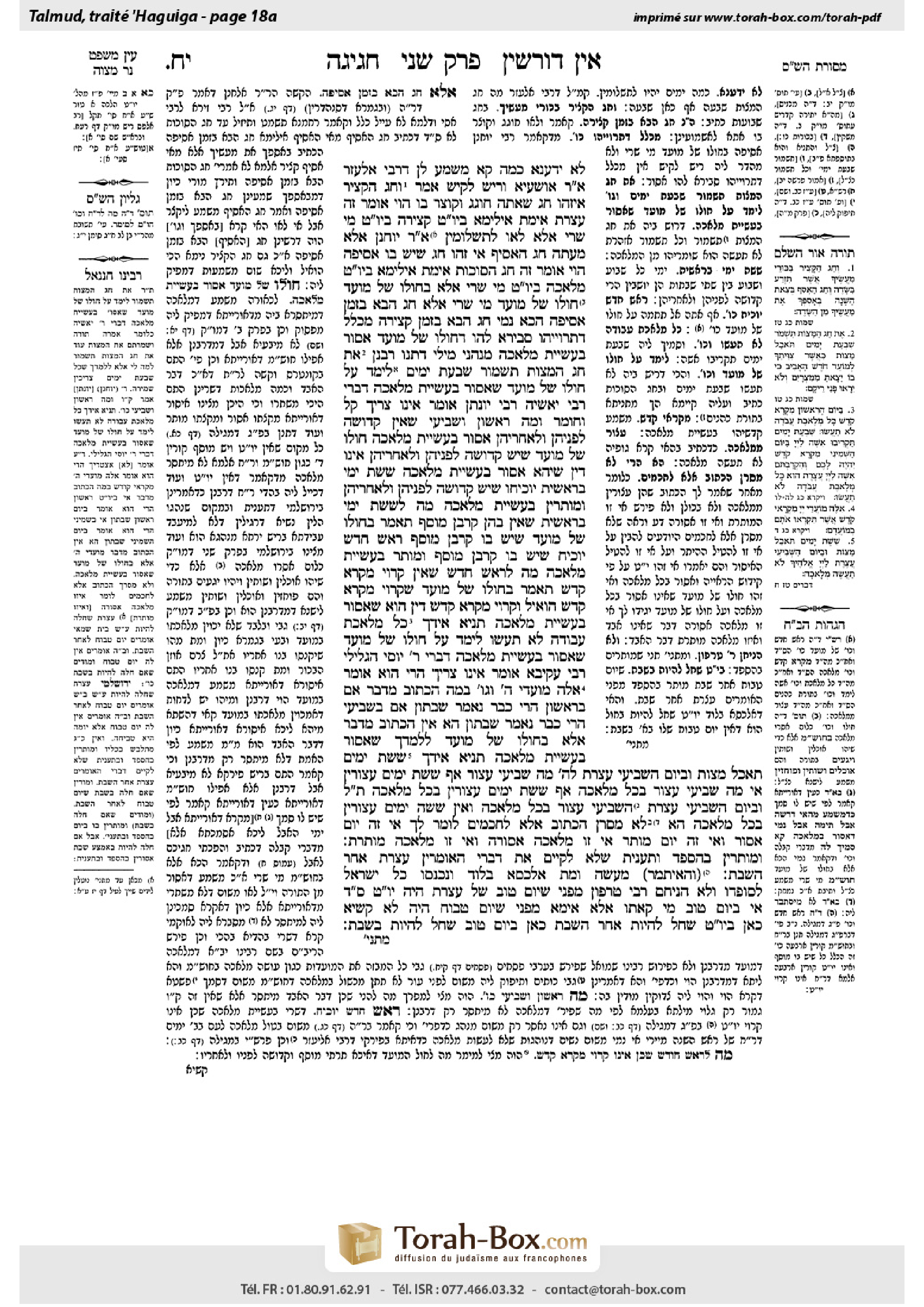
This page of Chagigah includes the Aramaic text, an English translation and an AI-generated French translation, alongside the scan above.
חגיגה י״ח א · Aramaic and Hebrew text
לָא יָדַעְנָא כַּמָּה, קָא מַשְׁמַע לַן דְּרַבִּי אֶלְעָזָר אָמַר רַבִּי אוֹשַׁעְיָא.
וְרֵישׁ לָקִישׁ אָמַר: ״וְחַג הַקָּצִיר״, אֵיזֶהוּ חַג שֶׁאַתָּה חוֹגֵג וְקוֹצֵר בּוֹ — הֱוֵי אוֹמֵר זֶה עֲצֶרֶת. אֵימַת? אִילֵּימָא בְּיוֹם טוֹב — קְצִירָה בְּיוֹם טוֹב מִי שְׁרֵי? אֶלָּא לָאו לְתַשְׁלוּמִין.
אָמַר רַבִּי יוֹחָנָן: אֶלָּא מֵעַתָּה, ״חַג הָאָסִיף״: אֵי זֶהוּ חַג שֶׁיֵּשׁ בּוֹ אֲסִיפָה — הֱוֵי אוֹמֵר זֶה חַג הַסּוּכּוֹת, אֵימַת? אִילֵּימָא בְּיוֹם טוֹב — מְלָאכָה בְּיוֹם טוֹב מִי שְׁרֵי? אֶלָּא בְּחוּלּוֹ שֶׁל מוֹעֵד. חוּלּוֹ שֶׁל מוֹעֵד מִי שְׁרֵי? אֶלָּא — חַג הַבָּא בִּזְמַן אֲסִיפָה, הָכָא נָמֵי — חַג הַבָּא בִּזְמַן קְצִירָה.
מִכְּלָל דְּתַרְוַיְיהוּ סְבִירָא לְהוּ דְּחוּלּוֹ שֶׁל מוֹעֵד אָסוּר בַּעֲשִׂיַּית מְלָאכָה.
מְנָהָנֵי מִילֵּי? דְּתָנוּ רַבָּנַן: ״אֶת חַג הַמַּצּוֹת תִּשְׁמוֹר שִׁבְעַת יָמִים״ — לִימֵּד עַל חוּלּוֹ שֶׁל מוֹעֵד שֶׁאָסוּר בַּעֲשִׂיַּית מְלָאכָה, דִּבְרֵי רַבִּי יֹאשִׁיָּה. רַבִּי יוֹנָתָן אוֹמֵר: אֵינוֹ צָרִיךְ, קַל וָחוֹמֶר: וּמָה רִאשׁוֹן וּשְׁבִיעִי שֶׁאֵין קְדוּשָּׁה לִפְנֵיהֶן וּלְאַחֲרֵיהֶן — אָסוּר בַּעֲשִׂיַּית מְלָאכָה, חוּלּוֹ שֶׁל מוֹעֵד שֶׁיֵּשׁ קְדוּשָּׁה לִפְנֵיהֶן וּלְאַחֲרֵיהֶן — אֵינוֹ דִּין שֶׁיְּהֵא אָסוּר בַּעֲשִׂיַּית מְלָאכָה.
שֵׁשֶׁת יְמֵי בְרֵאשִׁית יוֹכִיחוּ, שֶׁיֵּשׁ קְדוּשָּׁה לִפְנֵיהֶן וּלְאַחֲרֵיהֶן, וּמוּתָּרִין בַּעֲשִׂיַּית מְלָאכָה! מָה לְשֵׁשֶׁת יְמֵי בְּרֵאשִׁית שֶׁאֵין בָּהֶן קׇרְבַּן מוּסַף, תֹּאמַר בְּחוּלּוֹ שֶׁל מוֹעֵד שֶׁיֵּשׁ בּוֹ קׇרְבַּן מוּסַף. רֹאשׁ חֹדֶשׁ יוֹכִיחַ, שֶׁיֵּשׁ בּוֹ קׇרְבַּן מוּסַף, וּמוּתָּר בַּעֲשִׂיַּית מְלָאכָה! מָה לְרֹאשׁ חֹדֶשׁ שֶׁאֵין קָרוּי ״מִקְרָא קֹדֶשׁ״, תֹּאמַר בְּחוּלּוֹ שֶׁל מוֹעֵד שֶׁקָּרוּי ״מִקְרָא קֹדֶשׁ״, הוֹאִיל וְקָרוּי ״מִקְרָא קֹדֶשׁ״ — דִּין הוּא שֶׁאָסוּר בַּעֲשִׂיַּית מְלָאכָה.
תַּנְיָא אִידַּךְ: ״כׇּל מְלֶאכֶת עֲבוֹדָה לֹא תַעֲשׂוּ״ — לִימֵּד עַל חוּלּוֹ שֶׁל מוֹעֵד שֶׁאָסוּר בַּעֲשִׂיַּית מְלָאכָה, דִּבְרֵי רַבִּי יוֹסֵי הַגְּלִילִי. רַבִּי עֲקִיבָא אוֹמֵר: אֵינוֹ צָרִיךְ, הֲרֵי הוּא אוֹמֵר: ״אֵלֶּה מוֹעֲדֵי ה׳ וְגוֹ׳״. בַּמָּה הַכָּתוּב מְדַבֵּר? אִם בָּרִאשׁוֹן — הֲרֵי כְּבָר נֶאֱמַר ״שַׁבָּתוֹן״, אִם בַּשְּׁבִיעִי — הֲרֵי כְּבָר נֶאֱמַר ״שַׁבָּתוֹן״. הָא אֵין הַכָּתוּב מְדַבֵּר אֶלָּא בְּחוּלּוֹ שֶׁל מוֹעֵד, לְלַמֶּדְךָ שֶׁאָסוּר בַּעֲשִׂיַּית מְלָאכָה.
תַּנְיָא אִידַּךְ: ״שֵׁשֶׁת יָמִים תֹּאכַל מַצּוֹת וּבַיּוֹם הַשְּׁבִיעִי עֲצֶרֶת לַה׳״, מָה שְׁבִיעִי עָצוּר — אַף שֵׁשֶׁת יָמִים עֲצוּרִין. אִי: מָה שְׁבִיעִי עָצוּר בְּכׇל מְלָאכָה — אַף שֵׁשֶׁת יָמִים עֲצוּרִין בְּכׇל מְלָאכָה.
תַּלְמוּד לוֹמַר: ״וּבַיּוֹם הַשְּׁבִיעִי עֲצֶרֶת״, הַשְּׁבִיעִי עָצוּר בְּכׇל מְלָאכָה, וְאֵין שִׁשָּׁה יָמִים עֲצוּרִין בְּכׇל מְלָאכָה. הָא לֹא מְסָרָן הַכָּתוּב אֶלָּא לַחֲכָמִים, לוֹמַר לָךְ אֵי זֶה יוֹם אָסוּר וְאֵי זֶה יוֹם מוּתָּר, אֵי זוֹ מְלָאכָה אֲסוּרָה וְאֵי זוֹ מְלָאכָה מוּתֶּרֶת.
וּמוּתָּרִין בְּהֶסְפֵּד וְתַעֲנִית, שֶׁלֹּא לְקַיֵּים אֶת דִּבְרֵי הָאוֹמְרִין עֲצֶרֶת אַחַר הַשַּׁבָּת. וְהָאִיתְּמַר: מַעֲשֶׂה וּמֵת אֲלֶכְּסָא בְּלוֹד, וְנִכְנְסוּ כׇּל יִשְׂרָאֵל לְסוֹפְדוֹ, וְלֹא הִנִּיחָם רַבִּי טַרְפוֹן, מִפְּנֵי שֶׁיּוֹם טוֹב שֶׁל עֲצֶרֶת הָיָה.
יוֹם טוֹב סָלְקָא דַּעְתָּךְ? אִי בְּיוֹם טוֹב, מִי קָאָתוּ? אֶלָּא אֵימָא: מִפְּנֵי שֶׁיּוֹם טְבוֹחַ הָיָה! לָא קַשְׁיָא: כָּאן בְּיוֹם טוֹב שֶׁחָל לִהְיוֹת אַחַר הַשַּׁבָּת, כָּאן בְּיוֹם טוֹב שֶׁחָל לִהְיוֹת בְּשַׁבָּת.
Chagigah 18a · English translation
I would not know how many days of redress there are. The Gemara therefore teaches us, from the statement that Rabbi Elazar said that Rabbi Oshaya said, that there are seven days of redress.
And Reish Lakish said, providing a different proof: From the very name of the day: “And the Festival of harvest” (Exodus 23:16), we can learn the following: On which Festival do you celebrate and harvest? You must say it is Shavuot. When exactly does this apply? If we say that it is on the Festival day itself, is harvesting permitted on a Festival? Rather, is it not referring to the day of redress?
Rabbi Yoḥanan said to Reish Lakish: However, if that is so, you should likewise say with regard to “the Festival of gathering” (Exodus 23:16): On which Festival is there gathering? You must say it is the festival of Sukkot. When exactly? If we say it is on the Festival day itself, is labor permitted on a Festival? Rather, it is referring to the intermediate Festival days. But on the intermediate Festival days, too, is it permitted? One may perform only work that, if neglected, would result in irretrievable loss. Rather, you must explain that “the Festival of gathering” is referring to the season of the year, i.e., the Festival that occurs during the time of gathering. Here too: “The Festival of harvest” means a Festival that occurs during the time of harvest.
§ The Gemara comments: Since Reish Lakish does not dispute the accuracy of Rabbi Yoḥanan’s statement, it may be inferred from their statements that both of them hold that the performance of labor during the intermediate Festival days is prohibited by the Torah.
The Gemara proceeds to ask: From where are these matters derived; what is the biblical source for this prohibition? As the Sages taught: “You shall observe the festival of Passover seven days” (Exodus 23:15). This teaches that the performance of labor is prohibited during the intermediate Festival days, as “observe” denotes a negative commandment; this is the statement of Rabbi Yoshiyya. Rabbi Yonatan says: This proof is not necessary, as it does not accord with the straightforward meaning of the verse. Rather, it is learned from an a fortiori inference, as follows: If the performance of labor on the first and seventh days of Passover, which are not preceded and followed by sanctity as the days before the first day and after the seventh day are weekdays, is nevertheless prohibited, is it not right that on the days of the intermediate Festival days, which are preceded and followed by sanctity, i.e., the first and last days of the Festival, the performance of labor should be prohibited?
The Gemara questions this conclusion: The six days of Creation, i.e., the days of the week, shall prove this, since they are preceded and followed by the sanctity of Shabbat, and yet the performance of labor on them is permitted. The Gemara rejects this difficulty: What of the fact that the six days of Creation are regular weekdays on which there is no additional offering; can you say the same with regard to the intermediate Festival days, on which there is an additional offering, bestowing these days with a measure of sanctity? The Gemara counters this: The New Moon shall prove this, since it has an additional offering, and the performance of labor is nevertheless permitted on it. The Gemara refutes this argument: What of the fact that the New Moon is not called “a holy convocation”; can you say the same with regard to the intermediate Festival days, which are called “a holy convocation”? Since they are called “a holy convocation” it is logical that the performance of labor should be prohibited on them.
It is taught in another baraita concerning the same topic: With regard to the first day of Passover and Sukkot, the verse states: “You shall do no kind of laborious work” (Leviticus 23:35), followed by “seven days, you shall bring an offering made by fire to the Lord,” which teaches that the performance of labor is prohibited during the intermediate Festival days; this is the statement of Rabbi Yosei the Galilean. Rabbi Akiva says: This is not necessary, since it is stated earlier in that chapter: “These are the appointed Festivals of the Lord, holy convocations, which you shall proclaim in their appointed season” (Leviticus 23:4). With regard to what is the verse speaking? If it is referring to the first day of the Festival, it has already explicitly stated “a solemn rest” (Leviticus 23:39) with regard to that day; if it is referring to the seventh, it has already stated “a solemn rest” (Leviticus 23:39) with regard to that day as well. Therefore, the verse can be speaking only of the intermediate Festival days, teaching you that the performance of labor is prohibited on them.
It is taught in another baraita: The verse states: “Six days you shall eat unleavened bread, and on the seventh day there shall be a solemn assembly for the Lord your God; on it, you shall do no work” (Deuteronomy 16:8). If so, just as the seventh day of the Festival is precluded from the performance of labor, so are the six intermediate Festival days precluded, since the word “and” in the phrase “and on the seventh day” connects it to the previous days. If so, perhaps: Just as the seventh day is precluded from the performance of all labor, so too the six intermediate days are precluded from the performance of all labor, even those whose performance prevents irretrievable loss.
The verse therefore states: “And on the seventh day there shall be a solemn assembly,” literally, pause. This indicates that the seventh day alone is precluded from the performance of all labor, but the other six days are not precluded from the performance of all labor but only from certain forms of work. Since the Bible does not specify which types of work are prohibited, the verse has therefore entrusted the matter to the Sages exclusively, to tell you on which day work is prohibited and on which day it is permitted, and similarly which labor is prohibited and which labor is permitted.
§ The mishna taught: All were permitted to eulogize and fast on the days of slaughter, in order not to uphold the opinion of the Sadducees, who would say: Shavuot must always occur after Shabbat. The Gemara raises a difficulty: But wasn’t it stated: An incident occurred when Alexa died in Lod, and all of Israel gathered to eulogize him, but Rabbi Tarfon would not allow them do so because it was the Festival day of Shavuot?
The Gemara analyzes this passage: Can it enter your mind to say that it was a Festival day? If it had been a Festival day, would they have come? Certainly they would not have assembled to eulogize someone on the Festival itself. Rather, say that they were prohibited to eulogize because it was the Festival day of slaughter. The Gemara answers: This is not difficult, since here, the incident in Lod, is referring to a Festival that occurs after Shabbat, whose day of slaughter does not fall on a Sunday. The day of slaughter retains a measure of the sanctity of Shavuot through the offering of Festival offerings and should therefore be treated as a Festival. There, however, the mishna is referring to a Festival that occurs on Shabbat. Since in that case the day of slaughter occurs on a Sunday, it cannot be observed as a Festival, in order to counter the view of the Sadducees.
After discussing many issues unrelated to the main topic of the tractate, the Gemara now begins to discuss the topic of ritual purity and will do so for the remainder of the tractate. These halakhot are relevant to the pilgrim Festivals, as all are obligated to purify themselves in order to enter the Temple and sacrifice offerings.
Chagigah 18a · Traduction française (IA)
Je ne sais pas combien de jours de réparation il y a. La Guemara nous enseigne donc, à partir de la déclaration que Rabbi Elazar a rapportée de Rabbi Oshaya, qu'il y a sept jours de réparation.
Et Reish Lakish a dit, en donnant une preuve différente : D'après le nom même du jour : « Et le festival de la moisson » (Exode 23:16), nous pouvons apprendre ceci : Sur quel festival célèbre-t-on et moissonne-t-on ? On doit dire que c'est Shavuot. À quel moment cela s'applique-t-il ? Si l'on dit que c'est le jour du festival lui-même, la moisson est-elle permise le jour du festival ? Plutôt, n'est-ce pas en référence au jour de réparation ?
Rabbi Yoḥanan a dit à Reish Lakish : Cependant, si c'est ainsi, vous devriez aussi dire concernant « le festival de la récolte » (Exode 23:16) : Sur quel festival y a-t-il une récolte ? On doit dire que c'est le festival de Sucot. À quel moment ? Si l'on dit que c'est le jour du festival lui-même, le travail est-il permis le jour du festival ? Plutôt, il s'agit des jours intermédiaires du festival. Mais aussi sur les jours intermédiaires du festival, est-ce permis ? On peut effectuer uniquement un travail dont l'ignorance entraînerait une perte irréparable. Plutôt, vous devez expliquer que « le festival de la récolte » fait référence à la saison de l'année, c'est-à-dire le festival qui a lieu pendant la saison de la récolte. Ici aussi : « Le festival de la moisson » signifie un festival qui a lieu pendant la saison de la moisson.
§ La Guemara commente : Puisque Reish Lakish ne conteste pas la validité de la déclaration de Rabbi Yoḥanan, on peut en déduire de leurs déclarations que tous les deux considèrent que l'accomplissement de travaux pendant les jours intermédiaires du festival est interdit par la Torah.
La Guemara poursuit en posant la question : D'où ces choses sont-elles dérivées ; quelle est la source biblique de cette interdiction ? Comme les Sages ont enseigné : « Vous observerez le festival de Pessah sept jours » (Exode 23:15). Cela enseigne que l'accomplissement de travaux est interdit pendant les jours intermédiaires du festival, car « observer » désigne un commandement négatif ; c'est la déclaration de Rabbi Yoshiyya. Rabbi Yonatan dit : Cette preuve n'est pas nécessaire, car elle ne correspond pas au sens littéral du verset. Plutôt, elle est tirée d'une déduction par analogie, comme suit : Si l'accomplissement de travaux le premier et le septième jour de Pessah, qui ne sont pas précédés et suivis par la sanctité comme les jours avant le premier jour et après le septième jour sont des jours ordinaires, est toutefois interdit, n'est-ce pas juste que sur les jours intermédiaires du festival, qui sont précédés et suivis par la sanctité, c'est-à-dire les premiers et derniers jours du festival, l'accomplissement de travaux devrait être interdit ?
La Guemara questionne cette conclusion : Les six jours de la Création, c'est-à-dire les jours de la semaine, doivent prouver cela, car ils sont précédés et suivis par la sanctité du Shabbat, et pourtant l'accomplissement de travaux sur eux est permis. La Guemara rejette cette difficulté : Qu'en est-il du fait que les six jours de la Création sont des jours ordinaires où il n'y a pas d'offrande supplémentaire ; pouvez-vous dire la même chose concernant les jours intermédiaires du festival, où il y a une offrande supplémentaire, conférant à ces jours une mesure de sanctité ? La Guemara contre-argumente : La Nouvelle Lune doit prouver cela, car elle a une offrande supplémentaire, et pourtant l'accomplissement de travaux est toutefois permis sur elle. La Guemara réfute cet argument : Qu'en est-il du fait que la Nouvelle Lune n'est pas appelée « une assemblée sainte » ; pouvez-vous dire la même chose concernant les jours intermédiaires du festival, qui sont appelés « une assemblée sainte » ? Puisque ce sont appelés « une assemblée sainte », il est logique que l'accomplissement de travaux soit interdit sur eux.
Il est enseigné dans une autre baraïta concernant le même sujet : Concernant le premier jour de Pessah et de Sucot, le verset dit : « Vous ne ferez aucun travail pénible » (Lévitique 23:35), suivi de « sept jours, vous offrirez un holocauste à l'Éternel votre Dieu », ce qui enseigne que l'accomplissement de travaux est interdit pendant les jours intermédiaires du festival ; c'est la déclaration de Rabbi Yosei le Galiléen. Rabbi Akiva dit : Cela n'est pas nécessaire, car il est dit plus tôt dans ce chapitre : « Ces sont les festivals appointés de l'Éternel, des assemblées saintes, que vous proclamerez à leur saison fixe » (Lévitique 23:4). À propos de quoi le verset parle-t-il ? Si c'est en référence au premier jour du festival, il a déjà explicitement dit « un repos solennel » (Lévitique 23:39) concernant ce jour ; si c'est en référence au septième, il a déjà dit « un repos solennel » (Lévitique 23:39) concernant ce jour également. Par conséquent, le verset peut parler uniquement des jours intermédiaires du festival, enseignant que l'accomplissement de travaux est interdit sur eux.
Il est enseigné dans une autre baraïta : Le verset dit : « Six jours vous mangerez du pain aisé, et le septième jour il y aura une assemblée solennelle pour l'Éternel votre Dieu ; sur ce jour, vous ne ferez aucun travail » (Deutéronome 16:8). Si c'est ainsi, tout comme le septième jour du festival est exclu de l'accomplissement de travaux, les six jours intermédiaires du festival sont également exclus, car le mot « et » dans la phrase « et le septième jour » les relie aux jours précédents. Si c'est ainsi, peut-être : Tout comme le septième jour est exclu de l'accomplissement de tout travail, de même les six jours intermédiaires sont exclus de l'accomplissement de tout travail, même ceux dont l'accomplissement empêche une perte irréparable.
Le verset dit donc : « Et le septième jour il y aura une assemblée solennelle », littéralement, pause. Cela indique que seul le septième jour est exclu de l'accomplissement de tout travail, mais les six autres jours ne sont pas exclus de l'accomplissement de tout travail mais seulement de certains types de travaux. Puisque la Bible ne spécifie pas quels types de travaux sont interdits, le verset a donc confié cette affaire exclusivement aux Sages, pour vous dire sur quel jour le travail est interdit et sur quel jour il est permis, et de même quels travaux sont interdits et quels travaux sont permis.
§ La mitsva a enseigné : Tous étaient autorisés à faire des panégyriques et à jeûner les jours de sacrifice, afin de ne pas soutenir l'opinion des Sadducéens, qui disaient : la fête de Shavuot doit toujours avoir lieu après le sabbat. La Guemara soulève une difficulté : Mais n'était-il pas dit : un incident s'est produit lorsque Alexa est mort à Lod, et tout Israël s'est rassemblé pour faire des panégyriques, mais Rabbi Tarfon n'a pas permis cela car c'était le jour de fête de Shavuot ?
La Guemara analyse ce passage : Est-ce que tu penses qu'il s'agissait d'un jour de fête ? Si c'était un jour de fête, est-ce qu'ils auraient pu venir ? Certainement, ils n'auraient pas rassemblé des gens pour faire des panégyriques le jour même de la fête. Plutôt, disons qu'ils étaient interdits à des panégyriques car c'était le jour de sacrifice de la fête. La Guemara répond : cela n'est pas difficile, car ici, l'incident à Lod fait référence à une fête qui a lieu après le sabbat, dont le jour de sacrifice ne tombe pas un dimanche. Le jour de sacrifice conserve une mesure de la sainteté de Shavuot grâce à l'offrande des offrandes de fête et devrait donc être traité comme une fête. Là, cependant, la mitsva fait référence à une fête qui a lieu le sabbat. Puisque dans ce cas le jour de sacrifice tombe un dimanche, il ne peut pas être observé comme une fête, afin de contredire l'opinion des Sadducéens. Après avoir discuté de nombreux sujets non liés au sujet principal du traité, la Guemara commence maintenant à discuter du sujet de la pureté rituelle et le fera pour le reste du traité. Ces halakhot sont pertinents pour les fêtes de pèlerinage, car tous sont obligés de se purifier afin d'entrer dans le Temple et d'offrir des sacrifices.
Traduction française générée par IA à partir de l’édition anglaise de Sefaria. Vérifie toujours un passage avec le texte source.
Text from Sefaria: William Davidson Edition - Vocalized Aramaic (CC BY NC); William Davidson Edition - English (CC BY NC).