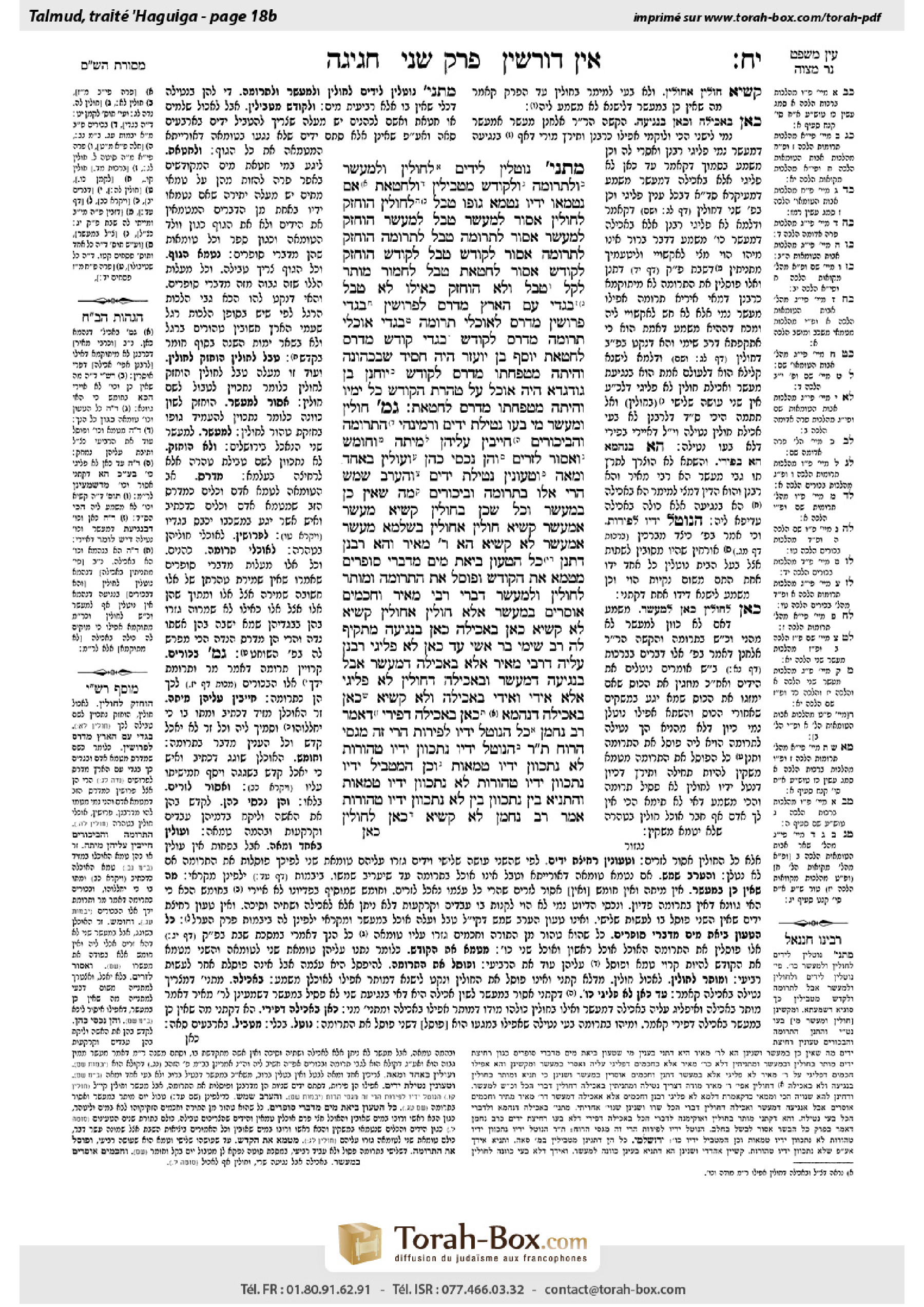
Chagigah 18b: Talmud study for Daf Yomi
Study the Talmud for Daf Yomi with scanned pages, Hebrew text, English translations from Sefaria and AI-generated French translations.
Passage selection and English or AI-generated French translation are available where the scan has annotations. Daf Study is independent of Torah-Box and Sefaria.
Browse Chagigah · חגיגה · All tractatesChagigah 18b text and translations
This page of Chagigah includes the Aramaic text, an English translation and an AI-generated French translation, alongside the scan above.
חגיגה י״ח ב · Aramaic and Hebrew text
מַתְנִי׳ נוֹטְלִין לַיָּדַיִם לַחוּלִּין וְלַמַּעֲשֵׂר וְלַתְּרוּמָה, וְלַקּוֹדֶשׁ — מַטְבִּילִין. וְלַחַטָּאת — אִם נִטְמְאוּ יָדָיו, נִטְמָא גּוּפוֹ.
טָבַל לַחוּלִּין, הוּחְזַק לַחוּלִּין — אָסוּר לַמַּעֲשֵׂר. טָבַל לַמַּעֲשֵׂר, הוּחְזַק לַמַּעֲשֵׂר — אָסוּר לַתְּרוּמָה. טָבַל לַתְּרוּמָה, הוּחְזַק לַתְּרוּמָה — אָסוּר לַקּוֹדֶשׁ. טָבַל לַקּוֹדֶשׁ, הוּחְזַק לַקּוֹדֶשׁ — אָסוּר לַחַטָּאת. טָבַל לֶחָמוּר — מוּתָּר לַקַּל. טָבַל וְלֹא הוּחְזַק — כְּאִילּוּ לֹא טָבַל.
בִּגְדֵי עַם הָאָרֶץ, מִדְרָס לִפְרוּשִׁין. בִּגְדֵי פְרוּשִׁין, מִדְרָס לְאוֹכְלֵי תְרוּמָה. בִּגְדֵי אוֹכְלֵי תְרוּמָה, מִדְרָס לַקּוֹדֶשׁ. בִּגְדֵי קוֹדֶשׁ, מִדְרָס לַחַטָּאת.
יוֹסֵף בֶּן יוֹעֶזֶר הָיָה חָסִיד שֶׁבַּכְּהוּנָּה, וְהָיְתָה מִטְפַּחְתּוֹ מִדְרָס לַקּוֹדֶשׁ. יוֹחָנָן בֶּן גּוּדְגְּדָא הָיָה אוֹכֵל עַל טׇהֳרַת הַקּוֹדֶשׁ כׇּל יָמָיו, וְהָיְתָה מִטְפַּחְתּוֹ מִדְרָס לַחַטָּאת.
גְּמָ׳ חוּלִּין וּמַעֲשֵׂר מִי בָּעוּ נְטִילַת יָדַיִם?
וּרְמִינְהִי: הַתְּרוּמָה וְהַבִּיכּוּרִים חַיָּיבִין עֲלֵיהֶן מִיתָה וָחוֹמֶשׁ, וַאֲסוּרִ[ין] לְזָרִים, וְהֵן נִכְסֵי כֹהֵן. וְעוֹלִין בְּאֶחָד וּמֵאָה, וּטְעוּנִין נְטִילַת יָדַיִם וְהֶעֱרֵב שֶׁמֶשׁ. הֲרֵי אֵלּוּ בִּתְרוּמָה וּבִיכּוּרִים, מָה שֶׁאֵין כֵּן בַּמַּעֲשֵׂר, וְכׇל שֶׁכֵּן בַּחוּלִּין.
קַשְׁיָא מַעֲשֵׂר אַמַּעֲשֵׂר, קַשְׁיָא חוּלִּין אַחוּלִּין!
בִּשְׁלָמָא מַעֲשֵׂר אַמַּעֲשֵׂר לָא קַשְׁיָא: הָא רַבִּי מֵאִיר וְהָא רַבָּנַן.
דִּתְנַן: כׇּל הַטָּעוּן בִּיאַת מַיִם מִדִּבְרֵי סוֹפְרִים — מְטַמֵּא אֶת הַקּוֹדֶשׁ, וּפוֹסֵל אֶת הַתְּרוּמָה, וּמוּתָּר לַחוּלִּין וּלְמַעֲשֵׂר, דִּבְרֵי רַבִּי מֵאִיר. וַחֲכָמִים אוֹסְרִים בְּמַעֲשֵׂר. אֶלָּא חוּלִּין אַחוּלִּין קַשְׁיָא!
לָא קַשְׁיָא: כָּאן בַּאֲכִילָה, כָּאן בִּנְגִיעָה.
מַתְקֵיף לַהּ רַב שִׁימִי בַּר אָשֵׁי: עַד כָּאן לָא פְּלִיגִי רַבָּנַן עֲלֵיהּ דְּרַבִּי מֵאִיר אֶלָּא בַּאֲכִילָה דְמַעֲשֵׂר, אֲבָל בִּנְגִיעָה דְמַעֲשֵׂר וּבַאֲכִילָה דְחוּלִּין לָא פְּלִיגִי? אֶלָּא: אִידֵּי וְאִידֵּי בַּאֲכִילָה, וְלָא קַשְׁיָא: כָּאן בַּאֲכִילָה דְנַהֲמָא, כָּאן בַּאֲכִילָה דְפֵירֵי. דְּאָמַר רַב נַחְמָן: כׇּל הַנּוֹטֵל יָדָיו לְפֵירוֹת — הֲרֵי זֶה מִגַּסֵּי הָרוּחַ.
תָּנוּ רַבָּנַן: הַנּוֹטֵל יָדָיו, נִתְכַּוֵּון — יָדָיו טְהוֹרוֹת, לֹא נִתְכַּוֵּון — יָדָיו טְמֵאוֹת. וְכֵן הַמַּטְבִּיל יָדָיו, נִתְכַּוֵּון — יָדָיו טְהוֹרוֹת, לֹא נִתְכַּוֵּון — יָדָיו טְמֵאוֹת. וְהָתַנְיָא: בֵּין נִתְכַּוֵּון בֵּין לֹא נִתְכַּוֵּון — יָדָיו טְהוֹרוֹת! אָמַר רַב נַחְמָן, לָא קַשְׁיָא: כָּאן לְחוּלִּין,
Chagigah 18b · English translation
MISHNA: One must wash his hands by pouring a quarter-log of water over them before eating non-sacred food, and for tithes and for teruma; but for eating sacrificial food one must immerse one’s hands in purification waters, such as those of a ritual bath. And with regard to one who wishes to touch the purification waters of the red heifer used for sprinkling, concerning which the Sages ordained further measures of sanctity, if one’s hands were rendered impure even by rabbinical ritual impurity, which usually only renders the hands impure, his entire body is rendered impure, and he must immerse himself in a ritual bath.
The mishna continues to list additional differences between various levels of ritual purity: If one immersed for the purpose of eating non-sacred food, he assumes a presumptive status of ritual purity for non-sacred food, and it is prohibited for him to eat tithes, as he did not purify himself with the intention of eating tithes. If one immersed to eat tithes, he assumes a presumptive status for tithes, but he is prohibited from eating teruma. If one immersed for teruma, he assumes a presumptive status for teruma, but he is prohibited from eating sacrificial food. If he immersed for sacrificial food, he assumes a presumptive status for sacrificial food, but he is prohibited from coming in contact with the purification waters. The principle is as follows: One who immersed to eat a food in a stringent category is permitted to eat a food in a lenient one. Another principle: One who immersed without the intention to assume a presumptive status of ritual purity, i.e., one who immersed but did not intend to purify himself, it is as though he has not immersed at all.
The mishna continues: The garments of an am ha’aretz, one who is not careful with regard to the laws of ritual purity, are considered impure with the ritual impurity imparted by the treading of a zav. That is considered a primary level of impurity for individuals who are scrupulous with regard to impurity [perushin]. The garments of perushin are considered impure by the treading of a zav for priests who eat teruma; the garments of those who eat teruma are considered impure by the treading of a zav for those who eat sacrificial food; and likewise the garments of those who eat sacrificial food are considered impure by the treading of a zav for those dealing with the preparation of the purification waters.
The mishna relates: Yosef ben Yo’ezer was the most pious member of the priesthood and was extremely careful to eat teruma in a state of ritual purity, and yet his cloth was considered impure by the treading of a zav for those who ate sacrificial food. Yoḥanan ben Gudgeda would eat non-sacred food while following the laws of ritual purity for sacrificial food all his days, and nevertheless his cloth was considered impure by the treading of a zav for those preparing the purification waters.
GEMARA: Before discussing the details of the halakhot listed in the mishna, the Gemara poses a basic question: Do non-sacred foods and tithes indeed require washing the hands?
The Gemara raises a contradiction to the mishna, from the following mishna in tractate Bikkurim (2:1): With regard to teruma and first fruits, one is liable to the death penalty for them, e.g., if a non-priest ate them intentionally; if he did so unintentionally, he must restore the amount he ate with the addition of a fifth; and they are prohibited to non-priests; and they are the property of the priest. Consequently, a priest can purchase anything he wishes with them, or betroth a woman with them. And if they fell into non-sacred produce and became mixed with it, they are nullified only in a mixture that contains one hundred and one times their amount; and they require washing of the hands and the setting of the sun before they can be eaten, i.e., an impure priest who has immersed at the proper time must still wait for the sun to set before he is fit to eat them. These laws apply to teruma and first fruits, but not to tithes. The mishna adds: And all the more so do they not apply to non-sacred food.
This is difficult: The halakha of tithes stated in Bikkurim seems to contradict the halakha of tithes taught in the mishna here, which states that the hands must be washed before tithes are eaten. Additionally, it is difficult with regard to the halakha of non-sacred food, as it contradicts the halakha applicable to non-sacred food stated in the mishna here.
The Gemara comments: Granted, one of the laws with regard to tithes, as opposed to the other law with regard to tithes, is not difficult, since the contradiction can be resolved as follows: This case, the mishna in Bikkurim, is in accordance with Rabbi Meir, while that case, the mishna here, follows the Rabbis.
As we learned in a mishna (Para 11:5): Anything that requires immersion in water by rabbinic law renders sacrificial food impure. If it touches a consecrated item, the latter is itself rendered impure with a second-degree ritual impurity. It also renders impure any other consecrated object that comes into contact with it with a third-degree ritual impurity and invalidates teruma, meaning that it renders the teruma itself impure, but not to the extent that the teruma can render other teruma impure. And anything that requires immersion in water by rabbinic law is permitted for non-sacred produce and for tithes, meaning that it does not render these items impure, as something impure to such a low degree does not invalidate even non-sacred food. This is the statement of Rabbi Meir. But the Rabbis prohibit this in the case of tithes, meaning that they are invalidated. This source demonstrates that according to the Rabbis, the halakha that applies to tithes differs from that of non-sacred produce, which explains why one must wash his hands for tithes. However, the law with regard to non-sacred food as opposed to the other law of non-sacred food is still difficult.
The Gemara responds: It is not difficult. Here the mishna is referring to eating, before which one must wash his hands. There the mishna in Bikkurim deals with touching alone, for which prior washing of the hands is not necessary.
Rav Shimi bar Ashi strongly objects to this: The Rabbis disagree with Rabbi Meir only with regard to eating tithes, but with regard to touching tithes and eating non-sacred food they do not disagree with him. Therefore, the Gemara’s resolution of the difficulty with regard to non-sacred food is not acceptable. Rather, the previous explanation is to be rejected in favor of the following: Both this mishna and that mishna are referring to eating, and it is not difficult: Here the mishna is dealing with eating bread, which requires washing one’s hands, whereas there, in Bikkurim, the mishna is referring to eating non-sacred fruit, for which one need not wash his hands, for Rav Naḥman said: Anyone who washes his hands for fruit is of the haughty of spirit because he shows himself to be more particular than required by the Sages.
§ The Sages taught: One who washes his hands, if he intended to purify them, his hands are pure; if he did not intend to do so, his hands are impure. Similarly, in the case of one who immerses his hands in forty se’a of water, if he intended to purify them, his hands are pure; if he did not so intend, his hands are impure. The Gemara raises a difficulty: But isn’t it taught in a baraita that his hands are pure whether he did or did not intend to purify them? Rav Naḥman said: This is not difficult, as there, the second baraita is referring to non-sacred food, for which one need not have the intention to purify his hands;
Chagigah 18b · Traduction française (IA)
MICHNA: On doit laver ses mains en versant un quart de log d'eau sur elles avant de manger des aliments non sacrés, ainsi que pour les dîmes et la terouma ; mais pour manger des aliments sacrés, on doit immerger ses mains dans des eaux de purification, telles que celles d'un mikvé. Et concernant celui qui souhaite toucher les eaux de purification de la bête rouge utilisées pour le sprinkling, à propos desquelles les Sages ont ordonné des mesures supplémentaires de sanctité, si ses mains sont devenues impures même par l'impureté rabbinique, qui rend généralement les mains impures, son corps entier est devenu impur, et il doit s'immerger dans un mikvé.
La mishna continue à énumérer d'autres différences entre divers niveaux de pureté rituelle : Si l'on s'est immergé pour manger des aliments non sacrés, on assume un statut présomptif de pureté rituelle pour les aliments non sacrés, et il est interdit de manger des dîmes, car l'on n'a pas purifié soi-même avec l'intention de manger des dîmes. Si l'on s'est immergé pour manger des dîmes, on assume un statut présomptif pour les dîmes, mais il est interdit de manger de la terouma. Si l'on s'est immergé pour la terouma, on assume un statut présomptif pour la terouma, mais il est interdit de manger des aliments sacrés. Si l'on s'est immergé pour les aliments sacrés, on assume un statut présomptif pour les aliments sacrés, mais il est interdit de venir en contact avec les eaux de purification. Le principe est le suivant : celui qui s'est immergé pour manger un aliment dans une catégorie stricte est autorisé à manger un aliment dans une catégorie plus clémente. Un autre principe : celui qui s'est immergé sans l'intention d'assumer un statut présomptif de pureté rituelle, c'est-à-dire celui qui s'est immergé sans l'intention de se purifier, est comme s'il n'avait pas immergé du tout.
La mishna continue : Les vêtements d'un am ha'aretz, celui qui n'est pas soigneux en matière de lois de pureté rituelle, sont considérés comme impurs par l'impureté transmise par la marche d'un zav. Cela est considéré comme un niveau principal d'impureté pour les individus soigneux en matière d'impureté [perushin]. Les vêtements des perushin sont considérés comme impurs par la marche d'un zav pour les prêtres qui mangent de la terouma ; les vêtements de ceux qui mangent de la terouma sont considérés comme impurs par la marche d'un zav pour ceux qui mangent des aliments sacrés ; et de même, les vêtements de ceux qui mangent des aliments sacrés sont considérés comme impurs par la marche d'un zav pour ceux qui s'occupent de la préparation des eaux de purification.
La mishna rapporte : Yosef ben Yo’ezer était le membre le plus pieux du clergé et était extrêmement soigneux de manger de la terouma dans un état de pureté rituelle, et pourtant son tissu était considéré comme impur par la marche d'un zav pour ceux qui mangeaient des aliments sacrés. Yoḥanan ben Gudgeda mangeait des aliments non sacrés tout en suivant les lois de pureté rituelle pour les aliments sacrés toute sa vie, et pourtant son tissu était considéré comme impur par la marche d'un zav pour ceux qui préparaient les eaux de purification.
GUEMARA : Avant d'aborder les détails des halakhot évoqués dans la mishna, la Guemara pose une question de base : les aliments non sacrés et les dîmes nécessitent-ils effectivement de laver les mains ?
La Guemara soulève une contradiction avec la mishna, à partir de la suivante dans le traité Bikkurim (2:1) : Concernant la terouma et les premiers fruits, on est puni de mort pour les avoir mangés, c'est-à-dire si un non-prêtre les a mangés intentionnellement ; s'il l'a fait accidentellement, il doit restituer la quantité qu'il a mangée avec l'ajout d'un cinquième ; et ils sont interdits aux non-prêtres ; et ils appartiennent au prêtre. Ainsi, un prêtre peut acheter tout ce qu'il veut avec eux, ou épouser une femme avec eux. Et si ils sont tombés dans les produits non sacrés et se sont mélangés à ceux-ci, ils sont annulés uniquement dans un mélange contenant cent et un fois leur quantité ; et ils nécessitent le lavage des mains et l'attente du coucher du soleil avant d'être mangés, c'est-à-dire un prêtre impur qui s'est immergé à l'heure appropriée doit encore attendre que le soleil soit couché avant d'être autorisé à les manger. Ces lois s'appliquent à la terouma et aux premiers fruits, mais pas aux dîmes. La mishna ajoute : Et encore davantage, ces lois ne s'appliquent pas aux aliments non sacrés.
Cela est difficile : la halakha des dîmes évoquée dans Bikkurim semble contredire la halakha des dîmes enseignée ici dans la mishna, qui stipule que l'on doit laver ses mains avant de manger des dîmes. De plus, cela est difficile concernant la halakha des aliments non sacrés, car cela contredit la halakha applicable aux aliments non sacrés évoquée ici dans la mishna.
La Guemara commente : D'accord, l'une des lois concernant les dîmes, par opposition à l'autre loi concernant les dîmes, n'est pas difficile, car la contradiction peut être résolue ainsi : ce cas, la mishna dans Bikkurim, est selon Rabbi Meir, tandis que ce cas, la mishna ici, suit les Rabbins.
Comme nous l'avons appris dans une mishna (Para 11:5) : Tout ce qui nécessite une immersion dans l'eau selon la loi rabbinique rend les aliments sacrés impurs. Si cela touche un objet consacré, l'objet consacré lui-même devient impur avec une impureté rituelle de deuxième degré. Il rend également impur tout autre objet consacré qui entre en contact avec lui avec une impureté rituelle de troisième degré et invalidate la terouma, c'est-à-dire qu'il rend la terouma elle-même impure, mais pas à tel point que la terouma puisse rendre d'autres teroumas impures. Et tout ce qui nécessite une immersion dans l'eau selon la loi rabbinique est permis pour les produits non sacrés et pour les dîmes, c'est-à-dire qu'il ne rend pas ces objets impurs, car quelque chose d'impur à un tel degré ne vaut même pas pour invalidé les aliments non sacrés. C'est la déclaration de Rabbi Meir. Mais les Rabbins interdisent cela dans le cas des dîmes, c'est-à-dire qu'ils sont invalidés. Cette source démontre que selon les Rabbins, la halakha applicable aux dîmes diffère de celle des produits non sacrés, ce qui explique pourquoi l'on doit laver ses mains pour les dîmes. Cependant, la loi concernant les aliments non sacrés par rapport à l'autre loi des aliments non sacrés reste difficile.
La Guemara répond : Ce n'est pas difficile. Ici, la mishna fait référence à l'acte de manger, avant lequel l'on doit laver ses mains. Là, la mishna dans Bikkurim traite du simple contact, pour lequel le lavage des mains n'est pas nécessaire.
Rav Shimi bar Ashi s'oppose fermement à cela : Les Sages ne s'opposent à Rabbi Meir qu'en ce qui concerne la consommation des dîmes, mais en ce qui concerne le contact avec les dîmes et la consommation de nourriture non sacrée, ils ne s'opposent pas à lui. Par conséquent, la résolution du Guemara concernant la nourriture non sacrée n'est pas acceptable. Plutôt, l'explication précédente doit être rejetée au profit de celle-ci : à la fois cette mitsva et celle-ci font référence à la consommation, et il n'y a pas de difficulté : ici, la mitsva traite de la consommation de pain, ce qui exige de laver ses mains, tandis que là, dans Bikkurim, la mitsva fait référence à la consommation de fruits non sacrés, pour lesquels il n'est pas nécessaire de laver ses mains, car Rav Naḥman a dit : celui qui lave ses mains pour les fruits est considéré comme étant de l'esprit hautain, car il montre qu'il est plus exigeant que ce que prescrivent les Sages.
§ Les Sages ont enseigné : celui qui lave ses mains, si son intention était de les purifier, ses mains sont pures ; si son intention n'était pas de le faire, ses mains sont impures. De même, dans le cas d'une personne qui immerge ses mains dans quarante se'ah d'eau, si son intention était de les purifier, ses mains sont pures ; si son intention n'était pas de le faire, ses mains sont impures. Le Guemara soulève une difficulté : mais n'est-il pas enseigné dans une baraïta que ses mains sont pures qu'importe s'il avait l'intention de les purifier ou non ? Rav Naḥman a dit : cela n'est pas difficile, car là, la deuxième baraïta fait référence à la nourriture non sacrée, pour laquelle il n'est pas nécessaire d'avoir l'intention de purifier ses mains ;
Traduction française générée par IA à partir de l’édition anglaise de Sefaria. Vérifie toujours un passage avec le texte source.
Text from Sefaria: William Davidson Edition - Vocalized Aramaic (CC BY NC); William Davidson Edition - English (CC BY NC).