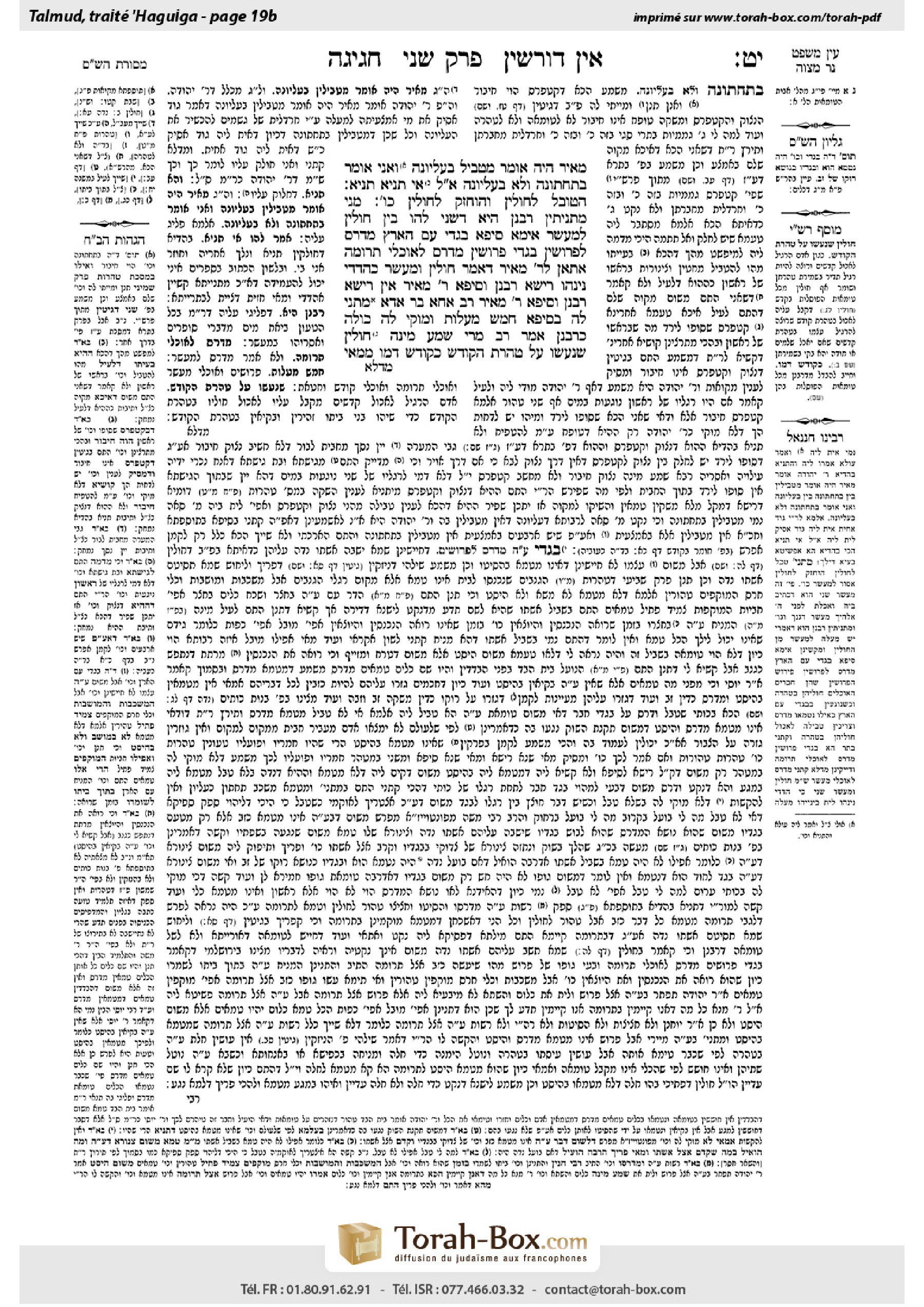
Chagigah 19b: Talmud study for Daf Yomi
Study the Talmud for Daf Yomi with scanned pages, Hebrew text, English translations from Sefaria and AI-generated French translations.
Passage selection and English or AI-generated French translation are available where the scan has annotations. Daf Study is independent of Torah-Box and Sefaria.
Browse Chagigah · חגיגה · All tractatesChagigah 19b text and translations
This page of Chagigah includes the Aramaic text, an English translation and an AI-generated French translation, alongside the scan above.
חגיגה י״ט ב · Aramaic and Hebrew text
מֵאִיר הָיָה אוֹמֵר: מַטְבִּיל בָּעֶלְיוֹנָה, וַאֲנִי אוֹמֵר: בַּתַּחְתּוֹנָה וְלֹא בָּעֶלְיוֹנָה! אֲמַר לֵיהּ: אִי תַּנְיָא — תַּנְיָא.
הַטּוֹבֵל לַחוּלִּין וְהוּחְזַק לַחוּלִּין כּוּ׳. מַנִּי מַתְנִיתִין — רַבָּנַן הִיא, דְּשָׁנֵי לְהוּ בֵּין חוּלִּין לְמַעֲשֵׂר.
אֵימָא סֵיפָא: בִּגְדֵי עַם הָאָרֶץ, מִדְרָס לִפְרוּשִׁין. בִּגְדֵי פְרוּשִׁין, מִדְרָס לְאוֹכְלֵי תְרוּמָה.
אֲתָאן לְרַבִּי מֵאִיר, דְּאָמַר: חוּלִּין וּמַעֲשֵׂר כַּהֲדָדֵי נִינְהוּ, רֵישָׁא רַבָּנַן וְסֵיפָא רַבִּי מֵאִיר?! אִין, רֵישָׁא רַבָּנַן וְסֵיפָא רַבִּי מֵאִיר.
רַב אַחָא בַּר אַדָּא מַתְנֵי לַהּ בְּסֵיפָא חָמֵשׁ מַעֲלוֹת, וּמוֹקֵי לַהּ כּוּלָּהּ כְּרַבָּנַן.
אָמַר רַב מָרִי: שְׁמַע מִינַּהּ חוּלִּין שֶׁנַּעֲשׂוּ עַל טׇהֳרַת הַקּוֹדֶשׁ — כְּקוֹדֶשׁ דָּמוּ. מִמַּאי —
Chagigah 19b · English translation
Rabbi Meir would say: One may immerse in the upper one, and I say: In the lower one but not in the upper one. This demonstrates that Rabbi Yehuda does not accept the principle of raising the partition. Rabbi Yoḥanan said to him: If this baraita is taught, it is taught, and I cannot take issue with it. Therefore, it is clear that the matter is held in dispute between tanna’im and that Rabbi Yehuda does not accept the principle of raising the partition.
§ It is taught in the mishna: One who immersed for the purpose of eating non-sacred food with the intention of assuming a presumptive status of ritual purity for non-sacred food it is prohibited for him to eat tithes. The Gemara comments: Whose opinion is expressed in the mishna? It is that of the Rabbis, who differentiate between non-sacred produce and tithes, since they maintain the following: If one who is required by rabbinic law to immerse touches non-sacred food, it remains pure, but if he comes into contact with tithes they are rendered ritually impure.
However, in that case, say the latter clause of the mishna, which states that the garments of an am ha’aretz, who is not careful with regard to the halakhot of ritual purity, are considered to be rendered ritually impure by the impurity imparted by the treading of a zav, which is considered a primary source of ritual impurity, for perushin, individuals who are careful to eat even non-sacred food in a state of purity. The garments of perushin, although they are careful to remain ritually pure, are nevertheless considered to be rendered impure by the treading of a zav for priests who partake of teruma. Consequently, the latter clause differs from the opinion of the Rabbis in the earlier clause.
Therefore, we have arrived at the opinion of Rabbi Meir, who said: Non-sacred produce and tithes are similar to one another, as this clause of the mishna does not distinguish between those eating non-sacred food and those eating tithes. Is the earlier clause the opinion of the Rabbis and the latter clause the opinion of Rabbi Meir? The Gemara answers: Yes; although it is unusual, in this instance we must explain that the earlier clause was said by the Rabbis and the latter clause by Rabbi Meir.
However, Rav Aḥa bar Adda would teach that five levels of ritual purity are listed in the latter clause of the mishna, by counting the clause that states that the clothes of those who eat non-sacred produce in a state of purity are ritually impure for tithes, and in this way he establishes the entire mishna in accordance with the opinion of the Rabbis.
§ Rav Mari said: They learn from the mishna that non-sacred produce that was prepared according to the level of ritual purity required for sacrificial food, i.e., with the same stringencies as required for sacrificial food, is like sacrificial food. From where is this deduced?
Chagigah 19b · Traduction française (IA)
Rabbi Meir disait : On peut immerger dans le supérieur, et moi, je dis : dans l'inférieur mais pas dans le supérieur. Cela montre que Rabbi Yéhuda ne reconnaît pas le principe de levée du partage. Rabbi Yoḥanan lui dit : Si ce baraïta est enseigné, il est enseigné, et je ne peux pas en contester. Ainsi, il est clair que la question est en débat entre les tannaïm et que Rabbi Yéhuda ne reconnaît pas le principe de levée du partage.
§ Il est enseigné dans la mitsna : Celui qui s'est immergé à l'intention de manger des aliments non sacrés, avec l'intention d'assumer un statut présomptif de pureté rituelle pour les aliments non sacrés, il est interdit de lui de manger les dîmes. La Guemara commente : Quel est l'avis exprimé dans la mitsna ? C'est celui des Rabbins, qui distinguent entre les aliments non sacrés et les dîmes, car ils maintiennent ce qui suit : Si celui qui est tenu par la loi rabbinique d'immerger touche des aliments non sacrés, ils restent purs, mais s'il entre en contact avec les dîmes, ceux-ci deviennent impurs.
Cependant, dans ce cas, disent les dernières clauses de la mitsna, qui stipulent que les vêtements d'un am ha'aretz, qui ne prend pas soin des halakhot de pureté rituelle, sont considérés comme impurs par l'impureté transmise par la marche d'un zav, qui est considéré comme une source principale d'impureté rituelle, pour les perushin, les individus qui prennent soin de manger même les aliments non sacrés dans un état de pureté. Les vêtements des perushin, bien qu'ils prennent soin de rester purs, sont néanmoins considérés comme impurs par la marche d'un zav pour les prêtres qui consomment la terouma. Ainsi, la dernière clause diffère de l'avis des Rabbins dans la clause précédente.
Par conséquent, nous sommes arrivés à l'avis de Rabbi Meir, qui disait : les aliments non sacrés et les dîmes sont semblables l'un à l'autre, car cette clause de la mitsna ne distingue pas entre ceux qui mangent des aliments non sacrés et ceux qui mangent des dîmes. Est-ce que la clause précédente est l'avis des Rabbins et la clause suivante celui de Rabbi Meir ? La Guemara répond : Oui ; bien que cela soit inhabituel, dans ce cas, nous devons expliquer que la clause précédente a été dite par les Rabbins et la clause suivante par Rabbi Meir.
Cependant, Rav Aḥa bar Adda enseignait que cinq niveaux de pureté rituelle sont énumérés dans la dernière clause de la mitsna, en comptant la clause qui stipule que les vêtements de ceux qui mangent des aliments non sacrés dans un état de pureté sont impurs pour les dîmes, et ainsi il établit toute la mitsna selon l'avis des Rabbins.
§ Rav Mari disait : Ils apprennent de la mitsna que les aliments non sacrés préparés selon le niveau de pureté rituelle requis pour les aliments sacrés, c'est-à-dire avec les mêmes stricteurs que ceux requis pour les aliments sacrés, sont comme les aliments sacrés. D'où cela est déduit ?
Traduction française générée par IA à partir de l’édition anglaise de Sefaria. Vérifie toujours un passage avec le texte source.
Text from Sefaria: William Davidson Edition - Vocalized Aramaic (CC BY NC); William Davidson Edition - English (CC BY NC).