Chagigah 20a: Talmud study for Daf Yomi
Study the Talmud for Daf Yomi with scanned pages, Hebrew text, English translations from Sefaria and AI-generated French translations.
Passage selection and English or AI-generated French translation are available where the scan has annotations. Daf Study is independent of Torah-Box and Sefaria.
Browse Chagigah · חגיגה · All tractatesChagigah 20a text and translations
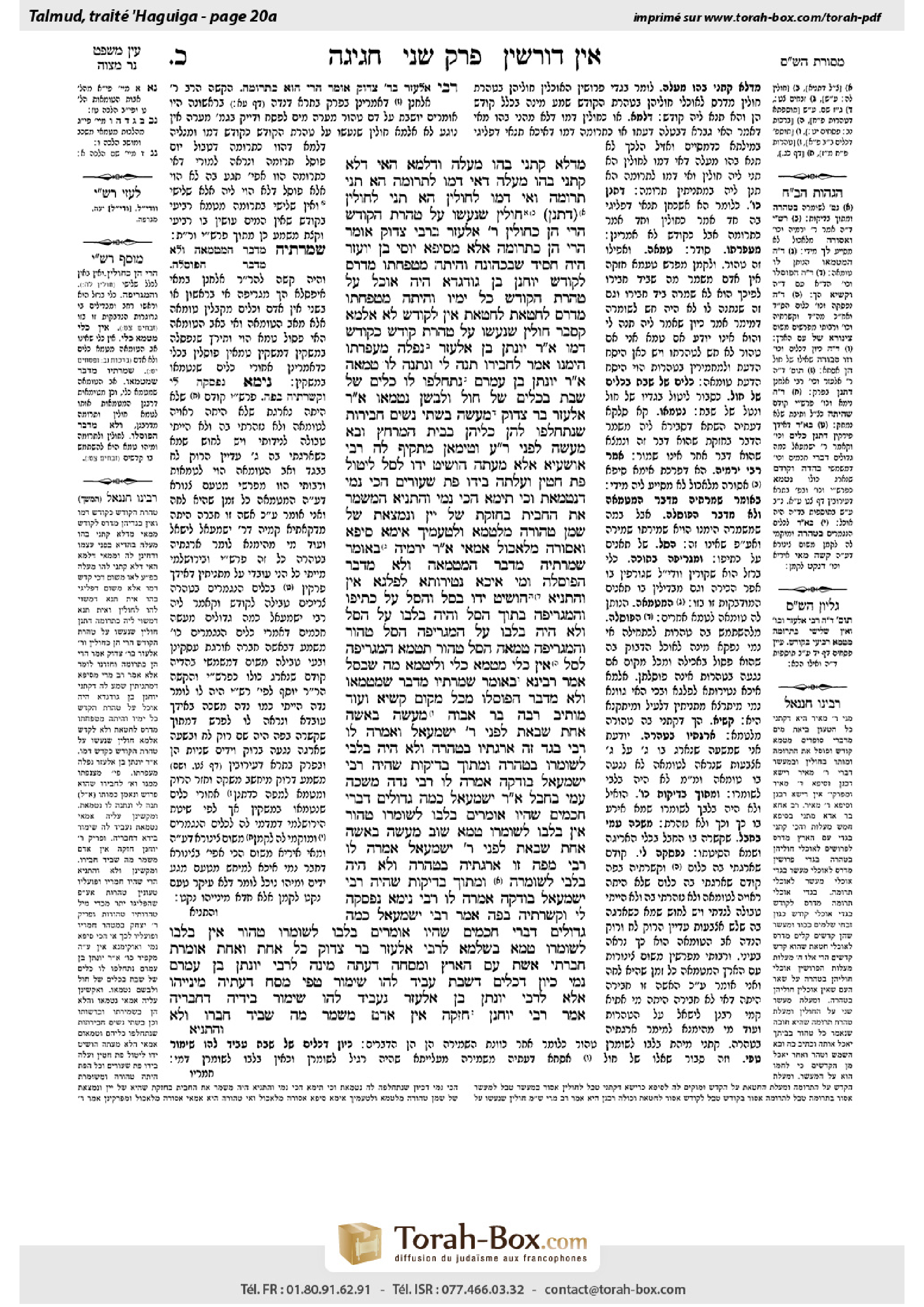
This page of Chagigah includes the Aramaic text, an English translation and an AI-generated French translation, alongside the scan above.
חגיגה כ׳ א · Aramaic and Hebrew text
מִדְּלָא קָתָנֵי בְּהוּ מַעֲלָה.
וְדִלְמָא הַאי דְּלָא קָתָנֵי בְּהוּ מַעֲלָה, דְּאִי דָּמוּ לִתְרוּמָה — הָא תָּנֵי תְּרוּמָה, וְאִי דָּמוּ לְחוּלִּין — הָא תָּנֵי לְחוּלִּין. דִּתְנַן: חוּלִּין שֶׁנַּעֲשׂוּ עַל טׇהֳרַת הַקּוֹדֶשׁ — הֲרֵי הֵן כְּחוּלִּין, רַבִּי אֶלְעָזָר בְּרַבִּי צָדוֹק אוֹמֵר: הֲרֵי הֵן כִּתְרוּמָה.
אֶלָּא מִסֵּיפָא: יוֹסֵי בֶּן יוֹעֶזֶר הָיָה חָסִיד שֶׁבַּכְּהוּנָּה, וְהָיְתָה מִטְפַּחְתּוֹ מִדְרָס לַקּוֹדֶשׁ. יוֹחָנָן בֶּן גּוּדְגְּדָא הָיָה אוֹכֵל עַל טׇהֳרַת הַקּוֹדֶשׁ כׇּל יָמָיו, וְהָיְתָה מִטְפַּחְתּוֹ מִדְרָס לַחַטָּאת.
לַחַטָּאת אִין, לַקּוֹדֶשׁ לָא. אַלְמָא קָסָבַר: חוּלִּין שֶׁנַּעֲשׂוּ עַל טׇהֳרַת קוֹדֶשׁ כְּקוֹדֶשׁ דָּמוּ.
אָמַר רַבִּי יוֹנָתָן בֶּן אֶלְעָזָר: נָפְלָה מַעְפׇּרְתּוֹ הֵימֶנּוּ, אָמַר לַחֲבֵירוֹ: ״תְּנָהּ לִי״ וּנְתָנָהּ לוֹ — טְמֵאָה. אָמַר רַבִּי יוֹנָתָן בֶּן עַמְרָם: נִתְחַלְּפוּ לוֹ כֵּלִים שֶׁל שַׁבָּת בְּכֵלִים שֶׁל חוֹל וּלְבָשָׁן — נִטְמְאוּ.
אָמַר רַבִּי אֶלְעָזָר בַּר צָדוֹק: מַעֲשֶׂה בִּשְׁתֵּי נָשִׁים חֲבֵירוֹת שֶׁנִּתְחַלְּפוּ לָהֶן כְּלֵיהֶן בְּבֵית הַמֶּרְחָץ, וּבָא מַעֲשֶׂה לִפְנֵי רַבִּי עֲקִיבָא וְטִימְּאָן.
מַתְקֵיף לַהּ רַבִּי אוֹשַׁעְיָא: אֶלָּא מֵעַתָּה, הוֹשִׁיט יָדוֹ לַסַּל לִיטּוֹל פַּת חִטִּין וְעָלְתָה בְּיָדוֹ פַּת שְׂעוֹרִים, הָכִי נָמֵי דְּנִטְמֵאת?
וְכִי תֵּימָא הָכִי נָמֵי — וְהָתַנְיָא: הַמְשַׁמֵּר אֶת הֶחָבִית בְּחֶזְקַת שֶׁל יַיִן וְנִמְצֵאת שֶׁל שֶׁמֶן — טְהוֹרָה מִלְּטַמֵּא! וּלְטַעְמָיךְ, אֵימָא סֵיפָא: וַאֲסוּרָה מִלֶּאֱכוֹל. אַמַּאי?
אָמַר רַבִּי יִרְמְיָה, בְּאוֹמֵר: שְׁמַרְתִּיהָ מִדָּבָר הַמְטַמְּאָהּ וְלֹא מִדָּבָר הַפּוֹסְלָהּ.
וּמִי אִיכָּא נְטִירוּתָא לְפַלְגָא? אִין, וְהָתַנְיָא: הוֹשִׁיט יָדוֹ בְּסַל, וְהַסַּל עַל כְּתֵיפוֹ, וְהַמַּגְרֵיפָה בְּתוֹךְ הַסַּל, וְהָיָה בְּלִבּוֹ עַל הַסַּל וְלֹא הָיָה בְּלִבּוֹ עַל הַמַּגְרֵיפָה — הַסַּל טָהוֹר וְהַמַּגְרֵיפָה טְמֵאָה.
הַסַּל טָהוֹר? תְּטַמֵּא הַמַּגְרֵיפָה לַסַּל! אֵין כְּלִי מְטַמֵּא כְּלִי. וְלִיטָּמֵא מַה שֶּׁבַּסַּל! אָמַר רָבִינָא, בְּאוֹמֵר: שְׁמַרְתִּיו מִדָּבָר שֶׁמְּטַמְּאוֹ וְלֹא מִדָּבָר הַפּוֹסְלוֹ.
מִכׇּל מָקוֹם קַשְׁיָא?
וְעוֹד מוֹתֵיב רַבָּה בַּר אֲבוּהּ: מַעֲשֶׂה בְּאִשָּׁה אַחַת שֶׁבָּאת לִפְנֵי רַבִּי יִשְׁמָעֵאל, וְאָמְרָה לוֹ: רַבִּי, בֶּגֶד זֶה אֲרַגְתִּיו בְּטׇהֳרָה, וְלֹא הָיָה בְּלִבִּי לְשׁוֹמְרוֹ בְּטׇהֳרָה. וּמִתּוֹךְ בְּדִיקוֹת שֶׁהָיָה רַבִּי יִשְׁמָעֵאל בּוֹדְקָהּ, אָמְרָה לוֹ: רַבִּי, נִדָּה מָשְׁכָה עִמִּי בַּחֶבֶל. אֲמַר רַבִּי יִשְׁמָעֵאל: כַּמָּה גְּדוֹלִים דִּבְרֵי חֲכָמִים, שֶׁהָיוּ אוֹמְרִים: בְּלִבּוֹ לְשׁוֹמְרוֹ — טָהוֹר, אֵין בְּלִבּוֹ לְשׁוֹמְרוֹ — טָמֵא.
שׁוּב מַעֲשֶׂה בְּאִשָּׁה אַחַת שֶׁבָּאת לִפְנֵי רַבִּי יִשְׁמָעֵאל, אָמְרָה לוֹ: רַבִּי, מַפָּה זוֹ אֲרַגְתִּיהָ בְּטָהֳרָה, וְלֹא הָיָה בְּלִבִּי לְשׁוֹמְרָהּ. וּמִתּוֹךְ בְּדִיקוֹת שֶׁהָיָה רַבִּי יִשְׁמָעֵאל בּוֹדְקָהּ, אָמְרָה לוֹ: רַבִּי, נִימָא נִפְסְקָה לִי וּקְשַׁרְתִּיהָ בַּפֶּה.
אָמַר רַבִּי יִשְׁמָעֵאל: כַּמָּה גְּדוֹלִים דִּבְרֵי חֲכָמִים, שֶׁהָיוּ אוֹמְרִים: בְּלִבּוֹ לְשׁוֹמְרוֹ — טָהוֹר, אֵין בְּלִבּוֹ לְשׁוֹמְרוֹ — טָמֵא.
בִּשְׁלָמָא לְרַבִּי אֶלְעָזָר בַּר צָדוֹק, כׇּל אַחַת וְאַחַת אוֹמֶרֶת: חֲבֶרְתִּי אֵשֶׁת עַם הָאָרֶץ, וּמַסְּחָה דַּעְתַּהּ מִינַּהּ.
לְרַבִּי יוֹנָתָן בֶּן עַמְרָם נָמֵי, כֵּיוָן דְּכֵלִים דְּשַׁבָּת עָבֵיד לְהוּ שִׁימּוּר טְפֵי — מַסַּח דַּעְתֵּיהּ מִינַּיְיהוּ. אֶלָּא לְרַבִּי יוֹנָתָן בֶּן אֶלְעָזָר, נַעֲבֵיד לְהוּ שִׁימּוּר בִּידֵיהּ דְּחַבְרֵיהּ?
אָמַר רַבִּי יוֹחָנָן: חֲזָקָה, אֵין אָדָם מְשַׁמֵּר מַה שֶּׁבְּיַד חֲבֵרוֹ. וְלֹא?
Chagigah 20a · English translation
It is deduced from the fact that it is not taught in their regard that those who eat non-sacred produce according to the level of ritual purity required for sacrificial food must treat the produce with a higher standard with regard to their degree of purity, like those who actually partake of sacrificial food.
The Gemara asks: But perhaps the reason for this fact, that a higher standard is not taught with regard to those who actually partake of sacrificial food, is that these foods are not on a distinct level of ritual purity, as, if they are similar to the level of teruma, teruma has already been taught; and if they are similar to non-sacred produce, non-sacred produce has also already been taught. As we learned in a baraita that they are not considered to be on a level of their own: Non-sacred foods prepared according to the level of ritual purity required for sacrificial food are like non-sacred food; Rabbi Elazar, son of Rabbi Tzadok, says: They are like teruma, but not like sacrificial food. Therefore, the fact that this level is not explicitly mentioned affords no proof.
Rather, the proof is derived from the last clause in the mishna: Yosei ben Yo’ezer was the most pious member of the priesthood, and yet his cloth was considered impure by the treading of a zav for those who ate sacrificial food. Yoḥanan ben Gudgeda would eat non-sacred foods prepared according to the level of ritual purity required for sacrificial food all his days, and nevertheless his cloth was considered rendered impure by the treading of a zav for those preparing the purification waters.
The Gemara infers from this: For the purifying waters, yes, his cloth was considered to have ritual impurity imparted by treading, but for sacrificial food, no, it was not considered to have ritual impurity imparted by treading. Apparently, he maintains that non-sacred produce prepared according to the level of ritual purity required for sacrificial food is like sacrificial food, as one who is particular to preserve the ritual purity required for sacrificial food even with regard to non-sacred produce is considered pure even with regard to sacrificial food themselves.
§ With regard to the particular care that must be taken to prevent any suspicion that one’s clothes have contracted impurity, Rabbi Yonatan ben Elazar said: If the shawl of one who was stringent with regard to ritual purity fell off of him, and he said to another person: Give it to me, and he gave it to him, the shawl is impure. Even if the other individual is himself pure, since his attention was diverted at that moment from being cautious with regard to impurity, it is as though the shawl were rendered impure. Similarly, Rabbi Yonatan ben Amram says: If one’s Shabbat clothes were switched for his weekday clothes and he wore them, they are impure. His assumption that they were different clothes than the clothes he had intended to wear is enough of a distraction to spoil his caution against impurity.
Rabbi Elazar bar Tzadok said: There was an incident involving two women who were wives of ḥaverim, who are meticulous in observance of halakha especially with regard to matters of impurity, whose clothes were switched in the bathhouse; and the incident came before Rabbi Akiva and he declared the clothes impure. This demonstrates that an unintentional act is considered a lapse of attention, which renders the items impure, even if there was no other reason to consider them impure.
Rabbi Oshaya strongly objects to this: However, if that is so, one who inserted his hand into a basket to take a loaf of wheat bread, and a loaf of barley bread came up in his hand instead; in that case, too, will you say that the loaf is rendered impure?
And if you would say, indeed, this is correct, but isn’t it taught in a baraita: One who is minding a barrel to ensure its ritual purity on the assumption that it is a barrel of wine and it is found to be of oil, it is ritually pure in the sense that it does not transmit impurity? This indicates that one’s lack of knowledge with regard to the identity of the item he is minding does not itself cause impurity. The Gemara rejects this: But according to your line of reasoning, say the latter clause of that same baraita: And it is prohibited to be eaten, which indicates that the supervision is insufficient in this case. The Gemara asks: Why is it that the barrel’s status is pure and yet there is a prohibition against eating its contents? If the supervisor’s error does not harm the food’s ritually pure status, one should likewise be permitted to eat it.
Rabbi Yirmeya said: The baraita is referring to one who says: I guarded it from things that render it impure but not from things that invalidate it. In other words, he was careful to guard it only from being rendered impure with a severe degree of impurity, which causes anything it renders impure to render others impure in turn, but not from a lesser degree of impurity that merely invalidates it for use but does not enable it to render other items ritually impure. Since he guarded it from impurity, it is considered pure with regard to rendering other items impure, but it still may not be eaten, in case it was invalidated by an impure object.
The Gemara asks: And is there guarding by half measures; can it be said that one was careful with regard to only a particular type of impurity? The Gemara responds: Yes, as it is indeed taught in a baraita: If one inserted his hand into a basket filled with figs, and the basket was placed on his shoulder, and a shovel was in the basket, and his mind was on the basket to guard it from impurity, but his mind was not on the shovel, the basket is pure and the shovel is impure.
The Gemara asks: Why is the basket pure? Let the shovel render the basket ritually impure, if the former is in fact impure. The Gemara answers: The halakha is that a vessel cannot render a different vessel impure. Therefore, the basket remains pure. The Gemara asks another question: And let it render impure any food that is inside the basket, as food is not a vessel and can therefore be rendered impure by a vessel. Ravina said: The baraita is referring to one who says: I guarded the shovel from things that render it ritually impure, which is why it cannot render other objects impure, but I did not guard it from things that invalidate it, so it is impure. Consequently, there is no proof from here that the contents of the barrel in the earlier case may not be eaten.
Returning to the prior discussion, the Gemara states that in any case it is difficult. Why should an object be impure just because the one guarding it was mistaken with regard to the identity of its contents; how would this accord with the baraita that explicitly taught that if one minds a barrel under the assumption that it is wine and it turns out to contain oil, the oil is pure and cannot render others impure?
And Rabba bar Avuh raised a further objection: There was an incident involving a certain woman who came before Rabbi Yishmael and said to him: Rabbi, I wove this garment in a ritually pure state, but my mind was not on it to guard its state of purity. In other words, although I did not intend to guard it in this manner, I am certain that no impurity came into contact with it. And during the interrogations that Rabbi Yishmael conducted with her, to see if it had remained in a state of purity, she happened to say to him: Rabbi, a menstruating woman pulled the rope with me as I was weaving, and the garment was therefore rendered fully impure by a menstruating woman moving it. Rabbi Yishmael said: How great are the words of the Sages when they said: If one’s mind is focused on guarding it, it is pure; if one’s mind is not focused on guarding it, it is impure. Since she was not focused on preserving the garment’s pure state, it contracted impurity without her noticing.
There was another incident involving a certain woman who came before Rabbi Yishmael and said to him: Rabbi, I wove this cloth in a state of ritual purity, but my mind was not on it to guard it from impurity. And during the interrogations that Rabbi Yishmael conducted with her, she said to him: Rabbi, a thread of mine that was woven into the cloth snapped and I tied it with my mouth. It can be assumed that the thread became moist from her spittle, which means that if that thread was touched by a source of impurity, the cloth would be rendered ritually impure by contact with impure liquids. This is because the Sages decreed that any impurity that touches liquid renders the liquid ritually impure to the first degree, so any vessel that comes into contact with the liquid would be impure to the second degree.
Rabbi Yishmael said: How great are the words of the Sages when they said: If one’s mind is focused on guarding it, it is pure; if one’s mind is not focused on guarding it, it is impure. In any case, if one intends to keep something in a state of ritual purity, a mistake on his part with regard to its identity is not considered enough of a distraction to render the item impure, unlike the baraita that explicitly taught that if one minds a barrel under the assumption that it is wine and it turns out to contain oil, the oil is pure and cannot render others impure.
The Gemara clarifies: Granted, according to Rabbi Elazar bar Tzadok there is no difficulty, as in the case of the two wives of ḥaverim whose garments were switched it can be said that each of them says to herself: My colleague is the wife of an am ha’aretz, and not a ḥaver. And she diverts her mind from her garments, as she is certain that they have already been rendered impure, and a distraction of this kind makes it likely that the garment contracted impurity. It is therefore considered impure.
Likewise, according to Rabbi Yonatan ben Amram there is no difficulty either, as with regard to the case of one who switched his Shabbat clothes with his weekday clothes, it can also be said that since he is more protective of Shabbat clothes, he will divert his mind from that higher level of protection if he thinks that they are weekday garments. A distraction of this kind makes it likely that the garment contracted impurity, so it is considered impure. But according to Rabbi Yonatan ben Elazar, who deals with the case where one’s shawl fell and another person lifts it up, why should this be considered a distraction? Let him guard his garments from ritual impurity while they are in the other person’s hands; why should they be considered impure?
Rabbi Yoḥanan said: It is a presumption that a person does not guard that which is in another’s hand. Since the object is in the hands of another, he will inevitably be distracted from guarding it. The Gemara asks: And can one indeed not guard an item in the hand of another?
Chagigah 20a · Traduction française (IA)
On en déduit que le fait qu'il n'est pas enseigné à leur sujet signifie que ceux qui mangent des produits non sacrés selon le niveau de pureté rituelle requis pour les aliments sacrés doivent traiter ces produits selon un niveau de pureté plus élevé que celui requis pour les aliments sacrés, comme ceux qui participent effectivement aux aliments sacrés.
La Guemara pose la question : Mais peut-être que la raison de ce fait, à savoir que le niveau plus élevé n'est pas enseigné concernant ceux qui participent effectivement aux aliments sacrés, est que ces aliments ne sont pas sur un niveau distinct de pureté rituelle, car, si ils sont semblables au niveau de terouma, la terouma a déjà été enseignée ; et si ils sont semblables aux produits non sacrés, les produits non sacrés ont également déjà été enseignés. Comme nous avons appris dans une baraïta qu'ils ne sont pas considérés comme étant sur un niveau propre : Les produits non sacrés préparés selon le niveau de pureté rituelle requis pour les aliments sacrés sont comme des produits non sacrés ; Rabbi Elazar, fils de Rabbi Tzadok, dit : Ils sont comme la terouma, mais pas comme les aliments sacrés. Ainsi, le fait que ce niveau n'est pas explicitement mentionné ne constitue pas une preuve.
Au contraire, la preuve est tirée de la dernière phrase de la michna : Yosei ben Yo’ezer était le membre le plus pieux du clergé, et pourtant son vêtement était considéré comme impur par le foulage d'un zav pour ceux qui mangeaient des aliments sacrés. Yoḥanan ben Gudgeda mangeait des produits non sacrés préparés selon le niveau de pureté rituelle requis pour les aliments sacrés toute sa vie, et pourtant son vêtement était considéré comme rendu impur par le foulage d'un zav pour ceux qui préparaient les eaux de purification.
La Guemara en déduit ceci : Pour les eaux de purification, oui, son vêtement était considéré comme ayant acquis une impureté rituelle par le foulage, mais pour les aliments sacrés, non, il n'était pas considéré comme ayant acquis une impureté rituelle par le foulage. Apparemment, il maintient que les produits non sacrés préparés selon le niveau de pureté rituelle requis pour les aliments sacrés sont comme les aliments sacrés, car celui qui est particulièrement rigoureux pour préserver la pureté rituelle requise pour les aliments sacrés même concernant les produits non sacrés est considéré comme pur même concernant les aliments sacrés eux-mêmes.
§ Concernant la vigilance particulière qu'il faut avoir pour éviter toute suspicion que ses vêtements aient contracté une impureté, Rabbi Yonatan ben Elazar dit : Si la couverture d'une personne qui était stricte concernant la pureté rituelle tombait de lui, et qu'il disait à un autre : Donnez-la-moi, et qu'il la lui donnait, la couverture est impure. Même si l'autre individu est lui-même pur, puisque son attention a été détournée à ce moment-là concernant la vigilance envers l'impureté, cela est comme si la couverture avait été rendue impure. De même, Rabbi Yonatan ben Amram dit : Si les vêtements de Shabbat d'une personne étaient échangés avec ses vêtements de semaine et qu'il les portait, ils sont impurs. Son hypothèse qu'ils étaient différents des vêtements qu'il avait l'intention de porter est suffisante pour distraire sa vigilance contre l'impureté.
Rabbi Elazar bar Tzadok dit : Il y avait un incident concernant deux femmes, épouses de ḥaverim, qui sont rigoureuses dans l'observation de la halakha, notamment concernant les questions d'impureté, dont les vêtements avaient été échangés dans la maison de bain ; et l'incident s'est produit devant Rabbi Akiva, et il a déclaré les vêtements impurs. Cela démontre que l'acte non intentionnel est considéré comme une distraction, ce qui rend les objets impurs, même s'il n'y avait pas d'autre raison de les considérer comme impurs.
Rabbi Oshaya s'oppose fermement à cela : Cependant, si c'est ainsi, celui qui a inséré sa main dans un panier pour prendre un pain de blé, et un pain de seigle est sorti de sa main au lieu de cela, ne diriez-vous pas que ce pain est rendu impur ?
Et si vous dites, en effet, que cela est correct, n'est-il pas enseigné dans une baraïta : Celui qui surveille un tonneau pour assurer sa pureté rituelle en supposant qu'il s'agit d'un tonneau de vin et qu'on découvre qu'il s'agit d'huile, il est rituellement pur dans le sens où il ne transmet pas l'impureté ? Cela indique que l'ignorance de l'identité de l'objet qu'on surveille ne cause pas lui-même l'impureté. La Guemara rejette cela : Mais selon votre raisonnement, disent les dernières phrases de cette même baraïta : Et il est interdit de l'ingérer, ce qui indique que la surveillance est insuffisante dans ce cas. La Guemara pose la question : Pourquoi est-ce que le statut du tonneau est pur et pourtant il y a une interdiction d'en manger ? Si l'erreur du superviseur ne nuit pas au statut rituellement pur de l'aliment, on devrait également être autorisé à l'ingérer.
Rabbi Yirmeya dit : La baraïta fait référence à celui qui dit : J'ai surveillé cela des choses qui le rendent impur mais pas des choses qui l'invalident. En d'autres termes, il était prudent pour surveiller seulement contre une impureté grave qui rend l'objet impur et qui rend à son tour d'autres objets impurs, mais pas contre une impureté moindre qui n'invalidait que l'usage mais ne permettait pas à l'objet de rendre d'autres objets impurs. Puisque il a surveillé contre l'impureté, il est considéré comme pur concernant la transmission d'impureté, mais il ne peut pas être mangé, en cas d'invalidation par un objet impur.
La Guemara pose la question : Et y a-t-il une vigilance à demi-mesure ; peut-on dire qu'une personne était attentive uniquement concernant un type particulier d'impureté ? La Guemara répond : Oui, car cela est effectivement enseigné dans une baraïta : Si l'on introduisait sa main dans un panier rempli de figues, et le panier était placé sur son épaule, et un pelle était dans le panier, et son esprit était fixé sur le panier pour le garder propre, mais son esprit n'était pas fixé sur la pelle, le panier est pur et la pelle est impure.
Le Guemara pose la question : Pourquoi le panier est-il pur ? Que la pelle rende le panier impur rituellement, si le premier est effectivement impur. Le Guemara répond : La halakha est que l'objet ne peut rendre un autre objet impur rituellement. Ainsi, le panier reste pur. Le Guemara pose une autre question : Et que cela rende impur tout ce qui est à l'intérieur du panier, car la nourriture n'est pas un objet et peut donc être rendue impure par un objet. Ravina dit : La baraïta fait référence à celui qui dit : J'ai gardé la pelle des choses qui la rendent impure rituellement, ce qui est pourquoi elle ne peut rendre d'autres objets impurs, mais je n'ai pas gardé la pelle des choses qui l'invalident, donc elle est impure. Ainsi, il n'y a pas de preuve ici que les contenants du tonneau dans le cas précédent ne puissent pas être mangés.
En revenant à la discussion précédente, le Guemara affirme que dans tous les cas, c'est difficile. Pourquoi un objet devrait-il être impur simplement parce que celui qui le gardait avait une erreur concernant son contenu ; comment cela s'alignerait-il avec la baraïta qui a explicitement enseigné que si l'on garde un tonneau en supposant qu'il contient du vin et qu'il s'avère qu'il contient de l'huile, l'huile est pure et ne peut rendre d'autres objets impurs ?
Et Rabba bar Avuh a soulevé une autre objection : Il y avait un cas concernant une certaine femme qui est venue devant Rabbi Yishmael et lui a dit : Rabbi, j'ai tissé cette robe dans un état de pureté rituelle, mais mon esprit n'était pas concentré sur la protection de son état de pureté. En d'autres termes, bien que je n'aie pas eu l'intention de la garder ainsi, je suis certain que rien de l'impureté n'a touché la robe. Et pendant les interrogatoires que Rabbi Yishmael a menés avec elle pour vérifier si elle avait resté pure, elle a dit à lui : Rabbi, une femme en état de menstruation a tiré la corde avec moi alors que j'étais en train de tisser, et la robe a donc été rendue entièrement impure par la femme en état de menstruation qui la déplaçait. Rabbi Yishmael a dit : Quels sont les mots des Sages lorsqu'ils ont dit : Si l'esprit est concentré sur la protection, il est pur ; si l'esprit n'est pas concentré sur la protection, il est impur. Puisque elle n'était pas concentrée sur la préservation de l'état pur de la robe, l'impureté s'est introduite sans qu'elle ne l'ait remarqué.
Il y avait un autre cas concernant une certaine femme qui est venue devant Rabbi Yishmael et lui a dit : Rabbi, j'ai tissé ce tissu dans un état de pureté rituelle, mais mon esprit n'était pas concentré sur sa protection contre l'impureté. Et pendant les interrogatoires que Rabbi Yishmael a menés avec elle, elle a dit à lui : Rabbi, un fil de mon tissu qui était tissé dans le tissu s'est cassé et j'ai lié ce fil avec ma bouche. On peut supposer que le fil s'est mouillé de sa salive, ce qui signifie que si ce fil avait été touché par une source d'impureté, le tissu aurait été rendu impur rituellement par contact avec des liquides impurs. Cela est dû au fait que les Sages ont décrété que toute impureté qui touche un liquide rend ce liquide impur rituellement au premier degré, donc tout récipient qui entre en contact avec ce liquide devient impur au deuxième degré.
Rabbi Yishmael a dit : Quels sont les mots des Sages lorsqu'ils ont dit : Si l'esprit est concentré sur la protection, il est pur ; si l'esprit n'est pas concentré sur la protection, il est impur. Dans tous les cas, si l'on veut garder quelque chose dans un état de pureté rituelle, une erreur de l'individu concernant son identité n'est pas considérée comme suffisamment distraire pour rendre l'objet impur, contrairement à la baraïta qui a explicitement enseigné que si l'on garde un tonneau en supposant qu'il contient du vin et qu'il s'avère qu'il contient de l'huile, l'huile est pure et ne peut rendre d'autres objets impurs.
Le Guemara clarifie : C'est évident selon Rabbi Elazar bar Tzadok, il n'y a pas de difficulté, car dans le cas des deux épouses de ḥaverim dont les vêtements ont été échangés, on peut dire que chacune d'elles dit à elle-même : Mon collègue est l'épouse d'un am ha'aretz, et non d'un ḥaver. Et elle détourne son esprit de ses vêtements, car elle est certaine qu'ils ont déjà été rendus impurs, et une distraction de ce genre rend probable que le vêtement ait contracté l'impureté. Il est donc considéré comme impur.
De même, selon Rabbi Yonatan ben Amram, il n'y a pas de difficulté non plus, car dans le cas de celui qui a échangé ses vêtements de Shabbat avec ses vêtements de semaine, on peut aussi dire que puisqu'il est plus protecteur des vêtements de Shabbat, il détournera son esprit de ce niveau plus élevé de protection s'il pense qu'ils sont des vêtements de semaine. Une distraction de ce genre rend probable que le vêtement ait contracté l'impureté, donc il est considéré comme impur. Mais selon Rabbi Yonatan ben Elazar, qui traite du cas où l'écharpe d'une personne tombe et que quelqu'un d'autre la lève, pourquoi devrait-on considérer cela comme une distraction ? Que l'individu garde ses vêtements de pureté rituelle pendant qu'ils sont entre les mains de quelqu'un d'autre ; pourquoi devraient-ils être considérés comme impurs ?
Rabbi Yoḥanan a dit : C'est une présomption que l'individu ne garde pas ce qui est entre les mains d'un autre. Puisque l'objet est entre les mains d'un autre, il sera inévitablement distrait de sa protection. Le Guemara demande : Et peut-on vraiment ne pas garder un objet entre les mains d'un autre ?
Traduction française générée par IA à partir de l’édition anglaise de Sefaria. Vérifie toujours un passage avec le texte source.
Text from Sefaria: William Davidson Edition - Vocalized Aramaic (CC BY NC); William Davidson Edition - English (CC BY NC).