Chagigah 20b: Talmud study for Daf Yomi
Study the Talmud for Daf Yomi with scanned pages, Hebrew text, English translations from Sefaria and AI-generated French translations.
Passage selection and English or AI-generated French translation are available where the scan has annotations. Daf Study is independent of Torah-Box and Sefaria.
Browse Chagigah · חגיגה · All tractatesChagigah 20b text and translations
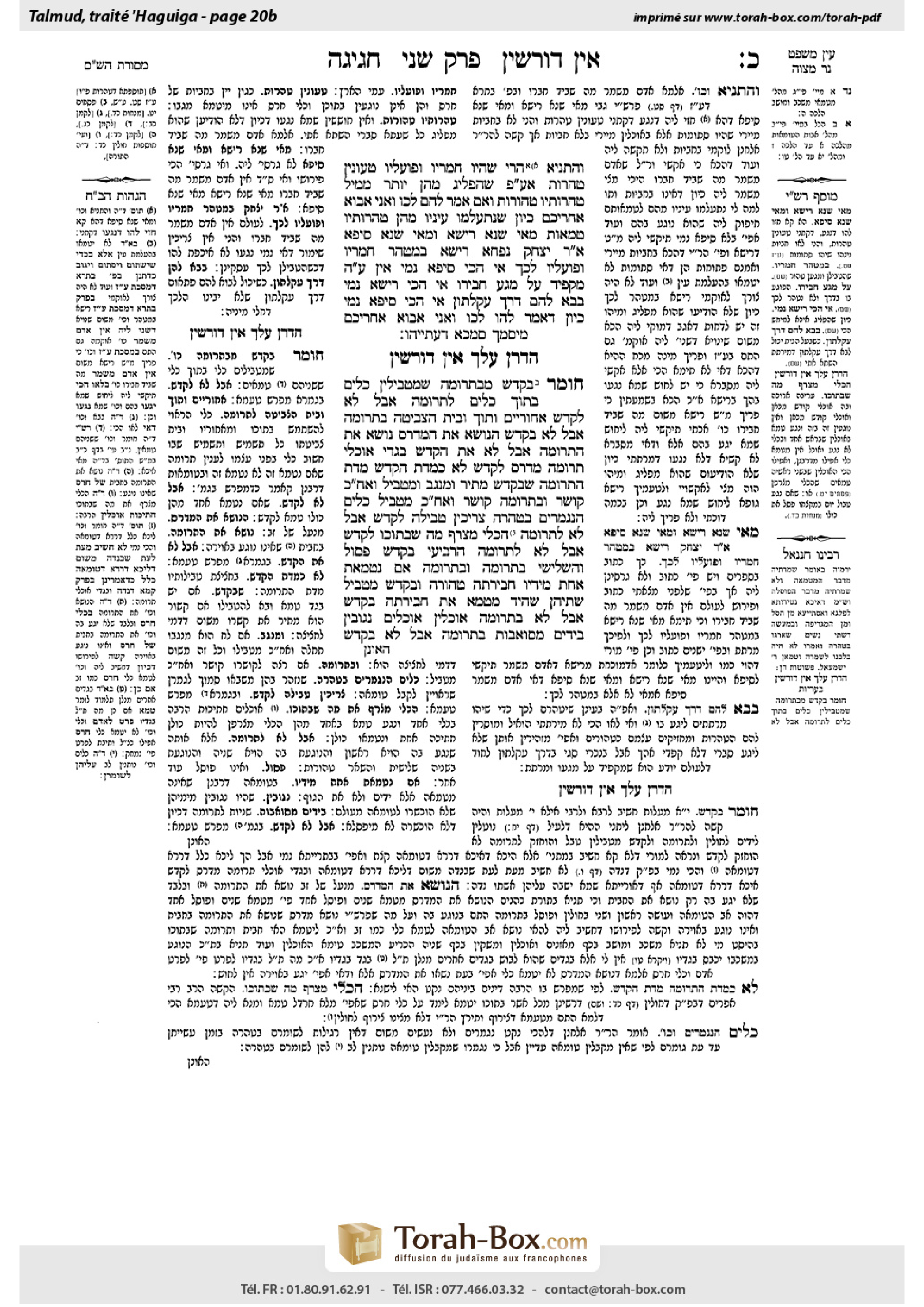
This page of Chagigah includes the Aramaic text, an English translation and an AI-generated French translation, alongside the scan above.
חגיגה כ׳ ב · Aramaic and Hebrew text
וְהָתַנְיָא: הֲרֵי שֶׁהָיוּ חֲמָרָיו וּפוֹעֲלָיו טְעוּנִין טְהָרוֹת, אַף עַל פִּי שֶׁהִפְלִיג מֵהֶן יוֹתֵר מִמִּיל — טַהֲרוֹתָיו טְהוֹרוֹת. וְאִם אָמַר לָהֶם: ״לְכוּ וַאֲנִי אָבוֹא אַחֲרֵיכֶם״, כֵּיוָן שֶׁנִּתְעַלְּמוּ עֵינָיו מֵהֶן — טַהֲרוֹתָיו טְמֵאוֹת.
מַאי שְׁנָא רֵישָׁא וּמַאי שְׁנָא סֵיפָא? אָמַר רַבִּי יִצְחָק נַפָּחָא: רֵישָׁא בִּמְטַהֵר חֲמָרָיו וּפוֹעֲלָיו לְכָךְ.
אִי הָכִי, סֵיפָא נָמֵי! אֵין עַם הָאָרֶץ מַקְפִּיד עַל מַגַּע חֲבֵירוֹ.
אִי הָכִי, רֵישָׁא נָמֵי! בְּבָא לָהֶם דֶּרֶךְ עֲקַלָּתוֹן.
אִי הָכִי, סֵיפָא נָמֵי! כֵּיוָן דַּאֲמַר לְהוּ ״לְכוּ וַאֲנִי אָבוֹא אַחֲרֵיכֶם״ — מִיסְמָךְ סָמְכָא דַּעְתַּיְיהוּ.
הֲדַרַן עֲלָךְ אֵין דּוֹרְשִׁין
חוֹמֶר בַּקֹּדֶשׁ מִבִּתְרוּמָה, שֶׁמַּטְבִּילִין כֵּלִים בְּתוֹךְ כֵּלִים לִתְרוּמָה, אֲבָל לֹא לַקֹּדֶשׁ. אֲחוֹרַיִים וָתוֹךְ וּבֵית הַצְּבִיטָה בִּתְרוּמָה, אֲבָל לֹא בַּקֹּדֶשׁ.
הַנּוֹשֵׂא אֶת הַמִּדְרָס, נוֹשֵׂא אֶת הַתְּרוּמָה, אֲבָל לֹא אֶת הַקֹּדֶשׁ. בִּגְדֵי אוֹכְלֵי תְרוּמָה, מִדְרָס לַקֹּדֶשׁ.
לֹא כְּמִדַּת הַקֹּדֶשׁ מִדַּת הַתְּרוּמָה. שֶׁבַּקֹּדֶשׁ: מַתִּיר וּמְנַגֵּב וּמַטְבִּיל, וְאַחַר כָּךְ קוֹשֵׁר. וּבִתְרוּמָה: קוֹשֵׁר, וְאַחַר כָּךְ מַטְבִּיל.
כֵּלִים הַנִּגְמָרִים בְּטָהֳרָה, צְרִיכִין טְבִילָה לַקֹּדֶשׁ, אֲבָל לֹא לִתְרוּמָה. הַכְּלִי מְצָרֵף מַה שֶּׁבְּתוֹכוֹ לַקֹּדֶשׁ, אֲבָל לֹא לִתְרוּמָה.
הָרְבִיעִי בַּקֹּדֶשׁ פָּסוּל, וְהַשְּׁלִישִׁי בִתְרוּמָה. וּבִתְרוּמָה, אִם נִטְמֵאת אַחַת מִיָּדָיו — חֲבֶירְתָּהּ טְהוֹרָה, וּבַקֹּדֶשׁ — מַטְבִּיל שְׁתֵּיהֶן, שֶׁהַיָּד מְטַמֵּא אֶת חֲבֶירְתָּהּ בַּקֹּדֶשׁ אֲבָל לֹא בִתְרוּמָה. אוֹכְלִין אוֹכָלִים נְגוּבִין בְּיָדַיִם מְסוֹאָבוֹת בִתְרוּמָה, אֲבָל לֹא בַּקֹּדֶשׁ.
Chagigah 20b · English translation
But isn’t it taught in a baraita: With regard to one whose donkey drivers and workers, who were amei ha’aretz, were bearing pure food, without touching the pure food itself but only the earthenware vessels containing them, even if he distanced himself from them as they walked by more than a mil, his pure foods are pure. Since the workers are unaware of his departure, he is still considered to be guarding the food in their possession and need not be concerned that they may have touched the pure foods. But if he said to them: Go, and I will follow behind you, then once they are no longer within his eyesight, his pure foods are impure.
The Gemara asks: What is different in the first clause of the baraita, where the food remains pure, and what is different in the latter clause, where the food is impure? Rabbi Yitzḥak Nappaḥa said: The first clause is referring to one who purifies his donkey drivers and workers for this purpose, meaning that he ensured that they immersed and purified themselves beforehand, so that concern for impurity was removed.
The Gemara questions this: If so, in the latter clause they should also be pure. The Gemara responds: An am ha’aretz is not particular about the contact of his colleague, and therefore there is concern that they might have encountered another am ha’aretz on the way, who touched the produce and thereby rendered it impure.
The Gemara counters: If so, in the first clause of the baraita there should also be concern that they might have met an am ha’aretz, and despite the employer’s warning to his workers to stay ritually pure, they are not careful with regard to the impurity of another am ha’aretz. The Gemara answers: The first clause is referring to a situation when he comes across them via a circuitous path. Since he is not walking directly behind them but can appear from the sides, they cannot always see him. Consequently, they are concerned that he may return at any moment. Therefore, they are careful not to render themselves ritually impure, and they are also wary of the contact of other amei ha’aretz, although they are not usually particular about the contact of their colleagues.
The Gemara raises a difficulty: If so, in the latter clause, too, since he can arrive from around a corner at any given moment, they should certainly be cautious. The Gemara responds: Since he said to them: Go and I will follow behind you, they rely on this, and they do not consider themselves to be under observation. Consequently, they are not particular about the contact of another am ha’aretz.
MISHNA: Concerning several matters there is greater stringency with regard to sacrificial food than with regard to teruma, a portion of the produce designated for the priest. This expresses itself in many ways, the first being that one may immerse vessels inside other vessels to purify them for teruma; but not for sacrificial food, for which one must immerse each vessel separately. Another difference is that the halakhot of the back of a vessel and its inside and its place for gripping apply to vessels used for teruma, meaning that each part of the vessel has its own use and is considered a separate vessel in that it does not convey impurity to the other parts of the vessel when it contracts impurity; but not to sacrificial food, for which an impure section of the vessel does convey impurity to all the other sections.
Likewise, one who carries an object trodden on by a zav, a man suffering from gonorrhea, may carry teruma at the same time, if he is careful that neither he nor the impure object should come into contact with the teruma, but this may not be done with sacrificial food. The garments of those who eat teruma are like an object trodden on by a zav with regard to sacrificial food.
The mishna lists other stringencies that apply to sacrificial foods but not to teruma: The characteristics of teruma are not like the characteristics of sacrificial food, as in the case of vessels that are used with sacrificial food, if one has a garment or vessel that is tied up he must untie it and dry it if there was any moisture on it, as both a knot and absorbed moisture are considered interpositions that prevent the water of the ritual bath from reaching the entire garment. And he may then immerse them, and afterward he may tie them up again if he wishes. But with regard to teruma he may, if he so desires, tie up the garment and then immerse it without any concern that the knot might be considered an interposition.
Vessels that were fashioned and completed in purity nevertheless require immersion to be considered pure for sacrificial foods, but not for teruma. A vessel combines all the food that is in it with regard to sacrificial food, meaning that if one piece of food becomes impure all the other pieces become impure as well; but not with regard to teruma, concerning which each piece is treated independently.
The mishna continues the list of differences between sacrificial food and teruma. Sacrificial food that is impure with fourth-degree impurity is disqualified, meaning that the sacrificial food is rendered impure but it does not impart impurity to other items. Teruma is disqualified when it is impure with third-degree impurity; it is not susceptible to fourth-degree impurity at all. And with regard to teruma, if one of one’s hands became impure by rabbinic law that renders only the hands impure, its counterpart, i.e., the other hand, remains pure. But with regard to sacrificial food, if one hand becomes impure he must immerse them both, as one hand renders its counterpart impure with regard to sacrificial food but not with regard to teruma. One may eat dry foods, i.e., foods that have never come into contact with liquid and are therefore not susceptible to impurity, with impure hands when it is teruma, but not when it is sacrificial food.
Chagigah 20b · Traduction française (IA)
Mais n’est-ce pas enseigné dans une baraïta : Concernant celui dont les conducteurs de bêtes de somme et les ouvriers, qui étaient des amei ha’aretz, transportaient des aliments purs, sans toucher les aliments purs eux-mêmes mais seulement les récipients en terre qui les contenaient, même s’il s’éloignait d’eux à mesure qu’ils passaient à plus d’un mil, ses aliments purs restent purs. Puisque les ouvriers ignorent son départ, il est considéré comme gardant les aliments en leur possession et n’a pas à crainre qu’ils aient pu toucher les aliments purs. Mais s’il dit à eux : Allez, et je vous suivrai, alors une fois qu’ils ne sont plus dans son champ de vision, ses aliments sont impurs.
La Guemara pose la question : Qu’est-ce qui diffère dans la première partie de la baraïta, où les aliments restent purs, et qu’est-ce qui diffère dans la seconde partie, où les aliments sont impurs ? Rabbi Yitzḥak Nappaḥa a dit : La première partie fait référence à celui qui purifie ses conducteurs de bêtes de somme et ses ouvriers à cette fin, c’est-à-dire qu’il a assuré qu’ils s’étaient purifiés et immergés d’avance, de sorte que l’inquiétude concernant l’impureté a été éliminée.
La Guemara soulève un doute à ce propos : Si c’est ainsi, dans la seconde partie ils devraient aussi être purs. La Guemara répond : L’am ha’aretz n’est pas particulier à l’contact de son collègue, et par conséquent il y a une inquiétude qu’ils aient pu rencontrer un autre am ha’aretz sur le chemin, qui a touché les produits et les a ainsi rendus impurs.
La Guemara rétorque : Si c’est ainsi, dans la première partie de la baraïta, il devrait y avoir aussi une inquiétude qu’ils aient pu rencontrer un am ha’aretz, et malgré la mise en garde de l’employeur à ses ouvriers pour qu’ils restent rituellement purs, ils ne sont pas vigilants concernant l’impureté d’un autre am ha’aretz. La Guemara répond : La première partie fait référence à un cas où il croise leur chemin par un chemin détourné. Puisqu’il ne marche pas directement derrière eux mais peut apparaître des côtés, ils ne peuvent pas toujours le voir. Par conséquent, ils craignent qu’il puisse revenir à tout moment. Ainsi, ils sont vigilants pour ne pas se rendre impurs, et ils sont également méfiants du contact d’autres am ha’aretz, bien qu’ils ne soient généralement pas particuliers au contact de leurs collègues.
La Guemara soulève une difficulté : Si c’est ainsi, dans la seconde partie également, puisqu’il peut arriver de derrière un coin à tout moment, ils devraient certainement être vigilants. La Guemara répond : Puisqu’il a dit à eux : Allez et je vous suivrai, ils s’appuient sur cela et ne considèrent pas qu’ils sont sous surveillance. Par conséquent, ils ne sont pas particuliers au contact d’un autre am ha’aretz.
MICHNA : Concernant plusieurs choses, il y a une stricte rigueur concernant les aliments sacrés par rapport à la terouma, une portion des produits désignée pour le prêtre. Cela se manifeste de nombreuses manières, la première étant que l’on peut immerger les récipients dans d’autres récipients pour les purifier en vue de la terouma, mais pas pour les aliments sacrés, pour lesquels l’on doit immerger chaque récipient séparément. Une autre différence est que les halakhot concernant le dos du récipient et son intérieur et sa partie de saisie s’appliquent aux récipients utilisés pour la terouma, c’est-à-dire que chaque partie du récipient a sa propre utilisation et est considérée comme un récipient distinct, de sorte qu’il ne transmet pas l’impureté aux autres parties du récipient lorsqu’il devient impur ; mais pas pour les aliments sacrés, pour lesquels une partie impure du récipient transmet l’impureté à toutes les autres parties.
De même, celui qui transporte un objet foulé par un zav, un homme souffrant de goutte, peut transporter la terouma en même temps, à condition qu’il soit vigilant pour que ni lui ni l’objet impur ne touchent la terouma, mais cela ne peut être fait avec les aliments sacrés. Les vêtements de ceux qui mangent la terouma sont comme un objet foulé par un zav concernant les aliments sacrés.
La mishna liste d’autres stricteurs qui s’appliquent aux aliments sacrés mais pas à la terouma : Les caractéristiques de la terouma ne sont pas comme celles des aliments sacrés, comme dans le cas des récipients utilisés avec les aliments sacrés, si l’on a un vêtement ou un récipient qui est noué, il faut le dénouer et le sécher si il y avait de la moiteur dessus, car un nœud et l’humidité absorbée sont considérés comme des interpositions qui empêchent l’eau du bain rituel d’atteindre tout le vêtement. Et il peut alors les immerger, et après cela il peut les relier à nouveau s’il le souhaite. Mais concernant la terouma, il peut, s’il le désire, nœud le vêtement et l’immerger sans craindre que le nœud soit considéré comme une interposition.
Les récipients qui ont été façonnés et achevés dans la pureté nécessitent tout de même une immersion pour être considérés comme purs pour les aliments sacrés, mais pas pour la terouma. Un récipient combine tous les aliments qui y sont contenus concernant les aliments sacrés, c’est-à-dire que si une pièce d’aliment devient impure, toutes les autres pièces deviennent impures également ; mais pas concernant la terouma, pour laquelle chaque pièce est traitée de manière indépendante.
La mishna continue la liste des différences entre les aliments sacrés et la terouma. Les aliments sacrés qui sont impurs avec une impureté de quatrième degré sont disqualifiés, c’est-à-dire que l’aliment sacré est rendu impur mais ne transmet pas l’impureté aux autres objets. La terouma est disqualifiée lorsqu’elle est impure avec une impureté de troisième degré ; elle n’est pas sujette à une impureté de quatrième degré du tout. Et concernant la terouma, si l’une de ses mains devient impure par la loi rabbinique qui rend seulement les mains impures, son homologue, c’est-à-dire l’autre main, reste pure. Mais concernant les aliments sacrés, si l’une des mains devient impure, il faut immerger les deux mains, car une main rend son homologue impure concernant les aliments sacrés mais pas concernant la terouma. On peut manger des aliments secs, c’est-à-dire des aliments qui n’ont jamais été en contact avec un liquide et sont donc insusceptibles d’impureté, avec des mains impures lorsqu’il s’agit de terouma, mais pas lorsqu’il s’agit d’aliments sacrés.
Traduction française générée par IA à partir de l’édition anglaise de Sefaria. Vérifie toujours un passage avec le texte source.
Text from Sefaria: William Davidson Edition - Vocalized Aramaic (CC BY NC); William Davidson Edition - English (CC BY NC).