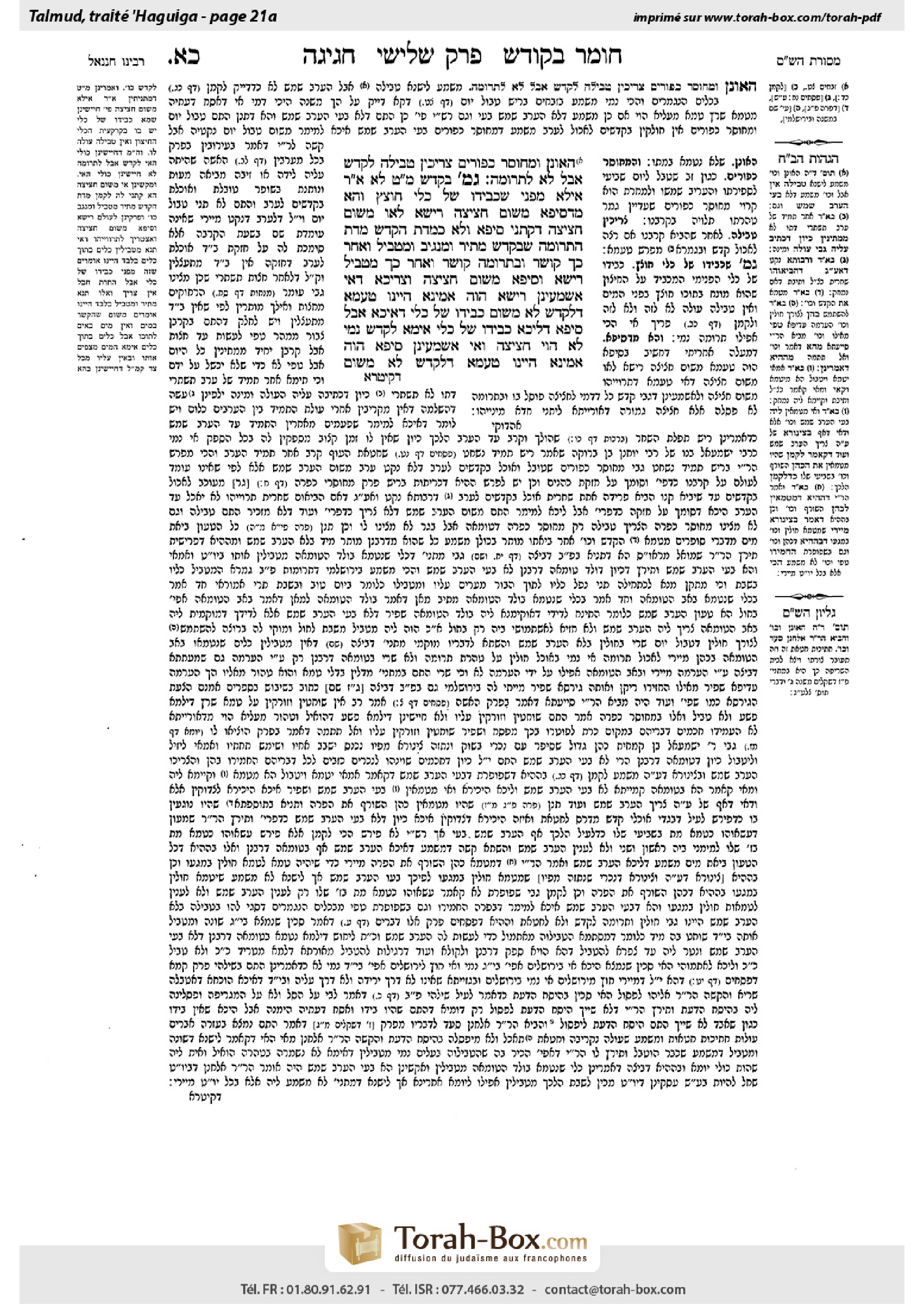
Chagigah 21a: Talmud study for Daf Yomi
Study the Talmud for Daf Yomi with scanned pages, Hebrew text, English translations from Sefaria and AI-generated French translations.
Passage selection and English or AI-generated French translation are available where the scan has annotations. Daf Study is independent of Torah-Box and Sefaria.
Browse Chagigah · חגיגה · All tractatesChagigah 21a text and translations
This page of Chagigah includes the Aramaic text, an English translation and an AI-generated French translation, alongside the scan above.
חגיגה כ״א א · Aramaic and Hebrew text
הָאוֹנֵן וּמְחוּסַּר כִּפּוּרִים צְרִיכִין טְבִילָה לַקֹּדֶשׁ, אֲבָל לֹא לִתְרוּמָה.
גְּמָ׳ בַּקֹּדֶשׁ מַאי טַעְמָא לָא? אָמַר רַבִּי אִילָא: מִפְּנֵי שֶׁכְּבֵידוֹ שֶׁל כְּלִי חוֹצֵץ.
וְהָא מִדְּסֵיפָא מִשּׁוּם חֲצִיצָה, רֵישָׁא לָאו מִשּׁוּם חֲצִיצָה! דְּקָתָנֵי סֵיפָא: וְלֹא כְּמִדַּת הַקֹּדֶשׁ מִדַּת הַתְּרוּמָה, שֶׁבַּקֹּדֶשׁ מַתִּיר וּמְנַגֵּיב וּמַטְבִּיל וְאַחַר כָּךְ קוֹשֵׁר, וּבַתְּרוּמָה קוֹשֵׁר וְאַחַר כָּךְ מַטְבִּיל!
רֵישָׁא וְסֵיפָא מִשּׁוּם חֲצִיצָה, וּצְרִיכָא: דְּאִי אַשְׁמְעִינַן רֵישָׁא, הֲוָה אָמֵינָא הַיְינוּ טַעְמָא דִּלְקֹדֶשׁ לָא — מִשּׁוּם כְּבֵידוֹ שֶׁל כְּלִי דְּאִיכָּא, אֲבָל סֵיפָא, דְּלֵיכָּא כְּבֵידוֹ שֶׁל כְּלִי — אֵימָא לְקֹדֶשׁ נָמֵי לָא הָוֵי חֲצִיצָה. וְאִי אַשְׁמְעִינַן סֵיפָא, הֲוָה אָמֵינָא: הַיְינוּ טַעְמָא דִּלְקֹדֶשׁ לָא, מִשּׁוּם
Chagigah 21a · English translation
An acute mourner [onen], i.e., someone who has experienced the loss of a close relative on that day, who had not come into contact with the deceased; and one who is lacking atonement, i.e., someone who still needs to bring an offering to complete his purification procedure, such as a zav or a woman after childbirth, both require immersion in order to eat sacrificial food. The onen would immerse after the day has passed and the one lacking atonement would immerse after the requisite offering is brought. However, immersion in these cases is not necessary for eating teruma.
GEMARA: It is taught in the mishna that one may not immerse one vessel inside another if they will be used for sacrificial food, though this may be done for teruma. The Gemara asks: With regard to sacrificial food, what is the reason that one may not immerse vessels in this manner? Rabbi Ila said: Because the weight of the inner vessel causes an interposition between the water and the vessels. That is, the innermost vessel weighs down on the bottom one, not allowing the water to reach the two vessels’ point of contact.
The Gemara poses a question on this explanation: But is it not so that since the latter clause of the mishna mentions that sacrificial foods and teruma differ with regard to matters of interposition, the first clause of the mishna must not be with regard to matters of interposition, but is referring to a different consideration? As it teaches in the latter part of the mishna: The characteristics of teruma are not like the characteristics of sacrificial food, as in the case of sacrificial food, if one has a garment or vessel that is tied up he must untie it and dry it, and he may then immerse them, and afterward he may tie them up again if he wishes; but with regard to teruma he may tie up the garment and then immerse it. This latter clause shows that there the Sages were concerned for any possibility of interposition with regard to sacrificial food, so most likely the earlier clause of the mishna is due to a different reason.
The Gemara answers: No, this is not necessarily so. In both the first clause and the latter clause of the mishna the concern is due to interposition, and it is nevertheless necessary to teach us both cases. For had the mishna taught us only the first clause, i.e., that one may not immerse one vessel within another, I would have said that this is the reason one may not do so for sacrificial food: Because there is the weight of the interior vessel that must be taken into account. But in the latter clause, where there is no weight of a vessel to be considered, I will say that it is not considered an interposition for sacrificial food either. And had it taught us only the latter clause dealing with the knotted garments, I would have said that this is the reason one may not do so for sacrificial food: Because it is possible
Chagigah 21a · Traduction française (IA)
Un veuf en deuil [onen], c'est-à-dire une personne ayant subi la perte d'un proche le même jour, sans avoir été en contact avec le défunt ; et celui qui manque d'atonement, c'est-à-dire une personne qui doit encore présenter un sacrifice pour achever sa purification, comme un zav ou une femme après l'accouchement, nécessite une immersion pour manger des aliments sacrés. L'onen s'immergera après que le jour aura passé, et celui qui manque d'atonement s'immergera après que l'offrande nécessaire aura été apportée. Cependant, l'immersion n'est pas nécessaire dans ces cas pour manger la terouma.
GUEMARA : Il est enseigné dans la mitsva que l'on ne peut pas immerger un récipient à l'intérieur d'un autre si ceux-ci seront utilisés pour des aliments sacrés, bien que cela soit permis pour la terouma. La Guemara pose une question : En ce qui concerne les aliments sacrés, quelle est la raison pour laquelle l'on ne peut pas immerger les récipients ainsi ? Rabbi Ila a dit : Parce que le poids du récipient intérieur crée une interposition entre l'eau et les récipients. C'est-à-dire que le récipient le plus intérieur pèse sur le récipient inférieur, empêchant l'eau de toucher le point de contact des deux récipients.
La Guemara pose une question sur cette explication : Mais n'est-ce pas le cas que puisque la dernière partie de la mitsna mentionne que les caractéristiques de la terouma diffèrent de celles des aliments sacrés en ce qui concerne l'interposition, la première partie de la mitsna ne doit pas concerner l'interposition, mais faire référence à une autre considération ? Comme il enseigne dans la dernière partie de la mitsna : Les caractéristiques de la terouma ne sont pas comme celles des aliments sacrés, comme dans le cas des aliments sacrés, si l'on a une robe ou un récipient qui est noué, il faut le dénouer et le sécher, puis on peut s'immerger dedans, et ensuite on peut le relier à nouveau si l'on le souhaite ; mais concernant la terouma, on peut nouer la robe et ensuite s'immerger dedans. Cette dernière partie montre que les Sages étaient préoccupés par toute possibilité d'interposition concernant les aliments sacrés, donc il est probable que la première partie de la mitsna soit due à une autre raison.
La Guemara répond : Non, cela n'est pas nécessairement vrai. Dans les deux parties de la mitsna, la préoccupation est due à l'interposition, et il est toutefois nécessaire d'enseigner ces deux cas. Car si la mitsna nous avait enseigné seulement la première partie, c'est-à-dire que l'on ne peut pas immerger un récipient à l'intérieur d'un autre, je dirais que c'est la raison pour laquelle l'on ne peut pas le faire pour les aliments sacrés : Parce qu'il faut prendre en compte le poids du récipient intérieur. Mais dans la dernière partie, où il n'y a pas de poids de récipient à considérer, je dirais que cela n'est pas considéré comme une interposition pour les aliments sacrés non plus. Et si la mitsna nous avait enseigné seulement cette dernière partie concernant les robes nouées, je dirais que c'est la raison pour laquelle l'on ne peut pas le faire pour les aliments sacrés : Parce que c'est possible
Traduction française générée par IA à partir de l’édition anglaise de Sefaria. Vérifie toujours un passage avec le texte source.
Text from Sefaria: William Davidson Edition - Vocalized Aramaic (CC BY NC); William Davidson Edition - English (CC BY NC).