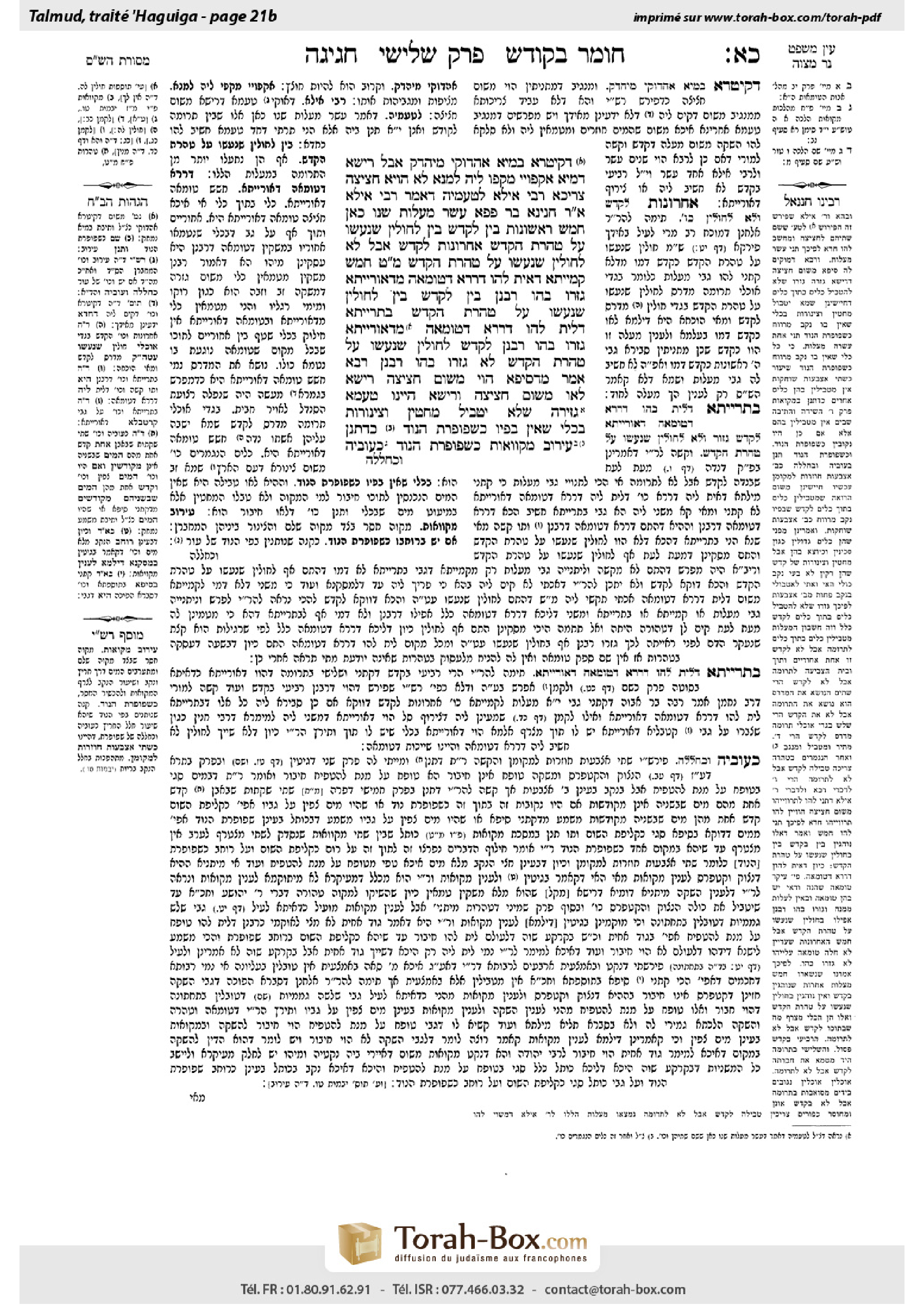
Chagigah 21b: Talmud study for Daf Yomi
Study the Talmud for Daf Yomi with scanned pages, Hebrew text, English translations from Sefaria and AI-generated French translations.
Passage selection and English or AI-generated French translation are available where the scan has annotations. Daf Study is independent of Torah-Box and Sefaria.
Browse Chagigah · חגיגה · All tractatesChagigah 21b text and translations
This page of Chagigah includes the Aramaic text, an English translation and an AI-generated French translation, alongside the scan above.
חגיגה כ״א ב · Aramaic and Hebrew text
דְּקִיטְרָא בְּמַיָּא אִהַדּוֹקֵי מִיהַדַּק, אֲבָל רֵישָׁא, דְּמַיָּא אַקְפּוֹיֵי מַקְפּוּ לֵיהּ לְמָנָא — לָא הָוְיָא חֲצִיצָה, צְרִיכָא.
רַבִּי אִילָא לְטַעְמֵיהּ, דְּאָמַר רַבִּי אִילָא אָמַר רַבִּי חֲנִינָא בַּר פָּפָּא: עֶשֶׂר מַעֲלוֹת שָׁנוּ כָּאן, חָמֵשׁ רִאשׁוֹנוֹת — בֵּין לַקֹּדֶשׁ, בֵּין לְחוּלִּין שֶׁנַּעֲשׂוּ עַל טׇהֳרַת הַקֹּדֶשׁ, אַחֲרוֹנוֹת — לַקֹּדֶשׁ, אֲבָל לֹא לְחוּלִּין שֶׁנַּעֲשׂוּ עַל טׇהֳרַת הַקֹּדֶשׁ.
מַאי טַעְמָא: חֲמֵשׁ קַמָּיָיתָא, דְּאִית לְהוּ דְּרָרָא דְטוּמְאָה מִדְּאוֹרָיְיתָא — גְּזַרוּ בְּהוּ רַבָּנַן בֵּין לְקֹדֶשׁ בֵּין לְחוּלִּין שֶׁנַּעֲשׂוּ עַל טׇהֳרַת הַקֹּדֶשׁ, בָּתְרָיָיתָא, דְּלֵית לְהוּ דְּרָרָא דְטוּמְאָה מִדְּאוֹרָיְיתָא — גְּזַרוּ בְּהוּ רַבָּנַן לְקֹדֶשׁ, לְחוּלִּין שֶׁנַּעֲשׂוּ עַל טׇהֳרַת הַקֹּדֶשׁ — לָא גְּזַרוּ בְּהוּ רַבָּנַן.
רָבָא אָמַר: מִדְּסֵיפָא הָוֵי מִשּׁוּם חֲצִיצָה, רֵישָׁא לָאו מִשּׁוּם חֲצִיצָה. וְרֵישָׁא, הַיְינוּ טַעְמָא: גְּזֵירָה שֶׁלֹּא יַטְבִּיל מְחָטִין וְצִינּוֹרוֹת בִּכְלִי שֶׁאֵין בְּפִיו כִּשְׁפוֹפֶרֶת הַנּוֹד. כְּדִתְנַן: עֵירוּב מִקְווֹאוֹת, כִּשְׁפוֹפֶרֶת הַנּוֹד, כְּעוֹבְיָהּ
Chagigah 21b · English translation
that it is the nature of knots to tighten even more in water, creating an interposition that bars the water from entering all the way, but in the case of the first clause of the mishna, which deals with one vessel inside another and where water by nature causes the top vessel to lighten and float away from the lower vessel rather than weigh down on it, I would have said that it is not considered an interposition. It is therefore necessary for the halakha to be stated in both cases.
The Gemara comments: Rabbi Ila here conforms to his standard line of reasoning in considering these two issues as one, as Rabbi Ila said that Rabbi Ḥanina bar Pappa said: They taught ten stringencies of sacrificial food here in this mishna, rather than the apparent eleven. The first five stringencies apply both to the sacrificial foods themselves and to non-sacred food that was prepared according to the standards of purity of sacrificial food, whereas the last five apply only to actual sacrificial food but not to non-sacred food that was prepared according to the standards of purity of sacrificial food. The fact that Rabbi Ila counts only ten cases in the mishna shows that he considered the two cases discussed above to be of the same category, and therefore they are counted together as one stringency.
The Gemara explains Rabbi Ila’s statement. What is the reason for this distinction? With regard to the first five stringencies, which have a connection to impurity as defined by Torah law because ignoring them can lead to a case of impurity by Torah law as opposed to merely rabbinic law, the Sages decreed these stringencies both for actual sacrificial food and for non-sacred food prepared according to the standards of purity of sacrificial food. However, with regard to the last five, which do not have a connection to impurity by Torah law, as their entire impurity is based on a rabbinic decree, the Sages decreed these stringencies only for actual sacrificial food. But with regard to non-sacred food made according to the standards of purity of sacrificial food, the Sages did not decree these stringencies for such foods.
Rava disagreed with Rabbi Ila. He said that since the reason for the stringency in the latter clause is due to concern for interposition, this implies that the reason for the stringency in the first clause is not due to interposition, but to a different reason. And with regard to the stringency in the first clause that one may not immerse one vessel within another, this is the reasoning: It is a rabbinic decree to ensure that one not immerse small vessels, such as needles and hooks, inside a vessel whose mouth is less than the width of the tube of a wineskin. In such a case the water in the bottle would not be considered attached to the rest of the ritual bath, as we learned in a mishna (Mikvaot 6:7): The joining of different bodies of water in cases of ritual baths takes place if the opening between the two bodies is at least as wide as the width of the tube of a wineskin, counting both the thickness of the wall of the tube
Chagigah 21b · Traduction française (IA)
que c'est la nature des nœuds de se resserrer davantage dans l'eau, créant un obstacle qui empêche l'eau d'entrer complètement, mais dans le cas de la première clause de la mitsna, qui traite d'un récipient à l'intérieur d'un autre et où l'eau, par sa nature, fait flotter le récipient supérieur loin du récipient inférieur plutôt que de le peser, j'aurais dit qu'il ne s'agissait pas d'un obstacle. Il est donc nécessaire que la halakha soit énoncée dans les deux cas.
Le Guemara commente : Rabbi Ila suit ici sa ligne de raisonnement habituelle en considérant ces deux questions comme une seule, car Rabbi Ila a dit que Rabbi Ḥanina bar Pappa a affirmé : Ils ont enseigné dix stringences concernant les aliments sacrés ici dans cette mitsna, plutôt que les onze apparentes. Les cinq premières stringences s'appliquent à la fois aux aliments sacrés eux-mêmes et aux aliments non sacrés préparés selon les normes de pureté des aliments sacrés, tandis que les cinq dernières s'appliquent uniquement aux aliments sacrés et non aux aliments non sacrés préparés selon les normes de pureté des aliments sacrés. Le fait que Rabbi Ila compte seulement dix cas dans la mitsna montre qu'il considérait les deux cas discutés ci-dessus comme appartenant à la même catégorie, et qu'ils sont donc comptés ensemble comme une seule stringence.
Le Guemara explique la déclaration de Rabbi Ila. Quelle est la raison de cette distinction ? Concernant les cinq premières stringences, qui sont liées à l'impureté définie par la Torah, car leur négligence peut entraîner un cas d'impureté par la Torah, contrairement à une décision rabbinique, les Sages ont institué ces stringences à la fois pour les aliments sacrés et pour les aliments non sacrés préparés selon les normes de pureté des aliments sacrés. Cependant, concernant les cinq dernières, qui n'ont pas de lien avec l'impureté par la Torah, car leur impureté est entièrement basée sur une décision rabbinique, les Sages ont institué ces stringences uniquement pour les aliments sacrés. En ce qui concerne les aliments non sacrés préparés selon les normes de pureté des aliments sacrés, les Sages n'ont pas institué ces stringences pour de tels aliments.
Rava s'est opposé à Rabbi Ila. Il a dit que puisque la raison de la stringence dans la seconde clause est liée à l'obstacle, cela implique que la raison de la stringence dans la première clause n'est pas liée à l'obstacle, mais à une autre raison. Et concernant la stringence dans la première clause qui interdit d'immerger un récipient dans un autre, cette raison est la suivante : il s'agit d'une décision rabbinique pour s'assurer que l'on ne plonge pas des petits récipients, tels que des aiguilles et des crochets, dans un récipient dont l'ouverture est inférieure à la largeur du tube d'un flacon. Dans ce cas, l'eau du flacon ne serait pas considérée comme attachée au reste du bain rituel, comme nous l'avons appris dans une mitsva (Mikvaot 6:7) : La jonction de différentes masses d'eau dans les bains rituels a lieu si l'ouverture entre les deux masses est au moins aussi large que la largeur du tube d'un flacon, en tenant compte de l'épaisseur de la paroi du tube.
Traduction française générée par IA à partir de l’édition anglaise de Sefaria. Vérifie toujours un passage avec le texte source.
Text from Sefaria: William Davidson Edition - Vocalized Aramaic (CC BY NC); William Davidson Edition - English (CC BY NC).