Chagigah 22a: Talmud study for Daf Yomi
Study the Talmud for Daf Yomi with scanned pages, Hebrew text, English translations from Sefaria and AI-generated French translations.
Passage selection and English or AI-generated French translation are available where the scan has annotations. Daf Study is independent of Torah-Box and Sefaria.
Browse Chagigah · חגיגה · All tractatesChagigah 22a text and translations
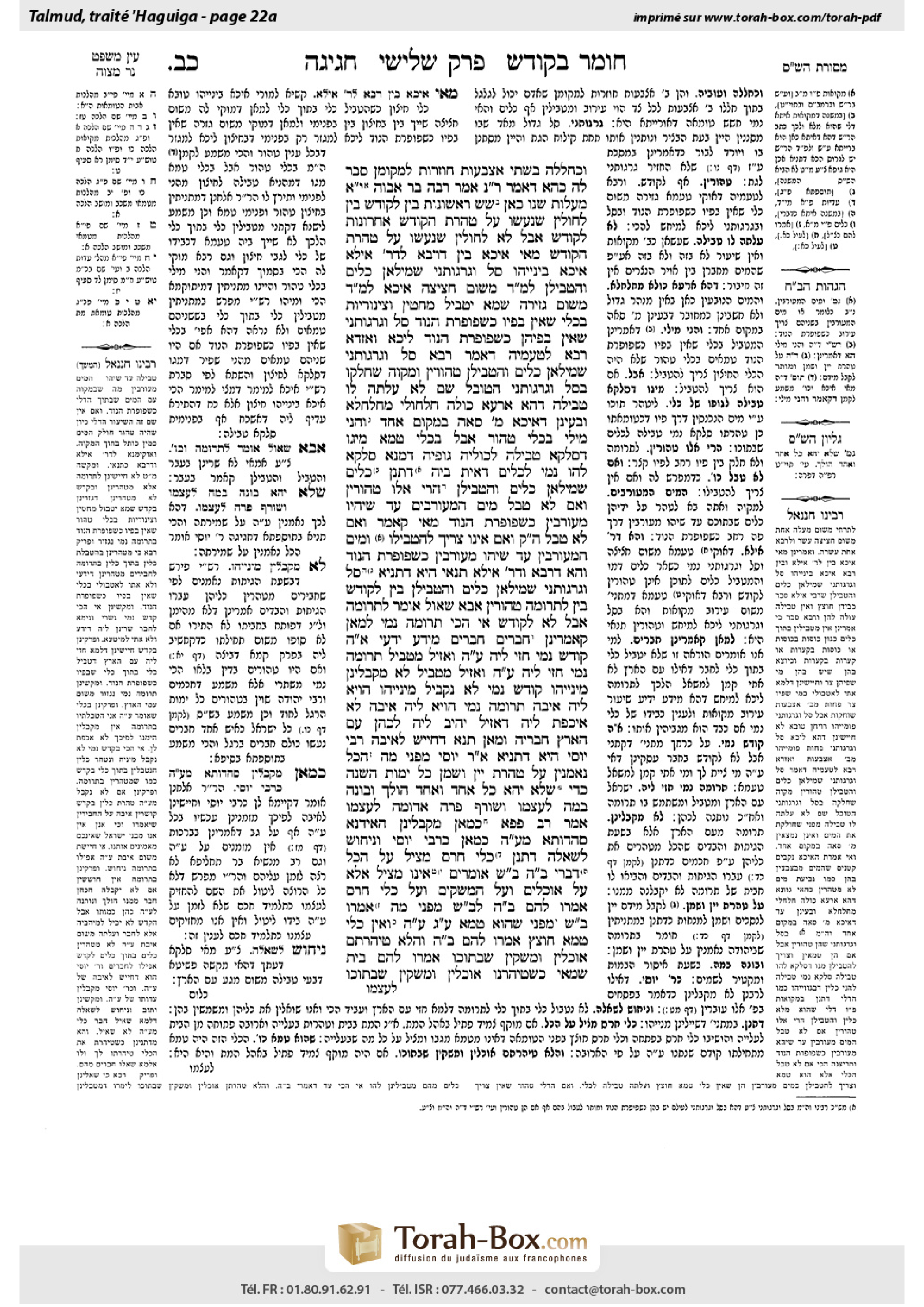
This page of Chagigah includes the Aramaic text, an English translation and an AI-generated French translation, alongside the scan above.
חגיגה כ״ב א · Aramaic and Hebrew text
וְכַחֲלָלָהּ, בִּשְׁתֵּי אֶצְבָּעוֹת חוֹזְרוֹת לִמְקוֹמָן.
סָבַר לַהּ כְּהָא דְּאָמַר רַב נַחְמָן אָמַר רַבָּה בַּר אֲבוּהּ: אַחַת עֶשְׂרֵה מַעֲלוֹת שָׁנוּ כָּאן: שֵׁשׁ רִאשׁוֹנוֹת — בֵּין לַקּוֹדֶשׁ, בֵּין לְחוּלִּין שֶׁנַּעֲשׂוּ עַל טׇהֳרַת הַקּוֹדֶשׁ. אַחֲרוֹנוֹת — לַקּוֹדֶשׁ, אֲבָל לֹא לְחוּלִּין שֶׁנַּעֲשׂוּ עַל טׇהֳרַת הַקּוֹדֶשׁ.
מַאי אִיכָּא בֵּין דְּרָבָא לִדְרַבִּי אִילָא?
אִיכָּא בֵּינַיְיהוּ סַל וְגַרְגוּתְנִי שֶׁמִּילְּאָן כֵּלִים וְהִטְבִּילָן. לְמַאן דְּאָמַר מִשּׁוּם חֲצִיצָה — אִיכָּא. לְמַאן דְּאָמַר מִשּׁוּם גְּזֵירָה שֶׁמָּא יַטְבִּיל מְחָטִין וְצִינּוֹרִיּוֹת בִּכְלִי שֶׁאֵין בְּפִיו כִּשְׁפוֹפֶרֶת הַנּוֹד — סַל וְגַרְגוּתְנִי שֶׁאֵין בְּפִיהֶן כִּשְׁפוֹפֶרֶת הַנּוֹד, לֵיכָּא.
וְאַזְדָּא רָבָא לְטַעְמֵיהּ, דְּאָמַר רָבָא: סַל וְגַרְגוּתְנִי שֶׁמִּילְּאָן כֵּלִים וְהִטְבִּילָן — טְהוֹרִין.
וּמִקְוֶה שֶׁחֲלָקוֹ בְּסַל וְגַרְגוּתְנִי — הַטּוֹבֵל שָׁם לֹא עָלְתָה לוֹ טְבִילָה. דְּהָא אַרְעָא כּוּלַּהּ חַלְחוֹלֵי מְחַלְחֲלָא, וּבָעֵינַן דְּאִיכָּא אַרְבָּעִים סְאָה בְּמָקוֹם אֶחָד.
וְהָנֵי מִילֵּי בִּכְלִי טָהוֹר, אֲבָל בִּכְלִי טָמֵא, מִיגּוֹ דְּסָלְקָא טְבִילָה לְכוּלֵּיהּ גּוּפֵיהּ דְּמָנָא, סָלְקָא לְהוּ נָמֵי לְכֵלִים דְּאִית בֵּיהּ.
דִּתְנַן: כֵּלִים שֶׁמִּילְּאָן כֵּלִים וְהִטְבִּילָן — הֲרֵי אֵלּוּ טְהוֹרִין. וְאִם לֹא טָבַל, מַיִם הַמְעוֹרָבִים — עַד שֶׁיִּהְיוּ מְעוֹרָבִין כִּשְׁפוֹפֶרֶת הַנּוֹד. מַאי קָאָמַר וְאִם לֹא טָבַל? הָכִי קָאָמַר: וְאִם אֵינוֹ צָרִיךְ לְהַטְבִּילוֹ, וּמַיִם הַמְעוֹרָבִין עַד שֶׁיְּהוּ מְעוֹרָבִין כִּשְׁפוֹפֶרֶת הַנּוֹד.
וְהָא דְּרָבָא וּדְרַבִּי אִילָא תַּנָּאֵי הִיא. דְּתַנְיָא: סַל וְגַרְגוּתְנִי שֶׁמִּילְּאָן כֵּלִים וְהִטְבִּילָן בֵּין לַקּוֹדֶשׁ בֵּין לַתְּרוּמָה, טְהוֹרִין. אַבָּא שָׁאוּל אוֹמֵר: לַתְּרוּמָה אֲבָל לֹא לַקּוֹדֶשׁ.
אִי הָכִי, תְּרוּמָה נָמֵי! לְמַאן קָאָמְרִינַן — חֲבֵרִים, חֲבֵרִים מִידָּע יָדְעִי.
אִי הָכִי, קוֹדֶשׁ נָמֵי! חָזֵי לֵיהּ עַם הָאָרֶץ וְאָזֵיל מַטְבִּיל.
תְּרוּמָה נָמֵי, חָזֵי לֵיהּ עַם הָאָרֶץ וְאָזֵיל מַטְבִּיל! לָא מְקַבְּלִינַן מִינַּיְיהוּ.
קוֹדֶשׁ נָמֵי, לָא נְקַבֵּיל מִינַּיְיהוּ! הָוְיָא לֵיהּ אֵיבָה.
תְּרוּמָה נָמֵי, הָוְיָא לֵיהּ אֵיבָה! לָא אִיכְפַּת לֵיהּ, דְּאָזֵיל יָהֵיב לֵיהּ לְכֹהֵן עַם הָאָרֶץ חַבְרֵיהּ.
וּמַאן תַּנָּא דְּחָיֵישׁ לְאֵיבָה — רַבִּי יוֹסֵי הִיא. דְּתַנְיָא, אָמַר רַבִּי יוֹסֵי: מִפְּנֵי מָה הַכֹּל נֶאֱמָנִין עַל טׇהֳרַת יַיִן וָשֶׁמֶן כׇּל יְמוֹת הַשָּׁנָה — כְּדֵי שֶׁלֹּא יְהֵא כׇּל אֶחָד וְאֶחָד הוֹלֵךְ וּבוֹנֶה בָּמָה לְעַצְמוֹ, וְשׂוֹרֵף פָּרָה אֲדוּמָּה לְעַצְמוֹ.
אָמַר רַב פָּפָּא: כְּמַאן מְקַבְּלִינַן הָאִידָּנָא סָהֲדוּתָא מֵעַם הָאָרֶץ — כְּמַאן כְּרַבִּי יוֹסֵי.
וְנֵיחוּשׁ לִשְׁאֵלָה.
דִּתְנַן: כְּלִי חֶרֶס מַצִּיל עַל הַכֹּל, דִּבְרֵי בֵּית הִלֵּל. בֵּית שַׁמַּאי אוֹמְרִים: אֵינוֹ מַצִּיל אֶלָּא עַל אוֹכָלִים וְעַל הַמַּשְׁקִים וְעַל כְּלֵי חֶרֶס.
אָמְרוּ לָהֶם בֵּית הִלֵּל לְבֵית שַׁמַּאי: מִפְּנֵי מָה? אָמְרוּ בֵּית שַׁמַּאי: מִפְּנֵי שֶׁהוּא טָמֵא עַל גַּבֵּי עַם הָאָרֶץ, וְאֵין כְּלִי טָמֵא חוֹצֵץ. אָמְרוּ לָהֶם בֵּית הִלֵּל: וַהֲלֹא טִיהַרְתֶּם אוֹכָלִין וּמַשְׁקִין שֶׁבְּתוֹכוֹ! אָמְרוּ לָהֶם בֵּית שַׁמַּאי: כְּשֶׁטִּיהַרְנוּ אוֹכָלִין וּמַשְׁקִין שֶׁבְּתוֹכוֹ —
Chagigah 22a · English translation
and its space, which is equivalent to the width of two fingers going around in their place, i.e., a space large enough to insert two fingers and twist them around inside. If one body of water contains the requisite forty se’a, while another, adjacent body is lacking this amount, then if the opening between the two bodies of water is wider than this measurement, the two bodies are considered as one, and the smaller body is also considered an acceptable ritual bath. Since any opening smaller than this is not considered to connect two bodies of water, the water inside a bottle with a narrow mouth would be considered disconnected from the water of the ritual bath, and smaller vessels inside such a narrow-necked vessel would not be considered as having come into contact with the water of the ritual bath. The Sages therefore enacted a decree rendering prohibited the immersion of any vessel inside another vessel.
The Gemara notes: Rava holds in accordance with this statement that Rav Naḥman said that Rabba bar Avuh said: They taught eleven stringencies of sacrificial food here in this mishna, rather than Rabbi Ila’s ten. The first six stringencies apply both to sacrificial food itself and to non-sacred food that was prepared according to the standards of purity of sacrificial food, whereas the last five apply only to actual sacrificial food but not to non-sacred food that was prepared according to the standards of purity of sacrificial food.
The Gemara asks: What practical difference is there between the opinion of Rava, i.e., that the Sages rendered it prohibited to immerse one vessel inside of another because they were concerned lest one immerse needles in a vessel whose mouth is narrower than the tube of a wineskin, and the opinion of Rabbi Ila, who holds that their concern was about interposition?
The Gemara answers: The practical difference between them is in the case of a basket or a wicker bin [gargutni] that one has filled with smaller vessels and has immersed them all together. According to Rabbi Ila, the one who said it is prohibited to immerse one vessel inside another due to the concern of interposition, in this case as well there is such a concern, as the inner vessels might weigh down against the basket and prevent the water from touching the contact points. But according to Rava, the one who said it is prohibited due to a rabbinic decree lest one immerse needles and hooks inside a vessel whose mouth does not have the width of the tube of a wineskin, there are no such things as baskets and wicker bins whose mouth does not have the width of the tube of a wineskin, and therefore the decree would not apply to them.
The Gemara notes: And Rava follows his line of reasoning, as Rava said: A basket or wicker bin that one has filled with smaller vessels and has immersed them all together, they are pure in all regards, even for sacrificial food.
Rava stated a second teaching with regard to baskets and bins as well: And in the case of a ritual bath that one divided into two sections by inserting a basket or wicker bin, so that each section is left with less than the required forty se’a, if one immerses there, his immersion is ineffective for him. Despite the certainty that water seeps through the basket or bin, this is not enough to join the two incomplete sections of the ritual bath to be counted as one. We know that this is so, for the earth is entirely porous, and nevertheless we do not rely on this to allow several adjacent, small ditches full of water to add up to forty se’a, but rather require that there be forty se’a together in one place.
The Gemara comments: And this halakha, that small vessels such as needles cannot be immersed inside a vessel with a narrow opening, applies only if he immersed them in a pure vessel, which does not require purification on its own. But if he did so in an impure vessel, which requires purification in its own right, since the immersion is effective for the whole of the outer vessel, including its inside, it is also effective for the vessels that are inside of it. Since the water that enters the outer vessel is considered attached to the rest of the ritual bath for purposes of purification of the outer vessel, so is it considered attached with regard to the purification of the inner vessels.
We know this, as we learned in a mishna (Mikvaot 6:2): With regard to vessels that one filled with other vessels and immersed them all together, they are pure, regardless of the width of the opening of the outer vessel. And if he did not immerse, the joining of waters is not effective until they are joined like the width of the tube of a wineskin. This second sentence of the mishna is unclear, and the Gemara seeks to clarify it. What is the mishna saying here when it says: And if he did not immerse? The Gemara explains. This is what the mishna is saying: And if he has no need to immerse the outer vessel, as it was already pure, and similarly in a case of two bodies of water that are joined together by means of a hole, it is not valid until the water is joined through a space as wide as the tube of a wineskin.
§ The Gemara notes: And this dispute between Rava and Rabbi Ila is also a dispute between tanna’im. As it is taught in a baraita: With regard to a basket or a wicker bin that one filled with vessels and then immersed them, whether for purposes of sacrificial food or for purposes of teruma, they are pure. This is identical to Rava’s opinion. Abba Shaul says: They are pure for purposes of teruma but not for purposes of sacrificial food. This is identical to Rabbi Ila’s opinion.
The Gemara asks: If so, in light of these two reasons we have given for concern with regard to immersing vessels inside other vessels, this should not be permitted for teruma either. The Gemara responds: For whom do we say the principle that one vessel may not be immersed inside another? For ḥaverim, individuals devoted to the meticulous observance of mitzvot, especially halakhot of ritual purity. Others do not carefully follow these halakhot in any event. And ḥaverim know such things well, that water is considered detached from the ritual bath if it is separated by a narrow opening, and that if one vessel is weighing down on another, preventing the water from reaching that spot, the top vessel must be lifted to allow the water to touch all parts of the vessel. Therefore, there is no need to apply these concerns and stringencies to the case of teruma.
The Gemara counters with another question. If so, we should say the same thing in the case of sacrificial food too, i.e., that all these halakhot are for ḥaverim, who meticulously follow ritual purity for sacrificial food and inquire about such halakhot. Why, then, did the Sages apply these concerns and stringencies to the case of sacrificial food? The Gemara responds: With regard to sacrificial food they were concerned that a common person [am ha’aretz], who is not meticulous about ritual purity, may see the ḥaver immersing small vessels inside of large vessels, and will then go and immerse vessels of his own in this manner. But he will not take the same precautions as the ḥaver would, ensuring that the outer vessel has a wide opening and that the vessels on top do not weigh down on the lower ones.
The Gemara objects: But the same concern could be raised with regard to teruma as well. It is possible that an am ha’aretz may see the ḥaver immerse vessels for teruma in this manner, and he will then go and immerse his vessels this way, without taking the precautions that the ḥaver would take. The Gemara answers: We do not accept teruma from amei ha’aretz, as they are not trustworthy with regard to the halakhot of ritual purity, and therefore it does not matter if the vessels he uses for teruma are not immersed properly. Therefore, the Sages were not concerned that the am ha’aretz may come to a misunderstanding when observing a ḥaver immersing vessels within vessels.
The Gemara continues its line of questioning. If so, we should likewise not accept sacrificial food from amei ha’aretz, since they are not sufficiently meticulous with ritual purity, and we should therefore not care if they immerse their vessels improperly. The Gemara responds: The am ha’aretz will have feelings of antagonism if sacrificial food is not accepted from him, and this would lead to internal discord and conflict within Israel.
The Gemara asks: If so, in the case of teruma he will also have feelings of antagonism if teruma is not accepted from him. Why were the Sages concerned about this factor only with regard to sacrificial food and not teruma? The Gemara replies: An am ha’aretz does not care if his teruma is not accepted by ḥaverim, as he can always go and give his teruma to an am ha’aretz priest who is his friend and who will accept it from him. In the case of sacrificial food, however, there is only one Temple, and care must be taken not to make the amei ha’aretz feel they are being rejected.
The Gemara notes that this sensitivity of not causing offense to the am ha’aretz is expressed elsewhere as well: And who is the tanna that is concerned for such antagonism of amei ha’aretz? It is Rabbi Yosei, as it is taught in a baraita: Rabbi Yosei said: For what reason are all people, i.e., even amei ha’aretz, trusted with regard to the purity of their wine and oil that they bring to the Temple for sacrificial purposes throughout the year? Why is the status of these items not investigated to determine that they were prepared with the necessary regard for ritual purity? In order to avoid schisms among the people, so that each and every individual should not go off and build a private altar for himself and burn a red heifer for himself. Were the Sages to reject sacrificial wine and oil from amei ha’aretz, they would become alienated and go off and create schisms, going so far as to build their own separate temples and bring their own private offerings.
Rav Pappa said: In accordance with whose opinion do we accept testimony nowadays from an am ha’aretz, despite the concern of some Sages that their carelessness with regard to observance of halakha might also lead to personal untrustworthiness? In accordance with whom is this done? In accordance with the opinion of Rabbi Yosei.
§ We have established that the reason for leniency with regard to immersing one vessel inside another for teruma is based on the fact that we do not care if the vessels amei ha’aretz use for teruma are improperly purified, since we do not accept teruma from them in any event. The Gemara asks: But let us be concerned about borrowing vessels from them. Although ḥaverim do not accept teruma from an am ha’aretz, they do sometimes borrow their vessels and use them for teruma. It should therefore be a matter of concern for us if those vessels are not properly purified.
The Gemara proves that it is acceptable to borrow vessels from an am ha’aretz: As we learned in a mishna (Eduyyot 1:14): An earthenware vessel of an am ha’aretz shields all kinds of items from the ritual impurity imparted by a corpse. There are two applications of this fact: If there are objects or foods inside a tightly sealed earthenware vessel located inside a room containing a corpse, the vessel prevents the impurity from reaching the items inside it. Also, if there is a corpse in the first floor of a house and food or vessels are located in a second story of the same building, with an opening such as a skylight in the floor between the two stories, an earthenware vessel plugging up the opening will prevent the ritual impurity from spreading to the second story. This is the statement of Beit Hillel. Beit Shammai say: It shields only food, drink, and earthenware vessels, but not utensils of metal, wood, cloth, etc.
The mishna continues: Beit Hillel said to Beit Shammai: For what reason do you make this distinction? It is clear that a closed, pure earthenware vessel serves as a barrier, blocking the spread of impurity in a room with a corpse (see Numbers 19:15). Beit Shammai said to them: Because the earthenware vessel itself is impure on account of its contact with an am ha’aretz. The Sages decreed that anything touched by an am ha’aretz is impure, since such people are not meticulous or sufficiently knowledgeable about the halakhot of purity; therefore his vessels are considered impure. And the principle is that an impure vessel does not serve as a barrier from impurity. Beit Hillel said to them: But didn’t you declare the food and drink inside the earthenware vessel to be pure? If the vessel of an am ha’aretz cannot serve as a barrier, why do you say that some items inside it are pure? Beit Shammai said to them: When we declared the food and drink inside it to be pure,
Chagigah 22a · Traduction française (IA)
et son espace, qui est équivalent à la largeur de deux doigts tournant autour de leur place, c'est-à-dire un espace suffisant pour insérer deux doigts et les faire tourner à l'intérieur. Si un corps d'eau contient la quantité requise de quarante se'ah, tandis qu'un autre corps d'eau adjacent manque de cette quantité, alors si l'ouverture entre les deux corps d'eau est plus large que cette mesure, les deux corps sont considérés comme un seul, et le petit corps est également considéré comme un bain rituel acceptable. Puisque toute ouverture plus petite que cela n'est pas considérée comme connectant deux corps d'eau, l'eau à l'intérieur d'une bouteille à col étroit serait considérée comme disjoints de l'eau du bain rituel, et les petits récipients à l'intérieur d'un tel récipient à col étroit ne seraient pas considérés comme ayant été en contact avec l'eau du bain rituel. Les Sages ont donc édicté un décret interdisant l'immergence de tout récipient à l'intérieur d'un autre récipient.
Le Guemara note : Rava suit cette déclaration selon laquelle Rav Naḥman a dit que Rabba bar Avuh a dit : Ils ont enseigné onze stringences concernant les aliments sacrés ici dans cette mitsna, plutôt que les dix de Rabbi Ila. Les six premières stringences s'appliquent à la fois aux aliments sacrés eux-mêmes et aux aliments non sacrés préparés selon les normes de pureté des aliments sacrés, tandis que les cinq dernières s'appliquent uniquement aux aliments sacrés, mais pas aux aliments non sacrés préparés selon les normes de pureté des aliments sacrés.
Le Guemara pose la question : Quelle différence pratique y a-t-il entre l'opinion de Rava, c'est-à-dire que les Sages ont rendu interdit d'immerger un récipient à l'intérieur d'un autre récipient par crainte qu'on n'immerge des aiguilles dans un récipient dont le goulot est plus étroit que le tube d'une outre, et l'opinion de Rabbi Ila, qui considère que leur préoccupation était liée à l'interposition ?
Le Guemara répond : La différence pratique entre eux est dans le cas d'un panier ou d'un bac en osier [gargutni] que l'on a rempli de petits récipients et qu'on a immergé tous ensemble. Selon Rabbi Ila, celui qui considère que l'interdiction d'immerger un récipient à l'intérieur d'un autre récipient est due à la crainte de l'interposition, dans ce cas également il y a une telle crainte, car les récipients internes pourraient peser contre le panier et empêcher l'eau de toucher les points de contact. Selon Rava, celui qui considère que l'interdiction est due à un décret rabbinique pour éviter d'immerger des aiguilles et des crochets dans un récipient dont le goulot ne possède pas la largeur du tube d'une outre, il n'y a pas de tels paniers ou bacs en osier dont le goulot ne possède pas la largeur du tube d'une outre, et par conséquent le décret ne s'appliquerait pas à eux.
Le Guemara note : Et Rava suit cette ligne de raisonnement, car Rava a dit : Un panier ou un bac en osier que l'on a rempli de petits récipients et qu'on a immergé tous ensemble, ils sont purs en tous points, même pour les aliments sacrés.
Rava a énoncé une seconde enseignement concernant les paniers et les bacs en osier : Et dans le cas d'un bain rituel que l'on a divisé en deux sections en insérant un panier ou un bac en osier, de sorte que chaque section reste avec moins de la quantité requise de quarante se'ah, si l'on s'immerge là, son immersion est inefficace. Malgré la certitude que l'eau passe à travers le panier ou le bac en osier, cela n'est pas suffisant pour relier les deux sections incomplètes du bain rituel et les considérer comme un seul. Nous savons que cela est ainsi, car la terre est entièrement poreuse, et pourtant nous ne nous appuyons pas sur cela pour permettre à plusieurs rigoles adjacentes pleines d'eau de s'additionner à quarante se'ah, mais exigeons qu'il y ait quarante se'ah ensemble dans un seul lieu.
Le Guemara commente : Et cette halakha, que les petits récipients tels que les aiguilles ne peuvent pas être immergés à l'intérieur d'un récipient à ouverture étroite, s'applique uniquement si l'on les a immergés dans un récipient pur, qui ne nécessite pas lui-même une purification. Mais si l'on les a immergés dans un récipient impur, qui nécessite une purification à son propre sujet, puisque l'immergence est efficace pour l'ensemble du récipient externe, y compris son intérieur, elle est également efficace pour les récipients qui sont à l'intérieur. Puisque l'eau qui entre dans le récipient externe est considérée comme attachée au reste du bain rituel pour la purification du récipient externe, elle est également considérée comme attachée concernant la purification des récipients internes.
Nous savons cela, car nous avons appris dans une mitsva (Mikvaot 6:2) : Concernant les récipients que l'on a remplis d'autres récipients et qu'on a immergés tous ensemble, ils sont purs, indépendamment de la largeur de l'ouverture du récipient externe. Et si l'on n'a pas immergé, la jonction des eaux n'est pas efficace jusqu'à ce qu'elles soient jointes comme la largeur du tube d'une outre. Cette seconde phrase de la mitsva est ambiguë, et le Guemara cherche à la clarifier. Qu'est-ce que la mitsva dit ici lorsqu'elle dit : Et s'il n'a pas immergé ? Le Guemara explique. C'est ce que la mitsva dit : Et s'il n'a pas besoin d'immerger le récipient externe, car il était déjà pur, et de même dans le cas de deux corps d'eau joints par un trou, il n'est pas valide jusqu'à ce que l'eau soit jointe par un espace aussi large que le tube d'une outre.
§ Le Guemara observe : Et ce débat entre Rava et Rabbi Ila est également un débat entre des tannaïm. Comme il est enseigné dans une baraïta : Concernant un panier ou un bac en osier que l'on a rempli de récipients et qu'on a immergé, que ce soit pour des aliments sacrés ou pour la terouma, ils sont purs. Cela correspond à l'opinion de Rava. Abba Shaul dit : Ils sont purs pour la terouma mais pas pour les aliments sacrés. Cela correspond à l'opinion de Rabbi Ila.
La Guemara pose la question : Si tel est le cas, en lumière de ces deux raisons que nous avons données pour l'inquiétude concernant l'immersion des récipients les uns dans les autres, cela ne devrait pas être permis non plus pour la terouma. La Guemara répond : Pour qui disons-nous le principe selon lequel un récipient ne peut être immergé dans un autre ? Pour les ḥaverim, des individus dévoués à l'observation minutieuse des mitsvot, en particulier des halakhot de pureté rituelle. Les autres ne suivent pas soigneusement ces halakhot en tout cas. Et les ḥaverim savent bien que l'eau est considérée comme détachée du bain rituel si elle est séparée par une ouverture étroite, et que si un récipient pèse sur un autre, empêchant l'eau d'atteindre ce point, le récipient supérieur doit être soulevé pour permettre à l'eau de toucher toutes les parties du récipient. Ainsi, il n'est pas nécessaire d'appliquer ces préoccupations et ces stringences au cas de la terouma.
La Guemara contredit avec une autre question. Si tel est le cas, nous devrions dire la même chose dans le cas des aliments sacrés, c'est-à-dire que toutes ces halakhot sont pour les ḥaverim, qui observent minutieusement la pureté rituelle pour les aliments sacrés et interrogent sur ces halakhot. Pourquoi, alors, les Sages ont-ils appliqué ces préoccupations et ces stringences au cas des aliments sacrés ? La Guemara répond : En ce qui concerne les aliments sacrés, ils avaient peur que le commun des hommes [am ha’aretz], qui n'observe pas minutieusement la pureté rituelle, puisse voir le ḥaver immerger des petits récipients dans de grands récipients, et puisse alors immerger lui-même ses récipients de cette manière. Mais il ne prendrait pas les mêmes précautions que le ḥaver, en veillant à ce que le récipient externe ait une ouverture large et que les récipients du dessus ne pèsent pas sur celui du dessous.
La Guemara s'oppose : Mais la même préoccupation pourrait être soulevée concernant la terouma également. Il est possible que l'am ha’aretz voie le ḥaver immerger des récipients pour la terouma de cette manière, et il puisse alors immerger lui-même ses récipients ainsi, sans prendre les précautions que le ḥaver prendrait. La Guemara répond : Nous ne prenons pas la terouma de l'am ha’aretz, car ils ne sont pas fiables concernant les halakhot de pureté rituelle, et par conséquent, il n'y a pas de problème si les récipients qu'ils utilisent pour la terouma ne sont pas immergés correctement. Ainsi, les Sages ne s'inquiétaient pas que l'am ha’aretz puisse avoir une confusion en observant un ḥaver immerger des récipients les uns dans les autres.
La Guemara continue sa ligne de questionnement. Si tel est le cas, nous devrions également ne pas accepter les aliments sacrés de l'am ha’aretz, car ils ne sont pas suffisamment minutieux concernant la pureté rituelle, et nous devrions donc ne pas nous soucier s'ils immergent leurs récipients de manière incorrecte. La Guemara répond : L'am ha’aretz pourrait avoir des sentiments d'antagonisme si les aliments sacrés ne sont pas acceptés de lui, ce qui entraînerait des conflits internes et des discordes au sein d'Israël.
La Guemara pose la question : Si tel est le cas, l'am ha’aretz aura également des sentiments d'antagonisme si la terouma n'est pas acceptée de lui. Pourquoi les Sages s'inquiétaient-ils de ce facteur uniquement concernant les aliments sacrés et pas la terouma ? La Guemara répond : L'am ha’aretz ne s'occupe pas s'il n'est pas accepté par les ḥaverim, car il peut toujours aller donner sa terouma à un prêtre am ha’aretz qui est son ami et qui l'acceptera. En revanche, concernant les aliments sacrés, il n'y a qu'un seul Temple, et il faut veiller à ne pas faire sentir à l'am ha’aretz qu'il est rejeté.
La Guemara souligne que cette sensibilité de ne pas causer d'offense à l'am ha’aretz est exprimée ailleurs également : Et qui est le tanna qui s'occupe de cette antipathie envers l'am ha’aretz ? C'est Rabbi Yosei, comme il est enseigné dans une baraïta : Rabbi Yosei a dit : Pour quelle raison tous les gens, c'est-à-dire même les amei ha’aretz, sont-ils considérés fiables concernant la pureté de leur vin et de leur huile qu'ils apportent au Temple pour des offrandes sacrées tout au long de l'année ? Pourquoi le statut de ces objets n'est-il pas examiné pour déterminer s'ils ont été préparés avec l'attention nécessaire à la pureté rituelle ? Pour éviter les schismes au sein du peuple, afin que chaque individu ne parte pas et ne construise pas un autel privé et ne brûle pas une vache rouge pour lui-même. Si les Sages rejetaient le vin et l'huile sacrés de l'am ha’aretz, ils deviendraient éloignés et pourraient créer des schismes, allant même jusqu'à construire leurs propres temples et à apporter leurs offrandes privées.
Rav Pappa a dit : Selon l'opinion de qui acceptons-nous aujourd'hui le témoignage d'un am ha’aretz, malgré l'inquiétude de certains Sages que leur négligence concernant l'observation des halakhot pourrait également entraîner une insécurité personnelle ? Selon l'opinion de qui est-ce fait ? Selon l'opinion de Rabbi Yosei.
§ Nous avons établi que la raison de la leniété concernant l'immersion d'un récipient dans un autre pour la terouma est basée sur le fait que nous ne nous soucions pas si les récipients utilisés par l'am ha’aretz pour la terouma ne sont pas correctement purifiés, car nous ne prenons pas la terouma de leur part en tout cas. La Guemara pose la question : Mais devons-nous nous inquiéter de prêter des récipients à partir d'eux ? Bien que les ḥaverim ne prennent pas la terouma d'un am ha’aretz, ils empruntent parfois leurs récipients et les utilisent pour la terouma. Il devrait donc être une question de préoccupation pour nous si ces récipients ne sont pas correctement purifiés.
La Guemara démontre qu'il est acceptable de prêter des récipients à un am ha’aretz : Comme nous avons appris dans une mitsna (Eduyyot 1:14) : Un récipient en terre d'un am ha’aretz protège tous les types d'objets contre la souillure rituelle transmise par un cadavre. Il y a deux applications de ce fait : Si des objets ou des aliments sont à l'intérieur d'un récipient en terre étanche situé dans une pièce contenant un cadavre, le récipient empêche la souillure de parvenir aux objets à l'intérieur. De plus, si un cadavre est au premier étage d'une maison et des aliments ou des récipients sont situés au deuxième étage du même bâtiment, avec une ouverture telle qu'un toit de lucarne entre les deux étages, un récipient en terre bouchant l'ouverture empêchera la souillure rituelle de se propager au deuxième étage. C'est l'opinion de Beit Hillel. Beit Shammai disent : Il protège uniquement les aliments, les boissons et les récipients en terre, mais pas les ustensiles en métal, en bois, en tissu, etc.
La Michna continue : Beit Hillel a dit à Beit Shammai : Pour quelle raison faites-vous cette distinction ? Il est clair qu’un récipient en terre fermé et pur sert de barrière, empêchant la propagation de l’impureté dans une pièce contenant un cadavre (cf. Nombres 19 : 15). Beit Shammai a répondu à eux : Parce que le récipient en terre lui-même est impur en raison de son contact avec un am ha’aretz. Les Sages ont décrété que tout ce qui a été touché par un am ha’aretz est impur, car ces personnes ne sont pas rigoureuses ou suffisamment informées sur les halakhot de la pureté ; donc leurs récipients sont considérés comme impurs. Et le principe est que le récipient impur ne sert pas de barrière contre l’impureté. Beit Hillel a dit à eux : Mais n’avez-vous pas déclaré les aliments et boissons à l’intérieur du récipient en terre à être purs ? Si le récipient d’un am ha’aretz ne peut pas servir de barrière, pourquoi dites-vous que certains objets à l’intérieur sont purs ? Beit Shammai a répondu à eux : Lorsque nous avons déclaré les aliments et boissons à l’intérieur d’un tel récipient à être purs,
Traduction française générée par IA à partir de l’édition anglaise de Sefaria. Vérifie toujours un passage avec le texte source.
Text from Sefaria: William Davidson Edition - Vocalized Aramaic (CC BY NC); William Davidson Edition - English (CC BY NC).