Chagigah 22b: Talmud study for Daf Yomi
Study the Talmud for Daf Yomi with scanned pages, Hebrew text, English translations from Sefaria and AI-generated French translations.
Passage selection and English or AI-generated French translation are available where the scan has annotations. Daf Study is independent of Torah-Box and Sefaria.
Browse Chagigah · חגיגה · All tractatesChagigah 22b text and translations
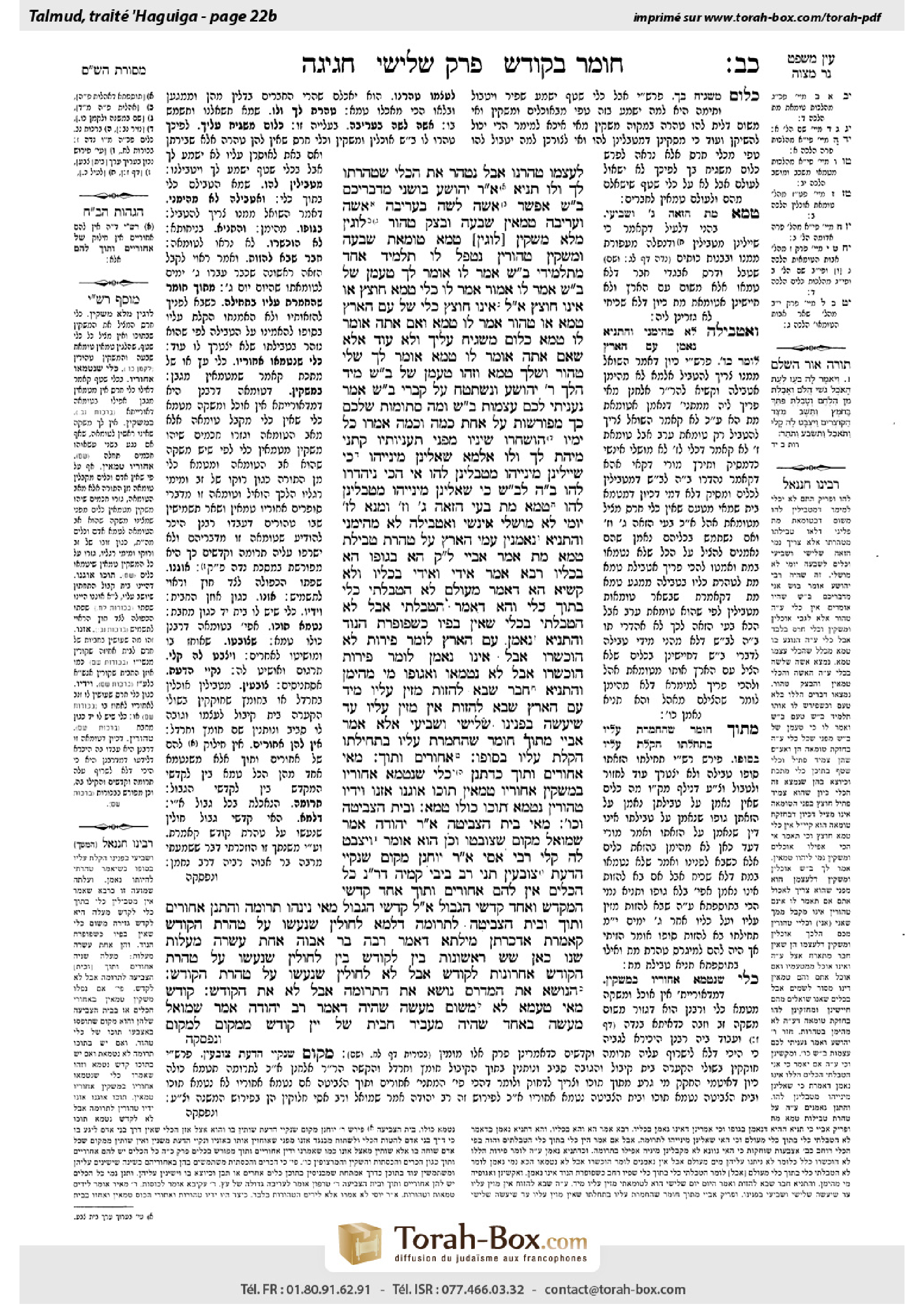
This page of Chagigah includes the Aramaic text, an English translation and an AI-generated French translation, alongside the scan above.
חגיגה כ״ב ב · Aramaic and Hebrew text
לְעַצְמוֹ טִהַרְנוּ.
אֲבָל נְטַהֵר אֶת הַכְּלִי, שֶׁטׇּהֳרָתוֹ לְךָ וָלוֹ?
תַּנְיָא, אָמַר רַבִּי יְהוֹשֻׁעַ: בּוֹשַׁנִי מִדִּבְרֵיכֶם, בֵּית שַׁמַּאי! אֶפְשָׁר אִשָּׁה לָשָׁה בַּעֲרֵיבָה — אִשָּׁה וַעֲרֵיבָה טְמֵאִין שִׁבְעָה, וּבָצֵק טָהוֹר? לוֹגִין מָלֵא מַשְׁקִין — לוֹגִין טָמֵא טוּמְאַת שִׁבְעָה, וּמַשְׁקִין טְהוֹרִין?!
נִטְפַּל לוֹ תַּלְמִיד אֶחָד מִתַּלְמִידֵי בֵּית שַׁמַּאי, אָמַר לוֹ: אוֹמַר לְךָ טַעְמָן שֶׁל בֵּית שַׁמַּאי. אָמַר לוֹ: אֱמוֹר. אָמַר לוֹ: כְּלִי טָמֵא — חוֹצֵץ אוֹ אֵינוֹ חוֹצֵץ? אָמַר לוֹ: אֵינוֹ חוֹצֵץ. כְּלִי שֶׁל עַם הָאָרֶץ — טָמֵא אוֹ טָהוֹר? אָמַר לוֹ: טָמֵא. וְאִם אַתָּה אוֹמֵר לוֹ ״טָמֵא״, כְּלוּם מַשְׁגִּיחַ עָלֶיךָ? וְלֹא עוֹד, אֶלָּא שֶׁאִם אַתָּה אוֹמֵר לוֹ ״טָמֵא״, אוֹמֵר לְךָ: ״שֶׁלִּי טָהוֹר וְשֶׁלְּךָ טָמֵא״.
וְזֶהוּ טַעְמָן שֶׁל בֵּית שַׁמַּאי.
מִיָּד הָלַךְ רַבִּי יְהוֹשֻׁעַ וְנִשְׁתַּטַּח עַל קִבְרֵי בֵּית שַׁמַּאי, אָמַר: נַעֲנֵיתִי לָכֶם עַצְמוֹת בֵּית שַׁמַּאי! וּמָה סְתוּמוֹת שֶׁלָּכֶם כָּךְ, מְפוֹרָשׁוֹת — עַל אַחַת כַּמָּה וְכַמָּה. אָמְרוּ: כׇּל יָמָיו הוּשְׁחֲרוּ שִׁינָּיו מִפְּנֵי תַּעֲנִיּוֹתָיו.
קָתָנֵי מִיהַת ״לְךָ וָלוֹ״, אַלְמָא שָׁאֲלִינַן מִינַּיְיהוּ! כִּי שָׁיְילִינַן מִינַּיְיהוּ מַטְבְּלִינַן לְהוּ.
אִי הָכִי, נַיהְדְּרוּ לְהוּ בֵּית הִלֵּל לְבֵית שַׁמַּאי: כִּי שָׁאֲלִינַן מִינַּיְיהוּ מַטְבְּלִינַן לְהוּ! טְמֵא מֵת בָּעֵי הַזָּאָה שְׁלִישִׁי וּשְׁבִיעִי, וּמָנָא לְשִׁבְעָה יוֹמֵי לָא מוֹשְׁלִי אִינָשֵׁי.
וְאַטְּבִילָה לָא מְהֵימְנִי? וְהָתַנְיָא: נֶאֱמָנִין עַמֵּי הָאָרֶץ עַל טׇהֳרַת טְבִילַת טְמֵא מֵת!
אָמַר אַבָּיֵי, לָא קַשְׁיָא: הָא בְּגוּפוֹ, הָא בְּכֵלָיו. רָבָא אָמַר: אִידֵּי וְאִידֵּי בְּכֵלָיו, וְלָא קַשְׁיָא: הָא דְּאָמַר ״מֵעוֹלָם לֹא הִטְבַּלְתִּי כְּלִי בְּתוֹךְ כְּלִי״, וְהָא דְּאָמַר ״הִטְבַּלְתִּי, אֲבָל לֹא הִטְבַּלְתִּי בִּכְלִי שֶׁאֵין בְּפִיו כִּשְׁפוֹפֶרֶת הַנּוֹד״.
וְהָתַנְיָא: נֶאֱמָן עַם הָאָרֶץ לוֹמַר פֵּירוֹת לֹא הוּכְשְׁרוּ, אֲבָל אֵינוֹ נֶאֱמָן לוֹמַר פֵּירוֹת הוּכְשְׁרוּ אֲבָל לֹא נִטְמְאוּ.
וְאַגּוּפוֹ מִי מְהֵימַן? וְהָתַנְיָא: חָבֵר שֶׁבָּא לְהַזּוֹת — מַזִּין עָלָיו מִיָּד, עַם הָאָרֶץ שֶׁבָּא לְהַזּוֹת — אֵין מַזִּין עָלָיו עַד שֶׁיַּעֲשֶׂה בְּפָנֵינוּ שְׁלִישִׁי וּשְׁבִיעִי!
אֶלָּא אָמַר אַבָּיֵי: מִתּוֹךְ חוֹמֶר שֶׁהֶחְמַרְתָּ עָלָיו בִּתְחִילָּתוֹ, הֵקַלְתָּ עָלָיו בְּסוֹפוֹ.
אֲחוֹרַיִם וָתוֹךְ. מַאי אֲחוֹרַיִם וָתוֹךְ?
כְּדִתְנַן: כְּלִי שֶׁנִּטְמָא אֲחוֹרָיו בְּמַשְׁקִין — אֲחוֹרָיו טְמֵאִין, תּוֹכוֹ, אוֹגְנוֹ, אׇזְנוֹ, וְיָדָיו — טְהוֹרִין. נִטְמָא תּוֹכוֹ — כּוּלּוֹ טָמֵא.
וּבֵית הַצְּבִיטָה וְכוּ׳. מַאי בֵּית הַצְּבִיטָה? אָמַר רַב יְהוּדָה אָמַר שְׁמוּאֵל: מָקוֹם שֶׁצּוֹבְטוֹ, וְכֵן הוּא אוֹמֵר: ״וַיִּצְבׇּט לָהּ קָלִי״. רַבִּי אַסִּי אָמַר רַבִּי יוֹחָנָן: מָקוֹם שֶׁנְּקִיֵּי הַדַּעַת צוֹבְעִין.
תָּנֵי רַב בִּיבִי קַמֵּיהּ דְּרַב נַחְמָן: כׇּל הַכֵּלִים אֵין לָהֶם אֲחוֹרַיִם וָתוֹךְ, אֶחָד קׇדְשֵׁי הַמִּקְדָּשׁ וְאֶחָד קׇדְשֵׁי הַגְּבוּל. אֲמַר לֵיהּ: קׇדְשֵׁי הַגְּבוּל מַאי נִינְהוּ — תְּרוּמָה, וְהָתְנַן: אֲחוֹרַיִם וָתוֹךְ וּבֵית הַצְּבִיטָה לִתְרוּמָה!
דִּלְמָא לְחוּלִּין שֶׁנַּעֲשׂוּ עַל טׇהֳרַת הַקּוֹדֶשׁ קָאָמְרַתְּ.
אַדְכַּרְתַּן מִילְּתָא דְּאָמַר רַבָּה בַּר אֲבוּהּ: אַחַת עֶשְׂרֵה מַעֲלוֹת שָׁנוּ כָּאן; שֵׁשׁ רִאשׁוֹנוֹת — בֵּין לַקּוֹדֶשׁ, בֵּין לְחוּלִּין שֶׁנַּעֲשׂוּ עַל טׇהֳרַת הַקּוֹדֶשׁ, אַחֲרוֹנוֹת — לַקּוֹדֶשׁ, אֲבָל לֹא לְחוּלִּין שֶׁנַּעֲשׂוּ עַל טׇהֳרַת הַקּוֹדֶשׁ.
הַנּוֹשֵׂא אֶת הַמִּדְרָס — נוֹשֵׂא אֶת הַתְּרוּמָה, אֲבָל לֹא אֶת הַקּוֹדֶשׁ. קוֹדֶשׁ, מַאי טַעְמָא לָא? מִשּׁוּם מַעֲשֶׂה שֶׁהָיָה. דְּאָמַר רַב יְהוּדָה אָמַר שְׁמוּאֵל: מַעֲשֶׂה בְּאֶחָד שֶׁהָיָה מַעֲבִיר חָבִית שֶׁל יֵין קוֹדֶשׁ מִמָּקוֹם לְמָקוֹם,
Chagigah 22b · English translation
we declared them pure for the am ha’aretz himself, not for ḥaverim, since ḥaverim in any event do not consider anything touched by an am ha’aretz to be pure. A ḥaver would therefore never relate to the food of an am ha’aretz as pure, and he would not use the earthenware vessels of an am ha’aretz for preparation of pure food, since an earthenware vessel cannot be purified through immersion. However, he might borrow a metal vessel, for instance, and purify it through immersion before using it for pure food.
But how can we purify a vessel of metal and other materials, whose purity would be relevant both for you and for him? A ḥaver may one day borrow a metal vessel from the am ha’aretz, and not realize that it was once inside an earthenware vessel in the same room as a corpse and as a result requires extensive purification from corpse contamination through the ashes of the red heifer, rather than mere immersion. Therefore, the am ha’aretz is informed that his vessels of metal and other materials have contracted impurity from the corpse, and must undergo the extensive purification process, and after this is done these vessels will now be fit for use of the ḥaver after mere immersion.
It is taught in a baraita with regard to this debate between Beit Shammai and Beit Hillel: Rabbi Yehoshua said: I am ashamed of your words, Beit Shammai, for they are illogical. Is it possible that there should be a corpse on the first floor, with an earthenware vessel blocking the opening to the second story, and a woman is standing upstairs kneading dough in a metal bowl, and the woman and the bowl are impure for seven days owing to the impurity of the corpse, while the dough inside the trough is pure? For that would be the result according to Beit Shammai, who distinguishes between food and earthenware vessels on the one hand and metal vessels on the other. Similarly: Is it possible that there is a metal pitcher [login] full of liquid in the second story, and the pitcher should be impure with impurity of seven days, while the liquids remain pure?
After Rabbi Yehoshua posed this question, one student from among the students of Beit Shammai approached him and said to him: I will tell you Beit Shammai’s reasoning. He said to him: Speak. He said to him: Does an impure vessel serve as a barrier to corpse contamination or does it not serve as a barrier? Rabbi Yehoshua said to him: It does not serve as a barrier. The student asked further: And is a vessel of an am ha’aretz pure or impure? He said to him: Impure. The student responded: And if you tell him that his vessel is impure, will he pay attention to you at all? Clearly he will not. What is more, if you say to him that it is impure, he will say to you: On the contrary, my vessel is pure and yours is impure.
And that is Beit Shammai’s reasoning: Food, drink, and earthenware vessels inside a sealed earthenware vessel remain pure, as, since they belong to an am ha’aretz, a ḥaver will not eat the food or borrow the earthenware vessel. Vessels of metal or similar materials may one day be borrowed by a ḥaver, however, and therefore Beit Shammai declared these to be impure.
Once he heard the logic behind Beit Shammai’s opinion, Rabbi Yehoshua immediately went and prostrated himself on the graves of Beit Shammai, i.e., the students and proponents of Shammai, and said: I humble myself before you, bones of Beit Shammai. If such clarity and wisdom is found in your rulings that you stated and left unexplained, all the more so must this be the case in your rulings when they were stated and explained. People said of Rabbi Yehoshua: Throughout his days his teeth darkened because of all his fasts that he undertook to atone for having spoken inappropriately of Beit Shammai.
The Gemara returns to its main point. In any event, this mishna teaches that the status of the vessels of an am ha’aretz is relevant both for you and for him. Apparently, then, we ḥaverim may borrow vessels from amei ha’aretz. The question therefore arises: Why are the Sages not concerned that amei ha’aretz may immerse vessels inside of other vessels in an inappropriate way, so that they will remain unpurified when borrowed by a ḥaver? The Gemara answers: For when we ḥaverim borrow vessels from them we immerse them before using them. It is therefore inconsequential to us if their vessels were not immersed properly beforehand.
The Gemara asks: If so, let Beit Hillel respond to Beit Shammai. They can respond as follows: When we borrow vessels from them we immerse them, and that is why we rule that vessels of metal or similar materials are pure. The Gemara explains: That dispute is referring to the impurity of a corpse. And that which becomes impure by proximity to a corpse requires sprinkling of the red heifer’s ashes on the third and seventh days of its purification, and people do not generally lend vessels for seven days. The solution the ḥaver implements of immersing vessels that he borrows from an am ha’aretz is effective only for other impurities, but not for the impurity imparted by a corpse.
The Gemara poses a question with regard to the halakha that a ḥaver must immerse vessels that he borrows from an am ha’aretz: But is it so that amei ha’aretz are not trusted with regard to immersion? Isn’t it taught in a baraita: Amei ha’aretz are trusted with regard to the purification process of immersion of that which has become impure by contact with a corpse? In addition to being sprinkled with purification water on the third and seventh days, a person or article that has been in contact with a corpse must also undergo immersion on the seventh day. An am ha’aretz is believed when he says that he has performed this immersion.
The Gemara presents two answers for this question. Abaye said one answer: This is not difficult. This baraita, which teaches that an am ha’aretz is trusted, is referring to the immersion of his body, whereas this teaching of the Gemara that amei ha’aretz are not trusted concerning immersion deals with his vessels. Rava said a different answer: Both this and that, both the baraita and the Gemara’s teaching, refer to the vessels of an am ha’aretz, and it is nevertheless not difficult. This baraita, which teaches that an am ha’aretz is trusted, is referring to an am ha’aretz who said: I never immersed one vessel inside another, which is a statement that we accept. And this teaching of the Gemara that amei ha’aretz are not trusted deals with one who said: I have immersed vessels inside of other vessels, but I did not immerse with a vessel whose mouth does not have the width of the tube of a wineskin. It is with regard to such details that an am ha’aretz cannot be trusted.
And so it was taught in a baraita to this effect: An am ha’aretz is trusted to say that produce has not been made susceptible to impurity, i.e., that it has never come into contact with water, but he is not trusted to say that the produce has been made susceptible to impurity but has not actually become impure. This baraita shows that amei ha’aretz are trusted concerning basic facts, but not concerning matters that require detailed knowledge and scrupulous care.
The Gemara poses a question with regard to Abaye’s opinion: And is an am ha’aretz really trusted concerning his body, when he claims to have immersed? Isn’t it taught in a baraita: Concerning a ḥaver who comes before those in charge of sprinkling water of purification to be sprinkled with that water, and claims that the requisite three days have passed since his contamination by a corpse, they may sprinkle upon him immediately. But concerning an am ha’aretz who comes before them and claims that three days have passed, they may not sprinkle upon him until he performs and counts in our presence the third day and the seventh day? This shows that an am ha’aretz is not trusted concerning the purity of his own body.
Rather, Abaye said, modifying his previous explanation: Because of the stringency that you applied to the am ha’aretz in his beginning, i.e., at the beginning of the purification process, by not allowing him to purify himself without first ensuring that he has not been in contact with a corpse for three days, you may be lenient with him in his end, in that he is trusted regarding having immersed at the end of the seven days, removing the impurity contracted through contact with a corpse.
§ The mishna teaches: The halakhot of the back of a vessel and its inside apply to vessels used for teruma, but not for sacrificial food. The Gemara asks: What is the meaning of: The back and its inside?
The Gemara explains. As we learned in a mishna (Keilim 25:6): A vessel whose back part, as opposed to its inside, was defiled by contact with impure liquid. Its back is impure, while its other parts, such as its inside, its rim, its ear-shaped handles, and its straight handles are pure. By Torah law, foods and liquids cannot impart ritual impurity to a vessel at all, but by rabbinic law liquids can. In order to clarify that it is only a rabbinic decree, they instituted that the impurity thereby imparted, if the liquid touched the outside of the vessel, should affect only the part touched by the liquid, but not its inside or the other parts of its outside. However, if its inside was defiled, even by impurity only according to rabbinic law, it is all impure. This halakha applies only to teruma, but regarding offerings, the defilement of any part of the vessel renders it all impure.
§ The mishna teaches: And its place for gripping. The Gemara asks: What is the meaning of: Place for gripping [beit hatzevita]? Rav Yehuda said that Shmuel said: It is the place where he grips the vessel in order to pass [tzovet] it, a kind of indentation used for grasping the vessel. And similarly it states: “And he pinched [vayitzbat] some parched corn for her” (Ruth 2:14), which means that he gave her a little of the corn. Therefore, the term is referring to a place on the vessel used to grasp it. Rabbi Asi said that Rabbi Yoḥanan said: It is the place that fastidious people use for dipping. A small receptacle for spices and the like would be attached to the sides of vessels for dipping one’s food.
Rav Beivai taught the following baraita before Rav Naḥman: No vessels have this difference between the back and inside, whether they are vessels used for consecrated foods of the Temple or those used for consecrated foods of outlying areas, i.e., outside the Temple. In these cases, if one of the parts of the vessel was defiled with impure liquids the entire vessel becomes impure. Rav Naḥman said to him: What are these consecrated foods of outlying areas mentioned in the baraita? This term is usually applied to teruma, but if so the baraita contradicts the mishna. For didn’t we learn in the mishna: The halakhot of the back of a vessel and its inside and its place for gripping apply to vessels used for teruma?
Rav Naḥman continued: Perhaps when you said the consecrated foods of outlying areas you were not referring to teruma, but rather you are speaking of non-sacred food prepared according to the standards of purity of sacrificial food, and you called them consecrated foods of outlying areas because this level of purity can be observed outside the Temple as well.
In the course of this discussion Rav Naḥman said to Rav Beivai: You have now reminded me of something that Rabba bar Avuh said concerning this issue: They taught eleven stringencies of sacrificial food here in the mishna. The first six apply both to sacrificial food and to non-sacred food prepared according to the standards of purity of sacrificial food, whereas the last five apply only to sacrificial foods but not to non-sacred food prepared according to the standards of purity of sacrificial food. Rabba bar Avuh’s statement therefore corroborates the interpretation of the baraita as dealing with non-sacred food prepared according to the standards of purity of sacrificial foods.
§ The mishna teaches: One who carries an object trodden by a zav may carry teruma at the same time, if he is careful that neither he nor the impure object come into contact with the teruma, but this may not be done with sacrificial food. The Gemara asks: Concerning sacrificial food, what is the reason that he may not carry it? As long as contact with the food is prevented, why should he not carry sacrificial food as well? The Gemara answers: This enactment was made due to an incident that occurred. As Rav Yehuda said that Shmuel said: There was once an incident involving someone who was transferring a barrel of sacrificial wine from one place to another,
Chagigah 22b · Traduction française (IA)
Nous avons déclaré ces vases purs pour l'am ha'aretz lui-même, pas pour les ḥaverim, car les ḥaverim, en tout cas, ne considèrent pas comme purs les choses touchées par un am ha'aretz. Un ḥaver ne considérerait donc jamais les aliments de l'am ha'aretz comme purs, et ne utiliserait pas les vases en terre de l'am ha'aretz pour la préparation d'aliments purs, car un vase en terre ne peut être purifié par l'immersion. Cependant, il pourrait emprunter un vase en métal, par exemple, et le purifier par l'immersion avant de l'utiliser pour des aliments purs.
Mais comment peut-on purifier un vase en métal et d'autres matériaux, dont la pureté est pertinente à la fois pour vous et pour lui ? Un ḥaver pourrait un jour emprunter un vase en métal à l'am ha'aretz, sans se rendre compte qu'il avait été à l'intérieur d'un vase en terre dans la même pièce qu'un cadavre, et en conséquence nécessitait une purification approfondie de la contamination du cadavre par les cendres du bouc rouge, et non simplement l'immersion. Ainsi, l'am ha'aretz est informé que ses vases en métal et d'autres matériaux ont contracté une impureté du cadavre, et doivent subir le processus de purification approfondi, et après cela, ces vases seront désormais propres à l'usage du ḥaver après une simple immersion.
Il est enseigné dans une baraïta concernant ce débat entre Beit Shammai et Beit Hillel : Rabbi Yehoshua dit : Je suis honteux de vos paroles, Beit Shammai, car elles sont absurdes. Est-il possible qu'il y ait un cadavre au premier étage, avec un vase en terre bloquant l'ouverture vers le deuxième étage, et une femme debout au-dessus, pétrissant la pâte dans un bol en métal, et la femme et le bol soient impurs pendant sept jours en raison de l'impureté du cadavre, tandis que la pâte à l'intérieur du bac soit pure ? Cela serait le résultat selon Beit Shammai, qui distingue entre les aliments et les vases en terre d'une part, et les vases en métal d'autre part. De même : Est-il possible qu'il y ait un bidon en métal plein de liquide au deuxième étage, et que le bidon devienne impur avec une impureté de sept jours, tandis que les liquides restent purs ?
Après que Rabbi Yehoshua ait posé cette question, un étudiant parmi les étudiants de Beit Shammai s'est approché de lui et lui a dit : Je vais te dire la raison de Beit Shammai. Il lui a dit : Parle. Il lui a dit : Un vase impur sert-il de barrière à la contamination du cadavre ou non ? Rabbi Yehoshua lui a dit : Il ne sert pas de barrière. L'étudiant a demandé ensuite : Et un vase de l'am ha'aretz est-il pur ou impur ? Il lui a dit : Impur. L'étudiant a répondu : Et si tu lui dis que son vase est impur, se souciera-t-il de toi du tout ? Évidemment non. De plus, si tu lui dis que c'est impur, il te dira : Au contraire, mon vase est pur et le tien est impur.
Et c'est la raison de Beit Shammai : Les aliments, les boissons et les vases en terre à l'intérieur d'un vase en terre scellé restent purs, car, puisque ceux-ci appartiennent à un am ha'aretz, un ḥaver ne mangera pas les aliments ni ne prêtera les vases en terre. Les vases en métal ou d'autres matériaux peuvent un jour être empruntés par un ḥaver, cependant, et par conséquent Beit Shammai a déclaré que ceux-ci sont impurs.
Une fois qu'il avait entendu la logique de l'opinion de Beit Shammai, Rabbi Yehoshua s'est immédiatement prosterné sur les tombes de Beit Shammai, c'est-à-dire les étudiants et les partisans de Shammai, et a dit : Je m'humilie devant vous, os de Beit Shammai. Si une clarté et une sagesse telles que celles que vous avez formulées et laissées sans explication sont trouvées dans vos décisions, à quel point plus encore doivent-elles être trouvées dans vos décisions lorsqu'elles ont été formulées et expliquées. On disait de Rabbi Yehoshua : Pendant ses jours, ses dents se sont assombries à cause de tous les jeûnes qu'il a entrepris pour s'attirer la miséricorde en raison de ses paroles inappropriées à l'égard de Beit Shammai.
La Guemara retourne à son point principal. En tout cas, cette mitsna enseigne que le statut des vases de l'am ha'aretz est pertinent à la fois pour vous et pour lui. Apparemment, alors, nous ḥaverim pouvons emprunter des vases à l'am ha'aretz. La question qui se pose donc est : Pourquoi les Sages ne sont-ils pas préoccupés par le fait que les am ha'aretz puissent immerger des vases les uns dans les autres de manière inappropriée, de sorte qu'ils restent impurs lorsqu'ils sont empruntés par un ḥaver ? La Guemara répond : Parce que lorsque nous ḥaverim empruntons des vases à eux, nous les immergeons avant de les utiliser. Il est donc inutile pour nous que leurs vases n'aient pas été immergés correctement auparavant.
La Guemara pose une question : Si tel est le cas, pourquoi Beit Hillel ne répond pas à Beit Shammai ? Ils pourraient répondre ainsi : Lorsque nous empruntons des vases à eux, nous les immergeons, et c'est pourquoi nous décrivons que les vases en métal ou en matériaux similaires sont purs. La Guemara explique : Ce débat concerne l'impureté d'un cadavre. Et ce qui devient impur par proximité avec un cadavre nécessite l'aspersion des cendres du bouc rouge le troisième et le septième jour de sa purification, et les gens ne prêtent généralement des vases que pendant sept jours. La solution que le ḥaver applique en immergeant les vases qu'il emprunte à un am ha'aretz est efficace uniquement pour d'autres impuretés, mais pas pour l'impureté transmise par un cadavre.
La Guemara pose une question concernant la halakha selon laquelle un ḥaver doit immerger les vases qu'il emprunte à un am ha'aretz : Mais est-ce que les am ha'aretz ne sont pas considérés comme fiables concernant l'immersion ? N'est-il pas enseigné dans une baraïta : Les am ha'aretz sont considérés comme fiables concernant le processus de purification par immersion des choses devenant impures par contact avec un cadavre ? En plus de l'asperge avec l'eau de purification le troisième et le septième jour, une personne ou un objet ayant été en contact avec un cadavre doit également subir l'immersion le septième jour. L'am ha'aretz est cru lorsqu'il dit qu'il a effectué cette immersion.
La Guemara présente deux réponses à cette question. Abaye dit une réponse : Ce n'est pas difficile. Cette baraïta, qui enseigne que l'am ha'aretz est digne de confiance, fait référence à l'immersion de son corps, tandis que cette enseignement de la Guemara, selon lequel les amei ha'aretz ne sont pas digne de confiance concernant l'immersion, concerne ses ustensiles. Rava dit une autre réponse : à la fois cette baraïta et l'enseignement de la Guemara concernent les ustensiles de l'am ha'aretz, et il n'est pas difficile. Cette baraïta, qui enseigne que l'am ha'aretz est digne de confiance, fait référence à un am ha'aretz qui dit : Je n'ai jamais immergé un ustensile dans un autre, ce qui est une déclaration que nous acceptons. Et cette enseignement de la Guemara, selon lequel les amei ha'aretz ne sont pas digne de confiance, concerne celui qui dit : J'ai immergé des ustensiles les uns dans les autres, mais je n'ai pas immergé avec un ustensile dont la bouche n'a pas la largeur du tube d'un vin de raisin. C'est à ce niveau de détails que l'am ha'aretz ne peut être digne de confiance.
Et ainsi, il a été enseigné dans une baraïta à cet effet : L'am ha'aretz est digne de confiance pour dire que les produits n'ont pas été rendus suspects à l'impureté, c'est-à-dire qu'ils n'ont jamais été en contact avec l'eau, mais il n'est pas digne de confiance pour dire que les produits ont été rendus suspects à l'impureté mais n'ont pas réellement devenu impurs. Cette baraïta montre que les amei ha'aretz sont digne de confiance concernant les faits de base, mais pas concernant les questions nécessitant une connaissance détaillée et une attention rigoureuse.
La Guemara pose une question concernant l'opinion d'Abaye : Et l'am ha'aretz est-il vraiment digne de confiance concernant son propre corps, lorsqu'il affirme avoir été immergé ? N'est-il pas enseigné dans une baraïta : Concernant un ḥaver qui vient avant ceux qui sont en charge de l'eau de purification pour être aspergé avec cet eau, et qui affirme que les trois jours requis depuis sa contamination par un cadavre ont passé, on peut asperger sur lui immédiatement. Mais concernant un am ha'aretz qui vient avant eux et affirme que les trois jours ont passé, on ne peut pas asperger sur lui avant qu'il ne réalise et compte devant nous le troisième jour et le septième jour ? Cela montre que l'am ha'aretz n'est pas digne de confiance concernant la pureté de son propre corps.
Plutôt, Abaye dit, modifiant son explication précédente : En raison de la stricte exigence que vous avez appliquée à l'am ha'aretz au début, c'est-à-dire au début du processus de purification, en ne permettant pas qu'il se purifie sans d'abord s'assurer qu'il n'a pas été en contact avec un cadavre pendant trois jours, vous pouvez être plus clément avec lui à la fin, en ce sens qu'il est digne de confiance concernant l'immersion à la fin des sept jours, éliminant l'impureté contractée par contact avec un cadavre.
§ La mitsva enseigne : Les halakhot du dos d'un ustensile et de son intérieur s'appliquent aux ustensiles utilisés pour la terouma, mais pas pour les aliments sacrés. La Guemara pose une question : Qu'entend-on par : le dos et son intérieur ?
La Guemara explique. Comme nous avons appris dans une mitsva (Keilim 25:6) : Un ustensile dont la partie arrière, contrairement à son intérieur, a été souillé par contact avec un liquide impur. Son dos est impur, tandis que ses autres parties, comme son intérieur, son bord, ses poignées en forme d'oreille et ses poignées droites, sont pures. Selon la Torah, les aliments et les liquides ne peuvent pas transmettre l'impureté rituelle à un ustensile du tout, mais selon la loi rabbinique les liquides peuvent. Afin de clarifier que c'est seulement une décision rabbinique, ils ont institué que l'impureté ainsi transmise, si le liquide a touché l'extérieur de l'ustensile, devrait affecter uniquement la partie touchée par le liquide, mais pas son intérieur ou les autres parties de son extérieur. Cependant, si son intérieur a été souillé, même selon la loi rabbinique, tout est impur. Cette halakha s'applique uniquement à la terouma, mais concernant les offrandes, la souillure de toute partie de l'ustensile rend l'ensemble impur.
§ La mitsva enseigne : Et son lieu de saisie. La Guemara pose une question : Qu'entend-on par : lieu de saisie [beit hatzevita] ? Rav Yehuda dit que Shmuel dit : C'est la place où l'on saisit l'ustensile afin de le faire passer [tzovet], une sorte de rebord utilisé pour saisir l'ustensile. De même, il est dit : « Et il saisit [vayitzbat] quelques grains de maïs pour elle » (Ruth 2:14), ce qui signifie qu'il lui a donné un peu de maïs. Ainsi, le terme fait référence à une partie de l'ustensile utilisée pour le saisir. Rabbi Asi dit que Rabbi Yoḥanan dit : C'est la place que les personnes soigneuses utilisent pour tremper. Un petit récipient pour des épices et ainsi de suite serait attaché aux côtés des ustensiles pour tremper son aliment.
Rav Beivai enseigna la suivante baraïta devant Rav Naḥman : Aucun ustensile n'a cette différence entre le dos et l'intérieur, qu'ils soient des ustensiles utilisés pour les aliments consacrés du Temple ou ceux utilisés pour les aliments consacrés des zones périphériques, c'est-à-dire en dehors du Temple. Dans ces cas, si l'une des parties de l'ustensile a été souillée par des liquides impurs, l'ensemble de l'ustensile devient impur. Rav Naḥman dit à lui : Quels sont ces aliments consacrés des zones périphériques mentionnés dans la baraïta ? Ce terme est généralement appliqué à la terouma, mais si c'est le cas, la baraïta contredit la halakha. N'avons-nous pas appris dans la mitsna : Les halakhot du dos d'un ustensile et de son intérieur et de son lieu de saisie s'appliquent aux ustensiles utilisés pour la terouma ?
Rav Naḥman continua : Peut-être que lorsque vous avez dit les aliments consacrés des zones périphériques, vous ne faisiez pas référence à la terouma, mais plutôt vous parliez d'aliments non sacrés préparés selon les normes de pureté des aliments sacrés, et vous les avez appelés aliments consacrés des zones périphériques parce que ce niveau de pureté peut être observé en dehors du Temple également.
Au cours de cette discussion, Rav Naḥman a dit à Rav Beivai : Vous m'avez maintenant rappelé quelque chose que Rabba bar Avuh a dit à propos de cette question : Ils ont enseigné onze stringences concernant la nourriture des sacrifices ici dans la Michna. Les six premières s'appliquent à la fois à la nourriture des sacrifices et à la nourriture non sacrée préparée selon les normes de pureté des aliments sacrés, tandis que les cinq dernières s'appliquent uniquement aux aliments sacrés et non à la nourriture non sacrée préparée selon les normes de pureté des aliments sacrés. L'assertion de Rabba bar Avuh corrobore donc l'interprétation de la baraïta selon laquelle elle traite de la nourriture non sacrée préparée selon les normes de pureté des aliments sacrés.
§ La Michna enseigne : Celui qui transporte un objet foulé par un zav peut transporter la terouma en même temps, à condition qu'il prenne soin que ni lui ni l'objet impur ne soient en contact avec la terouma, mais cela ne peut être fait avec la nourriture sacrée. La Guemara demande : Concernant la nourriture sacrée, quelle est la raison pour laquelle il ne peut pas la transporter ? Tant que le contact avec la nourriture est évité, pourquoi ne pourrait-il pas transporter la nourriture sacrée également ? La Guemara répond : Cette ordonnance a été instituée en raison d'un incident qui s'est produit. Comme Rav Yehuda a dit que Shmuel a dit : Il y avait un jour un incident concernant quelqu'un qui transportait une barrique de vin sacré d'un lieu à un autre,
Traduction française générée par IA à partir de l’édition anglaise de Sefaria. Vérifie toujours un passage avec le texte source.
Text from Sefaria: William Davidson Edition - Vocalized Aramaic (CC BY NC); William Davidson Edition - English (CC BY NC).