Chagigah 23a: Talmud study for Daf Yomi
Study the Talmud for Daf Yomi with scanned pages, Hebrew text, English translations from Sefaria and AI-generated French translations.
Passage selection and English or AI-generated French translation are available where the scan has annotations. Daf Study is independent of Torah-Box and Sefaria.
Browse Chagigah · חגיגה · All tractatesChagigah 23a text and translations
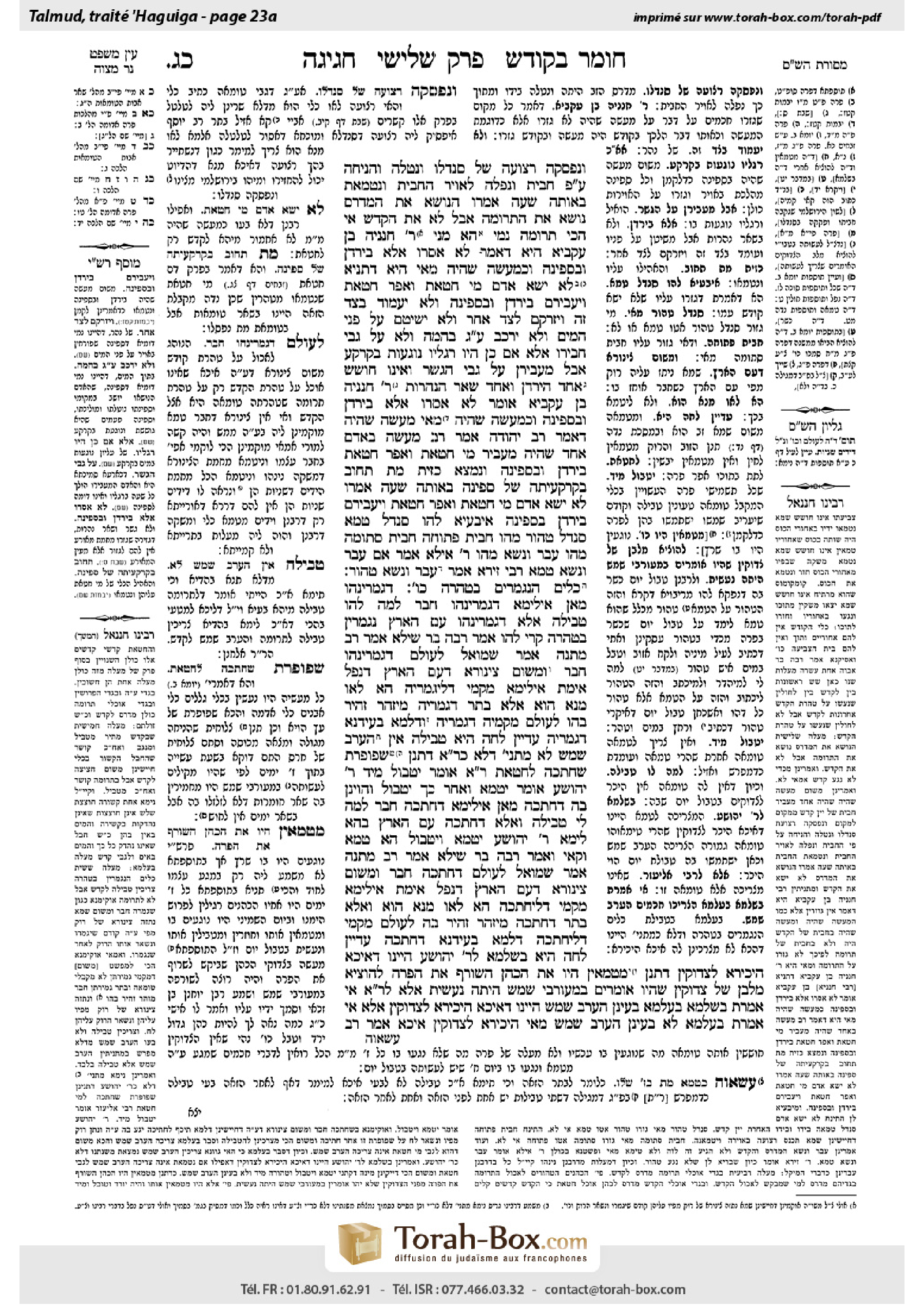
This page of Chagigah includes the Aramaic text, an English translation and an AI-generated French translation, alongside the scan above.
חגיגה כ״ג א · Aramaic and Hebrew text
וְנִפְסְקָה רְצוּעָה שֶׁל סַנְדָּלוֹ, וּנְטָלָהּ וְהִנִּיחָהּ עַל פִּי חָבִית, וְנָפְלָה לַאֲוִיר הֶחָבִית, וְנִטְמֵאת. בְּאוֹתָהּ שָׁעָה אָמְרוּ: הַנּוֹשֵׂא אֶת הַמִּדְרָס — נוֹשֵׂא אֶת הַתְּרוּמָה, אֲבָל לֹא אֶת הַקֹּדֶשׁ.
אִי הָכִי, תְּרוּמָה נָמֵי! הָא מַנִּי — רַבִּי חֲנַנְיָה בֶּן עֲקַבְיָא הִיא, דְּאָמַר: לֹא אָסְרוּ אֶלָּא בַּיַּרְדֵּן וּבִסְפִינָה, וּכְמַעֲשֶׂה שֶׁהָיָה.
מַאי הִיא? דְּתַנְיָא: לֹא יִשָּׂא אָדָם מֵי חַטָּאת וְאֵפֶר חַטָּאת וְיַעֲבִירֵם בַּיַּרְדֵּן וּבִסְפִינָה, וְלֹא יַעֲמוֹד בְּצַד זֶה וְיִזְרְקֵם לְצַד אַחֵר, וְלֹא יְשִׁיטֵם עַל פְּנֵי הַמַּיִם, וְלֹא יִרְכַּב עַל גַּבֵּי בְּהֵמָה, וְלֹא עַל גַּבֵּי חֲבֵירוֹ, אֶלָּא אִם כֵּן הָיוּ רַגְלָיו נוֹגְעוֹת בַּקַּרְקַע. אֲבָל מַעֲבִירָן עַל גַּבֵּי הַגֶּשֶׁר וְאֵינוֹ חוֹשֵׁשׁ; אֶחָד הַיַּרְדֵּן וְאֶחָד שְׁאָר הַנְּהָרוֹת. רַבִּי חֲנַנְיָה בֶּן עֲקַבְיָא אוֹמֵר: לֹא אָסְרוּ אֶלָּא בַּיַּרְדֵּן וּבִסְפִינָה, וּכְמַעֲשֶׂה שֶׁהָיָה.
מַאי מַעֲשֶׂה שֶׁהָיָה? דְּאָמַר רַב יְהוּדָה אָמַר רַב: מַעֲשֶׂה בְּאָדָם אֶחָד שֶׁהָיָה מַעֲבִיר מֵי חַטָּאת וְאֵפֶר חַטָּאת בַּיַּרְדֵּן וּבִסְפִינָה וְנִמְצָא כְּזַיִת מֵת תָּחוּב בְּקַרְקָעִיתָהּ שֶׁל סְפִינָה. בְּאוֹתָהּ שָׁעָה אָמְרוּ: לֹא יִשָּׂא אָדָם מֵי חַטָּאת וְאֵפֶר חַטָּאת וְיַעֲבִירֵם בַּיַּרְדֵּן בִּסְפִינָה.
אִיבַּעְיָא לְהוּ: סַנְדָּל טָמֵא, סַנְדָּל טָהוֹר מַהוּ? חָבִית פְּתוּחָה, חָבִית סְתוּמָה מַהוּ? עָבַר וְנָשָׂא מַהוּ?
רַבִּי אִילָא אָמַר: אִם עָבַר וְנָשָׂא — טָמֵא. רַבִּי זֵירָא אָמַר: עָבַר וְנָשָׂא — טָהוֹר.
כֵּלִים הַנִּגְמָרִים בְּטָהֳרָה כּוּ׳. דְּגַמְרִינְהוּ מַאן? אִילֵימָא דְּגַמְרִינְהוּ חָבֵר, לְמָה לְהוּ טְבִילָה?
אֶלָּא דְּגַמְרִינְהוּ עַם הָאָרֶץ — נִגְמָרִין בְּטׇהֳרָה קָרֵי לְהוּ? אָמַר רַבָּה בַּר שֵׁילָא אָמַר רַב מַתְנָה אָמַר שְׁמוּאֵל: לְעוֹלָם דְּגַמְרִינְהוּ חָבֵר, וּמִשּׁוּם צִינּוֹרָא דְּעַם הָאָרֶץ.
דִּנְפַל אֵימַת? אִילֵּימָא מִקַּמֵּי דְּלִיגְמְרֵיהּ — הָא לָאו מָנָא הוּא. אֶלָּא בָּתַר דְּגַמְרֵיהּ — מִיזְהָר זְהִיר בֵּהּו! לְעוֹלָם מִקַּמֵּיהּ דְּגַמְרֵיהּ, וְדִלְמָא בְּעִידָּנָא דְּגַמְרֵיהּ עֲדַיִין לַחָה הִיא.
טְבִילָה אִין, הֶעֱרֵב שֶׁמֶשׁ לָא.
מַתְנִיתִין דְּלָא כְּרַבִּי אֱלִיעֶזֶר, דִּתְנַן: שְׁפוֹפֶרֶת שֶׁחֲתָכָהּ לְחַטָּאת, רַבִּי אֱלִיעֶזֶר אוֹמֵר: יִטְבּוֹל מִיָּד. רַבִּי יְהוֹשֻׁעַ אוֹמֵר: יְטַמֵּא וְאַחַר כָּךְ יִטְבּוֹל. וְהָוֵינַן בַּהּ: דְּחַתְכַהּ מַאן? אִילֵימָא דְּחַתְכַהּ חָבֵר — לְמָה לִי טְבִילָה? וְאֶלָּא דְּחַתְכַהּ עַם הָאָרֶץ, בְּהָא לֵימָא רַבִּי יְהוֹשֻׁעַ יְטַמֵּא וְיִטְבּוֹל? הָא טָמֵא וְקָאֵי!
וְאָמַר רַבָּה בַּר שֵׁילָא אָמַר רַב מַתְנָה אָמַר שְׁמוּאֵל: לְעוֹלָם דְּחַתְכַהּ חָבֵר, וּמִשּׁוּם צִינּוֹרָא דְּעַם הָאָרֶץ. דִּנְפַל אֵימַת? אִילֵּימָא מִקַּמֵּי דְּלִיחְתְּכַהּ — הָא לָאו מָנָא הוּא, וְאֶלָּא בָּתַר דְּחַתְכַהּ — מִיזְהָר זְהִיר בַּהּ! לְעוֹלָם מִקַּמֵּי דְּלִיחְתְּכַהּ, דִּלְמָא בְּעִידָּנָא דְּחַתְכַהּ עֲדַיִין לַחָה הִיא.
בִּשְׁלָמָא לְרַבִּי יְהוֹשֻׁעַ, הַיְינוּ דְּאִיכָּא הֶיכֵּירָא לְצַדּוּקִין.
דִּתְנַן: מְטַמְּאִין הָיוּ אֶת הַכֹּהֵן הַשּׂוֹרֵף אֶת הַפָּרָה, לְהוֹצִיא מִלִּבָּן שֶׁל צַדּוּקִין. שֶׁהָיוּ אוֹמְרִים: בִּמְעוֹרְבֵי שֶׁמֶשׁ הָיְתָה נַעֲשֵׂית.
אֶלָּא לְרַבִּי אֱלִיעֶזֶר, אִי אָמְרַתְּ בִּשְׁלָמָא בְּעָלְמָא בָּעֵינַן הֶעֱרֵב שֶׁמֶשׁ, הַיְינוּ דְּאִיכָּא הֶיכֵּירָא לְצַדּוּקִין. אֶלָּא אִי אָמְרַתְּ בְּעָלְמָא לָא בָּעֵינַן הֶעֱרֵב שֶׁמֶשׁ — מַאי הֶיכֵּירָא לְצַדּוּקִין אִיכָּא?
אָמַר רַב:
Chagigah 23a · English translation
and the strap of his sandal, which had been rendered ritually impure by being trodden by a zav, broke off, and he picked up the strap and placed it on top of the mouth of the barrel, and it fell into the airspace of the barrel, thereby rendering the entire barrel impure. At that time the Sages said and issued a permanent decree that one who carries an object that is impure by having been trodden by a zav may carry teruma at the same time, but not sacrificial food.
The Gemara asks: If so, if they prohibited doing so due to that incident, they should have made the same decree with regard to teruma also, because if the same incident would occur with teruma it would defile the teruma as well. The Gemara answers: In accordance with whose opinion is this stated? It is that of Rabbi Ḥananya ben Akavya, who said concerning a similar issue: They prohibited it only in the Jordan River, and only in a boat, in a situation similar to the incident that occurred, which triggered the enactment. In his opinion, whenever the Sages enacted a decree prohibiting something due to a particular incident, they did not extend the prohibition to related cases, but only to the same set of circumstances that pertained to that specific incident.
The Gemara presents the background to Rabbi Ḥananya ben Akavya’s statement: What is that enactment that Rabbi Ḥananya ben Akavya was referring to? As it is taught in a baraita: A person may not carry the water of purification and the ashes of purification and transport them across the Jordan River, and this is if he is on a boat. Nor may he stand on one side of the river and throw them to the other side. Nor may he float them across the river. Nor may he ford the river riding on an animal or on his friend and carrying the water or ashes of purification, unless his feet are touching the ground as he fords the river. But he may transfer them across the river over a bridge without concern about transferring them improperly. This decree applies both to the Jordan and to other rivers. Rabbi Ḥananya ben Akavya says: The Sages prohibited these acts only in the Jordan River, and only if he transports them in a boat, and in circumstances exactly like those of the incident that occurred.
The Gemara inquires: What was the incident that occurred? Rav Yehuda said that Rav said: There was once an incident involving a person who was transferring water of purification and ashes of purification in the Jordan, and he was on a boat, and an olive-bulk from a corpse was discovered stuck in the floor of the boat, over which the water of purification had passed, thereby rendering them impure and invalid. At that time the Sages said: A person may not carry water of purification and ashes of purification and transport them across the Jordan, and this is if he is on a boat. Just as in that case, Rabbi Ḥananya ben Akavya stated that the decree was limited to the specific circumstances of the original incident, here too, he would say that since the original incident involved sacrificial food and not teruma the Sages did not apply the decree to teruma.
Several dilemmas were raised before the scholars: It is clear that this halakha, like the incident itself, applies to an object that has actually contracted impurity by being trodden by a zav, such as an impure sandal. But if it is a pure sandal, what is the halakha? Is the decree so far-reaching as to include a prohibition against carrying even a pure sandal together with sacrificial food? Similarly, the halakha certainly applies to an open barrel, where there is a danger that the sandal may enter the airspace of the barrel, as in the original incident, but if it was a closed barrel, where there is no such danger, what is the halakha? Does the decree apply in this case as well? Another question: If someone transgressed this decree and carried an impure sandal together with sacrificial food, what is the halakha? Did the Sages decree that the sacrificial food would become defiled because their decree was transgressed or not?
The Gemara presents a conclusion for the last dilemma. Rabbi Ila said: If one transgressed and carried sacrificial food together with an impure sandal, it is indeed rendered impure. Rabbi Zeira said: If he transgressed and carried sacrificial food in this manner, it is still pure.
§ The mishna states: Vessels that were fashioned and completed in purity require immersion for sacrificial food but not for teruma. The Gemara asks: Who completed the work of these vessels? If we say that it was a ḥaver, an individual who is meticulous about the halakhot of ritual purity, who completed them, why should they require immersion, given that he is meticulous about the halakhot of purity?
Rather, it must mean that an am ha’aretz completed them. But can one call these vessels completed in purity? The very touch of an am ha’aretz renders them impure. Rabba bar Sheila said that Rav Mattana said that Shmuel said: Actually, the mishna is dealing with vessels that a ḥaver completed, and the Sages declared them impure for sacrificial food due to a concern that the spittle of an am ha’aretz might have fallen on them, which would render them impure if he were a zav.
The Gemara asks: When did this hypothetical spittle fall on the vessel? If we say it was before he completed the vessel, in that case it is not yet a vessel, and therefore cannot contract impurity at that stage at all. Rather, it must have sprayed onto the vessel after he completed it. But at that point, since he is a ḥaver, he is careful about it. He would ensure that no spittle would fall on it, so there is no danger that it might have become defiled. The Gemara responds: Actually, we must explain that the spittle fell before he completed it, when the ḥaver was not yet guarding it against impurity, and the Sages were concerned that perhaps at the moment when he completed the vessel the spittle was still moist, and thus still capable of defiling the finished vessel, for the continued presence of the spittle on the vessel might have escaped the attention of the ḥaver craftsman.
The Gemara comments: The mishna states that the vessel requires immersion, implying: Immersion, yes, but the setting of the sun after immersion, not, i.e., it is considered pure immediately after immersion, even though generally the purification engendered by immersion does not take effect until sunset.
The Gemara asks: If so, the mishna is not in accordance with the opinion of Rabbi Eliezer. As we learned in a mishna (Para 5:4): Regarding a tube of reed, which one cut for storing ashes of purification, Rabbi Eliezer says: He should immerse it immediately; Rabbi Yehoshua says: He should first render it impure by touching it to an actual source of impurity and only after that immerse it. And we discussed the mishna’s case, asking: Who cut this tube? If we say a ḥaver cut it, why do I need immersion? The ḥaver prepared it with the strictest adherence to the halakhot of purity. Rather, it must be that an am ha’aretz cut it. But in that case, would Rabbi Yehoshua say that he should first render it impure and only then immerse it? Isn’t it already impure, due to the handling of the am ha’aretz?
And in response to this question, Rabba bar Sheila said that Rav Mattana said that Shmuel said: Actually, the case is that a ḥaver cut it, and the reason it requires immersion is because the Sages were concerned that the spittle of an am ha’aretz might have touched it. The Gemara asks: When did this hypothetical spittle fall on the tube? If we say it was before he cut the tube, in that case it is not yet a vessel and therefore cannot contract impurity at that stage. Rather, it must have sprayed onto the vessel after he completed it. But at that point, since he is a ḥaver, he is careful about it and would ensure that no spittle would fall on it, so there is no danger that it might have become impure. The Gemara responds: Actually we must explain that the spittle fell before he cut it, and the Sages were concerned that perhaps at the moment when he cut the tube the spittle was still moist, and thus still capable of rendering the finished tube impure.
The Gemara continues: Granted, according to Rabbi Yehoshua it is found that there is an act of recognition performed in opposition to the Sadducees, in order to demonstrate that the Sages do not take their opinions into account.
As we learned in a mishna (Para 3:7): They would render impure the priest who burns the red heifer, in order to counter the opinion of the Sadducees, who used to say: The ritual of the red heifer was to be performed by those who had experienced sunset after their immersion. The Sadducee opinion was that all those involved in the preparation of the red heifer must be completely pure, having undergone immersion as well as having waited until after sunset, when the purification takes full effect. The Sages, however, maintain that the red heifer may be prepared by people immediately after immersion, without waiting for sunset. In order to clearly demonstrate their rejection of the Sadducee opinion they would deliberately defile the people involved with preparing the red heifer and then immerse them. It is for this reason as well that Rabbi Yehoshua ruled that the tube must be rendered impure before it is immersed.
But according to Rabbi Eliezer, granted, if you say that generally, the setting of the sun is required after a vessel is completed, it is found that there is some act of recognition in opposition to the Sadducees, as according to him, the tube used for the red heifer ashes, which should normally have required the setting of the sun, is used without waiting for sunset. But if you say that generally the setting of the sun is not required to remove the impurity caused by the touch of an am ha’aretz, and immersion alone is sufficient, what act of recognition in opposition to the Sadducees is there here? It must be, therefore, that Rabbi Eliezer requires the setting of the sun for purification from the impurity imparted by an am ha’aretz. Therefore, the mishna, which implies that immersion alone is sufficient, does not accord with Rabbi Eliezer’s opinion.
Rav said: Indeed, Rabbi Eliezer does not require the setting of the sun for vessels that have been completed in purity, but there is nevertheless a demonstrative sign that the opinion of the Sadducees is rejected,
Chagigah 23a · Traduction française (IA)
et la lanière de ses sandales, qui avait été rendue impure par avoir été foulée par un zav, s'est détachée, et il a ramassé la lanière et l'a placée sur la bouche du tonneau, et elle est tombée dans l'espace aérien du tonneau, ce qui a rendu le tout impur. À ce moment-là, les Sages ont dit et émis un décret permanent selon lequel celui qui transporte un objet impur, ayant été foulé par un zav, peut transporter la terouma en même temps, mais pas les aliments sacrés.
La Guemara pose la question : Si c'est ainsi, si ils ont interdit cela en raison de cet incident, ils auraient dû aussi établir le même décret concernant la terouma, car si l'incident s'était produit avec la terouma, cela aurait rendu la terouma impure également. La Guemara répond : Selon quel avis est-ce dit ? C'est celui de Rabbi Ḥananya ben Akavya, qui a dit concernant un cas similaire : Ils l'ont interdit uniquement dans le Jourdain, et uniquement dans un bateau, dans un cas similaire à l'incident qui s'est produit, qui a déclenché l'établissement de ce décret. À son avis, chaque fois que les Sages ont établi un décret interdisant quelque chose en raison d'un incident particulier, ils n'ont pas étendu l'interdiction aux cas liés, mais uniquement aux mêmes circonstances qui concernaient cet incident spécifique.
La Guemara présente le contexte de l'affirmation de Rabbi Ḥananya ben Akavya : Quel est ce décret auquel Rabbi Ḥananya ben Akavya faisait référence ? Comme il est enseigné dans une baraïta : Une personne ne doit pas transporter l'eau de purification et les cendres de purification et les transporter au-delà du Jourdain, et cela est vrai si elle est sur un bateau. Ni ne doit-elle se tenir d'un côté du fleuve et jeter ces choses de l'autre côté. Ni ne doit-elle les faire flotter à travers le fleuve. Ni ne doit-elle traverser le fleuve montée sur un animal ou sur son ami et transporter l'eau ou les cendres de purification, sauf si ses pieds touchent le sol lorsqu'elle traverse le fleuve. Mais elle peut les transporter à travers le fleuve sur un pont sans craindre de les transporter de manière incorrecte. Ce décret s'applique aussi bien au Jourdain qu'à d'autres fleuves. Rabbi Ḥananya ben Akavya dit : Les Sages ont interdit ces actes uniquement dans le Jourdain, et uniquement si l'on les transporte en bateau, et dans des circonstances exactement comme celles de l'incident qui s'est produit.
La Guemara pose la question : Quel était l'incident qui s'est produit ? Rav Yehuda a dit que Rav a dit : Il y avait un incident concernant une personne qui transportait l'eau de purification et les cendres de purification dans le Jourdain, et elle était sur un bateau, et un morceau d'olive provenant d'un cadavre a été découvert collé au fond du bateau, sur lequel l'eau de purification avait passé, ce qui a rendu ces choses impures et inutiles. À ce moment-là, les Sages ont dit : Une personne ne doit pas transporter l'eau de purification et les cendres de purification et les transporter au-delà du Jourdain, et cela est vrai si elle est sur un bateau. Tout comme dans ce cas, Rabbi Ḥananya ben Akavya a dit que le décret était limité aux circonstances spécifiques de l'incident original, ici aussi, il dirait que puisque l'incident original concernait les aliments sacrés et non la terouma, les Sages n'ont pas appliqué ce décret à la terouma.
Plusieurs dilemmes ont été soulevés devant les savants : Il est clair que cette halakha, comme l'incident lui-même, s'applique à un objet qui a effectivement contracté l'impureté en ayant été foulé par un zav, tel qu'une sandale impure. Mais si c'est une sandale pure, quelle est la halakha ? Le décret est-il si vaste qu'il inclut une interdiction de transporter même une sandale pure avec les aliments sacrés ? De même, la halakha s'applique certainement à un tonneau ouvert, où il y a un danger que la sandale entre dans l'espace aérien du tonneau, comme dans l'incident original, mais si c'était un tonneau fermé, où il n'y a pas de tel danger, quelle est la halakha ? Le décret s'applique-t-il dans ce cas également ? Une autre question : Si quelqu'un a transgressé ce décret et a transporté une sandale impure avec les aliments sacrés, quelle est la halakha ? Les Sages ont-ils décrété que les aliments sacrés deviendraient impurs en raison de la transgression de ce décret ou non ?
La Guemara présente une conclusion pour ce dernier dilemme. Rabbi Ila a dit : Si l'on a transgressé et transporté les aliments sacrés avec une sandale impure, ils sont effectivement rendus impurs. Rabbi Zeira a dit : Si l'on a transgressé et transporté les aliments sacrés ainsi, ils restent purs.
§ La michna dit : Les récipients qui ont été façonnés et achevés dans la pureté nécessitent une immersion pour les aliments sacrés mais pas pour la terouma. La Guemara pose la question : Qui a achevé le travail de ces récipients ? Si nous disons qu'il s'agissait d'un ḥaver, une personne soigneuse des halakhot de pureté, qui les a achevés, pourquoi devraient-ils nécessiter une immersion, étant donné qu'il est soigneux des halakhot de pureté ?
Plutôt, cela doit signifier qu'un am ha'aretz les a achevés. Mais peut-on appeler ces récipients achevés dans la pureté ? Le simple contact d'un am ha'aretz les rend impurs. Rabba bar Sheila a dit que Rav Mattana a dit que Shmuel a dit : En réalité, la michna traite de récipients que le ḥaver a achevés, et les Sages les ont déclarés impurs pour les aliments sacrés en raison d'une crainte que la salive d'un am ha'aretz puisse avoir été sur eux, ce qui les rendrait impurs si celui-ci était un zav.
La Guemara pose la question : Quand cette salive hypothétique est-elle tombée sur le récipient ? Si nous disons qu'elle est tombée avant qu'il ne l'acheve, dans ce cas il n'est pas encore un récipient, et donc ne peut pas contracter l'impureté à cette étape. Plutôt, elle doit avoir été projetée sur le récipient après qu'il l'ait achevé. Mais à ce moment-là, puisqu'il est un ḥaver, il est prudent à cet égard. Il veillerait à ce que la salive ne tombe pas sur lui, donc il n'y a pas de danger qu'il devienne impur. La Guemara répond : En réalité, nous devons expliquer que la salive est tombée avant qu'il ne l'acheve, lorsque le ḥaver n'était pas encore vigilant contre l'impureté, et les Sages étaient préoccupés par le fait que peut-être, au moment où il a achevé le récipient, la salive était encore humide, et donc capable de rendre le récipient achevé impur, car la présence prolongée de la salive sur le récipient pourrait avoir échappé à l'attention du fabricant ḥaver.
La Guemara commente : La Michna affirme que le récipient nécessite une immersion, ce qui implique : L'immersion, oui, mais la mise du soleil après l'immersion, non, c'est-à-dire qu'il est considéré comme pur immédiatement après l'immersion, même si généralement la purification engendrée par l'immersion ne prend effet qu'après le coucher du soleil.
La Guemara pose la question : Si c'est ainsi, la Michna ne correspond pas à l'opinion de Rabbi Eliezer. Comme nous l'avons appris dans une Michna (Para 5:4) : Concernant un tube de roseau, que l'on a coupé pour stocker les cendres de purification, Rabbi Eliezer dit : Il doit être immergé immédiatement ; Rabbi Yéhoshua dit : Il doit d'abord être rendu impur en le touchant à une source réelle d'impureté et seulement après cela l'immerger. Et nous avons discuté du cas de la Michna, en demandant : Qui a coupé ce tube ? Si nous disons qu'un ḥaver l'a coupé, pourquoi ai-je besoin d'immersion ? Le ḥaver l'a préparé avec la stricte adhésion aux halakhot de pureté. Plutôt, il doit être que c'est un am ha'aretz qui l'a coupé. Mais dans ce cas, Rabbi Yéhoshua dirait-il qu'il doit d'abord être rendu impur et seulement ensuite immergé ? N'est-il pas déjà impur, en raison du maniement de l'am ha'aretz ?
Et en réponse à cette question, Rabba bar Sheila dit que Rav Mattana a dit que Shmuel a dit : En réalité, le cas est que c'est un ḥaver qui l'a coupé, et la raison pour laquelle il nécessite une immersion est que les Sages avaient peur que la salive d'un am ha'aretz ait touché le tube. La Guemara pose la question : Quand cette salive hypothétique est-elle tombée sur le tube ? Si nous disons qu'elle était avant qu'il ne le coupe, dans ce cas il n'est pas encore un récipient et donc ne peut pas contracter de l'impureté à cette étape. Plutôt, il doit avoir été projeté sur le récipient après qu'il l'ait terminé. Mais à ce moment-là, puisqu'il est un ḥaver, il est prudent à son égard et veillerait à ce que la salive ne tombe pas dessus, donc il n'y a pas de danger qu'il devienne impur. La Guemara répond : En réalité, nous devons expliquer que la salive est tombée avant qu'il ne le coupe, et les Sages avaient peur que peut-être au moment où il a coupé le tube, la salive était encore humide, et donc encore capable de rendre le tube fini impur.
La Guemara continue : D'accord, selon Rabbi Yéhoshua, on trouve qu'il y a un acte de reconnaissance en opposition aux Sadducéens, afin de démontrer que les Sages ne tiennent pas compte de leurs opinions.
Comme nous l'avons appris dans une Michna (Para 3:7) : Ils rendaient impurs le prêtre qui brûlait la vache rouge, afin de contredire l'opinion des Sadducéens, qui disaient que la cérémonie de la vache rouge devait être accomplie par ceux qui avaient connu le coucher du soleil après leur immersion. L'opinion des Sadducéens était que toutes les personnes impliquées dans la préparation de la vache rouge devaient être complètement purs, ayant subi une immersion ainsi que l'attente jusqu'après le coucher du soleil, moment où la purification prend pleinement effet. Les Sages, en revanche, maintenaient que la vache rouge pouvait être préparée par des personnes immédiatement après l'immersion, sans attendre le coucher du soleil. Afin de démontrer clairement leur rejet de l'opinion des Sadducéens, ils rendaient délibérément impurs les personnes impliquées dans la préparation de la vache rouge et puis les immergeaient. C'est pour cette raison également que Rabbi Yéhoshua a décidé que le tube devait être rendu impur avant d'être immergé.
Mais selon Rabbi Eliezer, d'accord, si vous dites que généralement, le coucher du soleil est requis après que le récipient est terminé, on trouve qu'il y a un acte de reconnaissance en opposition aux Sadducéens, car selon lui, le tube utilisé pour les cendres de la vache rouge, qui devrait normalement nécessiter le coucher du soleil, est utilisé sans attendre le coucher du soleil. Mais si vous dites que généralement le coucher du soleil n'est pas requis pour éliminer l'impureté causée par le toucher d'un am ha'aretz, et que l'immersion seule suffit, quel acte de reconnaissance en opposition aux Sadducéens y a-t-il ici ? Il faut donc que Rabbi Eliezer exige le coucher du soleil pour la purification de l'impureté causée par un am ha'aretz. Ainsi, la Michna, qui implique que l'immersion seule suffit, ne correspond pas à l'opinion de Rabbi Eliezer.
Rav dit : En effet, Rabbi Eliezer ne requiert pas le coucher du soleil pour les récipients qui ont été achevés dans la pureté, mais il y a tout de même un signe démonstratif que l'opinion des Sadducéens est rejetée,
Traduction française générée par IA à partir de l’édition anglaise de Sefaria. Vérifie toujours un passage avec le texte source.
Text from Sefaria: William Davidson Edition - Vocalized Aramaic (CC BY NC); William Davidson Edition - English (CC BY NC).