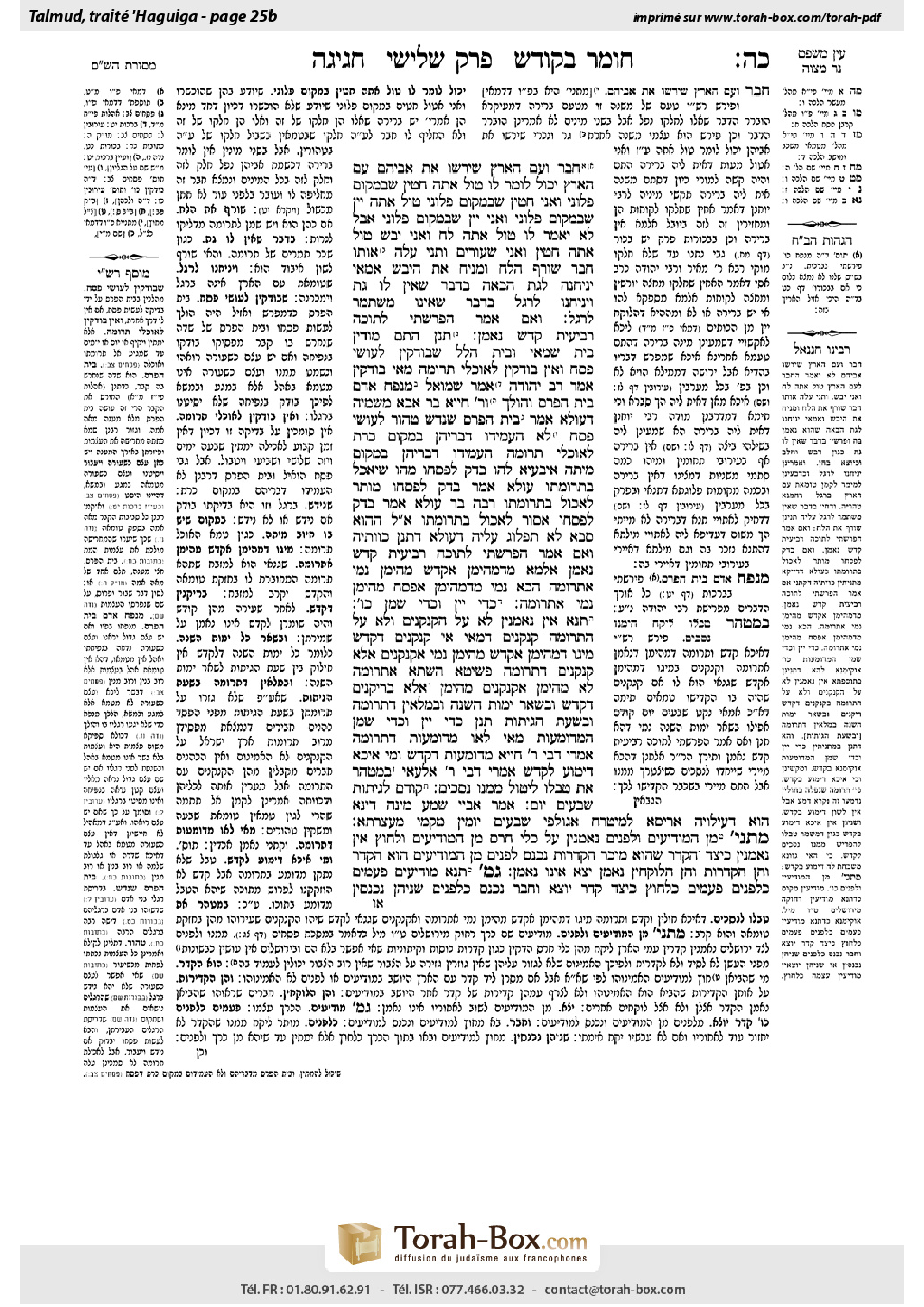
Chagigah 25b: Talmud study for Daf Yomi
Study the Talmud for Daf Yomi with scanned pages, Hebrew text, English translations from Sefaria and AI-generated French translations.
Passage selection and English or AI-generated French translation are available where the scan has annotations. Daf Study is independent of Torah-Box and Sefaria.
Browse Chagigah · חגיגה · All tractatesChagigah 25b text and translations
This page of Chagigah includes the Aramaic text, an English translation and an AI-generated French translation, alongside the scan above.
חגיגה כ״ה ב · Aramaic and Hebrew text
חָבֵר וְעַם הָאָרֶץ שֶׁיָּרְשׁוּ אֶת אֲבִיהֶם עַם הָאָרֶץ, יָכוֹל לוֹמַר לוֹ: טוֹל אַתָּה חִטִּין שֶׁבְּמָקוֹם פְּלוֹנִי, וַאֲנִי חִטִּין שֶׁבְּמָקוֹם פְּלוֹנִי.
טוֹל אַתָּה יַיִן שֶׁבְּמָקוֹם פְּלוֹנִי, וַאֲנִי יַיִן שֶׁבְּמָקוֹם פְּלוֹנִי.
אֲבָל לֹא יֹאמַר לוֹ: טוֹל אַתָּה לַח וַאֲנִי יָבֵשׁ, טוֹל אַתָּה חִטִּין וַאֲנִי שְׂעוֹרִים.
וְתָנֵי עֲלַהּ: אוֹתוֹ חָבֵר שׂוֹרֵף הַלַּח, וּמַנִּיחַ אֶת הַיָּבֵשׁ.
אַמַּאי? יַנִּיחֶנָּה לַגַּת הַבָּאָה! בַּדָּבָר שֶׁאֵין לוֹ גַּת. וְיַנִּיחֶנּוּ לָרֶגֶל! בְּדָבָר שֶׁאֵינוֹ מִשְׁתַּמֵּר לָרֶגֶל.
וְאִם אָמַר הִפְרַשְׁתִּי לְתוֹכָהּ רְבִיעִית קֹדֶשׁ — נֶאֱמָן. תְּנַן הָתָם: מוֹדִין בֵּית שַׁמַּאי וּבֵית הִלֵּל שֶׁבּוֹדְקִין לְעוֹשֵׂי פֶסַח, וְאֵין בּוֹדְקִין לְאוֹכְלֵי תְרוּמָה.
מַאי בּוֹדְקִין? אָמַר רַב יְהוּדָה אָמַר שְׁמוּאֵל: מְנַפֵּחַ אָדָם בֵּית הַפְּרָס וְהוֹלֵךְ.
וְרַבִּי חִיָּיא בַּר אַבָּא מִשְּׁמֵיהּ דְּעוּלָּא אָמַר: בֵּית הַפְּרָס שֶׁנִּדַּשׁ — טָהוֹר לְעוֹשֵׂי פֶסַח. לֹא הֶעֱמִידוּ דִּבְרֵיהֶן בִּמְקוֹם כָּרֵת.
לְאוֹכְלֵי תְרוּמָה הֶעֱמִידוּ דִּבְרֵיהֶן בִּמְקוֹם מִיתָה.
אִיבַּעְיָא לְהוּ: בָּדַק לְפִסְחוֹ, מַהוּ שֶׁיֹּאכַל בִּתְרוּמָתוֹ? עוּלָּא אָמַר: בָּדַק לְפִסְחוֹ — מוּתָּר לֶאֱכוֹל בִּתְרוּמָתוֹ. רַבָּה בַּר עוּלָּא אָמַר: בָּדַק לְפִסְחוֹ — אָסוּר לֶאֱכוֹל בִּתְרוּמָתוֹ.
אֲמַר לֵיהּ הָהוּא סָבָא: לָא תִּפְלוֹג עֲלֵיהּ דְּעוּלָּא, דִּתְנַן כְּווֹתֵיהּ: וְאִם אָמַר הִפְרַשְׁתִּי לְתוֹכָהּ רְבִיעִית קֹדֶשׁ — נֶאֱמָן, אַלְמָא: מִדִּמְהֵימַן אַקֹּדֶשׁ מְהֵימַן נָמֵי אַתְּרוּמָה, הָכָא נָמֵי: מִדִּמְהֵימַן אַפֶּסַח, מְהֵימַן נָמֵי אַתְּרוּמָה.
כַּדֵּי יַיִן וְכַדֵּי שֶׁמֶן כּוּ׳. תָּנָא: אֵין נֶאֱמָנִין לֹא עַל הַקַּנְקַנִּים וְלֹא עַל הַתְּרוּמָה. קַנְקַנִּים דְּמַאי? אִי קַנְקַנִּים דְּקֹדֶשׁ — מִיגּוֹ דִּמְהֵימַן אַקֹּדֶשׁ, מְהֵימַן נָמֵי אַקַּנְקַנִּים! אֶלָּא קַנְקַנִּים דִּתְרוּמָה — פְּשִׁיטָא, הַשְׁתָּא אַתְּרוּמָה לָא מְהֵימַן, אַקַּנְקַנִּים מְהֵימַן?
אֶלָּא בְּרֵיקָנִים דְּקֹדֶשׁ וּבִשְׁאָר יְמוֹת הַשָּׁנָה, וּבִמְלֵאִין דִּתְרוּמָה וּבִשְׁעַת הַגִּיתּוֹת.
תְּנַן: כַּדֵּי יַיִן וְכַדֵּי שֶׁמֶן הַמְדוּמָּעוֹת. מַאי לָאו, מְדוּמָּעוֹת דִּתְרוּמָה. אָמְרִי דְּבֵי רַבִּי חִיָּיא: מְדוּמָּעוֹת דְּקֹדֶשׁ.
וּמִי אִיכָּא דִּימּוּעַ לְקֹדֶשׁ? אָמְרִי דְּבֵי רַבִּי אִלְעַאי: בִּמְטַהֵר אֶת טִבְלוֹ לִיטּוֹל מִמֶּנּוּ נְסָכִים.
קוֹדֶם לַגִּיתּוֹת שִׁבְעִים יוֹם. אָמַר אַבָּיֵי, שְׁמַע מִינַּהּ: דִּינָא הוּא דְּעִילָּוֵי אֲרִיסָא לְמִיטְרַח אַגּוּלְפֵי שִׁבְעִים יוֹמִין מִקַּמֵּי מַעְצַרְתָּא.
מַתְנִי׳ מִן הַמּוֹדִיעִים וְלִפְנִים נֶאֱמָנִין עַל כְּלֵי חֶרֶס. מִן הַמּוֹדִיעִים וְלַחוּץ — אֵין נֶאֱמָנִין. כֵּיצַד? הַקַּדָּר שֶׁהוּא מוֹכֵר הַקְּדֵרוֹת, נִכְנַס לִפְנִים מִן הַמּוֹדִיעִים, הוּא הַקַּדָּר וְהֵן הַקְּדֵרוֹת וְהֵן הַלּוֹקְחִין — נֶאֱמָן, יָצָא — אֵינוֹ נֶאֱמָן.
גְּמָ׳ תָּנָא: מוֹדִיעִים — פְּעָמִים כְּלִפְנִים, פְּעָמִים כְּלַחוּץ. כֵּיצַד? קַדָּר יוֹצֵא וְחָבֵר נִכְנָס — כְּלִפְנִים. שְׁנֵיהֶן נִכְנָסִין
Chagigah 25b · English translation
In the case of a ḥaver and an am ha’aretz, who are brothers and inherited property from their father, who was also an am ha’aretz, the ḥaver can say to his am ha’aretz brother: You take the wheat that is in such and such a place and I will take the wheat that is in such and such a place. The ḥaver knows that the former batch of wheat had been made susceptible to impurity, and he would therefore have no use for it, while the latter batch had not been made susceptible to impurity.
The mishna continues: Similarly, the ḥaver brother may say to the am ha’aretz brother: You take the wine that is in such and such a place and I will take the wine that is in such and such a place. The ḥaver knows that the latter batch of wine has not been rendered impure, and he wants to take that batch as his share. When brothers inherit a quantity of a certain item they will each end up receiving an equal share of that item. Therefore, the principle of retroactive designation applies, meaning that it is considered that whatever portion any particular brother receives in the end is the one that had been designated for him as his inheritance from the beginning. It is not considered to be a trade or a business transaction with the other brothers in exchange for their portions.
The mishna continues: But the ḥaver brother may not say to the am ha’aretz brother: You take the wet produce and I will take the dry produce. Nor may he say: You take the wheat, and I will take the barley. The principle of retroactive designation does not apply to objects of different types. If one brother would take wheat and the other barley it would be considered a trade. And it is prohibited for a ḥaver to sell or transfer impure produce or produce that is susceptible to impurity to an am ha’aretz, who does not strictly follow the principles of purity, as this would involve the prohibition of “You shall not place a stumbling-block before the blind” (Leviticus 19:14).
And it is taught in a baraita with regard to this mishna: If the ḥaver receives a share that consists of some items that are wet and some that are dry, that ḥaver must burn the wet produce if it was teruma, as it has certainly been defiled and impure teruma is burned, but he may leave the dry produce and use it, as it can be assumed that it has not been defiled.
The Gemara draws a conclusion based on this baraita: Why must he burn the wet teruma? Let him leave it over until the following winepress season, during which time teruma from an am ha’aretz is considered pure. The fact that this option is not taken into account indicates that one may not intentionally leave over teruma received from an am ha’aretz until the next winepress season, which would resolve the dilemma presented to Rav Sheshet. The Gemara rejects this proof: Here it is referring to something that does not have a winepress, i.e., to liquids that are never used in the Temple service, as amei ha’aretz are careful only with regard to liquids that may be used in the Temple service. The Gemara asks: Even so, there is another option: And let him leave it for the next pilgrimage Festival, for the mishna later teaches (26a) that amei ha’aretz are assumed to observe all laws of ritual purity on Festivals. The Gemara answers: It is referring to something that would not last until the next pilgrimage Festival, but which would spoil beforehand. The dilemma presented to Rav Sheshet therefore remains unresolved.
§ It was taught in the mishna: And if the giver says to the priest: I separated and placed into this barrel of teruma a quarter-log of sacrificial wine or oil, he is deemed credible. The Gemara proceeds to cite a mishna in tractate Oholot, the discussion of which ultimately relates to this mishna here: We learned in a mishna elsewhere (Oholot 18:4): Beit Shammai and Beit Hillel agree that one may examine the ground for those performing the paschal offering, but one may not examine the ground for those who eat teruma.
The Gemara asks: What is the meaning of: One may examine? Rav Yehuda said that Shmuel said: A person may blow at the ground of a beit haperas and walk through it as he does so. A beit haperas is a patch of ground with a grave in it that was subsequently plowed over. The Sages were concerned that there might be small pieces of human bone scattered in the field, which would impart impurity to anyone moving them with his foot. Therefore, they decreed that whoever traverses such a field becomes impure. However, the Sages allowed one to pass through the field while maintaining his purity if he blows on the ground as he goes, the assumption being that any small pieces of bone would thereby be blown out of his path. This is the examination to which this mishna refers. The mishna teaches that this examination is sufficient to allow one to retain his purity as he goes to perform the paschal offering, but not to allow one to retain his purity with regard to the eating of teruma.
And Rabbi Ḥiyya bar Abba said in the name of Ulla: A beit haperas that has been trodden by passersby who have beaten a path through it is considered pure for those who are on their way to perform the paschal offering, as the assumption is that no more bone fragments remain on the surface of the ground. The examination referred to in the mishna, then, is referring to ascertaining whether a particular beit haperas has been trodden or not. The reason for this leniency is that the impure status of a beit haperas is only a rabbinical decree, and the Sages did not uphold their words decreeing the field to be impure in a place where this affects one’s ability to perform a mitzva involving karet; and failure to bring a paschal offering is punishable by karet.
However, with regard to those who wish to eat teruma after traversing a beit haperas, the Sages did uphold their words decreeing the field to be impure in a place of a sin involving the punishment of death by God’s hand. The sin of eating teruma in a state of impurity is punishable by death by God’s hand, and the Sages were therefore strict in insisting that one not eat it after traversing a beit haperas.
A dilemma was raised before the scholars: If one examined a beit haperas for the purpose of bringing his paschal offering, what is the halakha with regard to teruma after he has traversed the field? Is it permissible that he can rely on this examination to eat his teruma as well, since his passage through the field has been established as not having defiled him? Ulla said: If he examined the ground for purposes of bringing his paschal offering, he is permitted afterward to eat his teruma, for once he is declared pure with regard to the offerings it would be inconsistent to declare him at the same time impure with regard to teruma. But Rabba bar Ulla said: If one examined the ground for purposes of bringing his paschal offering, it is prohibited for him to eat his teruma.
A certain older man said to Rabba bar Ulla: Do not argue with Ulla, as we learned in the mishna in accordance with his opinion, for the mishna states: And if the am ha’aretz says to the priest: I separated and placed into this barrel of teruma a quarter-log of sacrificial wine or oil, he is deemed credible. Apparently, then, once the am ha’aretz is deemed credible with regard to the sacrificial items in the barrel he is also deemed credible with regard to the teruma in it. Here too, the same principle should be applied, so once he is deemed credible and is considered pure with regard to the paschal offering, he is also deemed credible with regard to teruma.
§ It was taught in the mishna: Concerning jugs of wine and jugs of oil that are mingled, amei ha’aretz are deemed credible during the period of the winepress and the olive press. A Sage taught in a baraita: Amei ha’aretz are not deemed credible, neither with regard to flasks nor with regard to teruma. The Gemara asks: Flasks of what? If it is referring to flasks of sacrificial food, since an am ha’aretz is deemed credible concerning the sacrificial items it contains, he must necessarily be deemed credible concerning the flasks as well. Rather, it is referring to flasks of teruma. But this is obvious: Now, if he is not deemed credible concerning the teruma itself, is it possible that he would be deemed credible concerning the flasks containing it?
The Gemara answers: Rather, it is referring to empty flasks that had contained sacrificial food during the rest of the days of the year, i.e., during all the days of the year, for an am ha’aretz is deemed credible with regard to sacrificial food throughout the year, yet he is not deemed credible with regard to its flask once the food has been removed, and it is referring as well to flasks full of teruma wine during the period of the winepress, when they are deemed credible with regard to the teruma itself, but not the vessels.
The Gemara asks a question: We learned in the mishna: With regard to jugs of wine and jugs of oil that are mingled [meduma], amei ha’aretz are deemed credible during the period of the winepress and the olive press, and seventy days before the winepress. The Gemara asks: What, is it not so that mingled means that there is a mixture of teruma oil or wine in the jug, and yet the mishna states that amei ha’aretz are deemed credible with regard to the jugs? This would appear to contradict the ruling of the baraita that they are not deemed credible with regard to flasks containing teruma. The Gemara answers: In the school of Rabbi Ḥiyya they say that the mishna in fact is referring to ordinary oil or wine mingled with sacrificial wine or oil, so that it contains a certain amount of sacrificial liquid.
The Gemara asks: And does the concept of meduma apply to sacrificial foods at all? This term meduma applies only to teruma, not to sacrificial items. In the school of Rabbi Elai they say that the halakha of the mishna is stated with regard to one who is keeping his wine tevel, i.e., produce from which the requisite teruma and tithes have not yet been separated, in purity, because he intends to take wine for libations from it. It is therefore in a sense a mixture of sacrificial food, teruma and non-sacred food all in one, and accordingly the term meduma is applicable. The mishna is teaching that since the am ha’aretz is deemed credible with regard to the sacrificial food in this mixture, he is also deemed credible with regard to the teruma and the jugs.
§ It is taught in the mishna that apart from the period of the winepress itself, amei ha’aretz are also deemed credible seventy days before the period of the winepress. Abaye said: You can learn from here, incidental to the laws of purity, that the law is that a tenant farmer in a vineyard must make the effort of acquiring flasks for the wine seventy days before the time of the winepress, for the mishna considers this amount of time the period of preparation for the pressing of grapes.
MISHNA: From Modi’im and inward toward Jerusalem, i.e., in the area surrounding Jerusalem, up to the distance of the town of Modi’im, which is fifteen mil from Jerusalem, all potters, including amei ha’aretz, are deemed credible with regard to the purity of earthenware vessels that they have produced. Because these places supplied earthenware vessels for the people in Jerusalem, the Sages did not decree impurity for them. From Modi’im and outward, however, they are not deemed credible. The details of this ruling are specified: How so? A potter who sells pots, if he entered within Modi’im from outside it, although the potter, and the pots, and the customers were all previously located outside Modi’im, where he is not deemed credible with regard to purity, he is now deemed credible. And the opposite is true of the opposite case: If the same person who was deemed credible inside left the boundaries of Modi’im, he is no longer deemed credible.
GEMARA: A tanna taught in a baraita: With regard to Modi’im itself, there are times that it is considered like inside the perimeter surrounding Jerusalem, and there are times that it is considered like outside that perimeter. How so? If a potter is leaving the perimeter and a ḥaver is entering it, and they meet in Modi’im, it is considered like inside, and the ḥaver may purchase the jugs. However, if both are entering the perimeter
Chagigah 25b · Traduction française (IA)
Dans le cas d’un ḥaver et d’un am ha’aretz, qui sont frères et qui ont hérité de biens de leur père, qui était également un am ha’aretz, le ḥaver peut dire à son frère am ha’aretz : Tu prends le blé qui est dans telle et telle place et je prendrai le blé qui est dans telle et telle place. Le ḥaver sait que la première quantité de blé avait été rendue susceptible d’impureté et qu’il n’aurait donc pas de besoin d’elle, tandis que la seconde quantité n’avait pas été rendue susceptible d’impureté.
La mishna continue : De même, le frère ḥaver peut dire au frère am ha’aretz : Tu prends le vin qui est dans telle et telle place et je prendrai le vin qui est dans telle et telle place. Le ḥaver sait que la seconde quantité de vin n’a pas été rendue impure et qu’il veut prendre cette quantité comme part. Lorsque des frères héritent d’une quantité d’un certain objet, ils finiront par recevoir chacun une part égale de cet objet. Par conséquent, le principe de désignation rétroactive s’applique, ce qui signifie que ce qui est finalement reçu par un frère est considéré comme ayant été désigné pour lui dès le début. Il ne s’agit pas d’une transaction commerciale avec les autres frères en échange de leurs parts.
La mishna continue : Mais le frère ḥaver ne peut pas dire au frère am ha’aretz : Tu prends les produits humides et je prendrai les produits secs. Ni ne peut-il dire : Tu prends le blé et je prendrai l’orge. Le principe de désignation rétroactive ne s’applique pas aux objets de types différents. Si un frère prend du blé et l’autre de l’orge, cela serait considéré comme un échange. Et il est interdit à un ḥaver de vendre ou de transférer des produits impurs ou des produits susceptibles d’impureté à un am ha’aretz, qui ne suit pas strictement les principes de pureté, car cela impliquerait la prohibition de « Tu ne mettras pas un obstacle devant le myope » (Lévitique 19:14).
Et il est enseigné dans une baraïta concernant cette mishna : Si le ḥaver reçoit une part qui comprend certains objets humides et d’autres secs, ce ḥaver doit brûler les produits humides s’ils sont terouma, car ils ont certainement été souillés et la terouma souillée est brûlée, mais il peut laisser les produits secs et les utiliser, car on peut supposer qu’ils n’ont pas été souillés.
La Guemara tire une conclusion à partir de cette baraïta : Pourquoi doit-il brûler la terouma humide ? Laissons-la jusqu’à la prochaine saison de pressage du vin, pendant laquelle la terouma provenant d’un am ha’aretz est considérée comme pure. Le fait que cette option ne soit pas prise en compte indique qu’on ne peut pas intentionnellement laisser la terouma reçue d’un am ha’aretz jusqu’à la prochaine saison de pressage, ce qui résoudrait le dilemme présenté à Rav Sheshet. La Guemara rejette cette preuve : ici, il s’agit de quelque chose qui n’a pas de pressage, c’est-à-dire des liquides qui ne sont jamais utilisés dans le service du Temple, car les amei ha’aretz sont vigilants uniquement concernant les liquides utilisés dans le service du Temple. La Guemara demande : Même ainsi, il y a une autre option : et laissez-le jusqu’au prochain festival de pèlerinage, car la mishna enseigne plus tard (26a) que les amei ha’aretz observent toutes les lois de pureté rituelle lors des festivals. La Guemara répond : il s’agit de quelque chose qui ne tiendrait pas jusqu’au prochain festival de pèlerinage, mais qui se gâterait avant. Le dilemme présenté à Rav Sheshet reste donc sans résolution.
§ Il a été enseigné dans la mishna : Et si le donneur dit au prêtre : J’ai séparé et placé dans ce tonneau de terouma un quart de log de vin sacré ou d’huile, il est considéré comme crédible. La Guemara poursuit en citant une mishna dans le tractat Oholot, la discussion de laquelle se rapporte finalement à cette mishna ici : Nous avons appris dans une mishna ailleurs (Oholot 18:4) : Beit Shammai et Beit Hillel s’accordent sur le fait qu’on peut examiner le sol pour ceux qui accomplissent l’offrande pascal, mais on ne peut pas examiner le sol pour ceux qui mangent la terouma.
La Guemara demande : Quelle est la signification de : On peut examiner ? Rav Yehuda a dit que Shmuel a dit : Une personne peut souffler sur le sol d’un beit haperas et marcher dessus en faisant cela. Un beit haperas est un morceau de sol avec une tombe qui a ensuite été labouré. Les Sages avaient peur qu’il y ait des petits ossements humains dispersés dans le champ, qui souilleraient quiconque les déplacerait avec son pied. Ils ont donc décrété que celui qui traverse ce champ devient souillé. Cependant, les Sages ont permis à une personne de traverser le champ tout en conservant sa pureté si elle soufflait sur le sol en marchant, en supposant que les petits ossements seraient ainsi éloignés de son chemin. C’est cette examen auquel cette mishna fait référence. La mishna enseigne que cet examen est suffisant pour permettre à une personne de conserver sa pureté lorsqu’elle va accomplir l’offrande pascal, mais pas pour permettre à une personne de conserver sa pureté concernant la consommation de la terouma.
Et Rabbi Ḥiyya bar Abba a dit en nom d’Ulla : Un beit haperas qui a été foulé par des passants qui ont tracé un chemin à travers lui est considéré comme pur pour ceux qui sont sur le chemin d’accomplir l’offrande pascal, car on suppose qu’il ne reste plus de fragments d’os sur la surface du sol. L’examen auquel fait référence la mishna est donc celui de déterminer si un beit haperas a été foulé ou non. La raison de cette lenienc est que le statut de souillure d’un beit haperas est seulement un décret rabbinique, et les Sages n’ont pas maintenu leur décret en un lieu où cela affecte la capacité à accomplir une mitsva impliquant karet ; et l’omission de présenter l’offrande pascal est punie par karet.
Cependant, concernant ceux qui souhaitent manger la terouma après avoir traversé un beit haperas, les Sages ont maintenu leur décret en un lieu où un péché implique la mort par la main de Dieu. Le péché de manger la terouma dans un état de souillure est puni par la mort par la main de Dieu, et les Sages ont donc été stricts en exigeant que l’on ne mange pas la terouma après avoir traversé un beit haperas.
Un dilemme a été soulevé devant les savants : Si l'on examine un beit haperas à l'effet de présenter son sacrifice pascal, quelle est la halakha concernant la terouma après qu'il ait traversé le champ ? Est-il permis qu'il puisse s'appuyer sur cette examination pour manger sa terouma également, puisque son passage dans le champ a été établi comme ne le rendant pas impur ? Ulla a dit : Si l'on examine le sol à l'effet de présenter son sacrifice pascal, il est permis ensuite de manger sa terouma, car une fois déclaré pur concernant les offrandes, il serait incohérent de le déclarer en même temps impur concernant la terouma. Mais Rabba bar Ulla a dit : Si l'on examine le sol à l'effet de présenter son sacrifice pascal, il est interdit de manger sa terouma.
Un homme âgé a dit à Rabba bar Ulla : Ne discutez pas avec Ulla, car nous avons appris dans la mitsna selon son avis, car la mitsna dit : Et si l'am ha'aretz dit au prêtre : J'ai séparé et placé dans ce tonneau de terouma un quart de log de vin sacré ou d'huile, il est considéré comme crédible. Apparemment, alors, une fois que l'am ha'aretz est considéré comme crédible concernant les objets sacrés dans le tonneau, il est également considéré comme crédible concernant la terouma dans ce tonneau. Ici aussi, le même principe devrait s'appliquer, donc une fois qu'il est considéré comme crédible et est considéré comme pur concernant l'offrande pascal, il est également considéré comme crédible concernant la terouma.
§ Il fut enseigné dans la mitsna : Concernant les tonneaux de vin et d'huile mêlés, les amei ha'aretz sont considérés comme crédibles durant la période de la presse à vin et de la presse d'olive. Un sage enseigna dans une baraïta : Les amei ha'aretz ne sont pas considérés comme crédibles, ni concernant les flacons ni concernant la terouma. La Guemara pose une question : De quels flacons s'agit-il ? Si cela fait référence aux flacons de nourriture sacrée, puisque l'am ha'aretz est considéré comme crédible concernant les objets sacrés qu'ils contiennent, il doit nécessairement être considéré comme crédible concernant les flacons eux-mêmes. Plutôt, cela fait référence aux flacons de terouma. Mais cela est évident : Maintenant, si l'on ne considère pas l'am ha'aretz comme crédible concernant la terouma elle-même, est-il possible qu'il soit considéré comme crédible concernant les flacons contenant la terouma ?
La Guemara répond : Plutôt, cela fait référence aux flacons vides qui avaient contenu de la nourriture sacrée durant les autres jours de l'année, c'est-à-dire durant tous les jours de l'année, car l'am ha'aretz est considéré comme crédible concernant la nourriture sacrée tout au long de l'année, mais pas concernant le flacon une fois que la nourriture a été retirée, et cela fait également référence aux flacons pleins de vin de terouma durant la période de la presse à vin, lorsqu'ils sont considérés comme crédibles concernant la terouma elle-même, mais pas les vases.
La Guemara pose une question : Nous avons appris dans la mitsva : Concernant les tonneaux de vin et d'huile mêlés [meduma], les amei ha'aretz sont considérés comme crédibles durant la période de la presse à vin et de la presse d'olive, et soixante-dix jours avant la presse à vin. La Guemara pose une question : Quoi, n'est-ce pas ainsi que meduma signifie qu'il y a un mélange d'huile ou de vin de terouma dans le tonneau, et pourtant la mitsva dit que les amei ha'aretz sont considérés comme crédibles concernant les tonneaux ? Cela semble contredire la décision de la baraïta qui dit qu'ils ne sont pas considérés comme crédibles concernant les flacons contenant la terouma. La Guemara répond : Dans l'école de Rabbi Ḥiyya, ils disent que la mitsva en question fait en réalité référence à de l'huile ou du vin ordinaires mêlés à du vin ou de l'huile sacrés, de sorte qu'ils contiennent une certaine quantité de liquide sacré.
La Guemara pose une question : Et la notion de meduma s'applique-t-elle aux aliments sacrés du tout ? Ce terme meduma s'applique uniquement à la terouma, pas aux objets sacrés. Dans l'école de Rabbi Elai, ils disent que la halakha de la mitsva est énoncée concernant celui qui garde son vin tevel, c'est-à-dire des produits dont les terouma et les dîmes nécessaires n'ont pas encore été séparés, en pureté, car il veut prendre du vin pour les libations. Il est donc dans un sens un mélange d'aliments sacrés, de terouma et d'aliments non sacrés tous ensemble, et par conséquent le terme meduma s'applique. La mitsva enseigne que puisque l'am ha'aretz est considéré comme crédible concernant l'aliment sacré dans ce mélange, il est également considéré comme crédible concernant la terouma et les tonneaux.
§ Il est enseigné dans la Michna que, en dehors de la période de la presse à vin elle-même, les amei ha'aretz sont également considérés comme crédibles soixante-dix jours avant la période de la presse à vin. Abaye a dit : Vous pouvez apprendre ici, en ce qui concerne les lois de pureté, que la loi est que le fermier en location d'un domaine de vigne doit faire l'effort d'acquérir des flacons pour le vin soixante-dix jours avant l'époque de la presse à vin, car la Michna considère cette durée comme la période de préparation pour la presse des raisins.
MICHNA : De Modi’im vers l'intérieur, c'est-à-dire dans la région entourant Jérusalem, jusqu'à la distance de la ville de Modi’im, qui est quinze mil de Jérusalem, tous les potiers, y compris les amei ha’aretz, sont considérés comme crédibles concernant la pureté des vases en terre qu'ils ont produits. Puisque ces lieux fournissaient des vases en terre aux habitants de Jérusalem, les Sages n'ont pas imposé l'impureté à leur sujet. De Modi’im vers l'extérieur, ils ne sont pas considérés comme crédibles. Les détails de cette décision sont spécifiés : Comment cela se passe-t-il ? Un potier qui vend des vases, si il entre dans Modi’im depuis l'extérieur, bien que le potier, les vases et les clients aient été tous précédemment situés en dehors de Modi’im, où il n'est pas considéré comme crédible concernant la pureté, il est maintenant considéré comme crédible. Et l'inverse est vrai dans le cas opposé : Si la même personne qui était considérée comme crédible à l'intérieur quitte les limites de Modi’im, il n'est plus considéré comme crédible.
GUEMARA : Un tanna enseigna dans une baraïta : Concernant Modi’im lui-même, il y a des moments où il est considéré comme étant à l'intérieur de la périphérie entourant Jérusalem, et des moments où il est considéré comme étant à l'extérieur de cette périphérie. Comment cela se passe-t-il ? Si un potier quitte la périphérie et un ḥaver entre dans la périphérie, et qu'ils se rencontrent à Modi’im, il est considéré comme étant à l'intérieur, et le ḥaver peut acheter les tonneaux. Cependant, si les deux entrent dans la périphérie
Traduction française générée par IA à partir de l’édition anglaise de Sefaria. Vérifie toujours un passage avec le texte source.
Text from Sefaria: William Davidson Edition - Vocalized Aramaic (CC BY NC); William Davidson Edition - English (CC BY NC).