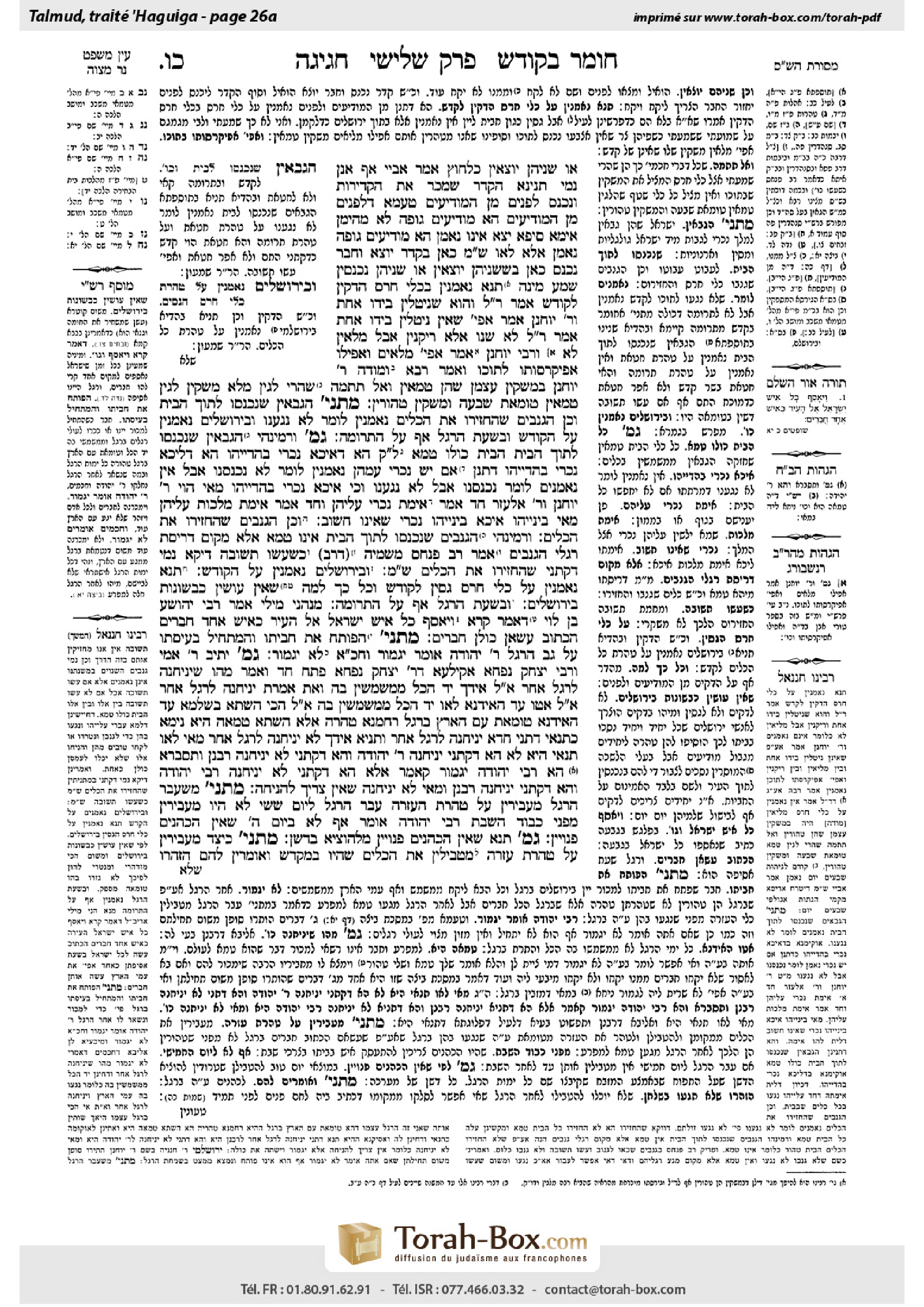
Chagigah 26a: Talmud study for Daf Yomi
Study the Talmud for Daf Yomi with scanned pages, Hebrew text, English translations from Sefaria and AI-generated French translations.
Passage selection and English or AI-generated French translation are available where the scan has annotations. Daf Study is independent of Torah-Box and Sefaria.
Browse Chagigah · חגיגה · All tractatesChagigah 26a text and translations
This page of Chagigah includes the Aramaic text, an English translation and an AI-generated French translation, alongside the scan above.
חגיגה כ״ו א · Aramaic and Hebrew text
אוֹ שְׁנֵיהֶן יוֹצְאִין — כְּלַחוּץ.
אָמַר אַבָּיֵי, אַף אֲנַן נָמֵי תְּנֵינָא: הַקַּדָּר שֶׁמָּכַר אֶת הַקְּדֵירוֹת וְנִכְנַס לִפְנִים מִן הַמּוֹדִיעִים. טַעְמָא דְּלִפְנִים מִן הַמּוֹדִיעִים, הָא מוֹדִיעִים גּוּפַהּ — לָא מְהֵימַן. אֵימָא סֵיפָא: יָצָא — אֵינוֹ נֶאֱמָן. הָא מוֹדִיעִים גּוּפָהּ — נֶאֱמָן. אֶלָּא לָאו שְׁמַע מִינַּהּ: כָּאן בְּקַדָּר יוֹצֵא וְחָבֵר נִכְנָס, כָּאן בְּשֶׁשְּׁנֵיהֶן יוֹצְאִין אוֹ שְׁנֵיהֶן נִכְנָסִין. שְׁמַע מִינַּהּ.
תָּנָא: נֶאֱמָנִין בִּכְלֵי חֶרֶס הַדַּקִּין לַקּוֹדֶשׁ. אָמַר רֵישׁ לָקִישׁ: וְהוּא שֶׁנִּיטָּלִין בְּיָדוֹ אַחַת. וְרַבִּי יוֹחָנָן אָמַר: אֲפִילּוּ שֶׁאֵין נִיטָּלִין בְּיָדוֹ אַחַת.
אָמַר רֵישׁ לָקִישׁ: לֹא שָׁנוּ אֶלָּא רֵיקָנִין, אֲבָל מְלֵאִין — לֹא. וְרַבִּי יוֹחָנָן אָמַר: אֲפִילּוּ מְלֵאִים, וַאֲפִילּוּ אַפִּיקָרְסוּתוֹ לְתוֹכוֹ. וְאָמַר רָבָא: וּמוֹדֶה רַבִּי יוֹחָנָן בְּמַשְׁקִין עַצְמָן, שֶׁהֵן טְמֵאִין. וְאַל תִּתְמַהּ, שֶׁהֲרֵי לָגִין מָלֵא מַשְׁקִין — לָגִין טְמֵאִין טוּמְאַת שִׁבְעָה, וּמַשְׁקִין טְהוֹרִין.
מַתְנִי׳ הַגַּבָּאִין שֶׁנִּכְנְסוּ לְתוֹךְ הַבַּיִת, וְכֵן הַגַּנָּבִים שֶׁהֶחְזִירוּ אֶת הַכֵּלִים — נֶאֱמָנִין לוֹמַר: לֹא נָגַעְנוּ. וּבִירוּשָׁלַיִם נֶאֱמָנִין עַל הַקּוֹדֶשׁ, וּבִשְׁעַת הָרֶגֶל אַף עַל הַתְּרוּמָה.
גְּמָ׳ וּרְמִינְהִי: הַגַּבָּאִין שֶׁנִּכְנְסוּ לְתוֹךְ הַבַּיִת — הַבַּיִת כּוּלּוֹ טָמֵא. לָא קַשְׁיָא: הָא דְּאִיכָּא גּוֹי בַּהֲדַיְיהוּ, הָא דְּלֵיכָּא גּוֹי בַּהֲדַיְיהוּ. דִּתְנַן: אִם יֶשׁ גּוֹי עִמָּהֶן — נֶאֱמָנִין לוֹמַר ״לֹא נִכְנַסְנוּ״, אֲבָל אֵין נֶאֱמָנִים לוֹמַר ״נִכְנַסְנוּ אֲבָל לֹא נָגַעְנוּ״.
וְכִי אִיכָּא גּוֹי בַּהֲדַיְיהוּ מַאי הָוֵי? רַבִּי יוֹחָנָן וְרַבִּי אֶלְעָזָר, חַד אָמַר: אֵימַת גּוֹי עֲלֵיהֶן. וְחַד אָמַר: אֵימַת מַלְכוּת עֲלֵיהֶן. מַאי בֵּינַיְיהוּ? אִיכָּא בֵּינַיְיהוּ גּוֹי שֶׁאֵינוֹ חָשׁוּב.
וְכֵן הַגַּנָּבִים שֶׁהֶחְזִירוּ אֶת הַכֵּלִים. וּרְמִינְהִי: הַגַּנָּבִים שֶׁנִּכְנְסוּ לְתוֹךְ הַבַּיִת — אֵינוֹ טָמֵא אֶלָּא מְקוֹם דְּרִיסַת רַגְלֵי הַגַּנָּבִים. אָמַר רַב פִּנְחָס מִשְּׁמֵיהּ דְּרַב: כְּשֶׁעָשׂוּ תְּשׁוּבָה. דַּיְקָא נָמֵי, דְּקָתָנֵי: שֶׁהֶחְזִירוּ אֶת הַכֵּלִים. שְׁמַע מִינַּהּ.
וּבִירוּשָׁלַיִם נֶאֱמָנִין עַל הַקּוֹדֶשׁ. תָּנָא: נֶאֱמָנִין עַל כְּלֵי חֶרֶס גַּסִּין לַקּוֹדֶשׁ. וְכׇל כָּךְ לָמָּה — שֶׁאֵין עוֹשִׂין כִּבְשׁוֹנוֹת בִּירוּשָׁלַיִם.
וּבִשְׁעַת הָרֶגֶל אַף עַל הַתְּרוּמָה. מְנָהָנֵי מִילֵּי? אָמַר רַבִּי יְהוֹשֻׁעַ בֶּן לֵוִי, דְּאָמַר קְרָא: ״וַיֵּאָסֵף כׇּל אִישׁ יִשְׂרָאֵל אֶל הָעִיר כְּאִישׁ אֶחָד חֲבֵרִים״, הַכָּתוּב עֲשָׂאָן כּוּלָּן חֲבֵרִים.
מַתְנִי׳ הַפּוֹתֵחַ אֶת חָבִיתוֹ, וְהַמַּתְחִיל בְּעִיסָּתוֹ עַל גַּב הָרֶגֶל, רַבִּי יְהוּדָה אוֹמֵר: יִגְמוֹר, וַחֲכָמִים אוֹמְרִים: לֹא יִגְמוֹר.
גְּמָ׳ יָתֵיב רַבִּי אַמֵּי וְרַבִּי יִצְחָק נַפָּחָא אַקִּילְעָא דְּרַבִּי יִצְחָק נַפָּחָא, פְּתַח חַד וַאֲמַר: מַהוּ שֶׁיַּנִּיחֶנָּה לְרֶגֶל אַחֵר?
אֲמַר לֵיהּ אִידַּךְ: יַד הַכֹּל מְמַשְׁמְשִׁין בָּהּ וְאַתְּ אָמְרַתְּ יַנִּיחֶנָּה לְרֶגֶל אַחֵר?! אֲמַר לֵיהּ: אַטּוּ עַד הָאִידָּנָא לָאו יַד הַכֹּל מְמַשְׁמְשִׁין בָּהּ? אֲמַר לֵיהּ: הָכִי הַשְׁתָּא?! בִּשְׁלָמָא עַד הָאִידָּנָא, טוּמְאַת עַם הָאָרֶץ בָּרֶגֶל רַחֲמָנָא טַהֲרַהּ, אֶלָּא הַשְׁתָּא טְמֵאָה הִיא.
נֵימָא כְּתַנָּאֵי, דְּתָנֵי חֲדָא: יַנִּיחֶנָּה לְרֶגֶל אַחֵר, וְתַנְיָא אִידַּךְ: לֹא יַנִּיחֶנָּה לְרֶגֶל אַחֵר. מַאי לָאו תַּנָּאֵי הִיא?
לָא, הָא דְּקָתָנֵי יַנִּיחֶנָּה — רַבִּי יְהוּדָה, וְהָא דְּקָתָנֵי לֹא יַנִּיחֶנָּה — רַבָּנַן. וְתִסְבְּרָא? הָא רַבִּי יְהוּדָה, יִגְמוֹר קָאָמַר?! אֶלָּא: הָא דְּקָתָנֵי לֹא יַנִּיחֶנָּה — רַבִּי יְהוּדָה, וְהָא דְּקָתָנֵי יַנִּיחֶנָּה — רַבָּנַן. וּמַאי לֹא יַנִּיחֶנָּה — שֶׁאֵין צָרִיךְ לְהַנִּיחָהּ.
מַתְנִי׳ מִשֶּׁעָבַר הָרֶגֶל — מַעֲבִירִין עַל טׇהֳרַת הָעֲזָרָה. עָבַר הָרֶגֶל לְיוֹם שִׁשִּׁי — לֹא הָיוּ מַעֲבִירִין, מִפְּנֵי כְּבוֹד הַשַּׁבָּת. רַבִּי יְהוּדָה אוֹמֵר: אַף לֹא בְּיוֹם חֲמִישִׁי, שֶׁאֵין הַכֹּהֲנִים פְּנוּיִין.
גְּמָ׳ תָּנָא: שֶׁאֵין הַכֹּהֲנִים פְּנוּיִין מִלְּהוֹצִיא בַּדֶּשֶׁן.
מַתְנִי׳ כֵּיצַד מַעֲבִירִין עַל טׇהֳרַת עֲזָרָה? מַטְבִּילִין אֶת הַכֵּלִים שֶׁהָיוּ בַּמִּקְדָּשׁ, וְאוֹמְרִין לָהֶם: הִזָּהֲרוּ
Chagigah 26a · English translation
or both are leaving it, it is considered like outside the perimeter and the ḥaver may not acquire vessels from him. The reason is that if they are both entering the perimeter they can easily wait until they are inside and then conduct the transaction, and if they are both leaving they should have completed the deal beforehand, and the ḥaver may not make up for this lapse by doing so now.
Abaye said: We, too, learn this in the mishna. For it is taught there: A potter who was selling pots and entered within the Modi’im area is deemed credible, which indicates that the only reason he is deemed credible is that he is inside the Modi’im area, thus implying that in Modi’im itself he is not deemed credible. But now say the latter clause of the mishna: If he left he is not deemed credible, thus implying that in Modi’im itself he is deemed credible, which contradicts the previous inference. Rather, must one not conclude from the mishna the following distinction: Here, in the latter clause, it is referring to a potter who is leaving and a ḥaver who is entering, in which case he is deemed credible; and there, in the first clause, it is referring to a situation where they are both leaving or both entering, in which case he is not deemed credible. Consequently, both inferences from the mishna are upheld. The Gemara concludes: Indeed, learn from here that this is the case.
§ A tanna taught in the Tosefta (3:33): All people, including amei ha’aretz, are deemed credible with regard to purity from Modi’im and inward only with regard to small earthenware vessels, and they may be used for sacrificial food. Since these small vessels were needed by all, the Sages deemed the amei ha’aretz credible concerning them. The amora’im discussed the meaning of the term small vessels. Reish Lakish said: It is speaking of those vessels that can be picked up in one hand, but no larger. And Rabbi Yoḥanan said: Even if they cannot be picked up in one hand, they can still be called small vessels.
Reish Lakish said further: They taught in the baraita only that amei ha’aretz are deemed credible with regard to empty vessels, but if they are full of liquid they are not deemed credible. And Rabbi Yoḥanan said: Even if the jugs are full, and even if his garment [apikarsuto] is inside the vessel, the Sages were not concerned about impurity, as they did not apply their decree to such vessels at all. And Rava said: And Rabbi Yoḥanan concedes with regard to the liquids themselves in the vessel that they are impure, for although the Sages declared the vessels to be pure they did not waive the decree that liquids touched by amei ha’aretz are impure. And do not be perplexed by this apparent contradiction, for there is a similar halakha in a case of an earthenware pitcher full of liquid in a room with a corpse and the pitcher is tightly sealed with another earthenware vessel of an am ha’aretz, where the halakha is that the pitcher is impure with a seven-day impurity, while the liquids remain pure.
MISHNA: In the case of amei ha’aretz tax collectors who entered a house to collect items for a tax, and similarly thieves who returned the vessels they had stolen, they are deemed credible when they say: We did not touch the rest of the objects in the house, and those items remain pure. And in Jerusalem all people, even amei ha’aretz, are deemed credible with regard to sacrificial food throughout the year, and during a pilgrimage Festival they are deemed credible even with regard to teruma.
GEMARA: And the Gemara raises a contradiction from a different mishna (Teharot 7:6): If amei ha’aretz tax collectors entered a house, the entire house is impure. The Gemara answers: It is not difficult, as that mishna is referring to a situation where there is a gentile with them, in which case they conduct a thorough search in the whole house, and certainly will have touched everything; whereas this mishna deals with a case when there is no gentile with them, and their claim not to have touched anything is therefore accepted. As we learned in a mishna (Teharot 7:6): If there is a gentile with the tax collectors, they are deemed credible if they were to say: We did not enter the house at all; but they are not deemed credible if they were to say: We entered the house but did not touch its vessels.
The Gemara raises a question: And when there is a gentile with them, what of it? Why does this affect the halakha? Rabbi Yoḥanan and Rabbi Elazar disputed this issue. One said: The fear of the gentile, who is their senior, is upon them, for they are afraid he might punish them. And one said: The fear of the kingdom, i.e., the government, is upon them, as the gentile might report them to the authorities if they do not carry out a thorough search. The Gemara asks: What is the practical difference between them? The Gemara responds: The practical difference between them is the case of a gentile who is not important, i.e., he does not have senior authority. In that case they are not afraid of him personally, but there is still concern that he might report them to the government authorities.
§ It is taught in the mishna: And similarly thieves who returned vessels are deemed credible. And the Gemara raises a contradiction from the following mishna (Teharot 7:6): Concerning the thieves who entered a house, only the place where the feet of the thieves had trodden is impure. The implication is that all the vessels of the section of the house where they had entered are impure, and they are not deemed credible if they say that they did not touch a particular item. Rav Pinḥas said in the name of Rav: The mishna here is referring to a case where the thieves repented, which is why they are deemed credible, whereas the mishna in Teharot is referring to a case in which the thieves did not repent. The Gemara comments: The language of the mishna is also precise, as it teaches: Thieves who returned vessels, which indicates that they repented and made restoration willingly. The Gemara concludes: Indeed, learn from here that this is the case.
§ The mishna teaches: And in Jerusalem all people are deemed credible with regard to sacrificial food. A tanna taught in a baraita: They are deemed credible even with regard to large earthenware vessels for sacrificial food, and not only small ones. And why did the Sages exhibit so much leniency, waiving their regular decrees of impurity within Jerusalem for large vessels and all the way to Modi’im for small vessels? Because there is a principle that potters’ kilns may not be made in Jerusalem, in order to preserve the quality of the air in the city. It is therefore necessary to bring in earthenware vessels from outside the city, and consequently the Sages were lenient concerning such utensils.
§ It was taught in the mishna: And during a pilgrimage Festival they are deemed credible even with regard to teruma. The Gemara poses a question: From where are these matters derived, i.e., that there is a difference between Festival days and other periods? Rabbi Yehoshua ben Levi said: The verse states concerning the incident of the concubine in Gibeah: “And all the men of Israel gathered to the city, like one man, united [ḥaverim]” (Judges 20:11). This verse is interpreted to teach that whenever the entire people of Israel gathers together in a single place, the Torah makes, i.e., considers, all of them ḥaverim. The final word of the phrase, ḥaverim, is a reference to the members of a group dedicated to scrupulous observance of mitzvot, as the term is used by the Sages.
MISHNA: In the case of one who opens his barrel of wine for public sale, and similarly one who starts selling his dough during the time of the pilgrimage Festival, and these items perforce come into contact with amei ha’aretz, Rabbi Yehuda says: Since the food was pure, despite its contact with amei ha’aretz, when he began selling it, he may finish selling it in a state of purity even after the Festival, and there is no concern about the contact that has been made by amei ha’aretz during the Festival. But the Rabbis say: He may not finish selling it.
GEMARA: Rabbi Ami and Rabbi Yitzḥak Nappaḥa were once sitting in the courtyard of Rabbi Yitzḥak Nappaḥa. One of them opened the discussion and said: What is the halakha with regard to the possibility of him leaving his wine for another, subsequent pilgrimage Festival and continuing to sell it at that point? Although according to the Rabbis one may not continue selling it once the Festival has concluded, may he leave the barrel aside until the next Festival, at which point it would once again be able to be sold in purity?
The other Sage said to him: Everyone’s hand has touched it, and yet you are saying that perhaps he may leave it for another pilgrimage Festival and then sell it in purity? How could such a possibility even be considered? He said back to him: Is that to say that until now, throughout the Festival, everyone’s hand was not touching it? It was permitted during the Festival despite the fact that everyone was touching it; apparently, their touching did not render it impure at all. He said to him: How can these cases be compared? Granted, until now, the Merciful One declares pure the impurity of the am ha’aretz during the Festival, and consequently his impurity is disregarded, but now that the Festival has passed, the touch of an am ha’aretz is once again considered impure.
The Gemara suggests: Let us say this dispute between amora’im is parallel to a dispute between tanna’im. For it is taught in one baraita: He may leave it for another pilgrimage Festival and then continue to sell it. And it was taught in a different baraita: He may not leave it for another Festival. What, is it not so that this very issue is a dispute between these two tanna’im, the authors of these two baraitot?
The Gemara rejects this suggestion: No, it is possible that this baraita, which teaches that he may leave it, follows the opinion, cited in the mishna, of Rabbi Yehuda, who allows the wine seller to finish selling his wine after the Festival, whereas that baraita, which teaches that he may not leave it, is in accordance with the opinion of the Rabbis, who prohibit him to finish it. The Gemara questions this conclusion: And how can you understand it that way? Didn’t Rabbi Yehuda say he may finish it after the Festival? Consequently, there would be no need for him to leave it for another Festival. Rather, say as follows: This baraita, which teaches that he may not leave it, is in accordance with the opinion of Rabbi Yehuda, whereas that baraita, which teaches that he may leave it, is in accordance with the opinion of the Rabbis. And what is the meaning of the statement: He may not leave it for another Festival? It means that he has no need to leave it for another Festival, as Rabbi Yehuda maintains he can finish selling it in purity immediately.
MISHNA: Once the pilgrimage Festival has passed by, the priests pass all the vessels of the Temple courtyard through a process of purification, since they were touched by am ha’aretz priests during the Festival. If the Festival passed by into a Friday, i.e., if the Festival ended on Thursday night, they would not pass the vessels through the purification process on that day, due to the honor of Shabbat, in order to give the priests time to prepare the requirements of Shabbat. Rabbi Yehuda says: They do not even purify them on Thursday, in the event that the Festival ended on Wednesday night, because the priests are not free to do so.
GEMARA: A tanna taught in a baraita, in explanation of Rabbi Yehuda’s words: The priests do not purify the vessels of the Temple courtyard on Thursday, as the priests are not free from removing the ashes. During the Festival days a large quantity of ash would accumulate on the altar, due to the large number of offerings brought at that time. Because they would not remove the ashes on the Festival itself, they would have to remove a very large amount afterward. Consequently, all the priests were kept busy with this task upon the conclusion of the Festival, which did not leave them with enough time to deal with other matters.
MISHNA: How do they pass all the vessels of the Temple courtyard through a process of purification? They immerse the vessels that were in the Temple. And they say to the am ha’aretz priests who served in the Temple during the Festival: Be careful
Chagigah 26a · Traduction française (IA)
Si l'un ou l'autre quitte la zone, cela est considéré comme étant en dehors de la zone, et le ḥaver ne peut pas acquérir des objets de lui. La raison est que si les deux entrent dans la zone, ils peuvent facilement attendre jusqu'à ce qu'ils soient à l'intérieur et ensuite effectuer l'opération, et si les deux quittent la zone, ils auraient dû terminer l'opération avant, et le ḥaver ne peut pas compenser ce retard en le faisant maintenant.
Abaye a dit : Nous apprenons également cela à partir de la mishna. Car il est enseigné là : Un potier qui vendait des pots et qui est entré dans la zone des Modi’im est considéré comme crédible, ce qui indique que la seule raison pour laquelle il est considéré comme crédible est qu'il est dans la zone des Modi’im, ce qui implique que dans la zone des Modi’im elle-même, il n'est pas considéré comme crédible. Mais maintenant, disons la seconde partie de la mishna : Si il est parti, il n'est pas considéré comme crédible, ce qui implique que dans la zone des Modi’im elle-même, il est considéré comme crédible, ce qui contredit l'inférence précédente. Plutôt, ne devons-nous pas conclure à partir de la mishna la distinction suivante : Ici, dans la seconde partie, il s'agit d'un potier qui quitte et d'un ḥaver qui entre, dans ce cas il est considéré comme crédible ; et là, dans la première partie, il s'agit d'une situation où ils quittent tous les deux ou entrent tous les deux, dans ce cas il n'est pas considéré comme crédible. Ainsi, les deux inférences à partir de la mishna sont maintenues. La Guemara conclut : En effet, apprenez cela à partir de là.
§ Un tanna a enseigné dans la Tosefta (3:33) : Tous les gens, y compris les amei ha’aretz, sont considérés comme crédibles concernant la pureté des Modi’im et uniquement concernant l'intérieur en ce qui concerne les petits récipients en terre, et ils peuvent être utilisés pour la nourriture sacrificielle. Puisque ces petits récipients étaient nécessaires à tous, les Sages ont considéré les amei ha’aretz comme crédibles concernant ceux-ci. Les amora’im ont discuté du sens du terme « petits récipients ». Reish Lakish a dit : Il s'agit de ceux qui peuvent être soulevés d'une main, mais pas plus grands. Et Rabbi Yoḥanan a dit : Même s'ils ne peuvent pas être soulevés d'une main, ils peuvent encore être appelés des petits récipients.
Reish Lakish a dit davantage : Ils ont enseigné dans la baraïta seulement que les amei ha’aretz sont considérés comme crédibles concernant les récipients vides, mais s'ils sont pleins de liquide, ils ne sont pas considérés comme crédibles. Et Rabbi Yoḥanan a dit : Même si les jarres sont pleines, et même si sa robe [apikarsuto] est à l'intérieur du récipient, les Sages ne s'inquiétaient pas de la souillure, car ils n'ont pas appliqué leur décret à de tels récipients. Et Rava a dit : Et Rabbi Yoḥanan reconnaît que concernant les liquides eux-mêmes dans le récipient, ils sont souillés, car bien que les Sages aient déclaré les récipients comme purs, ils n'ont pas révoqué le décret selon lequel les liquides touchés par les amei ha’aretz sont souillés. Et ne soyez pas troublé par cette contradiction apparente, car il existe une halakha similaire dans le cas d'un tonneau en terre plein de liquide dans une pièce avec un cadavre et le tonneau est étanche avec un autre récipient en terre d'un am ha’aretz, où la halakha est que le tonneau est souillé avec une souillure de sept jours, tandis que les liquides restent purs.
MICHNA : Dans le cas des collecteurs d'impôts des amei ha’aretz qui sont entrés dans une maison pour collecter des objets pour un impôt, et de même les voleurs qui ont rendu les récipients qu'ils avaient volés, ils sont considérés comme crédibles lorsqu'ils disent : Nous n'avons pas touché les autres objets de la maison, et ces objets restent purs. Et à Jérusalem, tous les gens, même les amei ha’aretz, sont considérés comme crédibles concernant la nourriture sacrificielle tout au long de l'année, et pendant un festival de pèlerinage, ils sont considérés comme crédibles même concernant la terouma.
GUEMARA : Et la Guemara soulève une contradiction à partir d'une autre mishna (Teharot 7:6) : Si les collecteurs d'impôts des amei ha’aretz sont entrés dans une maison, toute la maison est souillée. La Guemara répond : Ce n'est pas difficile, car cette mishna fait référence à un cas où il y a un non-Juif avec eux, dans ce cas ils effectuent une recherche approfondie dans toute la maison et certainement ont touché tout ; tandis que cette mishna traite d'un cas où il n'y a pas de non-Juif avec eux, et leur déclaration de ne pas avoir touché quoi que ce soit est donc acceptée. Comme nous avons appris dans une mishna (Teharot 7:6) : Si il y a un non-Juif avec les collecteurs d'impôts, ils sont considérés comme crédibles s'ils disent : Nous n'avons pas pénétré dans la maison du tout ; mais ils ne sont pas considérés comme crédibles s'ils disent : Nous avons pénétré dans la maison mais n'avons pas touché ses récipients.
La Guemara soulève une question : Et quand il y a un non-Juif avec eux, qu'est-ce que cela change ? Pourquoi cela affecte-t-il la halakha ? Rabbi Yoḥanan et Rabbi Elazar ont disputé ce point. L'un a dit : La crainte du non-Juif, qui est leur supérieur, pèse sur eux, car ils ont peur qu'il les punisse. Et l'autre a dit : La crainte du royaume, c'est-à-dire de l'État, pèse sur eux, car le non-Juif pourrait les dénoncer aux autorités s'ils ne font pas une recherche approfondie. La Guemara demande : Quelle est la différence pratique entre eux ? La Guemara répond : La différence pratique entre eux est le cas d'un non-Juif qui n'est pas important, c'est-à-dire qui n'a pas un pouvoir supérieur. Dans ce cas, ils ne craignent pas personnellement lui, mais il y a encore une préoccupation qu'il puisse les dénoncer aux autorités.
§ Il est enseigné dans la mishna : Et de même, les voleurs qui ont rendu les récipients sont considérés comme crédibles. Et la Guemara soulève une contradiction à partir de la suivante mishna (Teharot 7:6) : Concernant les voleurs qui sont entrés dans une maison, seulement la place où les pieds des voleurs avaient foulé est souillée. L'implication est que tous les récipients de la section de la maison où ils sont entrés sont souillés, et ils ne sont pas considérés comme crédibles s'ils disent qu'ils n'ont pas touché un objet particulier. Rav Pinḥas a dit en nom de Rav : La mishna ici fait référence à un cas où les voleurs se sont repentis, ce qui est pourquoi ils sont considérés comme crédibles, tandis que la mishna dans Teharot fait référence à un cas où les voleurs n'ont pas se repentis. La Guemara commente : La langue de la mishna est aussi précise, car elle enseigne : Les voleurs qui ont rendu les récipients, ce qui indique qu'ils se sont repentis et ont restauré volontairement. La Guemara conclut : En effet, apprenez cela à partir de là.
§ La Michna enseigne : À Jérusalem, tous les gens sont considérés comme dignes de confiance concernant les aliments sacrés. Un tanna a enseigné dans une baraïta : Ils sont considérés comme dignes de confiance même concernant les grands récipients en terre pour les aliments sacrés, et non seulement les petits. Et pourquoi les Sages ont-ils montré tant de clémence, en abandonnant leurs décrets habituels de souillure à l'intérieur de Jérusalem pour les grands récipients et même jusqu'à Modi’im pour les petits récipients ? Parce qu'il y a un principe selon lequel les fours des potiers ne peuvent pas être construits à Jérusalem, afin de préserver la qualité de l'air de la ville. Il est donc nécessaire d'apporter des récipients en terre depuis l'extérieur de la ville, et par conséquent les Sages ont été cléments concernant ces ustensiles.
§ Il a été enseigné dans la Michna : Et pendant les fêtes de pèlerinage, ils sont considérés comme dignes de confiance même concernant la terouma. La Guemara pose une question : D'où sont-ils dérivés ces points, c'est-à-dire qu'il y a une différence entre les jours de fête et d'autres périodes ? Rabbi Yehoshua ben Levi a dit : L'Écriture mentionne l'incident de la concubine de Gibeah : « Et tous les hommes d'Israël se réunirent à la ville, comme un seul homme, unis [ḥaverim] » (Juges 20:11). Cette versette est interprétée pour enseigner que chaque fois que tout le peuple d'Israël se réunit ensemble dans un seul lieu, la Torah considère, c'est-à-dire considère comme ḥaverim, tous ceux-ci. Le dernier mot de cette phrase, ḥaverim, fait référence aux membres d'un groupe dédié à l'observation rigoureuse des mitsvot, comme le termine les Sages.
MICHNA : Dans le cas d'une personne qui ouvre son tonneau de vin à la vente publique, et de même pour celui qui commence à vendre son pain pendant la fête de pèlerinage, et ces aliments sont nécessairement en contact avec les amei ha’aretz, Rabbi Yehuda dit : Puisque les aliments étaient purs, malgré leur contact avec les amei ha’aretz, lorsqu'il a commencé à les vendre, il peut terminer la vente dans un état de pureté même après la fête, et il n'y a pas de crainte concernant le contact qui a eu lieu avec les amei ha’aretz pendant la fête. Mais les Rabbins disent : Il ne peut pas terminer la vente.
GUEMARA : Rabbi Ami et Rabbi Yitzḥaq Nappaḥa étaient un jour assis dans la cour de Rabbi Yitzḥaq Nappaḥa. L'un d'eux a ouvert la discussion et a dit : Quelle est la halakha concernant la possibilité qu'il laisse son vin pour un autre, futur, festival de pèlerinage et continue à le vendre à ce moment-là ? Bien que selon les Rabbins on ne puisse pas continuer à vendre une fois que la fête est terminée, peut-il laisser le tonneau de côté jusqu'au prochain festival, à l'issue duquel il pourrait à nouveau être vendu dans la pureté ?
L'autre Sage a répondu à lui : Tous les mains ont touché, et pourtant vous dites que peut-être il peut laisser le vin pour un autre festival de pèlerinage et le vendre dans la pureté ? Comment cette possibilité pourrait-elle même être considérée ? Il a répondu à lui : Est-ce que cela signifie que jusqu'à présent, durant la fête, les mains de tous n'ont pas touché ? Il était permis durant la fête malgré le fait que tout le monde l'avait touché ; apparemment, leur toucher n'avait pas rendu le vin impur du tout. Il a répondu à lui : Comment ces cas peuvent-ils être comparés ? En effet, jusqu'à présent, le Bienveillant déclare pur la souillure des am ha’aretz durant la fête, et par conséquent leur souillure est négligée, mais maintenant que la fête est passée, le toucher d'un am ha’aretz est à nouveau considéré comme impur.
La Guemara suggère : Disons que ce débat entre les amora’im est parallèle à un débat entre les tanna’im. Car il est enseigné dans une baraïta : Il peut laisser le vin pour un autre festival de pèlerinage et le vendre à ce moment-là. Et il est enseigné dans une autre baraïta : Il ne peut pas laisser le vin pour un autre festival. Qu’est-ce que cela signifie, n’est-ce pas que cette même question est un débat entre ces deux tanna’im, auteurs de ces deux baraitot ?
La Guemara rejette cette suggestion : Non, il est possible que cette baraïta, qui enseigne qu’il peut laisser le vin, suit l’opinion, citée dans la michna, de Rabbi Yehuda, qui permet au vendeur de vin de terminer la vente après la fête, tandis que cette baraïta, qui enseigne qu’il ne peut pas laisser le vin, est en accord avec l’opinion des Rabbins, qui l’interdisent. La Guemara question cette conclusion : Et comment pouvez-vous l’interpréter ainsi ? N’a-t-il pas dit Rabbi Yehuda qu’il peut terminer la vente après la fête ? Par conséquent, il n’y aurait pas besoin qu’il le laisse pour un autre festival. Disons plutôt : Cette baraïta, qui enseigne qu’il ne peut pas laisser le vin, suit l’opinion de Rabbi Yehuda, tandis que celle qui enseigne qu’il peut le laisser suit l’opinion des Rabbins. Et quelle est la signification de l’affirmation : Il ne peut pas le laisser pour un autre festival ? Cela signifie qu’il n’a pas besoin de le laisser pour un autre festival, car Rabbi Yehuda maintient qu’il peut terminer la vente dans la pureté immédiatement.
MICHNA : Une fois que la fête de pèlerinage est passée, les prêtres passent tous les récipients du cour de temple par un processus de purification, car ils ont été touchés par des prêtres am ha’aretz pendant la fête. Si la fête est passée en un vendredi, c'est-à-dire si la fête s'est terminée le jeudi soir, ils ne passent pas les récipients par le processus de purification ce jour-là, en raison de l'honneur du Shabbat, afin de donner aux prêtres le temps de préparer les besoins du Shabbat. Rabbi Yehuda dit : Ils ne purifient même pas les récipients le jeudi, en cas que la fête se soit terminée le mercredi soir, car les prêtres ne sont pas libres de le faire.
GUEMARA : Un tanna a enseigné dans une baraïta, en explication des paroles de Rabbi Yehuda : Les prêtres ne purifient pas les récipients du cour de temple le jeudi, car les prêtres ne sont pas libres de retirer les cendres. Pendant les jours de la fête, une grande quantité de cendres s'accumulait sur l'autel, en raison du grand nombre d'offrandes apportées à ce moment-là. Comme ils ne retiraient pas les cendres pendant la fête elle-même, ils devaient en retirer une très grande quantité après. Par conséquent, tous les prêtres étaient occupés avec cette tâche à la fin de la fête, ce qui ne leur laissait pas assez de temps pour s'occuper d'autres affaires.
MICHNA : Comment passent-ils tous les ustensiles du cour de temple par un processus de purification ? Ils immergent les ustensiles qui étaient dans le temple. Et ils disent aux prêtres am ha’aretz qui ont servi dans le temple pendant la fête : Soyez vigilants
Traduction française générée par IA à partir de l’édition anglaise de Sefaria. Vérifie toujours un passage avec le texte source.
Text from Sefaria: William Davidson Edition - Vocalized Aramaic (CC BY NC); William Davidson Edition - English (CC BY NC).