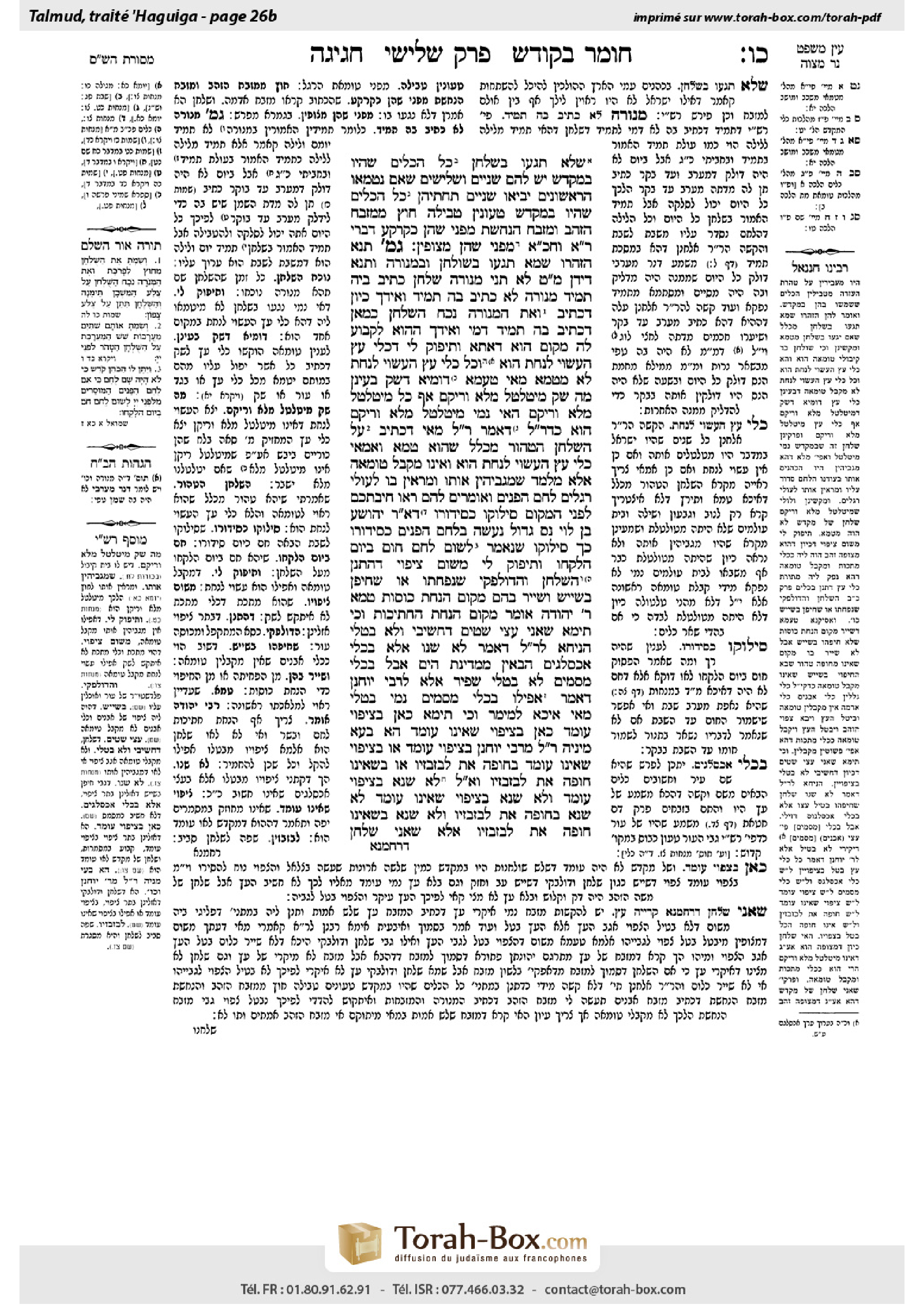
Chagigah 26b: Talmud study for Daf Yomi
Study the Talmud for Daf Yomi with scanned pages, Hebrew text, English translations from Sefaria and AI-generated French translations.
Passage selection and English or AI-generated French translation are available where the scan has annotations. Daf Study is independent of Torah-Box and Sefaria.
Browse Chagigah · חגיגה · All tractatesChagigah 26b text and translations
This page of Chagigah includes the Aramaic text, an English translation and an AI-generated French translation, alongside the scan above.
חגיגה כ״ו ב · Aramaic and Hebrew text
שֶׁלֹּא תִּגְּעוּ בַּשֻּׁלְחָן.
כׇּל הַכֵּלִים שֶׁהָיוּ בַּמִּקְדָּשׁ יֵשׁ לָהֶם שְׁנִיִּים וּשְׁלִישִׁים, שֶׁאִם נִטְמְאוּ הָרִאשׁוֹנִים — יָבִיאוּ שְׁנִיִּים תַּחְתֵּיהֶן. כׇּל הַכֵּלִים שֶׁהָיוּ בַּמִּקְדָּשׁ טְעוּנִין טְבִילָה, חוּץ מִמִּזְבַּח הַזָּהָב וּמִזְבַּח הַנְּחֹשֶׁת מִפְּנֵי שֶׁהֵן כַּקַּרְקַע, דִּבְרֵי רַבִּי אֱלִיעֶזֶר, וַחֲכָמִים אוֹמְרִים: מִפְּנֵי שֶׁהֵן מְצוּפִּין.
גְּמָ׳ תָּנָא: הִזָּהֲרוּ שֶׁמָּא תִּגְּעוּ בַּשּׁוּלְחָן וּבַמְּנוֹרָה. וְתַנָּא דִּידַן, מַאי טַעְמָא לָא תָּנֵי מְנוֹרָה? שֻׁלְחָן כְּתִיב בֵּיהּ ״תָּמִיד״, מְנוֹרָה לָא כְּתִיב בַּהּ ״תָּמִיד״.
וְאִידָּךְ: כֵּיוָן דִּכְתִיב: ״וְאֶת הַמְּנוֹרָה נֹכַח הַשֻּׁלְחָן״, כְּמַאן דִּכְתִיב בַּהּ ״תָּמִיד״ דָּמֵי. וְאִידָּךְ: הָהוּא לִקְבּוֹעַ לָהּ מָקוֹם הוּא דַּאֲתָא.
וְתִיפּוֹק לִי דִּכְלִי עֵץ הֶעָשׂוּי לְנַחַת הוּא, וְכׇל כְּלִי עֵץ הֶעָשׂוּי לְנַחַת לָא מְטַמֵּא. מַאי טַעְמָא — דּוּמְיָא דְשַׂק בָּעֵינַן: מָה שַׂק מִיטַּלְטֵל מָלֵא וְרֵיקָם — אַף כֹּל מִיטַּלְטֵל מָלֵא וְרֵיקָם!
הַאי נָמֵי מִיטַּלְטֵל מָלֵא וְרֵיקָם הוּא, כִּדְרֵישׁ לָקִישׁ. דְּאָמַר רֵישׁ לָקִישׁ: מַאי דִּכְתִיב: ״עַל הַשֻּׁלְחָן הַטָּהוֹר״, מִכְּלָל שֶׁהוּא טָמֵא.
וְאַמַּאי? כְּלִי עֵץ הֶעָשׂוּי לְנַחַת הוּא, וְאֵינוֹ מְקַבֵּל טוּמְאָה! אֶלָּא מְלַמֵּד שֶׁמַּגְבִּיהִין אוֹתוֹ וּמַרְאִין בּוֹ לְעוֹלֵי רְגָלִים לֶחֶם הַפָּנִים, וְאוֹמְרִים לָהֶם: רְאוּ חִיבַּתְכֶם לִפְנֵי הַמָּקוֹם, סִילּוּקוֹ כְּסִידּוּרוֹ. דְּאָמַר רַבִּי יְהוֹשֻׁעַ בֶּן לֵוִי: נֵס גָּדוֹל נַעֲשָׂה בְּלֶחֶם הַפָּנִים, כְּסִידּוּרוֹ כָּךְ סִילּוּקוֹ, שֶׁנֶּאֱמַר: ״לָשׂוּם לֶחֶם חוֹם בְּיוֹם הִלָּקְחוֹ״.
וְתִיפּוֹק לִי מִשּׁוּם צִיפּוּי. דְּהָתְנַן: הַשֻּׁלְחָן וְהַדּוּלְפְּקֵי שֶׁנִּפְחֲתוּ, אוֹ שֶׁחִיפָּן בְּשַׁיִישׁ, וְשִׁיֵּיר בָּהֶם מְקוֹם הַנָּחַת כּוֹסוֹת — טָמֵא. רַבִּי יְהוּדָה אוֹמֵר: מָקוֹם הַנָּחַת הַחֲתִיכוֹת.
וְכִי תֵּימָא: שָׁאנֵי עֲצֵי שִׁטִּים דַּחֲשִׁיבִי וְלָא בָּטְלִי, הָנִיחָא לְרֵישׁ לָקִישׁ, דְּאָמַר: לֹא שָׁנוּ אֶלָּא בִּכְלֵי אֶכְּסְלָגֵים הַבָּאִין מִמְּדִינַת הַיָּם, אֲבָל בִּכְלֵי מְסִמֵים — לָא בָּטְלִי, שַׁפִּיר. אֶלָּא לְרַבִּי יוֹחָנָן, דְּאָמַר: אֲפִילּוּ בִּכְלֵי מְסִמֵים נָמֵי בָּטְלִי, מַאי אִיכָּא לְמֵימַר?
וְכִי תֵּימָא: כָּאן בְּצִיפּוּי עוֹמֵד, כָּאן בְּצִיפּוּי שֶׁאֵינוֹ עוֹמֵד — הָא בְּעָא מִינֵּיהּ רֵישׁ לָקִישׁ מֵרַבִּי יוֹחָנָן: בְּצִיפּוּי עוֹמֵד, אוֹ בְּצִיפּוּי שֶׁאֵינוֹ עוֹמֵד? בְּחוֹפֶה אֶת לְבִזְבְּזָיו, אוֹ בְּשֶׁאֵינוֹ חוֹפֶה אֶת לְבִזְבְּזָיו?
וַאֲמַר לֵיהּ: לָא שְׁנָא בְּצִיפּוּי עוֹמֵד וְלָא שְׁנָא בְּצִיפּוּי שֶׁאֵינוֹ עוֹמֵד, לָא שְׁנָא בְּחוֹפֶה אֶת לְבִזְבְּזָיו וְלָא שְׁנָא בְּשֶׁאֵינוֹ חוֹפֶה אֶת לְבִזְבְּזָיו. אֶלָּא: שָׁאנֵי שֻׁלְחָן —
Chagigah 26b · English translation
that you not touch the table of the shewbread. If you defile it by touching it, it would need to be removed for immersion, and this would lead to the temporary suspension of the mitzva of the shewbread, which had to be on the table at all times.
The mishna continues: All the vessels that were in the Temple had second and third substitute vessels, so that if the first ones became impure they could bring the second ones in their place. All the vessels that were in the Temple required immersion after the Festival, apart from the golden altar and the bronze altar, because they are considered like the ground and therefore, like land itself, not susceptible to impurity. This is the statement of Rabbi Eliezer. And the Rabbis say: It is because they are coated.
GEMARA: A tanna taught in a baraita that they would say to the am ha’aretz priests: Be careful lest you touch the table, as explained above, or the candelabrum, as the Gemara will explain. The Gemara asks: And regarding the tanna of our mishna, what is the reason he did not teach that they were instructed not to touch the candelabrum as well? The Gemara answers: With regard to the table it is written: “Shewbread before Me always” (Exodus 25:30), indicating that the table holding the shewbread must always be in its place, whereas with regard to the candelabrum it is not written “always,” and therefore it can be removed for immersing.
The Gemara asks: And regarding the other tanna, in the baraita, why does he include the candelabrum? The Gemara answers: Since it is written: “And you shall set the table without the veil and the candelabrum opposite the table” (Exodus 26:35), indicating that the candelabrum must always be placed opposite the table; it is as though it is written “always” with regard to the candelabrum as well. And the other tanna, in the mishna, who does not object to removing the candelabrum for immersion, would reply: That verse comes only to establish a place for the candelabrum, to describe where it must be positioned, but it does not mean to say that it must be opposite the table at all times.
The Gemara poses a question concerning the requirement to keep amei ha’aretz away from the table: And let us derive it, i.e., let it be established, that it is not necessary to take care against contact with the table, as it is incapable of contracting ritual impurity. This is because it is a wooden vessel designated to rest in a fixed place, and the halakha is that any large, wooden vessel designated to rest in a fixed place cannot become impure. What is the reason for this halakha? Since wooden vessels and sacks are juxtaposed in the verse describing their impurity (Leviticus 11:32), we require a wooden vessel to be similar to a sack in order to be capable of contracting impurity, in the following manner: Just as a sack is carried when it is both full and empty, so too any wooden vessel that is carried full and empty can contract impurity, as opposed to vessels, such as the table, that are designated to rest in a fixed place. The table should therefore not be susceptible to impurity at all.
The Gemara answers: The table too is in fact carried full and empty, in accordance with the words of Reish Lakish. For Reish Lakish said: What is the meaning of that which is written: “And you shall set them in two rows, six in a row, upon the pure table” (Leviticus 24:6)? The words “pure table” teach by inference that it is capable of becoming impure, and therefore the Torah warns us to make sure it is pure when the twelve loaves of bread are placed there.
And why indeed is the table susceptible to ritual impurity, being that it is a wooden vessel designated to rest in a fixed place and should therefore not be susceptible to impurity? Rather, this verse teaches that they would lift the table with the shewbread on it to display the shewbread to the pilgrims standing in the Temple courtyard, as it was prohibited for Israelites to enter the Sanctuary, where the table stood, and they would say to them: Behold your affection before God, Who performs a perpetual miracle with the bread, for when it is removed from the table on Shabbat it is just as fresh as when it was arranged on the previous Shabbat. As Rabbi Yehoshua ben Levi said: A great miracle was performed with the shewbread: As its condition during its arrangement, so was its condition during its removal, as it is stated: “To place hot bread on the day when it was taken away” (I Samuel 21:7), indicating that it was as hot on the day of its removal as it was on the day when it was placed.
The Gemara asks another question: Let us derive this fact, i.e., that the table can contract ritual impurity, not because it is portable but due to its golden coating. For didn’t we learn in a mishna (Kelim 22:1): Concerning a table and a dulpaki that some of its surface became broken off, or that one coated with marble, i.e., stone not being susceptible to impurity: If he left on them a place on the surface that remained unbroken or uncoated, big enough for placing cups, it remains susceptible to impurity as a wooden vessel. Rabbi Yehuda says: It must have an unbroken and uncoated place big enough for placing pieces of meat and bread as well in order to maintain susceptibility to impurity as a wooden vessel. It is clear from this mishna that if a table is completely coated with stone it is not susceptible to impurity, showing that the status of a vessel follows its external coating, not its main material. The Temple table, which was coated with gold, should have the status of a metal vessel.
The Gemara proposes a possible answer: And if you would say that acacia wood, from which the Temple table was made, is different, as it is an important, valuable kind of wood and is therefore not nullified by a coating, this works out well according to Reish Lakish, who said: They taught that a wooden vessel is nullified by its coating only with regard to vessels made of cheap akhselag wood which comes from overseas, but vessels made of expensive masmi wood are not nullified by a coating. According to this opinion it is fine, for we can say that the acacia wood of the table is also not nullified by its golden coating. But according to Rabbi Yoḥanan, who said: Even expensive masmi vessels are also nullified by a coating, what is there to say?
The Gemara proposes another possible answer: And if you would say that the mishna is not applicable because here in the mishna the wood is nullified by its coating because it is speaking of a fixed coating, whereas there in the case of the Temple table the golden coating is not fixed onto the wood, this is impossible. For didn’t Reish Lakish inquire of Rabbi Yoḥanan: Does this law that vessels follow their coating deal only with a fixed coating or even with a coating that is not fixed? And he asked him further: Does it deal only with a coating that covers the table’s rim as well as the table itself, or even with one that does not cover its rim?
And Rabbi Yoḥanan said to him in response: It is not different if it is a fixed coating and it is not different if it is a coating that is not fixed; and it is not different if the coating covers the table’s rim and it is not different if it does not cover its rim. Therefore, since the coating always determines the status of the vessel, the Temple table, with its gold coating, should be susceptible to impurity. Rather, we must say a different explanation as to why the coating does not make the table susceptible to impurity: The table is different
Chagigah 26b · Traduction française (IA)
que vous ne touchiez pas la table du pain de proposition. Si vous la souilliez en la touchant, il faudrait la retirer pour l'immerger, ce qui entraînerait la suspension temporaire de la Mitsva du pain de proposition, qui devait être sur la table en permanence.
La Michna continue : Tous les ustensiles qui étaient dans le Temple avaient des ustensiles de remplacement secondaires et tertiaires, de sorte que si les premiers devenaient impurs, on pouvait utiliser les seconds à leur place. Tous les ustensiles qui étaient dans le Temple nécessitaient une immersion après la Fête, à l'exception de l'autel d'or et de l'autel de bronze, car ils sont considérés comme le sol et donc comme la terre elle-même, non sujets à l'impureté. C'est la déclaration de Rabbi Eliezer. Et les Sages disent : C'est parce qu'ils sont recouverts.
GUEMARA : Un tanna a enseigné dans une baraïta que l'on disait aux prêtres am ha'aretz : Soyez vigilants afin de ne pas toucher la table, comme expliqué ci-dessus, ou le candelabre, comme le expliquera la Guemara. La Guemara pose une question : Et concernant le tanna de notre Michna, pourquoi n'a-t-il pas enseigné qu'ils étaient instruits de ne pas toucher le candelabre également ? La Guemara répond : Concernant la table, il est écrit : « Pain de proposition devant Moi toujours » (Exode 25:30), indiquant que la table qui contient le pain de proposition doit toujours être en place, tandis que concernant le candelabre, il n'est pas écrit « toujours », et donc il peut être retiré pour l'immerger.
La Guemara pose une question : Et concernant l'autre tanna, dans la baraïta, pourquoi inclut-il le candelabre ? La Guemara répond : Puisque cela est écrit : « Et tu poseras le candelabre sans le voile et le candelabre opposé à la table » (Exode 26:35), indiquant que le candelabre doit toujours être placé opposé à la table ; c'est comme si cela était écrit « toujours » concernant le candelabre également. Et l'autre tanna, dans la michna, qui ne s'oppose pas à retirer le candelabre pour l'immerger, répondrait : Cette versette vient seulement pour établir une place pour le candelabre, pour décrire où il doit être placé, mais cela ne signifie pas que le candelabre doit être opposé à la table en permanence.
La Guemara pose une question concernant la nécessité de garder les amei ha'aretz éloignés de la table : Et permettons-nous de l'établir, c'est-à-dire de le considérer comme non nécessaire de prendre garde contre le contact avec la table, car elle est incapable de contracter une impureté rituelle. C'est parce qu'il s'agit d'un ustensile en bois destiné à rester en place, et la halakha est que tout grand ustensile en bois destiné à rester en place ne peut pas devenir impur. Quelle est la raison de cette halakha ? Puisque les ustensiles en bois et les sacs sont juxtaposés dans la versette décrivant leur impureté (Lévitique 11:32), nous exigeons qu'un ustensile en bois soit semblable à un sac afin d'être capable de contracter une impureté, comme suit : Tout comme un sac est porté quand il est plein et vide, de même tout ustensile en bois porté plein et vide peut contracter une impureté, contrairement aux ustensiles, tels que la table, destinés à rester en place. La table ne devrait donc pas être sujette à l'impureté du tout.
La Guemara répond : La table est en effet portée pleine et vide, conformément aux paroles de Reish Lakish. Car Reish Lakish a dit : Quelle est la signification de ce qui est écrit : « Et tu poseras les cierges en deux rangs, six dans un rang, sur la table pure » (Lévitique 24:6) ? Les mots « table pure » enseignent par déduction qu'elle peut devenir impure, et donc la Torah nous avertit de nous assurer qu'elle est pure lorsque les douze pains sont placés dessus.
Et pourquoi donc la table est-elle sujette à l'impureté rituelle, étant donné qu'il s'agit d'un ustensile en bois destiné à rester en place et devrait donc être insusceptible d'impureté ? Plutôt, cette versette enseigne qu'ils soulevaient la table avec le pain de proposition dessus pour montrer le pain de proposition aux pèlerins qui se tenaient dans la cour du Temple, car il était interdit aux Israélites d'entrer dans le Saint des Saints, où la table était, et ils disaient à ceux-ci : Regardez votre affection devant Dieu, Qui accompli un miracle perpétuel avec le pain, car lorsqu'il est retiré de la table le sabbat, il est aussi frais que lorsqu'il était disposé le sabbat précédent. Comme Rabbi Yehoshua ben Levi a dit : Un grand miracle a été accompli avec le pain de proposition : Comme sa condition lors de son arrangement, ainsi était sa condition lors de son retrait, comme il est dit : « Pour poser du pain chaud le jour où il fut retiré » (I Samuel 21:7), indiquant qu'il était aussi chaud le jour de son retrait que lorsqu'il était placé.
La Guemara pose une autre question : permettons-nous d'établir ce fait, c'est-à-dire que la table peut contracter une impureté rituelle, non parce qu'elle est portable mais en raison de son recouvrement d'or. Car n'avons-nous pas appris dans une Michna (Kelim 22:1) : concernant une table et un dulpaki dont une partie de leur surface était cassée, ou dont un recouvrement de marbre, c'est-à-dire de pierre non sujette à l'impureté, si l'on laissait sur eux une surface intacte ou non recouverte, suffisante pour poser des coupes, elles restaient sujettes à l'impureté comme des ustensiles en bois. Rabbi Yehuda dit : il faut qu'il y ait une surface intacte et non recouverte suffisante pour poser des morceaux de viande et de pain afin de maintenir la sujétion à l'impureté comme un ustensile en bois. Il est clair à partir de cette Michna que si une table est entièrement recouverte de pierre, elle n'est pas sujette à l'impureté, montrant que le statut d'un ustensile suit son recouvrement externe, et non son matériau principal. La table du Temple, qui était recouverte d'or, devrait avoir le statut d'un ustensile métallique.
La Guemara propose une réponse possible : Et si l'on disait que le bois d'acacia, duquel était fait la table du Temple, est différent, car il s'agit d'un bois précieux et donc ne se trouve pas annulé par un revêtement, cela s'accorde avec Reïsh Lakish, qui a dit : Ils enseignèrent que les vases en bois sont annulés par leur revêtement uniquement concernant les vases faits de bois ordinaire d'akhselag provenant d'outre-mer, mais les vases faits de bois précieux de masmi ne sont pas annulés par un revêtement. Selon cet avis, cela est acceptable, car nous pouvons dire que le bois d'acacia de la table n'est pas non plus annulé par son revêtement d'or. Mais selon Rabbi Yochanan, qui a dit : Même les vases en bois précieux de masmi sont annulés par un revêtement, que dire alors ?
La Guemara propose une autre réponse possible : Et si l'on disait que la Michna ne s'applique pas, car ici, dans la Michna, le bois est annulé par son revêtement car il s'agit d'un revêtement fixe, tandis que là, dans le cas de la table du Temple, le revêtement d'or n'est pas fixé sur le bois, cela est impossible. Car n'avait-il pas demandé à Rabbi Yochanan : Cette loi selon laquelle les vases suivent leur revêtement s'applique-t-elle uniquement aux revêtements fixes ou même à un revêtement non fixe ? Et il lui a demandé en outre : S'applique-t-elle uniquement à un revêtement qui recouvre la bordure de la table ainsi que la table elle-même, ou même à un revêtement qui ne recouvre pas sa bordure ?
Et Rabbi Yochanan répondit à lui en disant : Ce n'est pas différent si le revêtement est fixe et ce n'est pas différent si le revêtement n'est pas fixe ; et ce n'est pas différent si le revêtement recouvre la bordure de la table et ce n'est pas différent si le revêtement ne recouvre pas sa bordure. Ainsi, puisque le revêtement détermine toujours le statut du vase, la table du Temple, avec son revêtement d'or, devrait être sujette à la souillure. Cependant, nous devons dire une autre explication pour expliquer pourquoi le revêtement ne rend pas la table sujette à la souillure : la table est différente
Traduction française générée par IA à partir de l’édition anglaise de Sefaria. Vérifie toujours un passage avec le texte source.
Text from Sefaria: William Davidson Edition - Vocalized Aramaic (CC BY NC); William Davidson Edition - English (CC BY NC).