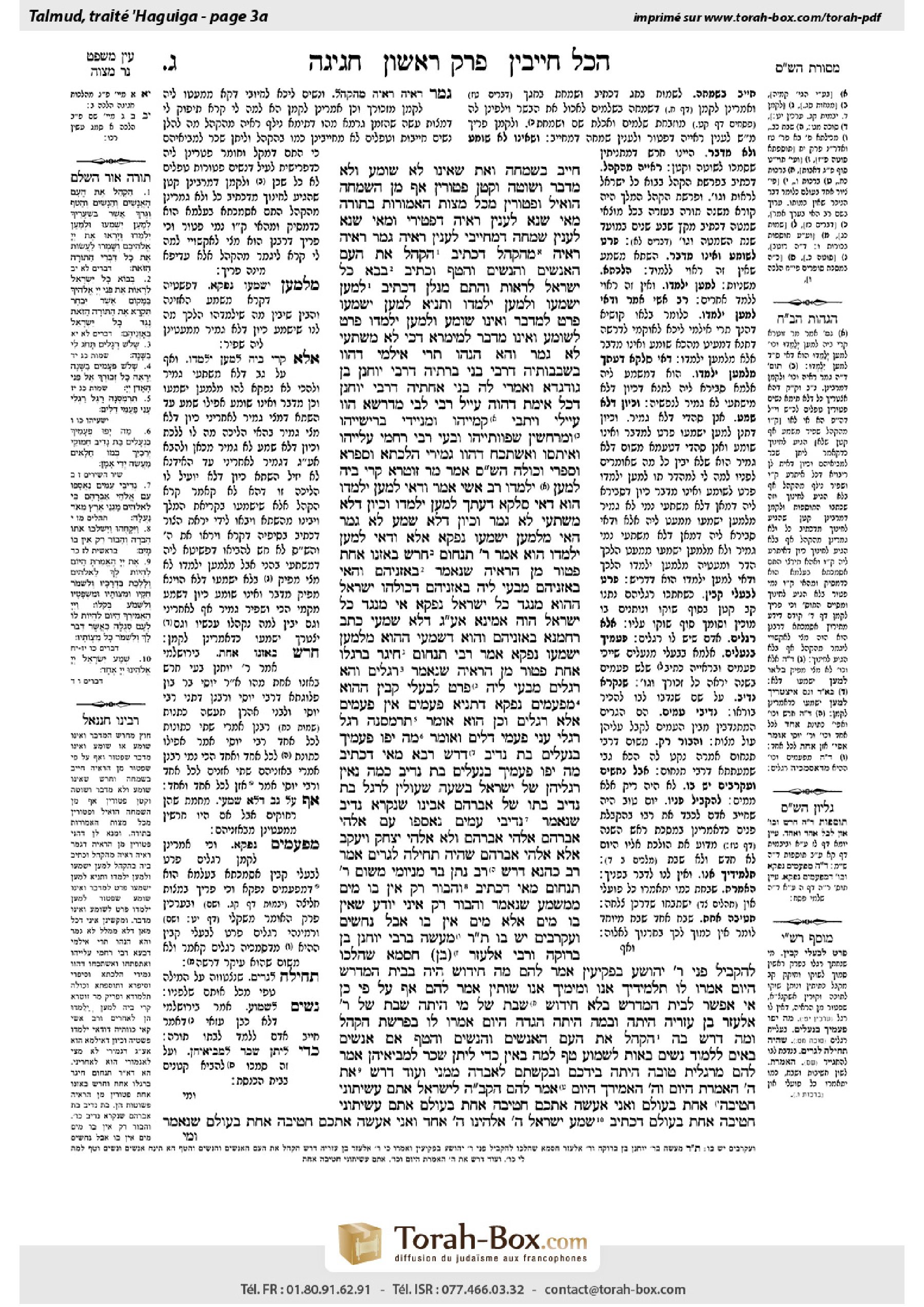
Chagigah 3a: Talmud study for Daf Yomi
Study the Talmud for Daf Yomi with scanned pages, Hebrew text, English translations from Sefaria and AI-generated French translations.
Passage selection and English or AI-generated French translation are available where the scan has annotations. Daf Study is independent of Torah-Box and Sefaria.
Browse Chagigah · חגיגה · All tractatesChagigah 3a text and translations
This page of Chagigah includes the Aramaic text, an English translation and an AI-generated French translation, alongside the scan above.
חגיגה ג׳ א · Aramaic and Hebrew text
חַיָּיב בְּשִׂמְחָה. וְאֶת שֶׁאֵינוֹ לֹא שׁוֹמֵעַ וְלֹא מְדַבֵּר, וְשׁוֹטֶה וְקָטָן — פְּטוּרִין אַף מִן הַשִּׂמְחָה, הוֹאִיל וּפְטוּרִין מִכׇּל מִצְוֹת הָאֲמוּרוֹת בַּתּוֹרָה. מַאי שְׁנָא לְעִנְיַן רְאִיָּה דִּפְטִירִי, וּמַאי שְׁנָא לְעִנְיַן שִׂמְחָה דִּמְחַיְּיבִי?
לְעִנְיַן רְאִיָּה גָּמַר ״רְאִיָּה״ ״רְאִיָּה״ מֵהַקְהֵל, דִּכְתִיב: ״הַקְהֵל אֶת הָעָם הָאֲנָשִׁים וְהַנָּשִׁים וְהַטַּף״, וּכְתִיב: ״בְּבֹא כׇּל יִשְׂרָאֵל לֵרָאוֹת״.
וְהָתָם מְנָלַן? דִּכְתִיב: ״לְמַעַן יִשְׁמְעוּ וּלְמַעַן יִלְמְדוּ״, וְתַנְיָא: ״לְמַעַן יִשְׁמְעוּ״ — פְּרָט לִמְדַבֵּר וְאֵינוֹ שׁוֹמֵעַ, ״וּלְמַעַן יִלְמְדוּ״ — פְּרָט לְשׁוֹמֵעַ וְאֵינוֹ מְדַבֵּר.
לְמֵימְרָא דְּכִי לָא מִשְׁתַּעֵי לָא גָּמַר? וְהָא הָנְהוּ תְּרֵי אִילְּמֵי דַּהֲווֹ בְּשִׁבָבוּתֵיהּ דְּרַבִּי, בְּנֵי בְרַתֵּיה דְּרַבִּי יוֹחָנָן בֶּן גּוּדְגְּדָא, וְאָמְרִי לַהּ בְּנֵי אֲחָתֵיהּ דְּרַבִּי יוֹחָנָן, דְּכׇל אֵימַת דַּהֲוָה עָיֵיל רַבִּי לְבֵי מִדְרְשָׁא הֲווֹ עָיְילִי וְיָתְבִי קַמַּיְיהוּ וּמְנַיְּידִי בְּרֵישַׁיְיהוּ וּמְרַחֲשִׁין שִׂפְווֹתַיְיהוּ,
וּבָעֵי רַבִּי רַחֲמֵי עֲלַיְיהוּ וְאִיתַּסּוֹ, וְאִשְׁתַּכַּח דַּהֲווֹ גְּמִירִי הִלְכְתָא וְסִפְרָא וְסִפְרֵי, וְכוּלֵּהּ תַּלְמוּדָא!
אָמַר מָר זוּטְרָא: קְרִי בֵּיהּ ״לְמַעַן יְלַמְּדוּ״. רַב אָשֵׁי אָמַר: וַדַּאי ״לְמַעַן יְלַמְּדוּ״ הוּא, דְּאִי סָלְקָא דַעְתָּךְ ״לְמַעַן יִלְמְדוּ״, וְכֵיוָן דְּלָא מִשְׁתַּעֵי לָא גָּמַר, וְכֵיוָן דְּלָא שָׁמַע לָא גָּמַר,
הַאי מִ״לְּמַעַן יִשְׁמְעוּ״ נָפְקָא! אֶלָּא וַדַּאי ״לְמַעַן יְלַמְּדוּ״ הוּא.
אָמַר רַבִּי תַּנְחוּם: חֵרֵשׁ בְּאׇזְנוֹ אַחַת פָּטוּר מִן הָרְאִיָּה, שֶׁנֶּאֱמַר ״בְּאׇזְנֵיהֶם״.
וְהַאי ״בְּאׇזְנֵיהֶם״ מִבְּעֵי לֵיהּ ״בְּאׇזְנֵיהֶם״ דְּכוּלְּהוּ יִשְׂרָאֵל! הַהוּא מִ״נֶּגֶד כׇּל יִשְׂרָאֵל״ נָפְקָא. אִי מִ״נֶּגֶד כׇּל יִשְׂרָאֵל״, הֲוָה אָמֵינָא: אַף עַל גַּב דְּלָא שָׁמְעִי — כְּתַב רַחֲמָנָא ״בְּאׇזְנֵיהֶם״, וְהוּא דְּשָׁמְעִי.
הָהוּא מִ״לְּמַעַן יִשְׁמְעוּ״ נָפְקָא.
אָמַר רַבִּי תַּנְחוּם: חִיגֵּר בְּרַגְלוֹ אַחַת — פָּטוּר מִן הָרְאִיָּה, שֶׁנֶּאֱמַר: ״רְגָלִים״.
וְהָא ״רְגָלִים״ מִבְּעֵי לֵיהּ, פְּרָט לְבַעֲלֵי קַבִּין! הָהוּא מִ״פְּעָמִים״ נָפְקָא, דְּתַנְיָא: ״פְּעָמִים״, אֵין ״פְּעָמִים״ אֶלָּא רַגְלַיִם, וְכֵן הוּא אוֹמֵר: ״תִּרְמְסֶנָּה רָגֶל רַגְלֵי עָנִי פַּעֲמֵי דַלִּים״. וְאוֹמֵר: ״מַה יָּפוּ פְעָמַיִךְ בַּנְּעָלִים בַּת נָדִיב״.
דָּרֵשׁ רָבָא, מַאי דִּכְתִיב: ״מַה יָּפוּ פְעָמַיִךְ בַּנְּעָלִים בַּת נָדִיב״ — כַּמָּה נָאִין רַגְלֵיהֶן שֶׁל יִשְׂרָאֵל בְּשָׁעָה שֶׁעוֹלִין לָרֶגֶל. ״בַּת נָדִיב״ — בִּתּוֹ שֶׁל אַבְרָהָם אָבִינוּ שֶׁנִּקְרָא נָדִיב, שֶׁנֶּאֱמַר: ״נְדִיבֵי עַמִּים נֶאֱסָפוּ עַם אֱלֹהֵי אַבְרָהָם״. ״אֱלֹהֵי אַבְרָהָם״, וְלֹא אֱלֹהֵי יִצְחָק וְיַעֲקֹב? אֶלָּא: ״אֱלֹהֵי אַבְרָהָם״ — שֶׁהָיָה תְּחִילָּה לְגֵרִים.
אָמַר רַב כָּהֲנָא, דָּרֵשׁ רַב נָתָן בַּר מִנְיוֹמֵי מִשּׁוּם רַבִּי תַּנְחוּם: מַאי דִּכְתִיב ״וְהַבּוֹר רֵק אֵין בּוֹ מָיִם״, מִמַּשְׁמַע שֶׁנֶּאֱמַר ״וְהַבּוֹר רֵק״ — אֵינִי יוֹדֵעַ שֶׁאֵין בּוֹ מָיִם? אֶלָּא: מַיִם אֵין בּוֹ, אֲבָל נְחָשִׁים וְעַקְרַבִּים יֵשׁ בּוֹ.
תָּנוּ רַבָּנַן: מַעֲשֶׂה בְּרַבִּי יוֹחָנָן בֶּן בְּרוֹקָה וְרַבִּי אֶלְעָזָר [בֶּן] חִסְמָא שֶׁהָלְכוּ לְהַקְבִּיל פְּנֵי רַבִּי יְהוֹשֻׁעַ בִּפְקִיעִין. אָמַר לָהֶם: מָה חִידּוּשׁ הָיָה בְּבֵית הַמִּדְרָשׁ הַיּוֹם? אָמְרוּ לוֹ: תַּלְמִידֶיךָ אָנוּ וּמֵימֶיךָ אָנוּ שׁוֹתִין. אָמַר לָהֶם: אַף עַל פִּי כֵן, אִי אֶפְשָׁר לְבֵית הַמִּדְרָשׁ בְּלֹא חִידּוּשׁ.
שַׁבָּת שֶׁל מִי הָיְתָה? שַׁבָּת שֶׁל רַבִּי אֶלְעָזָר בֶּן עֲזַרְיָה הָיְתָה. וּבַמֶּה הָיְתָה הַגָּדָה הַיּוֹם? אָמְרוּ לוֹ: בְּפָרָשַׁת הַקְהֵל. וּמָה דָּרַשׁ בָּהּ?
״הַקְהֵל אֶת הָעָם הָאֲנָשִׁים וְהַנָּשִׁים וְהַטַּף״. אִם אֲנָשִׁים בָּאִים לִלְמוֹד, נָשִׁים בָּאוֹת לִשְׁמוֹעַ, טַף לָמָּה בָּאִין? כְּדֵי לִיתֵּן שָׂכָר לִמְבִיאֵיהֶן. אָמַר לָהֶם: מַרְגָּלִית טוֹבָה הָיְתָה בְּיַדְכֶם, וּבִקַּשְׁתֶּם לְאַבְּדָהּ מִמֶּנִּי?
וְעוֹד דָּרַשׁ: ״אֶת ה׳ הֶאֱמַרְתָּ הַיּוֹם״, ״וַה׳ הֶאֱמִירְךָ הַיּוֹם״,
אָמַר לָהֶם הַקָּדוֹשׁ בָּרוּךְ הוּא לְיִשְׂרָאֵל: אַתֶּם עֲשִׂיתוּנִי חֲטִיבָה אַחַת בָּעוֹלָם, וַאֲנִי אֶעֱשֶׂה אֶתְכֶם חֲטִיבָה אַחַת בָּעוֹלָם. אַתֶּם עֲשִׂיתוּנִי חֲטִיבָה אַחַת בָּעוֹלָם, דִּכְתִיב: ״שְׁמַע יִשְׂרָאֵל ה׳ אֱלֹהֵינוּ ה׳ אֶחָד״, וַאֲנִי אֶעֱשֶׂה אֶתְכֶם חֲטִיבָה אַחַת בָּעוֹלָם, שֶׁנֶּאֱמַר:
Chagigah 3a · English translation
they are obligated in rejoicing. And one who does not hear and does not speak, an imbecile, and a minor are all exempt even from rejoicing, since they are exempt from all the mitzvot mentioned in the Torah. The Gemara asks: What is different with regard to the mitzva of appearance, that a deaf person and a mute are exempt from this mitzva? And what is different with regard to the mitzva of rejoicing, that they are obligated?
The Gemara explains: With regard to their exemption from the obligation of appearance, the tanna derives this halakha by means of a verbal analogy between the term appearance stated with regard to the mitzva of appearance at the Temple on the pilgrim Festival and the term appearance stated with regard to the mitzva of assembly, i.e., the obligation to assemble in the Temple on Sukkot in the year following the Sabbatical Year. As it is written, with regard to the mitzva of assembly: “Assemble the people, the men and the women and the little ones” (Deuteronomy 31:12), and it is written in that context: “When all of Israel come to appear” (Deuteronomy 31:11). Just as a deaf person and a mute are not obligated to attend the assembly, they are likewise exempt from appearing in the Temple on the Festivals.
The Gemara asks: And there, with regard to the mitzva of assembly, from where do we derive that a deaf person and a mute are exempt? As it is written there: “That they may hear, and that they may learn” (Deuteronomy 31:12), and it is taught in a baraita that the phrase “that they may hear” excludes one who speaks but does not hear; and the phrase “and that they may learn” excludes one who hears but does not speak, as he is unable to learn.
The Gemara asks: Is that to say that one who is not able to speak is not able to learn? But consider the following incident. There were two mute people who were in the neighborhood of Rabbi Yehuda HaNasi. They were the sons of the daughter of Rabbi Yoḥanan ben Gudgeda, and some say that they were the sons of the sister of Rabbi Yoḥanan ben Gudgeda. Whenever Rabbi Yehuda HaNasi would enter the study hall they would also enter and sit before the Sages, and they would nod their heads as if they understood and move their lips.
And Rabbi Yehuda HaNasi prayed for God to have mercy upon them, and they were healed. And it was discovered that they had learned and were proficient in halakha, i.e., Mishna; Sifra, the halakhic midrash on Leviticus; Sifrei, the halakhic midrash on Numbers and Deuteronomy; and the entire Talmud. This shows that those who cannot speak are able to learn.
Mar Zutra said that one should read into the verse: That they may teach [yelamdu], instead of: “That they may learn [yilmedu]” (Deuteronomy 31:12). Even if a mute person is able to learn he cannot teach others. Rav Ashi said that the verse is certainly to be read: That they may teach. As, if it enters your mind that one should read: “That they may learn,” as it is written, and you will explain that since he is not able to speak he is not able to learn, and similarly the reason for the exemption of a deaf person is that since he is not able to hear he is not able to learn, you will have erred. According to this interpretation, it is clear from the context that a deaf person is exempted by the phrase: “That they may hear,” not merely due to his lack of hearing but because his inability to hear prevents him from learning.
However, this is incorrect, for if so, this exemption of a mute could also be derived from: “That they may hear,” as the verse has already taught the basic principle that anyone who cannot learn is not obligated in the mitzva of assembly. Rather, the verse is certainly to be read as: “That they may teach,” which indicates that although a mute is able to learn himself, and therefore he is not exempted by the previous verse, he is nevertheless exempt because he is unable to teach others.
Rabbi Tanḥum said: One who is deaf in one ear is exempt from the mitzva of appearance in the Temple, as it is stated with regard to the mitzva of assembly: “When all Israel comes to appear before the Lord your God in the place that He shall choose, you shall read this law before all Israel in their ears” (Deuteronomy 31:11). This verse indicates that the obligation of assembly applies only to those who can hear with both ears. Since the two mitzvot are connected by verbal analogy, as explained above, this halakha applies to the mitzva of appearance as well.
The Gemara asks: But this phrase: “In their ears,” is necessary to teach that the reading of the Torah at the assembly must enter the ears of the entire Jewish people. Consequently, it cannot serve as the source of the halakha concerning one who is deaf in one ear. The Gemara answers: That halakha, that the reading of the Torah must be heard by the entire Jewish people, is derived from the phrase: “Before all Israel” (Deuteronomy 31:11). The Gemara asks: If that halakha were derived from: “Before all Israel,” I would say that the mitzva applies even though they cannot hear; therefore, the Merciful One writes: “In their ears,” and that indicates that they must be able to hear. If so, this phrase is not available for deriving the halakha of someone who is deaf in one ear.
The Gemara answers: That halakha, that the people must hear, is derived from: “That they may hear” (Deuteronomy 31:12). Therefore, the phrase: “In their ears,” is not required for that purpose. Rather, it teaches that only those who can hear with both ears are obligated in the mitzva of assembly, and by extension, in the mitzva of appearance as well.
Rabbi Tanḥum said: One who is lame in one leg is exempt from the mitzva of appearance, as it is stated: “Three times [regalim] shall you keep a feast for Me in the year” (Exodus 23:14).Since the term for feet is raglayim, it can be inferred from here that the obligation to ascend involves the use of both of one’s legs.
The Gemara asks: But the term “regalim” is necessary to exclude people with artificial legs. Although these people are capable of walking, as they do not have two natural legs they are exempt from ascending to the Temple. The Gemara responds: That halakha is derived from: “Three occasions [pe’amim] in the year all your males will appear before the Lord God” (Exodus 23:17). The term pe’amim can also mean legs, as it is taught in a baraita, with regard to the term “pe’amim”: Pe’amim means nothing other than legs. And so it says: “The foot shall tread it down, even the feet of the poor and the steps [pa’amei] of the needy” (Isaiah 26:6), and it says: “How beautiful are your feet [fe’amayikh] in sandals, daughter of the prince” (Song of Songs 7:2).
With regard to the aforementioned verse, Rava taught: What is the meaning of that which is written: “How beautiful are your feet in sandals, daughter of the prince [nadiv]”? How pleasant are the feet [raglehen] of the Jewish people when they ascend to Jerusalem on the pilgrimage Festival [regel]. “Daughter of the prince”: this is referring to the daughter of Abraham our father who is called a prince, as it is stated: “The princes of the peoples are gathered together, the people of the God of Abraham” (Psalms 47:10). The Gemara asks: Is God only “the God of Abraham,” and not the God of Isaac and Jacob? Rather, the verse mentions “the God of Abraham,” as he was the first of the converts. Abraham was the first prince, as all converts who follow in his path are called “the princes of the peoples.”
The Gemara cites another statement of Rabbi Tanḥum. Rav Kahana said that Rabbi Natan bar Manyumi taught in the name of Rabbi Tanḥum: What is the meaning of that which is written with regard to Joseph: “And they took him, and cast him into the pit; and the pit was empty, there was no water in it” (Genesis 37:24). By inference from that which is stated: “And the pit was empty,” don’t I know that there was no water in it? Rather, this teaches that there was no water in it, but there were snakes and scorpions in it.
§ The Sages taught: There was an incident involving Rabbi Yoḥanan ben Beroka and Rabbi Elazar ben Ḥisma, when they went to greet Rabbi Yehoshua in Peki’in. Rabbi Yehoshua said to them: What novel idea was taught today in the study hall? They said to him: We are your students and we drink from your water, i.e., all of our Torah knowledge comes from you, and therefore how can we tell you something you have not already learned? He said to them: Even so, there cannot be a study hall without a novelty.
He asked them: Whose week was it, i.e., who was the lecturer this week? They said to him: It was Rabbi Elazar ben Azarya’s week. He inquired: And on what subject was the lecture today? They said to him: He spoke about the portion of the mitzva of assembly. Rabbi Yehoshua persisted: And what verse did he interpret homiletically with regard to this mitzva?
They said to him that Rabbi Elazar ben Azarya interpreted the following verse: “Assemble the people, the men and the women and the little ones” (Deuteronomy 31:12). This verse is puzzling: If men come to learn, and women, who might not understand, come at least to hear, why do the little ones come? They come in order for God to give a reward to those who bring them, i.e., God credits those who bring their children to the assembly. Rabbi Yehoshua said to them: This good pearl of wisdom was in your hands, and you tried to conceal it from me?
Upon seeing that Rabbi Yehoshua was pleased to hear this idea, Rabbi Yoḥanan ben Beroka and Rabbi Elazar ben Ḥisma said to him: Additionally, Rabbi Elazar interpreted the following verses homiletically: “You have affirmed, this day, that the Lord is your God, and that you will walk in His ways and keep His statutes, His mitzvot, and His ordinances, and listen to His voice. And the Lord has affirmed you, this day, to be His treasure, as He promised you, and that you should keep all His mitzvot” (Deuteronomy 26:17–18).
Rabbi Elazar explained: The Holy One, Blessed be He, said to the Jewish people: You have made Me a single entity in the world, as you singled Me out as separate and unique. And therefore I will make you a single entity in the world, as you will be a treasured nation, chosen by God. You have made Me a single entity in the world, as it is written: “Hear, O Israel, the Lord our God, the Lord is One” (Deuteronomy 6:4). And therefore I will make you a single entity in the world, as it is stated:
Chagigah 3a · Traduction française (IA)
Ils sont tenus à la joie. Et celui qui n'écoute pas et ne parle pas, un imbécile, et un mineur sont tous dispensés même de la joie, car ils sont dispensés de toutes les mitsvot mentionnées dans la Torah. La Guemara pose la question : Qu'est-ce qui diffère concernant la mitsva de l'apparition, que les personnes sourdes et muettes soient dispensées de cette mitsva ? Et qu'est-ce qui diffère concernant la mitsva de la joie, qu'ils soient tenus ?
La Guemara explique : Concernant leur dispense de l'obligation d'apparition, le tanna dérive cette halakha par analogie verbale entre le terme d'apparition mentionné concernant la mitsva d'apparition au Temple lors des fêtes de pèlerinage et le terme d'apparition mentionné concernant la mitsva d'assemblée, c'est-à-dire l'obligation d'assembler les gens au Temple pendant la fête de Tabernacles dans l'année suivant l'année sabbatique. Comme il est écrit concernant la mitsva d'assemblée : « Assemblez le peuple, les hommes et les femmes et les petits enfants » (Deutéronome 31:12), et il est écrit dans ce contexte : « Quand tout Israël viendra s'offrir » (Deutéronome 31:11). Tout comme les personnes sourdes et muettes ne sont pas tenues d'assister à l'assemblée, elles sont également dispensées d'apparaître au Temple lors des fêtes.
La Guemara pose la question : Et là, concernant la mitsva d'assemblée, d'où dérivons-nous que les personnes sourdes et muettes sont dispensées ? Comme il est écrit là : « Pour qu'ils écoutent et qu'ils apprennent » (Deutéronome 31:12), et il est enseigné dans une baraïta que la phrase « pour qu'ils écoutent » exclut celui qui parle mais n'écoute pas ; et la phrase « et qu'ils apprennent » exclut celui qui entend mais ne parle pas, car il est incapable d'apprendre.
La Guemara pose la question : Est-ce que cela signifie que celui qui ne peut pas parler ne peut pas apprendre ? Mais considérez l'incident suivant. Il y avait deux personnes muettes dans le quartier de Rabbi Yehuda HaNasi. Ils étaient les fils de la fille de Rabbi Yoḥanan ben Gudgeda, et on dit aussi qu'ils étaient les fils de la sœur de Rabbi Yoḥanan ben Gudgeda. Quand Rabbi Yehuda HaNasi entrait dans la salle de study, ils entraient aussi et s'assisaient devant les Sages, et ils faisaient signe de la tête comme si ils comprenaient et bougeaient leurs lèvres.
Et Rabbi Yehuda HaNasi pria Dieu de lui accorder miséricorde envers eux, et ils furent guéris. Et on découvrit qu'ils avaient appris et étaient compétents en halakha, c'est-à-dire en Michna ; Sifra, le midrash halakhique sur le Lévitique ; Sifrei, le midrash halakhique sur les Nombres et le Deutéronome ; et l'ensemble du Talmud. Cela montre que ceux qui ne peuvent pas parler sont capables d'apprendre.
Mar Zutra dit que l'on devrait lire dans la phrase : « Pour qu'ils enseignent [yelamdu] », au lieu de : « Pour qu'ils apprennent [yilmedu] » (Deutéronome 31:12). Même si une personne muette est capable d'apprendre, elle ne peut pas enseigner aux autres. Rav Ashi dit que la phrase est certainement à lire : « Pour qu'ils enseignent ». Car, si vous avez l'idée de lire : « Pour qu'ils apprennent », comme il est écrit, et vous expliquez que puisque la personne ne peut pas parler, elle ne peut pas apprendre, et de même la raison de la dispense de la personne sourde est que puisque elle ne peut pas entendre, elle ne peut pas apprendre, vous avez commis une erreur. Selon cette interprétation, il est clair du contexte que la personne sourde est dispensée par la phrase : « Pour qu'ils écoutent », pas seulement en raison de son incapacité à entendre, mais parce que son incapacité à entendre l'empêche d'apprendre.
Cependant, cela est incorrect, car si tel est le cas, cette dispense de la personne muette pourrait également être dérivée de : « Pour qu'ils écoutent », comme la phrase a déjà enseigné le principe fondamental que quiconque ne peut pas apprendre n'est pas tenu de la Mitsva d'assemblée. Plutôt, la phrase est certainement à lire comme : « Pour qu'ils enseignent », ce qui indique que bien que la personne muette soit capable d'apprendre elle-même, et donc qu'elle n'est pas dispensée par la phrase précédente, elle est néanmoins dispensée car elle ne peut pas enseigner aux autres.
Rabbi Tanḥum dit : Celui qui est sourd d'un seul oreille est dispensé de la Mitsva d'apparition au Temple, car il est dit concernant la Mitsva d'assemblée : « Quand tout Israël viendra s'offrir devant l'Éternel votre Dieu au lieu qu'Il aura choisi, vous lirez cette loi devant tout Israël à leurs oreilles » (Deutéronome 31:11). Cette phrase indique que l'obligation d'assemblée s'applique uniquement à ceux qui peuvent entendre avec les deux oreilles. Puisque les deux Mitsvot sont liées par une analogie verbale, comme expliqué ci-dessus, cette halakha s'applique également à la Mitsva d'apparition.
La Guemara pose la question : Mais cette phrase : « À leurs oreilles », est nécessaire pour enseigner que la lecture de la Torah lors de l'assemblée doit entrer dans les oreilles de tout le peuple juif. Par conséquent, elle ne peut pas servir de source pour la halakha concernant celui qui est sourd d'un seul oreille. La Guemara répond : Cette halakha, que la lecture de la Torah doit être entendue par tout le peuple juif, est dérivée de la phrase : « Devant tout Israël » (Deutéronome 31:11). La Guemara pose la question : Si cette halakha était dérivée de : « Devant tout Israël », je dirais que la Mitsva s'applique même s'ils ne peuvent pas entendre ; donc, le Miséricordieux écrit : « À leurs oreilles », et cela indique qu'ils doivent être capables d'entendre. Si tel est le cas, cette phrase n'est pas disponible pour dériver la halakha concernant celui qui est sourd d'un seul oreille.
La Guemara répond : Cette halakha, que le peuple doit entendre, est dérivée de : « Pour qu'ils écoutent » (Deutéronome 31:12). Par conséquent, la phrase : « À leurs oreilles », n'est pas nécessaire à cet effet. Plutôt, elle enseigne que seul ceux qui peuvent entendre avec les deux oreilles sont tenus de la Mitsva d'assemblée, et par extension, de la Mitsva d'apparition.
Rabbi Tanḥum dit : Celui qui est boiteux d'une seule jambe est dispensé de la Mitsva d'apparition, car il est dit : « Trois fois [regalim] vous ferez un festin pour Moi dans l'année » (Exode 23:14). Puisque le terme pour les pieds est raglayim, on peut en déduire d'ici que l'obligation d'ascension implique l'utilisation des deux jambes.
Le Guemara pose la question : Mais le terme « regalim » est nécessaire pour exclure les personnes ayant des jambes artificielles. Bien que ces personnes soient capables de marcher, comme elles n'ont pas deux jambes naturelles, elles sont exemptées de monter au Temple. Le Guemara répond : Cette halakha est tirée de : « Trois fois par an, tous vos hommes viendront se présenter devant l'Éternel votre Dieu » (Exode 23 : 17). Le terme « pe’amim » peut aussi signifier « jambes », comme il est enseigné dans une baraïta, concernant le terme « pe’amim » : « Pe’amim » ne signifie rien d'autre que « jambes ». Et ainsi il est dit : « Le pied marchera sur lui, même les pieds des pauvres et les pas [pa’amei] des nécessiteux » (Isaïe 26 : 6), et il est dit : « Quels beaux pieds [fe’amayikh] dans des sandales, fille du prince » (Cantique des Cantiques 7 : 2).
Concernant la précédente versette, Ravava enseigna : Quelle est la signification de ce qui est écrit : « Quels beaux pieds [fe’amayikh] dans des sandales, fille du prince [nadiv] » ? Quel est le charme des pieds [raglehen] du peuple juif lorsqu'ils montent à Jérusalem lors des fêtes de pèlerinage [regel]. « Fille du prince » : cela fait référence à la fille d'Abraham notre père, qui est appelé un prince, comme il est dit : « Les princes des peuples se sont rassemblés, le peuple du Dieu d'Abraham » (Psaumes 47 : 10). Le Guemara pose la question : Dieu est-il seulement « le Dieu d'Abraham », et non celui d'Isaac et de Jacob ? Plutôt, la versette mentionne « le Dieu d'Abraham », car il était le premier des convertis. Abraham était le premier prince, car tous les convertis qui suivent son chemin sont appelés « les princes des peuples ».
Le Guemara cite une autre déclaration de Rabbi Tanḥum. Rav Kahana dit que Rabbi Natan bar Manyumi enseigna en nom de Rabbi Tanḥum : Quelle est la signification de ce qui est écrit concernant Joseph : « Et ils le prirent, et le jetèrent dans le puits ; et le puits était vide, il n'y avait pas d'eau dedans » (Genèse 37 : 24). Par l'inférence de ce qui est dit : « Et le puits était vide », ne sais-je pas que l'eau n'y était pas ? Plutôt, cela enseigne que l'eau n'y était pas, mais qu'il y avait des serpents et des scorpions dedans.
§ Les Sages enseignèrent : Il y avait un incident impliquant Rabbi Yoḥanan ben Beroka et Rabbi Elazar ben Ḥisma, lorsqu'ils allaient saluer Rabbi Yehoshua à Peki’in. Rabbi Yehoshua leur dit : Quelle idée nouvelle a-t-on apprise aujourd'hui dans la salle de étude ? Ils lui dirent : Nous sommes vos élèves et nous buvons de votre eau, c'est-à-dire que toute notre connaissance de la Torah vient de vous, et donc comment pouvons-nous vous dire quelque chose que vous n'avez pas déjà appris ? Il leur dit : Même ainsi, il ne peut pas y avoir une salle de étude sans une nouveauté.
Il leur demanda : Qui était la semaine, c'est-à-dire qui était l'orateur cette semaine ? Ils lui dirent : C'était la semaine de Rabbi Elazar ben Azarya. Il demanda : Et sur quel sujet était la leçon aujourd'hui ? Ils lui dirent : Il a parlé de la mitsva de l'assemblée. Rabbi Yehoshua persista : Et quelle versette a-t-il interprétée de manière allégorique concernant cette mitsva ?
Ils lui dirent que Rabbi Elazar ben Azarya avait interprété la suivante versette : « Assemblez le peuple, les hommes et les femmes et les petits enfants » (Deutéronome 31 : 12). Cette versette est étrange : si les hommes viennent apprendre, et les femmes, qui peuvent ne pas comprendre, viennent au moins pour écouter, pourquoi les petits enfants viennent-ils ? Ils viennent afin que Dieu accorde une récompense à ceux qui les amènent, c'est-à-dire que Dieu compte ceux qui amènent leurs enfants à l'assemblée. Rabbi Yehoshua dit à eux : Ce trésor de sagesse était entre vos mains, et vous avez tenté de le cacher à moi ?
En voyant que Rabbi Yehoshua était content d'entendre cette idée, Rabbi Yoḥanan ben Beroka et Rabbi Elazar ben Ḥisma dirent à lui : De plus, Rabbi Elazar a interprété les suivantes versettes de manière allégorique : « Vous avez affirmé, ce jour, que l'Éternel est votre Dieu, et que vous marcherez dans Ses voies et que vous observerez Ses lois, Ses mitsvot, Ses ordonnances, et que vous écouterez Sa voix. Et l'Éternel a affirmé vous, ce jour, pour être Son trésor, comme Il vous a promis, et que vous devriez observer toutes Ses mitsvot » (Deutéronome 26 : 17–18).
Rabbi Elazar expliqua : L'Éternel, le Très Saint, a dit au peuple juif : Vous avez fait de Moi un seul être dans le monde, car vous m'avez fait distinct et unique. Et donc Je ferai de vous un seul être dans le monde, car vous serez un peuple précieux, choisi par Dieu. Vous avez fait de Moi un seul être dans le monde, comme il est écrit : « Écoute, Israël, l'Éternel notre Dieu, l'Éternel est un » (Deutéronome 6 : 4). Et donc Je ferai de vous un seul être dans le monde, comme il est dit :
Traduction française générée par IA à partir de l’édition anglaise de Sefaria. Vérifie toujours un passage avec le texte source.
Text from Sefaria: William Davidson Edition - Vocalized Aramaic (CC BY NC); William Davidson Edition - English (CC BY NC).