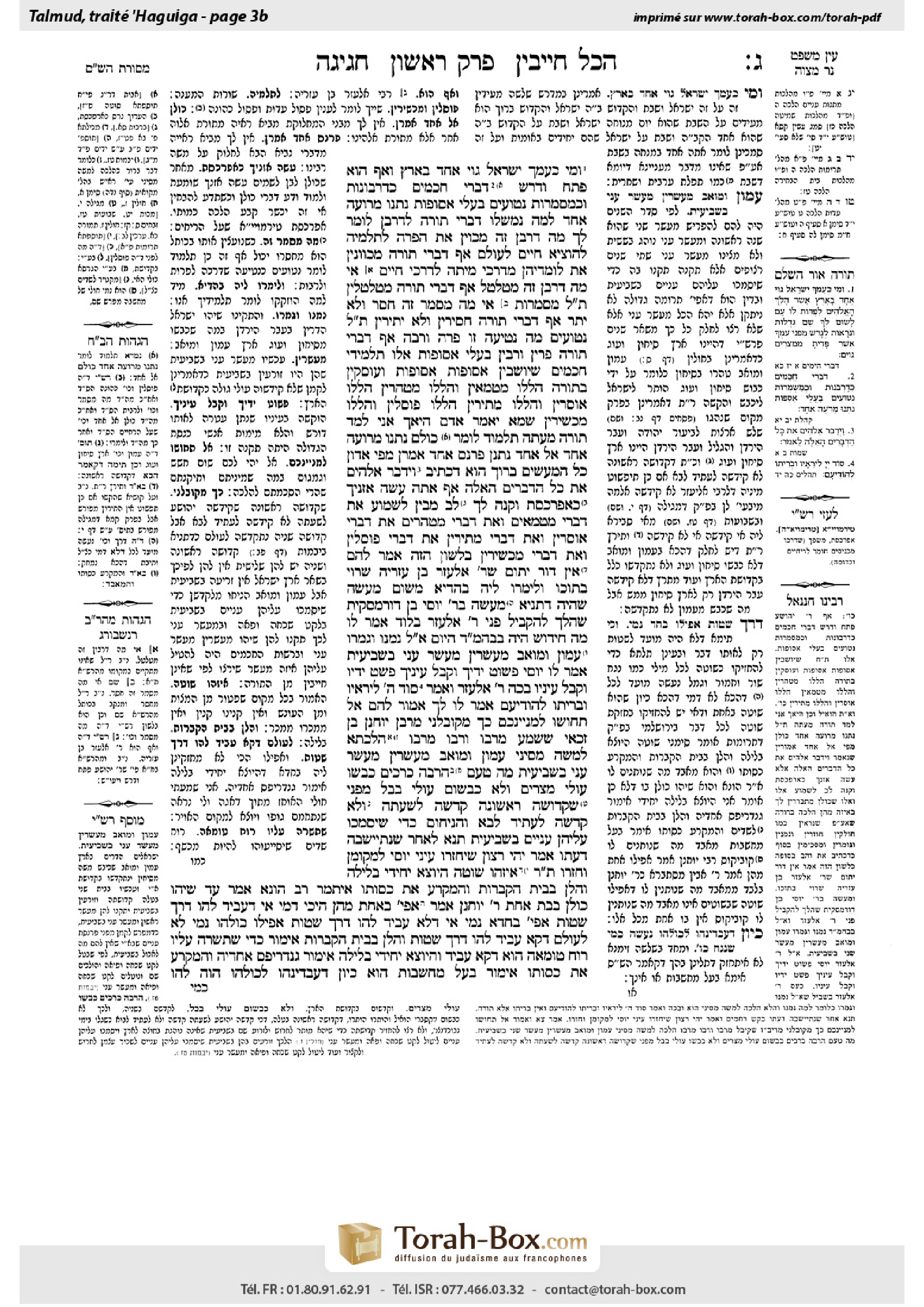
Chagigah 3b: Talmud study for Daf Yomi
Study the Talmud for Daf Yomi with scanned pages, Hebrew text, English translations from Sefaria and AI-generated French translations.
Passage selection and English or AI-generated French translation are available where the scan has annotations. Daf Study is independent of Torah-Box and Sefaria.
Browse Chagigah · חגיגה · All tractatesChagigah 3b text and translations
This page of Chagigah includes the Aramaic text, an English translation and an AI-generated French translation, alongside the scan above.
חגיגה ג׳ ב · Aramaic and Hebrew text
״וּמִי כְּעַמְּךָ יִשְׂרָאֵל גּוֹי אֶחָד בָּאָרֶץ״.
וְאַף הוּא פָּתַח וְדָרַשׁ: ״דִּבְרֵי חֲכָמִים כַּדָּרְבֹנוֹת וּכְמַשְׂמְרוֹת נְטוּעִים בַּעֲלֵי אֲסֻפּוֹת נִתְּנוּ מֵרוֹעֶה אֶחָד״, לָמָּה נִמְשְׁלוּ דִּבְרֵי תוֹרָה לְדָרְבָן? לוֹמַר לָךְ: מָה דָּרְבָן זֶה מְכַוֵּין אֶת הַפָּרָה לִתְלָמֶיהָ לְהוֹצִיא חַיִּים לְעוֹלָם — אַף דִּבְרֵי תוֹרָה מְכַוְּונִין אֶת לוֹמְדֵיהֶן מִדַּרְכֵי מִיתָה לְדַרְכֵי חַיִּים. אִי מָה דָּרְבָן זֶה מִטַּלְטֵל — אַף דִּבְרֵי תוֹרָה מִטַּלְטְלִין, תַּלְמוּד לוֹמַר: ״מַשְׂמְרוֹת״.
אִי מָה מַסְמֵר זֶה חָסֵר וְלֹא יָתֵר — אַף דִּבְרֵי תוֹרָה חֲסֵירִין וְלֹא יְתֵירִין, תַּלְמוּד לוֹמַר: ״נְטוּעִים״, מָה נְטִיעָה זוֹ פָּרָה וְרָבָה — אַף דִּבְרֵי תוֹרָה פָּרִין וְרָבִין. ״בַּעֲלֵי אֲסֻפּוֹת״ — אֵלּוּ תַּלְמִידֵי חֲכָמִים, שֶׁיּוֹשְׁבִין אֲסוּפּוֹת אֲסוּפּוֹת וְעוֹסְקִין בַּתּוֹרָה. הַלָּלוּ מְטַמְּאִין וְהַלָּלוּ מְטַהֲרִין, הַלָּלוּ אוֹסְרִין וְהַלָּלוּ מַתִּירִין, הַלָּלוּ פּוֹסְלִין וְהַלָּלוּ מַכְשִׁירִין,
שֶׁמָּא יֹאמַר אָדָם: הֵיאַךְ אֲנִי לָמֵד תּוֹרָה מֵעַתָּה — תַּלְמוּד לוֹמַר: ״כּוּלָּם נִתְּנוּ מֵרוֹעֶה אֶחָד״. אֵל אֶחָד נְתָנָן, פַּרְנָס אֶחָד אֲמָרָן, מִפִּי אֲדוֹן כׇּל הַמַּעֲשִׂים בָּרוּךְ הוּא, דִּכְתִיב: ״וַיְדַבֵּר אֱלֹהִים אֶת כׇּל הַדְּבָרִים הָאֵלֶּה״.
אַף אַתָּה, עֲשֵׂה אׇזְנֶיךָ כַּאֲפַרְכֶּסֶת, וּקְנֵה לְךָ לֵב מֵבִין לִשְׁמוֹעַ אֶת דִּבְרֵי מְטַמְּאִים וְאֶת דִּבְרֵי מְטַהֲרִים, אֶת דִּבְרֵי אוֹסְרִין וְאֶת דִּבְרֵי מַתִּירִין, אֶת דִּבְרֵי פוֹסְלִין וְאֶת דִּבְרֵי מַכְשִׁירִין. בַּלָּשׁוֹן הַזֶּה אָמַר לָהֶם: אֵין דּוֹר יָתוֹם שֶׁרַבִּי אֶלְעָזָר בֶּן עֲזַרְיָה שָׁרוּי בְּתוֹכוֹ.
וְלֵימְרוּ לֵיהּ בְּהֶדְיָא? מִשּׁוּם מַעֲשֶׂה שֶׁהָיָה. דְּתַנְיָא: מַעֲשֶׂה בְּרַבִּי יוֹסֵי בֶּן דּוֹרְמַסְקִית שֶׁהָלַךְ לְהַקְבִּיל פְּנֵי רַבִּי (אֶלְעָזָר) [אֱלִיעֶזֶר] בְּלוֹד, אָמַר לוֹ: מָה חִידּוּשׁ הָיָה בְּבֵית הַמִּדְרָשׁ הַיּוֹם?
אֲמַר לֵיהּ, נִמְנוּ וְגָמְרוּ: עַמּוֹן וּמוֹאָב מְעַשְּׂרִין מַעְשַׂר עָנִי בַּשְּׁבִיעִית.
אָמַר לוֹ: יוֹסֵי, פְּשׁוֹט יָדֶיךָ וְקַבֵּל עֵינֶיךָ. פָּשַׁט יָדָיו וְקִבֵּל עֵינָיו. בָּכָה רַבִּי אֶלְעָזָר וְאָמַר: ״סוֹד ה׳ לִירֵאָיו וּבְרִיתוֹ לְהוֹדִיעָם״.
אָמַר לוֹ, לֵךְ אֱמוֹר לָהֶם: אַל תָּחוּשׁוּ לְמִנְיַינְכֶם, כָּךְ מְקּוּבְּלַנִי מֵרַבָּן יוֹחָנָן בֶּן זַכַּאי, שֶׁשָּׁמַע מֵרַבּוֹ וְרַבּוֹ מֵרַבּוֹ: הִלְכְתָא לְמֹשֶׁה מִסִּינַי, עַמּוֹן וּמוֹאָב מְעַשְּׂרִין מַעְשַׂר עָנִי בַּשְּׁבִיעִית. מָה טַעַם — הַרְבֵּה כְּרַכִּים כָּבְשׁוּ עוֹלֵי מִצְרַיִם וְלֹא כְּבָשׁוּם עוֹלֵי בָּבֶל,
מִפְּנֵי שֶׁקְּדוּשָּׁה רִאשׁוֹנָה קִדְּשָׁה לִשְׁעָתָהּ וְלֹא קִדְּשָׁה לְעָתִיד לָבֹא, וְהִנִּיחוּם כְּדֵי שֶׁיִּסְמְכוּ עֲלֵיהֶן עֲנִיִּים בַּשְּׁבִיעִית.
תָּנָא: לְאַחַר שֶׁנִּתְיַישְּׁבָה דַּעְתּוֹ, אָמַר: יְהִי רָצוֹן שֶׁיַּחְזְרוּ עֵינֵי יוֹסֵי לִמְקוֹמָן, וְחָזְרוּ.
תָּנוּ רַבָּנַן: אֵיזֶהוּ שׁוֹטֶה? הַיּוֹצֵא יְחִידִי בַּלַּיְלָה, וְהַלָּן בְּבֵית הַקְּבָרוֹת, וְהַמְקָרֵעַ אֶת כְּסוּתוֹ. אִיתְּמַר, רַב הוּנָא אָמַר: עַד שֶׁיְּהוּ כּוּלָּן בְּבַת אַחַת, רַבִּי יוֹחָנָן אָמַר: אֲפִילּוּ בְּאַחַת מֵהֶן.
הֵיכִי דָמֵי? אִי דְּעָבֵיד לְהוּ דֶּרֶךְ שְׁטוּת — אֲפִילּוּ בַּחֲדָא נָמֵי, אִי דְּלָא עָבֵיד לְהוּ דֶּרֶךְ שְׁטוּת — אֲפִילּוּ כּוּלְּהוּ נָמֵי לָא.
לְעוֹלָם דְּקָא עָבֵיד לְהוּ דֶּרֶךְ שְׁטוּת, וְהַלָּן בְּבֵית הַקְּבָרוֹת — אֵימוֹר כְּדֵי שֶׁתִּשְׁרֶה עָלָיו רוּחַ טוּמְאָה הוּא דְּקָא עָבֵיד. וְהַיּוֹצֵא יְחִידִי בַּלַּיְלָה — אֵימוֹר גַּנְדְּרִיפַס אַחְדֵּיהּ, וְהַמְקָרֵעַ אֶת כְּסוּתוֹ — אֵימוֹר בַּעַל מַחְשָׁבוֹת הוּא, כֵּיוָן דְּעַבְדִינְהוּ לְכוּלְּהוּ, הָוֵה לְהוּ
Chagigah 3b · English translation
“And who is like Your people, Israel, one nation in the land?” (I Chronicles 17:21).
The Gemara adds: And Rabbi Elazar ben Azarya also commenced his lecture and taught: It is written: “The words of the wise are as goads, and as nails well fastened are those that are composed in collections; they are given by one shepherd” (Ecclesiastes 12:11). Why are matters of Torah compared to a goad? To tell you that just as this goad directs the cow to her furrow to bring forth sustenance for life to the world, so too the words of Torah direct those who study them from the paths of death to the paths of life. The Gemara asks: If so, derive the following from that same analogy: Just as this goad is movable and not rigid, so too matters of Torah are movable in accordance with circumstance and are not permanent. Therefore, the verse states: “Nails,” which are permanent.
The Gemara further asks: If so, one can explain as follows: Just as this nail is diminished in size and does not expand, as it wastes away over time, so too matters of Torah are gradually diminished and do not expand. Therefore, the verse states: “Well fastened [netuim].” Just as this plant [neti’a] flourishes and multiplies, so too matters of Torah flourish and multiply. “Those that are composed in collections [ba’alei asupot]”: These are Torah scholars who sit in many groups [asupot] and engage in Torah study. There are often debates among these groups, as some of these Sages render an object or person ritually impure and these render it pure; these prohibit an action and these permit it; these deem an item invalid and these deem it valid.
Lest a person say: Now, how can I study Torah when it contains so many different opinions? The verse states that they are all “given from one shepherd.” One God gave them; one leader, i.e., Moses, said them from the mouth of the Master of all creation, Blessed be He, as it is written: “And God spoke all these words” (Exodus 20:1). The plural form “words” indicates that God transmitted all the interpretations of the Ten Commandments. Since the Sages invariably utilize the Torah itself or the statements of the prophets as the sources for their opinions, there is a certain unity to the study of Torah, despite the numerous explanations and applications.
So too you, the student, make your ears like a funnel and acquire for yourself an understanding heart to hear both the statements of those who render objects ritually impure and the statements of those who render them pure; the statements of those who prohibit actions and the statements of those who permit them; the statements of those who deem items invalid and the statements of those who deem them valid. When Rabbi Yehoshua heard these interpretations, he said to them in these words: No generation is considered orphaned, i.e. without a leader, if Rabbi Elazar ben Azarya dwells among it.
The Gemara asks: But Rabbi Yoḥanan ben Beroka and Rabbi Elazar ben Ḥisma should have told Rabbi Yehoshua these statements of Rabbi Elazar ben Azarya directly, without delay. Why did they hesitate at first? The Gemara answers: They were hesitant due to an incident that occurred. As it is taught in a baraita: There was an incident involving Rabbi Yosei ben Durmaskit, who went to greet Rabbi Eliezer in Lod. Rabbi Elazar said to him: What novel idea was taught today in the study hall?
Rabbi Yosei ben Durmaskit said to him: The Sages assembled, counted the votes, and concluded that although the lands of Ammon and Moab on the eastern side of the Jordan River are not part of Eretz Yisrael, and therefore the halakhot of the Sabbatical Year and tithes should not apply to them, as these lands are adjacent to Eretz Yisrael, one separates the poor man’s tithe there in the Sabbatical Year. Since the Sages debated which tithes should be separated, they had to take a vote to determine the halakha in this regard.
Rabbi Elazar said to him in anger: Yosei, extend your hands and catch your eyes, which are about to come out of their sockets. He extended his hands and caught his eyes. Rabbi Elazar wept and said the verse: “The counsel of the Lord is with them who fear Him; and His covenant, to make them know it” (Psalms 25:14), i.e., the Sages arrived at the correct conclusion, although they were unaware of the proper rationale behind it.
Rabbi Elazar said to Rabbi Yosei to go and say to the Sages in the study hall: Do not be concerned with regard to your counting, that you might not have ruled properly, as you have not in fact instituted a new ordinance at all. This is the tradition that I received from Rabban Yoḥanan ben Zakkai, who heard from his teacher, and his teacher from his teacher: It is a halakha transmitted to Moses from Sinai that in Ammon and Moab one separates the poor man’s tithe in the Sabbatical Year. What is the reason? Those who ascended from Egypt conquered many cities, and those who ascended from Babylonia did not conquer them after the destruction of the First Temple.
This difference is important, because the first consecration of Eretz Yisrael, by those who ascended from Egypt, caused it to be sanctified only for its time and it was not sanctified forever, as that depended on the renewed conquest of the land by the Jewish people. And those who ascended from Babylonia left those cities aside and did not consider them part of Eretz Yisrael even after Jewish settlement was renewed there. They would plow and harvest in these places in the Sabbatical Year and tithe the poor man’s tithe, so that the poor of Eretz Yisrael, who did not have sufficient income from the previous years, could rely upon that produce in the Sabbatical Year, receiving help from this tithe.
It was taught that after Rabbi Elazar’s mind was put at ease, he said: May it be God’s will that Rabbi Yosei’s eyes should return to their place. And indeed his eyes returned. Due to this event, in which Rabbi Elazar responded harshly when his disciple related what he considered a novel idea, the students of Rabbi Yehoshua hesitated to recount what they had heard until their teacher encouraged them to do so.
§ The Sages taught: Who is considered an imbecile? One who goes out alone at night, and one who sleeps in a cemetery, and one who rends his garment. It was stated that Rav Huna said: One does not have the halakhic status of an imbecile until there are all of these signs present in him at the same time. Rabbi Yoḥanan said: He is considered an imbecile even due to the appearance of one of these signs.
The Gemara asks: What are the circumstances of the case under discussion? If he performs them in a deranged manner, then even the appearance of one sign should be enough to classify him as an imbecile. If he does not perform these actions in a deranged manner, but has a reason to act this way, then even if he performs all of them he should not be deemed an imbecile.
The Gemara answers: Actually, the baraita is referring to one who performs these actions in a deranged manner, but each action on its own could be explained rationally. With regard to one who sleeps in the cemetery, one could say that he is doing so in order that an impure spirit should settle upon him. Although it is inappropriate to do this, as there is a reason for this behavior it is not a sign of madness. And with regard to one who goes out alone at night, one could say that perhaps a fever took hold of him and he is trying to cool himself down. And as for one who tears his garments, one could say that he is a man engaged in thought, and out of anxiety he tears his clothing unintentionally. Despite these possible explanations, since one performed all of these together they are considered
Chagigah 3b · Traduction française (IA)
« Et qui est comme votre peuple, Israël, une nation dans le pays ? » (1 Rois 17:21).
La Guemara ajoute : Rabbi Elazar ben Azarya a également commencé sa lecture et enseigna : Il est écrit : « Les paroles des sages sont comme des bâtons, et comme des clous bien fixés sont ceux qui sont rédigés en collections ; ils sont donnés par un seul berger » (Ecclésiaste 12:11). Pourquoi les affaires de Torah sont-elles comparées à un bâton ? Pour vous dire que tout comme ce bâton guide la vache vers sa sillage afin de produire un aliment pour la vie du monde, de même les paroles de Torah guident ceux qui les étudient des chemins de la mort vers les chemins de la vie. La Guemara demande : Si c'est ainsi, tirez-en la conséquence suivante à partir de cette même comparaison : Tout comme ce bâton est mobile et non rigide, de même les affaires de Torah sont mobiles selon les circonstances et ne sont pas permanentes. Ainsi, la Sainte Écriture dit : « des clous », qui sont permanents.
La Guemara demande encore : Si c'est ainsi, on peut expliquer comme suit : Tout comme ce clou est diminué en taille et ne s'élargit pas, car il s'effrite avec le temps, de même les affaires de Torah sont progressivement diminuées et ne s'élargissent pas. Ainsi, la Sainte Écriture dit : « bien fixés [netuim] ». Tout comme cette plante [neti’a] fleurit et se multiplie, de même les affaires de Torah fleurissent et se multiplient. « Ceux qui sont rédigés en collections [ba’alei asupot] » : Ce sont les savants de Torah qui s'assoient dans de nombreux groupes [asupot] et s'engagent dans l'étude de la Torah. Il y a souvent des débats entre ces groupes, car certains de ces Sages déclarent un objet ou une personne impur rituellement, et d'autres le déclarent pur ; certains interdisent une action et d'autres la permettent ; certains considèrent un objet comme invalide et d'autres comme valide.
Pour que personne ne dise : Maintenant, comment puis-je étudier la Torah, puisqu'elle contient tant d'opinions différentes ? La Sainte Écriture dit qu'ils sont tous « donnés par un seul berger ». Un seul Dieu les a donnés ; un seul leader, c'est-à-dire Moïse, les a révélés à la bouche du Maître de toute création, béni soit-Il, comme il est écrit : « Et Dieu parla toutes ces paroles » (Exode 20:1). La forme plurielle « paroles » indique que Dieu a transmis toutes les interprétations des Dix Commandements. Puisque les Sages utilisent toujours la Torah elle-même ou les paroles des prophètes comme sources pour leurs opinions, il y a une certaine unité dans l'étude de la Torah, malgré les nombreuses explications et applications.
De même, toi, l'étudiant, fais tes oreilles comme un entonnoir et acquiers pour toi un cœur compréhensif pour entendre à la fois les paroles de ceux qui déclarent un objet rituellement impur et les paroles de ceux qui le déclarent pur ; les paroles de ceux qui interdisent une action et les paroles de ceux qui la permettent ; les paroles de ceux qui considèrent un objet comme invalide et les paroles de ceux qui le considèrent comme valide. Lorsque Rabbi Yéhoshua a entendu ces interprétations, il a dit à ceux-ci ces mots : Aucune génération n'est considérée comme orpheline, c'est-à-dire sans un leader, si Rabbi Elazar ben Azarya demeure parmi elle.
La Guemara demande : Mais Rabbi Yoḥanan ben Beroka et Rabbi Elazar ben Ḥisma auraient dû dire directement à Rabbi Yéhoshua ces paroles de Rabbi Elazar ben Azarya, sans délai. Pourquoi ont-ils hésité d'abord ? La Guemara répond : Ils hésitaient en raison d'un incident qui s'était produit. Il est enseigné dans une baraïta : Il y avait un incident concernant Rabbi Yosei ben Durmaskit, qui est allé saluer Rabbi Eliezer à Lod. Rabbi Elazar lui a dit : Quelle nouvelle idée a été enseignée aujourd'hui dans la salle d'étude ?
Rabbi Yosei ben Durmaskit lui a dit : Les Sages se sont réunis, ont compté les votes et ont conclu que bien que les terres d'Ammon et de Moab à l'est du fleuve Jourdain ne soient pas partie d'Eretz Yisrael, et donc les halakhot de la année sainte et des dîmes ne devraient pas s'appliquer à elles, car ces terres sont adjacentes à Eretz Yisrael, on sépare la dîme du pauvre en année sainte. Puisque les Sages débattaient sur quelles dîmes devaient être séparées, ils devaient prendre un vote pour déterminer la halakha à cet égard.
Rabbi Elazar lui a dit en colère : Yosei, étends tes mains et attrape tes yeux, qui sont sur le point de tomber de leurs orbites. Il a étendu ses mains et attrapé ses yeux. Rabbi Elazar a pleuré et a dit la Sainte Écriture : « Le conseil du Seigneur est avec ceux qui craignent Lui ; et Sa alliance, pour les faire connaître » (Psaumes 25:14), c'est-à-dire les Sages sont arrivés à la conclusion correcte, bien qu'ils ne fussent pas conscients de la raison correcte derrière cela.
Rabbi Elazar a dit à Rabbi Yosei de dire aux Sages de la salle d'étude : N'ayez pas peur concernant votre comptage, que vous n'ayez pas jugé correctement, car vous n'avez en fait pas institué une nouvelle ordonnance du tout. C'est la tradition que j'ai reçue de Rabban Yoḥanan ben Zakkai, qui a entendu de son maître, et son maître de son maître : C'est une halakha transmise à Moïse depuis Sinaï que dans Ammon et Moab on sépare la dîme du pauvre en année sainte. Quelle est la raison ? Ceux qui sont montés d'Égypte ont conquis beaucoup de villes, et ceux qui sont montés de Babylone n'ont pas conquis ces villes après la destruction du Premier Temple.
Cette différence est importante, car la première consécration d'Eretz Yisrael, par ceux qui sont montés d'Égypte, l'a sanctifiée seulement pour son temps et elle n'a pas été sanctifiée pour toujours, car cela dépendait de la reconquête du pays par le peuple juif. Et ceux qui sont montés de Babylone ont laissé ces villes de côté et ne les ont pas considérées comme partie d'Eretz Yisrael même après que la colonisation juive ait été renouvelée là. Ils ont labouré et récolté dans ces lieux en année sainte et ont séparé la dîme du pauvre, afin que les pauvres d'Eretz Yisrael, qui n'avaient pas suffisamment de revenus des années précédentes, puissent compter sur ce produit en année sainte, recevant de l'aide de cette dîme.
Il a été enseigné que, après que l'esprit de Rabbi Elazar ait été apaisé, il a dit : Que le Seigneur ait mis en œuvre que les yeux de Rabbi Yosei reviennent à leur place. Et effectivement, ses yeux sont revenus. En raison de cet événement, dans lequel Rabbi Elazar a répondu sévèrement lorsqu'on lui a rapporté ce qu'il considérait comme une idée nouvelle, les élèves de Rabbi Yéhoshua ont hésité à rapporter ce qu'ils avaient entendu jusqu'à ce que leur maître les encourage à le faire.
§ Les Sages enseignent : Qui est considéré comme un imbécile ? Celui qui sort seul la nuit, celui qui dort dans un cimetière, et celui qui déchire sa robe. Il a été dit que Rav Huna a dit : On ne considère pas une personne comme un imbécile tant qu'elle n'a pas simultanément tous ces signes. Rabbi Yoḥanan a dit : On le considère comme un imbécile même à cause de l'apparition d'un seul de ces signes.
La Guemara pose la question : Quelles sont les circonstances du cas en discussion ? Si elle les accomplit de manière déséquilibrée, alors même l'apparition d'un seul signe devrait suffire à le classer comme un imbécile. Si elle ne les accomplit pas de manière déséquilibrée, mais s'il y a une raison de les accomplit ainsi, alors même s'il les accomplit tous, il ne devrait pas être considéré comme un imbécile.
La Guemara répond : En réalité, la baraïta fait référence à une personne qui accomplit ces actions de manière déséquilibrée, mais chaque action prise séparément pourrait être expliquée rationnellement. En ce qui concerne celui qui dort dans le cimetière, on pourrait dire qu'il le fait afin qu'un esprit impur s'installe sur lui. Bien que cela soit inapproprié, comme il y a une raison pour ce comportement, cela n'est pas un signe de folie. Et en ce qui concerne celui qui sort seul la nuit, on pourrait dire qu'il est peut-être atteint de fièvre et qu'il essaie de se rafraîchir. Et quant à celui qui déchire ses vêtements, on pourrait dire qu'il est un homme en pleine réflexion, et qu'il déchire ses vêtements par inquiétude de manière involontaire. Malgré ces explications possibles, puisqu'il a accompli toutes ces actions ensemble, elles sont considérées
Traduction française générée par IA à partir de l’édition anglaise de Sefaria. Vérifie toujours un passage avec le texte source.
Text from Sefaria: William Davidson Edition - Vocalized Aramaic (CC BY NC); William Davidson Edition - English (CC BY NC).