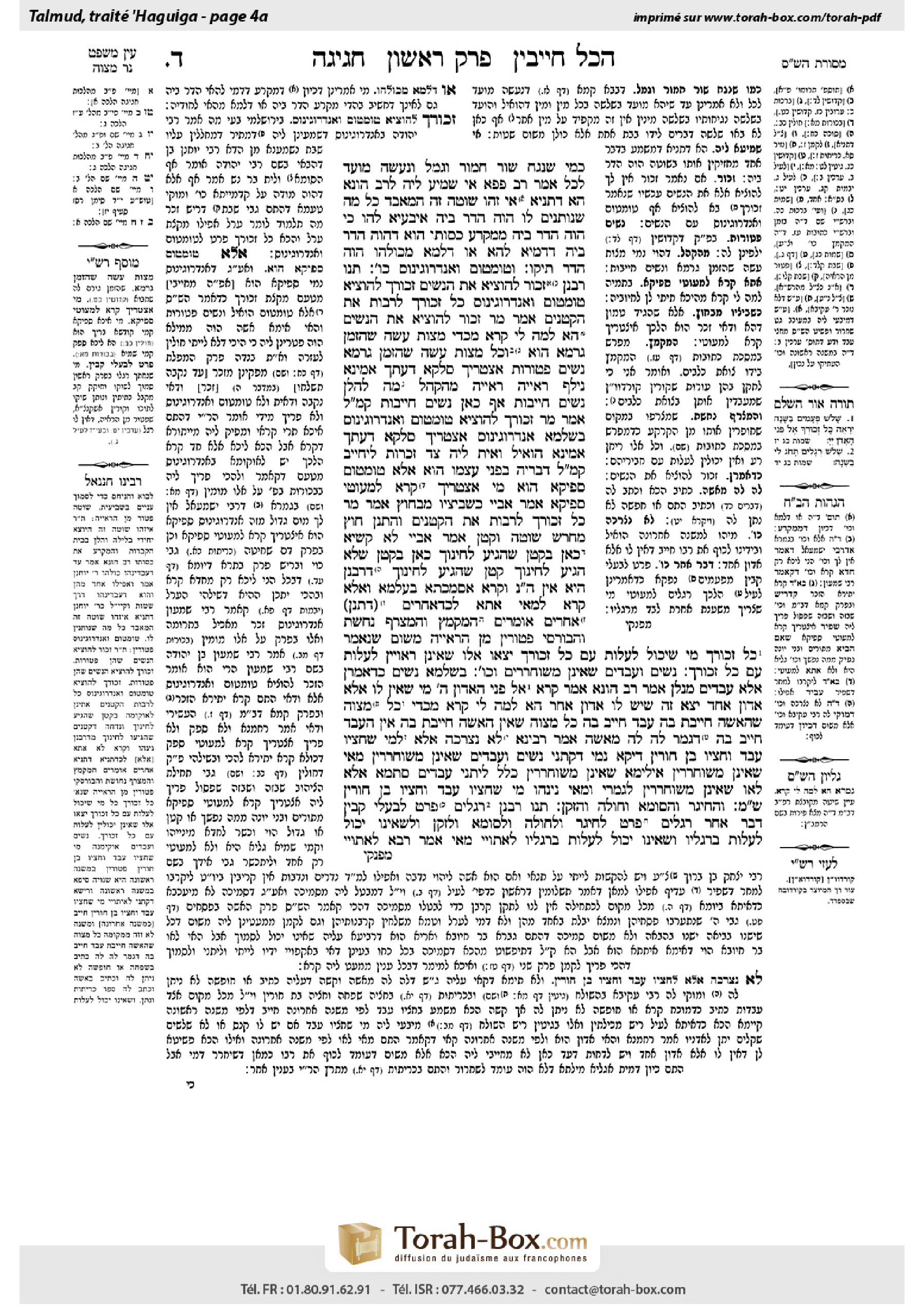
Chagigah 4a: Talmud study for Daf Yomi
Study the Talmud for Daf Yomi with scanned pages, Hebrew text, English translations from Sefaria and AI-generated French translations.
Passage selection and English or AI-generated French translation are available where the scan has annotations. Daf Study is independent of Torah-Box and Sefaria.
Browse Chagigah · חגיגה · All tractatesChagigah 4a text and translations
This page of Chagigah includes the Aramaic text, an English translation and an AI-generated French translation, alongside the scan above.
חגיגה ד׳ א · Aramaic and Hebrew text
כְּמִי שֶׁנָּגַח שׁוֹר חֲמוֹר וְגָמָל, וְנַעֲשָׂה מוּעָד לַכֹּל. אָמַר רַב פָּפָּא: אִי שְׁמִיעַ לֵיהּ לְרַב הוּנָא הָא דְּתַנְיָא: אֵי זֶהוּ שׁוֹטֶה — זֶה הַמְאַבֵּד כׇּל מַה שֶּׁנּוֹתְנִים לוֹ, הֲוָה הָדַר בֵּיהּ.
אִיבַּעְיָא לְהוּ: כִּי הֲוָה הָדַר בֵּיהּ — מִמְּקָרֵע כְּסוּתוֹ הוּא דַּהֲוָה הָדַר בֵּיהּ, דְּדָמְיָא לְהָא, אוֹ דִלְמָא: מִכּוּלְּהוּ הֲוָה הָדַר? תֵּיקוּ.
וְטוּמְטוּם וְאַנְדְּרוֹגִינוֹס כּוּ׳. תָּנוּ רַבָּנַן: ״זְכוּר״ לְהוֹצִיא אֶת הַנָּשִׁים. ״זְכוּרְךָ״, לְהוֹצִיא טוּמְטוּם וְאַנְדְּרוֹגִינוֹס. ״כָּל זְכוּרְךָ״, לְרַבּוֹת אֶת הַקְּטַנִּים.
אָמַר מָר: ״זְכוּר״, לְהוֹצִיא אֶת הַנָּשִׁים. הָא לְמָה לִי קְרָא? מִכְּדִי מִצְוַת עֲשֵׂה שֶׁהַזְּמַן גְּרָמָא הוּא, וְכׇל מִצְוַת עֲשֵׂה שֶׁהַזְּמַן גְּרָמָא נָשִׁים פְּטוּרוֹת!
אִצְטְרִיךְ, סָלְקָא דַּעְתָּךְ אָמֵינָא: נֵילַף ״רְאִיָּיה״ ״רְאִיָּיה״ מֵהַקְהֵל; מָה לְהַלָּן נָשִׁים חַיָּיבוֹת, אַף כָּאן נָשִׁים חַיָּיבוֹת, קָא מַשְׁמַע לַן.
אָמַר מָר: ״זְכוּרְךָ״, לְהוֹצִיא טוּמְטוּם וְאַנְדְּרוֹגִינוֹס. בִּשְׁלָמָא אַנְדְּרוֹגִינוֹס — אִצְטְרִיךְ, סָלְקָא דַּעְתָּךְ אָמֵינָא: הוֹאִיל וְאִית לֵיהּ צַד זַכְרוּת — לִיחַיַּיב, קָא מַשְׁמַע לַן דִּבְרִיָּה בִּפְנֵי עַצְמוֹ הוּא.
אֶלָּא טוּמְטוּם, סְפֵיקָא הוּא — מִי אִצְטְרִיךְ קְרָא לְמַעוֹטֵי סְפֵיקָא? אָמַר אַבָּיֵי: כְּשֶׁבֵּיצָיו מִבַּחוּץ.
אָמַר מָר: ״כׇּל זְכוּרְךָ״, לְרַבּוֹת אֶת הַקְּטַנִּים. וְהָתְנַן: חוּץ מֵחֵרֵשׁ שׁוֹטֶה וְקָטָן! אָמַר אַבָּיֵי, לָא קַשְׁיָא: כָּאן בְּקָטָן שֶׁהִגִּיעַ לְחִינּוּךְ, כָּאן בְּקָטָן שֶׁלֹּא הִגִּיעַ לְחִינּוּךְ. קָטָן שֶׁהִגִּיעַ לְחִינּוּךְ — דְּרַבָּנַן הִיא! אִין הָכִי נָמֵי, וּקְרָא אַסְמַכְתָּא בְּעָלְמָא.
וְאֶלָּא קְרָא לְמַאי אֲתָא? לִכְדַאֲחֵרִים. דִּתְנַן, אֲחֵרִים אוֹמְרִים: הַמְקַמֵּץ, וְהַמְצָרֵף נְחֹשֶׁת, וְהַבּוּרְסִי — פְּטוּרִין מִן הָרְאִיָּיה, מִשּׁוּם שֶׁנֶּאֱמַר: ״כׇּל זְכוּרְךָ״, מִי שֶׁיָּכוֹל לַעֲלוֹת עִם כׇּל זְכוּרְךָ. יָצְאוּ אֵלּוּ, שֶׁאֵינָן רְאוּיִין לַעֲלוֹת עִם כׇּל זְכוּרְךָ.
נָשִׁים וַעֲבָדִים שֶׁאֵינָן מְשׁוּחְרָרִים וְכוּ׳. בִּשְׁלָמָא נָשִׁים כְּדַאֲמַרַן, אֶלָּא עֲבָדִים מְנָלַן? אָמַר רַב הוּנָא, אָמַר קְרָא: ״אֶל פְּנֵי הָאָדוֹן ה׳״ — מִי שֶׁאֵין לוֹ אֶלָּא אָדוֹן אֶחָד, יָצָא זֶה שֶׁיֵּשׁ לוֹ אָדוֹן אַחֵר.
הָא לְמָה לִי קְרָא? מִכְּדֵי כׇּל מִצְוָה שֶׁהָאִשָּׁה חַיֶּיבֶת בָּהּ — עֶבֶד חַיָּיב בָּהּ, כׇּל מִצְוָה שֶׁאֵין הָאִשָּׁה חַיֶּיבֶת בָּהּ — אֵין הָעֶבֶד חַיָּיב בָּהּ, דְּגָמַר ״לָהּ״ ״לָהּ״ מֵאִשָּׁה!
אָמַר רָבִינָא: לֹא נִצְרְכָה אֶלָּא לְמִי שֶׁחֶצְיוֹ עֶבֶד וְחֶצְיוֹ בֶּן חוֹרִין. דַּיְקָא נָמֵי דְּקָתָנֵי: נָשִׁים וַעֲבָדִים שֶׁאֵינָן מְשׁוּחְרָרִין. מַאי שֶׁאֵינָן מְשׁוּחְרָרִין? אִילֵּימָא שֶׁאֵינָן מְשׁוּחְרָרִין כְּלָל — לִיתְנֵי ״עֲבָדִים״ סְתָמָא! אֶלָּא לָאו, שֶׁאֵינָן מְשׁוּחְרָרִין לִגְמָרֵי, וּמַאי נִינְהוּ — מִי שֶׁחֶצְיוֹ עֶבֶד וְחֶצְיוֹ בֶּן חוֹרִין. שְׁמַע מִינַּהּ.
וְהַחִיגֵּר וְהַסּוֹמֵא וְחוֹלֶה וְהַזָּקֵן. תָּנוּ רַבָּנַן: ״רְגָלִים״, פְּרָט לְבַעֲלֵי קַבִּין! דָּבָר אַחֵר: ״רְגָלִים״, פְּרָט לְחִיגֵּר וּלְחוֹלֶה וּלְסוֹמֵא וּלְזָקֵן וּלְשֶׁאֵינוֹ יָכוֹל לַעֲלוֹת בְּרַגְלָיו. וְשֶׁאֵינוֹ יָכוֹל לַעֲלוֹת בְּרַגְלָיו לְאֵתוֹיֵי מַאי? אָמַר רָבָא: לְאֵתוֹיֵי
Chagigah 4a · English translation
like the actions of a forewarned ox that gored an ox, a donkey, and a camel. Since this ox gored three different animals on three separate occasions, it is considered predisposed to gore and becomes forewarned for every type of animal. Likewise, if someone performs three different deranged actions, it is assumed that there is no logical reason for his behavior and he is classified as an imbecile. Rav Pappa said: If Rav Huna had heard that which is taught in a baraita: Who is an imbecile? This is one who destroys whatever is given to him, he would have retracted his statement that one is an imbecile only if he performs three deranged actions.
A dilemma was raised before the Sages with regard to Rav Pappa’s statement: When Rav Pappa claims that Rav Huna would have retracted his statement, would he have retracted only from the case of one who tears his garments, as this person is similar to one who destroys whatever is given to him? Or perhaps he would have retracted his opinion with regard to all of the signs of an imbecile? The Gemara states that the dilemma shall stand unresolved, as no answer was found.
§ The mishna taught: And a tumtum and a hermaphrodite are exempt from the mitzva of appearance in the Temple. The Sages taught, with regard to the verse: “Three occasions in the year all your males will appear before the Lord God” (Exodus 23:17), had the verse simply said “males,” this would serve to exclude women from this mitzva. By specifying “your males,” it comes to exclude a tumtum and a hermaphrodite as well. Furthermore, when the verse adds “all your males,” this serves to include male minors.
The Master said in the baraita: “Males” comes to exclude women. The Gemara asks: Why do I need a verse for this halakha? After all, the obligation of appearance on a Festival is a positive, time-bound mitzva, and women are exempt from any positive, time-bound mitzva.
The Gemara answers: This statement was necessary, as otherwise it could enter your mind to say: Let us derive by means of a verbal analogy between the term: Appearance, which appears here, and the term: Appearance, stated with regard to the mitzva of assembly (Deuteronomy 31:11), which is also a positive, time-bound mitzva. Just as there, women are obligated in the mitzva of assembly, so too here, women are obligated in the mitzva of appearance on the Festival. Therefore, the baraita teaches us that women are exempt.
The Master said in the baraita: “Your males” comes to exclude a tumtum and a hermaphrodite. The Gemara asks: Granted, the exclusion of a hermaphrodite was necessary, as it could enter your mind to say that since he possesses an aspect of masculinity, i.e., he has a male sexual organ, he should be obligated like a male. Therefore, the baraita teaches us that a hermaphrodite is a being unto itself, which is neither male nor female.
However, as the status of a tumtum, who lacks external sexual organs, is a halakhic uncertainty, is a verse necessary to exclude an uncertainty? Abaye said: It is referring to a case when the testicles of a tumtum are on the outside, although his penis is not visible. The verse teaches that this tumtum is not obligated in the mitzva of appearance, despite the fact that he is certainly male.
The Master said in the baraita: “All your males” comes to include minors. The Gemara asks: Didn’t we learn in the mishna: All are obligated to appear, except for a deaf-mute, an imbecile, and a minor? Abaye said: This is not difficult. Here, the baraita that obligates minors is referring to a minor who has reached the age of training in mitzvot. There, the mishna is referring to a minor who has not yet reached the age of training in mitzvot, and therefore he is exempt from the mitzva of appearance. The Gemara asks: The obligation of a minor who has reached the age of training is one that applies by rabbinic law. How then can the baraita derive this halakha from a verse? The Gemara answers: Yes, it is indeed so, and the verse is a mere support for this rabbinic obligation.
The Gemara asks: Rather, for what purpose does the verse: “All your males,” come? It comes to teach that which Aḥerim taught. As it is taught in a baraita: Aḥerim say that a scrimper, one who gathers dog feces to give them to tanners for the purpose of tanning hides; and a melder of copper, who purifies copper from dross; and a tanner of hides, are all exempt from the mitzva of appearance, as their occupation inflicts upon them a particularly unpleasant odor. This is because it is stated: “All your males,” which indicates that only one who is able to ascend with all your males is obligated, excluding those who are not suited to ascend with all your males, as people avoid their company.
§ The mishna taught that women and slaves who are not emancipated are exempt from the mitzva of appearance. The Gemara asks: Granted, women are exempt, as we said earlier that this is derived from the phrase: “Your males.” However, with regard to slaves, from where do we derive that they are exempt? Rav Huna said that the verse states: “Before the Lord God” (Exodus 23:17). This indicates that one who has only one Master is obligated, which excludes this slave, who has another master.
The Gemara asks: Why do I need a verse to teach this halakha? After all, with regard to every mitzva in which a woman is obligated, a slave is also obligated in that mitzva; and with regard to every mitzva in which a woman is not obligated, a slave is not obligated in it either. The reason for this principle is that it is derived by means of a verbal analogy between the phrase: “To her” (Leviticus 19:20), written with regard to a designated maidservant, and the phrase: “To her” (Deuteronomy 24:3), written with regard to a divorced woman.
Ravina said: This verse is necessary only to teach the exemption of one who is half-slave half-freeman. The Gemara notes that the language of the mishna is also precise, as it teaches: Women and slaves who are not emancipated. What is the purpose of specifying: Who are not emancipated? If we say that this means that they are not emancipated at all, let it simply teach: Slaves, without any further description. Rather, is it not the case that the mishna is referring to slaves who are not entirely emancipated? And who are these slaves? One who is half-slave half-freeman. The Gemara concludes: Learn from this that this is correct.
The mishna further taught: And the lame, and the blind, and the sick, and the old are all exempt from the mitzva of appearance. The Sages taught: “Times [regalim]” (Exodus 23:14) alludes to the use of one’s feet [raglayim], and therefore it excludes people with artificial legs. Although they are able to walk, they are exempt from traveling, as they do not have feet. Alternatively, the term “regalim” comes to exclude the lame, the sick, the blind, the old, and one who is unable to ascend on his own feet. The Gemara asks: The last category of one who is unable to ascend on his feet, comes to add what? The baraita already taught that the lame and the sick are exempt. Rava said: It comes to add
Chagigah 4a · Traduction française (IA)
comme les actions d'un bœuf averti qui a renversé un bœuf, un âne et un chameau. Puisque cet bœuf a renversé trois animaux différents à trois reprises différentes, il est considéré comme prédisposé à renverser et devient averti pour chaque type d'animal. De même, si quelqu'un commet trois actions différentes de folie, on considère qu'il n'y a pas de raison logique pour son comportement et il est classé comme un imbécile. Rav Pappa a dit : Si Rav Huna avait entendu ce qui est enseigné dans une baraïta : Qui est un imbécile ? C'est celui qui détruit tout ce qui lui est donné, il aurait rétracté son affirmation selon laquelle on est imbécile uniquement si l'on commet trois actions de folie.
Un dilemme a été soulevé devant les Sages concernant l'affirmation de Rav Pappa : Lorsque Rav Pappa affirme que Rav Huna aurait rétracté son affirmation, aurait-il rétracté uniquement dans le cas d'une personne qui déchire ses vêtements, comme cette personne est semblable à celui qui détruit tout ce qui lui est donné ? Ou bien aurait-il rétracté son opinion concernant tous les signes d'un imbécile ? La Guemara indique que ce dilemme restera sans réponse, car aucune réponse n'a été trouvée.
§ La mitsna enseigne : Et le tumtum et l'hermaphrodite sont exemptés de la mitsva de l'apparition dans le Temple. Les Sages enseignent, concernant la parole : « Trois fois par an, tous vos mâles apparaîtront devant l'Éternel, votre Dieu » (Exode 23:17), si la parole avait simplement dit « mâles », cela aurait servi à exclure les femmes de cette mitsva. En précisant « vos mâles », cela vise à exclure le tumtum et l'hermaphrodite également. De plus, lorsque la parole ajoute « tous vos mâles », cela sert à inclure les mineurs masculins.
Le Maître a dit dans la baraïta : « Mâles » sert à exclure les femmes. La Guemara pose la question : Pourquoi avoir besoin d'une parole pour cette halakha ? Après tout, l'obligation d'apparition lors d'un festival est une mitsva positive, temporelle, et les femmes sont exemptées de toute mitsva positive, temporelle.
La Guemara répond : Cette déclaration était nécessaire, car autrement, on pourrait penser que l'on peut déduire par analogie verbale entre le terme : Apparition, qui apparaît ici, et le terme : Apparition, mentionné concernant la mitsva de rassemblement (Deutéronome 31:11), qui est également une mitsva positive, temporelle. Comme là, les femmes sont obligées à la mitsva de rassemblement, ainsi ici, les femmes sont obligées à la mitsva d'apparition lors du festival. Par conséquent, la baraïta nous enseigne que les femmes sont exemptées.
Le Maître a dit dans la baraïta : « Vos mâles » sert à exclure le tumtum et l'hermaphrodite. La Guemara pose la question : Cela est évident, l'exclusion de l'hermaphrodite était nécessaire, car on pourrait penser que puisqu'il possède un aspect masculin, c'est-à-dire qu'il a un organe sexuel masculin, il devrait être obligé comme un mâle. Par conséquent, la baraïta nous enseigne que l'hermaphrodite est une créature à part, ni mâle ni femelle.
Cependant, comme le statut du tumtum, qui manque d'organes sexuels externes, est une incertitude halakhique, pourquoi avoir besoin d'une parole pour exclure une incertitude ? Abaye a dit : Il s'agit d'un cas où les testicules du tumtum sont à l'extérieur, bien que son pénis ne soit pas visible. La parole enseigne que ce tumtum n'est pas tenu de la mitsva de l'apparence, malgré le fait qu'il est certainement mâle.
Le Maître a dit dans la baraïta : « Tous vos mâles » sert à inclure les mineurs. La Guemara pose la question : N'avons-nous pas appris dans la mitsna : Tous sont obligés d'apparaître, sauf le sourd-muet, l'imbécile et le mineur ? Abaye a dit : Ce n'est pas difficile. Ici, la baraïta qui oblige les mineurs fait référence à un mineur qui a atteint l'âge de l'entraînement aux mitsvot. Là, la mitsna fait référence à un mineur qui n'a pas encore atteint l'âge de l'entraînement aux mitsvot, et donc il est exempt de la mitsva d'apparition. La Guemara pose la question : L'obligation du mineur qui a atteint l'âge de l'entraînement est une obligation de droit rabbinique. Comment alors la baraïta peut-elle déduire cette halakha d'une parole ? La Guemara répond : Oui, c'est exact, et la parole est simplement un soutien pour cette obligation rabbinique.
La Guemara pose la question : Plutôt, à quel effet la parole : « Tous vos mâles », vient-elle ? Elle vient enseigner ce que Aḥerim a enseigné. Comme il est enseigné dans une baraïta : Aḥerim disent que le ramasseur de crottins, celui qui ramasse les crottins de chien pour les donner aux tanneurs afin de tanner les peaux ; et le purificateur de cuivre, qui purifie le cuivre des impuretés ; et le tanneur de peaux, sont tous exemptés de la mitsva d'apparition, car leur occupation leur cause une odeur particulièrement désagréable. Cela est dû à la parole : « Tous vos mâles », qui indique que seul celui qui peut monter avec tous vos mâles est obligé, excluant ceux qui ne sont pas adaptés à monter avec tous vos mâles, car les gens évitent leur compagnie.
§ La mitsna a enseigné que les femmes et les esclaves non emancipés sont exemptés de la mitsva d'apparition. La Guemara pose la question : Cela est évident, les femmes sont exemptées, comme nous l'avons dit plus tôt, en déduisant de la phrase : « Vos mâles ». Cependant, concernant les esclaves, d'où déduisons-nous qu'ils sont exemptés ? Rav Huna a dit que la parole dit : « Devant l'Éternel, votre Dieu » (Exode 23:17). Cela indique que celui qui a un seul Maître est obligé, ce qui exclut cet esclave, qui a un autre maître.
La Guemara pose la question : Pourquoi avoir besoin d'une parole pour enseigner cette halakha ? Après tout, concernant toute mitsva dans laquelle une femme est obligée, un esclave est également obligé de cette mitsva ; et concernant toute mitsva dans laquelle une femme n'est pas obligée, un esclave n'est pas obligé de celle-ci non plus. La raison de ce principe est qu'il est déduit par analogie verbale entre la phrase : « À elle » (Lévitique 19:20), écrite concernant une servante désignée, et la phrase : « À elle » (Deutéronome 24:3), écrite concernant une femme divorcée.
Ravina a dit : Cette versette est nécessaire uniquement pour enseigner l'exemption de celui qui est moitié esclave et moitié libre. La Guemara note que la langue de la michna est aussi précise, car elle enseigne : Les femmes et les esclaves non emancipés. À quoi sert de préciser : Qui ne sont pas emancipés ? Si nous disons que cela signifie qu'ils ne sont pas emancipés du tout, il suffirait de simplement enseigner : Les esclaves, sans aucune description supplémentaire. Plutôt, n'est-ce pas le cas que la michna fait référence à des esclaves qui ne sont pas entièrement emancipés ? Et qui sont ces esclaves ? Celui qui est moitié esclave et moitié libre. La Guemara conclut : Apprenez-en que cela est correct.
La michna a également enseigné : Et le boiteux, et le voyant, et le malade, et le vieillard sont tous exemptés de la mitsva de l'apparition. Les Sages ont enseigné : « Les temps [regalim] » (Exode 23:14) fait référence à l'usage des pieds [raglayim], et donc il exclut les personnes ayant des prothèses. Bien qu'ils soient capables de marcher, ils sont exemptés de voyager, car ils n'ont pas de pieds. Alternativement, le terme « regalim » vient exclure le boiteux, le malade, le voyant, le vieillard et celui qui n'est pas capable de monter seul sur ses pieds. La Guemara demande : La dernière catégorie, celui qui n'est pas capable de monter seul sur ses pieds, vient ajouter quoi ? La baraïta a déjà enseigné que le boiteux et le malade sont exemptés. Rava a dit : Cela vient ajouter
Traduction française générée par IA à partir de l’édition anglaise de Sefaria. Vérifie toujours un passage avec le texte source.
Text from Sefaria: William Davidson Edition - Vocalized Aramaic (CC BY NC); William Davidson Edition - English (CC BY NC).