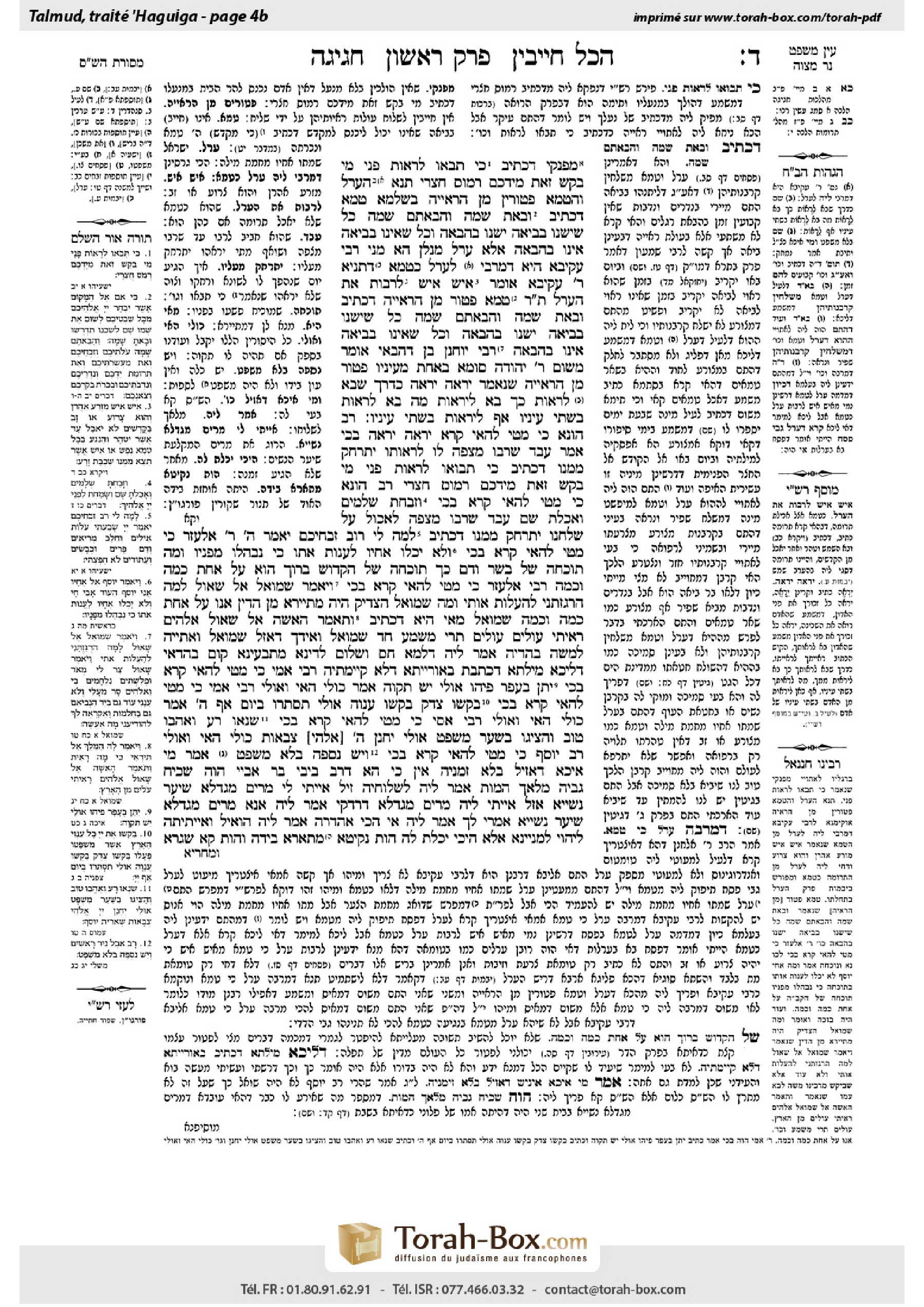
Chagigah 4b: Talmud study for Daf Yomi
Study the Talmud for Daf Yomi with scanned pages, Hebrew text, English translations from Sefaria and AI-generated French translations.
Passage selection and English or AI-generated French translation are available where the scan has annotations. Daf Study is independent of Torah-Box and Sefaria.
Browse Chagigah · חגיגה · All tractatesChagigah 4b text and translations
This page of Chagigah includes the Aramaic text, an English translation and an AI-generated French translation, alongside the scan above.
חגיגה ד׳ ב · Aramaic and Hebrew text
מְפַנְּקִי, דִּכְתִיב: ״כִּי תָבֹאוּ לֵרָאוֹת פָּנָי מִי בִקֵּשׁ זֹאת מִיֶּדְכֶם רְמוֹס חֲצֵרָי״.
תָּנָא: הֶעָרֵל וְהַטָּמֵא פְּטוּרִין מִן הָרְאִיָּיה. בִּשְׁלָמָא טָמֵא — דִּכְתִיב: ״וּבָאתָ שָּׁמָּה״ ״וַהֲבֵאתֶם שָׁמָּה״, כׇּל שֶׁיֶּשְׁנוֹ בְּבִיאָה — יֶשְׁנוֹ בַּהֲבָאָה, וְכׇל שֶׁאֵינוֹ בְּבִיאָה — אֵינוֹ בַּהֲבָאָה
אֶלָּא עָרֵל מְנָלַן? הָא מַנִּי רַבִּי עֲקִיבָא הִיא, דִּמְרַבֵּי לְעָרֵל כְּטָמֵא. דְּתַנְיָא, רַבִּי עֲקִיבָא אוֹמֵר: ״אִישׁ אִישׁ״, לְרַבּוֹת אֶת הֶעָרֵל.
תָּנוּ רַבָּנַן: טָמֵא פָּטוּר מִן הָרְאִיָּיה, דִּכְתִיב: ״וּבָאתָ שָּׁמָּה״ ״וַהֲבֵאתֶם שָׁמָּה״. כׇּל שֶׁיֶּשְׁנוֹ בְּבִיאָה — יֶשְׁנוֹ בַּהֲבָאָה, וְכׇל שֶׁאֵינוֹ בְּבִיאָה — אֵינוֹ בַּהֲבָאָה.
רַבִּי יוֹחָנָן בֶּן דַּהֲבַאי אוֹמֵר מִשּׁוּם רַבִּי יְהוּדָה: סוֹמֵא בְּאַחַת מֵעֵינָיו פָּטוּר מִן הָרְאִיָּיה, שֶׁנֶּאֱמַר: ״יִרְאֶה״ ״יֵרָאֶה״, כְּדֶרֶךְ שֶׁבָּא לִרְאוֹת כָּךְ בָּא לֵירָאוֹת. מַה בָּא לִרְאוֹת — בִּשְׁתֵּי עֵינָיו, אַף לֵירָאוֹת — בִּשְׁתֵּי עֵינָיו.
רַב הוּנָא כִּי מָטֵי לְהַאי קְרָא ״יִרְאֶה״ ״יֵרָאֶה״, בָּכֵי. אָמַר: עֶבֶד שֶׁרַבּוֹ מְצַפֶּה לוֹ לִרְאוֹתוֹ יִתְרַחֵק מִמֶּנּוּ, דִּכְתִיב: ״כִּי תָבוֹאוּ לֵרָאוֹת פָּנָי מִי בִקֵּשׁ זֹאת מִיֶּדְכֶם רְמוֹס חֲצֵרָי״.
רַב הוּנָא כִּי מָטֵי לְהַאי קְרָא, בָּכֵי: ״וְזָבַחְתָּ שְׁלָמִים וְאָכַלְתָּ שָּׁם״, עֶבֶד שֶׁרַבּוֹ מְצַפֶּה לֶאֱכוֹל עַל שֻׁלְחָנוֹ יִתְרַחֵק מִמֶּנּוּ? דִּכְתִיב: ״לָמָּה לִּי רוֹב זִבְחֵיכֶם יֹאמַר ה׳״.
רַבִּי אֶלְעָזָר כִּי מָטֵי לְהַאי קְרָא, בָּכֵי: ״וְלֹא יָכְלוּ אֶחָיו לַעֲנוֹת אֹתוֹ כִּי נִבְהֲלוּ מִפָּנָיו״, וּמָה תּוֹכֵחָה שֶׁל בָּשָׂר וָדָם כָּךְ, תּוֹכֵחָה שֶׁל הַקָּדוֹשׁ בָּרוּךְ הוּא — עַל אַחַת כַּמָּה וְכַמָּה. רַבִּי אֶלְעָזָר כִּי מָטֵי לְהַאי קְרָא, בָּכֵי: ״וַיֹּאמֶר שְׁמוּאֵל אֶל שָׁאוּל לָמָּה הִרְגַּזְתַּנִי לְהַעֲלוֹת אוֹתִי״, וּמָה שְׁמוּאֵל הַצַּדִּיק הָיָה מִתְיָירֵא מִן הַדִּין, אָנוּ — עַל אַחַת כַּמָּה וְכַמָּה!
שְׁמוּאֵל מַאי הִיא — דִּכְתִיב: ״וַתֹּאמֶר הָאִשָּׁה אֶל שָׁאוּל אֱלֹהִים רָאִיתִי עוֹלִים״. ״עוֹלִים״ — תְּרֵי מַשְׁמַע: חַד שְׁמוּאֵל, וְאִידָּךְ — דַּאֲזַל שְׁמוּאֵל וְאַתְיֵיהּ לְמֹשֶׁה בַּהֲדֵיהּ. אֲמַר לֵיהּ: דִּלְמָא חַס וְשָׁלוֹם לְדִינָא מִתְבְּעֵינָא, קוּם בַּהֲדַאי, דְּלֵיכָּא מִילְּתָא דִּכְתַבְתְּ בְּאוֹרָיְיתָא דְּלָא קַיֵּימְתַּיהּ.
רַבִּי אַמֵּי כִּי מָטֵי לְהַאי קְרָא, בָּכֵי: ״יִתֵּן בֶּעָפָר פִּיהוּ אוּלַי יֵשׁ תִּקְוָה״, אָמַר: כּוּלֵּי הַאי וְ״אוּלַי״?! רַבִּי אַמֵּי כִּי מָטֵי לְהַאי קְרָא, בָּכֵי: ״בַּקְּשׁוּ צֶדֶק בַּקְּשׁוּ עֲנָוָה אוּלַי תִּסָּתְרוּ בְּיוֹם אַף ה׳״, אָמַר: כּוּלֵּי הַאי וְ״אוּלַי״?! רַבִּי אַסִּי כִּי מָטֵי לְהַאי קְרָא, בָּכֵי: ״שִׂנְאוּ רָע וְאֶהֱבוּ טוֹב וְהַצִּיגוּ בַשַּׁעַר מִשְׁפָּט אוּלַי יֶחֱנַן ה׳ [אֱלֹהֵי] צְבָאוֹת״, כּוּלֵּי הַאי וְ״אוּלַי״?!
רַב יוֹסֵף כִּי מָטֵי לְהַאי קְרָא, בָּכֵי: ״וְיֵשׁ נִסְפֶּה בְּלֹא מִשְׁפָּט״, אָמַר: מִי אִיכָּא דְּאָזֵיל בְּלָא זִמְנֵיהּ? אִין, כִּי הָא דְּרַב בִּיבִי בַּר אַבָּיֵי הֲוָה שְׁכִיחַ גַּבֵּיהּ מַלְאַךְ הַמָּוֶת. אֲמַר לֵיהּ לִשְׁלוּחֵיהּ: זִיל אַיְיתִי לִי מִרְיָם מְגַדְּלָא שְׂיעַר נַשְׁיָיא. אֲזַל, אַיְיתִי לֵיהּ מִרְיָם מְגַדְּלָא דַּרְדְּקֵי.
אֲמַר לֵיהּ: אֲנָא מִרְיָם מְגַדְּלָא שֵׂיעָר נְשַׁיָּיא אֲמַרִי לָךְ! אֲמַר לֵיהּ: אִי הָכִי, אַהְדְּרַהּ! אֲמַר לֵיהּ: הוֹאִיל וְאַיְיתִיתַהּ — לֶיהֱוֵי לְמִנְיָינָא! אֶלָּא הֵיכִי יְכֵלְתְּ לַהּ? הֲוָת נְקִיטָא מְתָארָא בִּידַהּ וַהֲוָת קָא שָׁגְרָא
Chagigah 4b · English translation
a delicate man, who cannot walk without shoes. As it is written: “When you come to appear before Me, who has required this at your hand, to trample My courts?” (Isaiah 1:12). Entering the Temple with shoes is described by the prophet as trampling, and therefore one who cannot enter barefoot is exempt from the mitzva of appearance.
It is taught: The uncircumcised and the ritually impure are exempt from the mitzva of appearance. The Gemara comments: Granted, a ritually impure person is exempt, as it is written: “And there you shall come” (Deuteronomy 12:5), followed by: “And there you shall bring” (Deuteronomy 12:6). The juxtaposition of these verses teaches: Anyone included in the mitzva of coming, i.e., anyone who may enter the Temple, is also included in the obligation of bringing offerings; and anyone not included in the mitzva of coming is not included in the obligation of bringing either. Since it is prohibited for a person who is ritually impure to enter the Temple, he is also exempt from the obligation to bring a burnt-offering of appearance.
However, with regard to the uncircumcised, from where do we derive that he is exempt? The Gemara answers: In accordance with whose opinion is this baraita? It is in accordance with the opinion of Rabbi Akiva, who amplifies the halakha so that the uncircumcised is included in the same category as the ritually impure. As it is taught in a baraita: Rabbi Akiva says, with regard to the verse: “Any man [ish ish] of the seed of Aaron that is a leper or has an issue; he shall not eat of the sacred things” (Leviticus 22:4), the double use of the term: “Ish,” comes to include the uncircumcised. Like the ritually impure, the uncircumcised may neither eat sacrificial meat nor bring offerings to the Temple.
The Sages taught: A ritually impure person is exempt from the mitzva of appearance, as it is written: “And there shall you come,” “and there you shall bring.” Anyone included in coming is also included in the obligation of bringing offerings; and anyone not included in coming is not included in the obligation of bringing either.
Rabbi Yoḥanan ben Dehavai says in the name of Rabbi Yehuda: One who is blind in one of his eyes is exempt from the mitzva of appearance, as it is stated: “Three times a year all your males shall appear [yera’e] before the Lord God” (Exodus 23:17). Since there are no vowels in the text, this can be read as: All your males will see [yireh] the Lord God. This teaches that in the same manner that one comes to see, so he comes to be seen: Just as one comes to see with both his eyes, so too the obligation to be seen applies only to one who comes with both his eyes. Therefore, one who is blind in one eye is exempt from the mitzva of appearance in the Temple.
The Gemara relates that when Rav Huna reached this verse, which can be read as: “Will see” [yireh] and “shall appear” [yera’e], he cried. He said: Can it happen to a slave whose master expects to see him, that the master will eventually distance himself from him and not want him anymore? As it is written: “When you come to appear before Me, who has required this at your hand, to trample My courts?” (Isaiah 1:12).
Similarly, when Rav Huna reached this verse, he cried: “And you shall sacrifice peace-offerings, and you shall eat there” (Deuteronomy 27:7). Can it happen to a slave whose master expects him to eat at his table, that his master will eventually distance himself from him? As it is written: “To what purpose is the multitude of your offerings to Me? says the Lord” (Isaiah 1:11).
The Gemara similarly relates: When Rabbi Elazar reached this verse, he cried: “And his brethren could not answer him, for they were affrighted at his presence” (Genesis 45:3). He said, in explanation of his emotional reaction: If the rebuke of a man of flesh and blood was such that the brothers were unable to respond, when it comes to the rebuke of the Holy One, Blessed be He, all the more so. When Rabbi Elazar reached this verse, he cried: “And Samuel said to Saul: Why have you disquieted me, to bring me up” (I Samuel 28:15). He said: If Samuel the righteous was afraid of judgment when he was raised by necromancy, as he thought he was being summoned for a Divine judgment, all the more so that we should be afraid.
The Gemara asks: In the case of Samuel, what is it that he feared? As it is written: “And the woman said to Saul, I see a godlike being coming up [olim] out of the earth” (I Samuel 28:13). “Olim,” in the plural form, indicates that there were two of them. One of them was Samuel, but the other, who was he? The Gemara explains that Samuel went and brought Moses with him. He said to Moses: Perhaps, Heaven forbid, I was summoned for judgment by God; stand with me and testify on my behalf that there is nothing that you wrote in the Torah that I did not fulfill.
When Rabbi Ami reached this verse, he cried: “Let him put his mouth in the dust, perhaps there may be hope” (Lamentations 3:29). He said: A sinner suffers through all this punishment and only perhaps there may be hope? When Rabbi Ami reached this verse, he cried: “Seek righteousness, seek humility; perhaps you shall be hidden on the day of the Lord’s anger”(Zephaniah 2:3). He said: All of this is expected of each individual, and only perhaps God’s anger may be hidden? Likewise, when Rabbi Asi reached this verse, he cried: “Hate the evil, and love the good, and establish justice in the gate; perhaps the Lord, the God of hosts, will be gracious” (Amos 5:15). He said: All of this, and only perhaps?
When Rav Yosef reached this verse, he cried: “But there are those swept away without justice” (Proverbs 13:23). He said: Is there one who goes before his time and dies for no reason? The Gemara answers: Yes, like this incident of Rav Beivai bar Abaye, who would be frequented by the company of the Angel of Death and would see how people died at the hands of this angel. The Angel of Death said to his agent: Go and bring me, i.e., kill, Miriam the raiser, i.e., braider, of women’s hair. He went, but instead brought him Miriam, the raiser of babies.
The Angel of Death said to him: I told you to bring Miriam, the raiser of women’s hair. His agent said to him: If so, return her to life. He said to him: Since you have already brought her, let her be counted toward the number of deceased people. Apparently, this woman died unintentionally. Rav Beivai asked the agent: But as her time to die had not yet arrived, how were you able to kill her? The agent responded that he had the opportunity, as she was holding a shovel in her hand and with it she was lighting
Chagigah 4b · Traduction française (IA)
Un homme délicat, qui ne peut marcher sans chaussures. Comme il est écrit : « Quand vous viendrez vous présenter devant Moi, qui a exigé cela de votre main, pour foulé Mes cours ? » (Isaïe 1:12). Entrer dans le Temple avec des chaussures est décrit par le prophète comme une foulée, et par conséquent, celui qui ne peut entrer pieds nus est exempt de la Mitsva de la présence.
Il est enseigné : Les personnes non circoncis et les personnes impures rituellement sont exemptes de la Mitsva de la présence. La Guemara commente : Cela est évident, une personne impure rituellement est exemptée, car il est écrit : « Et là vous viendrez » (Deutéronome 12:5), suivi de : « Et là vous offrirez » (Deutéronome 12:6). La juxtaposition de ces versets enseigne : Tout celui inclus dans la Mitsva de la venue, c'est-à-dire tout celui qui peut entrer dans le Temple, est également inclus dans l'obligation d'offrir des sacrifices ; et tout celui non inclus dans la Mitsva de la venue n'est pas inclus dans l'obligation d'offrir non plus. Puisque c'est interdit à une personne impure rituellement d'entrer dans le Temple, elle est également exemptée de l'obligation d'offrir un holocauste de présence.
Cependant, concernant les personnes non circoncis, d'où tirons-nous que l'excuse est applicable ? La Guemara répond : Selon l'opinion de qui est-ce que ce baraïta ? C'est selon l'opinion de Rabbi Akiva, qui développe la halakha de sorte que le non circoncis soit inclus dans la même catégorie que la personne impure rituellement. Comme il est enseigné dans un baraïta : Rabbi Akiva dit, concernant le verset : « Tout homme [ish ish] de la semence d'Aaron qui est un lépreux ou qui a une maladie, il ne mangera pas des choses saintes » (Lévitique 22:4), l'emploi double du terme : « Ish » sert à inclure le non circoncis. Comme la personne impure, le non circoncis ne peut ni manger de viande sacrée ni offrir des sacrifices dans le Temple.
Les Sages ont enseigné : Une personne impure rituellement est exemptée de la Mitsva de la présence, car il est écrit : « Et là vous viendrez », « et là vous offrirez ». Tout celui inclus dans la venue est également inclus dans l'obligation d'offrir des sacrifices ; et tout celui non inclus dans la venue n'est pas inclus dans l'obligation d'offrir non plus.
Rabbi Yoḥanan ben Dehavai dit au nom de Rabbi Yehuda : Celui qui est aveugle dans l'un de ses yeux est exempt de la Mitsva de la présence, car il est dit : « Trois fois l'an, tous vos hommes masculins viendront [yera’e] devant l'Éternel, le Dieu » (Exode 23:17). Puisque le texte ne contient pas de voyelles, cela peut être lu comme : « Tous vos hommes masculins verront [yireh] l'Éternel, le Dieu ». Cela enseigne que de la même manière qu'on vient pour voir, on vient aussi pour être vu : Comme on vient pour voir avec les deux yeux, l'obligation d'être vu s'applique uniquement à celui qui vient avec les deux yeux. Par conséquent, celui qui est aveugle dans l'un des yeux est exempt de la Mitsva de la présence dans le Temple.
La Guemara rapporte que lorsque Rav Huna a atteint ce verset, qui peut être lu comme : « Verra » [yireh] et « viendra » [yera’e], il a pleuré. Il a dit : Comment peut-il arriver à un esclave dont le maître attend qu'il le voie, que le maître finisse par s'éloigner de lui et ne plus vouloir de lui ? Comme il est écrit : « Quand vous viendrez vous présenter devant Moi, qui a exigé cela de votre main, pour foulé Mes cours ? » (Isaïe 1:12).
De même, lorsque Rav Huna a atteint ce verset, il a pleuré : « Et vous offrirez des offrandes de paix, et vous mangerez là » (Deutéronome 27:7). Comment peut-il arriver à un esclave dont le maître attend qu'il mange à sa table, que le maître finisse par s'éloigner de lui ? Comme il est écrit : « À quel usage sont les multiples de vos offrandes pour Moi ? dit l'Éternel » (Isaïe 1:11).
La Guemara rapporte également : Lorsque Rabbi Elazar a atteint ce verset, il a pleuré : « Et ses frères ne pouvaient pas répondre à lui, car ils étaient effrayés de sa présence » (Genèse 45:3). Il a expliqué sa réaction émotionnelle ainsi : Si la réprimande d'un homme de chair et de sang était telle que les frères ne pouvaient pas répondre, combien plus encore lors de la réprimande de l'Éternel, le Très Haut. Lorsque Rabbi Elazar a atteint ce verset, il a pleuré : « Et Samuel dit à Saül : Pourquoi as-tu troublé moi, pour m'appeler ? » (I Samuel 28:15). Il a dit : Si Samuel le juste avait peur de la condamnation lorsqu'il était appelé par la sorcellerie, en pensant qu'il était convoqué pour un jugement divin, combien plus encore devrions-nous avoir peur.
La Guemara pose la question : Dans le cas de Samuel, de quoi a-t-il eu peur ? Comme il est écrit : « Et la femme dit à Saül, Je vois un être divin qui monte [olim] du sol » (I Samuel 28:13). « Olim », au pluriel, indique qu'il y avait deux d'entre eux. L'un d'eux était Samuel, mais l'autre, qui était-ce ? La Guemara explique que Samuel est allé et a amené Moïse avec lui. Il a dit à Moïse : Peut-être, hélas, j'ai été convoqué pour un jugement de Dieu ; reste avec moi et témoigne en ma faveur que tu n'as rien écrit dans la Torah que je n'ai pas accompli.
Lorsque Rabbi Ami a atteint ce verset, il a pleuré : « Qu'il mette sa bouche dans la poussière, peut-être il y a de l'espoir » (Lamentations 3:29). Il a dit : Un pécheur souffre de toute cette punition et seulement peut-être il y a de l'espoir ? Lorsque Rabbi Ami a atteint ce verset, il a pleuré : « Cherchez la justice, cherchez la humilité ; peut-être vous serez caché le jour de la colère de l'Éternel » (Zephaniah 2:3). Il a dit : Tout cela est attendu de chaque individu, et seulement peut-être la colère de Dieu peut-elle être cachée ? De même, lorsque Rabbi Asi a atteint ce verset, il a pleuré : « Hainez le mal, aimez le bien, et établissez la justice dans la porte ; peut-être l'Éternel, le Dieu des armées, sera-t-il miséricordieux » (Amos 5:15). Il a dit : Tout cela, et seulement peut-être ?
Lorsque Rav Yosef a atteint ce verset, il a pleuré : « Mais il y a ceux qui sont emportés sans justice » (Proverbs 13:23). Il a dit : Y a-t-il un homme qui meurt avant son temps pour une raison inconnue ? La Guemara répond : Oui, comme cet incident de Rav Beivai bar Abaye, qui était fréquenté par la compagnie de l'Ange de la Mort et voyait comment les gens mouraient à la main de cet ange. L'Ange de la Mort a dit à son agent : Va et apporte-moi, c'est-à-dire tue, Miriam la faiseuse, c'est-à-dire la tresseuse, de cheveux de femmes. Il est allé, mais au lieu d'apporter Miriam, la faiseuse de bébés.
L'Ange de la Mort lui dit : Je t'ai dit de ramener Miriam, celle qui fait lever les cheveux des femmes. Son agent lui répondit : Si c'est ainsi, ramène-la à la vie. Il dit : Puisque tu l'as déjà ramenée, compte-la parmi les morts. Il semble que cette femme soit morte accidentellement. Rav Beivai demanda à l'agent : Mais comme son heure de mourir n'était pas encore arrivée, comment as-tu pu la tuer ? L'agent répondit qu'il avait l'occasion, car elle tenait un pelle à la main et avec celle-ci elle allumait
Traduction française générée par IA à partir de l’édition anglaise de Sefaria. Vérifie toujours un passage avec le texte source.
Text from Sefaria: William Davidson Edition - Vocalized Aramaic (CC BY NC); William Davidson Edition - English (CC BY NC).