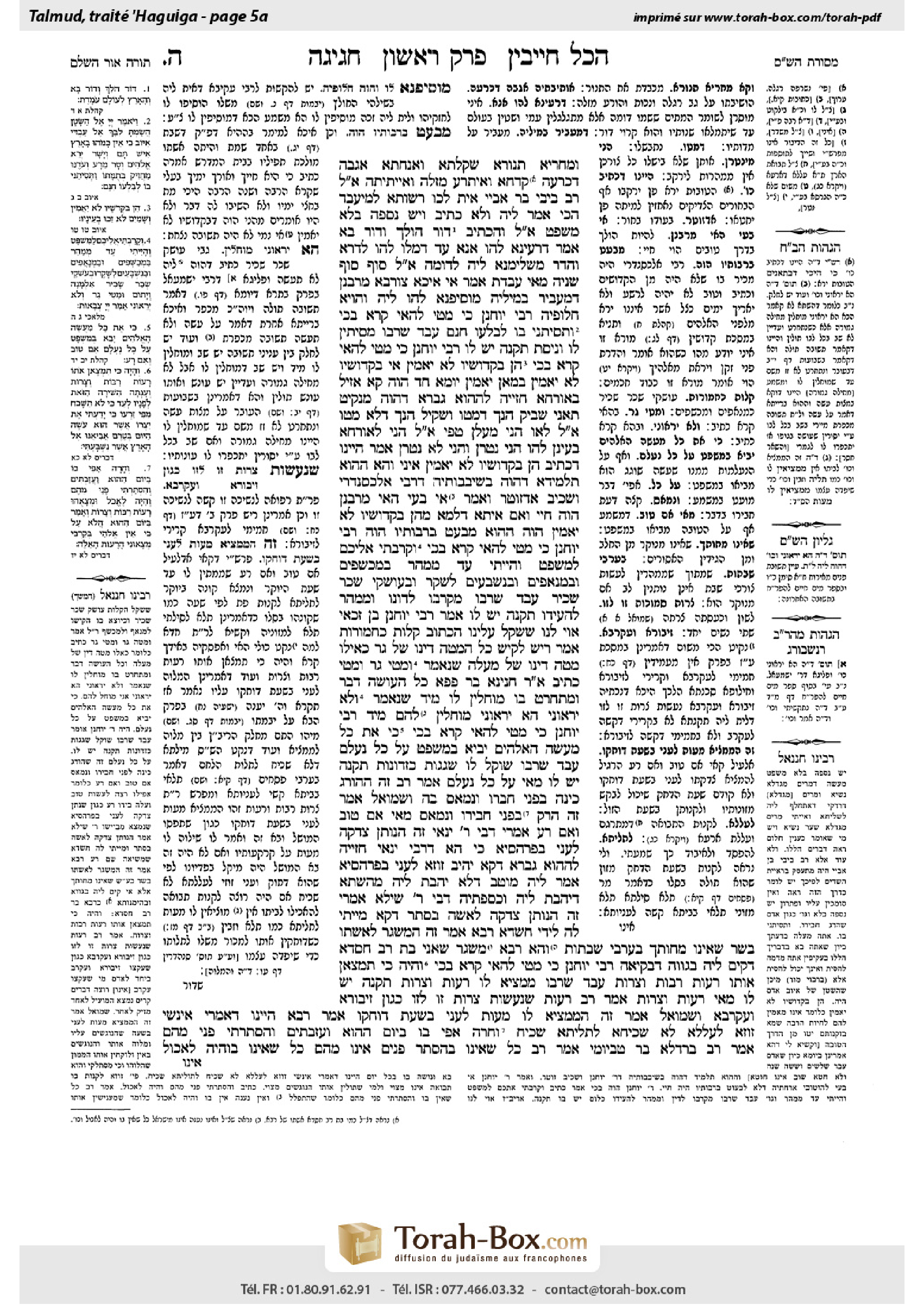
Chagigah 5a: Talmud study for Daf Yomi
Study the Talmud for Daf Yomi with scanned pages, Hebrew text, English translations from Sefaria and AI-generated French translations.
Passage selection and English or AI-generated French translation are available where the scan has annotations. Daf Study is independent of Torah-Box and Sefaria.
Browse Chagigah · חגיגה · All tractatesChagigah 5a text and translations
This page of Chagigah includes the Aramaic text, an English translation and an AI-generated French translation, alongside the scan above.
חגיגה ה׳ א · Aramaic and Hebrew text
וּמְחָרְיָא תַּנּוּרָא, שְׁקַלְתָּא וְאַנַּחְתָּא אַגַּבֵּהּ דְּכַרְעַהּ, קְדַחָא וְאִיתְּרַע מַזָּלַהּ, וְאַיְיתִיתַהּ.
אֲמַר לֵיהּ רַב בִּיבִי בַּר אַבָּיֵי: אִית לְכוּ רְשׁוּתָא לְמִיעְבַּד הָכִי? אֲמַר לֵיהּ, וְלָא כְּתִיב: ״וְיֵשׁ נִסְפֶּה בְּלֹא מִשְׁפָּט״? אֲמַר לֵיהּ, וְהָכְתִיב: ״דּוֹר הוֹלֵךְ וְדוֹר בָּא״!
אֲמַר: דְּרָעֵינָא לְהוּ אֲנָא עַד דְּמָלוּ לְהוּ לְדָרָא, וַהֲדַר מַשְׁלֵימְנָא לֵיהּ לְדוּמָה. אֲמַר לֵיהּ: סוֹף סוֹף, שְׁנֵיהּ מַאי עָבְדַתְּ? אֲמַר: אִי אִיכָּא צוּרְבָּא מֵרַבָּנַן דְּמַעְבֵּיר בְּמִילֵּיהּ — מוֹסֵיפְנָא לְהוּ לֵיהּ, וְהָוְיָא חִלּוּפֵיהּ.
רַבִּי יוֹחָנָן כִּי מָטֵי לְהַאי קְרָא, בָּכֵי: ״וַתְּסִיתֵנִי בוֹ לְבַלְּעוֹ חִנָּם״. עֶבֶד שֶׁרַבּוֹ מְסִיתִין לוֹ וְנִיסָת, תַּקָּנָה יֵשׁ לוֹ?! רַבִּי יוֹחָנָן כִּי מָטֵי לְהַאי קְרָא, בָּכֵי: ״הֵן בִּקְדֹשָׁיו לֹא יַאֲמִין״, אִי בִּקְדוֹשָׁיו לֹא יַאֲמִין — בְּמַאן יַאֲמִין?
יוֹמָא חַד הֲוָה קָא אָזֵיל בְּאוֹרְחָא, חַזְיֵיהּ לְהָהוּא גַּבְרָא דַּהֲוָה מְנַקֵּיט תֵּאנֵי, שָׁבֵיק הָנָךְ דִּמְטוֹ וְשָׁקֵיל הָנָךְ דְּלָא מְטוֹ. אֲמַר לֵיהּ: לָאו הָנֵי מְעַלָּן טְפֵי? אֲמַר לֵיהּ: הָנֵי לְאוֹרְחָא בָּעֵינַן לְהוּ, הָנֵי נָטְרָן וְהָנֵי לָא נָטְרָן. אֲמַר, הַיְינוּ דִּכְתִיב: ״הֵן בִּקְדוֹשָׁיו לֹא יַאֲמִין״.
אִינִי? וְהָא הָהוּא תַּלְמִידָא דַּהֲוָה בְּשִׁיבָבוּתֵיהּ דְּרַבִּי אֲלֶכְּסַנְדְּרִי וּשְׁכֵיב אַדְּזוּטַר, וַאֲמַר: אִי בָּעֵי הַאי מֵרַבָּנַן, הֲוָה חָיֵי. וְאִם אִיתָא, דִּלְמָא מֵ״הֵן בִּקְדוֹשָׁיו לֹא יַאֲמִין״ הֲוָה? הָהוּא מְבַעֵט בְּרַבּוֹתָיו הֲוָה.
רַבִּי יוֹחָנָן כִּי מָטֵי לְהַאי קְרָא, בָּכֵי: ״וְקָרַבְתִּי אֲלֵיכֶם לַמִּשְׁפָּט וְהָיִיתִי עֵד מְמַהֵר בַּמְכַשְּׁפִים וּבַמְנָאֲפִים וּבַנִּשְׁבָּעִים לַשָּׁקֶר וּבְעוֹשְׁקֵי שְׂכַר שָׂכִיר״. עֶבֶד שֶׁרַבּוֹ מְקָרְבוֹ לְדוּנוֹ, וּמְמַהֵר לַהֲעִידוֹ — תַּקָּנָה יֵשׁ לוֹ?!
אָמַר רַבִּי יוֹחָנָן בֶּן זַכַּאי: אוֹי לָנוּ שֶׁשָּׁקַל עָלֵינוּ הַכָּתוּב קַלּוֹת כַּחֲמוּרוֹת.
אָמַר רֵישׁ לָקִישׁ: כׇּל הַמַּטֶּה דִּינוֹ שֶׁל גֵּר — כְּאִילּוּ מַטֶּה דִּינוֹ שֶׁל מַעְלָה, שֶׁנֶּאֱמַר: ״וּמַטֵּי גֵר״, ״וּמַטִּי״ כְּתִיב. אָמַר רַבִּי חֲנִינָא בַּר פָּפָּא: כׇּל הָעוֹשֶׂה דָּבָר וּמִתְחָרֵט בּוֹ — מוֹחֲלִין לוֹ מִיָּד, שֶׁנֶּאֱמַר: ״וְלֹא יְרֵאוּנִי״. הָא ״יְרֵאוּנִי״ — מוֹחֲלִין לָהֶם מִיָּד.
רַבִּי יוֹחָנָן כִּי מָטֵי לְהַאי קְרָא, בָּכֵי: ״כִּי אֶת כׇּל מַעֲשֶׂה הָאֱלֹהִים יָבִיא בְמִשְׁפָּט עַל כׇּל נֶעְלָם״. עֶבֶד שֶׁרַבּוֹ שׁוֹקֵל לוֹ שְׁגָגוֹת כִּזְדוֹנוֹת, תַּקָּנָה יֵשׁ לוֹ?!
מַאי ״עַל כׇּל נֶעְלָם״? אָמַר רַב: זֶה הַהוֹרֵג כִּינָּה בִּפְנֵי חֲבֵרוֹ וְנִמְאָס בָּהּ. וּשְׁמוּאֵל אָמַר: זֶה הָרָק בִּפְנֵי חֲבֵירוֹ וְנִמְאָס.
מַאי ״אִם טוֹב וְאִם רָע״? אָמְרִי דְּבֵי רַבִּי יַנַּאי: זֶה הַנּוֹתֵן צְדָקָה לְעָנִי בְּפַרְהֶסְיָא. כִּי הָא דְּרַבִּי יַנַּאי חַזְיֵיהּ לְהָהוּא גַּבְרָא דְּקָא יָהֵיב זוּזָא לְעָנִי בְּפַרְהֶסְיָא, אֲמַר לֵיהּ: מוּטָב דְּלָא יְהַבְתְּ לֵיהּ, מֵהַשְׁתָּא דִּיהַבְתְּ לֵיהּ וְכַסֵּפְתֵּיהּ.
דְּבֵי רַבִּי שֵׁילָא אָמְרִי, זֶה הַנּוֹתֵן צְדָקָה לְאִשָּׁה בַּסֵּתֶר, דְּקָא מַיְיתֵי לַהּ לִידֵי חֲשָׁדָא. רָבָא אָמַר: זֶה הַמְשַׁגֵּר לְאִשְׁתּוֹ בָּשָׂר שֶׁאֵינוֹ מְחוּתָּךְ בְּעַרְבֵי שַׁבָּתוֹת.
וְהָא רָבָא מְשַׁגַּר! שָׁאנֵי בַּת רַב חִסְדָּא, דְּקִים לֵיהּ בְּגַוַּוהּ דִּבְקִיאָה.
רַבִּי יוֹחָנָן כִּי מָטֵי לְהַאי קְרָא, בָּכֵי: ״וְהָיָה כִּי תִמְצֶאןָ אוֹתוֹ רָעוֹת רַבּוֹת וְצָרוֹת״. עֶבֶד שֶׁרַבּוֹ מַמְצִיא לוֹ רָעוֹת וְצָרוֹת, תַּקָּנָה יֵשׁ לוֹ?!
מַאי ״רָעוֹת וְצָרוֹת״? אָמַר רַב: רָעוֹת שֶׁנַּעֲשׂוֹת צָרוֹת זוֹ לָזוֹ — כְּגוֹן זִיבּוּרָא וְעַקְרַבָּא.
וּשְׁמוּאֵל אָמַר: זֶה הַמַּמְצִיא לוֹ מָעוֹת לֶעָנִי בִּשְׁעַת דּוֹחְקוֹ. אָמַר רָבָא, הַיְינוּ דְּאָמְרִי אִינָשֵׁי: זוּזָא לְעַלְלָא לָא שְׁכִיחָא, לִתְלִיתָא שְׁכִיחַ.
״וְחָרָה אַפִּי בוֹ בַיּוֹם הַהוּא וַעֲזַבְתִּים וְהִסְתַּרְתִּי פָנַי מֵהֶם״, אָמַר רַב בַּרְדְּלָא בַּר טַבְיוֹמֵי אָמַר רַב: כׇּל שֶׁאֵינוֹ בְּהֶסְתֵּר פָּנִים — אֵינוֹ מֵהֶם, כׇּל שֶׁאֵינוֹ בִּ״וְהָיָה לֶאֱכוֹל״ —
Chagigah 5a · English translation
and sweeping the oven. She took the fire and set it on her foot; she was scalded and her luck suffered, which gave me the opportunity, and I brought her.
Rav Beivai bar Abaye said to the Angel of Death: Do you have the right to act in this manner, to take someone before his time? The Angel of Death said to him: And is it not written: “But there are those swept away without justice” (Proverbs 13:23)? Rav Beivai said to him: And isn’t it written: “One generation passes away, and another generation comes” (Ecclesiastes 1:4), which indicates that there is a predetermined amount of time for the life of every generation.
He said to him: I shepherd them, not releasing them until the years of the generation are completed, and then I pass them on to the angel Duma who oversees the souls of the dead. Rav Beivai said to him: Ultimately, what do you do with his extra years, those taken away from this individual? The Angel of Death said to him: If there is a Torah scholar who disregards his personal matters, i.e., who overlooks the insults of those who wrong him, I add those years to him and he becomes the deceased’s replacement for that time.
§ The Gemara returns to the previous topic. When Rabbi Yoḥanan reached this verse, he cried, as God said to the Satan about Job: “Although you did incite Me against him, to destroy him without cause” (Job 2:3). Rabbi Yoḥanan said: With regard to a slave whose master is one whom others incite to act harshly against the slave and the master is incited to do so, is there a remedy for the slave? Additionally, when Rabbi Yoḥanan reached this verse, he cried: “Behold He puts no trust in His sacred ones” (Job 15:15), saying: If He does not place trust in His sacred ones, in whom does He place trust?
The Gemara relates: One day Rabbi Yoḥanan was walking along the road, and he saw a certain man who was picking figs in an unusual manner: He left the ones that had reached the stage of ripeness and took those that had not yet reached that state. Rabbi Yoḥanan said to him: Aren’t these ripe ones much better? He said to him: I need these figs for the road; these that are not yet ripe will be preserved, and these that are already ripe will not be preserved. Rabbi Yoḥanan said: This is the same as is written: “Behold He puts no trust in His sacred ones”; there are righteous people whom God takes from this world before their time, as He knows that in the future they will stumble.
The Gemara asks: Is that so? But there was a certain student in the neighborhood of Rabbi Alexandri, and he died while he was still young. And Rabbi Alexandri said: If this young Sage had wanted, he would have lived, i.e., his actions caused him to die young. And if it is so, as Rabbi Yoḥanan suggested, perhaps this student was from those concerning whom it is written: “Behold he puts no trust in his sacred ones,” and it was not his sins that caused his death. The Gemara answers: That student was one who acted irreverently toward his teachers, and Rabbi Alexandri knew of his improper behavior.
When Rabbi Yoḥanan reached this verse, he cried: “And I will come near to you to judgment; and I will be a swift witness against the sorcerers, and against the adulterers, and against false witnesses, and against those who oppress the hireling in his wages, the widow, and the fatherless, and who turn aside the convert from his right, and do not fear Me, says the Lord” (Malachi 3:5). He said: With regard to a slave whose master comes near to him to judge him and is swift to testify against him, is there a remedy for him?
With regard to that same verse, Rabbi Yoḥanan ben Zakkai said: Woe to us, as the verse weighs lenient mitzvot for us like more stringent mitzvot, as it lists both those who violate sins punishable by death, e.g., sorcerers and adulterers, with those who violate apparently less severe sins, e.g., those who withhold payment from a hired worker.
Reish Lakish said: Anyone who distorts the judgment of a convert, it is considered as if he distorted the judgment of the One above, as it is stated: “And who turn aside [umattei] the convert” (Malachi 3:5). This term is written as: Umatti, turn Me aside, i.e., one who distorts the judgment of a convert is considered as though he distorts the judgment of God, as it were. Rabbi Ḥanina bar Pappa said: Anyone who does something sinful and regrets it, he is forgiven immediately, as it is stated: “And do not fear Me” (Malachi 3:5), which indicates that if they do fear Me and are embarrassed to sin before God, they are forgiven immediately.
Additionally, when Rabbi Yoḥanan reached this verse, he cried: “For God shall bring every work into the judgment concerning every hidden thing” (Ecclesiastes 12:14). He said: With regard to a slave whose master weighs his unwitting sins like intentional ones, i.e., God punishes him even for an action that was hidden from him, is there a remedy for him?
The Gemara asks: What sin is the verse referring to when it states: “Concerning every hidden thing”? Rav said: This is referring to one who kills a louse in the presence of another and his friend is disgusted by it. God judges him for the unintentional discomfort he caused. And similarly, Shmuel said: This is referring to one who spits in the presence of another and his friend is disgusted by his action.
The Gemara asks: What is the meaning of the end of that verse: “Whether it be good, or whether it be evil” (Ecclesiastes 12:14)? This verse indicates that God judges man harshly even for the good deeds he performs. The Sages from the school of Rabbi Yannai say: This verse is referring to one who gives charity to a poor person in public. Although he performed a good deed, he embarrassed the pauper, as in this case of Rabbi Yannai, who saw a certain man who was giving a dinar to a poor person in public. He said to him: It would have been better had you not given it to him than what you did, as now you gave it to him and embarrassed him.
The Sages from the school of Rabbi Sheila say: This verse is referring to one who gives charity to a woman in private, as he subjects her to suspicion, for people might think that he is engaging her services as a prostitute. Rava said: This is referring to one who sends his wife meat that is not sliced, i.e., that has not yet had the prohibited sciatic nerve removed, on Shabbat eve. Since she is in a hurry she might not notice and will perhaps cook the prohibited meat.
The Gemara asks: But yet Rava himself would send this type of meat to his wife on Shabbat eve. The Gemara answers: The daughter of Rav Ḥisda, Rava’s wife, is different, as he was certain about her that she was an expert in this matter. Rava trusted that his wife would realize the sciatic nerve had not been removed even when she was in a hurry on Shabbat eve.
Additionally, when Rabbi Yoḥanan reached this verse, he cried: “Then it shall come to pass, when many evils and troubles are come upon them” (Deuteronomy 31:21). He said: With regard to a slave whose master brings upon him evils and troubles, is there a remedy for him?
The Gemara asks: What is the verse referring to when it states: “Evils and troubles”? Rav said: Evils that become troubles for one another, i.e., the remedy for one problem has a deleterious effect on the other. For example, one who is stung by a hornet and a scorpion. The sting of a hornet must be treated only with a cold ointment, while that of a scorpion must be treated with a hot ointment. As these medicaments are mutually exclusive, one cannot treat both stings at the same time.
And Shmuel said: This verse is referring to one who provides money to a poor person as a loan during his exigent financial circumstances, but immediately after the borrower is released from the initial pressure by receiving the loan, the lender begins to demand repayment, subjecting the recipient to further pressure. Rava said that this explains the folk saying that people say: A dinar for produce is not found; for hanging it can be found. A poor person cannot find money to buy basic necessities; however, when the lenders hang on and pressure him he must come up with the money somehow.
On the same topic the Gemara states: “Then My anger shall be kindled against them in that day, and I will forsake them, and I will hide My face from them, and they shall be devoured” (Deuteronomy 31:17). Rav Bardela bar Tavyumei said that Rav said: Anyone who is not subject to His hiding of the face, i.e., whose prayers are invariably answered, is not from the Jewish people, as the verse states about the Jewish people that God will hide His face from them as a result of their sins. Similarly, anyone who is not subject to: “And they shall be devoured,” i.e., gentiles do not steal his money,
Chagigah 5a · Traduction française (IA)
et elle balayait la cheminée. Elle prit le feu et le posa sur son pied ; elle fut brûlée et sa chance s'effondra, ce qui m'a donné l'occasion, et je l'ai ramenée.
Rav Beivai bar Abaye dit à l'Ange de la Mort : Avez-vous le droit d'agir ainsi, de prendre quelqu'un avant l'heure ? L'Ange de la Mort répondit à lui : Et n'est-il pas écrit : « Mais il y a ceux qui sont emportés sans justice » (Proverbes 13:23) ? Rav Beivai dit à lui : Et n'est-il pas écrit : « Une génération passe, une autre vient » (Ecclésiaste 1:4), ce qui indique qu'il y a une durée prédéterminée pour la vie de chaque génération.
Il dit à lui : Je les fais paître, sans les relâcher avant que les années de la génération soient accomplies, puis je les remets à l'ange Duma qui surveille les âmes des morts. Rav Beivai dit à lui : Finalement, que faites-vous des années supplémentaires, celles qui sont prises à cet individu ? L'Ange de la Mort répondit à lui : Si un savant de la Torah néglige ses affaires personnelles, c'est-à-dire s'il ignore les injures de ceux qui l'ont maltraité, j'ajoute ces années à lui et il devient le remplaçant du défunt pendant cette période.
§ La Guemara reprend le sujet précédent. Lorsque Rabbi Yoḥanan arriva à cette versette, il pleura, comme Dieu dit au Diable concernant Job : « Bien que tu aies suscité contre lui, pour le détruire sans cause » (Job 2:3). Rabbi Yoḥanan dit : Concernant un esclave dont le maître est celui que d'autres incitent à agir cruellement contre l'esclave et que le maître est incité à le faire, y a-t-il un remède pour l'esclave ? De plus, lorsque Rabbi Yoḥanan arriva à cette versette, il pleura : « Regarde, Il ne confie pas en Ses saints » (Job 15:15), disant : Si Il ne place pas sa confiance en Ses saints, en qui place-t-il sa confiance ?
La Guemara rapporte : Un jour, Rabbi Yoḥanan marchait sur la route, et il vit un certain homme qui récoltait des figues de manière inhabituelle : il laissait celles qui étaient mûres et prenait celles qui n'étaient pas encore mûres. Rabbi Yoḥanan dit à lui : Ne sont-ce pas ces figues mûres qui sont bien meilleures ? Il répondit à lui : J'ai besoin de ces figues pour le chemin ; celles qui ne sont pas encore mûres seront conservées, et celles qui sont déjà mûres ne le seront pas. Rabbi Yoḥanan dit : C'est la même chose que ce qui est écrit : « Regarde, Il ne confie pas en Ses saints » ; il y a des justes que Dieu emporte de ce monde avant leur temps, car Il sait qu'ils trébucheront à l'avenir.
La Guemara pose la question : Est-ce ainsi ? Mais il y avait un étudiant dans le voisinage de Rabbi Alexandri, et il est mort jeune. Et Rabbi Alexandri dit : Si ce sage jeune avait voulu, il aurait vécu, c'est-à-dire ses actions ont causé sa mort prématurée. Et si c'est ainsi, comme suggère Rabbi Yoḥanan, peut-être cet étudiant était-il parmi ceux concernés par ce qui est écrit : « Regarde, Il ne confie pas en Ses saints », et ce n'était pas ses péchés qui ont causé sa mort. La Guemara répond : Cet étudiant était celui qui agissait avec mépris envers ses maîtres, et Rabbi Alexandri savait de son comportement inapproprié.
Lorsque Rabbi Yoḥanan arriva à ce verset, il pleura : « Et je viendrai près de vous pour le jugement ; et je serai un témoin rapide contre les sorciers, contre les adultères, contre les faux témoins, et contre ceux qui oppriment le salarié dans son salaire, la veuve, et l'orphelin, et qui détournent le converti de son droit, et qui ne craignent pas Moi, dit l'Éternel » (Malachie 3:5). Il dit : Concernant un esclave dont le maître vient près de lui pour le juger et est rapide à témoigner contre lui, y a-t-il un remède pour lui ?
Concernant ce même verset, Rabbi Yoḥanan ben Zakkai dit : Malheur à nous, car le verset pèse les mitsvot miséricordieuses pour nous comme des mitsvot plus strictes, car il liste à la fois ceux qui transgressent des péchés punis par la mort, par exemple les sorciers et les adultères, avec ceux qui transgressent des péchés moins graves, par exemple ceux qui retiennent le salaire d'un salarié.
Reish Lakish dit : Quiconque détourne le jugement d'un converti, cela est considéré comme s'il détourne le jugement de Celui qui est au-dessus, car il est dit : « Et qui détournent [umattei] le converti » (Malachie 3:5). Ce terme est écrit comme : Umatti, détourne Moi, c'est-à-dire celui qui détourne le jugement d'un converti est considéré comme s'il détourne le jugement de Dieu, comme si cela était. Rabbi Ḥanina bar Pappa dit : Quiconque commet un péché et regrette, il est pardonné immédiatement, car il est dit : « Et ne craignez pas Moi » (Malachie 3:5), ce qui indique que si ils craignent Moi et sont gênés de pécher devant Dieu, ils sont pardonnés immédiatement.
De plus, lorsque Rabbi Yoḥanan arriva à ce verset, il pleura : « Car Dieu fera venir toute œuvre devant le jugement concernant toute chose cachée » (Ecclésiaste 12:14). Il dit : Concernant un esclave dont le maître pèse ses péchés involontaires comme des péchés intentionnels, c'est-à-dire que Dieu punit même pour une action cachée de lui, y a-t-il un remède pour lui ?
La Guemara pose la question : Quel péché le verset fait-il référence lorsqu'il dit : « Concernant toute chose cachée » ? Rav dit : Cela fait référence à celui qui tue une mouche devant un autre et son ami est dégoûté par cela. Dieu juge contre le désagrément involontaire qu'il a causé. De même, Shmuel dit : Cela fait référence à celui qui crache devant un autre et son ami est dégoûté par son action.
La Guemara pose la question : Quelle est la signification de la fin de ce verset : « Qu'il soit bon ou qu'il soit mauvais » (Ecclésiaste 12:14) ? Ce verset indique que Dieu juge l'homme sévèrement même pour les bonnes actions qu'il accomplit. Les Sages de la maison de Rabbi Yannai disent : Ce verset fait référence à celui qui donne une charité à un pauvre en public. Bien qu'il ait accompli une bonne action, il a humilié le pauvre, comme dans le cas de Rabbi Yannai, qui vit un certain homme qui donnait un dinar à un pauvre en public. Il dit à lui : Il aurait été mieux que vous ne lui donniez pas, car maintenant vous l'avez humilié.
Les Sages de la maison de Rabbi Šilé disent : Cette versette fait référence à celui qui donne des dons à une femme en privé, car il la met en suspicion, car les gens pourraient penser qu'il l'engage comme prostituée. Rava dit : Cela fait référence à celui qui envoie à sa femme de la viande non tranchée, c'est-à-dire qui n'a pas encore eu le nerf sciatique interdit retiré, le soir du sabbat. Comme elle est pressée, elle pourrait ne pas remarquer et cuisiner la viande interdite.
La Guemara demande : Mais Rava lui-même enverrait ce type de viande à sa femme le soir du sabbat. La Guemara répond : La fille de Rav Ḥisda, l'épouse de Rava, est différente, car il était certain qu'elle était experte dans cette affaire. Rava avait confiance que sa femme comprendrait que le nerf sciatique n'avait pas été retiré même si elle était pressée le soir du sabbat.
De plus, lorsque Rabbi Yoḥanan est arrivé à cette versette, il a pleuré : « Alors il arrivera, lorsque beaucoup de maux et de tribulations seront sur eux » (Lévitique 31:21). Il a dit : En ce qui concerne un esclave dont le maître lui impose des maux et des tribulations, y a-t-il un remède pour lui ?
La Guemara demande : De quoi la versette parle-t-elle lorsqu'elle dit : « Maux et tribulations » ? Rav dit : Des maux qui deviennent des tribulations les uns pour les autres, c'est-à-dire que le remède d'un problème a un effet néfaste sur l'autre. Par exemple, celui qui est piqué par un guêpier et un scorpion. Le piquant du guêpier doit être traité uniquement avec un onguent froid, tandis que celui du scorpion doit être traité avec un onguent chaud. Comme ces remèdes sont mutuellement exclusifs, on ne peut pas traiter les deux piqûres en même temps.
Et Shmuel dit : Cette versette fait référence à celui qui fournit de l'argent à un pauvre comme prêt durant ses circonstances financières difficiles, mais aussitôt que le prêteur est libéré de la pression initiale en recevant le prêt, le prêteur commence à exiger le remboursement, mettant ainsi le receveur sous une nouvelle pression. Rava dit que cela explique la devise populaire que les gens disent : Un dinar pour les produits n'est pas trouvé ; pour l'attente, il peut être trouvé. Un pauvre ne peut pas trouver de l'argent pour acheter des besoins essentiels ; cependant, lorsque les prêteurs attendent et pressent, il doit trouver de l'argent de quelque manière que ce soit.
Sur le même sujet, la Guemara dit : « Alors ma colère s'embrasera contre eux ce jour-là, et je les abandonnerai, et je cacherais mon visage devant eux, et ils seront dévorés » (Deutéronome 31:17). Rav Bardela bar Tavyumei dit que Rav a dit : Celui qui n'est pas soumis à son cachement du visage, c'est-à-dire dont les prières sont toujours exaucées, n'est pas du peuple d'Israël, car la versette parle du peuple d'Israël que Dieu cache son visage devant eux en raison de leurs péchés. De même, celui qui n'est pas soumis à : « Et ils seront dévorés », c'est-à-dire que les gentils ne volent pas son argent,
Traduction française générée par IA à partir de l’édition anglaise de Sefaria. Vérifie toujours un passage avec le texte source.
Text from Sefaria: William Davidson Edition - Vocalized Aramaic (CC BY NC); William Davidson Edition - English (CC BY NC).