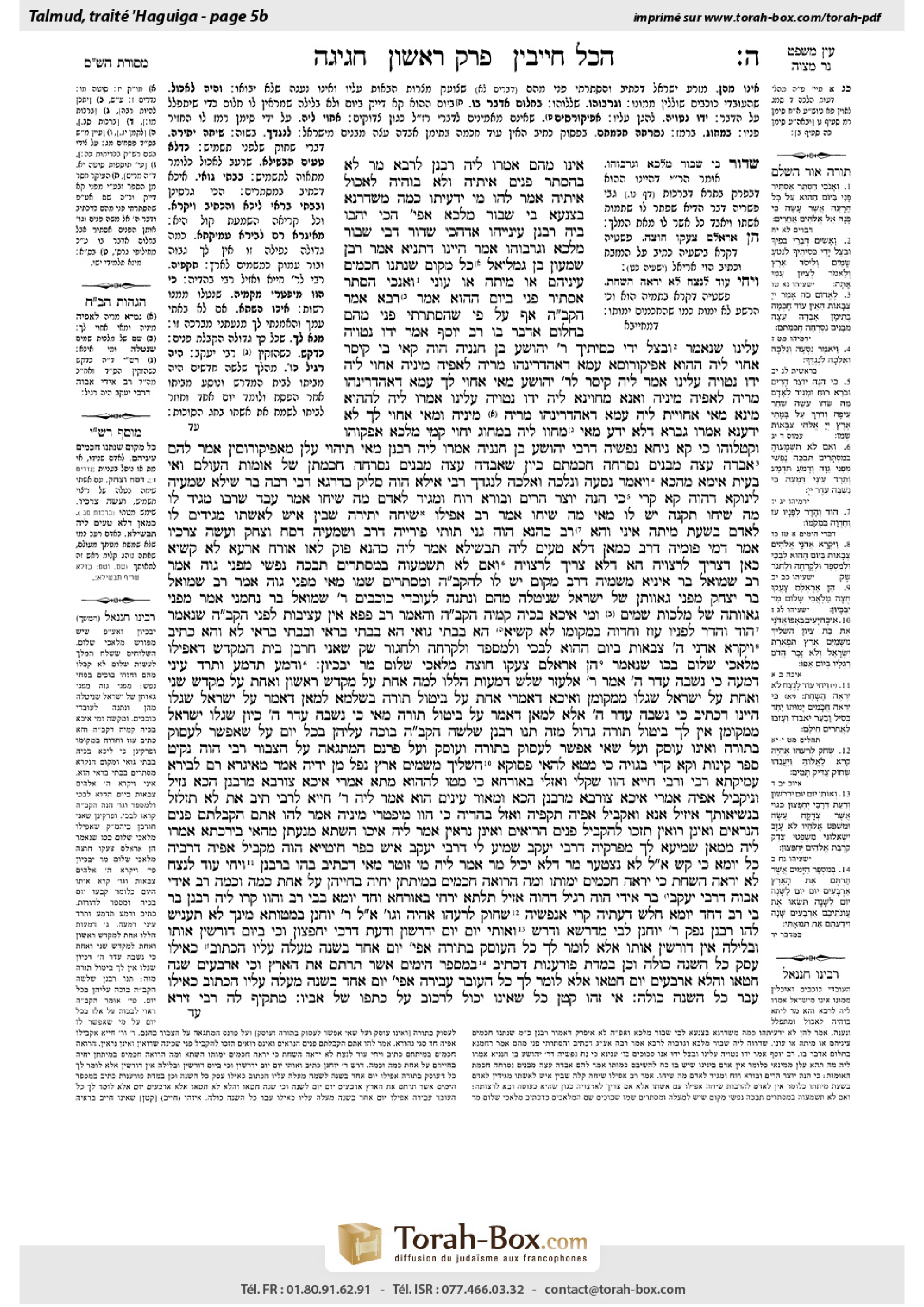
Chagigah 5b: Talmud study for Daf Yomi
Study the Talmud for Daf Yomi with scanned pages, Hebrew text, English translations from Sefaria and AI-generated French translations.
Passage selection and English or AI-generated French translation are available where the scan has annotations. Daf Study is independent of Torah-Box and Sefaria.
Browse Chagigah · חגיגה · All tractatesChagigah 5b text and translations
This page of Chagigah includes the Aramaic text, an English translation and an AI-generated French translation, alongside the scan above.
חגיגה ה׳ ב · Aramaic and Hebrew text
אֵינוֹ מֵהֶם. אֲמַרוּ לֵיהּ רַבָּנַן לְרָבָא: מָר לָא בְּהֶסְתֵּר פָּנִים אִיתֵיהּ, וְלָא בִּ״וְהָיָה לֶאֱכוֹל״ אִיתֵיהּ! אֲמַר לְהוּ: מִי יָדְעִיתוּ כַּמָּה מְשַׁדַּרְנָא בְּצִנְעָא בֵּי שַׁבּוּר מַלְכָּא? אֲפִילּוּ הָכִי, יְהַבוּ בֵּיהּ רַבָּנַן עֵינַיְיהוּ. אַדְּהָכִי שַׁדּוּר דְּבֵי שַׁבּוּר מַלְכָּא וְגַרְבוּהוּ. אֲמַר: הַיְינוּ דְּתַנְיָא, אָמַר רַבָּן שִׁמְעוֹן בֶּן גַּמְלִיאֵל: כׇּל מָקוֹם שֶׁ״נָּתְנוּ חֲכָמִים עֵינֵיהֶם״ — אוֹ מִיתָה אוֹ עוֹנִי.
״וְאָנֹכִי הַסְתֵּר אַסְתִּיר פָּנַי בַּיּוֹם הַהוּא״, אָמַר רָבָא, אָמַר הַקָּדוֹשׁ בָּרוּךְ הוּא: אַף עַל פִּי שֶׁהִסְתַּרְתִּי פָּנַי מֵהֶם — ״בַּחֲלוֹם אֲדַבֶּר בּוֹ״. רַב יוֹסֵף אָמַר: יָדוֹ נְטוּיָה עָלֵינוּ, שֶׁנֶּאֱמַר: ״וּבְצֵל יָדִי כִּסִּיתִיךָ״.
רַבִּי יְהוֹשֻׁעַ בֶּן חֲנַנְיָה הֲוָה קָאֵי בֵּי קֵיסָר, אַחְוִי לֵיהּ הָהוּא מִינָא: עַמָּא דְּאַהְדְּרִינְהוּ מָרֵיהּ לְאַפֵּיהּ מִינֵּיהּ. אַחְוִי לֵיהּ: יָדוֹ נְטוּיָה עָלֵינוּ. אֲמַר לֵיהּ קֵיסָר לְרַבִּי יְהוֹשֻׁעַ: מַאי אַחְוִי לָךְ? עַמָּא דְּאַהְדְּרִינְהוּ מָרֵיהּ לְאַפֵּיהּ מִינֵּיהּ, וַאֲנָא מַחְוֵינָא לֵיהּ יָדוֹ נְטוּיָה עָלֵינוּ.
אֲמַרוּ לֵיהּ לְהָהוּא מִינָא: מַאי אַחְוִיית לֵיהּ? עַמָּא דְּאַהְדְּרִינְהוּ מָרֵיהּ מִינֵּיהּ. וּמַאי אַחְוִי לָךְ? לָא יָדַעְנָא. אֲמַרוּ: גַּבְרָא דְּלָא יָדַע מַאי מַחְווּ לֵיהּ, בְּמָחוֹג יַחְוֵי קַמֵּי מַלְכָּא?! אַפְּקוּהוּ וְקַטְלוּהוּ.
כִּי קָא נִיחָא נַפְשֵׁיהּ דְּרַבִּי יְהוֹשֻׁעַ בֶּן חֲנַנְיָה, אֲמַרוּ לֵיהּ רַבָּנַן: מַאי תֶּיהְוֵי עֲלַן מִמִּינָאֵי? אָמַר לָהֶם: ״אָבְדָה עֵצָה מִבָּנִים נִסְרְחָה חׇכְמָתָם״. כֵּיוָן שֶׁאָבְדָה עֵצָה מִבָּנִים — נִסְרְחָה חׇכְמָתָן שֶׁל אוּמּוֹת הָעוֹלָם.
וְאִי בָּעֵית אֵימָא מֵהָכָא: ״וַיֹּאמֶר נִסְעָה וְנֵלֵכָה וְאֵלְכָה לְנֶגְדֶּךָ״.
רַבִּי אִילָא הֲוָה סָלֵיק בְּדַרְגָּא דְּבֵי רַבָּה בַּר שֵׁילָא. שַׁמְעֵיהּ לְיָנוֹקָא דַּהֲוָה קָא קָרֵי: ״כִּי הִנֵּה יוֹצֵר הָרִים וּבוֹרֵא רוּחַ וּמַגִּיד לְאָדָם מַה שִּׂיחוֹ״. אָמַר: עֶבֶד שֶׁרַבּוֹ מַגִּיד לוֹ מַה שִּׂיחוֹ תַּקָּנָה יֵשׁ לוֹ?! מַאי ״מַה שִּׂיחוֹ״? אָמַר רַב: אֲפִילּוּ שִׂיחָה יְתֵירָה שֶׁבֵּין אִישׁ לְאִשְׁתּוֹ מַגִּידִים לוֹ לְאָדָם בִּשְׁעַת מִיתָה.
אִינִי? וְהָא רַב כָּהֲנָא הֲוָה גָּנֵי תּוּתֵי פּוּרְיֵיהּ דְּרַב, וְשַׁמְעֵיהּ דְּסָח וְצָחַק וְעָשָׂה צְרָכָיו. אֲמַר: דָּמֵי פּוּמֵּיהּ דְּרַב כְּמַאן דְּלָא טְעִים לֵיהּ תַּבְשִׁילָא. אֲמַר לֵיהּ: כָּהֲנָא, פּוֹק! לָאו אוֹרַח אַרְעָא!
לָא קַשְׁיָא: כָּאן דִּצְרִיךְ לְרַצּוֹיַהּ, הָא דְּלָא צְרִיךְ לְרַצּוֹיַהּ.
״וְאִם לֹא תִשְׁמָעוּהָ בְּמִסְתָּרִים תִּבְכֶּה נַפְשִׁי מִפְּנֵי גֵוָה״, אָמַר רַב שְׁמוּאֵל בַּר אִינְיָא מִשְּׁמֵיהּ דְּרַב: מָקוֹם יֵשׁ לוֹ לְהַקָּדוֹשׁ בָּרוּךְ הוּא וּמִסְתָּרִים שְׁמוֹ. מַאי ״מִפְּנֵי גֵוָה״? אָמַר רַב שְׁמוּאֵל בַּר יִצְחָק: מִפְּנֵי גַּאֲווֹתָן שֶׁל יִשְׂרָאֵל שֶׁנִּיטְּלָה מֵהֶם וְנִתְּנָה לַגּוֹיִם. רַבִּי שְׁמוּאֵל בַּר נַחְמָנִי אָמַר: מִפְּנֵי גַּאֲווֹתָהּ שֶׁל מַלְכוּת שָׁמַיִם.
וּמִי אִיכָּא בְּכִיָּה קַמֵּיהּ הַקָּדוֹשׁ בָּרוּךְ הוּא? וְהָאָמַר רַב פָּפָּא: אֵין עֲצִיבוּת לִפְנֵי הַקָּדוֹשׁ בָּרוּךְ הוּא, שֶׁנֶּאֱמַר: ״הוֹד וְהָדָר לְפָנָיו עוֹז וְחֶדְוָה בִּמְקוֹמוֹ״! לָא קַשְׁיָא: הָא בְּבָתֵּי גַוָּאֵי, הָא בְּבָתֵּי בַרָאֵי.
וּבְבָתֵּי בַרָאֵי לָא? וְהָא כְּתִיב: ״וַיִּקְרָא אֲדֹנָי ה׳ צְבָאוֹת בַּיּוֹם הַהוּא לִבְכִי וּלְמִסְפֵּד וּלְקׇרְחָה וְלַחֲגוֹר שָׂק״! שָׁאנֵי חֻרְבַּן בֵּית הַמִּקְדָּשׁ, דַּאֲפִילּוּ מַלְאֲכֵי שָׁלוֹם בְּכוֹ, שֶׁנֶּאֱמַר: ״הֵן אֶרְאֶלָּם צָעֲקוּ חוּצָה מַלְאֲכֵי שָׁלוֹם מַר יִבְכָּיוּן״.
״וְדָמֹעַ תִּדְמַע וְתֵרַד עֵינִי דִּמְעָה כִּי נִשְׁבָּה עֵדֶר ה׳״, אָמַר רַבִּי אֶלְעָזָר: שָׁלֹשׁ דְּמָעוֹת הַלָּלוּ לָמָּה? אַחַת עַל מִקְדָּשׁ רִאשׁוֹן, וְאַחַת עַל מִקְדָּשׁ שֵׁנִי, וְאַחַת עַל יִשְׂרָאֵל שֶׁגָּלוּ מִמְּקוֹמָן. וְאִיכָּא דְּאָמְרִי: אַחַת עַל בִּיטּוּל תּוֹרָה.
בִּשְׁלָמָא לְמַאן דְּאָמַר עַל יִשְׂרָאֵל שֶׁגָּלוּ, הַיְינוּ דִּכְתִיב: ״כִּי נִשְׁבָּה עֵדֶר ה׳״, אֶלָּא לְמַאן דְּאָמַר עַל בִּיטּוּל תּוֹרָה — מַאי ״כִּי נִשְׁבָּה עֵדֶר ה׳״? כֵּיוָן שֶׁגָּלוּ יִשְׂרָאֵל מִמְּקוֹמָן — אֵין לְךָ בִּיטּוּל תּוֹרָה גָּדוֹל מִזֶּה.
תָּנוּ רַבָּנַן, שְׁלֹשָׁה הַקָּדוֹשׁ בָּרוּךְ הוּא בּוֹכֶה עֲלֵיהֶן בְּכׇל יוֹם: עַל שֶׁאֶפְשָׁר לַעֲסוֹק בַּתּוֹרָה וְאֵינוֹ עוֹסֵק, וְעַל שֶׁאִי אֶפְשָׁר לַעֲסוֹק בְּתוֹרָה וְעוֹסֵק, וְעַל פַּרְנָס הַמִּתְגָּאֶה עַל הַצִּבּוּר.
רַבִּי הֲוָה נָקֵיט סֵפֶר קִינוֹת וְקָא קָרֵי בְּגַוֵּיהּ, כִּי מְטָא לְהַאי פְּסוּקָא ״הִשְׁלִיךְ מִשָּׁמַיִם אֶרֶץ״ — נְפַל מִן יְדֵיהּ, אֲמַר: מֵאִיגָּרָא רָם לְבֵירָא עַמִּיקְתָּא.
רַבִּי וְרַבִּי חִיָּיא הֲווֹ שָׁקְלִי וְאָזְלִי בְּאוֹרְחָא, כִּי מְטוֹ לְהָהוּא מָתָא, אָמְרִי: אִיכָּא צוּרְבָּא מֵרַבָּנַן הָכָא? נֵזִיל וְנַיקְבֵּיל אַפֵּיהּ. אָמְרִי: אִיכָּא צוּרְבָּא מֵרַבָּנַן הָכָא, וּמְאוֹר עֵינַיִם הוּא. אֲמַר לֵיהּ רַבִּי חִיָּיא לְרַבִּי: תִּיב אַתְּ, לָא תְּזַלְזֵל בִּנְשִׂיאוּתָךְ. אֵיזִיל אֲנָא וְאַקְבֵּיל אַפֵּיהּ.
תַּקְפֵיהּ וַאֲזַל בַּהֲדֵיהּ. כִּי הֲווֹ מִיפַּטְרִי מִינֵּיהּ, אֲמַר לְהוּ: אַתֶּם הִקְבַּלְתֶּם פָּנִים הַנִּרְאִים וְאֵינָן רוֹאִין — תִּזְכּוּ לְהַקְבִּיל פָּנִים הָרוֹאִים וְאֵינָן נִרְאִין. אֲמַר לֵיהּ: אִיכוּ הַשְׁתָּא מְנַעְתַּן מֵהַאי בִּירְכְּתָא.
אֲמַרוּ לֵיהּ: מִמַּאן שְׁמִיעָא לָךְ? מִפִּרְקֵיהּ דְּרַבִּי יַעֲקֹב שְׁמִיעַ לִי, דְּרַבִּי יַעֲקֹב אִישׁ כְּפַר חִיטַּיָּיא הֲוָה מְקַבֵּיל אַפֵּיהּ דְּרַבֵּיהּ כׇּל יוֹמָא. כִּי קַשׁ, אֲמַר לֵיהּ: לָא נִצְטַעַר מָר, דְּלָא יָכֵיל מָר.
אֲמַר לֵיהּ, מִי זוּטַר מַאי דִּכְתִיב בְּהוּ בְּרַבָּנַן: ״וִיחִי עוֹד לָנֶצַח לֹא יִרְאֶה הַשָּׁחַת כִּי יִרְאֶה חֲכָמִים יָמוּתוּ״. וּמָה הָרוֹאֶה חֲכָמִים בְּמִיתָתָן יִחְיֶה — בְּחַיֵּיהֶן עַל אַחַת כַּמָּה וְכַמָּה.
רַב אִידִי אֲבוּהּ דְּרַבִּי יַעֲקֹב בַּר אִידִי הֲוָה רְגִיל דַּהֲוָה אָזֵיל תְּלָתָא יַרְחֵי בְּאוֹרְחָא וְחַד יוֹמָא בְּבֵי רַב, וַהֲווֹ קָרוּ לֵיהּ רַבָּנַן ״בַּר בֵּי רַב דְּחַד יוֹמָא״. חֲלַשׁ דַּעְתֵּיהּ, קָרֵי אַנַּפְשֵׁיהּ: ״שְׂחוֹק לְרֵעֵהוּ אֶהְיֶה וְגוֹ׳״. אֲמַר לֵיהּ רַבִּי יוֹחָנָן: בְּמָטוּתָא מִינָּךְ, לָא תַּעְנֵישׁ לְהוּ רַבָּנַן.
נְפַק רַבִּי יוֹחָנָן לְבֵי מִדְרְשָׁא וּדְרַשׁ: ״וְאוֹתִי יוֹם יוֹם יִדְרֹשׁוּן וְדַעַת דְּרָכַי יֶחְפָּצוּן״. וְכִי בַּיּוֹם דּוֹרְשִׁין אוֹתוֹ וּבַלַּיְלָה אֵין דּוֹרְשִׁין אוֹתוֹ?! אֶלָּא לוֹמַר לָךְ: כׇּל הָעוֹסֵק בַּתּוֹרָה אֲפִילּוּ יוֹם אֶחָד בַּשָּׁנָה — מַעֲלֶה עָלָיו הַכָּתוּב כְּאִילּוּ עָסַק כׇּל הַשָּׁנָה כּוּלָּהּ.
וְכֵן בְּמִדַּת פּוּרְעָנוּת, דִּכְתִיב: ״בְּמִסְפַּר הַיָּמִים אֲשֶׁר תַּרְתֶּם אֶת הָאָרֶץ״. וְכִי אַרְבָּעִים שָׁנָה חָטְאוּ? וַהֲלֹא אַרְבָּעִים יוֹם חָטְאוּ! אֶלָּא לוֹמַר לָךְ: כׇּל הָעוֹבֵר עֲבֵירָה אֲפִילּוּ יוֹם אֶחָד בַּשָּׁנָה — מַעֲלֶה עָלָיו הַכָּתוּב כְּאִילּוּ עָבַר כׇּל הַשָּׁנָה כּוּלָּהּ.
אֵי זֶהוּ קָטָן — כׇּל שֶׁאֵינוֹ יָכוֹל לִרְכּוֹב עַל כְּתֵפוֹ שֶׁל אָבִיו. מַתְקֵיף לַהּ רַבִּי זֵירָא:
Chagigah 5b · English translation
is not from among them. The Sages said to Rava: Master, you are not subject to His hiding of the face, as your prayers are heard, and you are not subject to: “And they shall be devoured,” as the authorities take nothing from you. He said to them: Do you know how many gifts I send in private to the house of King Shapur? Although it might seem that the monarchy does not take anything from me, in actuality I am forced to give many bribes. Even so, the Sages looked upon Rava with suspicion. In the meantime, messengers from the house of King Shapur sent for him and imprisoned him to extort more money from him. Rava said: This is as it is taught in a baraita that Rabban Shimon ben Gamliel said: Wherever the Sages looked upon someone, it resulted in either death or poverty.
With regard to the verse: “And I will hide my face in that day” (Deuteronomy 31:18), Rava said that the Holy One, Blessed be He, said: Even though I hid my face from them and My Divine Presence is not revealed, nevertheless: “I speak with him in a dream” (Numbers 12:6). Rav Yosef said: His hand is outstretched, guarding over us, as it is stated: “And I have covered you in the shadow of my hand” (Isaiah 51:16).
The Gemara relates: Rabbi Yehoshua ben Ḥananya was standing in the house of the Caesar. A certain heretic, who was also present, gestured to him, indicating that his was the nation whose Master, God, turned His face away from it. Rabbi Yehoshua gestured to him that His hand is outstretched over us in protection. The Caesar said to Rabbi Yehoshua: What did he gesture to you, and how did you respond? He replied: He indicated that mine is the nation whose Master turned His face from it, and I gestured to him that His hand is outstretched over us.
The members of the Caesar’s household said to that heretic: What did you gesture to him? He said to them: I gestured that his is the nation whose Master has turned His face from it. They asked: And what did he gesture to you? He said to them: I don’t know; I did not understand. They said: How can a man who does not know what others gesture to him dare to gesture in the presence of the king? They took him out and killed him.
The Gemara relates: When Rabbi Yehoshua ben Ḥananya was dying, the Sages said to him: What will become of us, from the threat of the heretics, when there is no scholar like you who can refute them? He said to them that the verse states: “Is wisdom no more in Teiman? Has counsel perished from the prudent? Has their wisdom vanished?” (Jeremiah 49:7). He explained: Since counsel has perished from the prudent, from the Jewish people, the wisdom of the nations of the world has vanished as well, and there will be no superior scholars among them.
And if you wish, say instead that the same idea can be derived from here: “And he said: Let us take our journey, and let us go, and I will go corresponding to you” (Genesis 33:12). Just as the Jewish people rise and fall, so too, the nations of the world simultaneously rise and fall, and they will never have an advantage.
The Gemara relates that Rabbi Ila was ascending the stairs in the house of Rabba bar Sheila, a children’s teacher. He heard a child who was reading a verse out loud: “For, lo, He Who forms the mountains, and creates the wind, and declares to man what is his speech” (Amos 4:13). Rabbi Ila said: With regard to a servant whose master declares to him what is his proper speech, is there a remedy for him? The Gemara asks. What is the meaning of the phrase: “What is his speech”? Rav said: Even frivolous speech that is between a man and his wife before engaging in relations is declared to a person at the time of death, and he will have to account for it.
The Gemara asks: Is that so? Is it prohibited for a man to speak in this manner with his wife? Wasn’t Rav Kahana lying beneath Rav’s bed, and he heard Rav chatting and laughing with his wife, and performing his needs, i.e., having relations with her. Rav Kahana said out loud: The mouth of Rav is like one who has never eaten a cooked dish, i.e., his behavior is lustful. Rav said to him: Kahana, leave, as this is not proper conduct. This shows that Rav himself engaged in frivolous talk before relations.
The Gemara answers: This is not difficult. Here, where this type of speech is permitted, it is referring to a situation where he must appease his wife before relations, and therefore this speech is appropriate. However, this statement, that it is prohibited, is referring to a situation where he doesn’t need to appease her. In these circumstances, it is prohibited to engage in excessively lighthearted chatter with one’s wife.
The verse states: “But if you will not hear it, my soul shall weep in secret [bemistarim] for your pride” (Jeremiah 13:17). Rav Shmuel bar Inya said in the name of Rav: The Holy One, Blessed be He, has a place where He cries, and its name is Mistarim. What is the meaning of “for your pride”? Rav Shmuel bar Yitzḥak said: God cries due to the pride of the Jewish people, which was taken from them and given to the gentile nations. Rav Shmuel bar Naḥmani said: He cries due to the pride of the kingdom of Heaven, which was removed from the world.
The Gemara asks: But is there crying before the Holy One, Blessed be He? Didn’t Rav Pappa say: There is no sadness before the Holy One, Blessed be He, as it is stated: “Honor and majesty are before Him; strength and gladness are in His place” (I Chronicles 16:27)? The Gemara responds: This is not difficult. This statement, that God cries, is referring to the innermost chambers, where He can cry in secret, whereas this statement, that He does not cry, is referring to the outer chambers.
The Gemara asks: And doesn’t God cry in the outer chambers? Isn’t it written: “And on that day the Lord, the God of hosts, called to weeping, and to mourning, and to baldness, and to girding with sackcloth” (Isaiah 22:12)? The Gemara responds: The destruction of the Temple is different, as even the angels of peace cried, as it is stated: “Behold, their valiant ones cry without; the angels of peace weep bitterly” (Isaiah 33:7).
The verse continues: “And my eye shall weep sore, and run down with tears, because the Lord’s flock is carried away captive” (Jeremiah 13:17). Rabbi Elazar said: Why these three references to tears in the verse? One is for the First Temple; one is for the Second Temple; and one is for the Jewish people who were exiled from their place. And there are those who say: The last one is for the unavoidable dereliction of the study of Torah in the wake of the exile.
The Gemara asks: Granted, according to the one who said that the last tear is for the Jewish people who were exiled, this is as it is written: “Because the Lord’s flock is carried away captive.” However, according to the one who said that this tear is for the dereliction of the study of Torah, what is the meaning of: “Because the Lord’s flock is carried away captive”? The Gemara answers: Since the Jewish people were exiled from their place, there is no greater involuntary dereliction of the study of Torah than that which was caused by this.
The Sages taught that there are three types of people for whom the Holy One, Blessed be He, cries every day: For one who is able to engage in Torah study and does not engage in it; and for one who is unable to engage in Torah study and nevertheless he endeavors and engages in it; and for a leader who lords over the community.
The Gemara relates: Rabbi Yehuda HaNasi was holding the book of Lamentations and was reading from it. When he reached the verse: “He has cast down from heaven to earth the beauty of Israel” (Lamentations 2:1), in his distress the book fell from his hand. He said: From a high roof to a deep pit, i.e., it is terrible to tumble from the sky to the ground.
§ The Gemara relates: Rabbi Yehuda HaNasi and Rabbi Ḥiyya were walking along the road. When they arrived at a certain city, they said: Is there a Torah scholar here whom we can go and greet? The people of the city said: There is a Torah scholar here but he is blind. Rabbi Ḥiyya said to Rabbi Yehuda HaNasi: You sit here; do not demean your dignified status as Nasi to visit someone beneath your stature. I will go and greet him.
Rabbi Yehuda HaNasi grabbed him and went with him anyway, and together they greeted the blind scholar. When they were leaving him, he said to them: You greeted one who is seen and does not see; may you be worthy to greet the One Who sees and is not seen. Rabbi Yehuda HaNasi said to Rabbi Ḥiyya: Now, if I had listened to you and not gone to greet him, you would have prevented me from receiving this blessing.
They said to the blind scholar: From whom did you hear that we are worthy of this blessing? He said to them: I heard it from the instruction of Rabbi Ya’akov, as Rabbi Ya’akov of the village of Ḥitiyya would greet his teacher every day. When Rabbi Ya’akov grew elderly, his teacher said to him: Do not despair, my Master, that my Master is unable to make the effort to greet me. It is better that you should not visit me.
Rabbi Ya’akov said to him: Is it a minor matter, that which is written about the Sages: “That he should still live always, that he should not see the pit. For he sees that wise men die” (Psalms 49:10–11)? In this regard an a fortiori inference applies: Just as one who sees Sages in their death will live, all the more so one who sees them in their lifetime. From here the blind scholar learned the importance of greeting Torah scholars, which is why he blessed the Sages who came to greet him.
The Gemara relates: Rav Idi, father of Rabbi Ya’akov bar Idi, would regularly travel three months on the road to reach the study hall and as he would immediately travel back again to arrive home for the festival of Sukkot, he spent only one day in the school of Rav. And the Sages would disparagingly call him: A student of Torah for one day. He was offended and read the following verse about himself: “I am as one that is a laughingstock to his neighbor, a man who calls upon God, and He answers him” (Job 12:4). Rabbi Yoḥanan said to him: Please do not punish the Sages, i.e., do not take offense and be harsh with them, as this will cause them to be punished by God.
Rabbi Yoḥanan left Rav Idi and went to the study hall and taught: “Yet they seek Me daily, and delight to know My ways” (Isaiah 58:2). But is it possible that only during the day they seek Him and at night they do not seek Him? What is the meaning of daily? Rather, this verse comes to say to you that with regard to anyone who engages in Torah study even one day a year, the verse ascribes him credit as though he engaged in Torah study the entire year.
And the same applies to the attribute of punishment, as it is written: “After the number of the days in which you spied out the land, even forty days, for every day a year, shall you bear your iniquities” (Numbers 14:34). But did they sin for forty years? Didn’t they sin for only forty days? Rather, this comes to say to you that anyone who transgresses a sin even one day a year, the verse ascribes him liability as though he transgressed the entire year.
§ The mishna taught: Who is a minor who is exempt from the mitzva of appearance in the Temple? Any child who is unable to ride on his father’s shoulders and ascend from Jerusalem to the Temple Mount. Rabbi Zeira strongly objects to this:
Chagigah 5b · Traduction française (IA)
Il n’est pas parmi eux. Les Sages dirent à Rava : Maître, vous n’êtes pas soumis à son cachement du visage, car vos prières sont entendues, et vous n’êtes pas soumis à : « Et ils seront dévorés », car les autorités ne prennent rien de vous. Il répondit à ceux-ci : Savez-vous combien de présents je fais en privé à la maison du roi Shapur ? Bien qu’il puisse sembler que la monarchie ne prenne rien de moi, en réalité je suis contraint de donner beaucoup de rançons. Cependant, les Sages regardèrent Rava avec suspicion. Pendant ce temps, des messagers de la maison du roi Shapur l’envoyèrent et l’enchaînèrent pour extorquer plus d’argent de lui. Rava dit : C’est ce qui est enseigné dans une baraïta que Rabban Shimon ben Gamliel a dit : Partout où les Sages regardaient quelqu’un, cela entraînait soit la mort soit la pauvreté.
Concernant la parole : « Et je cacherai mon visage ce jour-là » (Deutéronome 31:18), Rava dit que le Saint, le Très Haut, dit : Même si je cache mon visage d’eux et que ma Divine Présence n’est pas révélée, néanmoins : « Je parle à lui en rêve » (Nombres 12:6). Rav Yosef dit : Sa main s’étire, nous protégeant, comme il est dit : « Et je vous ai couverts sous l’ombre de ma main » (Isaïe 51:16).
Le Guemara rapporte : Rabbi Yehoshua ben Ḥananya était debout dans la maison du César. Un certain hérétique, qui était également présent, fit un geste en indiquant que c’était la nation dont le Maître, Dieu, avait tourné son visage. Rabbi Yehoshua fit un geste en indiquant que sa main s’étirait sur nous. Le César demanda à Rabbi Yehoshua : Qu’est-ce qu’il a fait et comment as-tu répondu ? Il répondit : Il a indiqué que c’était la nation dont le Maître avait tourné son visage, et j’ai fait un geste en indiquant que sa main s’étirait sur nous.
Les membres de la maison du César dirent à cet hérétique : Qu’as-tu fait ? Il répondit : J’ai fait un geste en indiquant que c’était la nation dont le Maître avait tourné son visage. Ils demandèrent : Et qu’as-t-il fait à toi ? Il répondit : Je ne sais pas ; je n’ai pas compris. Ils dirent : Comment un homme qui ne sait pas ce que d’autres font de gestes ose faire un geste en présence du roi ? Ils le sortirent et le tuèrent.
Le Guemara rapporte : Lorsque Rabbi Yehoshua ben Ḥananya mourait, les Sages dirent à lui : Qu’adviendra-t-il de nous, face à la menace des hérétiques, lorsqu’il n’y aura plus de savant comme toi pour les réfuter ? Il répondit à ceux-ci que la parole dit : « La sagesse n’est-elle plus en Téman ? La prudence est-elle perdue des sages ? Leur sagesse a-t-elle disparu ? » (Jérémie 49:7). Il expliqua : Puisque la prudence est perdue des sages, du peuple juif, la sagesse des nations du monde a également disparu, et il n’y aura plus de savants supérieurs parmi eux.
Et si vous le souhaitez, dites plutôt que la même idée peut être tirée d’ici : « Et il dit : Allons, et allons, et je vais suivre selon toi » (Genèse 33:12). Comme les Juifs montent et descendent, ainsi les nations du monde montent et descendent simultanément, et elles n’auront jamais un avantage.
Le Guemara rapporte que Rabbi Ila montait les escaliers dans la maison de Rabba bar Sheila, un instituteur d’enfants. Il entendit un enfant qui lisait une parole à haute voix : « Car, hélas, celui qui forme les montagnes, et crée le vent, et déclare à l’homme ce qui est sa parole » (Amos 4:13). Rabbi Ila dit : Concernant un serviteur dont le maître déclare à lui ce qui est sa propre parole, y a-t-il un remède pour lui ? Le Guemara demande. Quelle est la signification de la phrase : « Ce qui est sa parole » ? Rav dit : Même une parole légère entre un homme et sa femme avant l’acte est déclarée à une personne au moment de sa mort, et il devra rendre compte de cela.
Le Guemara demande : Est-ce ainsi ? Est-il interdit à un homme de parler ainsi avec sa femme ? N’était-ce pas Rav Kahana qui était allongé sous le lit de Rav, et il entendit Rav parler et rire avec sa femme, et faire ses besoins, c’est-à-dire avoir des relations avec elle. Rav Kahana dit à haute voix : La bouche de Rav est comme celle qui n’a jamais mangé de plat cuit, c’est-à-dire son comportement est luxueux. Rav dit à lui : Kahana, va-t’en, car cela n’est pas convenable. Cela montre que Rav lui-même engageait dans des paroles légères avant l’acte.
Le Guemara répond : Ce n’est pas difficile. Ici, où ce type de parole est permis, il s’agit d’une situation où il doit apaiser sa femme avant l’acte, et par conséquent cette parole est appropriée. Cependant, cette déclaration, qui dit qu’il est interdit, s’applique à une situation où il n’a pas besoin d’apaiser elle. Dans ces circonstances, il est interdit d’engager des conversations excessivement légères avec sa femme.
La parole dit : « Mais si tu ne l’écoutes pas, mon âme pleurera en secret [bemistarim] pour ta vanité » (Jérémie 13:17). Rav Shmuel bar Inya dit en nom de Rav : Le Saint, le Très Haut, a un lieu où Il pleure, et son nom est Mistarim. Quelle est la signification de « pour ta vanité » ? Rav Shmuel bar Yitzḥak dit : Dieu pleure à cause de la vanité du peuple juif, qui a été enlevée d’eux et donnée aux nations païennes. Rav Shmuel bar Naḥmani dit : Il pleure à cause de la vanité du royaume du Ciel, qui a été enlevée du monde.
Le Guemara demande : Mais y a-t-il des larmes devant le Saint, le Très Haut ? N’a-t-il pas dit Rav Pappa : Il n’y a pas de tristesse devant le Saint, le Très Haut, comme il est dit : « L’honneur et la majesté sont devant Lui ; la force et la joie sont dans Son lieu » (I Chroniques 16:27) ? Le Guemara répond : Ce n’est pas difficile. Cette déclaration, que Dieu pleure, s’applique aux chambres intérieures, où Il peut pleurer en secret, tandis que cette déclaration, qu’Il ne pleure pas, s’applique aux chambres extérieures.
Le Guemara pose la question : Et ne pleure-t-il pas Dieu dans les chambres extérieures ? N’est-il pas écrit : « Et ce jour-là, l’Éternel, le Seigneur des armées, appela à la douleur, à la tristesse, à la perte de cheveux, et à l’attirail de sacs » (Isaïe 22:12) ? Le Guemara répond : La destruction du Temple est différente, car même les anges de la paix pleurèrent, comme il est dit : « Regardez, leurs vaillants pleurent sans ; les anges de la paix pleurent amèrement » (Isaïe 33:7).
La versette continue : « Et mes yeux pleureront amèrement, et couleront de larmes, parce que l’agneau de l’Éternel est emporté en captivité » (Jérémie 13:17). Le Rabbi Eléazar dit : Pourquoi ces trois mentions de larmes dans la versette ? Une pour le Premier Temple, une pour le Second Temple, et une pour le peuple juif expulsé de son lieu. Et il y a ceux qui disent : La dernière est pour la négligence involontaire de l’étude de la Torah après l’exil.
Le Guemara pose la question : C’est vrai, selon celui qui dit que la dernière larme est pour le peuple juif expulsé, c’est comme il est écrit : « Parce que l’agneau de l’Éternel est emporté en captivité ». Cependant, selon celui qui dit que cette larme est pour la négligence involontaire de l’étude de la Torah, que signifie : « Parce que l’agneau de l’Éternel est emporté en captivité » ? Le Guemara répond : Puisque le peuple juif a été expulsé de son lieu, il n’y a pas de négligence involontaire plus grande de l’étude de la Torah que celle causée par cela.
Les Sages enseignèrent que trois types de personnes pour lesquelles l’Éternel, béni soit Son Nom, pleure chaque jour : celui qui est capable d’étudier la Torah et ne l’étudie pas ; celui qui n’est pas capable d’étudier la Torah mais s’efforce tout de même d’y participer ; et le chef qui domine la communauté.
Le Guemara rapporte : Rabbi Yéhuda HaNasi tenait le livre des Lamentations et lisait dedans. Lorsqu’il arriva à la versette : « Il a jeté du ciel à la terre la beauté d’Israël » (Lamentations 2:1), dans sa détresse, le livre tomba de ses mains. Il dit : Du toit élevé à la fosse profonde, c’est terrible de tomber du ciel à la terre.
§ Le Guemara rapporte : Rabbi Yéhuda HaNasi et Rabbi Ḥiyya marchaient sur la route. Lorsqu’ils arrivèrent à une certaine ville, ils dirent : Y a-t-il un savant de la Torah ici que nous puissions aller saluer ? Les habitants de la ville dirent : Il y a un savant de la Torah ici mais il est aveugle. Rabbi Ḥiyya dit à Rabbi Yéhuda HaNasi : Assieds-toi ici ; ne déshonore pas ton statut digne de Nasi en visitant quelqu’un inférieur à toi. Je vais aller le saluer.
Rabbi Yéhuda HaNasi l’attrapa et l’emmena avec lui, et ensemble ils saluèrent le savant aveugle. Lorsqu’ils étaient en train de le quitter, il leur dit : Vous avez salué celui qui est vu et ne voit pas ; que vous soyez dignes de saluer celui qui voit et n’est pas vu. Rabbi Yéhuda HaNasi dit à Rabbi Ḥiyya : Maintenant, si j’avais écouté et n’étais pas allé saluer, tu aurais empêché que je reçoive cette bénédiction.
Ils dirent au savant aveugle : D'où as-tu entendu que nous sommes dignes de cette bénédiction ? Il leur dit : J’ai entendu cela de l'enseignement de Rabbi Ya'akov, car Rabbi Ya'akov de la ville de Ḥitiyya saluait son maître chaque jour. Lorsque Rabbi Ya'akov est devenu âgé, son maître lui dit : Ne désespère pas, mon maître, que mon maître ne puisse plus faire l'effort de me saluer. Il est préférable que tu ne viennes pas me voir.
Rabbi Ya'akov dit à lui : Est-ce une chose mineure, celle qui est écrite sur les Sages : « Que celui-ci vive toujours, qu'il ne voie pas la fosse. Car il voit que les sages meurent » (Psaumes 49:10-11) ? À ce sujet, une inférence a fortiori s'applique : Comme celui qui voit les Sages mourir vivra, encore plus celui qui les voit vivants. C'est ainsi que le savant aveugle apprit l'importance de saluer les savants de la Torah, ce qui est pourquoi il bénit les Sages qui sont venus le saluer.
Le Guemara rapporte : Rav Idi, père de Rabbi Ya'akov bar Idi, voyageait régulièrement trois mois sur la route pour arriver à la salle de étude et, aussitôt, il revenait à la maison pour la fête de la Sucque, il passait seulement un jour dans la salle de Rav. Et les Sages le disaient méprisamment : Un étudiant de la Torah pour un jour. Il fut offensé et lut la suivante versette à son sujet : « Je suis comme celui qui est une risée à ses voisins, un homme qui invoque Dieu et Lui répond » (Job 12:4). Rabbi Yoḥanan dit à lui : S'il te plaît, ne punis pas les Sages, c'est-à-dire ne prends pas offense et ne sois pas dur envers eux, car cela causera leur punition par Dieu.
Rabbi Yoḥanan quitta Rav Idi et alla à la salle de étude et enseigna : « Et ils cherchent encore Dieu quotidiennement, et se réjouissent de connaître Ses voies » (Michna 58:2). Mais est-il possible que seul pendant la journée ils cherchent Lui et la nuit ils ne cherchent pas ? Que signifie quotidiennement ? Plutôt, cette versette vient vous dire que concernant toute personne qui étudie la Torah même un jour par an, la versette lui attribue la mérite comme s’il avait étudié la Torah toute l'année.
Et cela s'applique également à l'attribut de la punition, comme il est écrit : « Après le nombre des jours dans lesquels vous avez espionné la terre, même quarante jours, pour chaque jour un an, vous porterez vos iniquités » (Nombres 14:34). Mais ont-ils péché quarante ans ? N'ont-ils pas péché seulement quarante jours ? Plutôt, cela vient vous dire que toute personne qui transgresse un péché même un jour par an, la versette lui attribue la responsabilité comme s'il avait transgressé toute l'année.
§ La mitsna enseigna : Qui est un mineur exempt de la mitsva de l'apparition dans le Temple ? Tout enfant qui n'est pas capable de monter sur les épaules de son père et d'ascendre de Jérusalem au Mont du Temple. Rabbi Zéira s'oppose fortement à cela :
Traduction française générée par IA à partir de l’édition anglaise de Sefaria. Vérifie toujours un passage avec le texte source.
Text from Sefaria: William Davidson Edition - Vocalized Aramaic (CC BY NC); William Davidson Edition - English (CC BY NC).