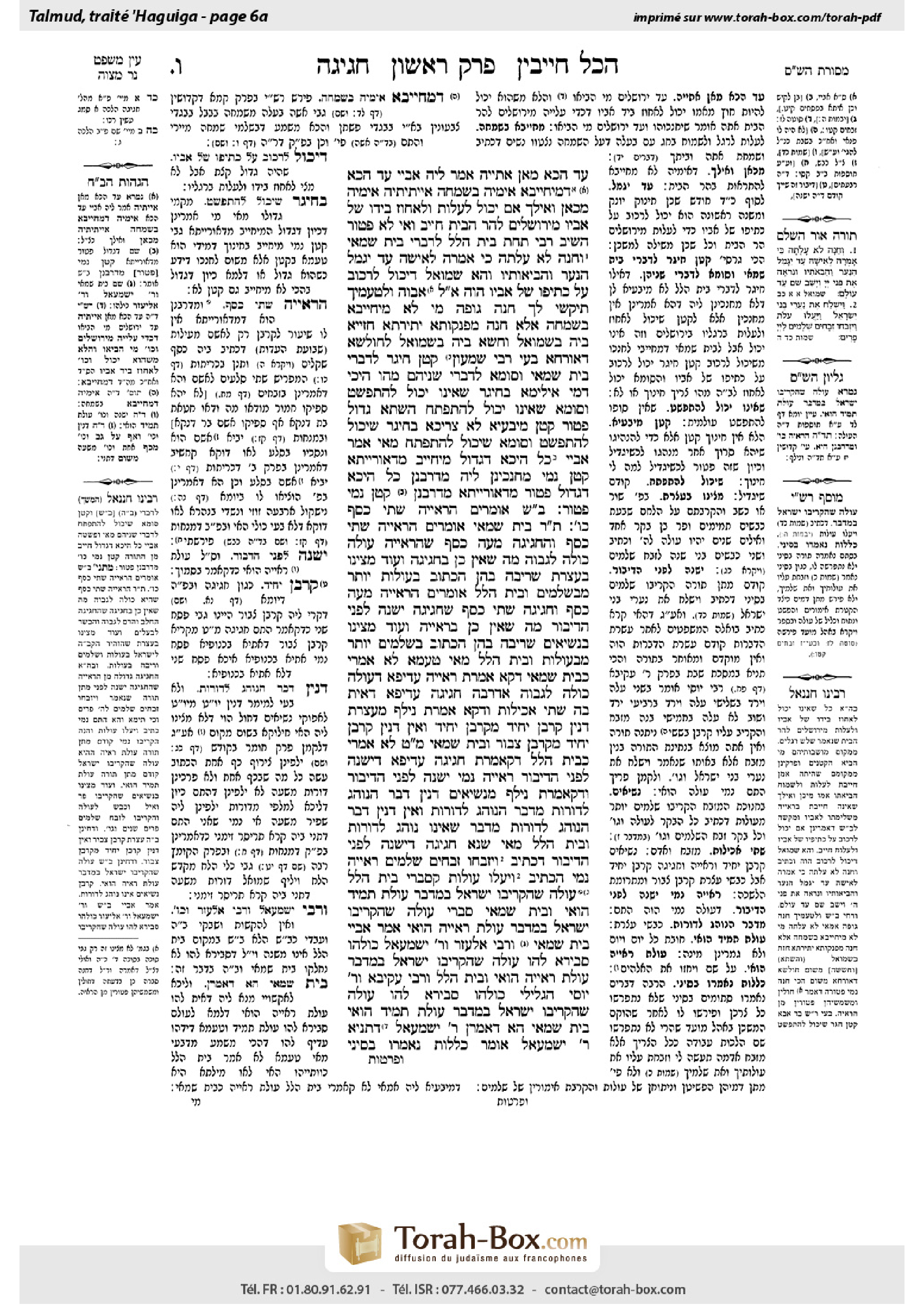
Chagigah 6a: Talmud study for Daf Yomi
Study the Talmud for Daf Yomi with scanned pages, Hebrew text, English translations from Sefaria and AI-generated French translations.
Passage selection and English or AI-generated French translation are available where the scan has annotations. Daf Study is independent of Torah-Box and Sefaria.
Browse Chagigah · חגיגה · All tractatesChagigah 6a text and translations
This page of Chagigah includes the Aramaic text, an English translation and an AI-generated French translation, alongside the scan above.
חגיגה ו׳ א · Aramaic and Hebrew text
עַד הָכָא, מַאן אַתְיֵיהּ?
אֲמַר לֵיהּ אַבָּיֵי: עַד הָכָא דְּמִיחַיְּיבָא אִימֵּיהּ בְּשִׂמְחָה — אַיְיתִיתֵיהּ אִימֵּיהּ. מִכָּאן וְאֵילָךְ, אִם יָכוֹל לַעֲלוֹת וְלֶאֱחוֹז בְּיָדוֹ שֶׁל אָבִיו מִירוּשָׁלַיִם לְהַר הַבַּיִת — חַיָּיב, וְאִי לָא — פָּטוּר.
הֵשִׁיב רַבִּי תַּחַת בֵּית הִלֵּל: לְדִבְרֵי בֵּית שַׁמַּאי, ״וְחַנָּה לֹא עָלָתָה כִּי אָמְרָה לְאִישָׁהּ עַד יִגָּמֵל הַנַּעַר וַהֲבִיאוֹתִיו״ — וְהָא שְׁמוּאֵל, דְּיָכוֹל לִרְכּוֹב עַל כְּתֵיפוֹ שֶׁל אָבִיו הֲוָה.
אֲמַר לֵיהּ אֲבוּהּ: וּלְטַעְמָיךְ, תִּיקְשֵׁי לָךְ, חַנָּה גּוּפַהּ מִי לָא מִיחַיְּיבָא בְּשִׂמְחָה? אֶלָּא חַנָּה, מְפַנְּקוּתָא יַתִּירְתָּא חַזְיָיא בֵּיהּ בִּשְׁמוּאֵל, וְחַשָּׁא בֵּיהּ בִּשְׁמוּאֵל לְחוּלְשָׁא דְאוֹרְחָא.
בָּעֵי רַבִּי שִׁמְעוֹן: קָטָן חִיגֵּר לְדִבְרֵי בֵּית שַׁמַּאי, וְסוֹמֵא לְדִבְרֵי שְׁנֵיהֶם, מַהוּ?
הֵיכִי דָמֵי? אִילֵּימָא בְּחִיגֵּר שֶׁאֵינוֹ יָכוֹל לְהִתְפַּשֵּׁט, וְסוֹמֵא שֶׁאֵינוֹ יָכוֹל לְהִתְפַּתֵּחַ? הַשְׁתָּא גָּדוֹל — פָּטוּר, קָטָן — מִיבַּעְיָא?! לָא צְרִיכָא: בְּחִיגֵּר שֶׁיָּכוֹל לְהִתְפַּשֵּׁט, וְסוֹמֵא שֶׁיָּכוֹל לְהִתְפַּתֵּחַ, מַאי?
אָמַר אַבָּיֵי: כֹּל הֵיכָא דְּגָדוֹל מִיחַיַּיב מִדְּאוֹרָיְיתָא — קָטָן נָמֵי מְחַנְּכִינַן לֵיהּ מִדְּרַבָּנַן, כֹּל הֵיכָא דְּגָדוֹל פָּטוּר מִדְּאוֹרָיְיתָא — מִדְּרַבָּנַן קָטָן נָמֵי פָּטוּר.
בֵּית שַׁמַּאי אוֹמְרִים: הָרְאִיָּיה שְׁתֵּי כֶּסֶף כּוּ׳.
תָּנוּ רַבָּנַן, בֵּית שַׁמַּאי אוֹמְרִים: הָרְאִיָּיה שְׁתֵּי כֶּסֶף, וְהַחֲגִיגָה מָעָה כֶּסֶף. שֶׁהָרְאִיָּיה עוֹלָה כּוּלָּהּ לַגָּבוֹהַּ, מַה שֶּׁאֵין כֵּן בַּחֲגִיגָה, וְעוֹד: מָצִינוּ בָּעֲצֶרֶת שֶׁרִיבָּה בָּהֶן הַכָּתוּב בְּעוֹלוֹת יוֹתֵר מִבִּשְׁלָמִים.
וּבֵית הִלֵּל אוֹמְרִים: הָרְאִיָּיה מָעָה כֶּסֶף וַחֲגִיגָה שְׁתֵּי כֶסֶף. שֶׁחֲגִיגָה יֶשְׁנָהּ לִפְנֵי הַדִּיבּוּר, מַה שֶּׁאֵין כֵּן בִּרְאִיָּיה. וְעוֹד: מָצִינוּ בַּנְּשִׂיאִים שֶׁרִיבָּה בָּהֶן הַכָּתוּב בִּשְׁלָמִים יוֹתֵר מִבְּעוֹלוֹת.
וּבֵית הִלֵּל, מַאי טַעְמָא לָא אָמְרִי כְּבֵית שַׁמַּאי? דְּקָא אָמְרַתְּ: רְאִיָּיה עֲדִיפָא — דְּעוֹלָה כּוּלָּהּ לַגָּבוֹהַּ, אַדְּרַבָּה: חֲגִיגָה עֲדִיפָא — דְּאִית בָּהּ שְׁתֵּי אֲכִילוֹת. וּדְקָא אָמְרַתְּ: נֵילַף מֵעֲצֶרֶת — דָּנִין קׇרְבַּן יָחִיד מִקׇּרְבַּן יָחִיד, וְאֵין דָּנִין קׇרְבַּן יָחִיד מִקׇּרְבַּן צִבּוּר.
וּבֵית שַׁמַּאי, מַאי טַעְמָא לָא אָמְרִי כְּבֵית הִלֵּל? דְּקָאָמְרַתְּ: חֲגִיגָה עֲדִיפָא — דְּיֶשְׁנָהּ לִפְנֵי הַדִּיבּוּר, רְאִיָּיה נָמֵי יֶשְׁנָהּ לִפְנֵי הַדִּיבּוּר.
וּדְקָאָמְרַתְּ: נֵילַף מִנְּשִׂיאִים — דָּנִין דָּבָר הַנּוֹהֵג לְדוֹרוֹת מִדָּבָר הַנּוֹהֵג לְדוֹרוֹת, וְאֵין דָּנִין דָּבָר הַנּוֹהֵג לְדוֹרוֹת מִדָּבָר שֶׁאֵינוֹ נוֹהֵג לְדוֹרוֹת.
וּבֵית הִלֵּל, מַאי שְׁנָא חֲגִיגָה דְּיֶשְׁנָהּ לִפְנֵי הַדִּיבּוּר, דִּכְתִיב: ״וַיִּזְבְּחוּ זְבָחִים שְׁלָמִים״, רְאִיָּיה נָמֵי, הָכְתִיב: ״וַיַּעֲלוּ עוֹלוֹת״!
קָסָבְרִי בֵּית הִלֵּל: עוֹלָה שֶׁהִקְרִיבוּ יִשְׂרָאֵל בַּמִּדְבָּר — עוֹלַת תָּמִיד הֲוַאי. וּבֵית שַׁמַּאי סָבְרִי: עוֹלָה שֶׁהִקְרִיבוּ יִשְׂרָאֵל בַּמִּדְבָּר — עוֹלַת רְאִיָּיה הֲוַאי.
אָמַר אַבָּיֵי: בֵּית שַׁמַּאי, וְרַבִּי אֶלְעָזָר, וְרַבִּי יִשְׁמָעֵאל, כּוּלְּהוּ סְבִירָא לְהוּ: עוֹלָה שֶׁהִקְרִיבוּ יִשְׂרָאֵל בַּמִּדְבָּר — עוֹלַת רְאִיָּיה הֲוַאי. וּבֵית הִלֵּל, וְרַבִּי עֲקִיבָא, וְרַבִּי יוֹסֵי הַגְּלִילִי, כּוּלְּהוּ סְבִירָא לְהוּ: עוֹלָה שֶׁהִקְרִיבוּ יִשְׂרָאֵל בַּמִּדְבָּר — עוֹלַת תָּמִיד הֲוַאי.
בֵּית שַׁמַּאי — הָא דַּאֲמַרַן. רַבִּי יִשְׁמָעֵאל — דְּתַנְיָא, רַבִּי יִשְׁמָעֵאל אוֹמֵר: כְּלָלוֹת נֶאֶמְרוּ בְּסִינַי,
Chagigah 6a · English translation
Who brought him to here, all the way to Jerusalem? If the father could bring his child to Jerusalem, why can’t he bring him to the Temple Mount?
Abaye said to him: With regard to the way to here, as his mother is also obligated in rejoicing on the Festival, his mother brought him when she herself ascended to the capital. From this point forward, if he is able to ascend and hold his father’s hand from Jerusalem to the Temple Mount, he is obligated, and if not, he is exempt.
It is taught in a baraita that Rabbi Yehuda HaNasi responded in place of Beit Hillel, that according to the statement of Beit Shammai that a child who is unable to ride on his father’s shoulders is not obligated in the mitzva of appearance, they must explain a verse that deals with Hanna, Samuel’s mother: “But Hanna did not ascend, for she said to her husband: Until the child is weaned, when I will bring him” (I Samuel 1:22). But Samuel was able to ride on his father’s shoulders. The age of weaning is twenty-four months, before which Samuel was already old enough to ride on his father’s shoulders, and yet he was not ready to ascend to the Tabernacle. This shows that only a child who is able to walk on his own is obligated in the mitzva of appearance.
Rabbi Yehuda HaNasi’s father said to him: According to your reasoning, ask about Hanna herself: Wasn’t she obligated in rejoicing? Why didn’t she travel to the Tabernacle to fulfill a mitzva in which she herself was obligated? Rather, Hanna saw in Samuel the need for extra pampering, and she was concerned about Samuel lest he experience weakness from the journey. Since she was unable to bring him, she herself did not come.
Rabbi Shimon raises a dilemma: With regard to a minor who is lame and yet he is able to ascend on his father’s shoulders, according to the statement of Beit Shammai, and likewise a minor who is blind but is able to hold his father’s hand and ascend, according to the statements of both Beit Shammai and Beit Hillel, what is the halakha? Are these children obligated in the mitzva of appearance?
The Gemara inquires: What are the circumstances of this case? If we say that it is referring to a lame minor who cannot be healed, and a blind child who cannot develop sight, what is the dilemma? Now, if an adult in this state is exempt, is it necessary to ask about a minor? Since this minor will never be obligated in the mitzva, even when he is an adult, there is no need to train him in its performance. The Gemara explains: No; it is necessary to ask with regard to a lame minor who can be healed and a blind minor who can develop sight. What is the halakha? Since the minor might eventually be obligated, is it necessary to train him at this point?
Abaye said: Anywhere that an adult is obligated by Torah law, one must also train a minor in that state of health by rabbinic law. Anywhere that an adult is exempt by Torah law, a minor in that same state is also exempt by rabbinic law. Since in this current condition an adult would be exempt, there is no obligation to train this minor either, despite the fact that he might become obligated in the future.
§ The mishna taught that Beit Shammai say: The burnt-offering of appearance, brought by a pilgrim when he appears at the Temple on a Festival, must be worth at least two silver coins, and the Festival peace-offering must be worth at least one silver ma’a coin. And Beit Hillel say: The burnt-offering of appearance must be worth at least one silver ma’a and the Festival peace-offering at least two silver coins.
The Sages taught in a baraita that Beit Shammai say: The burnt-offering of appearance must be worth two silver coins, and the Festival peace-offering need be worth only one silver ma’a. The reason the burnt-offering must be worth more is that the burnt-offering of appearance goes up entirely to God, which is not so with regard to the Festival peace-offering, as parts of a peace-offering are eaten by its owner while other portions are consumed by the priests. And furthermore, another reason for this difference is that we find with regard to the festival of Assembly, i.e., Shavuot, that the verse includes more burnt-offerings than peace-offerings. The sacrificial requirement consists of one bull, two rams, and seven sheep as burnt-offerings, but only two sheep for peace-offerings.
And Beit Hillel say: The burnt-offering of appearance must be worth one silver ma’a and the Festival peace-offering must be worth two silver coins. The reason for this difference is that the Festival peace-offering existed before the speech of God, i.e., before the giving of the Torah on Mount Sinai, which is not so with regard to the mitzva of appearance. And furthermore, another reason is that we find with regard to the offerings of the princes during the dedication of the Tabernacle that the verse includes more peace-offerings than burnt-offerings. Each prince brought one cow, a ram, and a sheep as burnt-offerings, but two cows, two rams, five goats, and five sheep as peace-offerings.
The Gemara asks: And Beit Hillel, what is the reason that they do not say in accordance with the opinion of Beit Shammai? Beit Hillel would respond to both claims of Beit Shammai. With regard to that which you said, that the burnt-offering of appearance is superior because it goes up entirely to God, on the contrary, the Festival peace-offering is superior, as it has two consumptions, by God on the altar and by people. And with regard to that which you said that we derive this halakha from the festival of Assembly, i.e., Shavuot, one could argue instead that one should derive the halakhot of the offering of an individual from another offering of an individual, i.e., the princes; and one does not derive the halakhot of the offering of an individual from the communal offering of Shavuot.
The Gemara asks the reverse question: And what is the reason that Beit Shammai do not say in accordance with the opinion of Beit Hillel? Beit Shammai would respond to the arguments of Beit Hillel: With regard to that which you said, that the Festival peace-offering is superior, as it existed before the speech of God, the burnt-offering of appearance also existed before the speech. According to the opinion of Beit Shammai, the Jewish people sacrificed burnt-offerings at Mount Sinai before the giving of the Torah.
And with regard to that which you said, that one derives the halakhot of these offerings from the offerings of the princes, one could argue that one derives the halakhot of a matter that is performed in all generations, i.e., the value of the different Festival offerings, from another matter that is performed in all generations, i.e., the offerings brought on Shavuot. However, one does not derive the halakhot of a matter that is performed in all generations from a matter that is not performed in all generations, as the offerings of the princes was a specific mitzva for the Tabernacle in the wilderness.
The Gemara asks: And according to the opinion of Beit Hillel, what is different about the Festival peace-offering, that it existed before the speech of God, as it is written: “And they sacrificed peace-offerings of bulls to the Lord” (Exodus 24:5)? The burnt-offering of appearance is also mentioned, as isn’t it written in the same verse: “And they sacrificed burnt-offerings”?
The Gemara responds: Beit Hillel hold that the burnt-offering that the Jewish people sacrificed in the desert at Mount Sinai was the daily burnt-offering, which is a communal offering, as there were no individual burnt-offerings before the giving of the Torah. And Beit Shammai hold that the burnt-offering that the Jewish people sacrificed in the desert at Mount Sinai was a burnt-offering of appearance, which is an individual offering.
Abaye said: Beit Shammai, Rabbi Elazar, and Rabbi Yishmael all hold that the burnt-offering that the Jewish people sacrificed in the desert at Mount Sinai was a burnt-offering of appearance. And Beit Hillel, Rabbi Akiva, and Rabbi Yosei HaGelili all hold that the burnt-offering that the Jewish people sacrificed in the desert at Mount Sinai was a daily burnt-offering, not an individual offering.
The Gemara explains the source for each opinion. Beit Shammai is that which we said. Rabbi Yishmael, as it is taught in a baraita that Rabbi Yishmael says: General statements were said at Sinai, i.e., Moses received general mitzvot at Sinai, including the Ten Commandments.
Chagigah 6a · Traduction française (IA)
Qui l’a amené ici, jusqu’à Jérusalem ? Si le père pouvait amener son enfant à Jérusalem, pourquoi ne pourrait-il pas l’amener jusqu’au Mont du Temple ?
Abaye répondit à lui : En ce qui concerne le chemin jusqu’ici, puisque la mère est également tenue de se réjouir pendant la fête, c’est elle qui l’a amené lorsqu’elle est montée à la capitale. À partir de ce point, si l’enfant est capable de monter et de tenir la main de son père de Jérusalem jusqu’au Mont du Temple, il est tenu, et si non, il est exempt.
Il est enseigné dans une baraïta que Rabbi Yehuda HaNasi a répondu à la place de Beit Hillel, que selon l’affirmation de Beit Shammai, un enfant qui ne peut pas monter sur les épaules de son père n’est pas tenu de la Mitsva de présence, ils doivent expliquer un verset concernant Hanna, la mère de Samuel : « Mais Hanna ne monta pas, car elle dit à son mari : Jusqu’à ce que l’enfant soit débarrassé, quand je le présenterai » (1 Samuel 1:22). Mais Samuel était capable de monter sur les épaules de son père. L’âge de la débarras est de vingt-quatre mois, avant lequel Samuel était déjà assez âgé pour monter sur les épaules de son père, et pourtant il n’était pas prêt à monter au Tabernacle. Cela montre que seul un enfant capable de marcher seul est tenu de la Mitsva de présence.
Le père de Rabbi Yehuda HaNasi lui dit : Selon votre raisonnement, posez la question à Hanna elle-même : N’était-elle pas tenue de se réjouir ? Pourquoi n’est-elle pas allée au Tabernacle pour accomplir une Mitsva dans laquelle elle était elle-même tenue ? Plutôt, Hanna a vu dans Samuel le besoin de soins supplémentaires, et elle s’inquiétait pour Samuel de crainte qu’il ne souffre de faiblesse pendant le voyage. Puisqu’elle n’était pas capable de l’amener, elle-même n’est pas venue.
Rabbi Shimon soulève un dilemme : En ce qui concerne un mineur boiteux, mais capable de monter sur les épaules de son père, selon l’affirmation de Beit Shammai, et de même un mineur aveugle mais capable de tenir la main de son père et de monter, selon les affirmations de Beit Shammai et de Beit Hillel, quelle est la halakha ? Ces enfants sont-ils tenus de la Mitsva de présence ?
La Guemara interroge : Quelles sont les circonstances de ce cas ? Si nous disons qu’il s’agit d’un mineur boiteux qui ne peut pas être guéri, et d’un enfant aveugle qui ne peut pas développer la vue, quelle est la difficulté ? Maintenant, si un adulte dans cet état est exempt, est-il nécessaire d’interroger un mineur ? Puisque ce mineur ne sera jamais tenu de la Mitsva, même lorsqu’il sera adulte, il n’est pas nécessaire de l’entraîner à accomplir cette Mitsva. La Guemara explique : Non ; il est nécessaire d’interroger concernant un mineur boiteux qui peut être guéri et un mineur aveugle qui peut développer la vue. Quelle est la halakha ? Puisque le mineur pourrait un jour être tenu, est-il nécessaire de l’entraîner à cette époque ?
Abaye dit : Partout où un adulte est tenu par la Loi, il faut aussi former un mineur dans cet état de santé par la Loi rabbinique. Partout où un adulte est exempt par la Loi, un mineur dans le même état est également exempt par la Loi rabbinique. Puisque dans cet état un adulte est exempt, il n’y a pas d’obligation de former ce mineur non plus, malgré le fait qu’il pourrait un jour être tenu de la Mitsva.
§ La mitsna enseignait que Beit Shammai disent : L’offrande brûlée de présence, apportée par un pèlerin lorsqu’il vient au Temple pendant une fête, doit valoir au moins deux monnaies d’argent, et l’offrande de paix de fête doit valoir au moins une monnaie d’argent ma’a. Et Beit Hillel disent : L’offrande brûlée de présence doit valoir au moins une monnaie d’argent ma’a et l’offrande de paix de fête au moins deux monnaies d’argent.
Les Sages enseignèrent dans une baraïta que Beit Shammai disent : L’offrande brûlée de présence doit valoir deux monnaies d’argent, et l’offrande de paix de fête n’a besoin que d’une monnaie d’argent ma’a. La raison pour laquelle l’offrande brûlée doit valoir plus est que l’offrande brûlée de présence monte entièrement à Dieu, ce qui n’est pas le cas de l’offrande de paix de fête, car des parties d’une offrande de paix sont mangées par son propriétaire tandis que d’autres sont consommées par les prêtres. Et de plus, une autre raison pour cette différence est que nous trouvons concernant la fête de l’Assemblée, c’est-à-dire Shavuot, que le verset inclut plus d’offrandes brûlées que d’offrandes de paix. La nécessité sacrifielle consiste en un bœuf, deux béliers et sept agnelles comme offrandes brûlées, mais seulement deux agnelles pour les offrandes de paix.
Et Beit Hillel disent : L’offrande brûlée de présence doit valoir une monnaie d’argent et l’offrande de paix de fête doit valoir deux monnaies d’argent. La raison de cette différence est que l’offrande de paix de fête existait avant la parole de Dieu, c’est-à-dire avant la révélation de la Torah sur le Mont Sinaï, ce qui n’est pas le cas de la Mitsva de présence. Et de plus, une autre raison est que nous trouvons concernant les offrandes des princes pendant la dédicace du Tabernacle que le verset inclut plus d’offrandes de paix que d’offrandes brûlées. Chaque prince apporta un bœuf, un bélier et un agneau comme offrandes brûlées, mais deux bœufs, deux béliers, cinq boucs et cinq agnelles comme offrandes de paix.
La Guemara interroge : Et Beit Hillel, quelle est la raison qu’ils ne disent pas selon l’opinion de Beit Shammai ? Beit Hillel répondrait aux deux revendications de Beit Shammai. En ce qui concerne ce que vous avez dit, que l’offrande brûlée de présence est supérieure car elle monte entièrement à Dieu, au contraire, l’offrande de paix de fête est supérieure, car elle a deux consommations, par Dieu sur l’autel et par les gens. Et en ce qui concerne ce que vous avez dit que nous dérivons cette halakha de la fête de l’Assemblée, c’est-à-dire Shavuot, on pourrait argumenter plutôt que l’on devrait dériver les halakhot de l’offrande individuelle d’une autre offrande individuelle, c’est-à-dire les princes ; et l’on ne dérive pas les halakhot de l’offrande individuelle de l’offrande communautaire de Shavuot.
La Guemara pose la question inverse : Et pourquoi Beit Shammai ne disent-ils pas selon l'opinion de Beit Hillel ? Beit Shammai répondrait aux arguments de Beit Hillel : En ce qui concerne ce que vous avez dit, à savoir que l'offrande de paix du festival est supérieure, car elle existait avant la parole de Dieu, l'holocauste d'apparence existait aussi avant la parole. Selon l'opinion de Beit Shammai, le peuple juif a offert des offrandes brûlées à Sinaï avant la révélation de la Torah.
Et en ce qui concerne ce que vous avez dit, à savoir que l'on déduit les halakhot de ces offrandes à partir des offrandes des princes, on pourrait argumenter que l'on déduit les halakhot d'une chose accomplie dans toutes les générations, c'est-à-dire la valeur des différentes offrandes du festival, à partir d'une autre chose accomplie dans toutes les générations, c'est-à-dire les offrandes offertes pendant le Shavuot. Cependant, on ne déduit pas les halakhot d'une chose accomplie dans toutes les générations à partir d'une chose qui n'est pas accomplie dans toutes les générations, car les offrandes des princes étaient une mitsva spécifique pour le Tabernacle dans le désert.
La Guemara pose la question : Et selon l'opinion de Beit Hillel, en quoi est-ce différent de l'offrande de paix du festival, qu'elle ait existé avant la parole de Dieu, comme il est écrit : « Et ils offrirent des offrandes de paix de taureaux à l'Éternel » (Exode 24:5) ? L'holocauste d'apparence est aussi mentionnée, comme il n'est pas écrit dans la même versette : « Et ils offrirent des offrandes brûlées » ?
La Guemara répond : Beit Hillel considère que l'holocauste que le peuple juif a offert dans le désert à Mount Sinai était l'holocauste quotidienne, qui est une offrande communautaire, car il n'y avait pas d'offrandes brûlées individuelles avant la révélation de la Torah. Et Beit Shammai considère que l'holocauste que le peuple juif a offert dans le désert à Mount Sinai était une offrande brûlée de visage, qui est une offrande individuelle.
Abaye dit : Beit Shammai, Rabbi Elazar et Rabbi Yishmael considèrent tous que l'holocauste que le peuple juif a offert dans le désert à Mount Sinai était une offrande brûlée de visage. Et Beit Hillel, Rabbi Akiva et Rabbi Yosei HaGelili considèrent tous que l'holocauste que le peuple juif a offert dans le désert à Mount Sinai était une offrande brûlée quotidienne, pas une offrande individuelle.
La Guemara explique la source de chaque opinion. Beit Shammai est celui que nous avons dit. Rabbi Yishmael, comme il est enseigné dans une baraïta que Rabbi Yishmael dit : Des déclarations générales furent dites à Sinai, c'est-à-dire que Moïse a reçu des mitsvot générales à Sinai, y compris les Dix Commandements.
Traduction française générée par IA à partir de l’édition anglaise de Sefaria. Vérifie toujours un passage avec le texte source.
Text from Sefaria: William Davidson Edition - Vocalized Aramaic (CC BY NC); William Davidson Edition - English (CC BY NC).