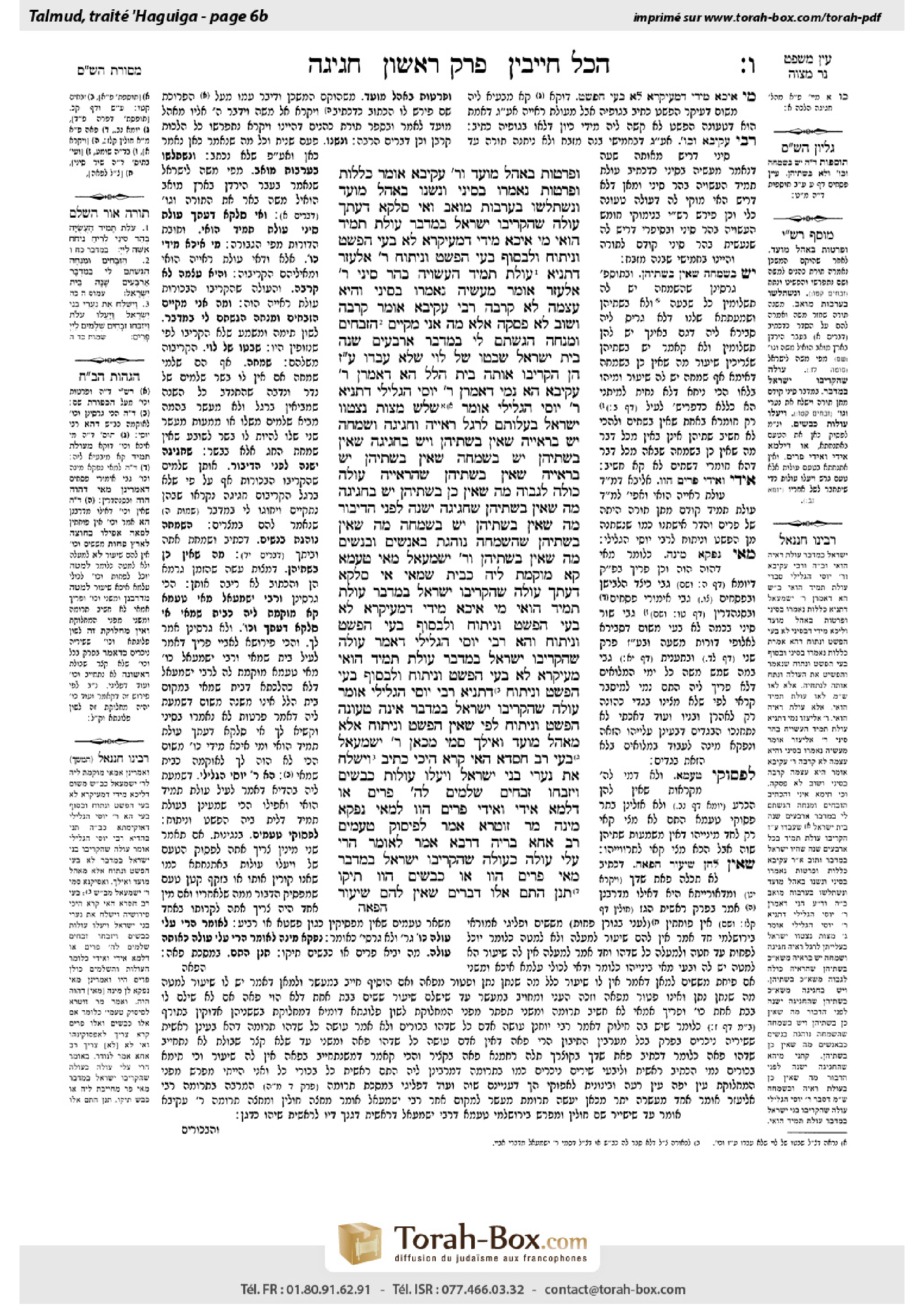
Chagigah 6b: Talmud study for Daf Yomi
Study the Talmud for Daf Yomi with scanned pages, Hebrew text, English translations from Sefaria and AI-generated French translations.
Passage selection and English or AI-generated French translation are available where the scan has annotations. Daf Study is independent of Torah-Box and Sefaria.
Browse Chagigah · חגיגה · All tractatesChagigah 6b text and translations
This page of Chagigah includes the Aramaic text, an English translation and an AI-generated French translation, alongside the scan above.
חגיגה ו׳ ב · Aramaic and Hebrew text
וּפְרָטוֹת בְּאֹהֶל מוֹעֵד. וְרַבִּי עֲקִיבָא אוֹמֵר: כְּלָלוֹת וּפְרָטוֹת נֶאֶמְרוּ בְּסִינַי, וְנִשְׁנוּ בְּאֹהֶל מוֹעֵד, וְנִשְׁתַּלְּשׁוּ בְּעַרְבוֹת מוֹאָב. וְאִי סָלְקָא דַּעְתָּךְ עוֹלָה שֶׁהִקְרִיבוּ יִשְׂרָאֵל בַּמִּדְבָּר — עוֹלַת תָּמִיד הֲוַאי,
מִי אִיכָּא מִידֵּי דְּמֵעִיקָּרָא לָא בָּעֵי הֶפְשֵׁט וְנִיתּוּחַ, וּלְבַסּוֹף בָּעֵי הֶפְשֵׁט וְנִיתּוּחַ?!
רַבִּי אֶלְעָזָר — דְּתַנְיָא: ״עוֹלַת תָּמִיד הָעֲשׂוּיָה בְּהַר סִינַי״, רַבִּי אֶלְעָזָר אוֹמֵר: מַעֲשֶׂיהָ נֶאֶמְרוּ בְּסִינַי, וְהִיא עַצְמָהּ לֹא קָרְבָה.
רַבִּי עֲקִיבָא אוֹמֵר: קָרְבָה, וְשׁוּב לֹא פָּסְקָה. אֶלָּא מָה אֲנִי מְקַיֵּים ״הַזְּבָחִים וּמִנְחָה הִגַּשְׁתֶּם לִי בַמִּדְבָּר אַרְבָּעִים שָׁנָה בֵּית יִשְׂרָאֵל״ —
שִׁבְטוֹ שֶׁל לֵוִי שֶׁלֹּא עָבְדוּ עֲבוֹדָה זָרָה, הֵן הִקְרִיבוּ אוֹתָהּ.
בֵּית הִלֵּל — הָא דַּאֲמַרַן. רַבִּי עֲקִיבָא — הָא נָמֵי דַּאֲמַרַן. רַבִּי יוֹסֵי הַגְּלִילִי — דְּתַנְיָא, רַבִּי יוֹסֵי הַגְּלִילִי אוֹמֵר: שָׁלֹשׁ מִצְוֹת נִצְטַוּוּ יִשְׂרָאֵל בַּעֲלוֹתָם לָרֶגֶל: רְאִיָּיה, וַחֲגִיגָה, וְשִׂמְחָה.
יֵשׁ בָּרְאִיָּיה שֶׁאֵין בִּשְׁתֵּיהֶן; וְיֵשׁ בַּחֲגִיגָה שֶׁאֵין בִּשְׁתֵּיהֶן; יֵשׁ בַּשִּׂמְחָה שֶׁאֵין בִּשְׁתֵּיהֶן. יֵשׁ בָּרְאִיָּיה שֶׁאֵין בִּשְׁתֵּיהֶן — שֶׁהָרְאִיָּיה עוֹלָה כּוּלָּהּ לַגָּבוֹהַּ, מַה שֶּׁאֵין כֵּן בִּשְׁתֵּיהֶן.
יֵשׁ בַּחֲגִיגָה מַה שֶּׁאֵין בִּשְׁתֵּיהֶן, שֶׁחֲגִיגָה יֶשְׁנָהּ לִפְנֵי הַדִּיבּוּר, מַה שֶּׁאֵין בִּשְׁתֵּיהֶן. יֵשׁ בַּשִּׂמְחָה מַה שֶּׁאֵין בִּשְׁתֵּיהֶן, שֶׁהַשִּׂמְחָה נוֹהֶגֶת בַּאֲנָשִׁים וּבְנָשִׁים, מַה שֶּׁאֵין בִּשְׁתֵּיהֶן.
וְרַבִּי יִשְׁמָעֵאל, מַאי טַעְמָא קָא מוֹקְמַתְּ לֵיהּ כְּבֵית שַׁמַּאי? אִי סָלְקָא דַּעְתָּךְ עוֹלָה שֶׁהִקְרִיבוּ יִשְׂרָאֵל בַּמִּדְבָּר עוֹלַת תָּמִיד הֲוַאי, מִי אִיכָּא מִידֵּי דְּמֵעִיקָּרָא לָא בָּעֵי הֶפְשֵׁט וְנִיתּוּחַ, וּלְבַסּוֹף בָּעֵי הֶפְשֵׁט וְנִיתּוּחַ?!
וְהָא רַבִּי יוֹסֵי הַגְּלִילִי, דְּאָמַר: עוֹלָה שֶׁהִקְרִיבוּ יִשְׂרָאֵל בַּמִּדְבָּר — עוֹלַת תָּמִיד הֲוַאי: מֵעִיקָּרָא לָא בָּעֵי הֶפְשֵׁט וְנִיתּוּחַ, וּלְבַסּוֹף בָּעֵי הֶפְשֵׁט וְנִיתּוּחַ.
דְּתַנְיָא, רַבִּי יוֹסֵי הַגְּלִילִי אוֹמֵר: עוֹלָה שֶׁהִקְרִיבוּ יִשְׂרָאֵל בַּמִּדְבָּר אֵינָהּ טְעוּנָה הֶפְשֵׁט וְנִיתּוּחַ, לְפִי שֶׁאֵין הֶפְשֵׁט וְנִיתּוּחַ אֶלָּא מֵאֹהֶל מוֹעֵד וְאֵילָךְ! סְמִי מִכָּאן רַבִּי יִשְׁמָעֵאל.
בָּעֵי רַב חִסְדָּא: הַאי קְרָא הֵיכִי כְּתִיב? ״וַיִּשְׁלַח אֶת נַעֲרֵי בְּנֵי יִשְׂרָאֵל וַיַּעֲלוּ עוֹלוֹת״ — כְּבָשִׂים, ״וַיִּזְבְּחוּ זְבָחִים שְׁלָמִים לַה׳״ — ״פָּרִים״. אוֹ דִּלְמָא: אִידֵּי וְאִידֵּי פָּרִים הֲווֹ.
לְמַאי נָפְקָא מִינַּהּ? מָר זוּטְרָא אָמַר: לְפִיסּוּק טְעָמִים.
רַב אַחָא בְּרֵיהּ דְּרָבָא אָמַר: לָאוֹמֵר ״הֲרֵי עָלַי עוֹלָה כָּעוֹלָה שֶׁהִקְרִיבוּ יִשְׂרָאֵל בַּמִּדְבָּר״, מַאי? פָּרִים הֲווֹ, אוֹ כְּבָשִׂים הֲווֹ?! תֵּיקוּ.
תְּנַן הָתָם, אֵלּוּ דְּבָרִים שֶׁאֵין לָהֶם שִׁיעוּר:
Chagigah 6b · English translation
And the details of the mitzvot, e.g., the particulars of the sacrificial process, were said to Moses at a later time in the Tent of Meeting. And Rabbi Akiva says: Both general statements and the details of mitzvot were said at Sinai and later repeated in the Tent of Meeting, and reiterated a third time by Moses to the Jewish people in the plains of Moab, as recorded in the book of Deuteronomy. And if it enters your mind to say that Rabbi Yishmael holds that the burnt-offering that the Jewish people sacrificed in the desert at Mount Sinai was the daily burnt-offering, rather than the burnt-offering of an individual, the following question arises:
Is there any offering that initially did not require skinning and cutting into pieces, as these details of the daily burnt-offering were transmitted later in the Tent of Meeting, and ultimately, when these details were added, the offering required skinning and cutting? It is not plausible that the details of a mitzva would change over time. Therefore, it is clear that according to the opinion of Rabbi Yishmael the Jews did not sacrifice the daily burnt-offering before the giving of the Torah, which means that the burnt-offering sacrificed at Mount Sinai must have been a burnt-offering of appearance.
The Gemara cites the source for the opinion of Rabbi Elazar. As it is taught in a baraita: “It is a daily burnt-offering, which was performed on Mount Sinai” (Numbers 28:6). Rabbi Elazar says: The details of its performance were said at Sinai, but it itself was not sacrificed until the Tabernacle was erected. This indicates that the offering brought on Mount Sinai was a burnt-offering of appearance.
Rabbi Akiva says: It was sacrificed when they stood at Mount Sinai and its sacrifice never ceased. The Gemara asks: But if so, how do I uphold, i.e., how does Rabbi Akiva explain the following verse: “Did you bring to Me sacrifices and offerings for forty years in the wilderness, house of Israel?” (Amos 5:25). This verse indicates that they did not sacrifice these offerings.
The Gemara answers: The tribe of Levi, which did not commit the sin of idol worship, sacrificed it from their own funds. Since the rest of the Jewish people did not contribute the funds for the daily burnt-offering, it is as though they did not sacrifice this offering. This concludes the list of sources of the opinions of those Sages who hold that the daily burnt-offering was not sacrificed at Mount Sinai, and the offering that was sacrificed there was a burnt-offering of appearance.
The Gemara cites the sources for the opinions that the daily burnt-offering was sacrificed at Mount Sinai. Beit Hillel: That which we said. Rabbi Akiva: Also that which we said, in the aforementioned dispute with Rabbi Elazar. Rabbi Yosei HaGelili: As it is taught in a baraita that Rabbi Yosei HaGelili says: The Jewish people were commanded to perform three mitzvot when they ascended to the Temple for the pilgrimage Festivals: The burnt-offering of appearance, and the Festival peace-offering, and the peace-offering of rejoicing.
Rabbi Yosei HaGelili continues. There is an element of the burnt-offering of appearance that is not present in the other two; there is an element of the Festival peace-offering that is not present in the other two; and there is an element of the peace-offering of rejoicing that is not present in the other two. He elaborates: There is an element of the burnt-offering of appearance that is not present in the other two, as the burnt-offering of appearance goes up entirely to God, which is not so with regard to the other two, as the majority portion of the other two offerings is eaten.
There is an element of the Festival peace-offering that is not present in the other two, as the Festival peace-offering existed before the speech of God at Mount Sinai, which is not so with regard to the other two. Finally, there is an element of the peace-offering of rejoicing that is not present in the other two, as the peace-offering of rejoicing is performed by both men and by women, which is not so with regard to the other two. This shows that Rabbi Yosei HaGelili holds that the burnt-offering of appearance was not sacrificed at Mount Sinai, which means that the burnt-offering mentioned in that context must have been the daily burnt-offering.
The Gemara asks a question with regard to Abaye’s explanation. And with regard to Rabbi Yishmael, what is the reason that you established his ruling in accordance with the opinion of Beit Shammai that the burnt-offering sacrificed at Mount Sinai was a burnt-offering of appearance? The explanation for his opinion was: If it enters your mind that the burnt-offering the Jewish people sacrificed in the desert was a daily burnt-offering, is there any offering that initially did not require skinning and cutting into pieces and ultimately required skinning and cutting into pieces?
But wasn’t it Rabbi Yosei HaGelili who said: The burnt-offering that the Jewish people sacrificed in the desert at Mount Sinai was the daily burnt-offering? Nevertheless, he holds that initially it did not require skinning and cutting into pieces, and ultimately it required skinning and cutting into pieces.
As it is taught in a baraita that Rabbi Yosei HaGelili says: The burnt-offering that the Jewish people sacrificed in the desert did not require skinning and cutting into pieces, because the requirement of skinning and cutting offerings applied only from the time God commanded this mitzva in the Tent of Meeting and onward. The Gemara concludes: There is no clear evidence as to what Rabbi Yishmael actually maintains in this regard, and therefore one should delete Rabbi Yishmael from this list here, i.e., the list of those who hold that the burnt-offering sacrificed in the desert was a burnt-offering of appearance.
Rav Ḥisda raises a dilemma: This verse, how is it written, i.e., how should it be understood? Should the following verse be read as two separate halves, with the first part consisting of: “And he sent the young men of the children of Israel, and they sacrificed burnt-offerings” (Exodus 24:5), which were sheep; and the second part consisting of the rest of the verse: “And they sacrificed peace-offerings of bulls to the Lord,” i.e., these peace-offerings alone were bulls? Or perhaps both of these were bulls, as the term: “Bulls,” refers both to the burnt-offerings and the peace-offerings.
The Gemara asks: What is the practical difference between the two readings? Mar Zutra said: The practical difference is with regard to the punctuation of the cantillation notes, whether there should be a break in the verse after: “And they sacrificed burnt-offerings,” indicating that these offerings consisted of sheep; or whether it should read: “And they sacrificed burnt-offerings and sacrificed peace-offerings of bulls,” as one clause.
Rav Aḥa, son of Rava, said that the difference between these two readings of the verse is for one who says in the form of a vow: It is incumbent upon me to bring a burnt-offering like the burnt-offering that the Jewish people sacrificed in the desert at Mount Sinai. What is he required to bring? Were they bulls or were they sheep? The Gemara does not provide an answer and states that the question shall stand unresolved.
We learned in a mishna there (Pe’a 1:1): These are the mitzvot that have no measure:
Chagigah 6b · Traduction française (IA)
Et les détails des mitsvot, par exemple les particularités du processus sacrificiel, furent transmis à Moïse plus tard, dans la Tente de Rencontre. Et Rabbi Akiva dit : Les déclarations générales ainsi que les détails des mitsvot furent donnés à Sinaï et répétés plus tard dans la Tente de Rencontre, et répétés une troisième fois par Moïse au peuple juif dans les plaines de Moab, comme mentionné dans le livre de Deutéronome. Et si vous avez l'idée que Rabbi Yishmael considère que l'holocauste que le peuple juif sacrifia dans le désert à Sinaï était l'holocauste quotidien, plutôt que l'holocauste d'un individu, la question suivante se pose :
Y a-t-il un sacrifice qui n'avait pas besoin de dépecage et de découpage en morceaux au départ, puisque ces détails de l'holocauste quotidien furent transmis plus tard dans la Tente de Rencontre, et finalement, lorsque ces détails furent ajoutés, le sacrifice nécessitait le dépecage et le découpage ? Il n'est pas plausible que les détails d'une mitsva changent avec le temps. Par conséquent, il est clair que selon l'opinion de Rabbi Yishmael, les Juifs n'ont pas sacrifié l'holocauste quotidien avant la révélation de la Torah, ce qui signifie que l'holocauste sacrifié à Sinaï devait être un holocauste d'apparence.
La Guemara cite la source de l'opinion de Rabbi Elazar. Comme il est enseigné dans une baraïta : « C'est un holocauste quotidien, qui fut accompli à Sinaï » (Nombres 28:6). Rabbi Elazar dit : Les détails de son accomplissement furent donnés à Sinaï, mais lui-même ne fut pas sacrifié avant que la Tente ne soit dressée. Cela indique que l'offrande apportée à Sinaï était un holocauste d'apparence.
Rabbi Akiva dit : Il fut sacrifié lorsqu'ils se tenaient à Sinaï et son sacrifice ne s'est jamais interrompu. La Guemara pose une question : Mais si c'est ainsi, comment Rabbi Akiva explique-t-il le verset suivant : « Avez-vous apporté des sacrifices et des offrandes à Moi pendant quarante ans dans le désert, maison d'Israël ? » (Amos 5:25). Ce verset indique qu'ils n'ont pas sacrifié ces offrandes.
La Guemara répond : La tribu de Lévi, qui n'a pas commis le péché d'idolâtrie, le sacrifia avec ses propres fonds. Puisque le reste du peuple juif n'a pas contribué les fonds pour l'holocauste quotidien, cela semble comme s'ils n'avaient pas sacrifié cette offrande. Cela conclut la liste des sources des opinions des Sages qui pensent que l'holocauste quotidien n'a pas été sacrifié à Sinaï, et que l'offrande sacrifiée là était un holocauste d'apparence.
La Guemara cite les sources des opinions qui pensent que l'holocauste quotidien fut sacrifié à Sinaï. Beit Hillel : Ce que nous avons dit. Rabbi Akiva : Aussi ce que nous avons dit, dans le débat mentionné précédemment avec Rabbi Elazar. Rabbi Yosei HaGelili : Comme il est enseigné dans une baraïta que Rabbi Yosei HaGelili dit : Le peuple juif fut commandé à accomplir trois mitsvot lorsqu'il monta au Temple pour les fêtes de pèlerinage : l'holocauste d'apparence, et l'offrande de paix de la fête, et l'offrande de paix de la joie.
Rabbi Yosei HaGelili continue. Il y a un élément de l'holocauste d'apparence qui n'est pas présent dans les autres deux ; il y a un élément de l'offrande de paix de la fête qui n'est pas présent dans les autres deux ; et il y a un élément de l'offrande de paix de la joie qui n'est pas présent dans les autres deux. Il développe : Il y a un élément de l'holocauste d'apparence qui n'est pas présent dans les autres deux, car l'holocauste d'apparence monte entièrement à Dieu, ce qui n'est pas le cas des autres deux, car la majorité de l'offrande des autres deux est mangée.
Il y a un élément de l'offrande de paix de la fête qui n'est pas présent dans les autres deux, car l'offrande de paix de la fête existait avant la parole de Dieu à Sinaï, ce qui n'est pas le cas des autres deux. Enfin, il y a un élément de l'offrande de paix de la joie qui n'est pas présent dans les autres deux, car l'offrande de paix de la joie est accomplie par les hommes et les femmes, ce qui n'est pas le cas des autres deux. Cela montre que Rabbi Yosei HaGelili considère que l'holocauste d'apparence n'a pas été sacrifié à Sinaï, ce qui signifie que l'holocauste mentionné dans ce contexte doit être l'holocauste quotidien.
La Guemara pose une question concernant l'explication d'Abaye. Et concernant Rabbi Yishmael, quelle est la raison que vous avez établi sa décision selon l'opinion de Beit Shammai que l'holocauste sacrifié à Sinaï était un holocauste d'apparence ? L'explication de son opinion était : Si vous avez l'idée que l'holocauste que le peuple juif sacrifia dans le désert était un holocauste quotidien, y a-t-il un sacrifice qui n'avait pas besoin de dépecage et de découpage en morceaux au départ, et qui nécessitait finalement le dépecage et le découpage en morceaux ?
Mais n'était-ce pas Rabbi Yosei HaGelili qui disait : L'holocauste que le peuple juif sacrifia dans le désert à Sinaï était l'holocauste quotidien ? Cependant, il considère que d'abord il n'avait pas besoin de dépecage et de découpage en morceaux, et finalement il en avait besoin.
Comme il est enseigné dans une baraïta que Rabbi Yosei HaGelili dit : L'holocauste que le peuple juif sacrifia dans le désert n'avait pas besoin de dépecage et de découpage en morceaux, car la nécessité du dépecage et du découpage des offrandes s'appliquait seulement à partir du moment où Dieu commanda cette mitsva dans la Tente de Rencontre et par la suite. La Guemara conclut : Il n'y a pas de preuve claire sur ce que Rabbi Yishmael maintient à ce sujet, et par conséquent, on devrait supprimer Rabbi Yishmael de cette liste ici, c'est-à-dire la liste de ceux qui pensent que l'holocauste sacrifié dans le désert était un holocauste d'apparence.
Rav Ḥisda pose un dilemme : Ce verset, comment est-il écrit, c'est-à-dire comment doit-il être compris ? Doit-on lire le verset suivant comme deux parties séparées, la première partie étant : « Et il envoya les jeunes hommes des enfants d'Israël, et ils offrirent des holocaustes » (Exode 24:5), qui étaient des brebis ; et la seconde partie étant le reste du verset : « Et ils offrirent des sacrifices de paix de taureaux à l'Éternel », c'est-à-dire que ces sacrifices de paix étaient exclusivement des taureaux ? Ou bien tous deux étaient des taureaux, car le terme « taureaux » s'applique à la fois aux holocaustes et aux sacrifices de paix.
La Guemara demande : Quelle est la différence pratique entre ces deux lectures ? Mar Zutra dit : La différence pratique concerne la ponctuation des notes de chant, savoir s'il doit y avoir une pause après : « Et ils offrirent des holocaustes », indiquant que ces offrandes étaient des brebis ; ou s'il faut lire : « Et ils offrirent des holocaustes et offrirent des sacrifices de paix de taureaux », comme une seule proposition.
Rav Acha, fils de Rava, dit que la différence entre ces deux lectures du verset est liée à celui qui formule une promesse : Il m'est imposé de présenter un holocauste semblable au holocauste que le peuple juif a offert dans le désert au mont Sinaï. Quel holocauste doit-il présenter ? Étaient-ce des taureaux ou des brebis ? La Guemara ne donne pas de réponse et indique que cette question restera sans réponse.
Nous avons appris dans une mitsva là (Pe’a 1:1) : Ces sont les mitsvot qui n'ont pas de mesure :
Traduction française générée par IA à partir de l’édition anglaise de Sefaria. Vérifie toujours un passage avec le texte source.
Text from Sefaria: William Davidson Edition - Vocalized Aramaic (CC BY NC); William Davidson Edition - English (CC BY NC).