Chagigah 7a: Talmud study for Daf Yomi
Study the Talmud for Daf Yomi with scanned pages, Hebrew text, English translations from Sefaria and AI-generated French translations.
Passage selection and English or AI-generated French translation are available where the scan has annotations. Daf Study is independent of Torah-Box and Sefaria.
Browse Chagigah · חגיגה · All tractatesChagigah 7a text and translations
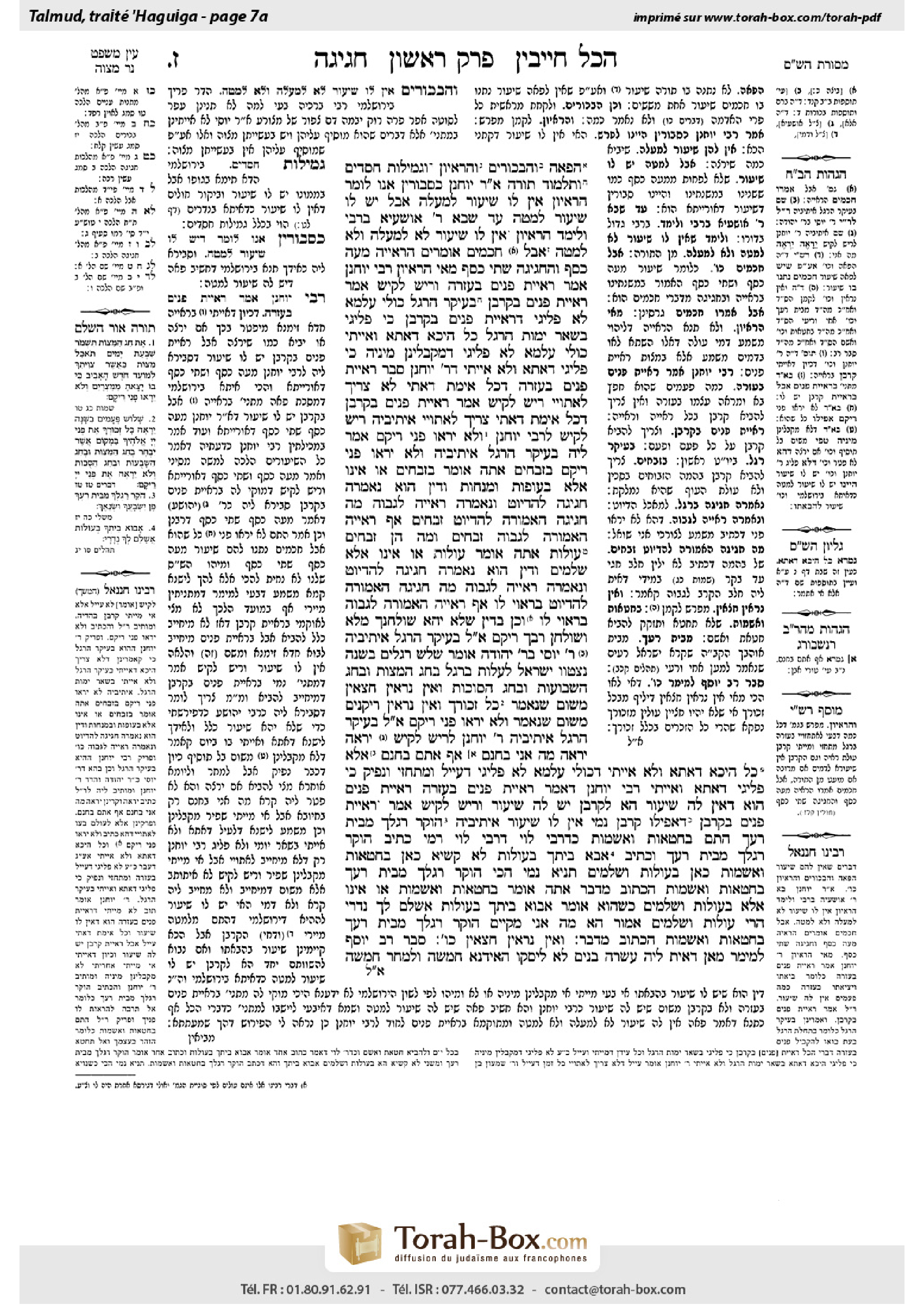
This page of Chagigah includes the Aramaic text, an English translation and an AI-generated French translation, alongside the scan above.
חגיגה ז׳ א · Aramaic and Hebrew text
הַפֵּאָה, וְהַבִּכּוּרִים, וְהָרֵאָיוֹן, וּגְמִילוּת חֲסָדִים, וְתַלְמוּד תּוֹרָה.
אָמַר רַבִּי יוֹחָנָן: כִּסְבוּרִין אָנוּ לוֹמַר, הָרֵאָיוֹן אֵין לוֹ שִׁיעוּר — לְמַעְלָה, אֲבָל יֵשׁ לוֹ שִׁיעוּר — לְמַטָּה, עַד שֶׁבָּא רַבִּי אוֹשַׁעְיָא בְּרַבִּי, וְלִימֵּד: הָרֵאָיוֹן אֵין לוֹ שִׁיעוּר לֹא לְמַעְלָה וְלֹא לְמַטָּה. אֲבָל חֲכָמִים אוֹמְרִים: הָרְאִיָּיה מָעָה כֶּסֶף, וְהַחֲגִיגָה שְׁתֵּי כֶסֶף.
מַאי הָרֵאָיוֹן? רַבִּי יוֹחָנָן אָמַר: רְאִיַּית פָּנִים בַּעֲזָרָה, וְרֵישׁ לָקִישׁ אָמַר: רְאִיַּית פָּנִים בְּקׇרְבָּן.
בָּעִיקָּר הָרֶגֶל, כּוּלֵּי עָלְמָא לָא פְּלִיגִי דִּרְאִיַּית פָּנִים בְּקׇרְבָּן. כִּי פְּלִיגִי בִּשְׁאָר יְמוֹת הָרֶגֶל: כׇּל הֵיכָא דַּאֲתָא וְאַיְיתִי — כּוּלֵּי עָלְמָא לָא פְּלִיגִי דִּמְקַבְּלִינַן מִינֵּיהּ, כִּי פְּלִיגִי דַּאֲתָא וְלָא אַיְיתִי.
דְּרַבִּי יוֹחָנָן סָבַר: רְאִיַּית פָּנִים בָּעֲזָרָה, דְּכׇל אֵימַת דְּאָתֵי לָא צָרִיךְ לְאֵתוֹיֵי, רֵישׁ לָקִישׁ אָמַר: רְאִיַּית פָּנִים בְּקׇרְבָּן, דְּכׇל אֵימַת דְּאָתֵי צָרִיךְ לְאֵתוֹיֵי.
אֵיתִיבֵיהּ רֵישׁ לָקִישׁ לְרַבִּי יוֹחָנָן: ״וְלֹא יֵרָאוּ פָנַי רֵיקָם״! אֲמַר לֵיהּ: בְּעִיקַּר הָרֶגֶל.
אֵיתִיבֵיהּ: ״וְלֹא יֵרָאוּ פָנַי רֵיקָם״ — בִּזְבָחִים. אַתָּה אוֹמֵר בִּזְבָחִים, אוֹ אֵינוֹ אֶלָּא בְּעוֹפוֹת וּמְנָחוֹת? וְדִין הוּא: נֶאֶמְרָה חֲגִיגָה לַהֶדְיוֹט, וְנֶאֶמְרָה רְאִיָּיה לַגָּבוֹהַּ. מָה חֲגִיגָה הָאֲמוּרָה לַהֶדְיוֹט — זְבָחִים, אַף רְאִיָּיה הָאֲמוּרָה לַגָּבוֹהַּ — זְבָחִים.
וּמָה הֵן זְבָחִים — עוֹלוֹת. אַתָּה אוֹמֵר עוֹלוֹת, אוֹ אֵינוֹ אֶלָּא שְׁלָמִים? וְדִין הוּא: נֶאֶמְרָה חֲגִיגָה לַהֶדְיוֹט, וְנֶאֶמְרָה רְאִיָּיה לַגָּבוֹהַּ. מָה חֲגִיגָה הָאֲמוּרָה לַהֶדְיוֹט — בְּרָאוּי לוֹ, אַף רְאִיָּיה הָאֲמוּרָה לַגָּבוֹהַּ — בְּרָאוּי לוֹ.
וְכֵן בְּדִין: שֶׁלֹּא יְהֵא שׁוּלְחָנְךָ מָלֵא, וְשׁוּלְחַן רַבְּךָ רֵיקָם. אֲמַר לֵיהּ: בְּעִיקַּר הָרֶגֶל.
אֵיתִיבֵיהּ, רַבִּי יוֹסֵי בְּרַבִּי יְהוּדָה אוֹמֵר: שָׁלֹשׁ רְגָלִים בַּשָּׁנָה נִצְטַוּוּ יִשְׂרָאֵל לַעֲלוֹת בָּרֶגֶל: בְּחַג הַמַּצּוֹת וּבְחַג הַשָּׁבוּעוֹת וּבְחַג הַסּוּכּוֹת. וְאֵין נִרְאִין חֲצָאִין, מִשּׁוּם שֶׁנֶּאֱמַר: ״כׇּל זְכוּרְךָ״, וְאֵין נִרְאִין רֵיקָנִים, מִשּׁוּם שֶׁנֶּאֱמַר: ״וְלֹא יֵרָאוּ פָנַי רֵיקָם״! אֲמַר לֵיהּ: בְּעִיקַּר הָרֶגֶל.
אֵיתִיבֵיהּ רַבִּי יוֹחָנָן לְרֵישׁ לָקִישׁ: ״יֵרָאֶה״ ״יִרְאֶה״ — מָה אֲנִי בְּחִנָּם, אַף אַתֶּם בְּחִנָּם.
אֶלָּא: כֹּל הֵיכָא דַּאֲתָא וְלָא אַיְיתִי — דְּכוּלֵּי עָלְמָא לָא פְּלִיגִי דְּעָיֵיל וּמִתְחֲזֵי וְנָפֵיק, כִּי פְּלִיגִי דַּאֲתָא וְאַיְיתִי.
רַבִּי יוֹחָנָן דְּאָמַר: רְאִיַּית פָּנִים בָּעֲזָרָה — רְאִיַּית פָּנִים הוּא דְּאֵין לָהּ שִׁיעוּר, הָא לְקׇרְבָּן — יֵשׁ לָהּ שִׁיעוּר. וְרֵישׁ לָקִישׁ אָמַר: רְאִיַּית פָּנִים — בְּקׇרְבָּן, דַּאֲפִילּוּ קׇרְבָּן נָמֵי אֵין לוֹ שִׁיעוּר.
אֵיתִיבֵיהּ: ״הֹקַר רַגְלְךָ מִבֵּית רֵעֶךָ״. הָתָם בְּחַטָּאוֹת וַאֲשָׁמוֹת.
כִּדְרַבִּי לֵוִי. דְּרַבִּי לֵוִי רָמֵי, כְּתִיב: ״הֹקַר רַגְלְךָ מִבֵּית רֵעֶךָ״, וּכְתִיב: ״אָבוֹא בֵיתְךָ בְעוֹלוֹת״! לָא קַשְׁיָא: כָּאן בְּחַטָּאוֹת וַאֲשָׁמוֹת, כָּאן בְּעוֹלוֹת וּשְׁלָמִים.
תַּנְיָא נָמֵי הָכִי: ״הֹקַר רַגְלְךָ מִבֵּית רֵעֶךָ״ — בְּחַטָּאוֹת וַאֲשָׁמוֹת הַכָּתוּב מְדַבֵּר. אַתָּה אוֹמֵר בְּחַטָּאוֹת וַאֲשָׁמוֹת, אוֹ אֵינוֹ אֶלָּא בְּעוֹלוֹת וּשְׁלָמִים? כְּשֶׁהוּא אוֹמֵר: ״אָבוֹא בֵיתְךָ בְעוֹלוֹת אֲשַׁלֵּם לְךָ נְדָרָי״ — הֲרֵי עוֹלוֹת וּשְׁלָמִים אָמוּר, הָא מָה אֲנִי מְקַיֵּים ״הֹקַר רַגְלְךָ מִבֵּית רֵעֶךָ״ — בְּחַטָּאוֹת וַאֲשָׁמוֹת הַכָּתוּב מְדַבֵּר.
וְאֵין נִרְאִין חֲצָאִין כּוּ׳. סָבַר רַב יוֹסֵף לְמֵימַר: מַאן דְּאִית לֵיהּ עֲשָׂרָה בָּנִים, לָא לִיסְּקוּ הָאִידָּנָא חַמְשָׁה וּלְמָחָר חַמְשָׁה.
Chagigah 7a · English translation
Produce in the corner of the field that must be left unharvested, which is given to the poor [pe’a]; and the first fruits, which are brought to the Temple; and the appearance in the Temple on the pilgrim Festivals; and acts of loving-kindness; and Torah study.
Rabbi Yoḥanan said: We thought to say that the mitzva of appearance in the Temple does not have a maximum measure, but it does have a minimum measure; until Rabbi Oshaya the Distinguished came and taught: The mitzva of appearance has neither a maximum nor a minimum measure. However, the Rabbis say: The burnt-offering of appearance must be worth one silver ma’a and the Festival peace-offering two silver coins.
§ What is the mitzva of appearance to which this mishna is referring? Rabbi Yoḥanan said: It is the mitzva of the appearance of one’s face in the Temple courtyard. One may appear in the Temple as often as he likes over the course of a Festival. And Reish Lakish said: It is the appearance of one’s face in the Temple with an offering. There is no measure in this regard, as every time one appears in the Temple during a Festival he must bring an offering.
The Gemara explains: On the main i.e., on the first, day of the pilgrimage Festival, everyone agrees that the appearance of one’s face must be accompanied by an offering. When they disagree, it is with regard to the rest of the days of the pilgrimage Festival, i.e., whether or not one who appears must sacrifice an offering. Furthermore, anywhere, i.e., in any case that one comes and brings an offering, everyone agrees that we accept it from him. When they disagree, it is when he comes and does not bring an offering. Is this man obligated to bring an offering or not?
The Gemara explains that Rabbi Yoḥanan holds that the mitzva is merely the appearance of one’s face in the Temple courtyard. Therefore, one doesn’t need to bring an offering whenever he comes to the Temple. Reish Lakish said that the mitzva is the appearance of one’s face with an offering, which means that whenever one comes he must bring an offering with him.
Reish Lakish raised an objection to the opinion of Rabbi Yoḥanan. The verse states: “Three times you shall keep a feast for Me in the year…and none shall appear before Me empty-handed” (Exodus 23:14–15). This verse indicates that one must bring an offering whenever he appears in the Temple. Rabbi Yoḥanan said to him: That obligation applies only on the main day of the pilgrimage Festival, but not on the rest of the Festival days.
Reish Lakish raised an objection to the opinion of Rabbi Yoḥanan from a baraita: “And none shall appear before Me empty-handed.” This teaches that Festival pilgrims must appear with animal offerings. Do you say that they must appear with animal offerings, or perhaps it is only with bird-offerings or meal-offerings? And it is possible to determine the answer by logical derivation: It is stated that one must bring a Festival peace-offering for a commoner to eat, and it is stated that one must bring a burnt-offering of appearance, which is for God. Just as the Festival peace-offering that is stated for a commoner is referring to animal offerings, so too, the burnt-offering of appearance that is stated to be sacrificed wholly for God is referring to animal offerings.
And what are these animal offerings that the Festival pilgrims sacrifice to God? Burnt-offerings. Do you say that they are burnt-offerings, or perhaps it is only that they are peace-offerings? And it is possible to determine the answer by logical derivation: It is stated that one must bring a Festival peace-offering for a commoner, and it is stated that one must bring a burnt-offering of appearance, which is solely for God. Just as the Festival peace-offering that is stated for a commoner is referring to an offering that is fitting for him to eat, i.e., a peace-offering, so too, the burnt-offering of appearance that is stated to be for God is referring to an offering that is fitting for Him, i.e., a burnt-offering, which is entirely consumed on the altar.
And similarly, one can learn by logical derivation that your table should not be full of meat while your Master’s table, i.e., the altar, is empty. This indicates that one must sacrifice a burnt-offering whenever one appears in the Temple, which contradicts the opinion of Rabbi Yoḥanan. Rabbi Yoḥanan again said to him: This obligation applies only on the main day of the pilgrimage Festival.
Reish Lakish raised another objection to the opinion of Rabbi Yoḥanan. Rabbi Yosei, son of Rabbi Yehuda, says: Three times a year the Jewish people were commanded to ascend on the pilgrimage Festival: On Passover, on Shavuot, and on Sukkot. They may not appear partially, i.e., only some of the people, because it is stated: “All your males” (Exodus 23:17). And they may not appear empty-handed, because it is stated: “And none shall appear before Me empty-handed” (Exodus 23:15). Rabbi Yoḥanan said to him: That too is referring to the main day of the pilgrimage Festival.
Rabbi Yoḥanan raised an objection to the opinion of Reish Lakish from a baraita: The verse states: “All your males shall appear.” Although the verse as written can be read: “Will see [yireh],” it is actually read: “Shall be seen [yera’e].” The baraita derives that just as I, God, come to see you for free, as He has no obligation to bring an offering when He comes to see us in the Temple, so too, you may come to see Me in the Temple for free, i.e., there is no requirement to bring an offering. The Gemara accepts this objection and therefore proceeds to explain the dispute between Rabbi Yoḥanan and Reish Lakish in a different manner.
Rather, with regard to anywhere that one comes to the Temple courtyard after the initial time on the first day of the Festival and he does not bring an offering, everyone agrees that one enters, appears, and exits without having to bring an offering. When they disagree it is in a case where one comes and brings an offering.
The Gemara explains: Rabbi Yoḥanan, who says that the appearance mentioned in the mishna is referring to the appearance of one’s face in the Temple courtyard, maintains that it is this appearance itself that has no maximum measure, i.e., one may appear as often as he wishes without an offering. However, there is a maximum measure, i.e., a limited number of offerings, that one may bring; only one burnt-offering of appearance per Festival. And Reish Lakish said: The appearance of one’s face means with an offering, as even offerings have no maximum measure. One may bring as many offerings during the Festival as he wishes.
Rabbi Yoḥanan raised an objection to the opinion of Reish Lakish: “Let your foot be seldom in your neighbor’s house, lest he be sated with you, and hate you” (Proverbs 25:17). It can be inferred from this verse that one should not bring extra gifts, i.e., offerings, to God. The Gemara responds: There, the verse is referring to sin-offerings and guilt-offerings, i.e., it is better not to sin in the first place.
This explanation is in accordance with the opinion of Rabbi Levi, as Rabbi Levi raised a contradiction between two verses. It is written: “Let your foot be seldom in your neighbor’s house,” and it is written: “I will come into Your house with burnt-offerings, I will perform for You my vows” (Psalms 66:13). Rabbi Levi explained: This is not difficult; here, the verse is referring to sin-offerings and guilt-offerings, and there, it is referring to burnt-offerings and peace-offerings, concerning which one may bring as many as he likes.
That opinion is also taught in a baraita: “Let your foot be seldom in your neighbor’s house.” The verse is speaking of sin-offerings and guilt-offerings. Do you say it is referring to sin-offerings and guilt-offerings, or perhaps it is only referring to burnt-offerings and peace-offerings? When it says: “I will come into Your house with burnt-offerings, I will perform for You my vows,” burnt-offerings and peace-offerings are mentioned, as these are more pleasant to sacrifice to God. How then do I uphold the meaning of the verse: “Let your foot be seldom in your neighbor’s house”? The verse is speaking of sin-offerings and guilt-offerings.
§ Earlier the baraita taught: The people may not appear partially, as the verse states: “All your males” (Exodus 23:17). Rav Yosef thought to say: One who has ten sons should not let five ascend now and the other five tomorrow. Rather, they must all ascend to the Temple together.
Chagigah 7a · Traduction française (IA)
Produire dans la limite du champ qui doit rester non récolté, donné aux pauvres [pe’a] ; et les premiers fruits, apportés au Temple ; et l'apparition dans le Temple aux fêtes de pèlerinage ; et les actes de bonté ; et l'étude de la Torah.
Rabbi Yoḥanan a dit : Nous pensions dire que la mitsva de l'apparition dans le Temple n'a pas de mesure maximale, mais elle a une mesure minimale ; jusqu'à ce que Rabbi Oshaya le Distingué vienne et enseigne : La mitsva de l'apparition n'a ni mesure maximale ni minimale. Cependant, les Sages disent : L'holocauste d'apparition doit valoir un monnaie d'argent et l'offrande de paix de fête deux monnaies d'argent.
§ Quelle est la mitsva d'apparition à laquelle cette mitsna fait référence ? Rabbi Yoḥanan a dit : C'est la mitsva d'apparition du visage dans le cour de l'Autel. On peut apparaître dans le Temple autant de fois qu'on veut durant la fête. Et Reish Lakish a dit : C'est l'apparition du visage dans le Temple avec une offrande. Il n'y a pas de mesure en ce sens, car chaque fois qu'on apparaît dans le Temple durant la fête, on doit apporter une offrande.
La Guemara explique : Sur le premier jour de la fête de pèlerinage, tous s'accordent sur le fait que l'apparition du visage doit être accompagnée d'une offrande. Lorsqu'ils divergent, c'est concernant les autres jours de la fête de pèlerinage, c'est-à-dire si une personne qui apparaît doit sacrifier une offrande. De plus, partout, c'est-à-dire dans tout cas où l'on vient et on apporte une offrande, tous s'accordent sur le fait que nous l'acceptons. Lorsqu'ils divergent, c'est lorsque l'on vient sans apporter une offrande. Cette personne est-elle tenue d'apporter une offrande ou non ?
La Guemara explique que Rabbi Yoḥanan considère que la mitsva est simplement l'apparition du visage dans le cour de l'Autel. Ainsi, on n'a pas besoin d'apporter une offrande chaque fois qu'on vient au Temple. Reish Lakish a dit que la mitsva est l'apparition du visage avec une offrande, ce qui signifie que chaque fois qu'on vient, on doit apporter une offrande avec soi.
Reish Lakish a soulevé une objection contre l'opinion de Rabbi Yoḥanan. La Sainte Écriture dit : « Trois fois par an, vous observerez des fêtes pour Moi dans l'année… et aucun ne viendra devant Moi les mains vides » (Exode 23:14–15). Cette verset indique que l'on doit apporter une offrande chaque fois qu'on apparaît dans le Temple. Rabbi Yoḥanan a dit à lui : Cette obligation s'applique uniquement sur le premier jour de la fête de pèlerinage, mais pas sur les autres jours de la fête.
Reish Lakish a soulevé une objection contre l'opinion de Rabbi Yoḥanan à partir d'une baraïta : « Et aucun ne viendra devant Moi les mains vides. » Cela enseigne que les pèlerins de la fête doivent apparaître avec des offrandes animales. Dis-tu qu'ils doivent apparaître avec des offrandes animales, ou peut-être seulement avec des offrandes de poulets ou de farines ? Et il est possible de déterminer la réponse par une déduction logique : Il est dit qu'on doit apporter une offrande de paix de fête pour un homme ordinaire pour manger, et il est dit qu'on doit apporter une offrande brûlée d'apparition, qui est pour Dieu. Tout comme l'offrande de paix de fête qui est dite pour un homme ordinaire fait référence à des offrandes animales, de même, l'holocauste d'apparition qui est dite sacrifiée entièrement pour Dieu fait référence à des offrandes animales.
Et quels sont ces offrandes animales que les pèlerins de la fête sacrifient à Dieu ? Des offrandes brûlées. Dis-tu qu'elles sont des offrandes brûlées, ou peut-être seulement qu'elles sont des offrandes de paix ? Et il est possible de déterminer la réponse par une déduction logique : Il est dit qu'on doit apporter une offrande de paix de fête pour un homme ordinaire, et il est dit qu'on doit apporter une offrande brûlée d'apparition, qui est uniquement pour Dieu. Tout comme l'offrande de paix de fête qui est dite pour un homme ordinaire fait référence à une offrande qui est appropriée pour lui manger, c'est-à-dire une offrande de paix, de même, l'holocauste d'apparition qui est dite pour Dieu fait référence à une offrande appropriée pour Lui, c'est-à-dire une offrande brûlée, entièrement consommée sur l'autel.
Et de même, on peut apprendre par une déduction logique que votre table ne doit pas être pleine de viande alors que la table de votre Maître, c'est-à-dire l'autel, est vide. Cela indique que l'on doit sacrifier une offrande brûlée chaque fois qu'on apparaît dans le Temple, ce qui contredit l'opinion de Rabbi Yoḥanan. Rabbi Yoḥanan a de nouveau dit à lui : Cette obligation s'applique uniquement sur le premier jour de la fête de pèlerinage.
Reish Lakish a soulevé une autre objection contre l'opinion de Rabbi Yoḥanan. Rabbi Yosei, fils de Rabbi Yehuda, dit : Trois fois par an, le peuple juif a été commandé à monter sur la fête de pèlerinage : Pendant la Pâque, pendant la Shavuot, et pendant la Sucot. Ils ne peuvent pas apparaître partiellement, c'est-à-dire seulement une partie du peuple, car il est dit : « Tous vos hommes » (Exode 23:17). Et ils ne peuvent pas apparaître les mains vides, car il est dit : « Et aucun ne viendra devant Moi les mains vides » (Exode 23:15). Rabbi Yoḥanan a dit à lui : Cela aussi fait référence au jour principal de la fête de pèlerinage.
Rabbi Yoḥanan a soulevé une objection contre l'opinion de Reish Lakish à partir d'une baraïta : Le verset dit : « Tous vos hommes doivent apparaître. » Bien que le verset puisse être lu : « Il verra [yireh], » il est en réalité lu : « Doivent être vus [yera’e]. » La baraïta dérive que tout comme Moi, Dieu, viens voir vous gratuitement, car Il n'a pas d'obligation d'apporter une offrande lorsqu'Il vient voir nous dans le Temple, de même, vous pouvez venir voir Moi dans le Temple gratuitement, c'est-à-dire qu'il n'y a pas de nécessité d'apporter une offrande. La Guemara accepte cette objection et donc procède à expliquer le débat entre Rabbi Yoḥanan et Reish Lakish d'une autre manière.
Plutôt, concernant n'importe quel endroit où l'on vient dans le cour de l'Autel après le moment initial du premier jour de la fête et qu'on n'apporte pas une offrande, tous s'accordent sur le fait qu'on entre, on apparaît, et on sort sans avoir à apporter une offrande. Lorsqu'ils divergent, c'est dans le cas où l'on vient et qu'on apporte une offrande.
La Guemara explique : Rabbi Yoḥanan, qui affirme que l'apparition mentionnée dans la michna fait référence à l'apparition du visage d'une personne dans le cour de l'Autel, maintient que c'est cette apparition elle-même qui n'a pas de mesure maximale, c'est-à-dire qu'on peut apparaître autant de fois qu'on le souhaite sans offrande. Cependant, il existe une mesure maximale, c'est-à-dire un nombre limité d'offrandes, que l'on peut présenter ; une seule offrande de l'apparition par fête. Et Reish Lakish a dit : L'apparition du visage signifie avec une offrande, car même les offrandes n'ont pas de mesure maximale. On peut présenter autant d'offrandes durant la fête qu'on le souhaite.
Rabbi Yoḥanan a soulevé une objection contre l'opinion de Reish Lakish : « Que ton pied ne soit pas souvent chez ton prochain, afin qu'il ne soit pas rassasié de toi et qu'il te déteste » (Proverbes 25:17). On peut en déduire de cette verset que l'on ne devrait pas présenter d'offrandes supplémentaires à Dieu. La Guemara répond : Là, le verset fait référence aux offrandes expiatoires et aux offrandes de culpabilité, c'est-à-dire qu'il est préférable de ne pas pécher d'abord.
Cette explication correspond à l'opinion de Rabbi Levi, car Rabbi Levi a soulevé une contradiction entre deux versets. Il est écrit : « Que ton pied ne soit pas souvent chez ton prochain », et il est écrit : « Je viendrai dans ta maison avec des offrandes holocauste, je remplirai mes vœux pour toi » (Psaumes 66:13). Rabbi Levi explique : Ce n'est pas difficile ; ici, le verset fait référence aux offrandes expiatoires et aux offrandes de culpabilité, et là, il fait référence aux offrandes holocauste et aux offrandes de paix, concernant lesquelles on peut présenter autant qu'on le souhaite.
Cette opinion est également enseignée dans une baraïta : « Que ton pied ne soit pas souvent chez ton prochain ». Le verset fait référence aux sacrifices expiatoires et aux sacrifices de culpabilité. Dis-tu qu'il fait référence aux sacrifices expiatoires et aux sacrifices de culpabilité, ou peut-être seulement aux sacrifices holocauste et aux sacrifices de paix ? Lorsqu'il dit : « Je viendrai dans ta maison avec des sacrifices holocauste, je remplirai mes vœux pour toi », les sacrifices holocauste et les sacrifices de paix sont mentionnés, car ces sacrifices sont plus agréables à présenter à Dieu. Comment alors maintenir le sens du verset : « Que ton pied ne soit pas souvent chez ton prochain » ? Le verset fait référence aux sacrifices expiatoires et aux sacrifices de culpabilité.
§ Plus tôt, la baraïta a enseigné : Le peuple ne doit pas apparaître partiellement, car le verset dit : « Tous vos fils » (Lévitique 23:17). Rav Yosef pensait dire : Celui qui a dix fils ne doit pas laisser cinq monter maintenant et les autres demain. Plutôt, ils doivent tous monter ensemble au Temple.
Traduction française générée par IA à partir de l’édition anglaise de Sefaria. Vérifie toujours un passage avec le texte source.
Text from Sefaria: William Davidson Edition - Vocalized Aramaic (CC BY NC); William Davidson Edition - English (CC BY NC).