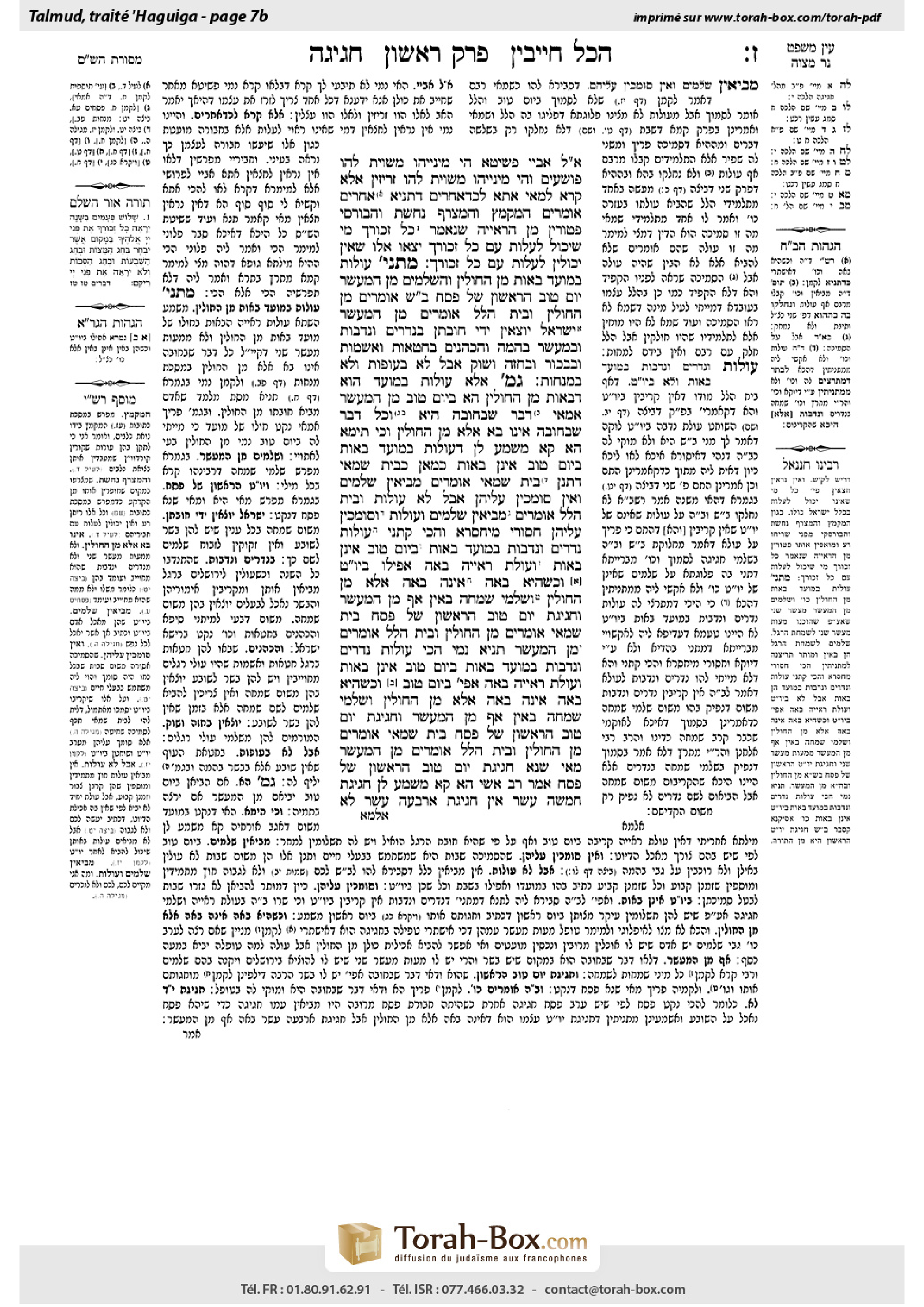
Chagigah 7b: Talmud study for Daf Yomi
Study the Talmud for Daf Yomi with scanned pages, Hebrew text, English translations from Sefaria and AI-generated French translations.
Passage selection and English or AI-generated French translation are available where the scan has annotations. Daf Study is independent of Torah-Box and Sefaria.
Browse Chagigah · חגיגה · All tractatesChagigah 7b text and translations
This page of Chagigah includes the Aramaic text, an English translation and an AI-generated French translation, alongside the scan above.
חגיגה ז׳ ב · Aramaic and Hebrew text
אֲמַר לֵיהּ אַבָּיֵי: פְּשִׁיטָא, הֵי מִינַּיְיהוּ מְשַׁוֵּית לְהוּ פּוֹשְׁעִים, וְהֵי מִינַּיְיהוּ מְשַׁוֵּית לְהוּ זְרִיזִין!
אֶלָּא קְרָא לְמַאי אֲתָא? לִכְדַאֲחֵרִים. דְּתַנְיָא, אֲחֵרִים אוֹמְרִים: הַמְקַמֵּץ, וְהַמְצָרֵף נְחֹשֶׁת, וְהַבּוּרְסִי — פְּטוּרִין מִן הָרְאִיָּיה, שֶׁנֶּאֱמַר: ״כׇּל זְכוּרְךָ״, מִי שֶׁיָּכוֹל לַעֲלוֹת עִם כׇּל זְכוּרְךָ. יָצְאוּ אֵלּוּ, שֶׁאֵין יְכוֹלִין לַעֲלוֹת עִם כׇּל זְכוּרְךָ.
מַתְנִי׳ עוֹלוֹת בַּמּוֹעֵד בָּאוֹת מִן הַחוּלִּין, וְהַשְּׁלָמִים מִן הַמַּעֲשֵׂר. יוֹם טוֹב הָרִאשׁוֹן שֶׁל פֶּסַח, בֵּית שַׁמַּאי אוֹמְרִים: מִן הַחוּלִּין, וּבֵית הִלֵּל אוֹמְרִים: מִן הַמַּעֲשֵׂר.
יִשְׂרָאֵל יוֹצְאִין יְדֵי חוֹבָתָן בִּנְדָרִים וּנְדָבוֹת וּבְמַעְשַׂר בְּהֵמָה. וְהַכֹּהֲנִים בְּחַטָּאוֹת וַאֲשָׁמוֹת וּבִבְכוֹר, וּבְחָזֶה וָשׁוֹק. אֲבָל לֹא בְּעוֹפוֹת, וְלֹא בִּמְנָחוֹת.
גְּמָ׳ אֶלָּא: עוֹלוֹת — בַּמּוֹעֵד הוּא דְּבָאוֹת מִן הַחוּלִּין, הָא בְּיוֹם טוֹב — מִן הַמַּעֲשֵׂר? אַמַּאי, דָּבָר שֶׁבְּחוֹבָה, הִיא! וְכׇל דָּבָר שֶׁבְּחוֹבָה, אֵינוֹ בָּא אֶלָּא מִן הַחוּלִּין.
וְכִי תֵּימָא: הָא קָא מַשְׁמַע לַן דְּעוֹלוֹת בַּמּוֹעֵד בָּאוֹת, בְּיוֹם טוֹב אֵינָן בָּאוֹת, כְּמַאן — כְּבֵית שַׁמַּאי?!
דִּתְנַן, בֵּית שַׁמַּאי אוֹמְרִים: מְבִיאִין שְׁלָמִים וְאֵין סוֹמְכִין עֲלֵיהֶן, אֲבָל לֹא עוֹלוֹת. וּבֵית הִלֵּל אוֹמְרִים: מְבִיאִין שְׁלָמִים וְעוֹלוֹת, וְסוֹמְכִין עֲלֵיהֶן.
חַסּוֹרֵי מִיחַסְּרָא וְהָכִי קָתָנֵי: עוֹלוֹת נְדָרִים וּנְדָבוֹת — בַּמּוֹעֵד בָּאוֹת, בְּיוֹם טוֹב — אֵינָן בָּאוֹת. וְעוֹלַת רְאִיָּיה בָּאָה אֲפִילּוּ בְּיוֹם טוֹב, וּכְשֶׁהִיא בָּאָה — אֵינָהּ בָּאָה אֶלָּא מִן הַחוּלִּין. וְשַׁלְמֵי שִׂמְחָה בָּאִין אַף מִן הַמַּעֲשֵׂר. וַחֲגִיגַת יוֹם טוֹב הָרִאשׁוֹן שֶׁל פֶּסַח, בֵּית שַׁמַּאי אוֹמְרִים: מִן הַחוּלִּין, וּבֵית הִלֵּל אוֹמְרִים: מִן הַמַּעֲשֵׂר.
תַּנְיָא נָמֵי הָכִי: עוֹלוֹת, נְדָרִים וּנְדָבוֹת — בַּמּוֹעֵד בָּאוֹת, בְּיוֹם טוֹב — אֵינָן בָּאוֹת. וְעוֹלַת רְאִיָּיה בָּאָה אֲפִילּוּ בְּיוֹם טוֹב. וּכְשֶׁהִיא בָּאָה — אֵינָהּ בָּאָה אֶלָּא מִן הַחוּלִּין. וְשַׁלְמֵי שִׂמְחָה בָּאִין אַף מִן הַמַּעֲשֵׂר. וַחֲגִיגַת יוֹם טוֹב הָרִאשׁוֹן שֶׁל פֶּסַח, בֵּית שַׁמַּאי אוֹמְרִים: מִן הַחוּלִּין, וּבֵית הִלֵּל אוֹמְרִים: מִן הַמַּעֲשֵׂר.
מַאי שְׁנָא חֲגִיגַת יוֹם טוֹב הָרִאשׁוֹן שֶׁל פֶּסַח? אָמַר רַב אָשֵׁי: הָא קָא מַשְׁמַע לַן, חֲגִיגַת חֲמִשָּׁה עָשָׂר — אִין, חֲגִיגַת אַרְבָּעָה עָשָׂר — לָא.
Chagigah 7b · English translation
Abaye said to him: This is obvious; which of his sons would he render sinners, who are too lazy to ascend, and which of them would he render vigilant, eager to perform the mitzva at the first opportunity?
Rather, for what purpose does the verse: “All your males,” come? It comes to teach that which Aḥerim taught. As it is taught in a baraita: Aḥerim say that a scrimper, one who gathers dog feces to give them to tanners for the purpose of tanning hides; a melder of copper, who purifies copper from dross; and a tanner of hides are all exempt from the mitzva of appearance, as their occupation inflicts upon them an unpleasant odor. As it is stated: “All your males,” which indicates that only one who is able to ascend with all your males is obligated, excluding these. As people avoid their company, they cannot ascend with all your males.
MISHNA: Burnt-offerings that one sacrifices on the intermediate days of the Festival must come from non-sacred property, not from sacred property such as second-tithe money. But the peace-offerings may be brought from the second tithe, i.e., from money with which one redeemed second tithe, which is subsequently used to purchase food in Jerusalem. With regard to the Festival peace-offering sacrificed on the first day of the festival of Passover, Beit Shammai say: It must come from non-sacred property, and Beit Hillel say: It may be brought even from the second tithe.
In general, Israelites fulfill their obligation to eat peace-offerings of rejoicing with their voluntary vows and gift offerings donated during the year and sacrificed on the Festival; and likewise with animal tithes. And the priests fulfill their obligation of rejoicing with the meat of sin-offerings and guilt-offerings and with firstborn offerings, as the priests receive a portion of these, and with the breast and thigh of peace-offerings, to which they are also entitled. However, they do not fulfill their obligation with birds, e.g., a bird sacrificed as a sin-offering, nor with meal-offerings, as only the eating of meat constitutes rejoicing.
GEMARA: When the mishna states that burnt-offerings sacrificed during the intermediate days of the Festival may come from non-sacred property, this leads to the surprising conclusion that on the Festival they may even come from the second tithe. The Gemara asks: Why should this be the case? The burnt-offering is an obligatory matter, and there is a principle that any obligatory matter with regard to offerings may come only from non-sacred property that was consecrated expressly for this purpose alone, not from property that was previously consecrated for another purpose.
And if you would say that this teaches us that burnt-offerings may come, i.e., be sacrificed, on the intermediate days of the Festival, whereas on the Festival they may not come at all, in accordance with whose opinion is this mishna? It is in accordance with the opinion of Beit Shammai.
As we learned in a mishna (Beitza 19a) that Beit Shammai say: One brings peace-offerings on a Festival, but one does not place his hands on them, as placing one’s hands on an animal on a Festival is prohibited by rabbinic law. However, one may not sacrifice burnt-offerings at all, as they are not eaten, and slaughtering is permitted on a Festival only for human needs. And Beit Hillel say: One brings both peace-offerings and burnt-offerings, and one does place his hands on them. It is unlikely that an anonymous mishna would follow the opinion of Beit Shammai, whose rulings are not accepted as halakha.
The Gemara answers: This mishna is incomplete, and this is what it is teaching: Burnt-offerings brought as a fulfillment of one’s vow or as gift offerings may come on the intermediate days of the Festival. However, on the Festival itself they may not come. And the burnt-offering of appearance comes even on the Festival, but when it comes, it may come only from non-sacred property, as it is obligatory. And peace-offerings of rejoicing may come even from the second tithe. And with regard to the Festival peace-offering brought on the first day of Passover, Beit Shammai say: It may come only from non-sacred property, and Beit Hillel say: It may come even from the second tithe.
That opinion is also taught in a baraita: Burnt-offerings brought as a fulfillment of one’s vow or as gift offerings may come on the intermediate days of the Festival. However, on the Festival itself they may not come. And the burnt-offering of appearance comes even on the Festival, but when it comes it may come only from non-sacred property. And peace-offerings of rejoicing may come even from the second tithe. And with regard to the Festival peace-offering brought on the first day of the festival of Passover, Beit Shammai say: It may come only from non-sacred property, and Beit Hillel say: It may come even from the second tithe.
The Gemara asks: What is different about the Festival peace-offering brought on the first day of the festival of Passover? Rav Ashi said: This emphasis on the specific date teaches us that for the Festival peace-offering of the fifteenth, i.e., the pilgrimage Festival offerings brought on the first day of Passover, yes, this restriction applies; however, for the Festival peace-offering of the fourteenth, no, this limitation is not in force. If the Paschal lamb was too small for a group, they would bring an additional peace-offering so that the Paschal lamb could be eaten when one was full. This offering was called the Festival peace-offering of the fourteenth of Nisan. Since this offering is not obligatory, everyone agrees that it may be purchased with second-tithe money.
Chagigah 7b · Traduction française (IA)
Abaye dit à lui : Cela est évident ; quel fils de lui ferait-il devenir un pécheur, celui qui est trop paresseux pour monter, et quel fils de lui ferait-il devenir vigilant, désireux d'accomplir la mitsva dès la première occasion ?
En réalité, à quoi sert la parole : « Tous vos mâles », dit-elle ? Elle vient enseigner ce que Aḥerim a enseigné. Comme il est dit dans une baraïta : Aḥerim disent que le ramasseur de crottins, celui qui ramasse les crottins de chien pour les donner aux tanneurs afin de tanner les peaux ; le fondreur de cuivre, celui qui purifie le cuivre des impuretés ; et le tanneur de peaux sont tous dispensés de la Mitsva de présence, car leur métier leur donne un odeur désagréable. Comme il est dit : « Tous vos mâles », ce qui indique que seul celui qui peut monter avec tous vos mâles est tenu, excluant ceux-ci. Comme les gens évitent leur compagnie, ils ne peuvent monter avec tous vos mâles.
MICHNA : Les holocaustes que l'on sacrifie aux jours intermédiaires du festival doivent provenir de biens non sacrés, pas de biens sacrés tels que l'argent de la deuxième dîme. Les offrandes de paix peuvent cependant être offertes à partir de la deuxième dîme, c'est-à-dire à partir de l'argent avec lequel l'on a racheté la deuxième dîme, qui est ensuite utilisé pour acheter des aliments à Jérusalem. En ce qui concerne l'offrande de paix du festival sacrifié le premier jour du festival de Pâques, Beit Shammai disent : Elle doit provenir de biens non sacrés, et Beit Hillel disent : Elle peut être offerte même à partir de la deuxième dîme.
En général, les Israélites remplissent leur obligation de manger les offrandes de paix de joie avec leurs vœux volontaires et les offrandes de dons offerts durant l'année et sacrifiés lors du festival ; de même avec les dîmes animales. Les prêtres remplissent leur obligation de joie avec la viande des offrandes de péché et des offrandes de culpabilité ainsi qu'avec les offrandes des premiers-nés, car les prêtres reçoivent une part de ces offrandes, et avec la poitrine et la cuisse des offrandes de paix, auxquelles ils ont également droit. Cependant, ils ne remplissent pas leur obligation avec les oiseaux, par exemple un oiseau sacrifié comme offrande de péché, ni avec les offrandes de farine, car seule la consommation de viande constitue la joie.
GUEMARA : Lorsque la Michna dit que les holocaustes sacrifiés aux jours intermédiaires du festival peuvent provenir de biens non sacrés, cela conduit à la conclusion surprenante que lors du festival, ils peuvent même provenir de la deuxième dîme. La Guemara pose la question : Pourquoi devrait-ce être le cas ? Le holocauste est une obligation, et il y a un principe selon lequel toute obligation concernant les offrandes peut provenir uniquement de biens non sacrés qui ont été consacrés expressément à cette fin seule, pas de biens qui ont été précédemment consacrés à une autre fin.
Et si vous dites que cela enseigne que les holocaustes peuvent être sacrifiés, c'est-à-dire être offerts, aux jours intermédiaires du festival, alors que lors du festival ils ne peuvent pas être offerts du tout, selon quel avis est-ce que cette Michna ? C'est selon l'avis de Beit Shammai.
Comme nous avons appris dans une michna (Beitza 19a) que Beit Shammai disent : On apporte des offrandes de paix lors d'un festival, mais on ne place pas ses mains sur elles, car placer ses mains sur un animal lors d'un festival est interdit par la loi rabbinique. Cependant, on ne peut pas sacrifier d'offrandes brûlées du tout, car elles ne sont pas mangées, et la mise à mort est permise lors d'un festival uniquement pour des besoins humains. Et Beit Hillel disent : On apporte à la fois des offrandes de paix et des offrandes brûlées, et on place ses mains sur elles. Il est peu probable qu'une michna anonyme suive l'avis de Beit Shammai, dont les décisions ne sont pas acceptées comme halakha.
La Guemara répond : Cette Michna est incomplète, et c'est ce qu'elle enseigne : Les holocaustes apportés en accomplissement d'un vœu ou en tant qu'offrandes de don peuvent être offerts aux jours intermédiaires du festival. Cependant, lors du festival lui-même ils ne peuvent pas être offerts. Et le holocauste de présence peut être offert même lors du festival, mais lorsqu'il est offert, il peut être offert uniquement à partir de biens non sacrés, car il est obligatoire. Les offrandes de paix de joie peuvent être offertes même à partir de la deuxième dîme. Et concernant l'offrande de paix du festival offerte le premier jour du festival de Pâques, Beit Shammai disent : Elle peut être offerte uniquement à partir de biens non sacrés, et Beit Hillel disent : Elle peut être offerte même à partir de la deuxième dîme.
Cette opinion est également enseignée dans une baraïta : Les holocaustes apportés en accomplissement d'un vœu ou en tant qu'offrandes de don peuvent être offerts aux jours intermédiaires du festival. Cependant, lors du festival lui-même ils ne peuvent pas être offerts. Et le holocauste de présence peut être offert même lors du festival, mais lorsqu'il est offert, il peut être offert uniquement à partir de biens non sacrés. Les offrandes de paix de joie peuvent être offertes même à partir de la deuxième dîme. Et concernant l'offrande de paix du festival offerte le premier jour du festival de Pâques, Beit Shammai disent : Elle peut être offerte uniquement à partir de biens non sacrés, et Beit Hillel disent : Elle peut être offerte même à partir de la deuxième dîme.
La Guemara pose la question : Qu'est-ce qui diffère dans l'offrande de paix du festival apportée le premier jour du festival de Pâques ? Rav Ashi dit : Cette insistance sur la date spécifique nous enseigne que pour l'offrande de paix du festival du quinzième, c'est-à-dire les offrandes de pèlerinage du festival apportées le premier jour de Pâques, oui, cette restriction s'applique ; cependant, pour l'offrande de paix du festival du quatorzième, non, cette limitation n'est pas en vigueur. Si l'agneau pascal était trop petit pour un groupe, ils apportaient une offrande supplémentaire de paix afin que l'agneau pascal puisse être mangé lorsqu'on était rassasié. Cette offrande était appelée l'offrande de paix du quatorzième de Nisan. Puisque cette offrande n'est pas obligatoire, tout le monde convient qu'elle peut être achetée avec l'argent de la deuxième dîme.
Traduction française générée par IA à partir de l’édition anglaise de Sefaria. Vérifie toujours un passage avec le texte source.
Text from Sefaria: William Davidson Edition - Vocalized Aramaic (CC BY NC); William Davidson Edition - English (CC BY NC).