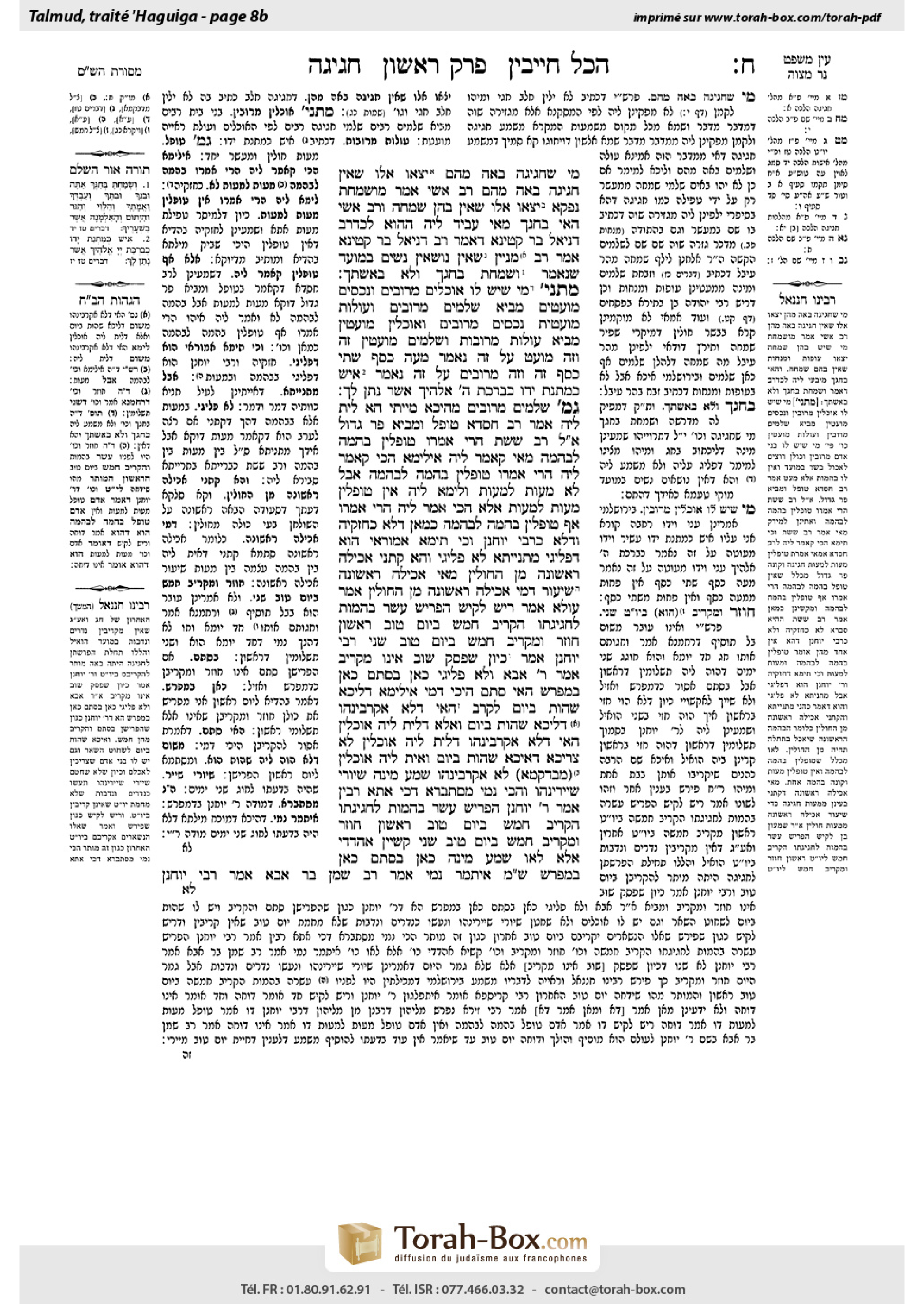
Chagigah 8b: Talmud study for Daf Yomi
Study the Talmud for Daf Yomi with scanned pages, Hebrew text, English translations from Sefaria and AI-generated French translations.
Passage selection and English or AI-generated French translation are available where the scan has annotations. Daf Study is independent of Torah-Box and Sefaria.
Browse Chagigah · חגיגה · All tractatesChagigah 8b text and translations
This page of Chagigah includes the Aramaic text, an English translation and an AI-generated French translation, alongside the scan above.
חגיגה ח׳ ב · Aramaic and Hebrew text
מִי שֶׁחֲגִיגָה בָּאָה מֵהֶם, יָצְאוּ אֵלּוּ שֶׁאֵין חֲגִיגָה בָּאָה מֵהֶם.
רַב אָשֵׁי אָמַר: מִ״וְּשָׂמַחְתָּ״ נָפְקָא. יָצְאוּ אֵלּוּ שֶׁאֵין בָּהֶן שִׂמְחָה.
וְרַב אָשֵׁי, הַאי ״בְּחַגֶּךָ״ מַאי עָבֵיד לֵיהּ? הַהוּא, לְכִדְרַב דָּנִיאֵל בַּר קַטִּינָא. דְּאָמַר רַב דָּנִיאֵל בַּר קַטִּינָא אָמַר רַב: מִנַּיִין שֶׁאֵין נוֹשְׂאִין נָשִׁים בַּמּוֹעֵד — שֶׁנֶּאֱמַר: ״וְשָׂמַחְתָּ בְּחַגֶּךָ״, וְלֹא בְּאִשְׁתֶּךָ.
מַתְנִי׳ מִי שֶׁיֵּשׁ לוֹ אוֹכְלִים מְרוּבִּים וּנְכָסִים מוּעָטִים — מֵבִיא שְׁלָמִים מְרוּבִּים וְעוֹלוֹת מוּעָטוֹת. נְכָסִים מְרוּבִּים וְאוֹכְלִין מוּעָטִין — מֵבִיא עוֹלוֹת מְרוּבּוֹת וּשְׁלָמִים מוּעָטִין.
זֶה וָזֶה מוּעָט — עַל זֶה נֶאֱמַר: מָעָה כֶּסֶף, שְׁתֵּי כֶּסֶף. זֶה וָזֶה מְרוּבִּים — עַל זֶה נֶאֱמַר: ״אִישׁ כְּמַתְּנַת יָדוֹ כְּבִרְכַּת ה׳ אֱלֹהֶיךָ אֲשֶׁר נָתַן לָךְ״.
גְּמָ׳ שְׁלָמִים מְרוּבִּים. מֵהֵיכָא מַיְיתֵי? הָא לֵית לֵיהּ! אָמַר רַב חִסְדָּא: טוֹפֵל וּמֵבִיא פַּר גָּדוֹל. אָמַר לֵיהּ רַב שֵׁשֶׁת: הֲרֵי אָמְרוּ טוֹפְלִין בְּהֵמָה לִבְהֵמָה!
מַאי קָאָמַר לֵיהּ? אִילֵּימָא הָכִי קָאָמַר לֵיהּ: הֲרֵי אָמְרוּ טוֹפְלִין בְּהֵמָה לִבְהֵמָה אֲבָל לֹא מָעוֹת לְמָעוֹת, וְלֵימָא לֵיהּ: אֵין טוֹפְלִין מָעוֹת לְמָעוֹת! אֶלָּא הָכִי אֲמַר לֵיהּ: הֲרֵי אָמְרוּ אַף טוֹפְלִין בְּהֵמָה לִבְהֵמָה.
כְּמַאן? דְּלָא כְּחִזְקִיָּה וּדְלָא כְּרַבִּי יוֹחָנָן!
וְכִי תֵּימָא: אָמוֹרָאֵי הוּא דִּפְלִיגִי, מַתְנְיָיתָא לָא פְּלִיגִי. וְהָא קָתָנֵי: אֲכִילָה רִאשׁוֹנָה מִן הַחוּלִּין.
מַאי אֲכִילָה רִאשׁוֹנָה — שִׁיעוּר דְּמֵי אֲכִילָה רִאשׁוֹנָה מִן הַחוּלִּין.
אָמַר עוּלָּא אָמַר רֵישׁ לָקִישׁ: הִפְרִישׁ עֶשֶׂר בְּהֵמוֹת לַחֲגִיגָתוֹ, הִקְרִיב חָמֵשׁ בְּיוֹם טוֹב רִאשׁוֹן — חוֹזֵר וּמַקְרִיב חָמֵשׁ בְּיוֹם טוֹב שֵׁנִי. רַבִּי יוֹחָנָן אָמַר: כֵּיוָן שֶׁפָּסַק, שׁוּב אֵינוֹ מַקְרִיב.
אָמַר רַבִּי אַבָּא, וְלָא פְּלִיגִי: כָּאן בִּסְתָם, כָּאן בִּמְפָרֵשׁ.
הַאי סְתָם הֵיכִי דָמֵי? אִילֵּימָא דְּלֵיכָּא שְׁהוּת בַּיּוֹם לִקְרַב, הַאי דְּלָא אַקְרְבִינְהוּ — דְּלֵיכָּא שְׁהוּת בַּיּוֹם.
וְאֶלָּא דְּלֵית לֵיהּ אוֹכְלִין, הַאי דְּלָא אַקְרְבִינְהוּ — דְּלֵית לֵיהּ אוֹכְלִין.
לָא צְרִיכָא, דְּאִיכָּא שְׁהוּת בַּיּוֹם וְאִית לֵיהּ אוֹכְלִין, מִדִּבְקַמָּא לָא אַקְרְבִינְהוּ, שְׁמַע מִינַּהּ שַׁיּוֹרֵי שַׁיְּירִינְהוּ.
וְהָכִי נָמֵי מִסְתַּבְּרָא, דְּכִי אֲתָא רָבִין אָמַר רַבִּי יוֹחָנָן: הִפְרִישׁ עֶשֶׂר בְּהֵמוֹת לַחֲגִיגָתוֹ, הִקְרִיב חָמֵשׁ בְּיוֹם טוֹב רִאשׁוֹן — חוֹזֵר וּמַקְרִיב חָמֵשׁ בְּיוֹם טוֹב שֵׁנִי. קַשְׁיָין אַהֲדָדֵי.
אֶלָּא לָאו שְׁמַע מִינַּהּ: כָּאן בִּסְתָם, כָּאן בִּמְפָרֵשׁ. שְׁמַע מִינַּהּ.
אִיתְּמַר נָמֵי, אָמַר רַב שֶׁמֶן בַּר אַבָּא אָמַר רַבִּי יוֹחָנָן:
Chagigah 8b · English translation
This teaches that eating those animals from which the Festival peace-offering may come, i.e., sheep and cattle, is a fulfillment of the mitzva of rejoicing. This excludes these, i.e., bird-offerings and meal-offerings, from which the Festival peace-offering may not come.
Rav Ashi said: There is no need to derive this halakha from “And you shall rejoice in your feast” by explaining that the word feast is referring to the Festival peace-offering. Rather, this halakha is derived simply from the phrase “And you shall rejoice.” This excludes those bird-offerings and meal-offerings that do not have an element of rejoicing, as the joy of eating is provided only by animal meat.
The Gemara asks: And what does Rav Ashi do with the phrase: “In your feast”? The Gemara answers: That phrase comes to teach in accordance with the statement of Rav Daniel bar Ketina. As Rav Daniel bar Ketina said that Rav said: From where is it derived that one may not marry a woman on the intermediate days of the Festival? As it is stated: “And you shall rejoice in your feast,” indicating that one should rejoice only in your feast and not with your wife.
MISHNA: One who has many eaters, i.e., members of his household, and a small amount of property, may bring many peace-offerings and few burnt-offerings, so he can feed the members of his household with the peace-offerings. If one has much property and few eaters, he should bring many burnt-offerings and few peace-offerings.
If both these and those, his property and the members of his household, are few, with regard to this individual it is stated in the mishna (2a) that the Sages established the smallest amount of one silver ma’a for the burnt-offering of appearance in the Temple and two silver coins for the Festival peace-offerings. If both his eaters and his property are many, with regard to this individual it is stated: “Every man shall give as he is able, according to the blessing of the Lord your God, which He has given you” (Deuteronomy 16:17).
GEMARA: With regard to the mishna’s statement that one who has many eaters and a small amount of property may bring many peace-offerings, the Gemara asks: From where can he bring many peace-offerings? He does not have much property. Rav Ḥisda said: He combines his property with the second-tithe money and brings a large bull. In this way he will have a lot of meat from the peace-offering. Rav Sheshet said to him: The Sages said that one may combine an animal with another animal.
Since Rav Sheshet’s objection is unclear, the Gemara asks: What is he saying to Rav Ḥisda? If we say that he was saying to him as follows: They said that one may only combine an animal with another animal, but one may not combine money with other money to purchase one large bull, then let him simply say: One may not combine money with other money. Rather, this is what he said to him: The Sages said that one may even combine an animal with another animal. Why did you, Rav Ḥisda, limit him to the purchase of one large animal? Why not also suggest that this individual may bring other animals from second-tithe money?
The Gemara asks: In accordance with whose opinion did Rav Sheshet say this? It is not in accordance with the opinion of Ḥizkiya, who said that one may combine only one animal with another animal, and not in accordance with the opinion of Rabbi Yoḥanan, who said that one may combine only money with other money.
And if you would say: It is the amora’im who disagree, whereas the baraitot that were cited in support of their opinions do not disagree and therefore Rav Sheshet may present his own opinion on the matter, this cannot be the case, as the baraita teaches: The first eating must come from non-sacred property. In other words, the first animal one eats must come entirely from non-sacred property, and combining is permitted only for the second animal. This indicates that although one may combine an additional animal with that first one, one may not combine money with other money to purchase even one animal.
The Gemara explains. What is the meaning of: The first eating? This means that when one combines non-sacred money with second-tithe money, the monetary value of the required measure of the first eating from the offering must come from non-sacred funds. However, the remaining value of that animal may come from second-tithe funds. Therefore, according to the opinion of Rav Sheshet, one may combine an animal with another animal, i.e., by purchasing two separate animals, one from non-sacred funds and one from second-tithe money. Another option is to purchase one animal with combined funds, provided that the first eating is from non-sacred funds.
§ Ulla said that Reish Lakish said: If one separated ten animals for the purpose of his Festival peace-offering, and he sacrificed five of them on the first day of the Festival, he may return and sacrifice the remaining five on the second day of the Festival, or on any of the other days. There is no concern for the prohibition of: “You shall not add” (Deuteronomy 13:1), as though he were celebrating the first day twice, because the remaining offerings merely complete the first day’s offerings. Rabbi Yoḥanan said: Since he stopped after the first five offerings on the day on which he first brought the Festival peace-offerings, he may no longer sacrifice the remaining animals on the other days, as that would be considered celebrating an extra day.
Rabbi Abba said: And these amora’im do not disagree, as they are referring to different circumstances. Here, Rabbi Yoḥanan is speaking of a case where one did not specify when he intended to sacrifice these offerings, and therefore it is assumed that he meant to sacrifice them all on the first day. There, Reish Lakish is referring to a case where one explicitly said at the outset that he intended to bring them on all the days of the Festival (Rabbeinu Ḥananel).
The Gemara asks: With regard to this case where he did not specify, what are the circumstances? If we say that there was no time left in the day to sacrifice, i.e., he brought all his animals on the first day and realized that there was not enough time to sacrifice all of them, one can assume that the reason that he did not bring them is that there was no time left in the day. If so, his offering on another day is certainly considered merely the completion of the obligations of the first day. In this case his bringing of the additional offerings is not prohibited.
But rather, you must say that this is referring to a case where he does not have enough eaters in his household, and as one may not have leftovers, he did not sacrifice the remaining offerings. Here too, the fact that he did not sacrifice them is because he does not have enough eaters. Again, this cannot be the case in which it is prohibited to sacrifice the extra offerings.
The Gemara answers: No, it is necessary to teach this ruling only in a case where there is time left in the day and he has eaters in his household. From the fact that he did not sacrifice them on the first day of the Festival, one can conclude from it that he left them intentionally. Therefore, he is no longer permitted to sacrifice them on the other days of the Festival.
The Gemara comments: So too, it is reasonable that Rabbi Yoḥanan agrees that if one specifies his intentions he may sacrifice the offerings on the remaining days, as when Ravin came from Eretz Yisrael to Babylonia he said that Rabbi Yoḥanan said: If one separated ten animals for his Festival peace-offering, and he sacrificed five on the first day of the Festival, he may return and sacrifice the other five on the second day of the Festival. These two statements of Rabbi Yoḥanan, cited by Ulla and Ravin respectively, apparently contradict each other.
Rather, isn’t it correct to conclude from this contradiction that this statement here is dealing with a case where one did not specify, whereas there it is referring to a situation where one stated his intentions explicitly? The Gemara concludes: Indeed, conclude from here that it is so.
It was also stated that Rav Shemen bar Abba said that Rabbi Yoḥanan said:
Chagigah 8b · Traduction française (IA)
Cela enseigne que manger ces animaux, dont peuvent venir l'offrande de paix du festival, c'est-à-dire les brebis et les bovins, constitue un accomplissement de la Mitsva de la joie. Cela exclut ceux-ci, c'est-à-dire les offrandes d'oiseaux et les offrandes de pain, dont l'offrande de paix du festival ne peut pas venir.
Rav Ashi a dit : Il n'est pas nécessaire de déduire cette halakha à partir de « Et vous vous réjouirez à votre fête » en expliquant que le mot « fête » fait référence à l'offrande de paix du festival. Plutôt, cette halakha est déduite simplement du mot « vous vous réjouirez ». Cela exclut ces offrandes d'oiseaux et de pain qui n'ont pas un élément de joie, car la joie du manger est fournie uniquement par la viande animale.
Le Guemara demande : Et que fait Rav Ashi avec la phrase « à votre fête » ? Le Guemara répond : Cette phrase vient enseigner selon l'opinion de Rav Daniel bar Ketina. Comme Rav Daniel bar Ketina a dit que Rav a dit : D'où est-il déduit que l'on ne peut pas épouser une femme pendant les jours intermédiaires du festival ? Comme il est dit : « Et vous vous réjouirez à votre fête », indiquant que l'on doit se réjouir uniquement à votre fête et non avec votre femme.
MICHNA : Celui qui a beaucoup de mangeurs, c'est-à-dire des membres de sa famille, et peu de propriété, peut apporter beaucoup d'offrandes de paix et peu d'offrandes brûlées, afin de nourrir les membres de sa famille avec les offrandes de paix. Si l'on a beaucoup de propriété et peu de mangeurs, on doit apporter beaucoup d'offrandes brûlées et peu d'offrandes de paix.
Si à la fois ces deux choses, sa propriété et les membres de sa famille, sont rares, concernant cette personne il est dit dans la mishna (2a) que les Sages ont établi le montant minimum d'une once d'argent pour l'holocauste de présentation dans le Temple et deux fois cette somme pour les offrandes de paix du festival. Si à la fois ses mangeurs et sa propriété sont nombreux, concernant cette personne il est dit : « Chacun donnera selon ses forces, selon la bénédiction du Seigneur votre Dieu, qui Il a donnée à vous » (Deutéronome 16:17).
GUEMARA : Concernant l'affirmation de la mishna que celui qui a beaucoup de mangeurs et peu de propriété peut apporter beaucoup d'offrandes de paix, le Guemara demande : D'où peut-il apporter beaucoup d'offrandes de paix ? Il n'a pas beaucoup de propriété. Rav Ḥisda a dit : Il combine sa propriété avec l'argent de la dîme secondaire et apporte un taureau grand. Ainsi, il aura beaucoup de viande à partir de l'offrande de paix. Rav Sheshet a dit à lui : Les Sages ont dit qu'on peut combiner un animal avec un autre animal.
Puisque l'objection de Rav Sheshet n'est pas claire, le Guemara demande : De quoi parle-t-il à Rav Ḥisda ? Si nous disons qu'il disait ainsi : Ils ont dit qu'on peut seulement combiner un animal avec un autre animal, mais on ne peut pas combiner de l'argent avec d'autres fonds pour acheter un taureau grand, alors laissez-le simplement dire : On ne peut pas combiner de l'argent avec d'autres fonds. Plutôt, c'est ce qu'il a dit à lui : Les Sages ont dit qu'on peut même combiner un animal avec un autre animal. Pourquoi, Rav Ḥisda, avez-vous limité à l'achat d'un seul animal ? Pourquoi ne pas suggérer aussi que cette personne peut apporter d'autres animaux à partir de l'argent de la dîme secondaire ?
Le Guemara demande : Selon l'opinion de qui a-t-il dit cela ? Ce n'est pas selon l'opinion de Ḥizkiya, qui a dit qu'on peut combiner seulement un animal avec un autre animal, et non selon l'opinion de Rabbi Yoḥanan, qui a dit qu'on peut combiner seulement de l'argent avec d'autres fonds.
Et si vous dites : C'est l'opinion des amoraïm qui divergent, alors que les baraitot citées en soutien de leurs opinions ne divergent pas et donc Rav Sheshet peut présenter son propre avis sur la question, cela ne peut pas être le cas, car la baraïta enseigne : La première consommation doit venir de propriété non sacrée. En d'autres termes, la première bête que l'on mange doit venir entièrement de propriété non sacrée, et la combinaison est permise uniquement pour la deuxième bête. Cela indique que bien qu'on puisse combiner une bête supplémentaire avec celle-ci, on ne peut pas combiner de l'argent avec d'autres fonds pour acheter même une seule bête.
Le Guemara explique. Quelle est la signification de : La première consommation ? Cela signifie que lorsque l'on combine des fonds non sacrés avec l'argent de la dîme secondaire, la valeur monétaire de la mesure requise de la première consommation provenant de l'offrande doit venir de fonds non sacrés. Cependant, la valeur restante de cette bête peut venir des fonds de la dîme secondaire. Ainsi, selon l'opinion de Rav Sheshet, on peut combiner une bête avec une autre bête, c'est-à-dire en achetant deux bêtes séparées, l'une à partir de fonds non sacrés et l'autre à partir de l'argent de la dîme secondaire. Une autre option est d'acheter une seule bête avec des fonds combinés, à condition que la première consommation vienne de fonds non sacrés.
§ Ulla a dit que Reish Lakish a dit : Si l'on a séparé dix animaux à l'intention de son offrande de paix du festival, et qu'il a sacrifié cinq d'entre eux le premier jour du festival, il peut revenir et sacrifier les cinq restants le deuxième jour du festival, ou n'importe quel autre jour. Il n'y a pas de crainte concernant l'interdiction de : « Vous ne devez pas ajouter » (Deutéronome 13:1), comme s'il célébrait le premier jour deux fois, car les offrandes restantes complètent simplement les offrandes du premier jour. Rabbi Yoḥanan a dit : Puisqu'il a arrêté après les cinq offrandes du jour où il a d'abord apporté l'offrande de paix du festival, il ne peut plus sacrifier les animaux restants les autres jours, car cela serait considéré comme célébrer un jour supplémentaire.
Rabbi Abba a dit : Et ces amoraïm ne divergent pas, car ils parlent de circonstances différentes. Ici, Rabbi Yoḥanan parle d'un cas où l'on n'a pas spécifié quand il avait l'intention de sacrifier ces offrandes, et donc on suppose qu'il voulait les sacrifier tous le premier jour. Là, Reish Lakish parle d'un cas où l'on a explicitement dit au départ qu'il avait l'intention de les apporter tous les jours du festival (Rabbeinu Ḥananel).
La Guemara pose la question : Dans le cas où il n’a pas spécifié, quelles sont les circonstances ? Si nous disons qu’il n’y avait plus de temps dans la journée pour sacrifier, c’est-à-dire qu’il a amené tous ses animaux le premier jour et a réalisé qu’il n’y avait pas assez de temps pour sacrifier tous ceux-ci, on peut supposer que la raison pour laquelle il n’a pas sacrifié les animaux est qu’il n’y avait plus de temps dans la journée. Dans ce cas, son sacrifice le jour suivant est certainement considéré comme la continuation des obligations du premier jour. Dans ce cas, l’offrande supplémentaire qu’il apporte n’est pas interdite.
Mais plutôt, vous devez dire que cela fait référence à un cas où il n’y a pas assez de mangeurs dans sa maison, et comme on ne peut pas avoir de restes, il n’a pas sacrifié les offrandes restantes. De même, le fait qu’il n’ait pas sacrifié ces offrandes est dû au fait qu’il n’y a pas assez de mangeurs. À nouveau, cela ne peut pas être le cas où il est interdit de sacrifier les offrandes supplémentaires.
La Guemara répond : Non, il est nécessaire d’enseigner cette décision uniquement dans un cas où il reste du temps dans la journée et qu’il y a des mangeurs dans sa maison. Du fait qu’il n’a pas sacrifié ces offrandes le premier jour du festival, on peut en conclure qu’il les a laissés intentionnellement. Par conséquent, il n’est plus autorisé à sacrifier ces offrandes les autres jours du festival.
La Guemara commente : De même, il est raisonnable que Rabbi Yoḥanan accepte que si l’on spécifie ses intentions, on puisse sacrifier les offrandes les jours restants, comme lorsque Ravin est venu de la Terre d’Israël en Babylone, il a dit que Rabbi Yoḥanan a dit : Si l’on a séparé dix animaux pour son offrande de paix du festival, et qu’il a sacrifié cinq le premier jour du festival, il peut revenir et sacrifier les autres cinq le deuxième jour du festival. Ces deux déclarations de Rabbi Yoḥanan, citées respectivement par Ulla et Ravin, semblent s’opposer l’une à l’autre.
Plutôt, n’est-il pas correct de conclure de ce paradoxe que cette déclaration ici fait référence à un cas où l’on n’a pas spécifié, tandis que là, il s’agit d’un cas où l’on a exprimé clairement ses intentions ? La Guemara conclut : En effet, concluez-en ici qu’il en est ainsi.
Il a également été dit que Rav Shemen bar Abba a dit que Rabbi Yoḥanan a dit :
Traduction française générée par IA à partir de l’édition anglaise de Sefaria. Vérifie toujours un passage avec le texte source.
Text from Sefaria: William Davidson Edition - Vocalized Aramaic (CC BY NC); William Davidson Edition - English (CC BY NC).