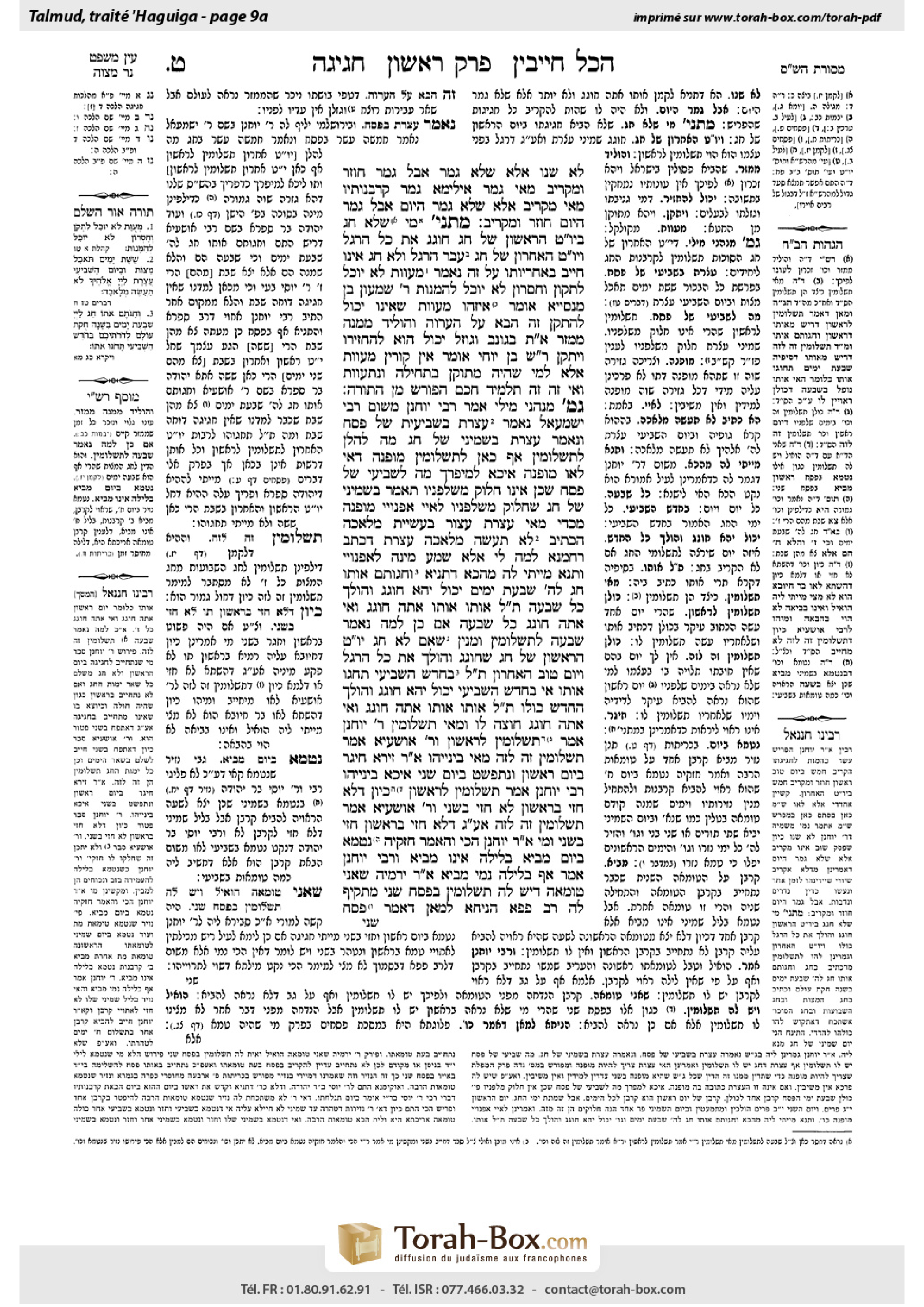
Chagigah 9a: Talmud study for Daf Yomi
Study the Talmud for Daf Yomi with scanned pages, Hebrew text, English translations from Sefaria and AI-generated French translations.
Passage selection and English or AI-generated French translation are available where the scan has annotations. Daf Study is independent of Torah-Box and Sefaria.
Browse Chagigah · חגיגה · All tractatesChagigah 9a text and translations
This page of Chagigah includes the Aramaic text, an English translation and an AI-generated French translation, alongside the scan above.
חגיגה ט׳ א · Aramaic and Hebrew text
לֹא שָׁנוּ אֶלָּא שֶׁלֹּא גָּמַר, אֲבָל גָּמַר — חוֹזֵר וּמַקְרִיב.
מַאי ״גָּמַר״? אִילֵּימָא גָּמַר קׇרְבְּנוֹתָיו — מַאי מַקְרִיב? אֶלָּא שֶׁלֹּא גָּמַר הַיּוֹם, אֲבָל גָּמַר הַיּוֹם — חוֹזֵר וּמַקְרִיב.
מַתְנִי׳ מִי שֶׁלֹּא חָג בְּיוֹם טוֹב הָרִאשׁוֹן שֶׁל חַג — חוֹגֵג אֶת כָּל הָרֶגֶל וְיוֹם טוֹב הָאַחֲרוֹן שֶׁל חַג.
עָבַר הָרֶגֶל וְלֹא חָג — אֵינוֹ חַיָּיב בְּאַחְרָיוּתוֹ, עַל זֶה נֶאֱמַר ״מְעֻוָּות לֹא יוּכַל לִתְקוֹן וְחֶסְרוֹן לֹא יוּכַל לְהִמָּנוֹת״.
רַבִּי שִׁמְעוֹן בֶּן מְנַסְּיָיא אוֹמֵר: אֵיזֶהוּ מְעֻוָּות שֶׁאֵינוֹ יָכוֹל לְהִתָּקֵן? זֶה הַבָּא עַל הָעֶרְוָה וְהוֹלִיד מִמֶּנָּה מַמְזֵר. אִם תֹּאמַר בְּגוֹנֵב וְגוֹזֵל — יָכוֹל הוּא לְהַחְזִירוֹ, וִיתַקֵּן.
רַבִּי שִׁמְעוֹן בֶּן יוֹחַי אוֹמֵר: אֵין קוֹרִין מְעֻוָּות אֶלָּא לְמִי שֶׁהָיָה מְתוּקָּן בַּתְּחִילָּה וְנִתְעַוֵּות, וְאֵי זֶה? זֶה תַּלְמִיד חָכָם הַפּוֹרֵשׁ מִן הַתּוֹרָה.
גְּמָ׳ מְנָהָנֵי מִילֵּי? אָמַר רַבִּי יוֹחָנָן מִשּׁוּם רַבִּי יִשְׁמָעֵאל: נֶאֱמַר ״עֲצֶרֶת״ בִּשְׁבִיעִי שֶׁל פֶּסַח, וְנֶאֱמַר ״עֲצֶרֶת״ בִּשְׁמִינִי שֶׁל חַג. מָה לְהַלָּן לְתַשְׁלוּמִין — אַף כָּאן לְתַשְׁלוּמִין.
מוּפְנֶה. דְּאִי לָאו מוּפְנֶה, אִיכָּא לְמִיפְרַךְ: מָה לִשְׁבִיעִי שֶׁל פֶּסַח שֶׁכֵּן אֵינוֹ חָלוּק מִשֶּׁלְּפָנָיו, תֹּאמַר בִּשְׁמִינִי שֶׁל חַג שֶׁחָלוּק מִשֶּׁלְּפָנָיו.
לָאיֵי אִפְּנוֹיֵי מוּפְנֶה. מִכְּדֵי מַאי ״עֲצֶרֶת״ — עָצוּר בַּעֲשִׂיַּית מְלָאכָה, הָכְתִיב: ״לֹא תַעֲשֶׂה מְלָאכָה״, ״עֲצֶרֶת״ דִּכְתַב רַחֲמָנָא לְמָה לִי? אֶלָּא שְׁמַע מִינַּהּ לְאַפְנוֹיֵי.
וְתַנָּא מַיְיתֵי לַהּ מֵהָכָא, דְּתַנְיָא: ״וְחַגּוֹתֶם אוֹתוֹ חַג לַה׳ שִׁבְעַת יָמִים״, יָכוֹל יְהֵא חוֹגֵג וְהוֹלֵךְ כָּל שִׁבְעָה — תַּלְמוּד לוֹמַר: ״אוֹתוֹ״ — אוֹתוֹ אַתָּה חוֹגֵג, וְאִי אַתָּה חוֹגֵג כׇּל שִׁבְעָה. אִם כֵּן לָמָּה נֶאֱמַר ״שִׁבְעָה״ — לְתַשְׁלוּמִין.
וּמִנַּיִן שֶׁאִם לֹא חָג יוֹם טוֹב הָרִאשׁוֹן שֶׁל חַג שֶׁחוֹגֵג וְהוֹלֵךְ אֶת כָּל הָרֶגֶל וְיוֹם טוֹב הָאַחֲרוֹן — תַּלְמוּד לוֹמַר: ״בַּחֹדֶשׁ הַשְּׁבִיעִי תָּחֹגּוּ אוֹתוֹ״, אִי ״בַּחֹדֶשׁ הַשְּׁבִיעִי״, יָכוֹל יְהֵא חוֹגֵג וְהוֹלֵךְ הַחֹדֶשׁ כּוּלּוֹ — תַּלְמוּד לוֹמַר: ״אוֹתוֹ״ — אוֹתוֹ אַתָּה חוֹגֵג, וְאִי אַתָּה חוֹגֵג חוּצָה לוֹ.
וּמַאי תַּשְׁלוּמִין? רַבִּי יוֹחָנָן אָמַר: תַּשְׁלוּמִין לָרִאשׁוֹן, וְרַבִּי אוֹשַׁעְיָא אָמַר: תַּשְׁלוּמִין זֶה לָזֶה.
מַאי בֵּינַיְיהוּ? אָמַר רַבִּי זֵירָא: חִיגֵּר בְּיוֹם רִאשׁוֹן וְנִתְפַּשֵּׁט בְּיוֹם שֵׁנִי אִיכָּא בֵּינַיְיהוּ. רַבִּי יוֹחָנָן אָמַר: תַּשְׁלוּמִין לָרִאשׁוֹן, כֵּיוָן דְּלָא חֲזֵי בָּרִאשׁוֹן — לָא חֲזֵי בַּשֵּׁנִי. וְרַבִּי אוֹשַׁעְיָא אָמַר: תַּשְׁלוּמִין זֶה לָזֶה, אַף עַל גַּב דְּלָא חֲזֵי בָּרִאשׁוֹן — חֲזֵי בִּשְׁנֵי.
וּמִי אָמַר רַבִּי יוֹחָנָן הָכִי?
וְהָאָמַר חִזְקִיָּה: נִטְמָא בַּיּוֹם — מֵבִיא, בַּלַּיְלָה — אֵינוֹ מֵבִיא.
וְרַבִּי יוֹחָנָן אָמַר: אַף בַּלַּיְלָה נָמֵי מֵבִיא.
אָמַר רַבִּי יִרְמְיָה: שָׁאנֵי טוּמְאָה, דְּיֵשׁ לָהּ תַּשְׁלוּמִין בְּפֶסַח שֵׁנִי.
מַתְקֵיף לַהּ רַב פָּפָּא: הָנִיחָא לְמַאן דְּאָמַר פֶּסַח
Chagigah 9a · English translation
They taught that one may sacrifice the Festival peace-offering on the first Festival day but not on all seven days, as recorded in the baraita on this amud below, only in a case where he did not finish. However, if he finished, he may go back and sacrifice.
The Gemara asks: What is the meaning of the term: Finish, in this context? If we say it means that he finished sacrificing all of his offerings, what is he going back to sacrifice? Rather, it means that if the day did not end and he still has offerings left over, he may not return to sacrifice those on other Festival days. However, if the day ended and he had not finished sacrificing his offerings, he may go back and sacrifice them. This shows that Rabbi Yoḥanan concedes that in these circumstances it is permitted to sacrifice Festival peace-offerings during the remaining days of the Festival.
MISHNA: With regard to one who did not celebrate by bringing the Festival peace-offering on the first day of the festival of Sukkot, he may celebrate and bring it during the entire remaining days of the pilgrimage Festival, and even on the final day of the Festival, i.e., on the Eighth Day of Assembly.
If the pilgrimage Festival passed and one did not celebrate by bringing the Festival peace-offering, he is not obligated to pay restitution for it. Even if he consecrated an animal for this purpose and it was lost, once the Festival is over he has no obligation to replace it, as he has missed the opportunity for performing this mitzva. And about this it is stated: “That which is crooked cannot be made straight; and that which is wanting cannot be numbered” (Ecclesiastes 1:15).
Rabbi Shimon ben Menasya says: Who is the crooked that cannot be made straight? This verse is referring to one who engaged in intercourse with a woman forbidden to him and fathered a mamzer with her. This individual is unable to rectify his sin, because the status of the illegitimate child is permanent. And if you say that it is referring to one who steals or robs, although he is crooked he can return what he stole and in this manner his sin will be rectified.
Rabbi Shimon ben Yoḥai says: One calls crooked only someone who was initially straight and subsequently became crooked. And who is this? This is a Torah scholar who leaves his Torah study. Here is an example of something straight that became crooked.
GEMARA: The mishna taught that if one did not bring his Festival peace-offering on the first day of the festival of Sukkot, he may bring it even on the Eighth Day of Assembly, despite the fact that it is a separate Festival. The Gemara asks: From where are these matters derived? Rabbi Yoḥanan said in the name of Rabbi Yishmael that this halakha is derived by means of a verbal analogy. It is stated: “Assembly” (Deuteronomy 16:8), with regard to the seventh day of Passover, and it is stated: “Assembly” (Leviticus 23:36), with regard to the eighth day of the festival of Sukkot. Just as there, with regard to Passover, the day of assembly, i.e., the seventh day of Passover, is available for redress, as it is certainly part of the Festival, so too here, in the case of Sukkot, the Eighth Day of Assembly is available for redress.
The Gemara adds that the term assembly in each of these contexts is free for this verbal analogy, i.e., it is superfluous in both contexts. As, if it is not free the verbal analogy can be refuted, because each context in which the term appears contains features that do not apply to the other one. What can one say about the seventh day of Passover? That it is not distinct from the days preceding it with regard to the Festival offerings and the prohibition against eating leavened bread. Can you say the same with regard to the eighth day of the festival of Sukkot, which is distinct from the days preceding it, i.e., that the Eighth Day of Assembly does not involve the same mitzvot as the festival of Sukkot?
However, this is not so [la’ei], as the term assembly is certainly free. Now, what is the meaning of: “assembly [atzeret]”? It means that one is stopped [atzur], i.e., prohibited, from performing labor. But isn’t it already written: “You shall not perform labor” (Deuteronomy 16:8)? Why then do I need this term atzeret that the Merciful One writes? Rather, learn from here that it is free for the verbal analogy.
The Gemara comments: And a tanna cites proof from here, as it is taught in a baraita with regard to a verse that deals with the festival of Sukkot: “And you shall keep it a feast to the Lord seven days” (Leviticus 23:41). One might have thought that one may continue to celebrate by bringing the Festival peace-offering all seven days of the Festival. Therefore, the verse states: “It,” which teaches: It, i.e., the first day of the Festival, you shall celebrate with these offerings, and you may not celebrate all seven days. If so, why is “seven” stated? For redress, i.e., if one failed to bring an offering on the first day he may do so all seven days.
And from where is it derived that if one did not celebrate by bringing the Festival peace-offering on the first day of the festival of Sukkot that he may continue to celebrate throughout the pilgrimage Festival and even on the last festival day of Sukkot, which is the Eighth Day of Assembly? The verse states: “You shall keep it in the seventh month” (Leviticus 23:41), which indicates that one may bring the Festival offerings even after the seven days of the Festival. If the verse said only: “In the seventh month,” one might have thought that one may continue to celebrate by bringing the offering at any time during the rest of the entire month. Therefore, the verse states: “It,” indicating that you celebrate it, i.e., any of the Festival days, and you may not celebrate outside of these days.
§ The Gemara asks: What is the meaning of the concept of redress mentioned in the baraita? The Gemara answers that Rabbi Yoḥanan said: The other days are redress for the first day. If one did not bring the Festival offering on the first day, he may still do so on the remaining days of the Festival. And Rabbi Oshaya said: The days are redress for one another. Each day can be considered the main day of obligation, i.e., if one did not bring the offering on the first available day he may do so on the remaining days.
The Gemara asks: What is the practical difference between these two explanations? Rabbi Zeira said: The practical difference between them is in a case of one who was lame on the first day of the Festival and was healed on the second day. Rabbi Yoḥanan said that the other days are redress for the first day; since he was not fit, i.e., was not qualified to sacrifice his offerings on the first day, he is not fit to do so even on the second, as the second day is redress for the first. The second day is not for those who were completely exempt on the first, but for those who were obligated to sacrifice but neglected to do so. And Rabbi Oshaya said that the days are redress for one another. Consequently, even though he was not fit to bring the offering on the first day, he is fit to do so on the second. Since a separate obligation applies on each day, even if one was unfit to bring the offering on the first day he must do so when he becomes fit.
The Gemara asks: And did Rabbi Yoḥanan actually say this? Rabbi Yoḥanan was involved in a dispute with regard to a nazirite. A nazirite who becomes ritually impure as a result of contact with a corpse must undergo a seven-day process of ritual purification, after which he must bring a set of offerings and restart counting the days of his nazirite period. Usually, a nazirite may bring one set of offerings even for many occurrences of ritual impurity. However, if he came into contact with a corpse for a second time on the eighth day after he first became ritually impure he must bring two sets of offerings, as the second impurity occurred at a time when he could have begun counting the days of his nazirite vow again. The amora’im dispute the details of this halakha.
The Gemara continues. Didn’t Ḥizkiya say that if a nazirite became ritually impure on the eighth day itself, he brings a second set of offerings? However, if he became ritually impure on the previous night he does not bring an additional set of offerings, because he could not have brought the offering at night. Although seven complete days have passed, as he did not yet have the opportunity to bring the offering, it is as though his seven days were not yet complete. Consequently, he may still bring one set of offerings for the two instances of ritual impurity.
And Rabbi Yoḥanan said: Even if the nazirite became ritually impure on the night on which the eighth day begins, he also brings a second set of offerings. Rabbi Yoḥanan maintains that this nazirite is effectively ready to begin counting the days of his vow again, as only the technicality that one may not bring offerings at night prevents him from doing so. This shows that according to the opinion of Rabbi Yoḥanan, even when one is incapable of sacrificing his offerings, his obligation remains intact. So too, in the case of a lame person, his obligation to bring the Festival offering applies in theory even on the first day, which means that he should be able to bring the offerings at a later date during the Festival.
Rabbi Yirmeya said: The case of one who cannot bring an offering due to ritual impurity is different. He is not completely disqualified, as there is redress for ritual purity. This can be demonstrated from the halakha of the second Pesaḥ. Just as one who is ritually impure and may not sacrifice the Paschal offering has the opportunity to redress the situation by means of the second Pesaḥ, so too, anyone who cannot bring an offering due to impurity may redress this at a later date.
Rav Pappa strongly objects to this reasoning: This works out well according to the one who said that the second Pesaḥ
Chagigah 9a · Traduction française (IA)
Ils enseignent que l'on peut sacrifier l'offrande de paix du festival sur le premier jour du festival, mais pas sur les sept jours, comme indiqué dans la baraïta sur cette amud ci-dessous, uniquement dans le cas où l'on n'a pas terminé. Cependant, si l'on a terminé, l'on peut revenir et sacrifier à nouveau.
La Guemara demande : Quelle est la signification du terme « terminer » dans ce contexte ? Si l'on dit que cela signifie que l'on a terminé le sacrifice de toutes ses offrandes, à quoi l'on revient pour sacrifier ? Plutôt, cela signifie que si le jour n'a pas encore pris fin et qu'il reste des offrandes à sacrifier, l'on ne peut pas revenir pour les sacrifier sur d'autres jours de festival. Cependant, si le jour est terminé et qu'on n'a pas terminé le sacrifice de ses offrandes, l'on peut revenir et les sacrifier. Cela montre que Rabbi Yoḥanan reconnaît que dans ces circonstances, il est permis de sacrifier les offrandes de paix du festival pendant les jours restants du festival.
MICHNA : Concernant celui qui n'a pas célébré en apportant l'offrande de paix du festival le premier jour du festival de Tabernacles, il peut célébrer et l'apporter durant tout le reste des jours du festival pèlerin, et même le dernier jour du festival, c'est-à-dire le Huitième jour de la réunion.
Si le festival pèlerin est passé et qu'on n'a pas célébré en apportant l'offrande de paix du festival, on n'est pas tenu de réparer cela. Même si l'on a consacré un animal à cet effet et qu'il a été perdu, une fois que le festival est terminé, on n'a plus l'obligation de le remplacer, car on a manqué l'occasion d'accomplir cette mitsva. Et sur cela il est dit : « Ce qui est déformé ne peut être corrigé ; et ce qui manque ne peut être compté » (Ecclésiaste 1:15).
Rabbi Shimon ben Menasya dit : Qui est le déformé qui ne peut être corrigé ? Cette verset fait référence à celui qui a eu des relations sexuelles avec une femme interdite à lui et a engendré un mamzer avec elle. Cette personne ne peut pas corriger son péché, car le statut de l'enfant illégitime est permanent. Et si l'on dit que cela fait référence à celui qui vole ou vole, bien qu'il soit déformé, il peut rendre ce qu'il a volé et ainsi son péché sera corrigé.
Rabbi Shimon ben Yoḥai dit : On appelle déformé seulement celui qui était d'abord droit et qui est ensuite devenu déformé. Et qui est-ce ? C'est un savant de la Torah qui quitte ses études de Torah. Voici un exemple de quelque chose droit qui est devenu déformé.
GUEMARA : La Michna enseigne que si l'on n'a pas apporté son offrande de paix du festival le premier jour du festival de Tabernacles, l'on peut l'apporter même le Huitième jour de la réunion, malgré le fait qu'il s'agisse d'un festival distinct. La Guemara demande : D'où ces choses sont-elles dérivées ? Rabbi Yoḥanan a dit en nom de Rabbi Yishmael que cette halakha est dérivée par analogie verbale. Il est dit : « Réunion » (Deutéronome 16:8), concernant le septième jour de Pâques, et il est dit : « Réunion » (Lévitique 23:36), concernant le huitième jour du festival de Tabernacles. Tout comme là, concernant Pâques, le jour de la réunion, c'est-à-dire le septième jour de Pâques, est disponible pour la réparation, car il fait certainement partie du festival, ainsi ici, concernant Tabernacles, le Huitième jour de la réunion est disponible pour la réparation.
La Guemara ajoute que le terme « réunion » dans chaque contexte est libre pour cette analogie verbale, c'est-à-dire qu'il est superflu dans les deux contextes. Car, si ce terme n'était pas libre, l'analogie verbale pourrait être réfutée, car chaque contexte dans lequel il apparaît contient des caractéristiques qui ne s'appliquent pas à l'autre. Qu'est-ce que l'on peut dire du septième jour de Pâques ? Que ce n'est pas distinct des jours précédents concernant les offrandes du festival et l'interdiction de manger du pain levé. Peut-on dire la même chose concernant le huitième jour du festival de Tabernacles, qui est distinct des jours précédents, c'est-à-dire que le Huitième jour de la réunion ne comprend pas les mêmes mitsvot que le festival de Tabernacles ?
Cependant, cela n'est pas ainsi [la’ei], car le terme « réunion » est certainement libre. Maintenant, quelle est la signification de : « réunion [atzeret] » ? Cela signifie que l'on est arrêté [atzur], c'est-à-dire interdit, de faire du travail. Mais n'est-il pas déjà écrit : « Vous ne ferez pas de travail » (Deutéronome 16:8) ? Pourquoi alors avoir ce terme atzeret que l'Éternel a écrit ? Plutôt, apprenez-en ici que c'est libre pour l'analogie verbale.
La Guemara commente : Et un tanna cite une preuve à partir de là, comme il est enseigné dans une baraïta concernant un verset qui traite du festival de Tabernacles : « Et vous observerez cela comme un festival à l'Éternel sept jours » (Lévitique 23:41). On aurait pu penser qu'on peut continuer à célébrer en apportant l'offrande de paix du festival pendant les sept jours du festival. Ainsi, le verset dit : « Il », ce qui enseigne : Il, c'est-à-dire le premier jour du festival, vous le célébrerez avec ces offrandes, et vous ne pouvez pas célébrer pendant les sept jours. Si tel est le cas, pourquoi dit-on « sept » ? Pour la réparation, c'est-à-dire si l'on a raté d'apporter une offrande le premier jour, l'on peut le faire pendant les sept jours.
Et d'où est-il dérivé que si l'on n'a pas célébré en apportant l'offrande de paix du festival le premier jour du festival de Tabernacles, l'on peut continuer à célébrer tout au long du festival pèlerin et même le dernier jour du festival de Tabernacles, qui est le Huitième jour de l'assemblée ? Le verset dit : « Vous observerez cela en le septième mois » (Lévitique 23:41), ce qui indique qu'on peut apporter les offrandes du festival même après les sept jours du festival. Si le verset avait dit seulement : « En le septième mois », on aurait pu penser qu'on peut continuer à célébrer en apportant l'offrande à tout moment pendant le reste du mois. Ainsi, le verset dit : « Il », indiquant que vous le célébrez, c'est-à-dire n'importe quel jour du festival, et vous ne pouvez pas célébrer en dehors de ces jours.
§ Le Guemara demande : Quelle est la signification du concept de réparation mentionné dans la baraïta ? Le Guemara répond que Rabbi Yoḥanan a dit : Les autres jours sont une réparation pour le premier jour. Si l'on n'a pas offert l'offrande de fête le premier jour, on peut le faire sur les jours restants de la fête. Et Rabbi Oshaya a dit : Les jours sont une réparation les uns les autres. Chaque jour peut être considéré comme le jour principal de l'obligation, c'est-à-dire si l'on n'a pas offert l'offrande sur le premier jour disponible, on peut le faire sur les jours restants.
Le Guemara demande : Quelle est la différence pratique entre ces deux explications ? Rabbi Zeira a dit : La différence pratique entre elles est dans le cas d'une personne boiteuse le premier jour de la fête et guérie le deuxième jour. Rabbi Yoḥanan a dit que les autres jours sont une réparation pour le premier jour ; puisque l'homme n'était pas apte, c'est-à-dire n'était pas qualifié pour sacrifier ses offrandes le premier jour, il n'est pas apte à le faire même le deuxième jour, car le deuxième jour est une réparation pour le premier. Le deuxième jour n'est pas pour ceux qui étaient totalement exempt le premier jour, mais pour ceux qui étaient obligés de sacrifier mais avaient négligé de le faire. Et Rabbi Oshaya a dit que les jours sont une réparation les uns les autres. Ainsi, même s'il n'était pas apte à offrir l'offrande le premier jour, il est apte à le faire le deuxième. Puisque une obligation séparée s'applique chaque jour, même si l'on n'était pas apte à offrir l'offrande le premier jour, on doit le faire lorsqu'on devient apte.
Le Guemara demande : Et Rabbi Yoḥanan a-t-il vraiment dit cela ? Rabbi Yoḥanan était en désaccord concernant un nazirite. Un nazirite qui devient impur par contact avec un cadavre doit subir un processus de purification rituelle de sept jours, après quoi il doit offrir un ensemble d'offrandes et reprendre le décompte des jours de son vœu de nazir. Normalement, un nazirite peut offrir un seul ensemble d'offrandes même pour plusieurs occurrences d'impureté rituelle. Cependant, s'il est entré en contact avec un cadavre une deuxième fois le huitième jour après qu'il ait été devenu impur la première fois, il doit offrir deux ensembles d'offrandes, car l'impureté secondaire s'est produite à un moment où il aurait pu recommencer le décompte des jours de son vœu de nazir. Les amora’im débattent des détails de cette halakha.
Le Guemara continue. N'a-t-il pas dit Ḥizkiya que si un nazirite devient impur le huitième jour lui-même, il offre un second ensemble d'offrandes ? Cependant, si il devient impur la veille, il ne doit pas offrir un autre ensemble d'offrandes, car il ne pouvait pas offrir l'offrande la nuit. Bien que sept jours complets aient passé, puisqu'il n'avait pas encore eu l'occasion d'offrir l'offrande, cela semble comme si ses sept jours n'étaient pas encore complets. Ainsi, il peut encore offrir un seul ensemble d'offrandes pour les deux occurrences d'impureté rituelle.
Et Rabbi Yoḥanan a dit : Même si le nazirite est devenu impur la nuit où le huitième jour commence, il offre également un second ensemble d'offrandes. Rabbi Yoḥanan maintient que ce nazirite est effectivement prêt à recommencer le décompte des jours de son vœu, car seule la question technique selon laquelle on ne peut pas offrir des offrandes la nuit l'empêche de le faire. Cela montre que selon l'opinion de Rabbi Yoḥanan, même lorsqu'on est incapable de sacrifier ses offrandes, l'obligation reste intacte. De même, dans le cas d'une personne boiteuse, son obligation d'offrir l'offrande de fête s'applique en théorie même le premier jour, ce qui signifie qu'il devrait pouvoir offrir les offrandes plus tard pendant la fête.
Rabbi Yirmeya a dit : Le cas d'une personne qui ne peut offrir une offrande en raison d'impureté rituelle est différent. Il n'est pas totalement disqualifié, car il y a une réparation pour la pureté. Cela peut être démontré à partir de la halakha du second Pessaḥ. Tout comme celui qui est impur et ne peut pas sacrifier l'offrande pascal a l'opportunité de réparer la situation grâce au second Pessaḥ, de même, toute personne qui ne peut offrir une offrande en raison d'impureté peut réparer cela plus tard.
Rav Pappa s'oppose fermement à cette raisonnement : Cela fonctionne bien selon celui qui a dit que le second Pessaḥ
Traduction française générée par IA à partir de l’édition anglaise de Sefaria. Vérifie toujours un passage avec le texte source.
Text from Sefaria: William Davidson Edition - Vocalized Aramaic (CC BY NC); William Davidson Edition - English (CC BY NC).