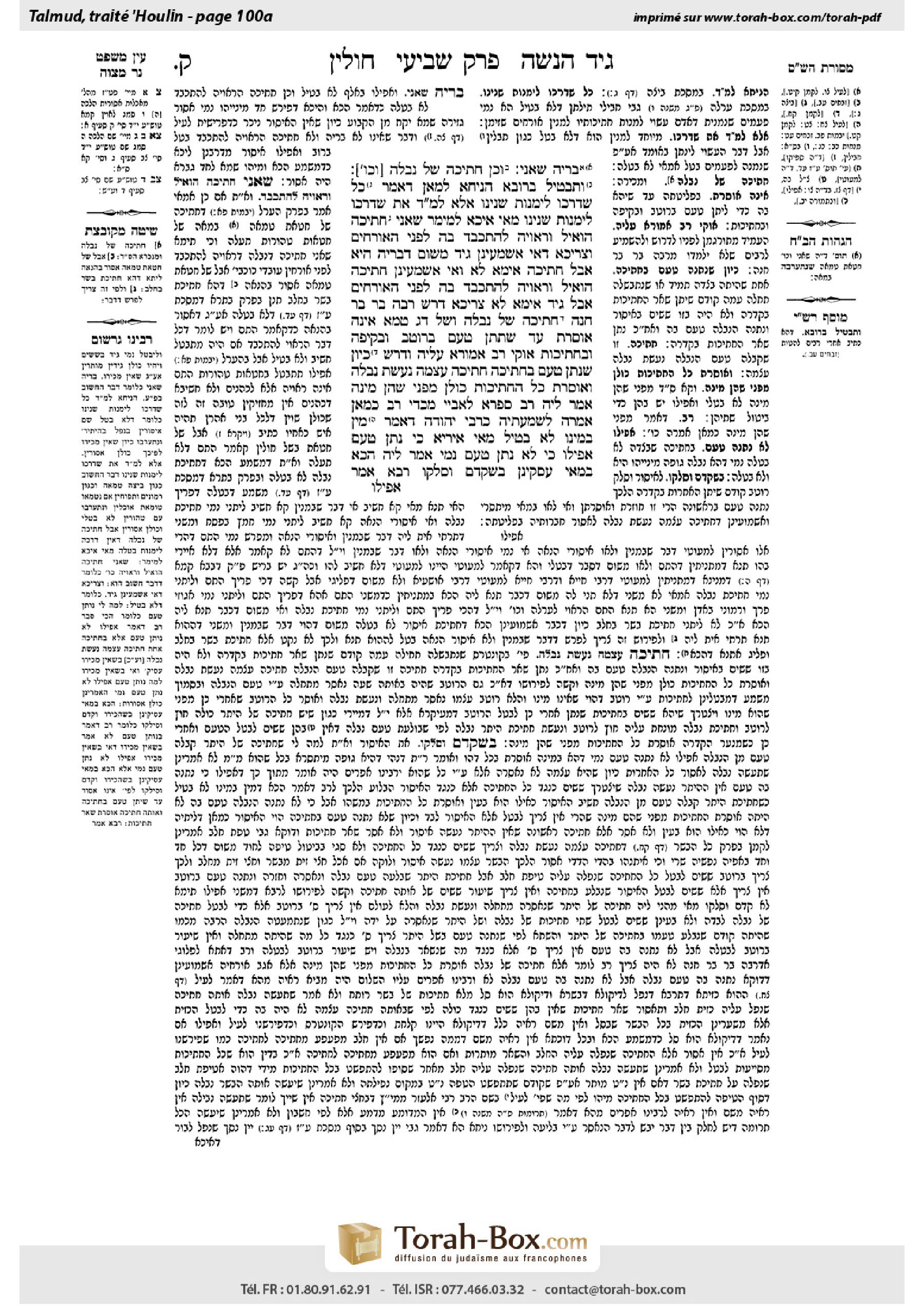
Chullin 100a: Talmud study for Daf Yomi
Study the Talmud for Daf Yomi with scanned pages, Hebrew text, English translations from Sefaria and AI-generated French translations.
Passage selection and English or AI-generated French translation are available where the scan has annotations. Daf Study is independent of Torah-Box and Sefaria.
Browse Chullin · חולין · All tractatesChullin 100a text and translations
This page of Chullin includes the Aramaic text, an English translation and an AI-generated French translation, alongside the scan above.
חולין ק׳ א · Aramaic and Hebrew text
בְּרִיָּה שָׁאנֵי.
וְכֵן חֲתִיכָה שֶׁל נְבֵלָה [וְכוּ׳]. וְתִבְטֵיל בְּרוּבָּא!
הָנִיחָא לְמַאן דְּאָמַר, כֹּל שֶׁדַּרְכּוֹ לִימָּנוֹת שָׁנִינוּ, אֶלָּא לְמַאן דְּאָמַר אֶת שֶׁדַּרְכּוֹ לִימָּנוֹת שָׁנִינוּ, מַאי אִיכָּא לְמֵימַר? שָׁאנֵי חֲתִיכָה, הוֹאִיל וּרְאוּיָה לְהִתְכַּבֵּד בָּהּ לִפְנֵי הָאוֹרְחִים.
וּצְרִיכָא, דְּאִי אַשְׁמְעִינַן גִּיד – מִשּׁוּם דִּבְרִיָּה הִיא, אֲבָל חֲתִיכָה – אֵימָא לָא.
וְאִי אַשְׁמְעִינַן חֲתִיכָה, הוֹאִיל וּרְאוּיָה לְהִתְכַּבֵּד בָּהּ לִפְנֵי הָאוֹרְחִים, אֲבָל גִּיד – אֵימָא לָא. צְרִיכָא.
דָּרֵשׁ רַבָּה בַּר בַּר חָנָה: חֲתִיכָה שֶׁל נְבֵלָה וְשֶׁל דָּג טָמֵא אֵינָהּ אוֹסֶרֶת, עַד שֶׁתִּתֵּן טַעַם בָּרוֹטֶב וּבַקֵּיפֶה וּבַחֲתִיכוֹת.
אוֹקֵי רַב אָמוֹרָא עֲלֵיהּ, וּדְרַשׁ: כֵּיוָן שֶׁנָּתַן טַעַם בַּחֲתִיכָה – חֲתִיכָה עַצְמָהּ נַעֲשֵׂת נְבֵלָה, וְאוֹסֶרֶת כׇּל הַחֲתִיכוֹת כּוּלָּן מִפְּנֵי שֶׁהֵן מִינָהּ.
אֲמַר לֵיהּ רַב סָפְרָא לְאַבָּיֵי: מִכְּדֵי רַב כְּמַאן אַמְרַהּ לִשְׁמַעְתֵּיהּ? כְּרַבִּי יְהוּדָה, דְּאָמַר מִין בְּמִינוֹ לֹא בָּטֵיל. מַאי אִירְיָא כִּי נָתַן טַעַם? אֲפִילּוּ כִּי לֹא נָתַן טַעַם נָמֵי! אֲמַר לֵיהּ: הָכָא בְּמַאי עָסְקִינַן – בְּשֶׁקָּדַם וְסִלְּקוֹ.
רָבָא אָמַר:
Chullin 100a · English translation
The Gemara answers that the sciatic nerve is a distinct entity, and therefore it is different in that it is not subject to nullification.
§ The mishna states: And similarly, in the case of a piece of an animal carcass or a piece of non-kosher fish that was cooked with similar pieces of kosher meat or fish, when one identifies the forbidden piece and removes it, the rest of the meat or fish is forbidden only if the forbidden piece was large enough to impart flavor to the entire mixture. And if he does not identify and remove the forbidden piece, all the pieces are forbidden, due to the possibility that each piece one selects might be the forbidden piece. The Gemara challenges: Even if the piece of an animal carcass was not removed, let it be nullified by a simple majority, as the majority of the pieces are kosher.
The Gemara clarifies its challenge. This ruling works out well according to the one who said that we learned: Any item whose manner is to be counted, i.e., that is sometimes sold by unit rather than by weight or volume, is considered significant and therefore is not subject to nullification. But according to the one who said that we learned: It is only an item whose manner is exclusively to be counted, i.e., that is always sold by unit, that is considered significant, and is therefore not subject to nullification, what can be said? Since pieces of meat or fish are not always sold by unit, they should be subject to nullification. The Gemara answers: A piece of meat or fish is different, since it is suitable to give honor with it by placing it before guests. Therefore, due to its significance it is not subject to nullification.
The Gemara adds: And it was necessary for the mishna to teach both the halakha that the sciatic nerve is not nullified and the halakha that a piece of non-kosher meat or fish is not nullified, as if the mishna had taught us only the case of a sciatic nerve, one might think that it is not nullified because it is a distinct entity, but in the case of a piece of non-kosher meat, say it is not significant, and it is subject to nullification.
And if the mishna had taught us the halakha only in the case of a piece of non-kosher meat or fish, one might think that it is not nullified since it is suitable to give honor with it by placing it before the guests. But in the case of a sciatic nerve, say it is not significant, and it is subject to nullification. Therefore it was necessary for the mishna to teach both cases.
§ Rabba bar bar Ḥana taught: A piece of meat of an unslaughtered carcass or of a non-kosher species of fish that fell into a pot of kosher food does not render the contents of the pot forbidden unless it imparts flavor to the broth and to the deposits of food remaining in the pot and to the other pieces of food in the pot.
Rav disagreed with Rabba bar bar Ḥana and appointed a disseminator to stand before him and teach his statement to a wider audience, and he taught: Once the non-kosher meat or fish has imparted flavor to another piece in the pot, that second piece itself becomes non-kosher. And this second piece renders all the pieces of meat or fish in the pot forbidden, because they are of the same type; therefore, nullification does not apply.
Rav Safra said to Abaye: Now, in accordance with whose opinion did Rav say his statement? It is in accordance with the opinion of Rabbi Yehuda, who says that a type of food mixed with food of its own type is not nullified. But if so, why does Rav state specifically that the non-kosher meat renders all the pieces forbidden only when it has imparted flavor to another piece? Even if it did not impart flavor to another piece it should render all the contents of the pot forbidden. Abaye said to him: Here we are dealing with a case where he cooked the non-kosher piece with one kosher piece and first removed the non-kosher piece before adding the other pieces. Consequently, the remaining pieces are forbidden only if the non-kosher piece imparted flavor to the piece it was cooked with.
Rava said an alternate answer to Rav Safra’s challenge of Rav’s statement:
Chullin 100a · Traduction française (IA)
La Guemara répond que le nerf sciatique est une entité distincte, et par conséquent, il est différent dans le sens où il n'est pas soumis à l'annulation.
§ La Michna stipule : De même, dans le cas d'une portion d'un cadavre d'animaux ou d'une portion de poisson non-kosher cuite avec d'autres portions de viande ou de poisson kosher, lorsqu'on identifie la portion interdite et on la retire, le reste de la viande ou du poisson est interdit uniquement si la portion interdite était suffisamment grande pour imprimer son goût à l'ensemble du mélange. Et si l'on ne l'identifie pas et ne le retire pas, toutes les portions sont interdites, en raison de la possibilité que chaque portion que l'on choisit puisse être la portion interdite. La Guemara conteste : Même si la portion du cadavre d'animaux n'a pas été retirée, qu'elle soit annulée par la majorité simple, car la majorité des portions sont kosher.
La Guemara clarifie sa contestation. Ce jugement s'applique bien selon celui qui a dit que nous avons appris : Tout objet dont la manière est de se compter, c'est-à-dire qui est parfois vendu par unité plutôt que par poids ou volume, est considéré comme important et donc n'est pas soumis à l'annulation. Mais selon celui qui a dit que nous avons appris : C'est uniquement un objet dont la manière est exclusivement de se compter, c'est-à-dire qui est toujours vendu par unité, qui est considéré comme important et donc n'est pas soumis à l'annulation, que peut-on dire ? Puisque les portions de viande ou de poisson ne sont pas toujours vendues par unité, elles devraient être soumises à l'annulation. La Guemara répond : Une portion de viande ou de poisson est différente, car elle est adaptée à l'honneur, en la plaçant devant les invités. Par conséquent, en raison de son importance, elle n'est pas soumise à l'annulation.
La Guemara ajoute : Il était nécessaire que la Michna enseigne à la fois la halakha selon laquelle le nerf sciatique n'est pas annulé et la halakha selon laquelle une portion de viande ou de poisson non-kosher n'est pas annulée, car si la Michna avait enseigné seulement le cas du nerf sciatique, on pourrait penser qu'il n'est pas annulé parce qu'il est une entité distincte, mais dans le cas d'une portion de viande non-kosher, on dirait qu'elle n'est pas importante et qu'elle est soumise à l'annulation.
Et si la Michna avait enseigné la halakha uniquement dans le cas d'une portion de viande ou de poisson non-kosher, on pourrait penser qu'elle n'est pas annulée car elle est adaptée à l'honneur, en la plaçant devant les invités. Mais dans le cas du nerf sciatique, on dirait qu'il n'est pas important et qu'il est soumis à l'annulation. Par conséquent, il était nécessaire que la Michna enseigne les deux cas.
§ Rabba bar bar Ḥana enseigna : Une portion de viande d'un cadavre non sacrifié ou d'un poisson non-kosher qui est tombé dans une casserole de nourriture kosher ne rend pas les aliments de la casserole interdits à moins qu'elle n'imprime son goût au bouillon et aux dépôts de nourriture restants dans la casserole ainsi qu'aux autres portions de nourriture dans la casserole.
Rav s'est opposé à Rabba bar bar Ḥana et a désigné un diffuseur pour se tenir devant lui et enseigner sa déclaration à un public plus large, et il enseigna : Une fois que la viande ou le poisson non-kosher a imprégné d'arôme un autre morceau dans la casserole, ce deuxième morceau devient lui-même non-kosher. Et ce deuxième morceau rend tous les morceaux de viande ou de poisson dans la casserole interdits, car ils sont de la même catégorie ; par conséquent, l'annulation ne s'applique pas.
Rav Safra a dit à Abaye : Maintenant, selon quel avis Rav a-t-il dit son opinion ? C'est selon l'avis de Rabbi Yehuda, qui dit qu'un aliment mélangé avec un aliment de la même catégorie n'est pas annulé. Mais si c'est ainsi, pourquoi Rav précise-t-il spécifiquement que la viande non-kosher rend tous les morceaux interdits uniquement lorsqu'elle a imprégné d'arôme un autre morceau ? Même si elle n'a pas imprégné d'arôme un autre morceau, elle devrait rendre tous les contenants de la casserole interdits. Abaye a dit à lui : Ici, nous sommes en présence d'un cas où l'on a cuisiné la portion non-kosher avec une portion kosher et où l'on a d'abord retiré la portion non-kosher avant d'ajouter les autres morceaux. Par conséquent, les morceaux restants sont interdits uniquement si la portion non-kosher a imprégné d'arôme le morceau avec lequel elle a été cuisinée.
Rava a donné une réponse alternative à la contestation de Rav Safra concernant l'opinion de Rav :
Traduction française générée par IA à partir de l’édition anglaise de Sefaria. Vérifie toujours un passage avec le texte source.
Text from Sefaria: William Davidson Edition - Vocalized Aramaic (unknown); William Davidson Edition - English (CC BY NC).