Chullin 100b: Talmud study for Daf Yomi
Study the Talmud for Daf Yomi with scanned pages, Hebrew text, English translations from Sefaria and AI-generated French translations.
Passage selection and English or AI-generated French translation are available where the scan has annotations. Daf Study is independent of Torah-Box and Sefaria.
Browse Chullin · חולין · All tractatesChullin 100b text and translations
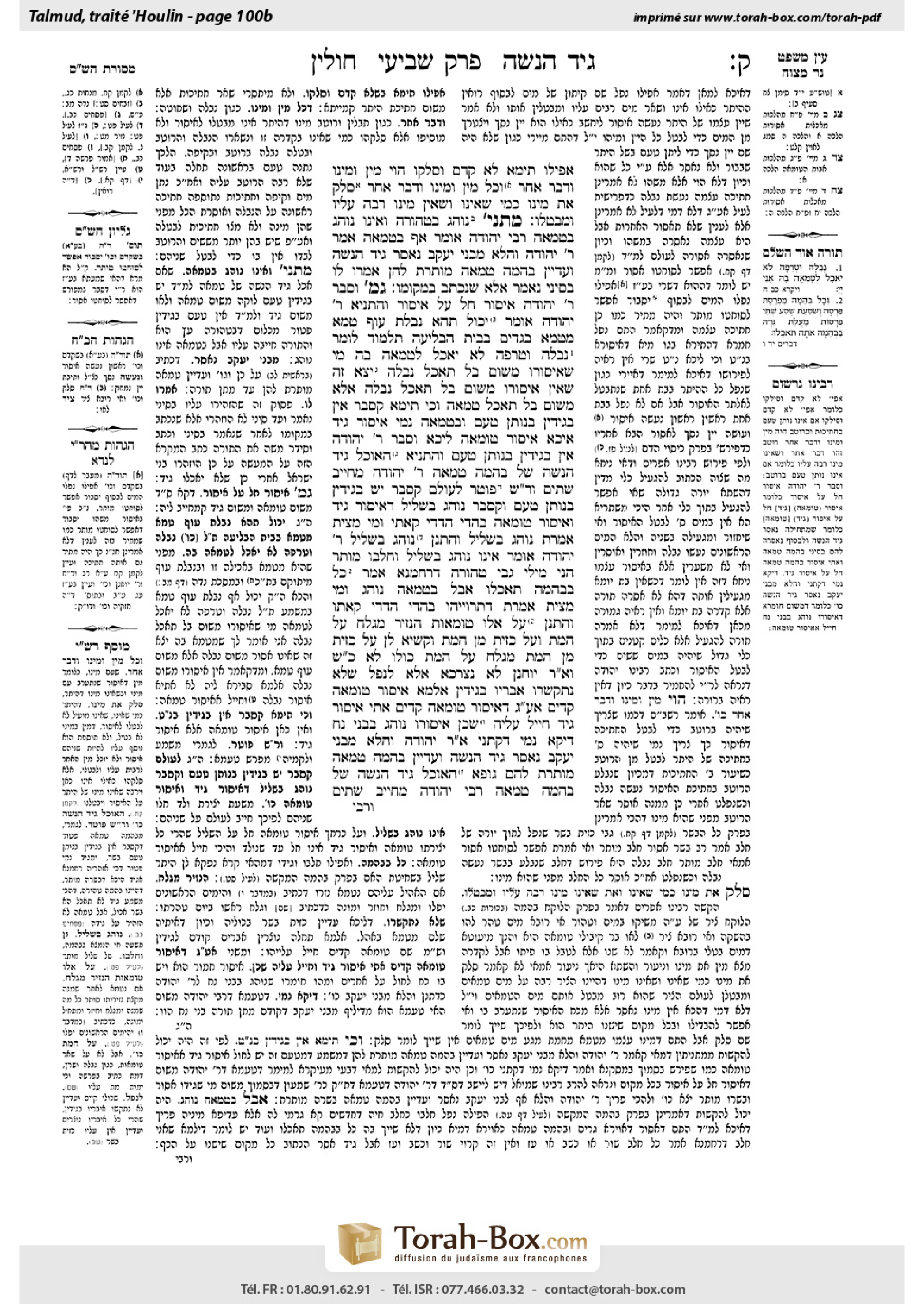
This page of Chullin includes the Aramaic text, an English translation and an AI-generated French translation, alongside the scan above.
חולין ק׳ ב · Aramaic and Hebrew text
אֲפִילּוּ תֵּימָא לֹא קָדַם וְסִלְּקוֹ, הָוֵי מִין וּמִינוֹ וְדָבָר אַחֵר.
וְכׇל מִין וּמִינוֹ וְדָבָר אַחֵר – סַלֵּק אֶת מִינוֹ כְּמִי שֶׁאֵינוֹ, וְשֶׁאֵין מִינוֹ רָבֶה עָלָיו וּמְבַטְּלוֹ.
מַתְנִי׳ נוֹהֵג בִּטְהוֹרָה, וְאֵינוֹ נוֹהֵג בִּטְמֵאָה. רַבִּי יְהוּדָה אוֹמֵר: אַף בִּטְמֵאָה. אָמַר רַבִּי יְהוּדָה: וַהֲלֹא מִבְּנֵי יַעֲקֹב נֶאֱסַר גִּיד הַנָּשֶׁה, וַעֲדַיִין בְּהֵמָה טְמֵאָה מוּתֶּרֶת לָהֶן? אָמְרוּ לוֹ: בְּסִינַי נֶאֱמַר, אֶלָּא שֶׁנִּכְתַּב בִּמְקוֹמוֹ.
גְּמָ׳ וְסָבַר רַבִּי יְהוּדָה אִיסּוּר חָל עַל אִיסּוּר? וְהָתַנְיָא: רַבִּי יְהוּדָה אוֹמֵר: יָכוֹל תְּהֵא נִבְלַת עוֹף טָמֵא מְטַמְּאָה בְּגָדִים בְּבֵית הַבְּלִיעָה?
תַּלְמוּד לוֹמַר ״נְבֵלָה וּטְרֵפָה לֹא יֹאכַל לְטׇמְאָה בָהּ״ – מִי שֶׁאִיסּוּרוֹ מִשּׁוּם ״בַּל תֹּאכַל נְבֵלָה״, יָצָא זֶה שֶׁאֵין אִיסּוּרוֹ מִשּׁוּם ״בַּל תֹּאכַל נְבֵלָה״ אֶלָּא מִשּׁוּם ״בַּל תֹּאכַל טְמֵאָה״.
וְכִי תֵּימָא, קָסָבַר אֵין בְּגִידִין בְּנוֹתֵן טַעַם, וּבִטְמֵאָה נָמֵי אִיסּוּר גִּיד אִיכָּא, אִיסּוּר טוּמְאָה לֵיכָּא.
וְסָבַר רַבִּי יְהוּדָה אֵין בְּגִידִין בְּנוֹתֵן טַעַם? וְהָתַנְיָא: הָאוֹכֵל גִּיד הַנָּשֶׁה שֶׁל בְּהֵמָה טְמֵאָה – רַבִּי יְהוּדָה מְחַיֵּיב שְׁתַּיִם, וְרַבִּי שִׁמְעוֹן פּוֹטֵר!
לְעוֹלָם, קָסָבַר יֵשׁ בְּגִידִין בְּנוֹתֵן טַעַם, וְקָסָבַר נוֹהֵג בַּשְּׁלִיל, דְּאִיסּוּר גִּיד וְאִיסּוּר טוּמְאָה בַּהֲדֵי הֲדָדֵי קָאָתֵי.
וּמִי מָצֵית אָמְרַתְּ נוֹהֵג בַּשְּׁלִיל? וְהָתְנַן: נוֹהֵג בַּשְּׁלִיל, רַבִּי יְהוּדָה אוֹמֵר: אֵינוֹ נוֹהֵג בַּשְּׁלִיל, וְחֶלְבּוֹ מוּתָּר!
הָנֵי מִילֵּי גַּבֵּי טְהוֹרָה, דְּרַחֲמָנָא אָמַר: ״כֹּל בַּבְּהֵמָה תֹּאכֵלוּ״, אֲבָל בִּטְמֵאָה נוֹהֵג.
וּמִי מָצֵית אָמְרַתְּ דְּתַרְוַיְיהוּ בַּהֲדֵי הֲדָדֵי קָאָתוּ? וְהָתְנַן: עַל אֵלּוּ טוּמְאוֹת הַנָּזִיר מְגַלֵּחַ, עַל הַמֵּת וְעַל כְּזַיִת מִן הַמֵּת.
וְקַשְׁיָא לַן: עַל כְּזַיִת מִן הַמֵּת מְגַלֵּחַ, עַל הַמֵּת כּוּלּוֹ לֹא כׇּל שֶׁכֵּן? וְאָמַר רַבִּי יוֹחָנָן: לֹא נִצְרְכָא אֶלָּא לְנֵפֶל שֶׁלֹּא נִתְקַשְּׁרוּ אֵבָרָיו בְּגִידִין. אַלְמָא אִיסּוּר טוּמְאָה קָדֵים!
אַף עַל גַּב דְּאִיסּוּר טוּמְאָה קָדֵים, אָתֵי אִיסּוּר גִּיד חָיֵיל עֲלֵיהּ, שֶׁכֵּן אִיסּוּרוֹ נוֹהֵג בִּבְנֵי נֹחַ.
דַּיְקָא נָמֵי, דְּקָתָנֵי: אָמַר רַבִּי יְהוּדָה: וַהֲלֹא מִבְּנֵי יַעֲקֹב נֶאֱסַר גִּיד הַנָּשֶׁה, וַעֲדַיִין בְּהֵמָה טְמֵאָה מוּתֶּרֶת לָהֶם.
גּוּפָא: הָאוֹכֵל גִּיד הַנָּשֶׁה שֶׁל בְּהֵמָה טְמֵאָה – רַבִּי יְהוּדָה מְחַיֵּיב שְׁתַּיִם,
Chullin 100b · English translation
You may even say that it is referring to a case where he did not first remove the piece of non-kosher meat or fish. Nevertheless, this is a case of a mixture of one type of food with its own type of food and with something else, i.e., the spices and broth in the pot.
And in any case of a type of forbidden food mixed with its own type of food and with something else, disregard the food that is its own type, as though it is not present in the mixture, and if the amount of permitted food that is not its own type is sixty times greater than the forbidden food, the permitted food nullifies it. Rav’s ruling applies to a case where the forbidden piece of meat or fish imparts flavor to another piece before the spices and broth are added, and there is a total volume sixty times greater than the original non-kosher piece. Consequently, even if the amount of spices and broth is eventually sixty times greater than the original non-kosher piece of meat or fish, the entire mixture is forbidden, as the spices and broth are not sixty times greater than the two pieces of meat or fish which are now non-kosher.
MISHNA: The prohibition of eating the sciatic nerve applies to a kosher animal and does not apply to a non-kosher animal. Rabbi Yehuda says: It applies even to a non-kosher animal. Rabbi Yehuda said in explanation: Wasn’t the sciatic nerve forbidden for the children of Jacob, as it is written: “Therefore the children of Israel eat not the sciatic nerve” (Genesis 32:33), yet the meat of a non-kosher animal was still permitted to them? Since the sciatic nerve of non-kosher animals became forbidden at that time, it remains forbidden now. The Rabbis said to Rabbi Yehuda: The prohibition was stated in Sinai, but it was written in its place, in the battle of Jacob and the angel despite the fact that the prohibition did not take effect then.
GEMARA: The Gemara asks: And does Rabbi Yehuda hold that a prohibition takes effect where another prohibition already exists? But isn’t it taught in a baraita: Rabbi Yehuda says: One might have thought that the carcass of a non-kosher bird renders the garments of one who swallows it ritually impure when it is in the throat, similar to the carcass of a kosher bird.
Therefore the verse states concerning the impurity of carcasses of birds: “A carcass, or that which is torn of animals, he shall not eat to defile himself with it” (Leviticus 22:8). The verse indicates that only those birds that are forbidden specifically due to the prohibition: You shall not eat of a carcass, i.e., kosher birds that died without ritual slaughter, cause impurity in this manner. This serves to exclude any bird that is not forbidden due to the prohibition: You shall not eat of a carcass, but rather due to the prohibition: You shall not eat a non-kosher bird. This indicates that according to Rabbi Yehuda, the prohibition of eating a carcass does not take effect with regard to a non-kosher bird, because it is already subject to a different prohibition.
The Gemara continues with its question: And if you would say that Rabbi Yehuda holds that sciatic nerves do not impart flavor, i.e., they do not have flavor and therefore are not classified as food, and even with regard to a non-kosher animal it is prohibited to eat the sciatic nerve because the general prohibition of eating a sciatic nerve applies, whereas the prohibition of eating non-kosher animals does not apply because the sciatic nerve is not considered food, this is untenable.
The Gemara explains: And does Rabbi Yehuda hold that sciatic nerves do not impart flavor? But isn’t it taught in a baraita: With regard to one who eats the sciatic nerve of a non-kosher animal, Rabbi Yehuda deems him liable to receive two sets of lashes, one for eating the sciatic nerve and one for eating the meat of a non-kosher animal, and Rabbi Shimon exempts him entirely from lashes. This indicates that Rabbi Yehuda holds that the sciatic nerve does have flavor.
The Gemara answers: Actually Rabbi Yehuda holds that sciatic nerves do impart flavor, and he also holds that the prohibition of eating the sciatic nerve applies to the sciatic nerve of an animal fetus. Consequently, although Rabbi Yehuda holds that a prohibition does not take effect where another already exists, one who eats the sciatic nerve of a non-kosher animal is flogged twice, because the prohibition of eating a sciatic nerve and the prohibition of eating meat from a non-kosher animal come into effect at the same time.
The Gemara challenges this answer: And can you say that Rabbi Yehuda holds that the prohibition of eating a sciatic nerve applies to the sciatic nerve of a fetus? But didn’t we learn in a mishna (89b): The prohibition applies to a late-term fetus in the womb. Rabbi Yehuda says: It does not apply to a fetus, and similarly the fat of a fetus is permitted?
The Gemara answers: This statement, that the prohibition of eating the sciatic nerve does not apply to a fetus, is with regard to a kosher species of animal, because the Merciful One stated in the Torah: “And every animal that divides the hoof, and has the hoof wholly cloven in two, and chews the cud, among the animals [babehema], that you may eat” (Deuteronomy 14:6). The term babehema may also be translated as: Inside the animals, indicating that anything inside a kosher animal when it is slaughtered is permitted for consumption, including all parts of a fetus. But with regard to a non-kosher species of animal the prohibition applies.
The Gemara challenges the assertion that the prohibitions of eating the sciatic nerve and of eating non-kosher meat take effect at the same time. And can you say that they both come into effect at the same time? But didn’t we learn in a mishna (Nazir 49b): A nazirite shaves for having become impure from these following sources of ritual impurity: For having become impure with impurity imparted by a corpse; and for impurity imparted by an olive-bulk of a corpse.
And this poses a difficulty for us: If a nazirite shaves for becoming impure from an olive-bulk of a corpse, is it not obvious that all the more so he must shave for becoming impure from an entire corpse? And Rabbi Yoḥanan said: It is necessary only with regard to a miscarried fetus whose limbs have not yet become joined to its sinews. Although the fetus does not yet contain an olive-bulk of flesh, since it is a complete entity, it transmits impurity to anything under the same roof. Evidently, the limbs of the body are formed before the nerves and sinews, and therefore the prohibition of eating non-kosher meat takes effect prior to the prohibition of the sciatic nerve.
The Gemara answers: Even though the prohibition of eating non-kosher meat takes effect prior to the prohibition of eating the sciatic nerve, the prohibition of the sciatic nerve also comes and takes effect upon a non-kosher animal because this prohibition applies to descendants of Noah, i.e., to gentiles. Since the prohibition of eating the sciatic nerve adds an additional stringency that did not exist with regard to non-kosher meat, it takes effect even though there was an already existing prohibition.
According to this answer, the language of the mishna is also precise, as it teaches: Rabbi Yehuda said: Wasn’t the sciatic nerve forbidden for the children of Jacob, as it is written: “Therefore the children of Israel eat not the sciatic nerve” (Genesis 32:33), yet the meat of a non-kosher animal was still permitted to them? This indicates that the basis of Rabbi Yehuda’s opinion is the fact that the sciatic nerve was forbidden to the children of Jacob, who had the status of descendants of Noah.
§ The Gemara returns to the matter itself cited above. With regard to one who eats the sciatic nerve of a non-kosher animal, Rabbi Yehuda deems him liable to receive two sets of lashes: One for eating the sciatic nerve and one for eating the meat of a non-kosher animal;
Chullin 100b · Traduction française (IA)
On peut même dire qu'il s'agit d'un cas où il n'a pas d'abord retiré la pièce de viande ou de poisson non-kosher. Cependant, il s'agit d'un cas de mélange d'un type de nourriture avec son propre type de nourriture et avec quelque chose d'autre, c'est-à-dire les épices et le bouillon dans la marmite.
Et dans tout cas de nourriture interdite mélangée avec son propre type de nourriture et avec quelque chose d'autre, on néglige la nourriture de son propre type, comme si elle n'était pas présente dans le mélange, et si la quantité de nourriture permise qui n'est pas de son propre type est soixante fois supérieure à la nourriture interdite, la nourriture permise annule celle-ci. La décision de Rava s'applique à un cas où la pièce de viande ou de poisson interdite imprègne le goût d'une autre pièce avant l'ajout des épices et du bouillon, et où le volume total est soixante fois supérieur à la pièce originale non-kosher. Ainsi, même si la quantité d'épices et de bouillon est finalement soixante fois supérieure à la pièce originale non-kosher de viande ou de poisson, l'ensemble du mélange est interdit, car les épices et le bouillon ne sont pas soixante fois supérieurs aux deux pièces de viande ou de poisson qui sont maintenant non-kosher.
MICHNA : La prohibition de manger le nerf sciatique s'applique à un animal kasher et ne s'applique pas à un animal non-kasher. Rabbi Yehuda dit : Elle s'applique même à un animal non-kasher. Rabbi Yehuda explique ainsi : N'était-ce pas interdit aux fils d'Israël de manger le nerf sciatique, comme il est écrit : « Par conséquent, les fils d'Israël ne doivent pas manger le nerf sciatique » (Genèse 32:33), et pourtant la viande d'un animal non-kasher leur était encore permise ? Puisque le nerf sciatique des animaux non-kashers est devenu interdit à cette époque, il reste interdit aujourd'hui. Les Sages dirent à Rabbi Yehuda : La prohibition a été énoncée au Sinaï, mais elle a été écrite à l'endroit où elle est, dans le combat de Jacob et de l'ange, malgré le fait qu'elle n'avait pas encore d'effet à cette époque.
GUEMARA : La Guemara pose la question : Et Rabbi Yehuda considère-t-il que la prohibition s'applique dans un cas où une autre prohibition existe déjà ? Mais n'est-il pas enseigné dans une baraïta : Rabbi Yehuda dit : On pourrait penser que le cadavre d'un oiseau non-kasher rend impur les vêtements de celui qui le déglutit lorsqu'il est dans la gorge, de la même manière que le cadavre d'un oiseau kasher.
Par conséquent, le verset qui parle de l'impureté des cadavres d'oiseaux dit : « Il ne doit pas manger un cadavre, ni ce qui est déchiré d'animaux, afin de ne pas s'abaisser par lui » (Lévitique 22:8). Ce verset indique que seul les oiseaux qui sont interdits spécifiquement en raison de la prohibition : « Tu ne dois pas manger un cadavre », c'est-à-dire les oiseaux kashers qui sont morts sans immolation rituelle, causent cette impureté. Cela sert à exclure tout oiseau qui n'est pas interdit en raison de la prohibition : « Tu ne dois pas manger un cadavre », mais plutôt en raison de la prohibition : « Tu ne dois pas manger un oiseau non-kasher ». Cela indique que selon Rabbi Yehuda, la prohibition de manger un cadavre ne s'applique pas aux oiseaux non-kashers, car ils sont déjà soumis à une autre prohibition.
La Guemara continue avec sa question : Et si vous dites que Rabbi Yehuda considère que les nerfs sciatiques ne transmettent pas de goût, c'est-à-dire qu'ils n'ont pas de goût et donc ne sont pas considérés comme de la nourriture, et même concernant un animal non-kasher, il est interdit de manger le nerf sciatique car la prohibition générale de manger un nerf sciatique s'applique, alors que la prohibition de manger un animal non-kasher ne s'applique pas car le nerf sciatique n'est pas considéré comme de la nourriture, cela est inacceptable.
La Guemara explique : Et Rabbi Yehuda considère-t-il que les nerfs sciatiques ne transmettent pas de goût ? Mais n'est-il pas enseigné dans une baraïta : Concernant celui qui mange le nerf sciatique d'un animal non-kasher, Rabbi Yehuda considère qu'il est puni de deux séances de flagellation, une pour manger le nerf sciatique et une pour manger la viande d'un animal non-kasher, et Rabbi Shimon l'exempte entièrement de flagellation. Cela indique que Rabbi Yehuda considère que le nerf sciatique a un goût.
La Guemara répond : En réalité, Rabbi Yehuda considère que les nerfs sciatiques transmettent un goût, et il considère également que la prohibition de manger le nerf sciatique s'applique au nerf sciatique d'un fœtus. Ainsi, bien que Rabbi Yehuda considère que la prohibition ne s'applique pas lorsqu'une autre existe déjà, celui qui mange le nerf sciatique d'un animal non-kasher est flagellé deux fois, car la prohibition de manger un nerf sciatique et la prohibition de manger la viande d'un animal non-kasher s'appliquent en même temps.
La Guemara conteste cette réponse : Et pouvez-vous dire que Rabbi Yehuda considère que la prohibition de manger un nerf sciatique s'applique au nerf sciatique d'un fœtus ? Mais n'avons-nous pas appris dans une mitsna (89b) : La prohibition s'applique à un fœtus en fin de terme dans le ventre. Rabbi Yehuda dit : Elle ne s'applique pas à un fœtus, et de même la graisse du fœtus est permise ?
La Guemara répond : Cette déclaration, selon laquelle la prohibition de manger le nerf sciatique ne s'applique pas à un fœtus, concerne une espèce kasher d'animal, car l'Éternel a dit dans la Torah : « Et tout animal qui divise le sabot, et qui a le sabot entièrement cloisonné en deux, et qui mâche l'herbe, parmi les animaux [babehema], que tu dois manger » (Deutéronome 14:6). Le terme babehema peut aussi être traduit par : À l'intérieur des animaux, indiquant que tout ce qui est à l'intérieur d'un animal kasher lorsqu'il est sacrifié est permis à la consommation, y compris toutes les parties d'un fœtus. Mais concernant une espèce non-kasher d'animal, la prohibition s'applique.
La Guemara conteste l'affirmation que les prohibitions de manger le nerf sciatique et de manger de la viande non-kasher s'appliquent en même temps. Et pouvez-vous dire qu'elles s'appliquent toutes deux en même temps ? Mais n'avons-nous pas appris dans une mitsva (Nazir 49b) : Un nazirite rasait les cheveux en raison de l'impureté provenant de ces sources d'impureté rituelle : En raison de l'impureté provenant du cadavre, et en raison de l'impureté provenant d'une quantité d'olive d'un cadavre.
Et cela pose un problème pour nous : si un nazirite se rase pour devenir impur à cause d’un corps dont la quantité est celle d’une olive, n’est-ce pas évident que d’autant plus il doit se raser pour devenir impur à cause d’un corps entier ? Rabbi Yoḥanan a dit : cela est nécessaire uniquement en ce qui concerne un fœtus dont les membres n’ont pas encore été joints à ses nerfs et à ses tendons. Bien que ce fœtus ne contienne pas encore une quantité d’olive de chair, puisqu’il est une entité complète, il transmet l’impureté à tout ce qui est sous le même toit. Il est évident que les membres du corps sont formés avant les nerfs et les tendons, et par conséquent la prohibition de manger de la viande non kasher s’applique avant la prohibition du nerf sciatique.
La Guemara répond : même si la prohibition de manger de la viande non kasher s’applique avant la prohibition de manger le nerf sciatique, la prohibition du nerf sciatique s’applique également à un animal non kasher, car cette prohibition s’applique aux descendants de Noé, c’est-à-dire aux non-Juifs. Puisque la prohibition du nerf sciatique ajoute une stricteur supplémentaire qui n’existait pas en ce qui concerne la viande non kasher, elle s’applique même s’il y avait déjà une prohibition existante.
Selon cette réponse, la formulation de la mitsna est aussi précise, car elle enseigne : Rabbi Yéhuda a dit : n’est-ce pas que le nerf sciatique était interdit aux enfants de Jacob, comme il est écrit : « Ainsi les enfants d’Israël ne mangent pas le nerf sciatique » (Genèse 32 : 33), et pourtant la viande d’un animal non kasher leur était encore permise ? Cela indique que la base de l’opinion de Rabbi Yéhuda est le fait que le nerf sciatique était interdit aux enfants de Jacob, qui avaient le statut de descendants de Noé.
§ La Guemara reprend la question évoquée ci-dessus. En ce qui concerne celui qui mange le nerf sciatique d’un animal non kasher, Rabbi Yéhuda considère qu’il est tenu responsable de deux flagellations : une pour avoir mangé le nerf sciatique et une pour avoir mangé la viande d’un animal non kasher ;
Traduction française générée par IA à partir de l’édition anglaise de Sefaria. Vérifie toujours un passage avec le texte source.
Text from Sefaria: William Davidson Edition - Vocalized Aramaic (unknown); William Davidson Edition - English (CC BY NC).