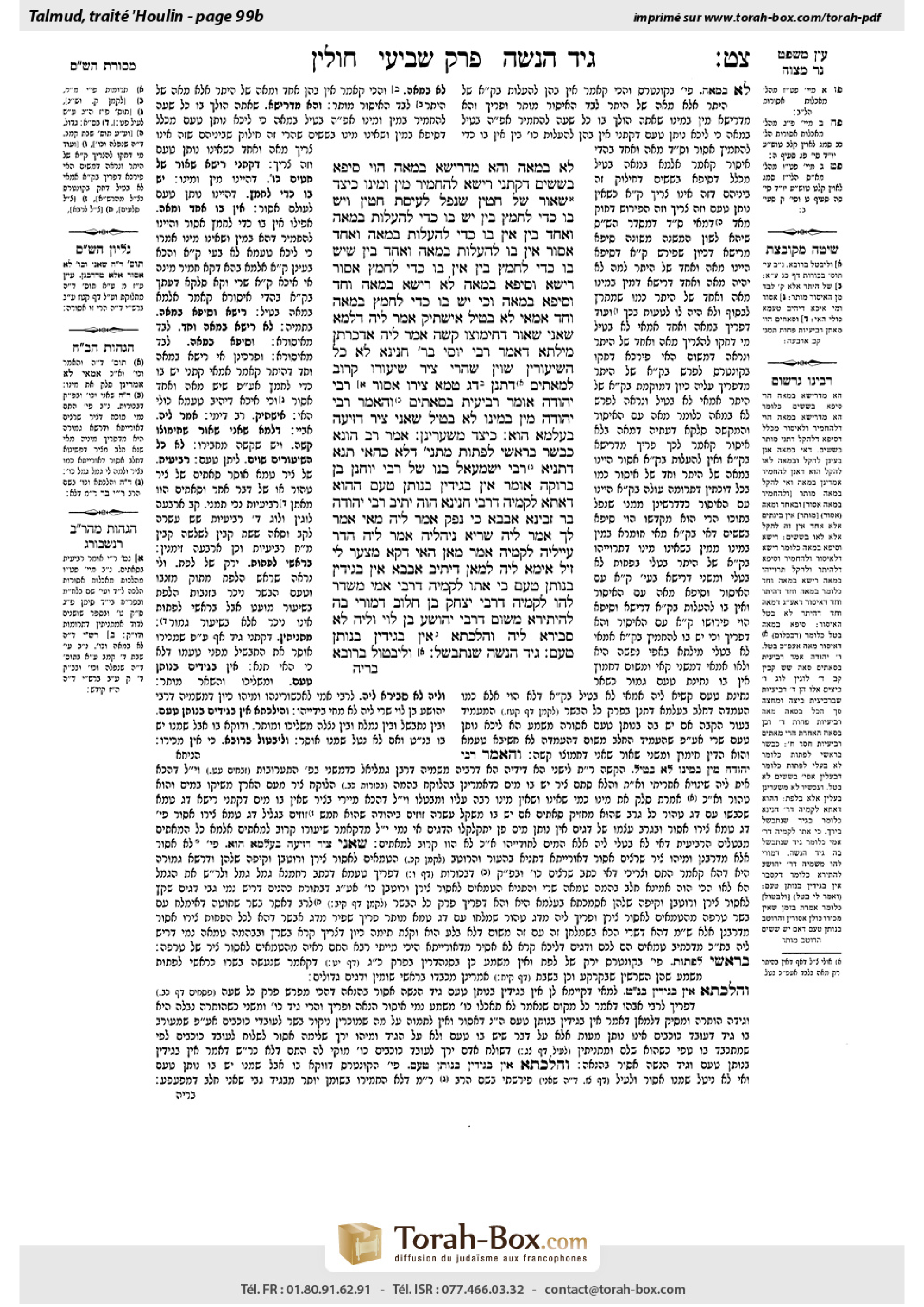
Chullin 99b: Talmud study for Daf Yomi
Study the Talmud for Daf Yomi with scanned pages, Hebrew text, English translations from Sefaria and AI-generated French translations.
Passage selection and English or AI-generated French translation are available where the scan has annotations. Daf Study is independent of Torah-Box and Sefaria.
Browse Chullin · חולין · All tractatesChullin 99b text and translations
This page of Chullin includes the Aramaic text, an English translation and an AI-generated French translation, alongside the scan above.
חולין צ״ט ב · Aramaic and Hebrew text
לָא, בְּמֵאָה.
וְהָא מִדְּרֵישָׁא בְּמֵאָה הָוֵי, סֵיפָא בְּשִׁשִּׁים! דְּקָתָנֵי רֵישָׁא: לְהַחְמִיר מִין וּמִינוֹ כֵּיצַד? שְׂאוֹר שֶׁל חִטִּין שֶׁנָּפַל לְעִיסַּת חִטִּין, וְיֵשׁ בּוֹ כְּדֵי לְחַמֵּץ, בֵּין יֵשׁ בּוֹ כְּדֵי לְהַעֲלוֹת בְּמֵאָה וְאֶחָד, בֵּין אֵין בּוֹ כְּדֵי לְהַעֲלוֹת בְּמֵאָה וְאֶחָד – אָסוּר.
אֵין בּוֹ לְהַעֲלוֹת בְּמֵאָה וְאֶחָד, בֵּין שֶׁיֵּשׁ בּוֹ כְּדֵי לְחַמֵּץ, בֵּין אֵין בּוֹ כְּדֵי לְחַמֵּץ – אָסוּר. רֵישָׁא וְסֵיפָא בִּמְאָה?
לָא, רֵישָׁא בִּמְאָה וְחַד, וְסֵיפָא בִּמְאָה.
וְכִי יֵשׁ בּוֹ כְּדֵי לְחַמֵּץ בִּמְאָה וְחַד, אַמַּאי לָא בְּטִיל? אִישְׁתִּיק.
אֲמַר לֵיהּ: דִּלְמָא שָׁאנֵי שְׂאוֹר דְּחִימּוּצוֹ קָשֶׁה. אֲמַר לֵיהּ: אַדְכַּרְתַּן מִילְּתָא דְּאָמַר רַבִּי יוֹסֵי בְּרַבִּי חֲנִינָא: לֹא כׇּל הַשִּׁיעוּרִין שָׁוִין, שֶׁהֲרֵי צִיר שִׁיעוּרוֹ קָרוֹב לְמָאתַיִם. דִּתְנַן: דָּג טָמֵא צִירוֹ אָסוּר, רַבִּי יְהוּדָה אוֹמֵר: רְבִיעִית בְּסָאתַיִם.
וְהָאָמַר רַבִּי יְהוּדָה: מִין בְּמִינוֹ לֹא בָּטֵיל? שָׁאנֵי צִיר, דְּזֵיעָה בְּעָלְמָא הוּא.
כֵּיצַד מְשַׁעֲרִינַן? אָמַר רַב הוּנָא: כְּבָשָׂר בְּרָאשֵׁי לְפָתוֹת. מַתְנִיתִין דְּלָא כְּהַאי תַּנָּא, דְּתַנְיָא: רַבִּי יִשְׁמָעֵאל בְּנוֹ שֶׁל רַבִּי יוֹחָנָן בֶּן בְּרוֹקָה אוֹמֵר: אֵין בְּגִידִין בְּנוֹתֵן טַעַם.
הָהוּא דַּאֲתָא לְקַמֵּיהּ דְּרַבִּי חֲנִינָא, הֲוָה יָתֵיב רַבִּי יְהוּדָה בַּר זְבִינָא אַבָּבָא. כִּי נְפַק, אֲמַר לֵיהּ: מַאי אֲמַר לָךְ? אֲמַר לֵיהּ: שַׁרְיָא נִיהֲלֵיהּ.
אֲמַר לֵיהּ הֲדַר עַיְּילַיהּ לְקַמֵּיהּ, אֲמַר: מַאן הַאי דְּקָא מְצַעַר לִי? זִיל אֵימָא לֵיהּ לְמַאן דְּיָתֵיב אַבָּבָא: אֵין בְּגִידִין בְּנוֹתֵן טַעַם.
כִּי אֲתוֹ לְקַמֵּיהּ דְּרַבִּי אַמֵּי, מְשַׁדַּר לְהוּ לְקַמֵּיהּ דְּרַבִּי יִצְחָק בֶּן חֲלוּב, דְּמוֹרֵי בַּהּ לְהֶיתֵּירָא מִשּׁוּם דְּרַבִּי יְהוֹשֻׁעַ בֶּן לֵוִי, וְלֵיהּ לָא סְבִירָא לֵיהּ. וְהִלְכְתָא: אֵין בְּגִידִין בְּנוֹתֵן טַעַם.
גִּיד הַנָּשֶׁה שֶׁנִּתְבַּשֵּׁל. וְלִיבְטוֹל בְּרוּבָּא!
Chullin 99b · English translation
Rav Dimi answered Abaye: No, the mishna means that although there is not one hundred and one times as much non-sacred food as teruma, the teruma is nullified because there is one hundred times its volume of non-sacred food.
Abaye responded: But since the first clause states that it is nullified in one hundred times its volume, it must be that the latter clause is referring to a case where there is sixty times its volume. As the mishna (Orla 2:6) teaches in the first clause: When it is stated that the halakha is to be stringent if one type of teruma is mixed with non-sacred food of its type, how is this accomplished? For example, in a case of leaven of teruma wheat that fell into dough made of non-sacred wheat, and there is enough teruma to cause the non-sacred wheat to become leavened, whether there is enough non-sacred wheat to neutralize the teruma in one hundred and one times its volume, or whether there is not enough non-sacred wheat to neutralize the teruma in one hundred and one times its volume, the entire dough is forbidden to a non-priest.
But if there is not enough non-sacred wheat to neutralize the teruma in one hundred and one times its volume, then whether there is enough teruma to cause the non-sacred wheat to become leavened or whether there is not enough teruma to cause the non-sacred wheat to become leavened, the entire dough is forbidden to a non-priest. Would you suggest that both the first clause and the latter clause are stating that the teruma is nullified in one hundred times its volume?
Rav Dimi answered: No. The first clause is referring to a case where the teruma is mixed with one hundred and one times its volume of non-sacred food, and the latter clause is referring to a case where the teruma is mixed with one hundred times its volume of non-sacred food.
Abaye asked Rav Dimi: If so, when the mishna states that if there is enough teruma to cause the non-sacred wheat to become leavened the entire mixture is forbidden to non-priests, why is that the case? If leaven is mixed with one hundred and one times its volume of non-sacred wheat it will have no leavening effect, so why is it not nullified? Rav Dimi did not have an answer and was silent.
Abaye said to him: Perhaps leaven is different, because its leavening properties are potent, and there are some forms of leaven that can have an effect on such a large quantity of dough. Rav Dimi said to him: You reminded me of a matter that Rabbi Yosei, son of Rabbi Ḥanina, said: Not all the measures are equal, because the measure required in order to nullify non-kosher fish brine is close to two hundred times its volume. As we learned in a mishna (Terumot 10:8): The brine of a non-kosher fish is forbidden. Rabbi Yehuda says: A quarter-log of non-kosher fish brine renders kosher food forbidden even if it is mixed with two se’a of permitted food, which is one hundred ninety-two times as much as a quarter-log.
The Gemara asks: How can Rabbi Yehuda say that fish brine is nullified at all? Doesn’t Rabbi Yehuda say that a type of food mixed with food of its own type is not nullified? The Gemara answers: Brine is different because it is merely sweat, i.e., it does not have the halakhic status of the fish itself.
§ The mishna (96b) teaches: How does one measure whether there is enough sciatic nerve to impart flavor to the meat of the entire thigh? One relates to it as though the sciatic nerve were meat and the thigh were a turnip. If the meat would impart flavor to the turnip when they were cooked together, then the entire thigh is forbidden. The Gemara states that Rav Huna says: The mishna means that it is measured like meat cooked in a pot with turnip heads. The Gemara notes that the mishna is not in accordance with the opinion of this tanna, as it is taught in a baraita: Rabbi Yishmael, son of Rabbi Yoḥanan ben Beroka, says: Sciatic nerves do not impart flavor at all.
There was a certain man who came before Rabbi Ḥanina to ask about the status of a thigh of an animal that was cooked with its sciatic nerve, and Rabbi Yehuda bar Zevina was sitting at the gate. When the man left, Rabbi Yehuda bar Zevina said to him: What did Rabbi Ḥanina say to you? The man said to him: He permitted me to eat the thigh.
Rabbi Yehuda bar Zevina said to him: Bring the animal before him again; perhaps he did not fully understand the question. When the man returned to Rabbi Ḥanina, Rabbi Ḥanina said: Who is this person who is bothering me? Go and say to the individual who is sitting at the gate, i.e., Rabbi Yehuda bar Zevina: Sciatic nerves do not impart flavor. Consequently, he can remove the sciatic nerve and the rest of the meat is permitted.
When people would come before Rabbi Ami to ask about the halakha of a thigh that was cooked with the sciatic nerve inside, he would send them before Rabbi Yitzḥak ben Ḥalov, who would rule leniently about this issue and say that it was permitted, in the name of Rabbi Yehoshua ben Levi. Rabbi Ami himself did not hold accordingly, but he did not wish to rule stringently for others. And the halakha is that sciatic nerves do not impart flavor at all.
§ The mishna states (96b): With regard to a sciatic nerve that was cooked with other sinews, when one identifies the sciatic nerve and removes it, the other sinews are forbidden if the sciatic nerve was large enough to impart flavor. And if he does not identify it, all the sinews are forbidden because each one could be the sciatic nerve. The Gemara challenges: Let the sciatic nerve be nullified by a simple majority.
Chullin 99b · Traduction française (IA)
Rav Dimi répondit à Abaye : Non, la mitsva signifie que bien que la nourriture non sacrée ne soit pas cent et un fois plus que la terouma, la terouma est annulée car il y a cent fois son volume de nourriture non sacrée.
Abaye répondit : Mais puisque la première clause indique que la terouma est annulée dans un volume cent fois supérieur, il doit être que la seconde clause fait référence à un cas où il y a soixante fois son volume. Comme la mitsva (Orla 2:6) enseigne dans la première clause : Lorsqu'il est dit que la halakha est stricte si un type de terouma est mélangé avec une nourriture non sacrée de son genre, comment cela est-il accompli ? Par exemple, dans le cas de levain de blé terouma qui est tombé dans une pâte faite de blé non sacré, et qu'il y a assez de terouma pour que le blé non sacré devienne levain, que l'on ait assez de blé non sacré pour annuler la terouma dans un volume cent et un fois supérieur, ou que l'on n'ait pas assez de blé non sacré pour annuler la terouma dans un volume cent et un fois supérieur, la pâte entière est interdite aux non-prêtres.
Mais si l'on n'a pas assez de blé non sacré pour annuler la terouma dans un volume cent et un fois supérieur, alors que l'on ait assez de terouma pour que le blé non sacré devienne levain ou que l'on n'ait pas assez de terouma pour que le blé non sacré devienne levain, la pâte entière est interdite aux non-prêtres. Voudriez-vous suggérer que les deux clauses sont toutes deux affirmant que la terouma est annulée dans un volume cent fois supérieur ?
Rav Dimi répondit : Non. La première clause fait référence à un cas où la terouma est mélangée avec un volume cent fois supérieur à son propre volume de nourriture non sacrée, et la seconde clause fait référence à un cas où la terouma est mélangée avec un volume cent fois supérieur à son propre volume de nourriture non sacrée.
Abaye demanda à Rav Dimi : Si c'est ainsi, lorsque la Michna stipule que si l'on a assez de terouma pour que le blé non sacré devienne levain, le mélange entier est interdit aux non-prêtres, pourquoi est-ce le cas ? Si le levain est mélangé avec un volume cent fois supérieur à son propre volume de blé non sacré, il n'aura pas d'effet de levain, pourquoi n'est-il pas annulé ? Rav Dimi n'avait pas de réponse et resta silencieux.
Abaye dit à lui : Peut-être que le levain est différent, car ses propriétés de levain sont puissantes, et il existe certaines formes de levain qui peuvent avoir un effet sur une quantité aussi grande de pâte. Rav Dimi dit à lui : Vous m'avez rappelé une affaire que Rabbi Yosei, fils de Rabbi Ḥanina, a dit : Ce n'est pas toutes les mesures qui sont égales, car la mesure requise pour annuler la saumure de poisson non kasher est proche de deux cents fois son volume. Comme nous avons appris dans une mitsva (Terumot 10:8) : La saumure d'un poisson non kasher est interdite. Rabbi Yehuda dit : Un quart de log de saumure non kasher rend la nourriture kasher interdite même si elle est mélangée avec deux se'ot de nourriture permise, ce qui est cent quatre-vingt-douze fois plus qu'un quart de log.
La Guemara demande : Comment Rabbi Yehuda peut-il dire que la saumure est annulée en totalité ? N'est-ce pas que Rabbi Yehuda dit qu'un type de nourriture mélangé avec une nourriture de son genre n'est pas annulé ? La Guemara répond : La saumure est différente car elle est simplement la sueur, c'est-à-dire qu'elle n'a pas le statut halakhique du poisson lui-même.
§ La mitsva (96b) enseigne : Comment mesure-t-on si il y a assez de nerf sciatique pour transmettre un goût à la viande de la cuisse ? On considère cela comme si le nerf sciatique était de la viande et la cuisse était un chou. Si la viande transmettrait un goût au chou lorsqu'ils sont cuits ensemble, alors toute la cuisse est interdite. La Guemara dit que Rav Huna dit : La mitsva signifie que c'est mesuré comme de la viande cuite dans une marmite avec des têtes de chou. La Guemara note que la mitsva n'est pas en accord avec l'opinion de ce tanna, car cela est appris dans une baraïta : Rabbi Yishmael, fils de Rabbi Yoḥanan ben Beroka, dit : Les nerfs sciatiques ne transmettent aucun goût.
Il y avait un certain homme qui s'est présenté devant Rabbi Ḥanina pour demander sur le statut d'une cuisse d'un animal cuite avec son nerf sciatique, et Rabbi Yehuda bar Zevina était assis à la porte. Lorsque l'homme est parti, Rabbi Yehuda bar Zevina dit à lui : Qu'est-ce que Rabbi Ḥanina t'a dit ? L'homme dit à lui : Il m'a permis de manger la cuisse.
Rabbi Yehuda bar Zevina dit à lui : Apporte l'animal devant lui à nouveau ; peut-être qu'il n'a pas bien compris la question. Lorsque l'homme est revenu devant Rabbi Ḥanina, Rabbi Ḥanina dit : Qui est cette personne qui me dérange ? Va et dis à l'individu qui est assis à la porte, c'est-à-dire Rabbi Yehuda bar Zevina : Les nerfs sciatiques ne transmettent aucun goût. Ainsi, il peut retirer le nerf sciatique et le reste de la viande est permis.
Lorsque les gens venaient devant Rabbi Ami pour demander sur la halakha d'une cuisse cuite avec le nerf sciatique à l'intérieur, il les envoyait devant Rabbi Yitzḥak ben Ḥalov, qui rendait cette question plus clémente et disait qu'il était permis, en nom de Rabbi Yehoshua ben Levi. Rabbi Ami lui-même ne tenait pas à cette opinion, mais il ne voulait pas juger strictement pour les autres. Et la halakha est que les nerfs sciatiques ne transmettent aucun goût.
§ La mitsva dit (96b) : En ce qui concerne un nerf sciatique cuisiné avec d'autres nerfs, lorsque l'on identifie le nerf sciatique et l'enlève, les autres nerfs sont interdits si le nerf sciatique était suffisamment grand pour transmettre un goût. Et si l'on ne l'identifie pas, tous les nerfs sont interdits car chacun pourrait être le nerf sciatique. La Guemara conteste : Que le nerf sciatique soit annulé par une majorité simple.
Traduction française générée par IA à partir de l’édition anglaise de Sefaria. Vérifie toujours un passage avec le texte source.
Text from Sefaria: William Davidson Edition - Vocalized Aramaic (unknown); William Davidson Edition - English (CC BY NC).