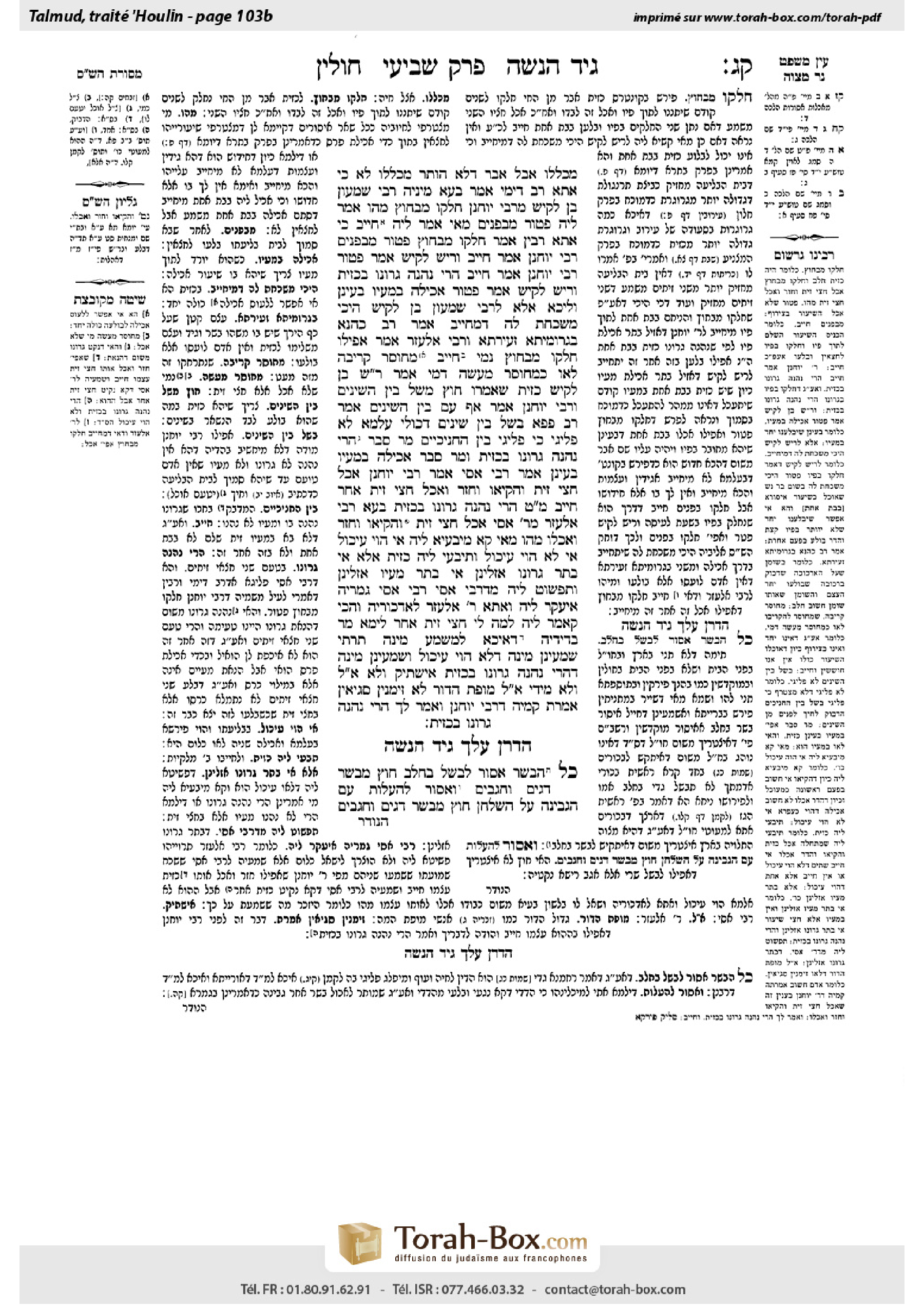
Chullin 103b: Talmud study for Daf Yomi
Study the Talmud for Daf Yomi with scanned pages, Hebrew text, English translations from Sefaria and AI-generated French translations.
Passage selection and English or AI-generated French translation are available where the scan has annotations. Daf Study is independent of Torah-Box and Sefaria.
Browse Chullin · חולין · All tractatesChullin 103b text and translations
This page of Chullin includes the Aramaic text, an English translation and an AI-generated French translation, alongside the scan above.
חולין ק״ג ב · Aramaic and Hebrew text
מִכְּלָלוֹ, אֲבָל אֵבֶר דְּלֹא הוּתַּר מִכְּלָלוֹ – לָא.
כִּי אֲתָא רַב דִּימִי אָמַר: בְּעָא מִינֵּיהּ רַבִּי שִׁמְעוֹן בֶּן לָקִישׁ מֵרַבִּי יוֹחָנָן: חִלְּקוֹ מִבַּחוּץ, מַהוּ? אֲמַר לֵיהּ: פָּטוּר.
מִבִּפְנִים, מַאי? אֲמַר לֵיהּ: חַיָּיב.
כִּי אֲתָא רָבִין אָמַר: חִלְּקוֹ מִבַּחוּץ – פָּטוּר, מִבְּפָנִים – רַבִּי יוֹחָנָן אָמַר חַיָּיב, וְרֵישׁ לָקִישׁ אָמַר פָּטוּר.
רַבִּי יוֹחָנָן אָמַר: חַיָּיב, הֲרֵי נֶהֱנָה גְּרוֹנוֹ בִּכְזַיִת. וְרֵישׁ לָקִישׁ אָמַר: פָּטוּר, אֲכִילָה בְּמֵעָיו בָּעֵינַן וְלֵיכָּא.
אֶלָּא לְרַבִּי שִׁמְעוֹן בֶּן לָקִישׁ, הֵיכִי מַשְׁכַּחַתְּ לַהּ דִּמְחַיֵּיב? אָמַר רַב כָּהֲנָא: בִּגְרוֹמִיתָא זְעֵירְתָּא.
וְרַבִּי אֶלְעָזָר אָמַר: אֲפִילּוּ חִלְּקוֹ מִבַּחוּץ נָמֵי חַיָּיב, מְחוּסַּר קְרִיבָה לָאו כִּמְחוּסַּר מַעֲשֶׂה דָּמֵי.
אָמַר רַבִּי שִׁמְעוֹן בֶּן לָקִישׁ: כְּזַיִת שֶׁאָמְרוּ – חוּץ מִשֶּׁל בֵּין הַשִּׁינַּיִם, וְרַבִּי יוֹחָנָן אָמַר: אַף עִם בֵּין הַשִּׁינַּיִם.
אָמַר רַב פָּפָּא: בְּשֶׁל בֵּין שִׁינַּיִם – דְּכוּלֵּי עָלְמָא לָא פְּלִיגִי, כִּי פְּלִיגִי – בֵּין הַחֲנִיכַיִים. מָר סָבַר: הֲרֵי נֶהֱנָה גְּרוֹנוֹ בִּכְזַיִת, וּמָר סָבַר: אֲכִילָה בְּמֵעָיו בָּעֵינַן.
אָמַר רַבִּי אַסִּי אָמַר רַבִּי יוֹחָנָן: אָכַל חֲצִי זַיִת וֶהֱקִיאוֹ, וְחָזַר וְאָכַל חֲצִי זַיִת אַחֵר – חַיָּיב. מַאי טַעְמָא? הֲרֵי נֶהֱנָה גְּרוֹנוֹ בִּכְזַיִת.
בְּעָא רַבִּי אֶלְעָזָר מֵרַבִּי אַסִּי: אָכַל חֲצִי זַיִת וֶהֱקִיאוֹ וְחָזַר וַאֲכָלוֹ, מַהוּ? מַאי קָא מִיבַּעְיָא לֵיהּ? אִי הָוֵי עִיכּוּל אִי לָא הָוֵי עִיכּוּל, וְתִיבְּעֵי לֵיהּ כְּזַיִת!
אֶלָּא, אִי בָּתַר גְּרוֹנוֹ אָזְלִינַן, אִי בָּתַר מֵעָיו אָזְלִינַן. וְתִפְשׁוֹט לֵיהּ מִדְּרַבִּי אַסִּי!
רַבִּי אַסִּי גְּמָרֵיהּ אִיעֲקַר לֵיהּ, וַאֲתָא רַבִּי אֶלְעָזָר לְאַדְכּוֹרֵיהּ, וְהָכִי קָאָמַר לֵיהּ: לְמָה לִי חֲצִי זַיִת אַחֵר? לֵימָא מָר בְּדִידֵיהּ, דְּאִיכָּא לְמִשְׁמַע מִינַּהּ תַּרְתֵּי: שָׁמְעִינַן מִינַּהּ דְּלָא הָוֵי עִיכּוּל, וְשָׁמְעִינַן מִינַּהּ דַּהֲרֵי נֶהֱנָה גְּרוֹנוֹ בִּכְזַיִת.
אִישְׁתִּיק וְלָא אֲמַר לֵיהּ וְלָא מִידֵּי, אֲמַר לֵיהּ: מוֹפֵת הַדּוֹר, לָא זִימְנִין סַגִּיאִין אָמְרַתְּ קַמֵּיהּ דְּרַבִּי יוֹחָנָן, וְאָמַר לָךְ: הֲרֵי נֶהֱנָה גְּרוֹנוֹ בִּכְזַיִת?
הֲדַרַן עֲלָךְ גִּיד הַנָּשֶׁה.
מַתְנִי׳ כׇּל הַבָּשָׂר אָסוּר לְבַשֵּׁל בְּחָלָב, חוּץ מִבְּשַׂר דָּגִים וַחֲגָבִים, וְאָסוּר לְהַעֲלוֹת עִם הַגְּבִינָה עַל הַשֻּׁלְחָן, חוּץ מִבְּשַׂר דָּגִים וַחֲגָבִים.
Chullin 103b · English translation
to its general prohibition, as the fat of an undomesticated animal is permitted. But with regard to a limb from a living animal, where there are no permitted circumstances to its general prohibition, the prohibition of consuming a tereifa does not take effect.
§ The Gemara continues its discussion of the prohibition against eating a limb from a living animal. When Rav Dimi came from Eretz Yisrael to Babylonia, he said: Rabbi Shimon ben Lakish inquired of Rabbi Yoḥanan: If one took from a living animal a limb that was an olive-bulk and divided it into two pieces when it was outside his mouth and ate each piece separately, what is the halakha? Rabbi Yoḥanan said to him: He is exempt.
Reish Lakish then asked Rabbi Yoḥanan: If he placed an olive-bulk of a limb from a living animal inside his mouth and then divided it and swallowed the two parts separately, what is the halakha? Rabbi Yoḥanan said to him: He is liable to receive lashes.
When Ravin came from Eretz Yisrael to Babylonia he said an alternative version of this discussion. If one took from a living animal a limb that was an olive-bulk and divided it into two pieces when it was outside his mouth, and he then ate each piece separately, he is exempt. If he divided the limb into two parts inside his mouth, Rabbi Yoḥanan says that he is liable, and Reish Lakish says that he is exempt.
Rabbi Yoḥanan says he is liable because his throat derives pleasure from an olive-bulk of a limb from a living animal. And Reish Lakish says that he is exempt because in order to be liable we require an act of eating that contains the requisite amount, i.e., an olive-bulk, when it enters his stomach, and in this case there is not a full olive-bulk that enters his stomach at one time.
The Gemara asks: According to the opinion of Rabbi Yoḥanan it is clear how one can be liable for eating an olive-bulk of a limb from a living animal. But according to Rabbi Shimon ben Lakish, how can you find a case where one will be liable for eating a limb from a living animal, since the food is generally broken up before he swallows it? Rav Kahana said: One would be liable in a case where he eats a small bone that contains an olive-bulk of meat, bone and sinew all together, and that he can swallow whole.
As quoted above, Rabbi Yoḥanan and Reish Lakish agree that if one divides a limb from a living animal before placing it in his mouth, he is not liable for eating it. The Gemara adds: But Rabbi Elazar says: Even if one divided the limb outside his mouth he is liable. This is because the fact that the two pieces are lacking in proximity to each other as they are placed in one’s mouth is not comparable to lacking an action, i.e., it is not comparable to a case where he ate only half an olive-bulk. Since he ate an entire olive-bulk, he is liable.
§ The Gemara cites another dispute between Rabbi Yoḥanan and Reish Lakish pertaining to the measure of an olive-bulk with regard to prohibitions involving eating. Rabbi Shimon ben Lakish says: The olive-bulk of which the Sages spoke with regard to prohibitions involving eating is measured by the food one actually swallows, aside from the food that remains stuck between the teeth. And Rabbi Yoḥanan says that it includes even the food that remains stuck between the teeth.
In explanation of this dispute, Rav Pappa says: With regard to food that remains stuck between the teeth, everyone agrees that it is not included in measuring an olive-bulk that would render one liable to receive lashes. When they disagree it is with regard to food that remains on the palate, which one tastes but does not swallow. One Sage, Rabbi Yoḥanan, holds that since his throat derives pleasure from an olive-bulk, i.e., he tastes the full olive-bulk, he is liable. And one Sage, Reish Lakish, holds that in order to be liable, we require an act of eating that contains the requisite amount, i.e., an olive-bulk, when it enters his stomach.
§ The Gemara quotes another related ruling of Rabbi Yoḥanan: Rabbi Asi says that Rabbi Yoḥanan says: If one ate half an olive-bulk of a forbidden food and vomited it, and then ate another half an olive-bulk, he is liable. What is the reason? It is because his throat derives pleasure from an olive-bulk of the forbidden food, even though the full olive-bulk did not actually enter his stomach.
Rabbi Elazar raised a dilemma before Rabbi Asi: If one ate half an olive-bulk of forbidden food and vomited it, and then ate it again, what is the halakha? The Gemara clarifies: What is the dilemma he is raising? If it is about whether the half-olive-bulk that he ate and vomited up is considered to have been digested, in which case it is no longer considered food, or whether it is not considered to have been digested, let him raise the dilemma with regard to an entire olive-bulk. If one eats an entire olive-bulk and vomits it and then eats it again, if the food is considered not to have been digested the first time, he is liable to be flogged twice.
Rather, his dilemma must be about whether we follow the throat or whether we follow the stomach in measuring how much forbidden food one has swallowed. That being the case, let him resolve the dilemma from that which Rabbi Asi said that Rabbi Yoḥanan said, which indicates that we follow the throat.
The Gemara explains that Rabbi Elazar knew the answer to his question, but Rabbi Asi forgot the statement that he had learned from Rabbi Yoḥanan, and Rabbi Elazar came to remind him of what he had known previously. And this is what Rabbi Elazar was saying to him: Why do I need the case where he swallows another half an olive-bulk? Let the Master teach this ruling in a case where he swallows the same half-olive-bulk he had swallowed previously and vomited, as two principles can be derived from the ruling in that case: We can learn from it that the food was not considered to have been digested the first time he swallowed it, and we can learn from it that since his throat derives pleasure from a full olive-bulk, he is liable.
Rabbi Asi was silent and did not say anything. Rabbi Elazar said to him: Wonder of the generation, did you not say this case many times before Rabbi Yoḥanan, and he said to you: This person is liable because his throat derives pleasure from a full olive-bulk?
MISHNA: It is prohibited to cook any meat of domesticated and undomesticated animals and birds in milk, except for the meat of fish and grasshoppers, whose halakhic status is not that of meat. And likewise, the Sages issued a decree that it is prohibited to place any meat together with milk products, e.g., cheese, on one table. The reason for this prohibition is that one might come to eat them after they absorb substances from each other. This prohibition applies to all types of meat, except for the meat of fish and grasshoppers.
Chullin 103b · Traduction française (IA)
par rapport à sa prohibition générale, car la graisse d'un animal non domestiqué est permise. Mais concernant un membre d'un animal vivant, où il n'y a pas de circonstances permises par rapport à sa prohibition générale, la prohibition de consommer un tereifa ne s'applique pas.
§ La Guemara continue sa discussion sur la prohibition de manger un membre d'un animal vivant. Quand Rav Dimi est venu d'Eretz Yisrael vers Babylone, il a dit : Rabbi Shimon ben Lakish a interrogé Rabbi Yoḥanan : Si l'on a pris d'un animal vivant un membre dont la quantité est celle d'une olive et qu'on l'a divisé en deux morceaux en dehors de sa bouche et qu'on a mangé chaque morceau séparément, quelle est la halakha ? Rabbi Yoḥanan a dit à lui : Il est exempt.
Reish Lakish a ensuite demandé à Rabbi Yoḥanan : Si l'on a mis un membre dont la quantité est celle d'une olive d'un animal vivant dans sa bouche et qu'on l'a divisé et qu'on a avalé les deux parties séparément, quelle est la halakha ? Rabbi Yoḥanan a dit à lui : Il est punissable de flagellation.
Quand Ravin est venu d'Eretz Yisrael en Babylone, il a dit une version alternative de cette discussion. Si l'on a pris d'un animal vivant un membre dont la quantité est celle d'une olive et qu'on l'a divisé en deux morceaux en dehors de sa bouche et qu'on a mangé chaque morceau séparément, il est exempt. Si l'on a divisé le membre en deux parties à l'intérieur de sa bouche, Rabbi Yoḥanan dit qu'il est coupable, et Reish Lakish dit qu'il est exempt.
Rabbi Yoḥanan dit qu'il est coupable car sa gorge éprouve du plaisir d'une quantité d'une olive d'un membre d'un animal vivant. Et Reish Lakish dit qu'il est exempt car, pour être coupable, nous exigeons une action de manger qui contient la quantité requise, c'est-à-dire une olive, lorsque celle-ci entre dans son estomac, et dans ce cas, il n'y a pas une quantité d'une olive qui entre dans son estomac à la fois.
La Guemara pose la question : Selon l'opinion de Rabbi Yoḥanan, il est clair comment l'on peut être coupable de manger une quantité d'une olive d'un membre d'un animal vivant. Mais selon l'opinion de Rabbi Shimon ben Lakish, comment peut-on trouver un cas où l'on est coupable de manger un membre d'un animal vivant, puisque la nourriture est généralement écrasée avant qu'il ne l'avale ? Rav Kahana a dit : On serait coupable dans un cas où l'on mange un petit os qui contient une quantité d'une olive de viande, d'os et de chair ensemble, et qu'on peut avaler entier.
Comme mentionné ci-dessus, Rabbi Yoḥanan et Reish Lakish s'accordent sur le fait que si l'on divise un membre d'un animal vivant avant de le mettre dans sa bouche, il n'est pas punissable de le manger. La Guemara ajoute : Mais Rabbi Elazar dit : Même si l'on a divisé le membre en dehors de sa bouche, il est punissable. Cela est dû au fait que le fait que les deux morceaux manquent de proximité l'un à l'autre lorsqu'ils sont placés dans la bouche n'est pas comparable à un manque d'action, c'est-à-dire à un cas où l'on a mangé seulement la moitié d'une olive. Puisque l'on a mangé une quantité d'une olive entière, il est punissable.
§ La Guemara cite un autre débat entre Rabbi Yoḥanan et Reish Lakish concernant la mesure d'une quantité d'une olive en ce qui concerne les prohibitions liées à la consommation. Rabbi Shimon ben Lakish dit : La quantité d'une olive dont les Sages parlaient en ce qui concerne les prohibitions liées à la consommation est mesurée par la nourriture que l'on avale effectivement, en dehors de la nourriture qui reste coincée entre les dents. Et Rabbi Yoḥanan dit que cela inclut même la nourriture qui reste coincée entre les dents.
Pour expliquer ce débat, Rav Pappa dit : En ce qui concerne la nourriture qui reste coincée entre les dents, tout le monde convient qu'elle n'est pas incluse dans la mesure d'une quantité d'une olive qui rendrait l'on punissable de flagellation. Lorsqu'ils divergent, c'est en ce qui concerne la nourriture qui reste sur la palate, que l'on goûte mais ne déglutit pas. Un Sage, Rabbi Yoḥanan, dit que puisque sa gorge éprouve du plaisir d'une quantité d'une olive, c'est-à-dire qu'il goûte la quantité d'une olive entière, il est punissable. Et un autre Sage, Reish Lakish, dit que pour être punissable, nous exigeons une action de manger qui contient la quantité requise, c'est-à-dire une olive, lorsque celle-ci entre dans son estomac.
§ La Guemara cite une autre décision de Rabbi Yoḥanan : Rabbi Asi dit que Rabbi Yoḥanan dit : Si l'on a mangé la moitié d'une quantité d'une olive d'une nourriture interdite et qu'on a vomi, puis qu'on a mangé une autre moitié d'une quantité d'une olive, il est punissable. Quelle est la raison ? C'est parce que la gorge de l'individu éprouve du plaisir d'une quantité d'une olive de la nourriture interdite, même si la quantité d'une olive complète n'a pas réellement entré dans son estomac.
Rabbi Elazar a posé un dilemme devant Rabbi Asi : Si l'on a mangé la moitié d'une quantité d'une olive de nourriture interdite et qu'on a vomi, puis qu'on a mangé à nouveau cette nourriture, quelle est la halakha ? La Guemara précise : Quel dilemme est-il en train de poser ? Si c'est à propos de savoir si la moitié d'une quantité d'une olive que l'on a mangé et vomi est considérée comme digérée, dans ce cas elle n'est plus considérée comme de la nourriture, ou si elle n'est pas considérée comme digérée, qu'il pose ce dilemme concernant une quantité d'une olive entière. Si l'on mange une quantité d'une olive entière et qu'on la vomi, puis qu'on la mange à nouveau, si la nourriture n'est pas considérée comme digérée la première fois, il est punissable de flagellation deux fois.
Au contraire, son dilemme doit être à propos de savoir si nous suivons la gorge ou si nous suivons l'estomac pour mesurer la quantité de nourriture interdite que l'on a avalée. Dans ce cas, qu'il le résolve à partir de ce que Rabbi Asi a dit que Rabbi Yoḥanan a dit, ce qui indique que nous suivons la gorge.
La Guemara explique que le maître Eléazar savait la réponse à sa question, mais que le maître Asi avait oublié l'affirmation qu'il avait apprise du maître Yochanan, et que le maître Eléazar vint le lui rappeler. Et c'est ce que le maître Eléazar disait à lui : Pourquoi ai-je besoin du cas où il avale un autre demi-olive ? Que le maître enseigne cette décision dans un cas où il avale le même demi-olive qu'il avait avalé précédemment et qu'il a éructé, car deux principes peuvent être tirés de cette décision : nous pouvons en tirer que la nourriture n'était pas considérée comme digérée la première fois qu'il l'avala, et nous pouvons en tirer que puisque son gosier tire du plaisir d'une olive pleine, il est responsable.
Le maître Asi resta silencieux et ne dit rien. Le maître Eléazar lui dit : Merveille de la génération, n'as-tu pas dit ce cas plusieurs fois auparavant au maître Yochanan, et il t'a répondu : cette personne est responsable car son gosier tire du plaisir d'une olive pleine ?
MICHNA : Il est interdit de cuire la viande d'animaux domestiques et non domestiques ainsi que les oiseaux dans le lait, sauf pour la viande des poissons et des criquets, dont le statut halakhique n'est pas celui de viande. De même, les Sages ont émis un décret interdisant de placer toute viande avec des produits laitiers, par exemple du fromage, sur la même table. La raison de cet interdit est que l'on pourrait venir à manger ces aliments après qu'ils aient absorbé des substances les uns des autres. Cet interdit s'applique à tous les types de viande, sauf celle des poissons et des criquets.
Traduction française générée par IA à partir de l’édition anglaise de Sefaria. Vérifie toujours un passage avec le texte source.
Text from Sefaria: William Davidson Edition - Vocalized Aramaic (unknown); William Davidson Edition - English (CC BY NC).