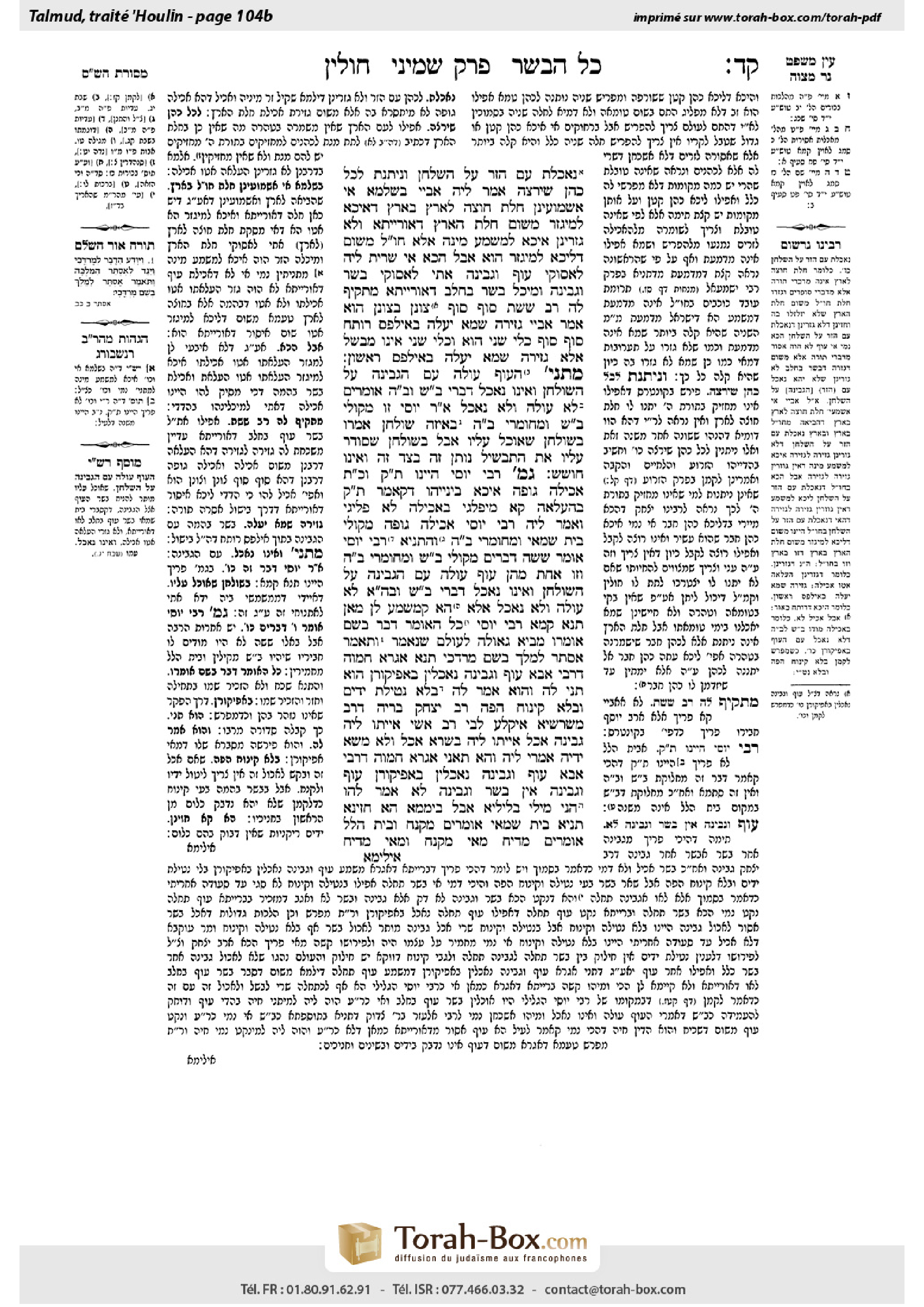
Chullin 104b: Talmud study for Daf Yomi
Study the Talmud for Daf Yomi with scanned pages, Hebrew text, English translations from Sefaria and AI-generated French translations.
Passage selection and English or AI-generated French translation are available where the scan has annotations. Daf Study is independent of Torah-Box and Sefaria.
Browse Chullin · חולין · All tractatesChullin 104b text and translations
This page of Chullin includes the Aramaic text, an English translation and an AI-generated French translation, alongside the scan above.
חולין ק״ד ב · Aramaic and Hebrew text
נֶאֱכֶלֶת עִם הַזָּר עַל הַשֻּׁלְחָן, וְנִיתֶּנֶת לְכׇל כֹּהֵן שֶׁיִּרְצֶה.
אֲמַר לֵיהּ אַבָּיֵי: בִּשְׁלָמָא אִי אַשְׁמוֹעִינַן חַלַּת חוּצָה לָאָרֶץ בָּאָרֶץ, דְּאִיכָּא לְמִיגְזַר מִשּׁוּם חַלַּת הָאָרֶץ דְּאוֹרָיְיתָא, וְלָא גָּזְרִינַן – אִיכָּא לְמִשְׁמָע מִינַּהּ.
אֶלָּא חוּצָה לְאָרֶץ, מִשּׁוּם דְּלֵיכָּא לְמִיגְזַר הוּא. אֲבָל הָכָא, אִי שָׁרֵית לֵיהּ לְאַסּוֹקֵי עוֹף וּגְבִינָה, אָתֵי לְאַסּוֹקֵי בָּשָׂר וּגְבִינָה, וּמֵיכַל בָּשָׂר בְּחָלָב דְּאוֹרָיְיתָא.
מַתְקֵיף לַהּ רַב שֵׁשֶׁת: סוֹף סוֹף צוֹנֵן בְּצוֹנֵן הוּא! אָמַר אַבָּיֵי: גְּזֵירָה שֶׁמָּא יַעֲלֶה בְּאִילְפָּס רוֹתֵחַ.
סוֹף סוֹף, כְּלִי שֵׁנִי הוּא, וּכְלִי שֵׁנִי אֵינוֹ מְבַשֵּׁל! אֶלָּא גְּזֵירָה שֶׁמָּא יַעֲלֶה בְּאִילְפָּס רִאשׁוֹן.
מַתְנִי׳ הָעוֹף עוֹלֶה עִם הַגְּבִינָה עַל הַשּׁוּלְחָן, וְאֵינוֹ נֶאֱכָל, דִּבְרֵי בֵּית שַׁמַּאי. וּבֵית הִלֵּל אוֹמְרִים: לֹא עוֹלֶה וְלֹא נֶאֱכָל. אָמַר רַבִּי יוֹסֵי: זוֹ מִקּוּלֵּי בֵּית שַׁמַּאי וּמֵחוּמְרֵי בֵּית הִלֵּל.
בְּאֵיזֶה שׁוּלְחָן אָמְרוּ? בְּשׁוּלְחָן שֶׁאוֹכֵל עָלָיו, אֲבָל בְּשׁוּלְחָן שֶׁסּוֹדֵר עָלָיו אֶת הַתַּבְשִׁיל – נוֹתֵן זֶה בְּצַד זֶה, וְאֵינוֹ חוֹשֵׁשׁ.
גְּמָ׳ רַבִּי יוֹסֵי הַיְינוּ תַּנָּא קַמָּא? וְכִי תֵּימָא: אֲכִילָה גּוּפַהּ אִיכָּא בֵּינַיְיהוּ, דְּקָאָמַר תַּנָּא קַמָּא: בְּהַעֲלָאָה קָא מִיפַּלְגִי, בַּאֲכִילָה לָא פְּלִיגִי, וַאֲמַר לֵיהּ רַבִּי יוֹסֵי: אֲכִילָה גּוּפַהּ מִקּוּלֵּי בֵּית שַׁמַּאי וּמֵחוּמְרֵי בֵּית הִלֵּל.
וְהָתַנְיָא, רַבִּי יוֹסֵי אוֹמֵר: שִׁשָּׁה דְּבָרִים מִקּוּלֵּי בֵּית שַׁמַּאי וּמֵחוּמְרֵי בֵּית הִלֵּל, וְזוֹ אַחַת מֵהֶן – עוֹף עוֹלֶה עִם הַגְּבִינָה עַל הַשּׁוּלְחָן, וְאֵינוֹ נֶאֱכָל, דִּבְרֵי בֵּית שַׁמַּאי. וּבֵית הִלֵּל אוֹמְרִים: לֹא עוֹלֶה וְלֹא נֶאֱכָל!
אֶלָּא, הָא קָמַשְׁמַע לַן: מַאן תַּנָּא קַמָּא? רַבִּי יוֹסֵי – כׇּל הָאוֹמֵר דָּבָר בְּשֵׁם אוֹמְרוֹ מֵבִיא גְּאוּלָּה לָעוֹלָם, שֶׁנֶּאֱמַר ״וַתֹּאמֶר אֶסְתֵּר לַמֶּלֶךְ בְּשֵׁם מׇרְדֳּכָי״.
תְּנָא אַגְרָא חֲמוּהּ דְּרַבִּי אַבָּא: עוֹף וּגְבִינָה נֶאֱכָלִין בְּאַפִּיקוֹרַן. הוּא תָנֵי לַהּ, וְהוּא אָמַר לַהּ: בְּלֹא נְטִילַת יָדַיִם וּבְלֹא קִינּוּחַ הַפֶּה.
רַב יִצְחָק בְּרֵיהּ דְּרַב מְשַׁרְשְׁיָא אִיקְּלַע לְבֵי רַב אָשֵׁי, אַיְיתוֹ לֵיהּ גְּבִינָה – אֲכַל, אַיְיתוֹ לֵיהּ בִּשְׂרָא – אֲכַל, וְלָא מְשָׁא יְדֵיהּ. אָמְרִי לֵיהּ: וְהָא תָּאנֵי אַגְרָא חֲמוּהּ דְּרַבִּי אַבָּא: עוֹף וּגְבִינָה נֶאֱכָלִין בְּאֶפִּיקוֹרֶן, עוֹף וּגְבִינָה – אִין, בָּשָׂר וּגְבִינָה – לָא!
אֲמַר לְהוּ: הָנֵי מִילֵּי בְּלֵילְיָא, אֲבָל בִּימָמָא הָא חָזֵינָא.
תַּנְיָא: בֵּית שַׁמַּאי אוֹמְרִים: מְקַנֵּחַ, וּבֵית הִלֵּל אוֹמְרִים: מֵדִיחַ. מַאי ״מְקַנֵּחַ״ וּמַאי ״מֵדִיחַ״?
Chullin 104b · English translation
may be eaten with a non-priest present at the same table. The Sages did not issue a decree prohibiting this lest the non-priest partake of the ḥalla, as the separation of ḥalla outside of Eretz Yisrael is itself a rabbinic decree. This proves that the Sages do not issue one decree to prevent violation of another decree. And similarly, ḥalla from outside of Eretz Yisrael may be given to any priest that one wishes, even an uneducated priest who would not guard its state of ritual purity. This is in contrast to ḥalla from Eretz Yisrael, which may be given only to priests who observe the halakhot of ritual purity.
Abaye said to Rav Yosef: Granted, your inference would be valid if the mishna in tractate Ḥalla had taught us this with regard to ḥalla from outside of Eretz Yisrael that had been brought into Eretz Yisrael. As in that case, there could be reason to decree against eating it while a non-priest is at the same table, despite the fact that the non-priest eating it is prohibited only by rabbinic law, due to the concern that one might come to eat ḥalla from Eretz Yisrael, which is prohibited to the non-priest by Torah law, at the same table as a non-priest; and yet we do not decree against this practice. If so, there would be grounds to learn from this mishna that the Sages do not issue one decree to prevent violation of another decree.
But the mishna actually teaches this halakha with regard to ḥalla from outside of Eretz Yisrael that remains there. It therefore proves nothing about compound decrees, as it can be claimed that the practice is permitted only because there is no reason to decree. Since by Torah law the obligation of ḥalla does not apply outside of Eretz Yisrael, there is no chance that such behavior will lead to transgression of Torah law. But here, if you permit one to place the meat of birds and cheese on the same table, some might come to place the meat of domesticated animals and cheese on a single table and to eat this meat cooked in milk, thereby transgressing a prohibition by Torah law.
Rav Sheshet objects to the premise of Rav Yosef’s inference: Even if one were to posit that the meat of birds in milk is prohibited by Torah law, ultimately this is still a decree issued due to another decree, as it is a case of cold food in another cold food, consumption of which is itself prohibited by rabbinic law. Abaye said: It is a rabbinic decree, lest one place the meat with cheese in a boiling stewpot, which is a manner of cooking and therefore prohibited by Torah law.
The Gemara counters: Ultimately, even a stewpot is only a secondary vessel, i.e., not the vessel that was on the fire, and as a rule, a secondary vessel does not cook. Rather, one must say that it is a rabbinic decree, lest one place the meat with cheese in a stewpot that is a primary vessel, i.e., that was on the fire. This is certainly cooking meat in milk, and it is prohibited by Torah law.
MISHNA: The meat of birds may be placed with cheese on one table but may not be eaten together with it; this is the statement of Beit Shammai. And Beit Hillel say: It may neither be placed on one table nor be eaten with cheese. Rabbi Yosei said: This is one of the disputes involving leniencies of Beit Shammai and stringencies of Beit Hillel.
The mishna elaborates: With regard to which table are these halakhot stated? It is with regard to a table upon which one eats. But on a table upon which one prepares the cooked food, one may place this meat alongside that cheese or vice versa, and need not be concerned that perhaps they will be mixed and one will come to eat them together.
GEMARA: The Gemara challenges: The opinion of Rabbi Yosei is identical to that of the first tanna. And if you would say that there is a difference between them with regard to the permissibility of eating itself, as the first tanna says that Beit Shammai and Beit Hillel disagree with regard to placing meat of birds with cheese on one table, which indicates that with regard to eating they do not disagree, and Rabbi Yosei said in response to this that they also disagree with regard to the permissibility of eating meat of birds in milk, and this is itself one of the disputes involving leniencies of Beit Shammai and stringencies of Beit Hillel, one can refute this claim.
The refutation is as follows: Isn’t it taught in a baraita that Rabbi Yosei says that six matters are included as the disputes involving leniencies of Beit Shammai and stringencies of Beit Hillel, and this is one of them: The meat of birds is placed with cheese on one table, but it may not be eaten together with it; this is the statement of Beit Shammai. And Beit Hillel say: It may neither be placed on one table nor be eaten with cheese. Evidently, Rabbi Yosei agrees that even according to Beit Shammai the meat of birds may not be eaten with cheese.
Rather, this is what the mishna teaches us: Who is the first tanna? It is Rabbi Yosei. The identification is important, since whoever reports a statement in the name of the one who said it brings redemption to the world. As it is stated with respect to the incident of Bigthan and Teresh: “And Esther reported it to the king in the name of Mordecai” (Esther 2:22), and Mordecai was later rewarded for saving the king’s life, paving the way for the miraculous salvation.
§ The Gemara continues discussing the consumption of poultry cooked in milk. The Sage Agra, the father-in-law of Rabbi Abba, taught: The meat of birds and cheese may be eaten freely [apikoren], i.e., there is no need to be strict in this matter. The Gemara notes: He, Agra, teaches it and he says it, i.e., explains his statement: The meat of birds and cheese may be eaten without washing one’s hands and without wiping the mouth between the consumption of each.
The Gemara relates: Rav Yitzḥak, son of Rav Mesharshiyya, happened to come to the house of Rav Ashi. They brought him cheese, and he ate it. Next they brought him meat, and he ate it without first washing his hands. The members of Rav Ashi’s household said to him: But didn’t Agra, the father-in-law of Rabbi Abba, teach only that the meat of birds and cheese may be eaten freely? One can infer that with regard to the meat of birds and cheese, yes, one may eat them without washing one’s hands in between, but with regard to the meat of domesticated animals and cheese, no, one may not.
Rav Yitzḥak said to them: This statement of Agra applies only if one eats them at night, as one cannot see whether some of the food of the previous dish still remains on his hands, and he must therefore wash them. But if one eats by day, I can see that no food remains on his hands, and consequently there is no need to wash them.
It is taught in a baraita: Beit Shammai say: Between the consumption of meat and milk one must wipe out his mouth, and Beit Hillel say that he must rinse his mouth. The Gemara asks: What is the meaning of the word: Wipe [mekane’aḥ], and what is the meaning of the word: Rinse [mediaḥ]?
Chullin 104b · Traduction française (IA)
on peut le manger en présence d'un non-prêtre à la même table. Les Sages n'ont pas émis un décret interdisant cela de peur que le non-prêtre parte à la part de la challa, car la séparation de la challa en dehors de la Terre d'Israël est elle-même un décret rabbinique. Cela prouve que les Sages ne donnent pas un décret pour empêcher la violation d'un autre décret. De même, la challa provenant en dehors de la Terre d'Israël peut être donnée à tout prêtre que l'on souhaite, même un prêtre non instruit qui ne garderait pas son état de pureté rituelle. Cela contraste avec la challa provenant de la Terre d'Israël, qui ne peut être donnée qu'aux prêtres observant les halakhot de pureté rituelle.
Abaye dit à Rav Yosef : Cela serait valable si la mitsva du traité Ḥalla avait enseigné cela concernant la challa provenant en dehors de la Terre d'Israël qui est entrée dans la Terre d'Israël. Car dans ce cas, il pourrait y avoir une raison de décréter contre son ingestion en présence d'un non-prêtre, malgré le fait que l'ingestion du non-prêtre est interdite uniquement par la loi rabbinique, en raison de la crainte qu'on vienne à manger de la challa de la Terre d'Israël, interdite au non-prêtre par la loi divine, à la même table qu'un non-prêtre ; et pourtant, nous ne décrétons pas contre cette pratique. Si tel est le cas, il y aurait des raisons pour apprendre à partir de cette mitsva que les Sages ne donnent pas un décret pour empêcher la violation d'un autre décret.
Mais la mitsva enseigne effectivement cette halakha concernant la challa provenant en dehors de la Terre d'Israël qui reste là. Elle prouve donc rien concernant les décrets multiples, car on pourrait affirmer que cette pratique est permise uniquement parce qu'il n'y a pas de raison de décréter. Puisque, selon la loi divine, l'obligation de la challa ne s'applique pas en dehors de la Terre d'Israël, il n'y a pas de risque que ce comportement mène à une transgression de la loi divine. Mais ici, si l'on permet à l'homme de placer la viande d'oiseaux et le fromage sur la même table, certains pourraient venir à placer la viande d'animaux domestiques et le fromage sur une seule table et à manger cette viande cuite avec du lait, en transgressant ainsi une interdiction par la loi divine.
Rav Sheshet s'oppose à la base de l'inférence de Rav Yosef : Même si l'on supposait que la viande d'oiseaux avec du lait est interdite par la loi divine, finalement cela reste un décret émis en raison d'un autre décret, car il s'agit d'un cas de nourriture froide dans une autre nourriture froide, la consommation de laquelle est elle-même interdite par la loi rabbinique. Abaye dit : C'est un décret rabbinique, de peur qu'on place la viande avec le fromage dans une marmite, qui est une manière de cuisson et donc interdite par la loi divine.
La Guemara réfute : Finalement, même une marmite n'est qu'un récipient secondaire, c'est-à-dire celui qui n'était pas sur le feu, et, en général, un récipient secondaire ne cuisine pas. Il faut plutôt dire que c'est un décret rabbinique, de peur qu'on place la viande avec le fromage dans une marmite qui est un récipient principal, c'est-à-dire celui qui était sur le feu. Cela est certainement de la cuisson de viande avec du lait, et cela est interdit par la loi divine.
MICHNA: La viande d'oiseaux peut être placée avec du fromage sur une même table, mais ne peut pas être mangée avec elle ; c'est l'opinion de Beit Shammai. Et Beit Hillel disent : Elle ne peut ni être placée sur une même table ni être mangée avec du fromage. Rabbi Yosei dit : Cela est l'une des disputes concernant les leniencies de Beit Shammai et les stringencies de Beit Hillel.
La mitsva précise : Concernant quelle table ces halakhot sont-elles énoncées ? C'est concernant une table sur laquelle l'on mange. Mais sur une table sur laquelle l'on prépare la nourriture cuite, l'on peut placer cette viande à côté de ce fromage ou inversement, et il n'y a pas de crainte que l'on mélange et qu'on vienne à manger ensemble.
GUEMARA : La Guemara conteste : L'opinion de Rabbi Yosei est identique à celle du premier tanna. Et si l'on disait qu'il y a une différence entre eux concernant la permissibilité de l'ingestion, car le premier tanna dit que Beit Shammai et Beit Hillel divergent concernant le placement de la viande d'oiseaux avec du fromage sur une même table, ce qui indique qu'ils ne divergent pas concernant l'ingestion, et Rabbi Yosei a répondu à cela en disant qu'ils divergent également concernant la permissibilité de l'ingestion de la viande d'oiseaux avec du lait, et cela est lui-même l'une des disputes concernant les leniencies de Beit Shammai et les stringencies de Beit Hillel, on peut réfuter cette affirmation.
La réfutation est la suivante : N'est-ce pas enseigné dans une baraïta que Rabbi Yosei dit que six choses sont incluses dans les disputes concernant les leniencies de Beit Shammai et les stringencies de Beit Hillel, et cela est l'une d'entre elles : La viande d'oiseaux est placée avec du fromage sur une même table, mais elle ne peut pas être mangée avec elle ; c'est l'opinion de Beit Shammai. Et Beit Hillel disent : Elle ne peut ni être placée sur une même table ni être mangée avec du fromage. Évidemment, Rabbi Yosei est d'accord avec le fait que même selon Beit Shammai, la viande d'oiseaux ne peut pas être mangée avec du fromage.
Plutôt, c'est ce que la mitsna nous enseigne : Qui est le premier tanna ? C'est Rabbi Yosei. L'identification est importante, car celui qui rapporte une déclaration en nom de celui qui l'a dite apporte la rédemption au monde. Comme il est dit concernant l'incident de Bigthan et de Teresh : « Et Esther rapporta cela au roi en nom de Mordecai » (Esther 2:22), et Mordecai fut récompensé pour avoir sauvé la vie du roi, ouvrant la voie à la salut miraculeux.
§ La Guemara continue la discussion sur la consommation de volaille cuite avec du lait. Le Sage Agra, le beau-père de Rabbi Abba, enseigna : La viande d'oiseaux et le fromage peuvent être mangés librement [apikoren], c'est-à-dire qu'il n'y a pas besoin d'être strict à ce sujet. La Guemara note : Il, Agra, enseigne cela et il dit cela, c'est-à-dire explique sa déclaration : La viande d'oiseaux et le fromage peuvent être mangés sans laver ses mains et sans essuyer la bouche entre la consommation de chaque aliment.
La Guemara rapporte : Rav Yitzḥak, fils de Rav Mesharshiyya, vint par hasard chez Rav Ashi. On lui apporta du fromage, qu'il mangea. Puis on lui apporta de la viande, qu'il mangea sans d'abord se laver les mains. Les membres de la maison de Rav Ashi lui dirent : N'avez-vous pas appris par Agra, le beau-père de Rabbi Abba, que la viande des oiseaux et le fromage peuvent être mangés librement ? On peut en déduire que concernant la viande des oiseaux et le fromage, oui, on peut les manger sans se laver les mains entre les plats, mais concernant la viande des animaux domestiques et le fromage, non, on ne peut pas.
Rav Yitzḥak leur dit : Cette déclaration d'Agra s'applique uniquement si l'on mange la nuit, car on ne peut pas voir si une partie de la nourriture du plat précédent reste sur ses mains, et il faut donc se laver les mains. Mais si l'on mange de jour, je peux voir qu'aucune nourriture ne reste sur ses mains, et par conséquent, il n'est pas nécessaire de se laver les mains.
Il est enseigné dans une baraïta : Beit Shammai disent : Entre la consommation de viande et de lait, on doit essuyer sa bouche, et Beit Hillel disent qu'on doit rincer sa bouche. La Guemara demande : Quelle est la signification du mot « essuyer » [mekane’aḥ], et quelle est la signification du mot « rincer » [mediaḥ] ?
Traduction française générée par IA à partir de l’édition anglaise de Sefaria. Vérifie toujours un passage avec le texte source.
Text from Sefaria: William Davidson Edition - Vocalized Aramaic (unknown); William Davidson Edition - English (CC BY NC).